Richard Mille RM 011 Felipe Massa Flyback Chronograph: The Watch That Made the RM Sports Chronograph Collectible
Richard Mille RM 011 Felipe Massa Flyback Chronograph: The Watch That Made the RM Sports Chronograph Collectible
The Richard Mille RM 011 Felipe Massa Flyback Chronograph is not the most complicated Richard Mille, not the rarest, and not the most technically radical. It is more important than that. Introduced in 2007, the RM 011 turned the brand’s Formula 1 language into a repeatable, commercially dominant sports-watch format: tonneau case, skeletonised automatic calibre, annual calendar, flyback chronograph, visible engineering, and a named athlete whose connection to the watch was not decorative. The RM 011 is the model that made Richard Mille’s modern collecting market legible.
That matters because the RM 011 arrived before the full social-media distortion of the brand. Its reputation was initially built at the wrist, in paddocks, in collector circles, and in the retail reality of a watch that cost serious money but was still recognisable as a functional chronograph rather than an allocation trophy. The watch has since become a reference point for understanding why Richard Mille moved from disruptive independent to one of the most liquid names in contemporary high-end watchmaking.
Origin: Felipe Massa, Formula 1, and the RM 011 Lineage
The RM 011 belongs to the first decade of Richard Mille, when the company was still defining its vocabulary. The brand had launched in 2001 with the RM 001 Tourbillon, followed by models such as the RM 004 Split-Seconds Chronograph and RM 005 Automatic. The Felipe Massa relationship began before the RM 011: Massa wore earlier ultra-light tourbillon references, including the RM 006 and RM 009, during his Formula 1 career. That context matters. The RM 011 was not retroactively named after a celebrity; it came from an active technical and commercial alignment between a young high-performance watch brand and a Ferrari Formula 1 driver.
When the RM 011 Felipe Massa appeared in 2007, Massa was driving for Scuderia Ferrari and entering the most visible period of his career. He would narrowly lose the 2008 Formula 1 World Championship to Lewis Hamilton by one point. That near-miss gave the RM 011 a convenient mythology, but the model’s endurance rests on stronger foundations: it offered the complications collectors actually use, wrapped in a case architecture that was unmistakably Richard Mille.
The RM 011 also sits in the direct line leading to later Richard Mille chronographs, especially the RM 11-03 Automatic Flyback Chronograph that succeeded it in the mid-2010s. The later watch amplified the design, enlarged the visual aggression, and introduced the RMAC3 calibre. The RM 011 remains the more balanced expression. It is the original commercially mature formula, not the maximalist sequel.
Case Architecture and Proportions
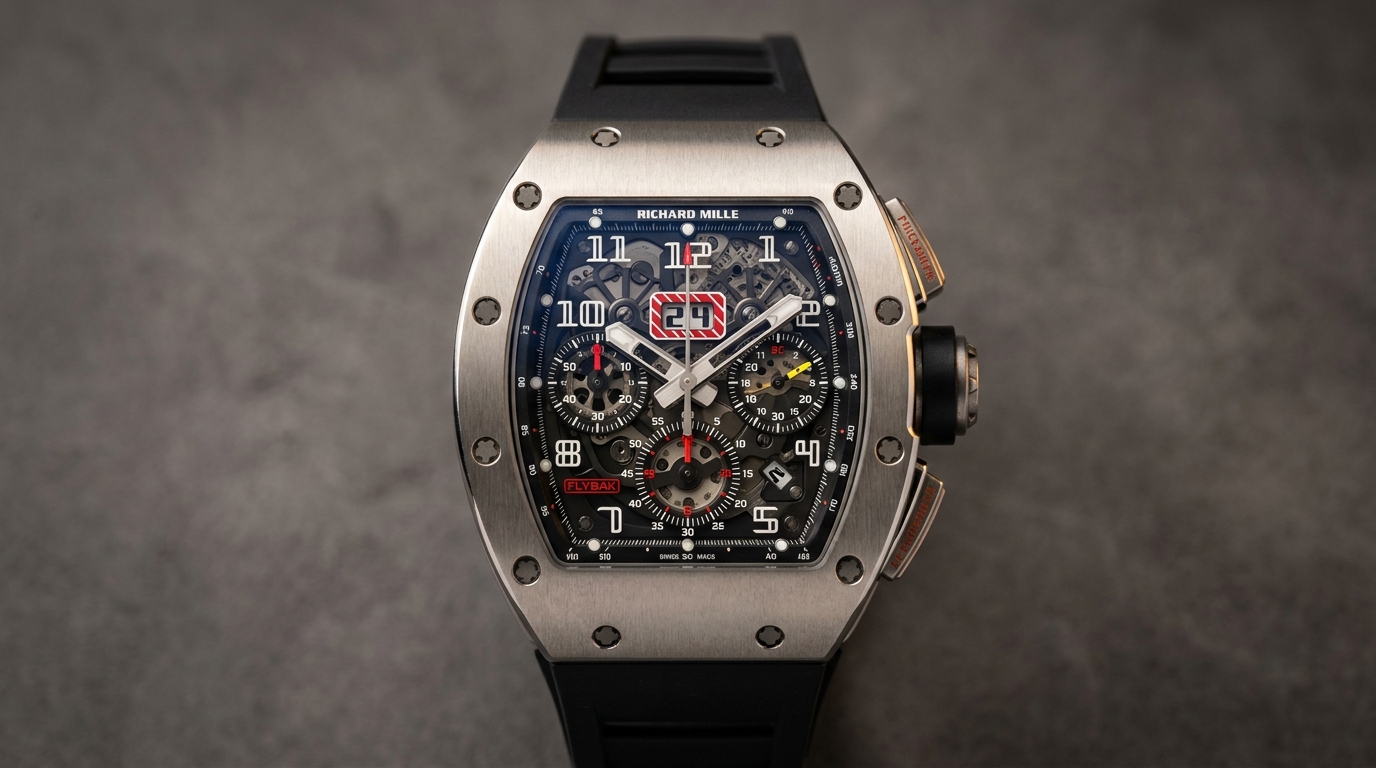
The RM 011 uses Richard Mille’s signature tripartite tonneau case, with a curved front bezel, caseband, and back secured by spline screws. The published dimensions are approximately 50.00 mm long, 40.00 mm wide, and 16.15 mm thick. Those numbers sound large until the watch is on the wrist. The case is not a flat rectangle. Its curvature, short effective lug span, and integrated strap geometry make it wear closer to a highly sculpted sports instrument than a conventional 50 mm watch.
Early RM 011 Felipe Massa examples were offered in materials including titanium, rose gold, and white gold, with later executions extending into darker and more experimental treatments. The titanium examples best express the original point of the model: technical lightness rather than precious-metal signalling. Rose gold RM 011s bring visual heat and a stronger secondary-market presence among collectors who want a more obviously luxurious Richard Mille, but the titanium version is arguably the purer watch.
The case construction is not merely aesthetic theatre. Richard Mille’s early identity depended on adapting ideas from motorsport and aerospace engineering into watch cases: grade 5 titanium components, torque-controlled screws, complex gaskets, and shaped sapphire crystals. The RM 011 does not wear like a Royal Oak Offshore, a Daytona, or a Big Bang of the same era. Its case is less about mass and more about volume, skeletonisation, and wrist ergonomics. That difference is the reason the model has aged better than many oversized chronographs from the late 2000s.
Dial Layout: Functional Density, Not Simplicity
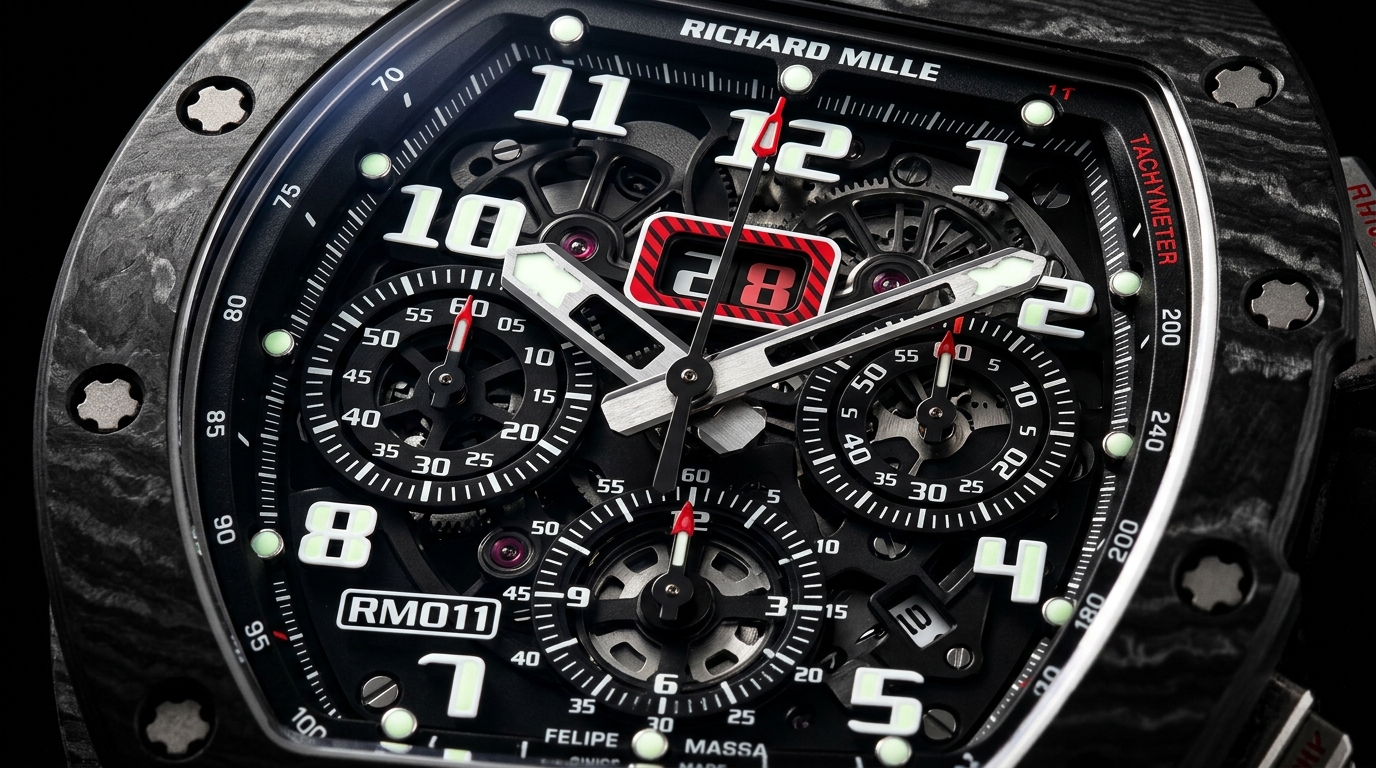
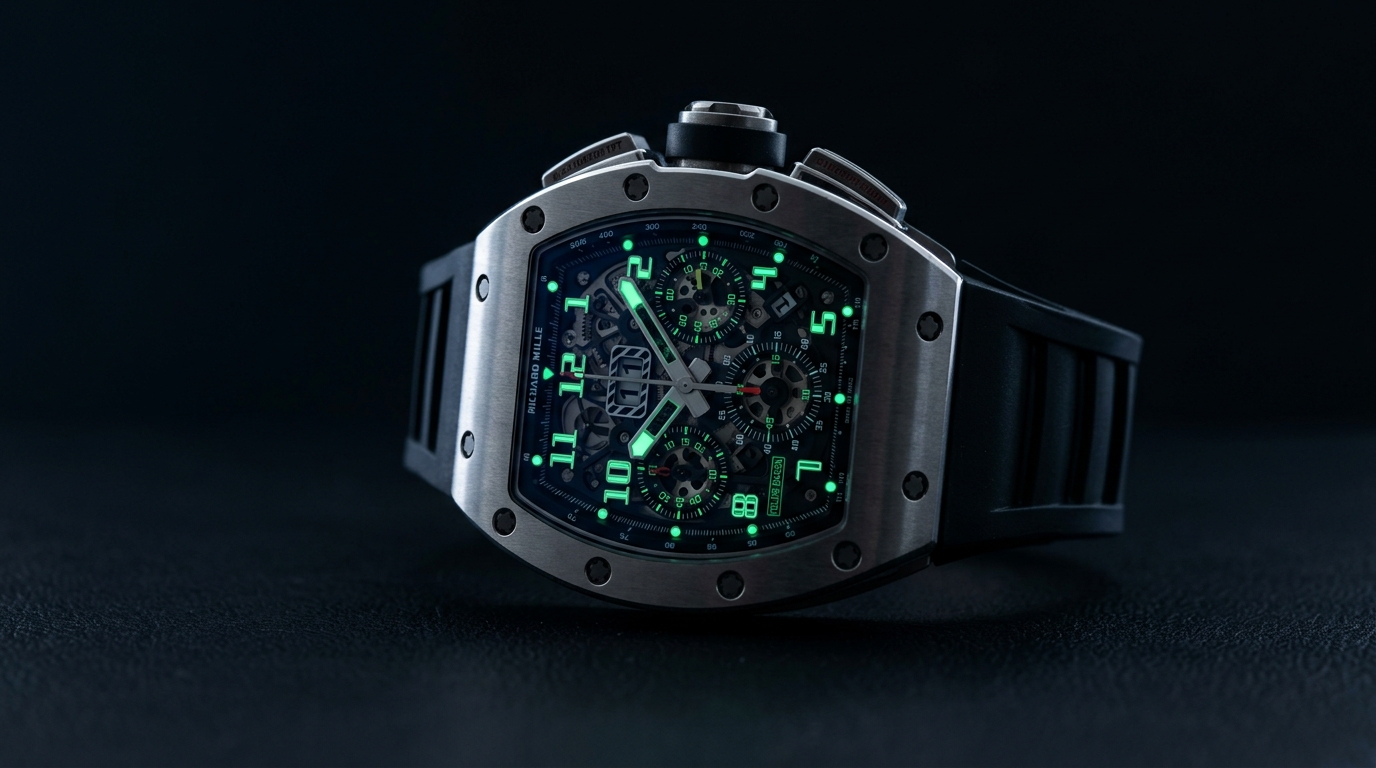
The RM 011 Felipe Massa is not a minimal watch and should not be judged as one. Its dial is a layered mechanical display built around chronograph and calendar information. The oversized date sits at 12 o’clock, the month indication is positioned between 4 and 5 o’clock, the running seconds are at 3 o’clock, the 12-hour chronograph totaliser is at 6 o’clock, and the 60-minute countdown display is at 9 o’clock. Central hands carry the hours, minutes, and chronograph seconds.
This is a dense arrangement, but it is coherent. The oversized date anchors the top of the dial; the three sub-displays form a technical dashboard; the month aperture confirms the annual-calendar function without forcing the watch into dress-watch territory. Legibility varies by execution, especially depending on hand colour, flange treatment, and case material, but the original formula works because the information is arranged by task rather than symmetry alone.
The design codes became familiar because the RM 011 was widely seen, but they were not generic in 2007. The Arabic numerals, openworked dial, coloured chronograph hands, visible calendar discs, and curved tonneau case created a watch that could not be confused with Swiss conservatism. That was the commercial insight. Richard Mille did not try to make a traditional complicated chronograph look sportier; it made a sports chronograph complicated from first principles.
Calibre RMAC1: Annual Calendar, Flyback Chronograph, and Industrial Finishing
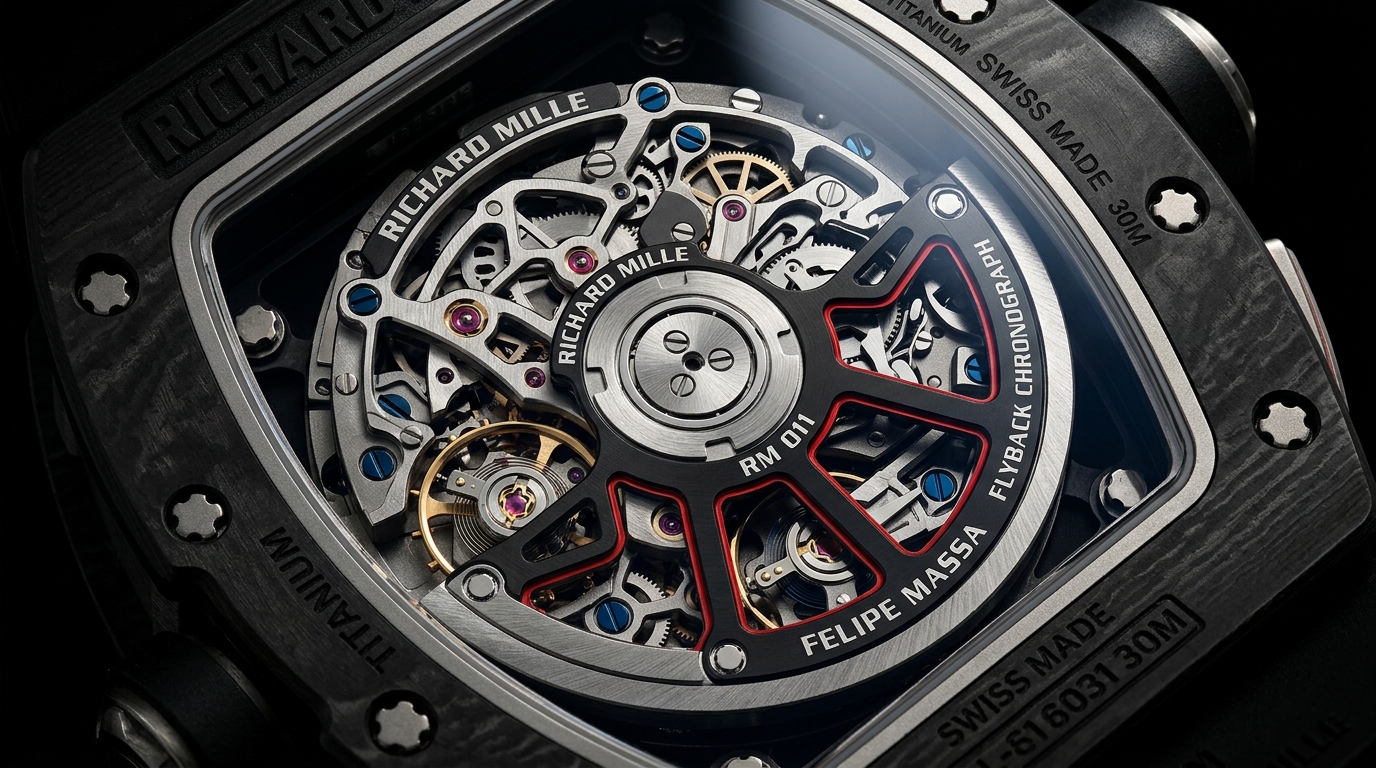
Inside the RM 011 is the automatic calibre RMAC1, the movement that defines the model as much as the case does. It is a skeletonised automatic calibre with flyback chronograph, annual calendar, oversized date, month display, and approximately 55 hours of power reserve. It runs at 28,800 vibrations per hour, or 4 Hz, a practical frequency for a modern chronograph. The movement is typically stated with 68 jewels, reflecting the complexity of the automatic, calendar, and chronograph mechanisms.
The flyback function allows the chronograph to be reset and restarted with a single push, rather than stopping, resetting, and restarting in three separate actions. In motorsport terms, that is a useful complication rather than a decorative one. The annual calendar automatically accounts for months of 30 and 31 days, requiring correction at the end of February. This is exactly the kind of complication pairing the RM 011 gets right: not poetic, not nostalgic, but genuinely functional.
The RMAC1 also uses a variable-geometry winding rotor, one of Richard Mille’s important early signatures. The rotor’s inertia can be adjusted according to the owner’s activity level, increasing or reducing winding efficiency. In practice, most owners will never have this adjusted often, but the concept is consistent with the model’s engineering premise. It is not just a skeletonised rotor placed behind a sapphire back for display; it is part of the watch’s mechanical argument.
Finishing on the RMAC1 is a point where collectors should be precise. This is not a movement finished in the language of Geneva tradition, with broad striping, black polishing, and inward-angle handwork presented as the main event. The RM 011’s movement finishing is industrial and architectural: microblasted and satin-finished surfaces, treated titanium bridges and plates, sharply machined forms, visible screws, and a technical rather than romantic presentation. The result is appropriate to the watch, though not beyond criticism. At the price level now attached to the RM 011, some traditionalists will reasonably expect more artisanal hand-finishing. But that objection also misses the model’s thesis. The RM 011 was never trying to be a Datograph in a carbon-fibre costume.
How the RM 011 Wears
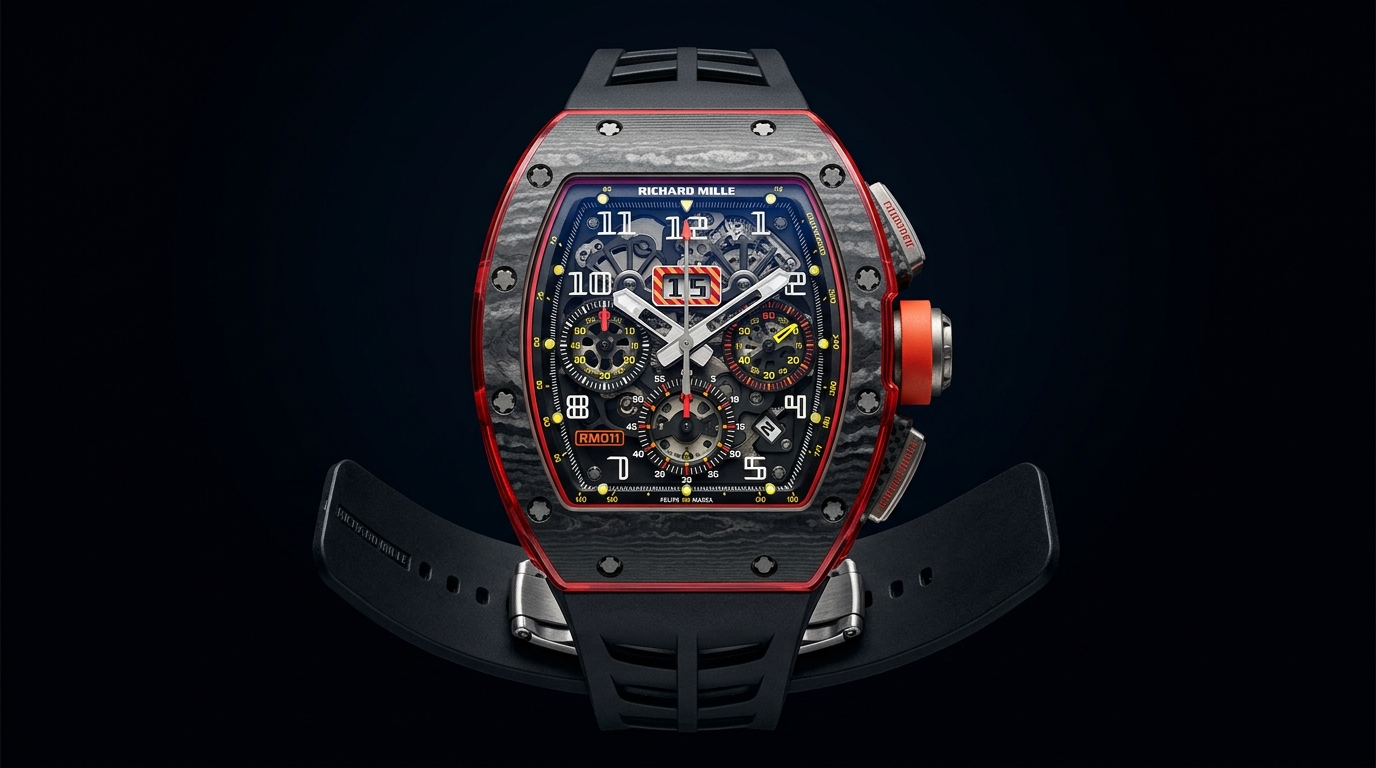
The RM 011 wears better than its dimensions suggest, which is one reason it became the default Richard Mille chronograph for serious buyers before the RM 11-03. The curved caseback and tonneau profile distribute height across the wrist rather than stacking it vertically. The strap exits the case cleanly and pulls the watch down rather than leaving it perched above the wrist. In titanium, the weight is controlled enough that the size feels intentional. In gold, the same proportions become more assertive, and the watch shifts from technical instrument to high-visibility luxury object.
The thickness of roughly 16.15 mm is real. This is not a discreet watch and cannot be made discreet by wishing it so. It sits high enough to catch cuffs and attract attention. But the ergonomics are superior to many large chronographs of its period because the case is shaped in three dimensions. The RM 011 is large by measurement, but it is not lazy-large. That distinction is crucial.
On the wrist, the watch communicates its era clearly. It belongs to the late-2000s moment when independent and high-end sports watchmaking became more experimental, more architectural, and less deferential to traditional case shapes. Yet it avoids the dated bulk of many contemporaries because its design language became the foundation of a continuing collection rather than a one-cycle trend.
Market Position and Collector Behaviour
The RM 011 Felipe Massa has a stronger market position than many more limited Richard Mille references because it is the recognisable template. It was produced in multiple materials and special editions, which means it is not rare in the narrow sense, but collector demand has remained durable because the watch is historically central. Discontinued RM 011 examples generally trade below the most sought-after limited RM tourbillons and ultra-light sports models, but they remain among the most liquid Richard Mille chronographs.
Original retail pricing varied by material and period, with early titanium examples generally in the high five-figure to low six-figure range when new. The secondary market changed dramatically as Richard Mille production remained constrained and brand demand accelerated in the late 2010s and early 2020s. By the mid-2020s, asking prices for RM 011 Felipe Massa examples commonly sit well into six figures, with titanium pieces often positioned below rose-gold and rarer special executions, and condition, completeness, service history, and case originality making a large difference.
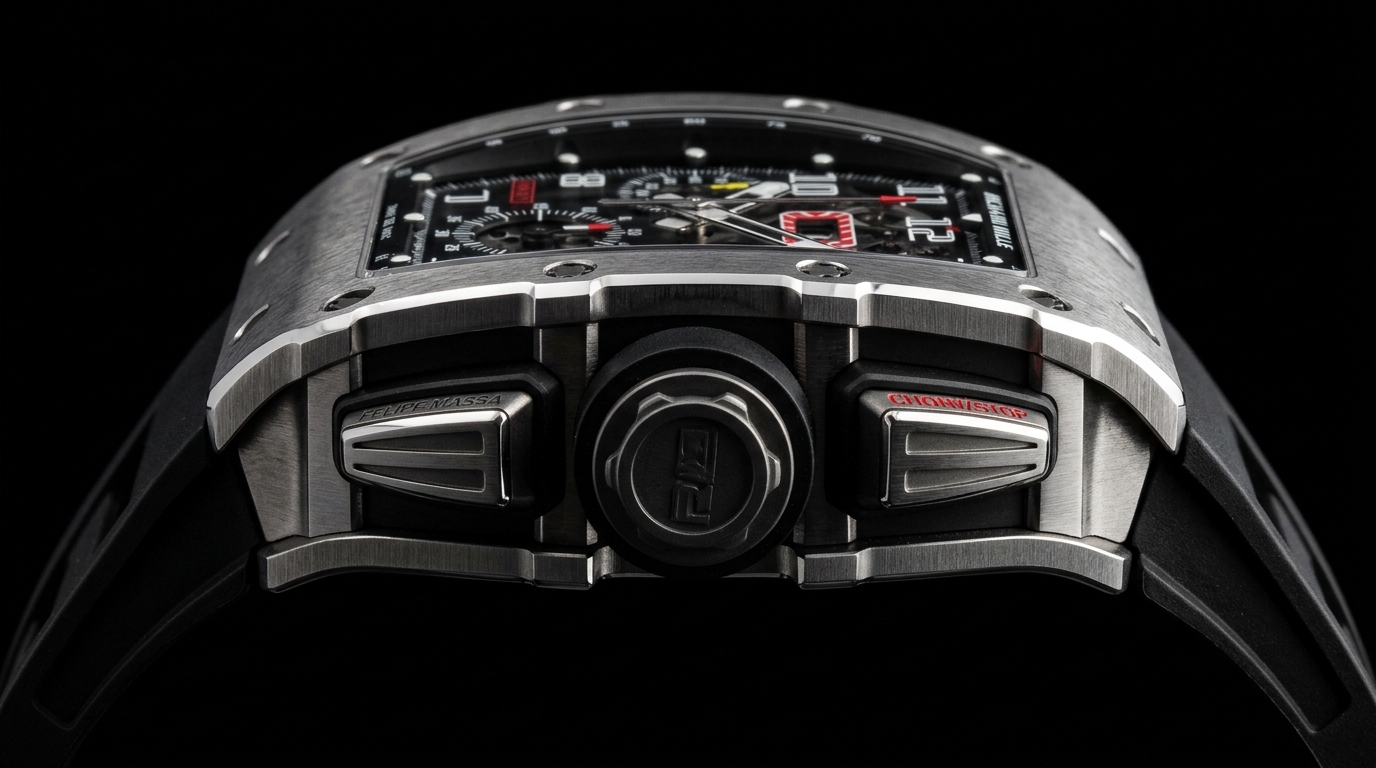
Collectors should be careful with this model. The RM 011 is complicated, expensive to service, and visually unforgiving if polished incorrectly. Case edges, spline screws, pushers, crown condition, strap fit, and the clarity of both sapphire crystals matter. Full sets carry a premium, particularly because Richard Mille buyers tend to be highly documentation-sensitive. Service through authorised channels is not optional for a watch with this calibre architecture and market value.
The most desirable RM 011 configuration depends on collector intent. Titanium is the connoisseur’s choice if the goal is to own the cleanest expression of the Felipe Massa chronograph. Rose gold is more visible and often more commercially attractive. White gold sits in between, with precious-metal mass but less immediate visual signal. Special editions can command premiums, but the safest long-term thesis remains the core RM 011 Felipe Massa: the watch that established the category.
Why the RM 011 Endures
The RM 011 Felipe Massa endures because it solved a real strategic problem for Richard Mille. The brand had already shown that it could build spectacular high-end watches. What it needed was a complicated automatic sports model that could carry the identity of the house at scale without diluting it. The RM 011 did exactly that. It combined a recognisable case, a useful complication set, a credible motorsport association, and a movement architecture that looked and behaved like a Richard Mille.
Its endurance is also helped by restraint, at least by Richard Mille standards. Compared with later references, the RM 011 has a cleaner case language and a less exaggerated visual footprint. It is busy, but not chaotic. It is large, but not absurd. It is expensive, but historically anchored. Those distinctions matter in a market where many watches are collected for recognisability alone.
The RM 011 is not beyond critique. Its movement finishing will not satisfy collectors who measure value by traditional handcraft. Its service costs are serious. Its market price reflects brand scarcity and cultural capital as much as horological content. But dismissing it as hype is analytically weak. The watch has a specific place in the chronology of modern independent watchmaking: it is the model that turned Richard Mille’s experimental vocabulary into a durable sports-chronograph franchise.
For collectors, the Richard Mille RM 011 Felipe Massa Flyback Chronograph is best understood not as an entry point, but as a cornerstone. It is the reference that explains why the RM chronograph became a market category of its own. Nearly two decades after its launch, it remains the Richard Mille that most clearly connects the brand’s early engineering seriousness with its later commercial power. That is why the RM 011 still matters.