F.P. Journe Chronomètre Bleu: The Tantalum Watch That Became the Modern Independent Benchmark
F.P. Journe Chronomètre Bleu: The Tantalum Watch That Became the Modern Independent Benchmark
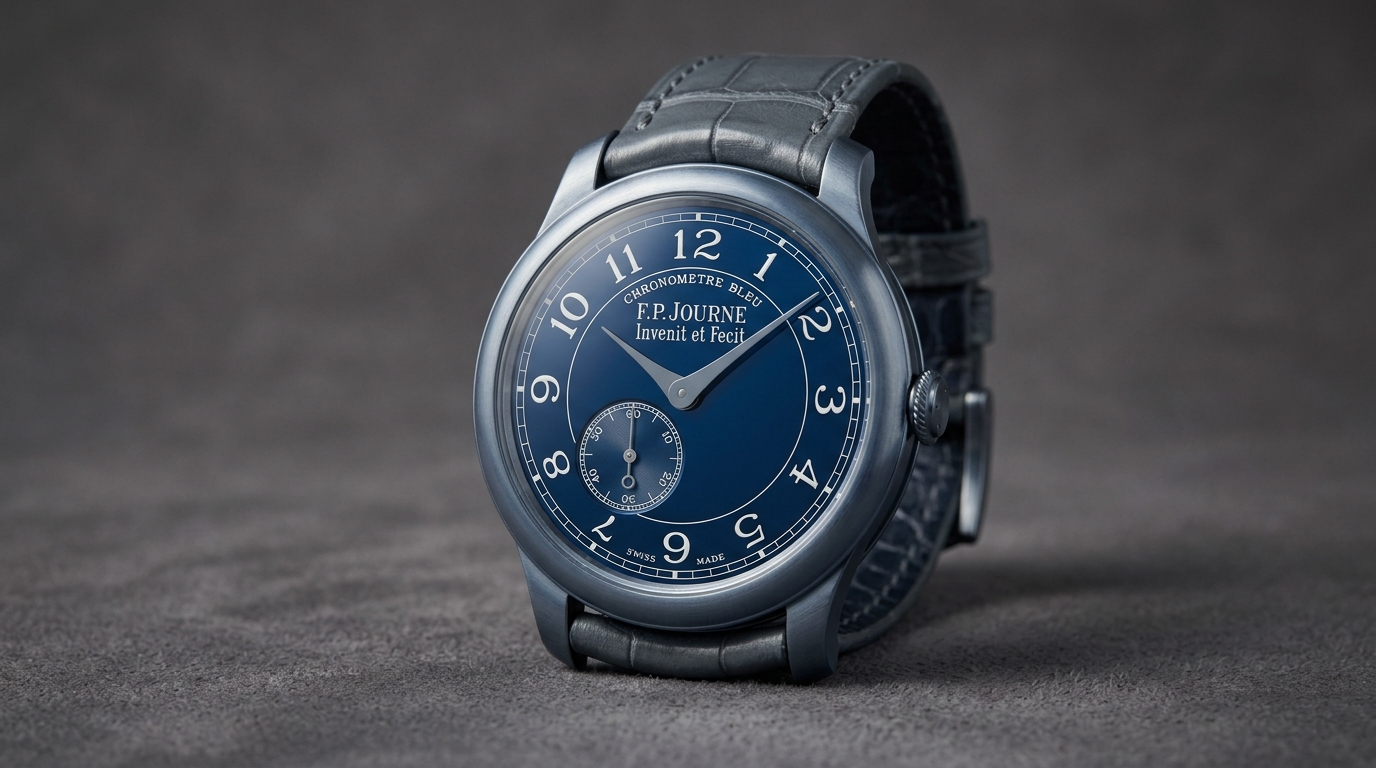
The F.P. Journe Chronomètre Bleu is the rare watch that became famous for being restrained. It has no tourbillon, no remontoir, no resonance system, no precious-stone dial, and no limited-edition certificate. Its case measures 39 mm, its movement is manually wound, and its display is limited to hours, minutes, and small seconds. Yet since its 2009 launch, the Chronomètre Bleu has moved from an ostensibly approachable entry point into F.P. Journe to one of the most scrutinised time-only independents of the last twenty years. That evolution was not accidental. The watch compresses several hard-to-fake ingredients into a single model: a tantalum case, a difficult blue chrome dial, an 18k rose-gold movement, and a design language that could only have come from François-Paul Journe’s atelier.
Origin: A Simple Watch With Very Specific Intent
The Chronomètre Bleu was introduced in 2009 within the F.P. Journe Souveraine collection. It was not conceived as a derivative luxury steel sports watch, nor as a lower-cost simplification of a complicated reference. It was a chronometer-style time-only watch, positioned below the more classically formal Chronomètre Souverain, which had appeared in 2005. The lineage is important because both watches share the same conceptual base: a thin manually wound movement architecture, chronometric emphasis, twin barrels, and the brand’s characteristic off-centre small seconds display.
Collectors usually refer to the model simply as the “CB”, because F.P. Journe does not frame it around a conventional commercial reference number in the Rolex or Patek Philippe sense. That absence has not weakened its identity. If anything, the Chronomètre Bleu’s identity is unusually concentrated. It exists as a 39 mm tantalum-cased watch with a blue mirror-like dial and calibre 1304 visible through the sapphire caseback. Unlike many modern icons, it did not require a family of variants to become recognisable.
The timing of the launch matters. In 2009, F.P. Journe was already established among serious collectors, but the independent-watch market had not yet become the broad financialised category it would become in the late 2010s and during the 2020–2022 surge. The Chronomètre Bleu arrived before the brand was seen as a mainstream trophy. Its original role was closer to a collector’s gateway into Journe’s world: mechanically serious, visually distinctive, and materially unusual, but still a clean time-only watch.
The Tantalum Case: Not Decoration, But Character
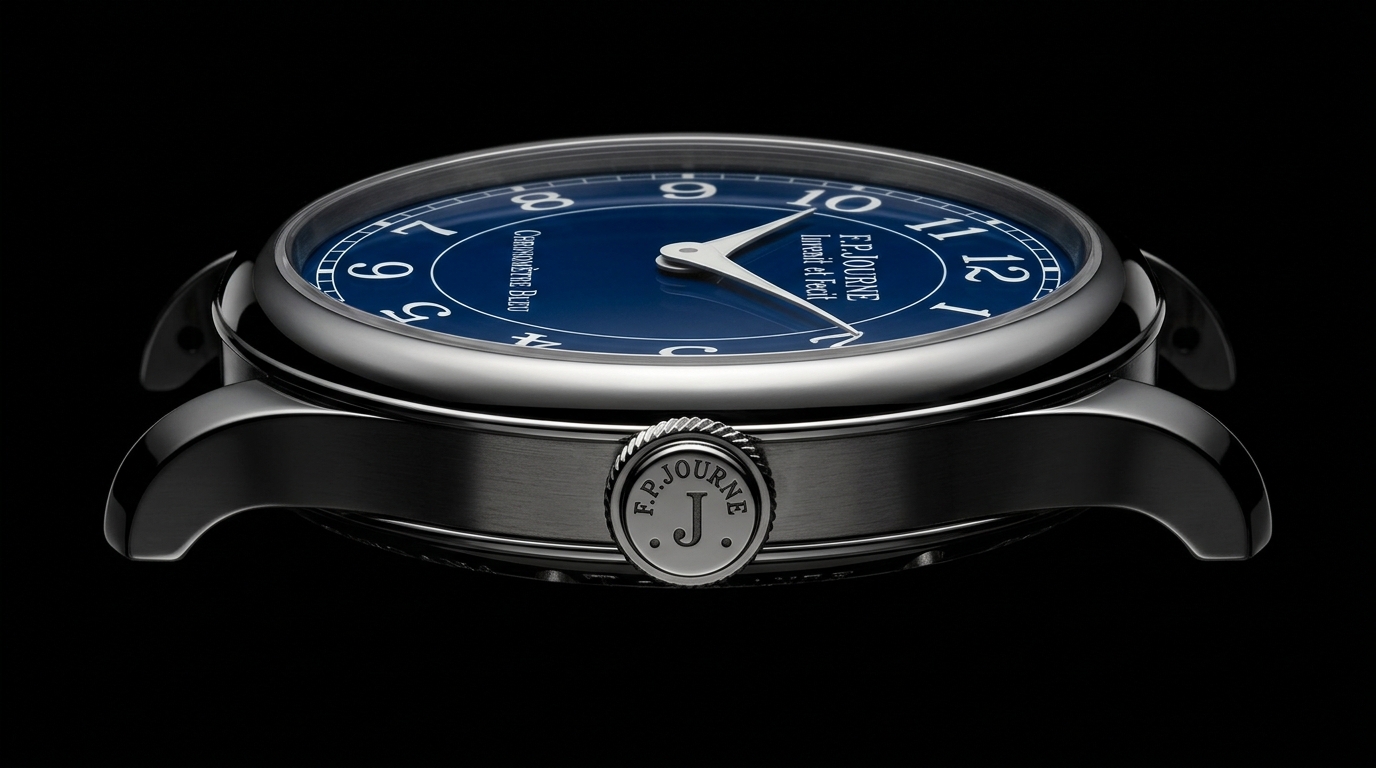
The defining decision is the case material. The Chronomètre Bleu is made in tantalum, a dense blue-grey metal with atomic number 73 and a density of roughly 16.6 g/cm³, meaning it is substantially heavier than stainless steel while remaining below platinum. Tantalum had appeared sporadically in watchmaking before, but rarely as the material foundation for a refined dress-adjacent chronometer. In this model, it is not used for novelty. It sets the tonal register of the entire watch.
The case measures 39 mm in diameter and approximately 8.6 mm thick, proportions that are central to the watch’s success. On paper, 39 mm sounds moderate; on the wrist, the density of tantalum gives the watch more presence than its height suggests. The case has Journe’s familiar rounded bezel, slim profile, pronounced but controlled lugs, and flat polished surfaces that catch light against the darker hue of the metal. It is neither a traditional dress case nor a sports case. It occupies a more difficult middle ground: formal enough for a strap and shirt cuff, unusual enough to avoid anonymity.
Tantalum is also not an easy production choice. It is hard, dense, and difficult to machine cleanly. That matters because the Chronomètre Bleu was never a limited edition, yet production has always been constrained by practical realities: case machining, dial rejection rates, and the general scale of F.P. Journe’s manufacture, which has typically operated in the low hundreds to around the high hundreds of watches annually across all models rather than industrial volumes. The case material is therefore part aesthetic choice and part production bottleneck.
The Dial: Blue Made Unstable, Then Controlled
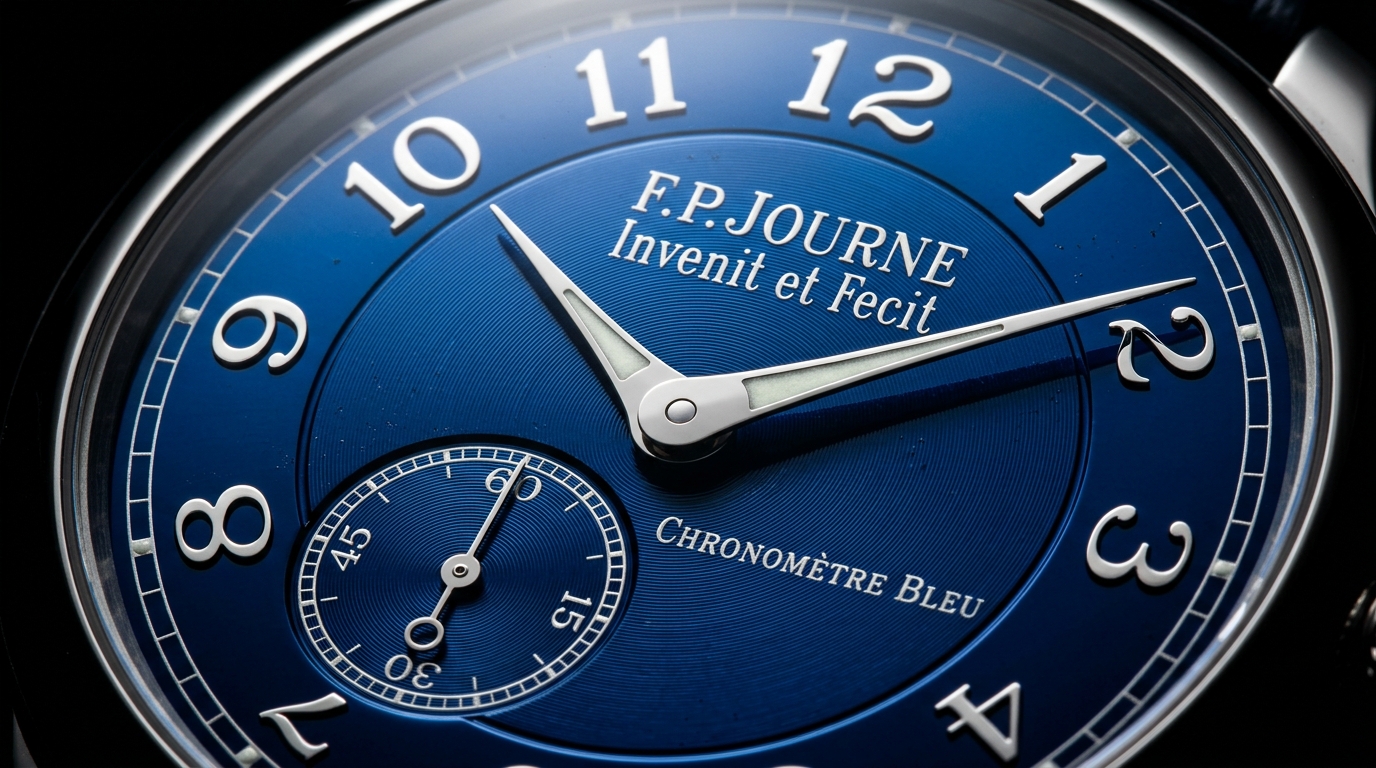
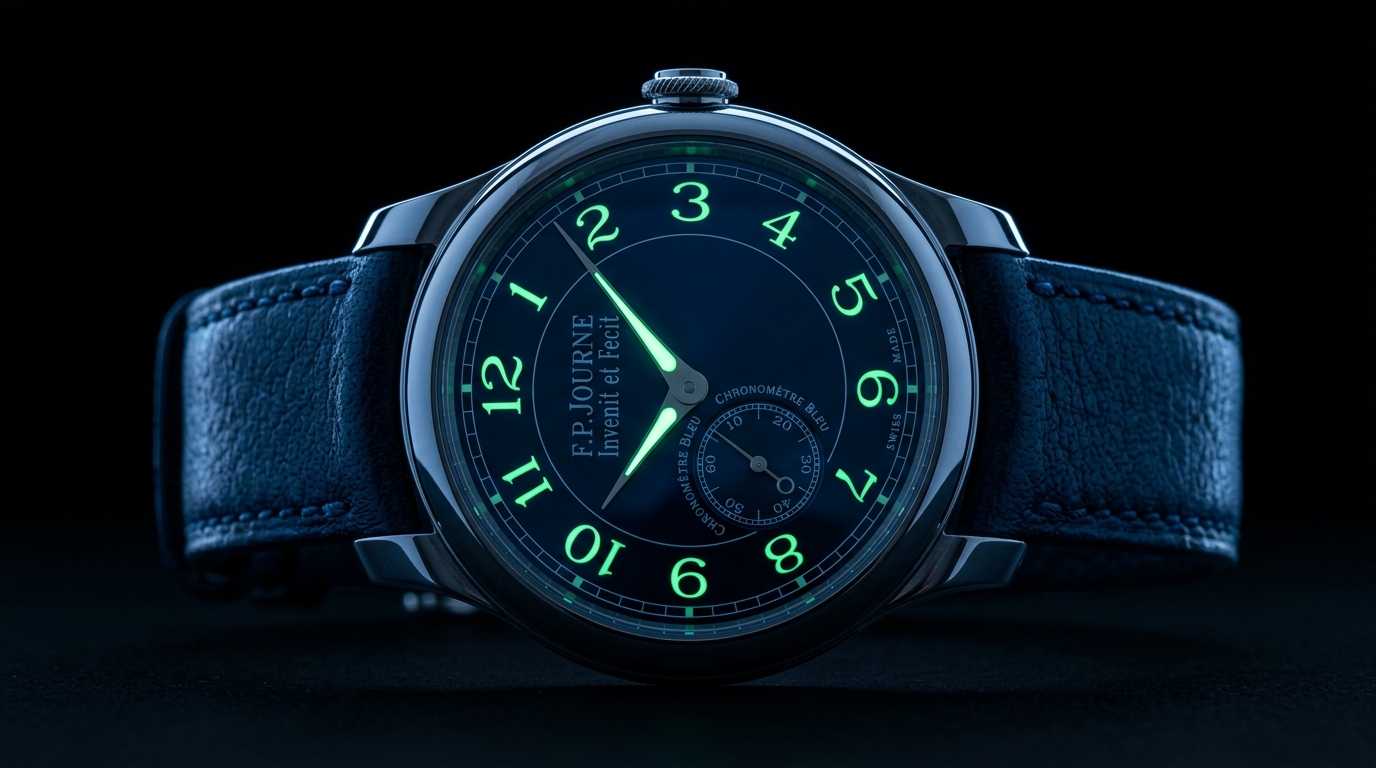
The dial is the most photographed part of the Chronomètre Bleu, but photographs usually flatten what makes it interesting. It is not a matte blue dial, nor the kind of sunburst blue used across industrial luxury watchmaking. It is a blue chrome dial with a reflective, almost liquid surface that shifts sharply with light. In bright conditions it can move toward electric cobalt; at other angles it becomes dark navy or nearly black. This instability is the point. The watch changes without needing applied decoration.
The design is unmistakably Journe. Large Arabic numerals sit around the dial with a printed railway minute track, while the small seconds register is placed asymmetrically around 7:30. That small seconds placement links the Chronomètre Bleu to the Chronomètre Souverain and to Journe’s broader habit of disturbing classical symmetry just enough to make the composition proprietary. The hour and minute hands are slim and polished, while the seconds hand is light and precise. The result is cleaner than it first appears: the dial has drama, but the typography and display remain functional.
The critique is worth making. The reflective blue surface can reduce legibility in certain light, and the dial is not as immediately readable as a matte silver Chronomètre Souverain. But that is part of the model’s bargain. The Chronomètre Bleu is not the most rational expression of a chronometer dial; it is the most visually distinctive simple Journe. Its enduring appeal comes from that tension between chronometric minimalism and theatrical surface.
Calibre 1304: A Gold Movement With a Serious Architecture
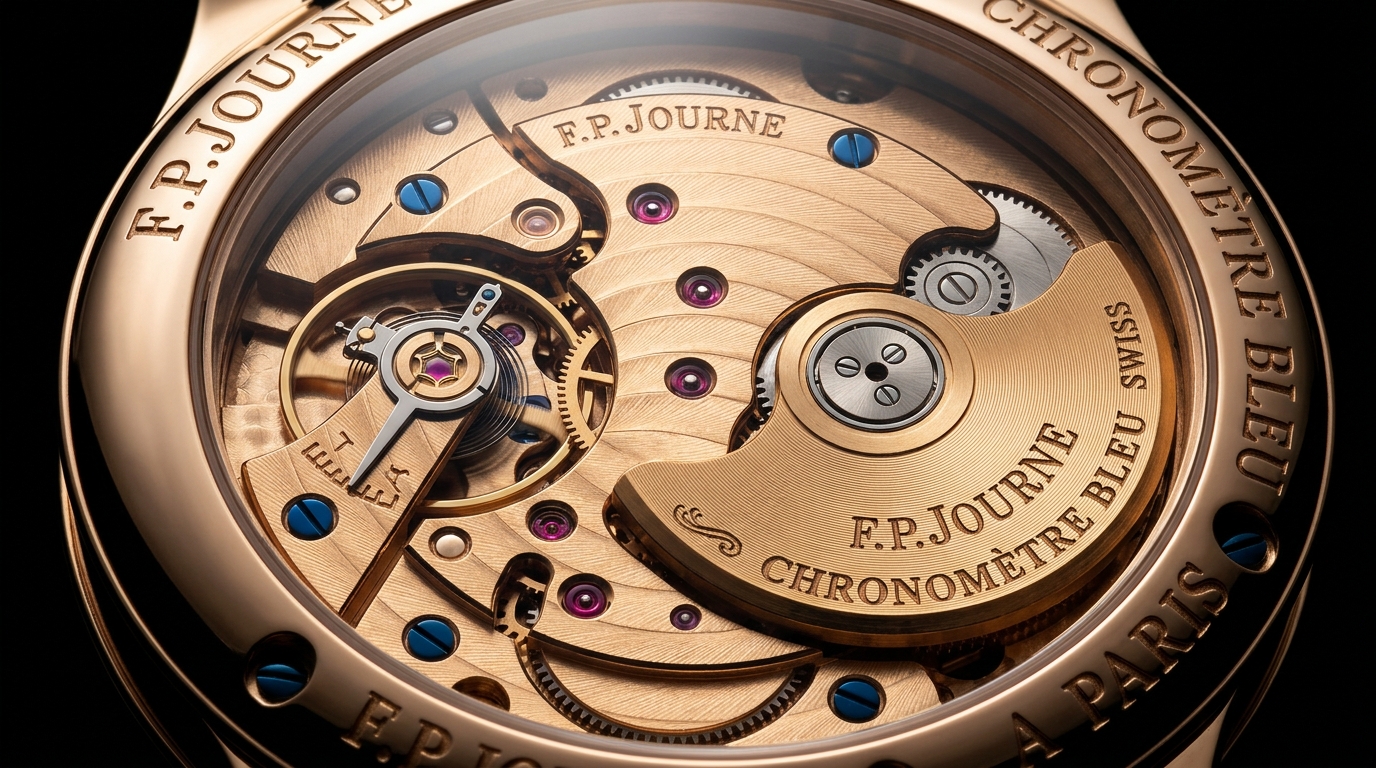
Inside the Chronomètre Bleu is F.P. Journe calibre 1304, a manually wound movement made with 18k rose-gold bridges and plates. This is not decorative plating. The movement’s main structural components are gold, a practice F.P. Journe adopted across its serial production after the earlier brass-movement period. The calibre runs at 21,600 vibrations per hour, has 22 jewels, and offers approximately 56 hours of power reserve. Its twin barrels are arranged in parallel, a configuration intended to deliver more stable torque rather than simply chasing an inflated power-reserve figure.
The display is minimal: central hours and minutes with small seconds. The absence of a power-reserve indicator distinguishes the Chronomètre Bleu from the Chronomètre Souverain, where that indication sits prominently on the dial side. In the CB, the removal is correct. The dial would not benefit from another scale, and the watch’s identity depends on leaving the blue field largely uninterrupted. Mechanically, the omission does not make the calibre unserious; it makes the model more disciplined.
Finishing on calibre 1304 is characteristic of Journe rather than Geneva school maximalism. Expect Geneva stripes across the bridges, circular graining on the baseplate, clean bevels, polished screw heads, and a coherent architectural layout visible through the sapphire back. It is not trying to compete with Philippe Dufour’s Simplicity on inward-angle theatre or black-polished excess. Journe’s finishing is more technical, more restrained, and more manufacture-consistent. The editorial point is simple: calibre 1304 is not loved because it is the most elaborately hand-finished time-only movement in the world. It is loved because it is thin, chronometrically minded, visually distinctive, and made in precious metal in a watch that remains sober on the wrist.
How It Wears: Small Diameter, Real Mass
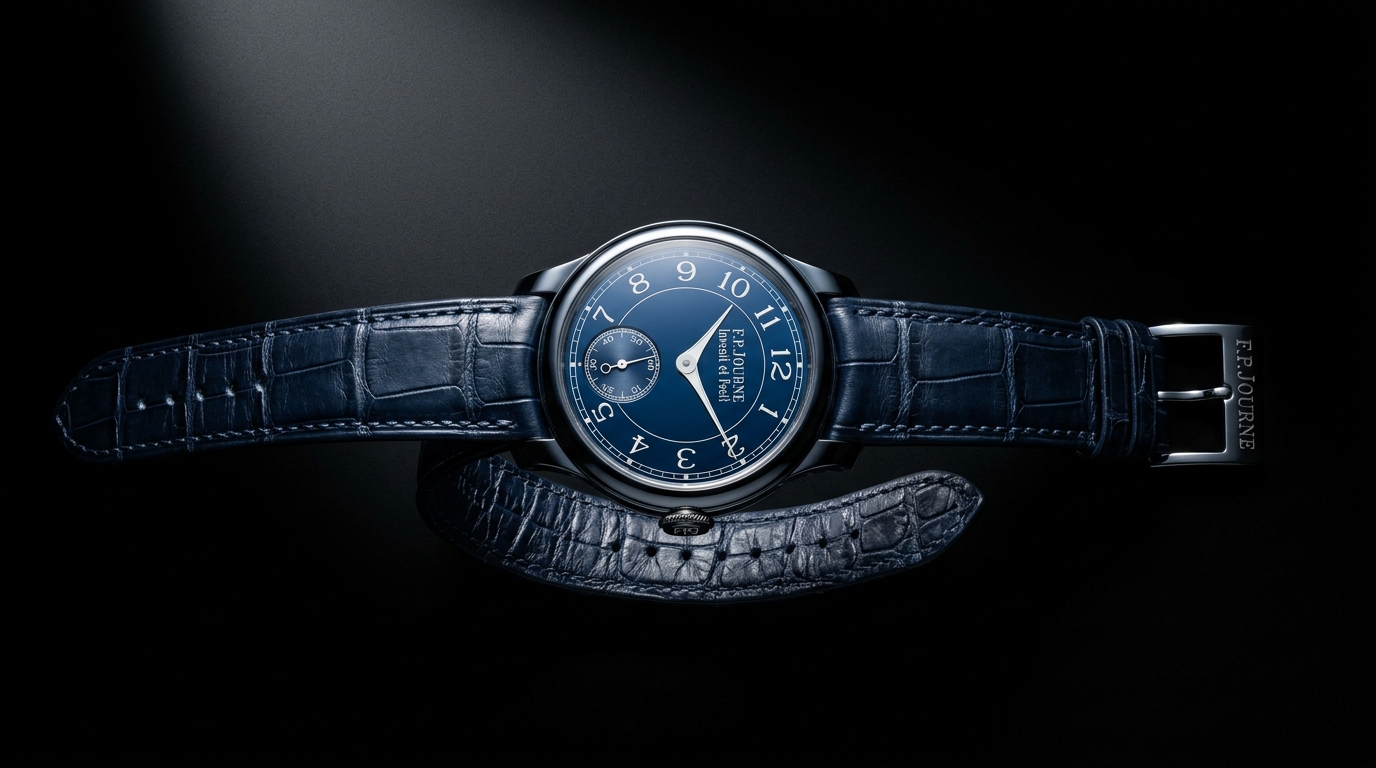
The Chronomètre Bleu wears unlike a steel 39 mm watch. The tantalum case gives it a physical density that is immediately noticeable when handled, especially on a leather strap. Yet the slim profile keeps it from feeling bulky. This is an important distinction. A heavy watch can still wear elegantly if its height, lug geometry, and caseback profile are controlled. The CB gets that equation right.
On the wrist, the 39 mm diameter sits in the contemporary sweet spot between vintage formality and modern visibility. A smaller case might have made the blue dial too precious; a larger one would have turned the watch into a dial object rather than a chronometer. The thickness, under 9 mm, allows it to pass under a cuff, while the darker case metal prevents the watch from reading as ostentatious. It has presence, but not the broad-shouldered presence of a sports watch.
There are practical compromises. Polished tantalum can show hairlines, and refinishing exotic case metals is not something to treat casually. The mirror dial is also unforgiving: fingerprints on the crystal, dust, and reflections are more visible than on a matte dial. The crown is small in keeping with the case design, and hand-winding is pleasant rather than luxurious in the exaggerated sense. These points do not undermine the model; they clarify it. The Chronomètre Bleu is a collector’s watch designed for regular careful wear, not a utility object.
Market Position: From Entry Point to Allocation Watch
The market story of the Chronomètre Bleu is inseparable from the broader rise of F.P. Journe as a collecting category. When the CB was introduced, it was one of the most approachable routes into a Journe wristwatch. In the 2010s, retail pricing sat far below the levels now associated with secondary-market examples, and the watch was discussed as intelligent value: an independent manufacture, tantalum case, gold movement, and distinctive dial at a price below many complicated mainstream pieces.
That conversation is over. By the late 2010s and especially during the 2020–2022 independent-watch boom, the Chronomètre Bleu became a benchmark allocation piece. Public auction results and dealer listings pushed well beyond original retail pricing, with examples at the market peak trading in the six-figure dollar range depending on condition, completeness, and timing. The market cooled from the most speculative levels, as did much of the upper collector segment after 2022, but the CB did not return to its old role as an accessible entry point. It now occupies a more complicated position: too expensive to be called value in the conventional sense, but too important within the modern independent canon to be dismissed as hype.
Collectors prize complete sets, early ownership provenance, condition of the tantalum case, dial quality, and service history through F.P. Journe. Because the watch is not a limited edition, rarity has to be understood correctly. It is not rare in the way a numbered run of 20 pieces is rare. It is scarce because annual production is constrained, demand is global, and the model has become the default target for collectors who want one pure, recognisable Journe. That is a healthier form of scarcity than arbitrary limitation, though it has still produced an uncomfortable premium over retail.
Why the Chronomètre Bleu Endures
The Chronomètre Bleu endures because its identity is not dependent on market temperature. If prices soften, the watch remains a 39 mm tantalum Journe with an 18k rose-gold calibre 1304 and a dial that no larger brand has convincingly replicated. If prices rise, it does not suddenly become mechanically more important, but the reasons collectors wanted it in the first place remain intact. That separation between merit and speculation is important.
Its strongest quality is coherence. The blue-grey metal supports the blue chrome dial. The thin case supports the manually wound calibre. The asymmetrical seconds display connects the watch to Journe’s Souveraine language without overcomplicating the dial. The 39 mm size gives modern wearability without sacrificing proportion. Nothing feels borrowed from another category. It is not a dress watch pretending to be a sports watch, nor an independent piece trying to mimic mainstream luxury codes.
There are more technically spectacular F.P. Journe watches: the Chronomètre à Résonance, the Tourbillon Souverain, the Centigraphe, and the Sonnerie Souveraine all make stronger claims on invention. But the Chronomètre Bleu makes a different argument. It shows how much identity can be carried by a simple watch when the material, dial, movement, and proportions are all fixed with conviction. That is why the CB has become the definitive modern time-only Journe, even if it was never meant to carry that burden.
The editorial view is straightforward: the F.P. Journe Chronomètre Bleu is no longer the bargain it once was, and buyers should resist treating it as a frictionless financial instrument. But as a single-model study in modern independent watchmaking, it remains one of the clearest successes of the post-2000 era. Its appeal is not that it does everything. Its appeal is that it does very little, with unusually few mistakes.