H. Moser & Cie Streamliner Flyback Chronograph: The Integrated Chronograph That Refused the Usual Template
H. Moser & Cie Streamliner Flyback Chronograph: The Integrated Chronograph That Refused the Usual Template
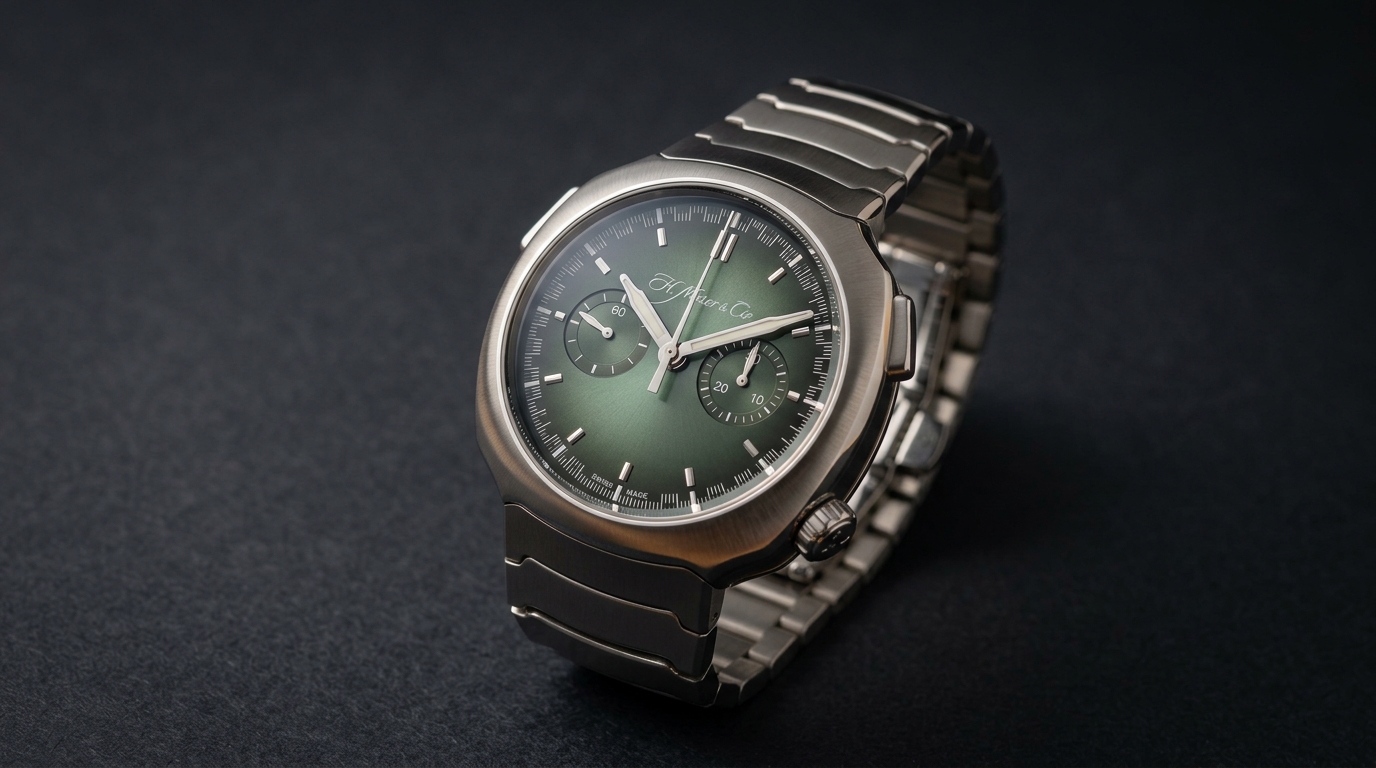
The H. Moser & Cie Streamliner Flyback Chronograph is not important because it joined the integrated-bracelet sports-watch category. It matters because it entered that category in 2020 and declined to copy its established grammar. No octagonal bezel, no exposed screws, no patterned dial borrowed from the 1970s, no conventional tri-compax chronograph layout. Instead, Moser launched its entire Streamliner line with a 42.3 mm steel automatic flyback chronograph driven by the HMC 902 calibre, a movement developed with Agenhor and built around central chronograph indications. In a segment where most brands begin with a three-hand watch and later add complications, Moser did the opposite. That decision still defines the model.
The first version, reference 6902-1200, appeared in January 2020 as the inaugural Streamliner. It was limited to 100 pieces and carried a funky blue fumé dial. The later Matrix Green reference 6902-1201 broadened the idea into a continuing production model, but the essential architecture remained the same: stainless steel case and bracelet, cushion-form case, integrated pushers, central elapsed seconds and minutes, no date, and a calibre visible through the back rather than obscured by a rear rotor. The watch is best understood not as Moser’s answer to the Royal Oak Chronograph or Nautilus 5980, but as a strategic alternative to them.
Origin and Lineage
The Streamliner Flyback Chronograph sits at a particular moment in Moser’s modern history. MELB Holding, controlled by the Meylan family, had acquired H. Moser & Cie in 2012, and by the late 2010s the brand had become known for fumé dials, irreverent positioning, and a relatively pure approach to time-only watches such as the Endeavour and Pioneer. The Streamliner was a larger move: it gave Moser a steel bracelet platform at a time when demand for luxury sports watches had become structurally important, not merely fashionable.
The name “Streamliner” refers to the aerodynamic trains of the 1920s and 1930s rather than to any Moser archive case. That matters. Moser did not have to pretend that the watch was a rediscovered integrated-bracelet design from 1976. The model was new, and its design was allowed to be new. The reference 6902-1200 therefore functioned as both product and manifesto: Moser was entering the most contested category in modern collecting, but it would do so with a complication and a silhouette that were not derivative.
The choice of a chronograph was especially telling. Chronographs are rarely the cleanest way to launch a new case family because they add thickness, pushers, dial complexity, and service burden. Yet the Streamliner needed to establish itself immediately as something more than another steel integrated bracelet watch. The HMC 902 gave Moser that leverage. It also linked the model to Agenhor’s modern chronograph thinking, most visibly the AgenGraphe architecture seen in Singer Reimagined’s Track1 before Moser adapted the concept for its own use.
Case, Proportions and Design Codes
The Streamliner Flyback Chronograph measures 42.3 mm in diameter and approximately 14.2 mm thick, with 12 ATM water resistance. Those figures place it outside the thin dress-sports ideal and firmly in the realm of practical contemporary chronographs. The important point is that the watch does not wear like a standard 42 mm case on a bracelet. There are no protruding lugs. The case flows directly into the first bracelet links, and the cushion shape reduces the visual spread across the wrist.
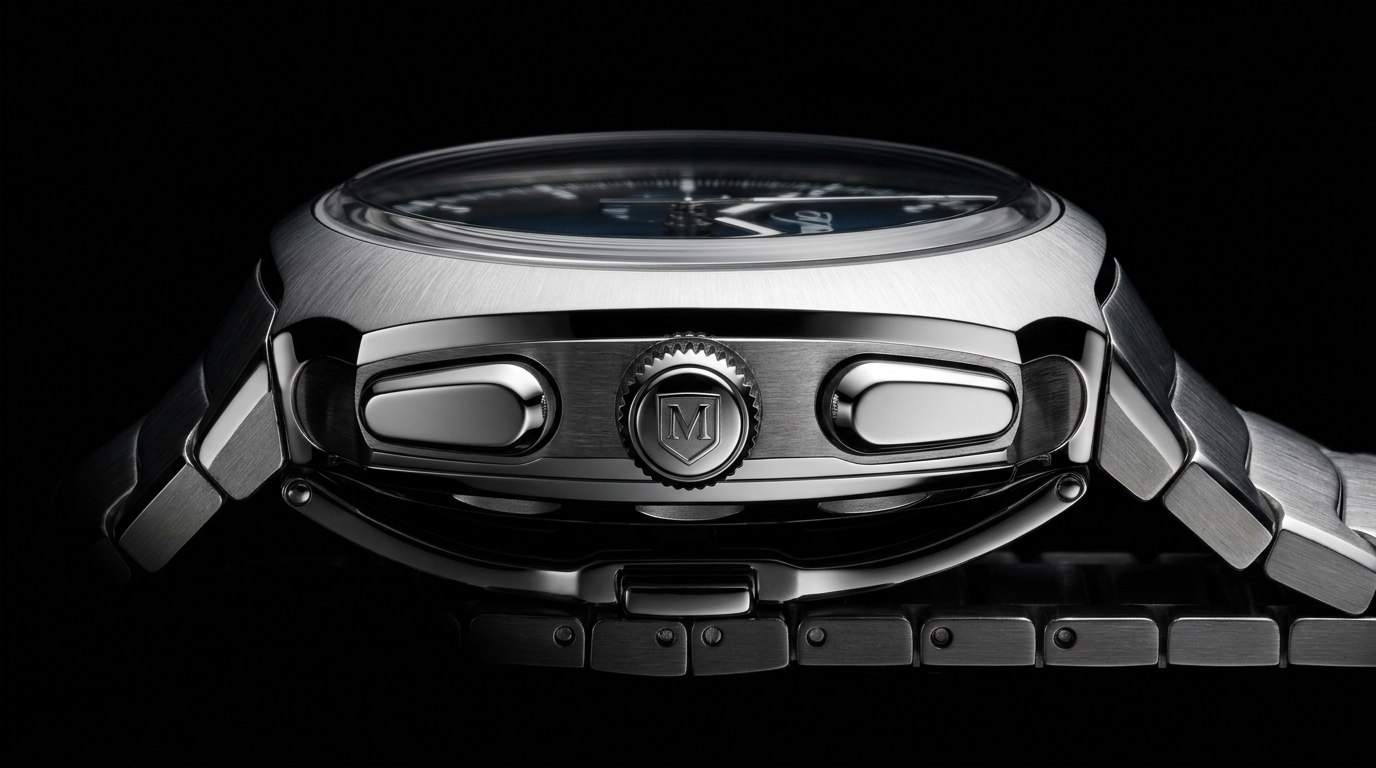
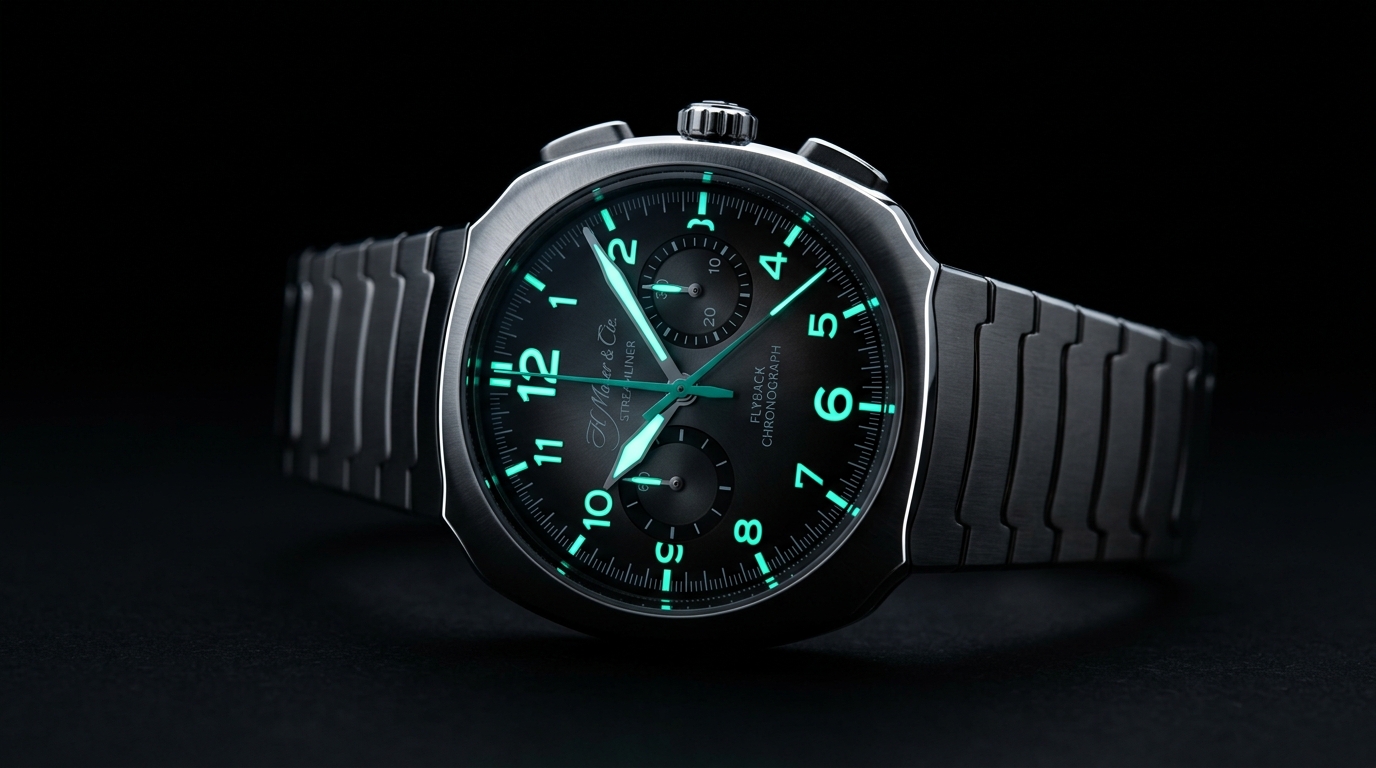
The case is round only in the broadest sense. Its soft-square cushion profile, rounded bezel, and recessed brushed surfaces create a visual mass that is smoother than the angular language of the Royal Oak and less formal than the Nautilus. The chronograph pushers at 2 and 4 o’clock are integrated into the case flank rather than bolted on as obvious cylinders. This is one of the model’s better design decisions: the pushers are functionally clear but do not break the aerodynamic line that gives the Streamliner its name.
The bracelet is central to the watch’s identity. Its articulated links resemble overlapping scales more than the flat H-link construction used by many competitors. The finishing alternates brushed planes and polished bevels, but the effect is fluid rather than architectural. It is also more comfortable than photographs suggest. The bracelet drapes close to the wrist, and the absence of conventional lugs helps the watch sit securely despite its thickness. The main practical reservation is adjustability. As with many butterfly-clasp integrated bracelets, sizing depends heavily on link removal rather than a generous on-the-fly micro-adjustment system. For a 12 ATM steel chronograph, that is a real-world limitation.
The Dial: Chronograph First, Branding Second
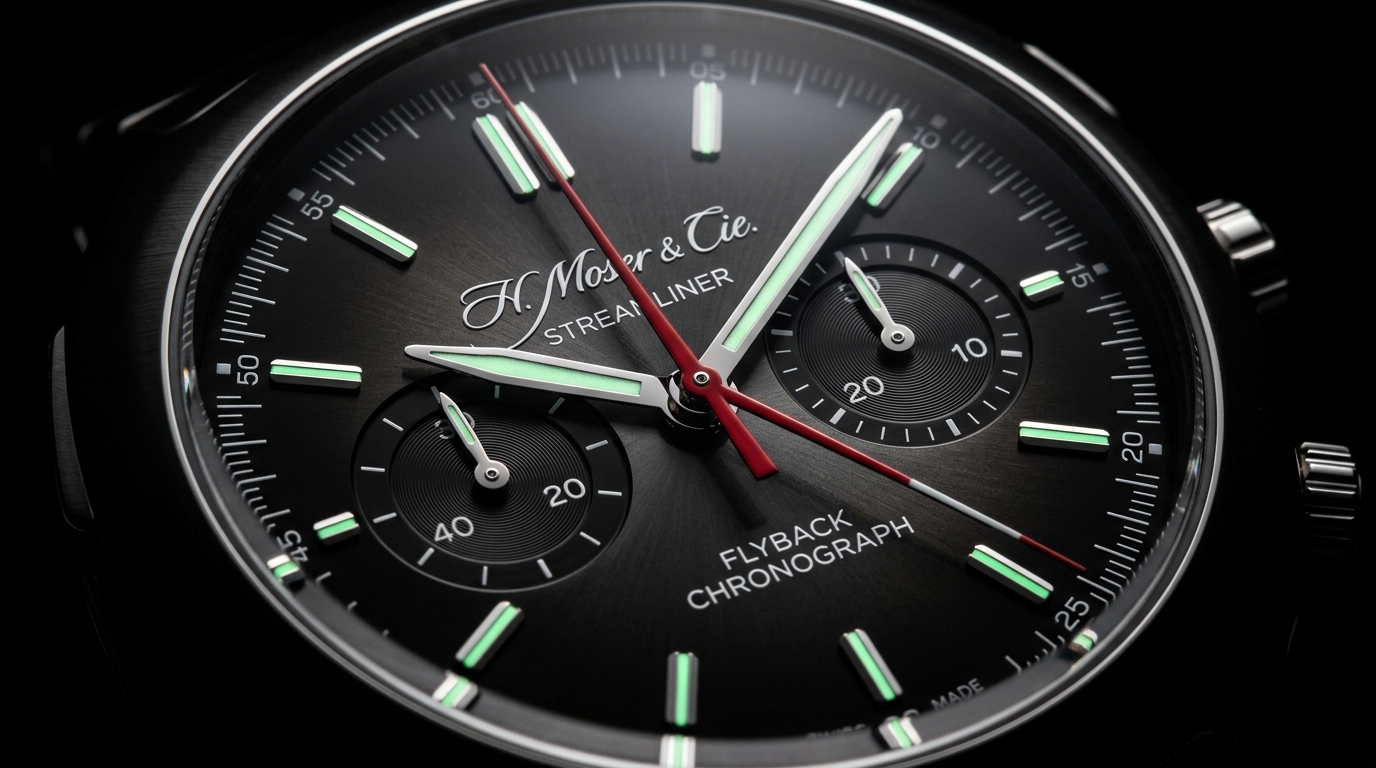
The dial of the Streamliner Flyback Chronograph is not a conventional chronograph dial cleaned up. It is a different solution altogether. Both elapsed chronograph seconds and elapsed chronograph minutes are displayed from the centre, using two coaxial hands. This eliminates sub-registers and allows the wearer to read elapsed time in the same field as the regular time display. It is not just aesthetic minimalism; it changes the hierarchy of information.
On the original reference 6902-1200, Moser used a funky blue fumé dial. On the reference 6902-1201, the Matrix Green fumé dial became the better-known expression of the model. Both use the brand’s gradient colour language, but the Streamliner chronograph avoids decorative excess. The minute and seconds scale around the periphery is functional, and the hands are equipped with Globolight inserts, a ceramic-based luminous material that gives the watch a modern technical identity rather than a vintage one.
The absence of a date is the correct decision. A date aperture would have compromised the central chronograph concept and introduced a retail-friendly feature at the expense of coherence. The lack of running seconds is more debatable. Some collectors prefer visual confirmation that the watch is alive, especially in an automatic chronograph. Moser’s answer is that the dial is dedicated to elapsed timing and time-of-day clarity. In this case, that argument holds. The watch is cleaner because the movement display is disciplined.
Branding is restrained. Moser has often used transparent lacquer logos or minimal signatures, and the Streamliner Flyback Chronograph benefits from that restraint. In a category where the case shape often carries brand recognition, Moser had to let the watch establish its own identity. The dial does not shout the manufacture’s name because the watch’s architecture already does the work.
HMC 902: The Point of the Watch
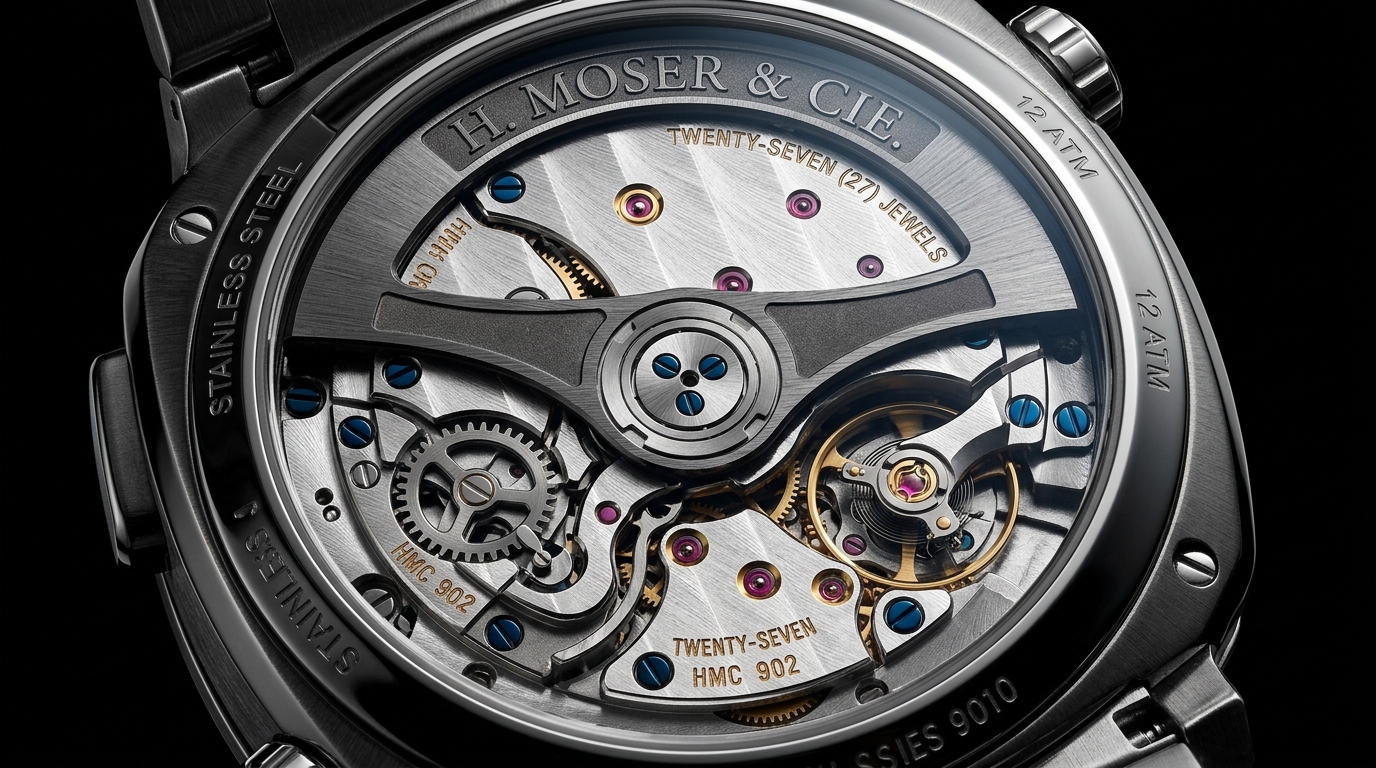
The calibre HMC 902 is the reason the Streamliner Flyback Chronograph deserves sustained attention. It is an automatic flyback chronograph developed with Agenhor, the Geneva movement specialist led by Jean-Marc Wiederrecht, and it uses a chronograph architecture derived from the AgenGraphe. The calibre has 434 components, 55 jewels, a 21,600 vph frequency, and a power reserve of approximately 54 hours. It is not a standard modular chronograph dressed in an unusual case.
The central chronograph display is the defining mechanical feature. Rather than placing elapsed minutes in a subdial at 3, 6, or 9 o’clock, the HMC 902 drives both elapsed seconds and elapsed minutes centrally. This makes the chronograph unusually legible and also explains the dial’s balance. The watch does not need subdials because the movement was designed not to need them.
The flyback function allows the chronograph to be reset and restarted with a single press while running. That is a practical complication, originally rooted in aviation timing, and it makes more sense on this watch than a tachymeter scale would. The column-wheel control and Agenhor architecture give the pushers a precise, engineered feel, though anyone expecting the heavy, traditional tactility of a manually wound lateral-clutch chronograph will find the sensation more modern than romantic.
One of the HMC 902’s cleverest choices is the automatic winding system. The oscillating mass is positioned on the dial side, leaving the caseback free to show the chronograph mechanism. This is not a trivial detail. Many automatic chronographs hide their most interesting mechanics beneath a central rotor. Moser’s solution preserves convenience while giving the owner access to the calibre’s architecture. For a watch whose value proposition depends heavily on its movement, that visibility matters.
Finishing is contemporary rather than deeply traditional. Expect clean anglage, polished screw heads, darkened bridges, and Moser’s restrained decorative language rather than lavish hand-engraving or old-Geneva theatricality. That is appropriate for the Streamliner. The movement is technical, open, and architectural; over-ornamentation would be out of character. Still, collectors should be precise in their expectations: the HMC 902 is a sophisticated chronograph calibre, but it is also collaborative. Calling it purely in-house would flatten the truth. Its credibility comes partly from Moser and partly from Agenhor.
On the Wrist
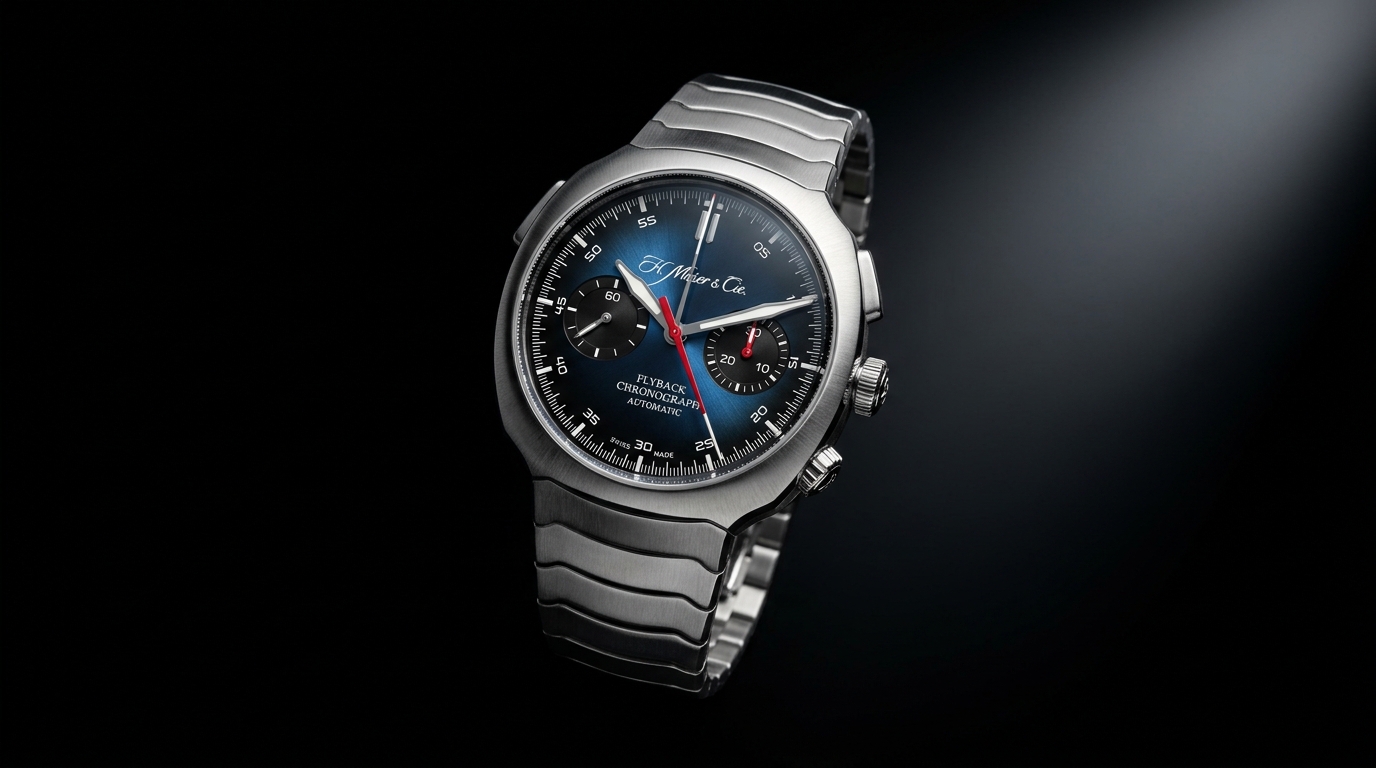
The Streamliner Flyback Chronograph is not a small watch, but it is a more wearable watch than the numbers imply. The 42.3 mm case has presence, and the 14.2 mm thickness is noticeable, especially compared with thinner integrated-bracelet three-handers. Yet the lugless construction and supple bracelet reduce the sense of bulk. It wears broad and low enough to feel controlled, though not discreet.
The case finishing helps. Brushed surfaces reduce glare, while polished accents define the case and bracelet without turning the watch into a jewellery object. The crown and pushers are easy to operate, and the 12 ATM water resistance makes the watch more usable than many haute horlogerie chronographs. This is one of the model’s quiet strengths. Moser did not produce a fragile complicated steel watch that merely looks sporty; the specification supports the design language.
The main ergonomic question is bracelet fit. On a bracelet watch with this much visual continuity, a poor fit undermines the whole object. The Streamliner bracelet is comfortable when sized correctly, but the clasp system does not offer the kind of extensive micro-adjustment that would make seasonal changes effortless. For collectors used to Rolex Oyster-style practical adjustability, this is a point against it. For collectors used to haute horlogerie bracelets, it is familiar but still worth noting.
Market Position and Collector Reception
At launch, the reference 6902-1200 was priced around the high five-figure steel chronograph segment, roughly US$40,000, and limited to 100 pieces. That placed it above many mainstream luxury chronographs but below the speculative peak pricing of the most demanded Patek Philippe and Audemars Piguet steel chronographs. The Matrix Green reference 6902-1201 later gave the model broader visibility without making it common.
The direct comparison set is obvious but imperfect. The Audemars Piguet Royal Oak Chronograph, Patek Philippe Nautilus 5980, Vacheron Constantin Overseas Chronograph, and, more recently, the A. Lange & Söhne Odysseus Chronograph all occupy the high-end integrated-bracelet sports-chronograph conversation. The Moser is different because its chronograph display is conceptually cleaner and its brand equity is more independent-driven. It lacks the historical weight of the Royal Oak and Nautilus, but it also avoids their burden of being instantly recognisable status objects.
Among collectors, the Streamliner Flyback Chronograph has tended to appeal to buyers who already understand the integrated-bracelet category and want something less obvious. It is not a universal watch. The case is distinctive, the bracelet polarising, the movement complex, and the brand still smaller than the Swiss establishment. Those are not weaknesses in themselves. They define the audience. This is a watch for someone who wants a serious chronograph architecture and is prepared to accept a design that does not flatter everyone’s expectations.
On the secondary market, the Streamliner Flyback Chronograph has not behaved like the most overheated steel icons of 2021. That is healthy. The model’s long-term appeal is not based solely on scarcity or queue economics. The original 100-piece blue reference has obvious collector significance as the first Streamliner, while the Matrix Green version is arguably the more representative long-term daily-wear expression. Both are tied to the same core proposition: movement-led modern design in a steel integrated format.
Why the Streamliner Flyback Chronograph Endures
The reason the H. Moser & Cie Streamliner Flyback Chronograph endures is that its design and mechanics argue for the same idea. The case is fluid, the bracelet is continuous, the pushers are integrated, and the chronograph indications are central. Nothing feels like a complication added after the fact. That coherence is rare in a category crowded with watches that rely on bracelet geometry and brand memory.
It is not a perfect watch. The thickness is real, the clasp adjustability could be better, and the movement’s collaborative origin requires clear-eyed understanding. But those criticisms do not weaken the model’s importance. If anything, they place it in the proper collector context: this is not a safe mainstream integrated chronograph, but a technically ambitious independent one.
The reference 6902-1200 will remain historically important because it launched the Streamliner family in 2020. The reference 6902-1201 strengthened the model by proving that the concept was not a one-off limited-edition flourish. Together, they show Moser at its most strategically disciplined: using a complex movement not as decoration, but as the organising principle of the entire watch.
In the broader luxury sports-watch market, many pieces survive because they are familiar. The Streamliner Flyback Chronograph survives for the opposite reason. It is recognisable without being nostalgic, complicated without being cluttered, and independent without being eccentric for its own sake. That combination is difficult to execute and easy to underestimate. Five years on from its debut, the model still looks less like a reaction to the integrated-bracelet boom than one of the few intelligent critiques of it.