Grand Seiko Snowflake SBGA211: The Spring Drive Reference That Still Sets the Standard
Grand Seiko Snowflake SBGA211: The Spring Drive Reference That Still Sets the Standard
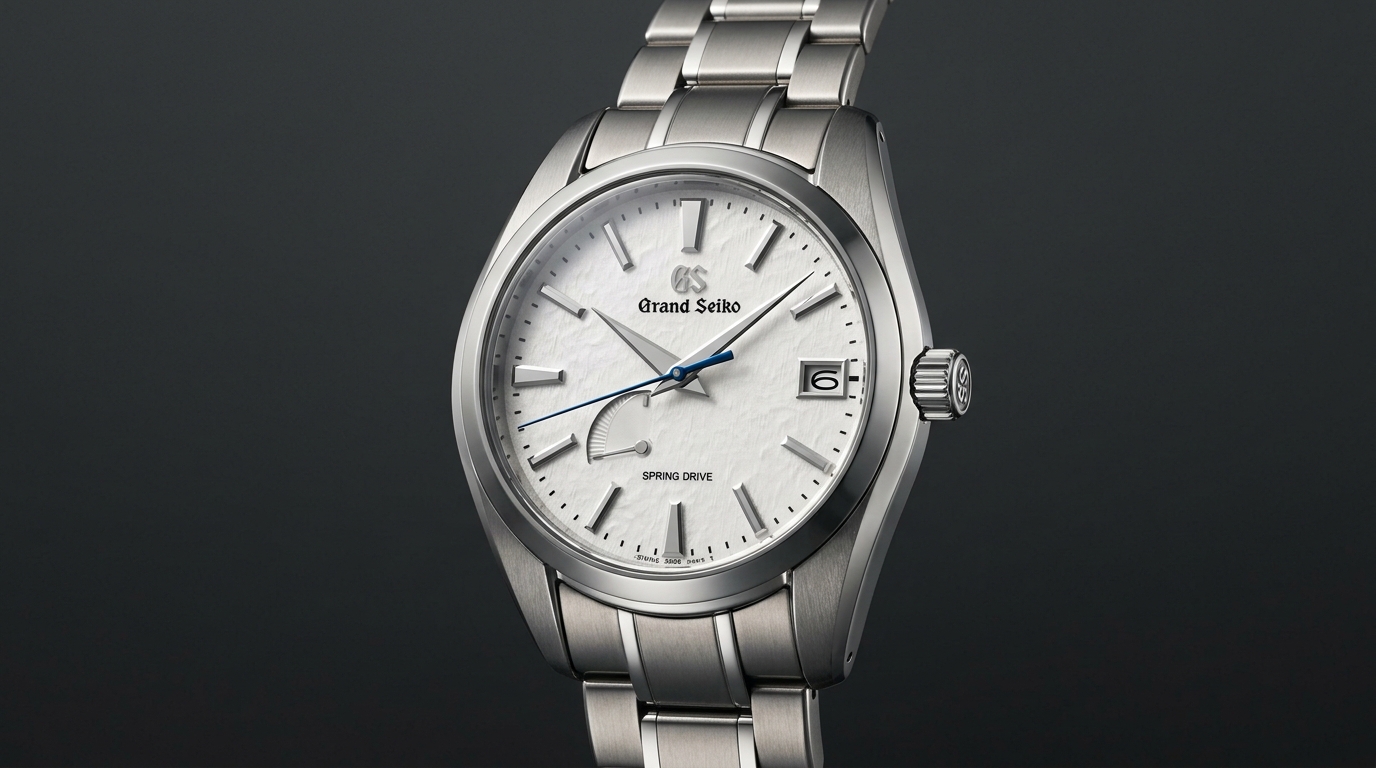
The Grand Seiko Snowflake SBGA211 is not important because it is rare, complicated, or especially new. It matters because it has become the clearest single-watch argument for Grand Seiko’s modern identity: a textured dial made in Shinshu, a high-intensity titanium case finished with unusual sharpness, and the 9R65 Spring Drive calibre doing something neither conventional Swiss lever escapements nor quartz movements quite do. Few watches at this price have been discussed so often, copied so indirectly, and misunderstood so regularly.
That overexposure has created a problem. The SBGA211 is now familiar enough to be treated as obvious. It should not be. Behind the shorthand name “Snowflake” is a reference with a specific lineage, a specific set of compromises, and a specific reason for still being the default recommendation when collectors ask which Grand Seiko to buy first. The answer is not always SBGA211. But it remains the model against which most modern Grand Seiko watches are quietly measured.
From SBGA011 to SBGA211: The Snowflake’s Actual Lineage
The SBGA211 did not appear from nowhere. Its direct predecessor was the SBGA011, introduced in 2005, one year after Grand Seiko launched the 9R Spring Drive family in 2004. The SBGA011 carried the older dial hierarchy of the period, with “Seiko” at 12 o’clock and “Grand Seiko” below. When Grand Seiko was separated more clearly as an independent brand identity in 2017, the watch became the SBGA211, with the GS logo and “Grand Seiko” moved to 12 o’clock. That change was more than cosmetic. It marked the model’s transition from a cult Japanese-market favourite into one of the signature references of Grand Seiko’s global catalogue.
The essentials remained intact: 41mm high-intensity titanium case, textured white dial, blued seconds hand, date at 3 o’clock, power-reserve display between 7 and 8 o’clock, and calibre 9R65 visible through the caseback. This continuity is part of the SBGA211’s authority. It has not needed annual redesigns or artificial scarcity to hold attention. The watch is essentially the same proposal Grand Seiko made in 2005: modern Japanese watchmaking expressed through Spring Drive rather than through Swiss-derived mechanical orthodoxy.
The “Snowflake” nickname came from collectors before it became part of the commercial language around the watch. Its dial is associated with the snow-covered landscape around Shinshu, where Grand Seiko’s Spring Drive watches are produced. More precisely, the watch belongs to the world of Grand Seiko Studio Shinshu in Shiojiri, Nagano Prefecture, rather than the mechanical 9S production associated with Shizukuishi in Iwate. That distinction matters. The SBGA211 is not simply a Grand Seiko with a pretty dial; it is a Spring Drive watch rooted in the location and manufacturing culture that created Spring Drive as a serially produced luxury calibre.
Design Codes: White Texture, Titanium Geometry, Measured Asymmetry
The SBGA211 measures 41.0mm in diameter, approximately 12.5mm thick, with a 20mm lug width and a lug-to-lug span around 49mm. Those numbers place it in the modern everyday-watch category rather than the vintage-inspired dress-watch category. It is often described as a dress watch by people looking only at the white dial and polished facets, but on the wrist it behaves more like a light, refined sports-everyday watch with 100 metres of water resistance and a screw-down crown.
The case is high-intensity titanium, Grand Seiko’s harder and brighter titanium alloy. This is central to the model. In steel, the Snowflake would be more conventional and heavier; in titanium, it becomes technically purposeful but visually less cold than many grey titanium watches. The material also changes the ownership experience. The SBGA211 is large enough on paper to concern collectors accustomed to 38mm or 39mm watches, but the low weight makes it wear smaller and less assertive than the stated diameter suggests.
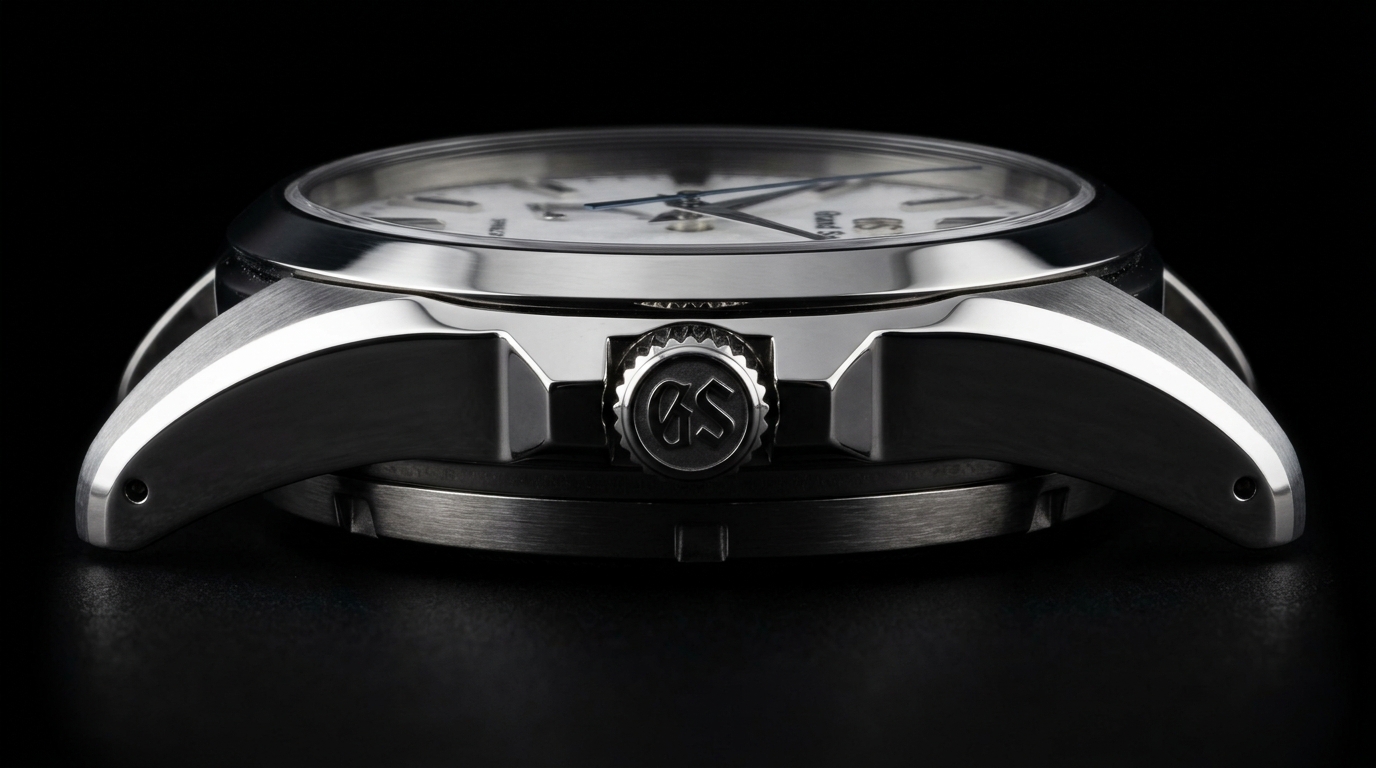
The case finishing is one of the model’s main arguments. Grand Seiko uses its familiar combination of flat mirror-polished surfaces and precise hairline brushing, with Zaratsu polishing giving the broad planes their distortion-free reflectivity. Titanium is less forgiving than steel under this sort of finishing; the fact that the SBGA211 retains crisp transitions between polished and brushed surfaces is not incidental. This is where the watch justifies a meaningful part of its price. The geometry is not the aggressively angular 44GS formula, but it clearly follows Grand Seiko’s broader grammar: strong planes, visible transitions, and a refusal to rely on rounded softness.
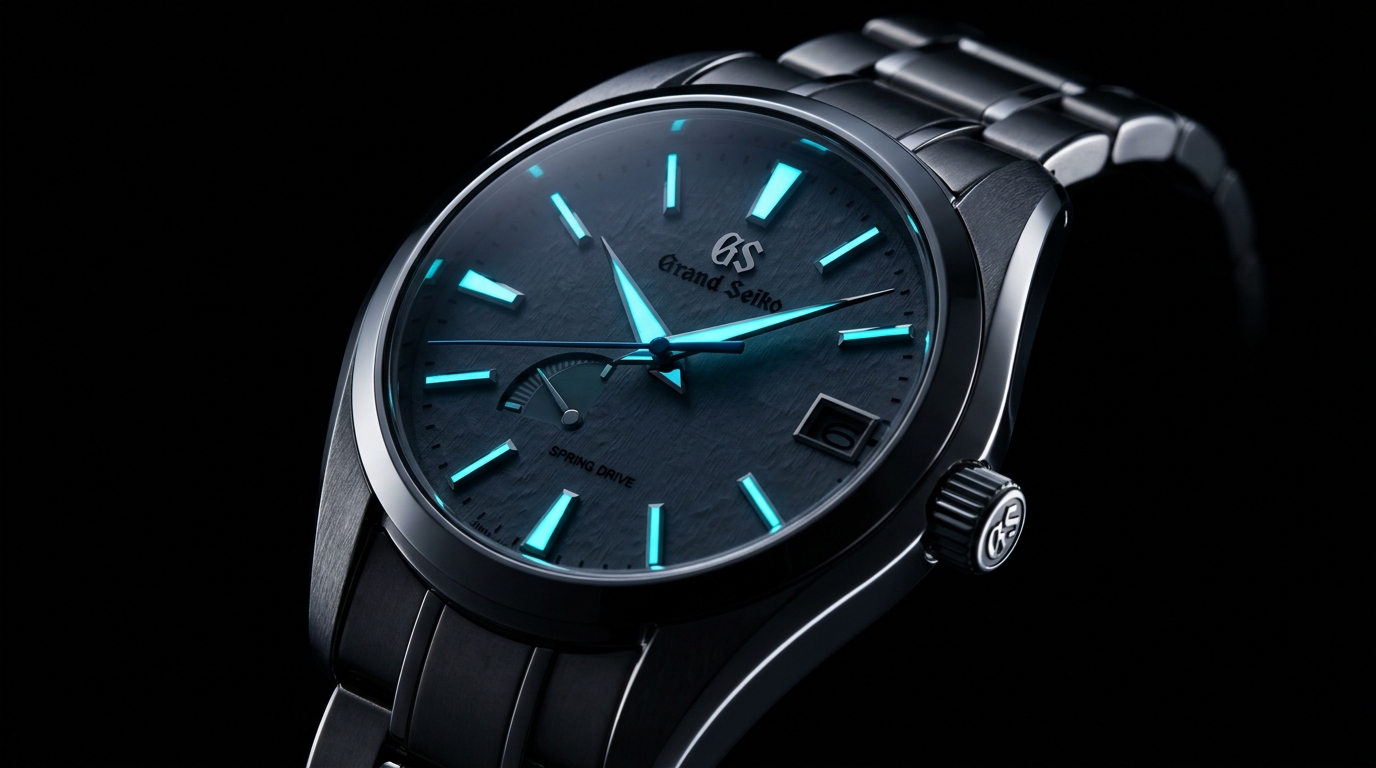
The dial is the part that made the watch famous, but it is also the most frequently simplified. It is not a flat white dial with decorative grain. It is a textured, silvery-white surface whose effect changes materially with light. In low light it can look quiet and almost matte; in direct light it reads as a stratified landscape of fine ridges. Grand Seiko’s applied markers and hands are diamond-cut and polished with enough precision that legibility remains stronger than one might expect from a white-on-silver composition.
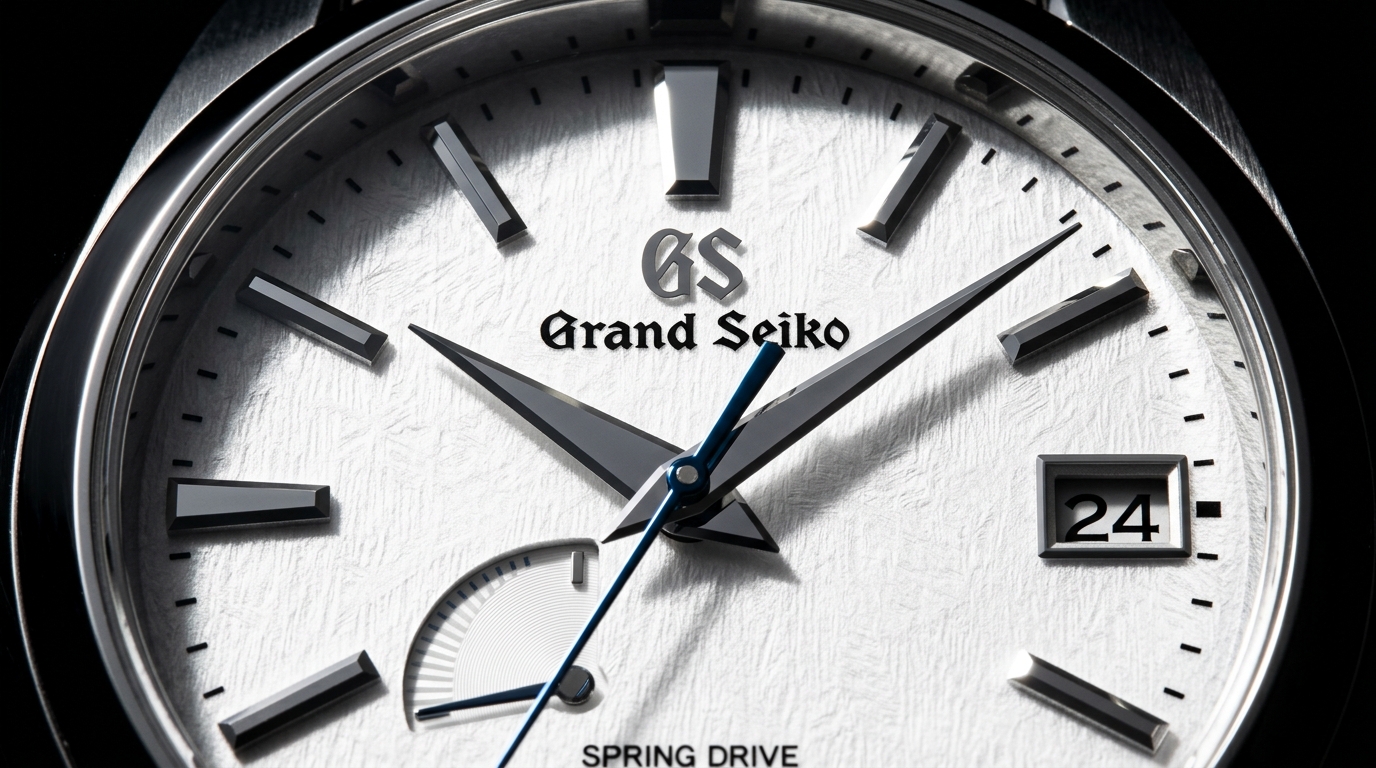
The power-reserve indicator is the dividing line for many collectors. Placed on the dial rather than hidden on the movement side, it breaks the symmetry. Purists often object to it, and their point is legitimate: the SBGA211 would be cleaner without it. But it would also be less specific. The power-reserve display is part of the 9R65 identity and a visual reminder that this is not a conventional automatic. On this reference, the asymmetry has become part of the watch’s recognisable architecture.
Calibre 9R65: Why Spring Drive Matters Here
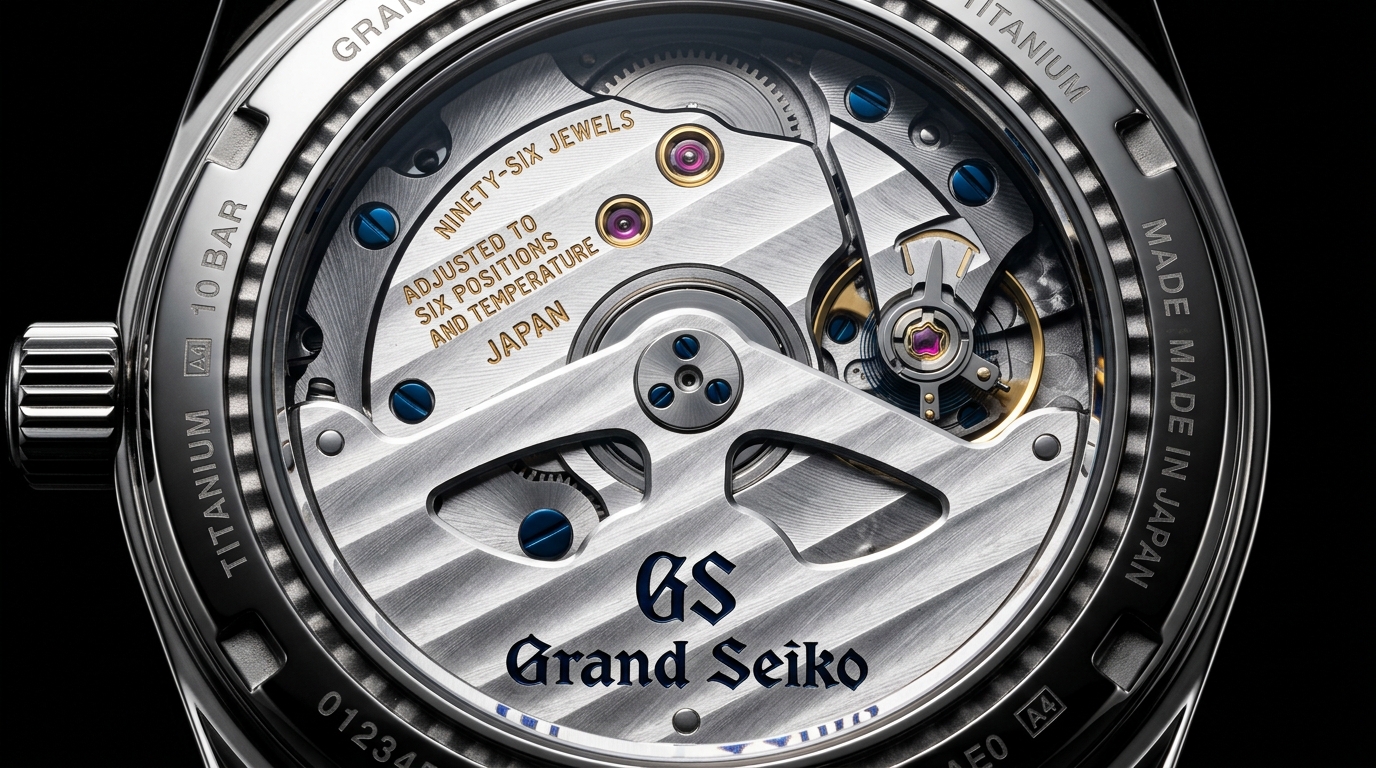
The SBGA211 is powered by calibre 9R65, an automatic Spring Drive movement with manual winding, date, 30 jewels, and a 72-hour power reserve. Its rated accuracy is ±15 seconds per month, or approximately ±1 second per day. That specification is not marketing decoration; it is the practical consequence of Spring Drive’s architecture. Energy comes from a mainspring, as in a mechanical watch, but timekeeping is governed by Grand Seiko’s Tri-synchro regulator, which controls mechanical, electrical, and electromagnetic energy through a quartz reference and electromagnetic braking system.
The simplest way to understand the SBGA211 is this: it makes a mechanical watch more accurate without becoming a battery-powered quartz watch. The glide of the seconds hand is not a theatrical flourish. It reflects the absence of a conventional escapement’s stop-start release. On the dial, the blue seconds hand moves continuously rather than beating at 6, 8, or 10 increments per second. That has become one of the Snowflake’s signatures, and it is more convincing here than on many later Grand Seiko references because the pale dial gives the hand maximum contrast.
Finishing on the 9R65 is clean, industrially refined, and honest. The movement is visible through a sapphire caseback, with a signed rotor, striped bridges, polished screw heads, and neatly controlled surfaces. It is not finished to the standard of hand-bevelled independent watchmaking, nor should it be judged as if that were the assignment. Its value lies in engineering coherence and production execution: a robust 72-hour automatic movement with quartz-regulated precision and the tactile habits of a mechanical watch.
There is a philosophical objection to Spring Drive among some mechanical purists, and it should not be dismissed too quickly. If a collector defines mechanical watchmaking strictly by the escapement, then the SBGA211 sits outside that tradition. But that objection also narrows the field in a way that makes the hobby less interesting. Spring Drive was not a shortcut invented to imitate mechanical prestige; its development traces back to Seiko engineer Yoshikazu Akahane’s concept in the late 1970s and took decades to industrialise before commercial production arrived in 1999. By the time the SBGA011 appeared in 2005, Spring Drive had become one of the few genuinely distinctive movement technologies in mainstream luxury watchmaking.
On the Wrist: Larger Than a Dress Watch, Lighter Than Expected
The SBGA211’s wearing experience is defined by tension between size and weight. At 41mm across, it is not a small watch. The lugs have presence, and the case has enough breadth that collectors with wrists under about 6.5 inches should try it before buying. Yet the titanium construction changes the equation. The watch is light enough that the case head never feels as substantial as the dimensions imply. This is one reason the Snowflake has remained commercially resilient: it gives visual presence without the physical burden of a steel watch of comparable size.
The bracelet is competent rather than exceptional. It is made from matching high-intensity titanium and uses Grand Seiko’s familiar multi-link construction, with brushed surfaces and polished accents. The criticism is predictable and fair: the clasp lacks the kind of modern tool-free micro-adjustment now common among competitors, and sizing can require more fiddling with half-links than should be necessary at this price. The bracelet is comfortable, but it is not the reason to buy the SBGA211. The case, dial, and movement are.
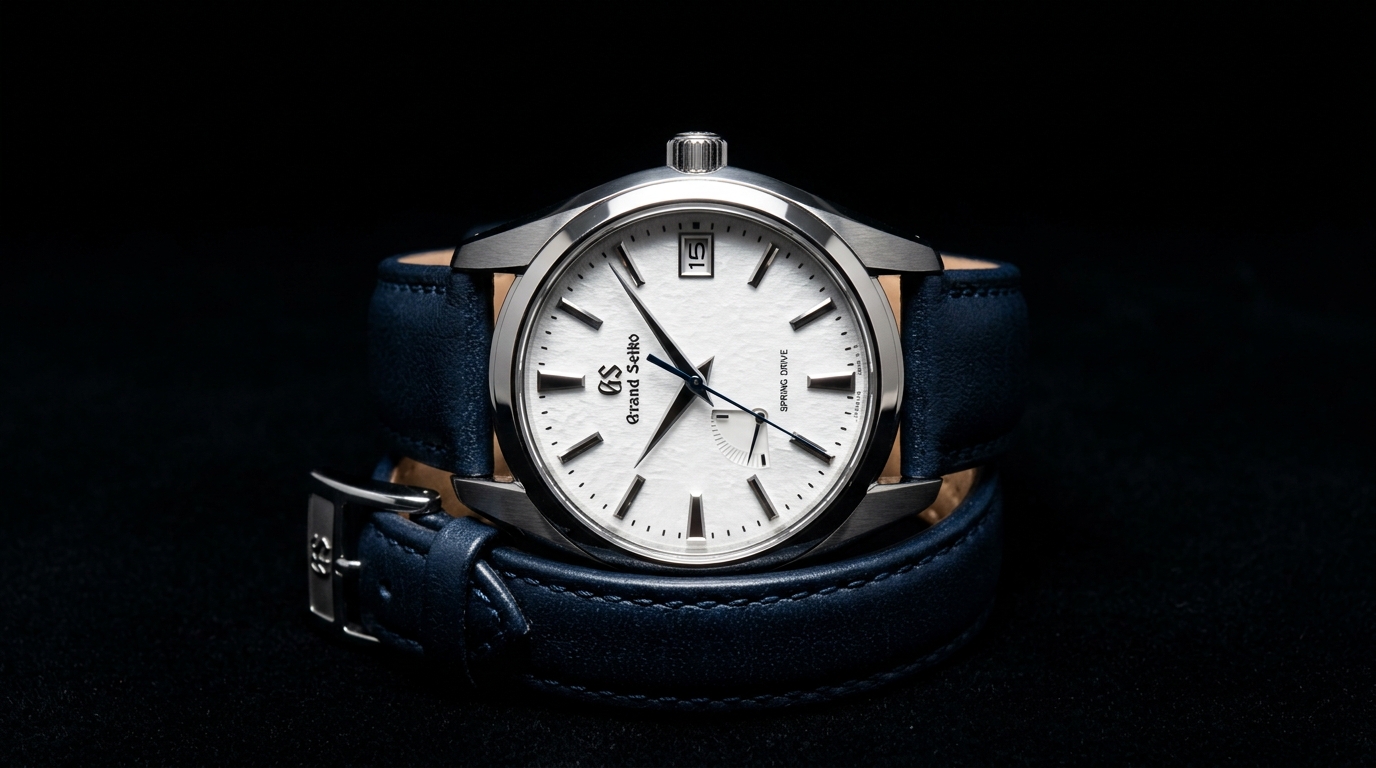
The watch also works well on straps, though not every strap suits it. Dark leather can make the case look broader and the dial more formal; grey suede or textured calf tends to align better with the titanium and the winter-dial concept without becoming costume-like. Still, the SBGA211 is most coherent on its bracelet. Grand Seiko designed it as an integrated daily watch, and the lightness of the full titanium package is part of the reference’s character.
Market Position: Not Rare, Still Important
The SBGA211 sits in Grand Seiko’s Heritage Collection and has long been priced in the mid-luxury segment, with recent US retail around the low-$6,000 range. On the secondary market, full-set examples commonly trade below retail, with condition, age, bracelet completeness, and warranty status making a meaningful difference. This is not a scarcity-driven watch. Anyone buying the SBGA211 as an investment is probably asking the wrong question.
Its real market position is more interesting. Against an Omega Seamaster Aqua Terra, the SBGA211 offers a more distinctive movement technology and a more artisanal dial, but gives up the Omega’s bracelet refinement, anti-magnetic Master Chronometer narrative, and broader service familiarity. Against a Rolex Oyster Perpetual or Datejust, the Grand Seiko is more technically unusual and often more available, but it lacks Rolex’s liquidity and social recognition. Against other Grand Seiko models, especially later seasonal dial references such as the SBGA413 “Shunbun,” the SBGA211 feels less novel but more foundational.
That last point matters. The Snowflake is no longer the most surprising Grand Seiko. The brand has released many textured dials since, and some are more subtle, smaller, or better proportioned. But many of those watches exist in the market the SBGA211 helped create. It trained collectors outside Japan to take Grand Seiko dials seriously, to understand Spring Drive as more than a curiosity, and to accept Japanese finishing as a legitimate alternative to Swiss default thinking.
Collector Status: The Gateway Watch That Outgrew the Label
Calling the SBGA211 a “gateway Grand Seiko” is accurate but slightly unfair. It is often the first reference collectors encounter because it communicates the brand’s main strengths quickly. But it is not merely an introductory model. Many collectors with far more expensive watches keep the Snowflake because it serves a role that other watches do not. It is precise enough to be used as a practical reference, visually distinctive without being loud, and sufficiently robust for regular wear.
The objections have not changed. The case is a little large for those who want a classically proportioned daily watch. The power-reserve display interrupts the dial. The bracelet clasp should be better. The titanium can feel too light to collectors who associate weight with value. These criticisms are valid, and they are part of why the SBGA211 is more interesting than a universally agreeable watch. It has identifiable positions rather than generic competence.
What the Snowflake avoids is trend dependence. It is not a green dial, a limited edition, a vintage reissue, or an integrated-bracelet response to market fashion. It is a watch with a coherent identity built from one dial, one material, one movement technology, and one place of production. That coherence is increasingly rare in a market where many references are engineered around colour rotation and controlled availability.
Why the SBGA211 Endures
The Grand Seiko Snowflake SBGA211 endures because it is specific. Its 41mm titanium case is not interchangeable with a generic steel dress case. Its textured dial is linked to Shinshu rather than to an abstract design department. Its calibre 9R65 is not a standard automatic with a decorative rotor, but a Spring Drive movement with a 72-hour reserve and ±15 seconds per month accuracy. Its flaws are equally specific, which is why serious collectors can debate it rather than simply admire or dismiss it.
The strongest case for the SBGA211 is not that it is the best Grand Seiko ever made. That claim would be too broad and probably wrong, depending on whether one values case architecture, movement finishing, thinness, or historical purity. The stronger argument is that the SBGA211 remains the most complete expression of the modern Spring Drive Grand Seiko in regular production. It explains the brand’s technical independence, its finishing priorities, and its relationship to landscape-inspired design in a single reference.
For buyers, the conclusion should be practical. If the 41mm size works, if the power-reserve display does not offend, and if titanium’s lightness feels like an advantage rather than a compromise, the SBGA211 is still one of the most defensible purchases in its segment. Not because it is perfect. Because nearly twenty years after the SBGA011 established the formula, the SBGA211 still has a clearer point of view than many newer watches built to chase attention.