Hublot Big Bang Unico 42mm: The Big Bang That Finally Got the Proportions Right
Hublot Big Bang Unico 42mm: The Big Bang That Finally Got the Proportions Right
The Hublot Big Bang Unico 42mm matters because it corrects the one weakness that made the modern Big Bang difficult for many serious buyers to take seriously: scale. The original Big Bang was never meant to be discreet, and the 45mm Big Bang Unico doubled down on that position. The 42mm version, introduced in 2018, did not make the watch conservative. It made it credible on a wrist that was not built for exhibitionism.
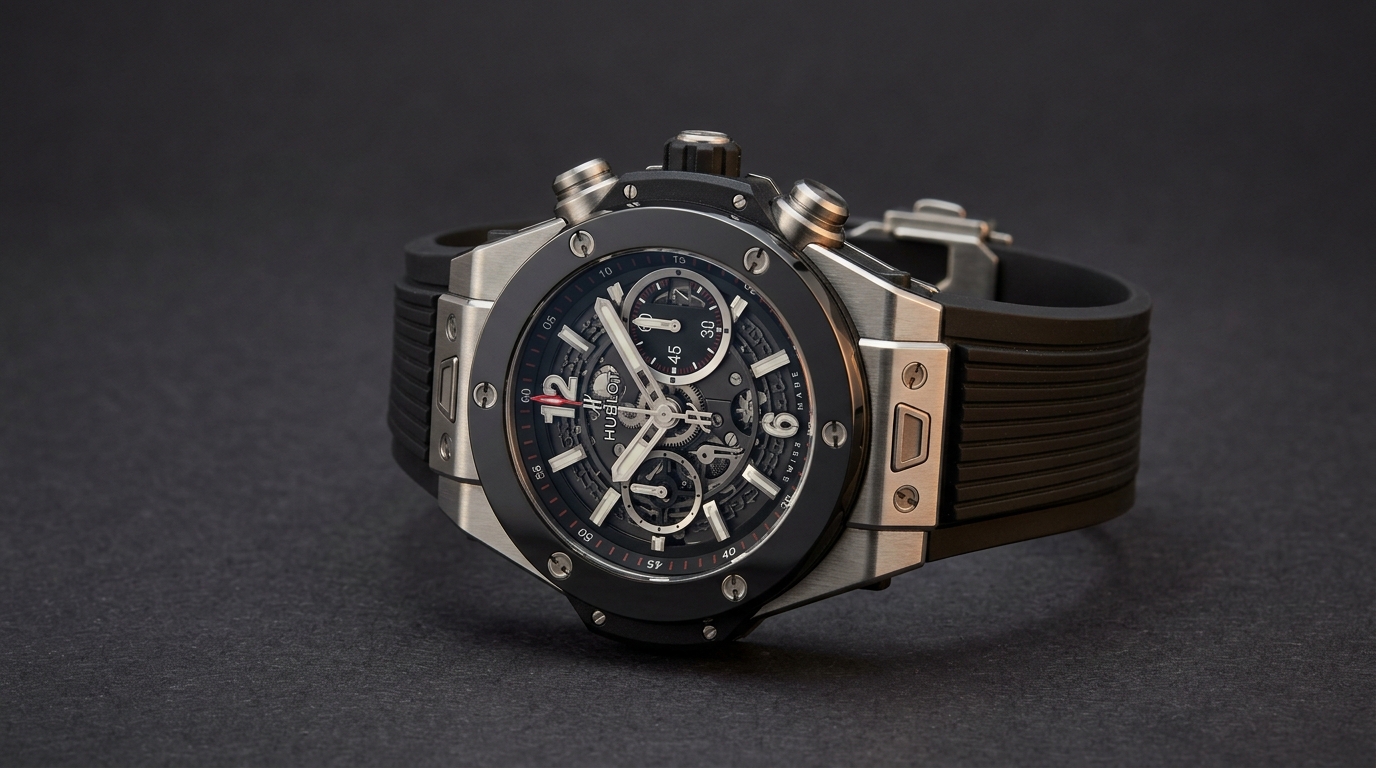
This is still unmistakably a Big Bang: a layered case, visible screws, rubber strap, openworked chronograph dial and a proprietary movement designed to be seen from both sides. But the 42mm Unico is the model where Hublot’s industrial sports-watch language becomes less dependent on size as a statement. In titanium ref. 441.NX.1171.RX, black ceramic ref. 441.CI.1171.RX, King Gold ref. 441.OX.1180.RX and their related 42mm variants, the watch is not a smaller afterthought. It is the strongest execution of the Unico idea.
Origin: From Big Bang to Big Bang Unico 42mm
The Big Bang lineage begins in 2005, under Jean-Claude Biver’s leadership, when Hublot turned Carlo Crocco’s 1980 rubber-strap porthole concept into a much more aggressive contemporary sports watch. The 2005 Big Bang was not subtle; its case construction, exposed bezel screws and mixed materials were the product. The watch also arrived at the right moment, when large luxury sports watches were becoming cultural objects rather than merely technical ones.
The Unico chapter came later. Hublot was acquired by LVMH in 2008, and the brand invested heavily in movement development at Nyon. The original Unico chronograph calibre, HUB1242, appeared as Hublot’s in-house automatic flyback chronograph and became central to the Big Bang Unico 45mm. That 45mm case gave the movement room, but it also limited the audience. A 45mm Hublot chronograph is not a neutral proposition; it asks for a large wrist and a tolerance for volume.
The Big Bang Unico 42mm arrived in 2018 with the calibre HUB1280, also known as Unico 2. This was the strategic move. Hublot did not simply put the old architecture into a smaller shell; it developed a more compact version of the Unico movement, reducing the height relative to the earlier construction and allowing the case to come down to 42mm while preserving the flyback chronograph, column wheel and open dial-side mechanics. The result is the most wearable mainstream Big Bang Unico without diluting the design into anonymity.
Case and Proportions: Still Big Bang, Less Burden
The Big Bang Unico 42mm uses a 42mm case with a thickness of roughly 14.5mm and water resistance rated to 100 metres. Those numbers are important. This is not a thin chronograph, and anyone expecting Royal Oak Jumbo discretion is looking in the wrong category. But compared with the 45mm Unico, the reduction is meaningful because Hublot’s case architecture carries visual mass: bezel, mid-case, lateral inserts, pushers, caseback and strap integration all add perceived size.
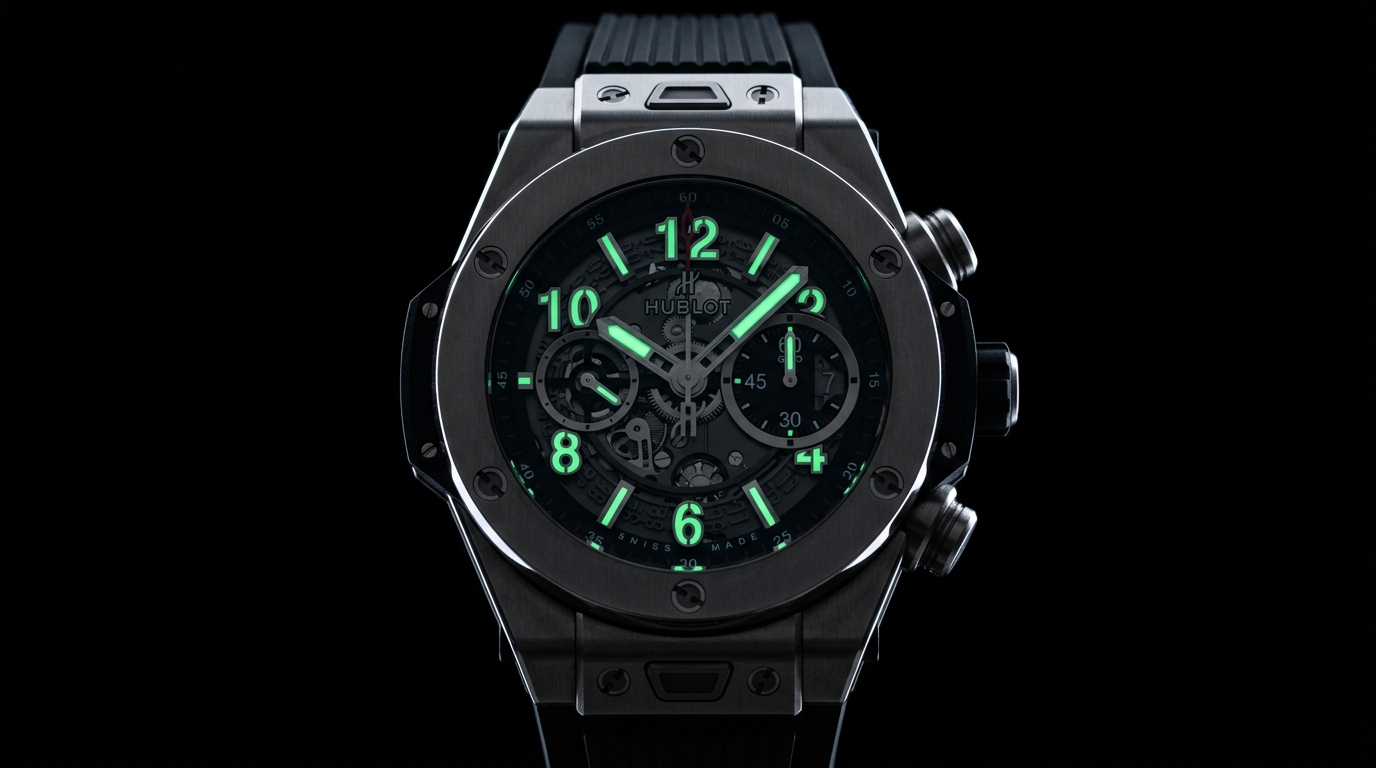
The titanium ref. 441.NX.1171.RX is the clearest expression of the format. It combines satin and polished titanium, black composite resin inserts, a black structured rubber strap and the six H-shaped bezel screws that define the Big Bang silhouette. The black ceramic ref. 441.CI.1171.RX moves the same architecture toward a stealthier and slightly harder-wearing personality, while the King Gold ref. 441.OX.1180.RX makes the model heavier, warmer and more overtly luxurious. The proportions remain constant, but the wearing character changes substantially by material.
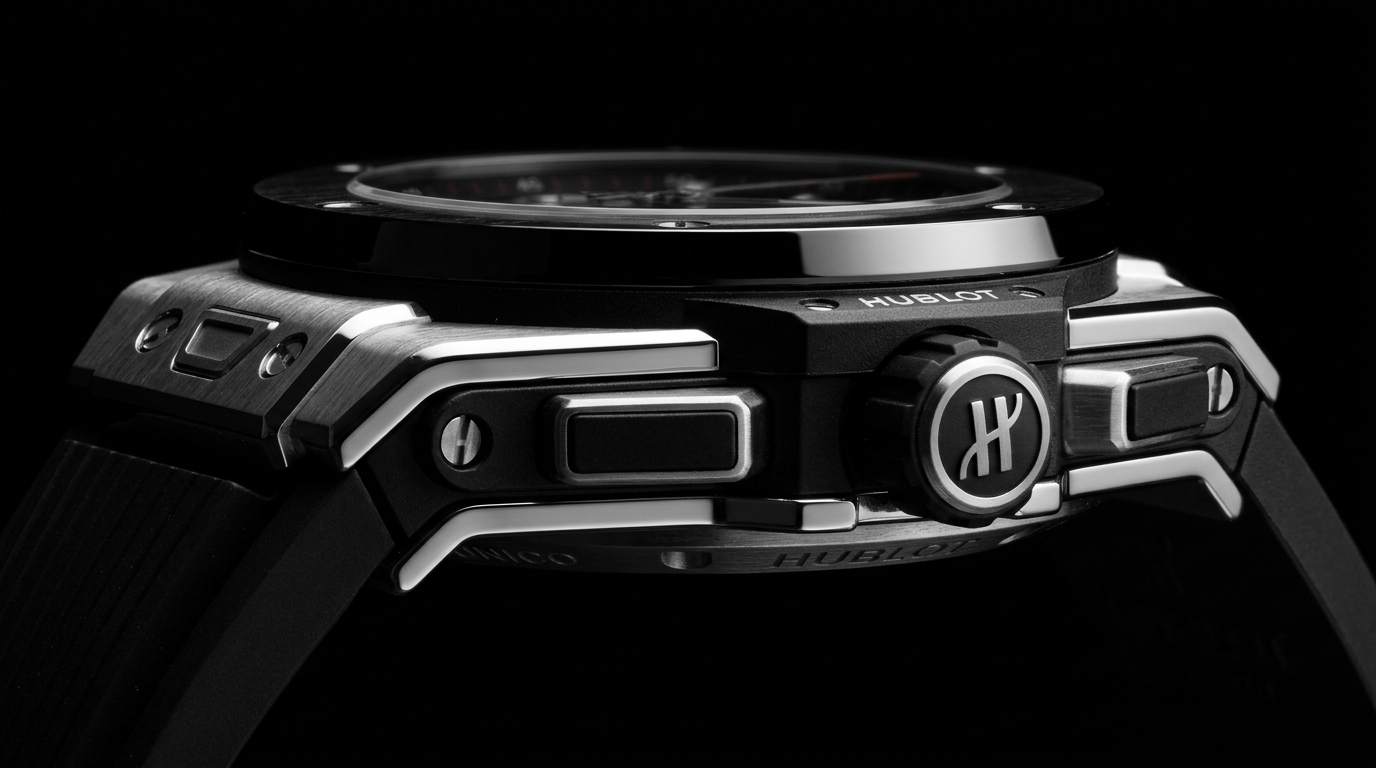
Hublot’s case is often dismissed as merely decorative, but that is too simple. The Big Bang Unico 42mm is a built object with a deliberately modular identity. The bezel, lugs, case middle, pushers and strap interface are visually separated rather than blended. Whether one admires that is subjective; that it is executed consistently is not. The watch is not trying to imitate a mid-century chronograph. It is an industrial sports watch built around assembly, contrast and exposed construction.
Dial Architecture: Skeletonisation With Purpose, Not Restraint
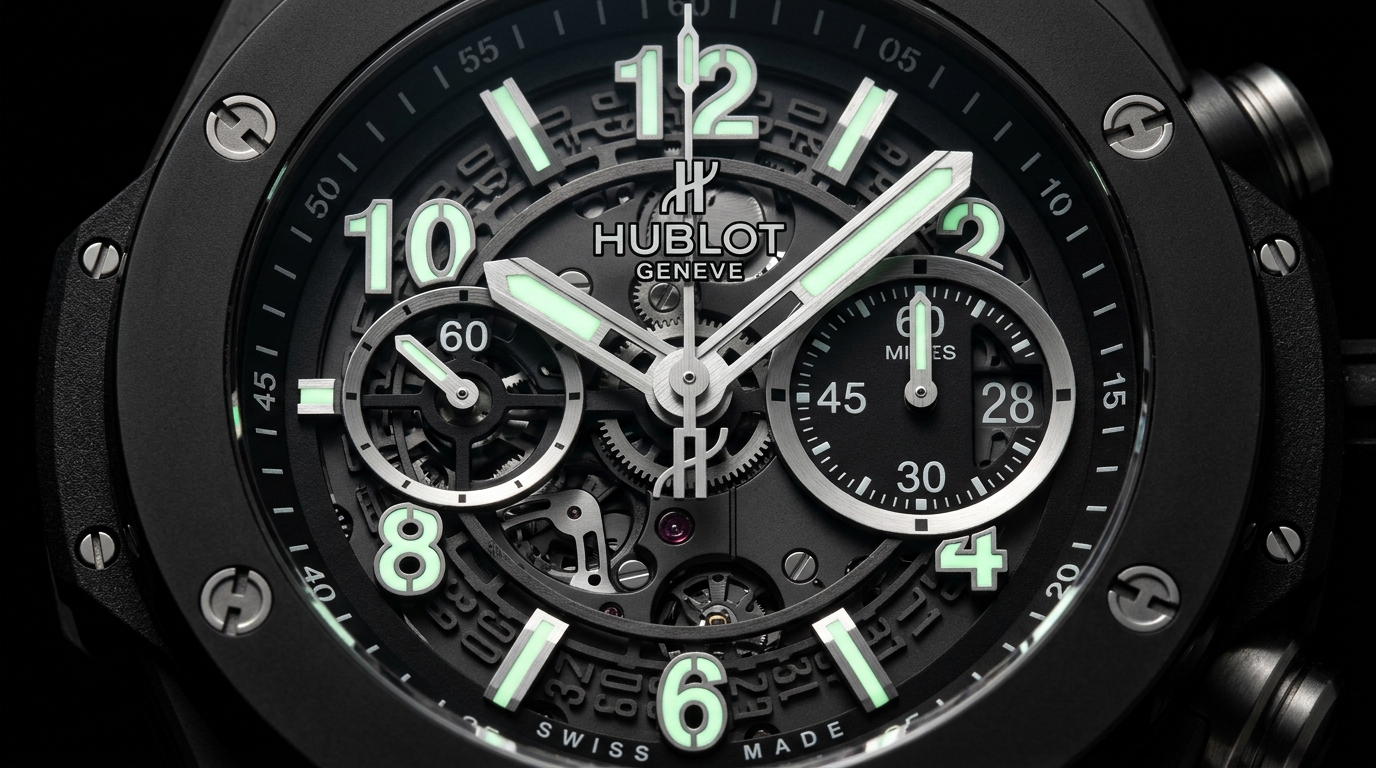
The dial of the Big Bang Unico 42mm is openworked, but not in the traditional decorative sense. It is not skeletonised to display hand engraving or mirrored interior anglages. It is open because the Unico movement was designed to put the chronograph mechanism, including the column wheel, on the dial side. That detail gives the watch more technical legitimacy than many open-dial sports watches, where the aperture is often little more than a sales device.
The layout is bicompax. Small seconds sit at 9 o’clock, while the 60-minute chronograph counter and date indication occupy the 3 o’clock side of the dial. The central chronograph seconds hand keeps the functional hierarchy familiar. The date is not hidden, and the visible date ring is a point of contention: it reinforces the machine aesthetic but compromises purity. On this model, however, purity was never the brief. The Big Bang Unico 42mm is more convincing when read as mechanical instrumentation than as elegant dial design.
Legibility is acceptable rather than exceptional. Applied hour markers and large hands provide enough contrast on the titanium and ceramic versions, but the layered dial can become busy in poor light. Hublot partially solves this through scale and bold hand geometry, not through restraint. The result is a chronograph that rewards looking closely but will not satisfy buyers who want the instant clarity of a Speedmaster Professional or the clean symmetry of a Zenith Chronomaster Sport.
Calibre HUB1280: The Reason the 42mm Exists
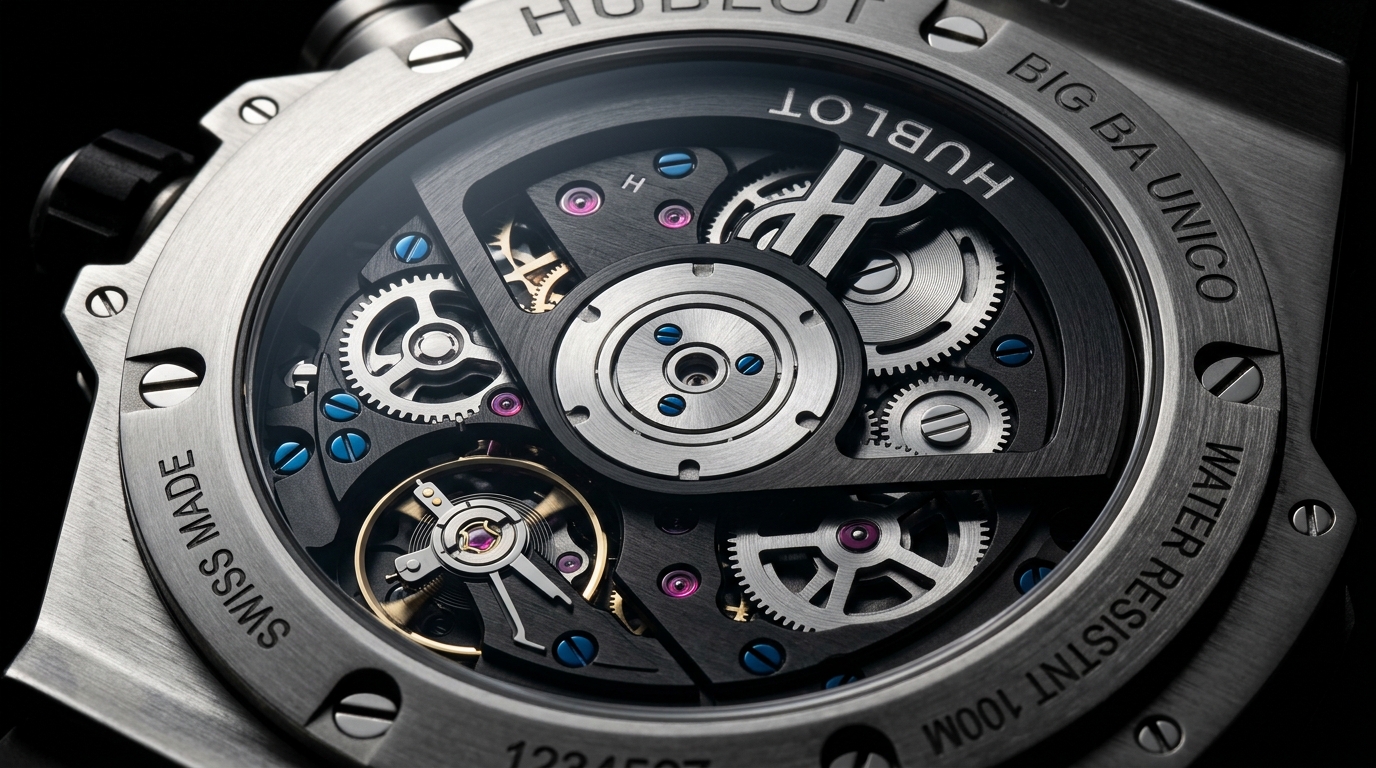
The core of the Big Bang Unico 42mm is the HUB1280 automatic flyback chronograph movement. It runs at 4Hz, offers a 72-hour power reserve, uses a column wheel, and is constructed with 43 jewels and approximately 354 components. Its importance is not only that it is in-house, but that it was engineered as a compact Unico platform suitable for a smaller Big Bang case.
The flyback function allows the chronograph to be reset and restarted with a single press while running, a useful feature in theory and a marker of seriousness in chronograph design. More relevant in daily ownership is the pusher feel. The column wheel gives the start, stop and reset sequence a more deliberate action than cam-actuated chronographs generally provide, although Hublot’s pushers are broad and modern rather than delicate. The action suits the watch: firm, mechanical and unromantic.
Viewed through the sapphire caseback, the HUB1280 is not finished to haute horlogerie standards, and it should not be described as if it were. The bridges are industrially treated, the rotor is openworked, and the surfaces are cleanly executed with contemporary machine finishing. There is no Geneva Seal ambition here, no movement architecture pretending to belong in a hand-finished Vallée de Joux complication. That criticism matters because the retail price places the watch in serious company. But it is also part of the model’s honesty: the Unico is a modern manufacture chronograph built to be robust, visible and brand-specific.
The stronger point is architecture. A proprietary automatic flyback chronograph with dial-side column wheel, 72 hours of reserve and a case designed around it is materially different from a sports watch using an outsourced 7750-derived calibre behind an opaque dial. The Big Bang Unico 42mm earns its technical identity more convincingly than older Big Bang references based on modified third-party movements.
On the Wrist: The 42mm Case Changes the Argument
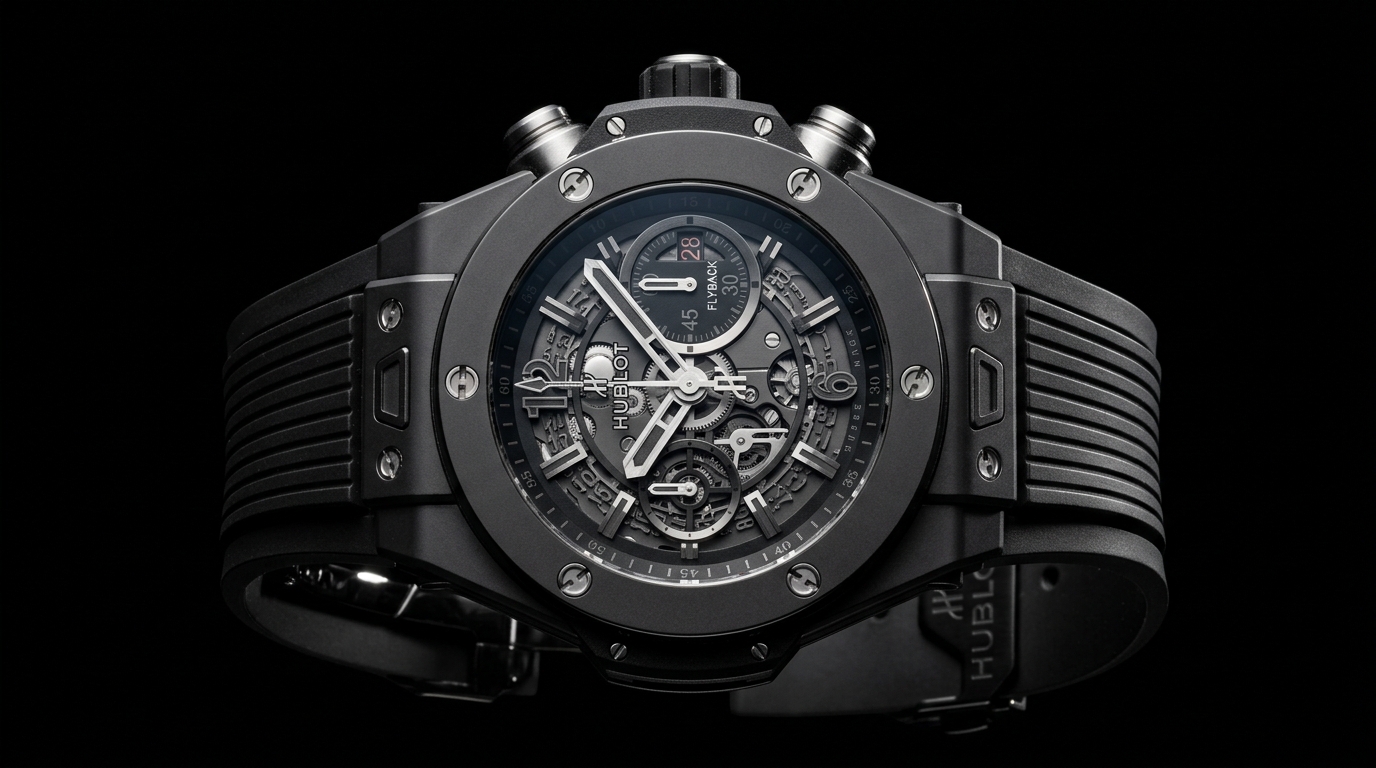
The Big Bang Unico 42mm wears larger than a traditional 42mm chronograph but far better than its dimensions might suggest. Thickness remains present, and the watch sits with the upright stance typical of modern integrated-strap sports chronographs. Yet the short case extensions and flexible rubber strap prevent the watch from sprawling across the wrist in the way many 45mm Big Bang models do.
The one-click strap system is one of Hublot’s practical strengths. It allows the owner to change straps without tools, and on a watch so dependent on material contrast, that matters. The black rubber strap is still the correct default. It links the Unico 42mm directly to the original Hublot idea from 1980: precious or technical watchmaking worn on rubber. Leather and fabric options can work, but they often soften the design. Rubber keeps the model disciplined.
Material choice determines daily usability. Titanium is the most balanced because it keeps weight down and lets the case finishing show without overwhelming the wrist. Black ceramic is harder and more scratch-resistant, but visually more severe. King Gold has the strongest presence and the least neutrality; it is arguably less versatile but more aligned with Hublot’s taste for contrast between precious metal and rubber. For most collectors approaching the Big Bang Unico 42mm as a long-term daily sports chronograph, titanium is the reference point.
Market Position: Expensive, Polarising and More Rational Than Its Reputation
The Big Bang Unico 42mm sits in a difficult part of the market. At recent retail levels, the titanium ref. 441.NX.1171.RX is typically around the high-teens in US dollars, with ceramic versions such as ref. 441.CI.1171.RX higher and King Gold models moving significantly beyond that. That places it above a Zenith Chronomaster Sport and many IWC chronographs, but below the practical market cost of a Rolex Daytona and far below the Royal Oak Offshore or Royal Oak Chronograph territory where availability and premiums dominate the discussion.
On the secondary market, the model behaves like most modern Hublot references: depreciation is real, and collectors should account for it. Titanium and ceramic Big Bang Unico 42mm examples commonly trade well below retail, often in the low-to-mid five figures depending on condition, age, completeness and material. That is not a weakness for the informed buyer. It is the market correctly distinguishing between brand heat and product substance.
Hublot is not a consensus collector brand in the way Rolex, Patek Philippe, Audemars Piguet or even Zenith can be. The Big Bang remains polarising because it is associated with conspicuous luxury, celebrity visibility and limited-edition proliferation. Those criticisms have foundation at the brand level, but they should not obscure the merits of this specific model. The Big Bang Unico 42mm is not merely a logo watch. It has a real movement, a coherent case system and proportions that solve the central ergonomic problem of the larger Unico.
The closest strategic rivals are not vintage-inspired chronographs. They are modern luxury sports chronographs with strong identities: Zenith’s Chronomaster Sport for movement heritage and value, the Rolex Daytona for market power and compactness, the Audemars Piguet Royal Oak Offshore for architectural aggression, and the TAG Heuer Carrera Chronograph Glassbox for mainstream modern chronograph design at a lower price. Against those, the Hublot wins on material theatre and proprietary architecture, loses on finishing romance, and depends heavily on whether the buyer accepts its design language.
Why the Big Bang Unico 42mm Endures
The reason the Hublot Big Bang Unico 42mm endures is not that it is universally loved. It endures because it is specific. Many modern luxury sports watches try to balance heritage cues with contemporary size, and the result often feels negotiated. The Unico 42mm does not negotiate much. It is open, modular, technical-looking and unapologetically modern. The crucial difference is that, at 42mm, it no longer asks the owner to accept poor proportions as the price of personality.
It is also one of the more strategically honest watches in Hublot’s catalogue. The model connects the 2005 Big Bang design language to the in-house Unico movement era and packages that combination in a wearable case. The HUB1280 is not a decorative movement pretending to be old-world craft; it is a contemporary automatic flyback chronograph designed for this watch. The case is not minimal because Hublot is not minimal. The rubber strap is not an accessory but part of the concept.
The criticisms remain legitimate. The watch is thick, the dial can be busy, the finishing does not justify the price if judged by traditional haute horlogerie standards, and resale values punish buyers who pay full retail without conviction. But those objections do not erase the model’s achievement. The Big Bang Unico 42mm is the point at which Hublot’s modern chronograph became more than a large statement piece. It became a properly resolved watch.
For collectors who dislike Hublot on principle, this model will not convert them. For those willing to judge the watch rather than the discourse around the brand, the Big Bang Unico 42mm is the reference that deserves attention. It is not the most discreet, the most historically important, or the best-finished chronograph in its price range. It is, however, the most convincing Big Bang Unico because it preserves the architecture, movement and attitude of the line while finally bringing the size under control.