Cartier Crash: The Distorted Case That Turned Cartier London Into a Collector’s Benchmark
Cartier Crash: The Distorted Case That Turned Cartier London Into a Collector’s Benchmark
The Cartier Crash is not important because it looks strange. It is important because, more than half a century after its 1967 debut at Cartier London, it remains one of the few watches whose value is tied less to complication, metallurgy, or movement architecture than to authorship, proportion, and cultural timing. That makes it unusually difficult to judge. A Crash with the wrong case geometry is merely eccentric; a correct one is among the most intellectually coherent designs Cartier ever produced.
The model’s mythology has become almost too convenient. The familiar story is that a Cartier Baignoire or Maxi Oval was damaged in a car accident, brought into the London workshop, and reimagined as a watch. It is a good anecdote, but it should be treated cautiously. What is better supported is the context: Cartier London, under Jean-Jacques Cartier, was operating with a degree of creative independence from Paris and New York during the 1960s. The Crash appeared in 1967, in the same London climate that produced the Pebble, the Radley, and other shaped Cartier experiments. It was not a corporate product brief. It was a small-workshop object, made in numbers so low that the original London examples now function almost as individual pieces.
The London Origin: 1967, Not a Retrospective Fantasy
The first Cartier Crash watches were made by Cartier London in yellow gold, with dials signed for London and cases produced in precious metal by local workshops. The usually cited launch year is 1967, and early examples from the late 1960s and early 1970s are the watches that define the model. Their scarcity is not manufactured in the modern sense. Production was genuinely slight, and estimates for surviving early London Crash watches tend to sit in the low dozens rather than the hundreds. That scarcity matters because the Crash is a watch whose proportions are exceptionally sensitive to reproduction.
Cartier’s three historic branches were still separately controlled before the later consolidation of the business. Louis Cartier’s descendants had presided over Paris, New York, and London as related but distinct houses; by the 1960s, Jean-Jacques Cartier’s London operation had latitude to pursue designs that would likely have been difficult to justify through a centralized product committee. The Crash belongs to that moment. It shares Cartier grammar — Roman numerals, chemin-de-fer minute track, cabochon crown, precious-metal case — but it warps that grammar until the watch becomes self-critical. It is a Cartier that questions the formality of Cartier without abandoning it.
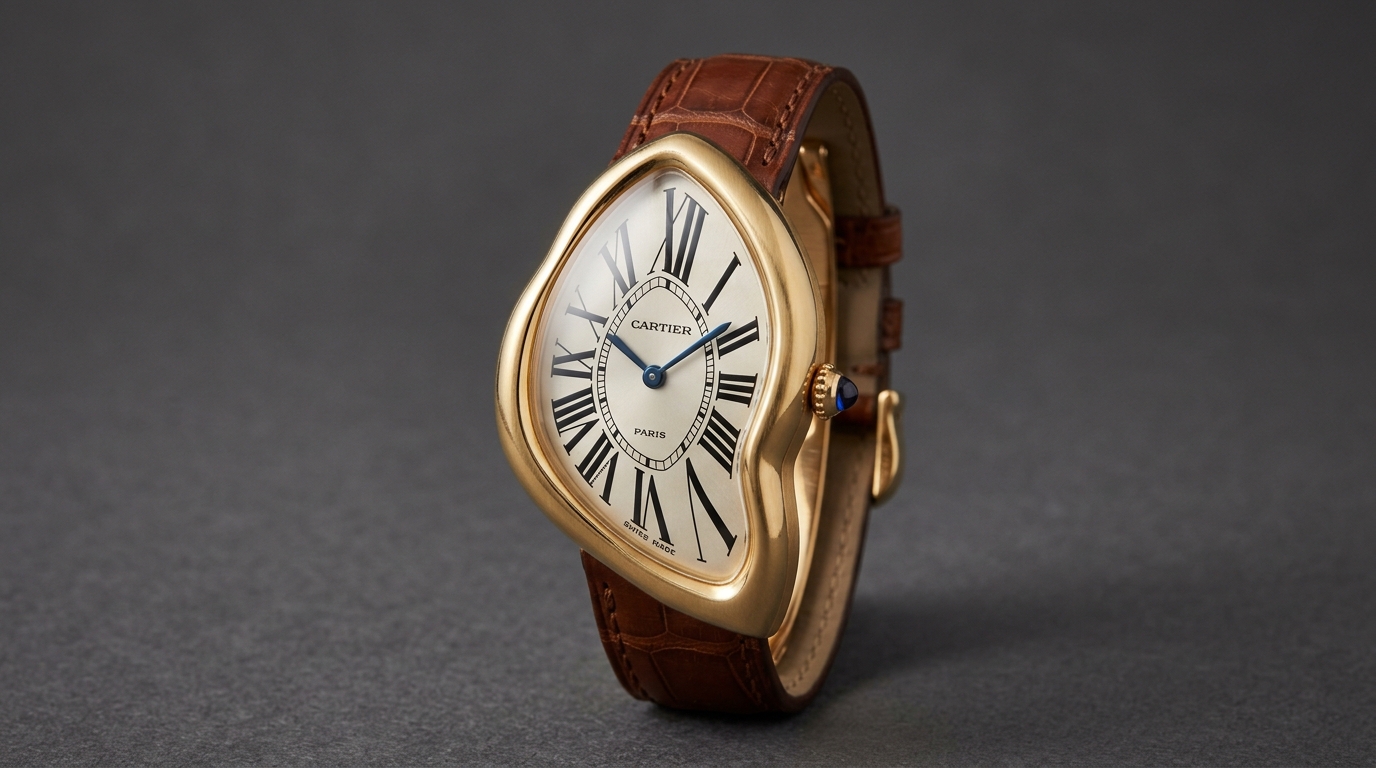
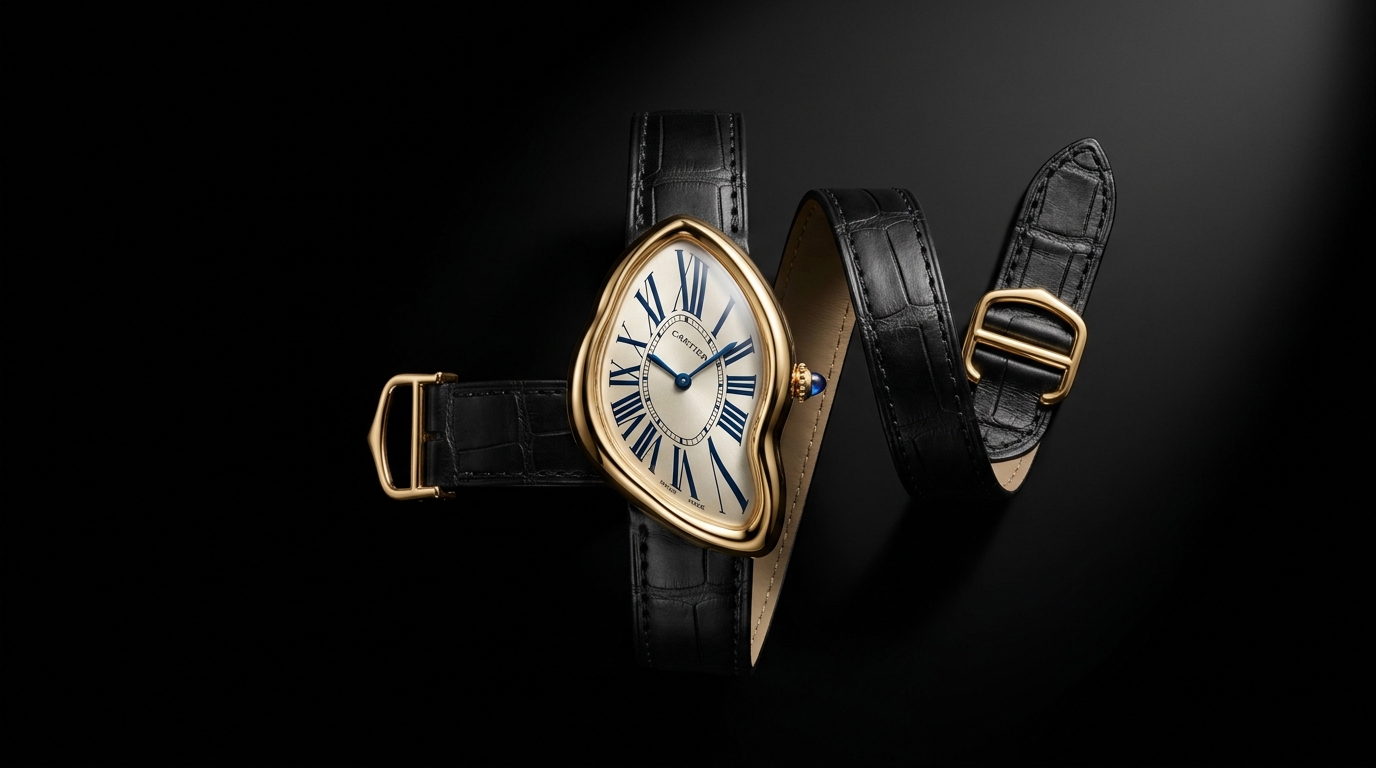
The key point is that the Crash is not simply an Oval gone soft. The asymmetry is controlled. The left flank swells and collapses; the right side twists around the crown; the lugs are not aligned conventionally, yet they are positioned to let the strap pull the watch into balance on the wrist. Early London examples are generally around 43 mm in length and roughly 25 mm across, depending on where the case is measured, because there is no useful “diameter” in the ordinary sense. Later reissues changed those relationships, sometimes subtly, sometimes decisively.
Design Codes: Distortion Held Under Tension
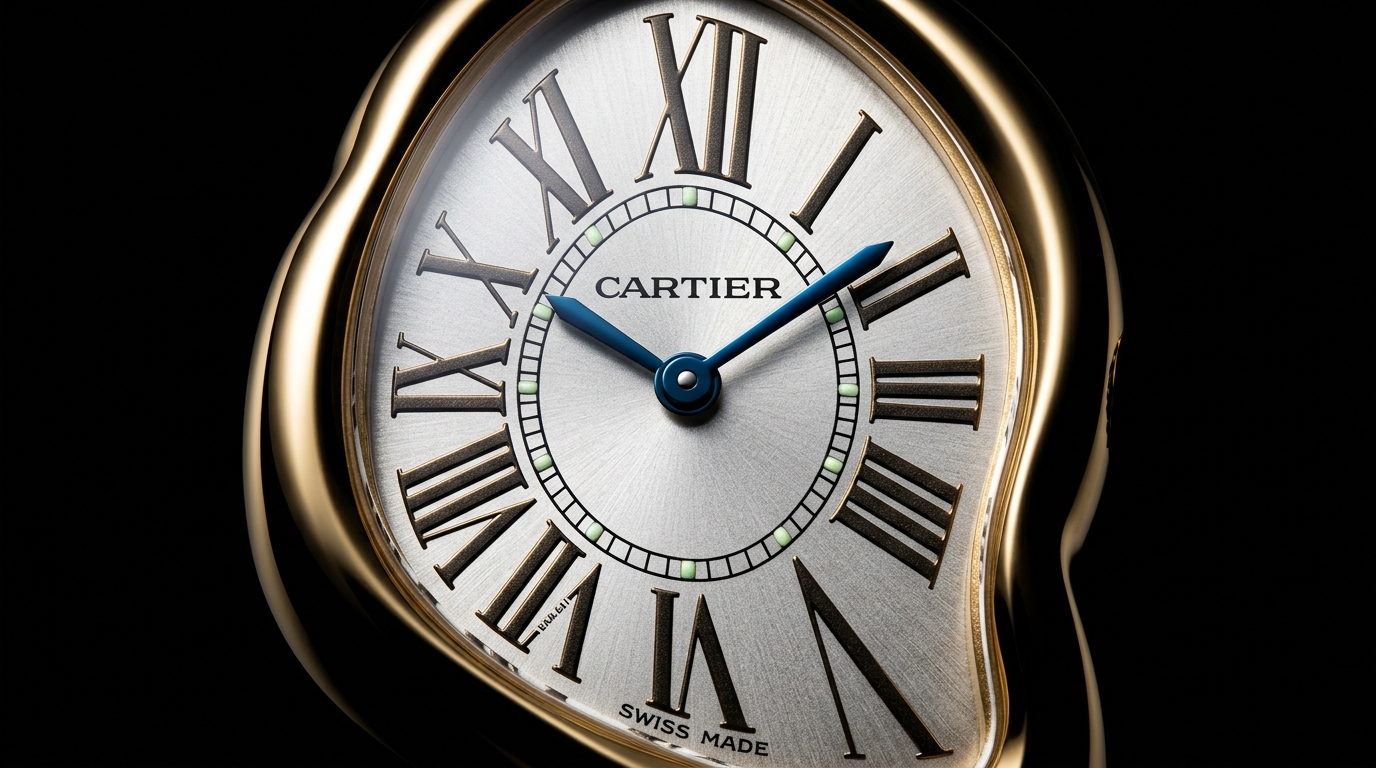
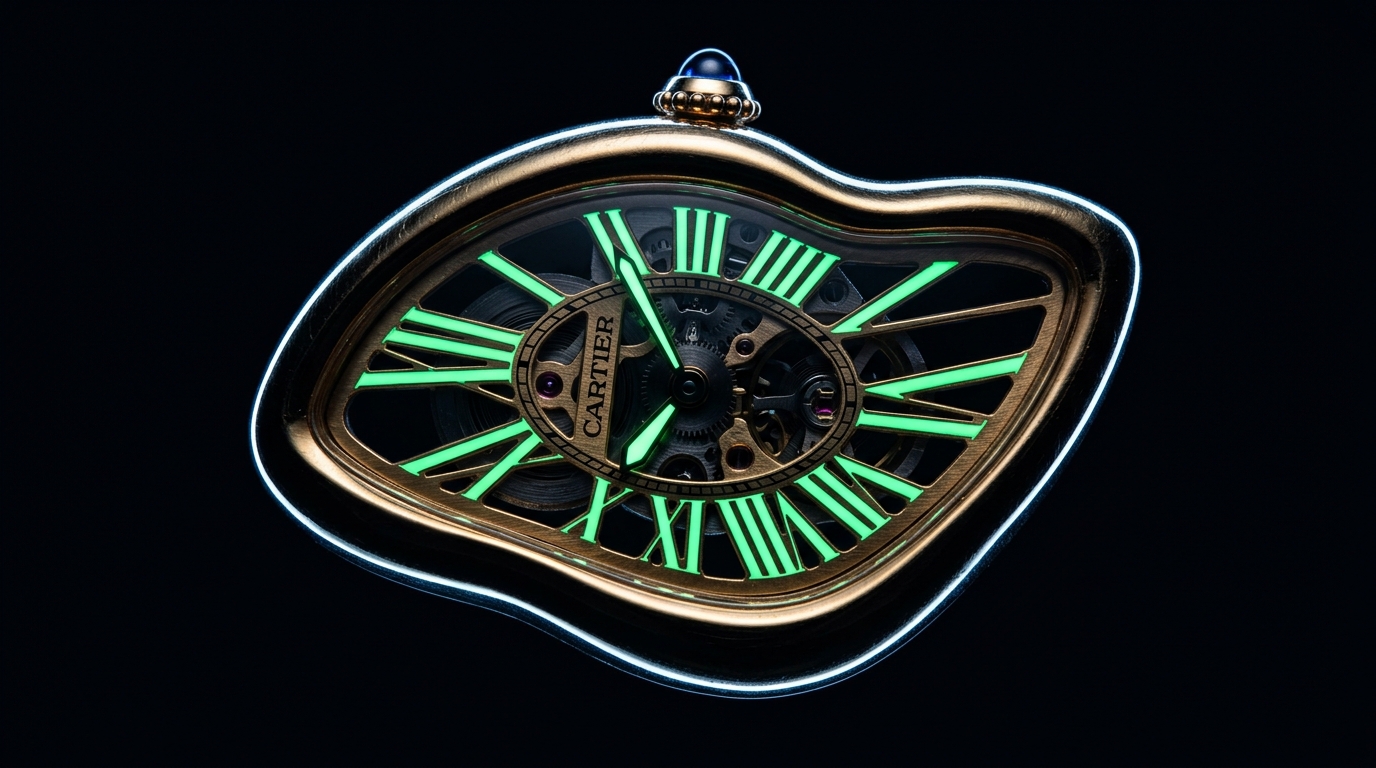
The Crash works because it preserves Cartier’s classical dial architecture while making the case appear to have suffered a private catastrophe. The stretched Roman numerals are not decorative afterthoughts. They perform the same job as the case: they imply motion while remaining legible enough to read as a watch rather than an illustration. The minute track follows the contour of the case and reinforces the impression that the dial has been pulled out of shape. Blued sword hands, where fitted, provide a sober counterpoint to the distorted dial.
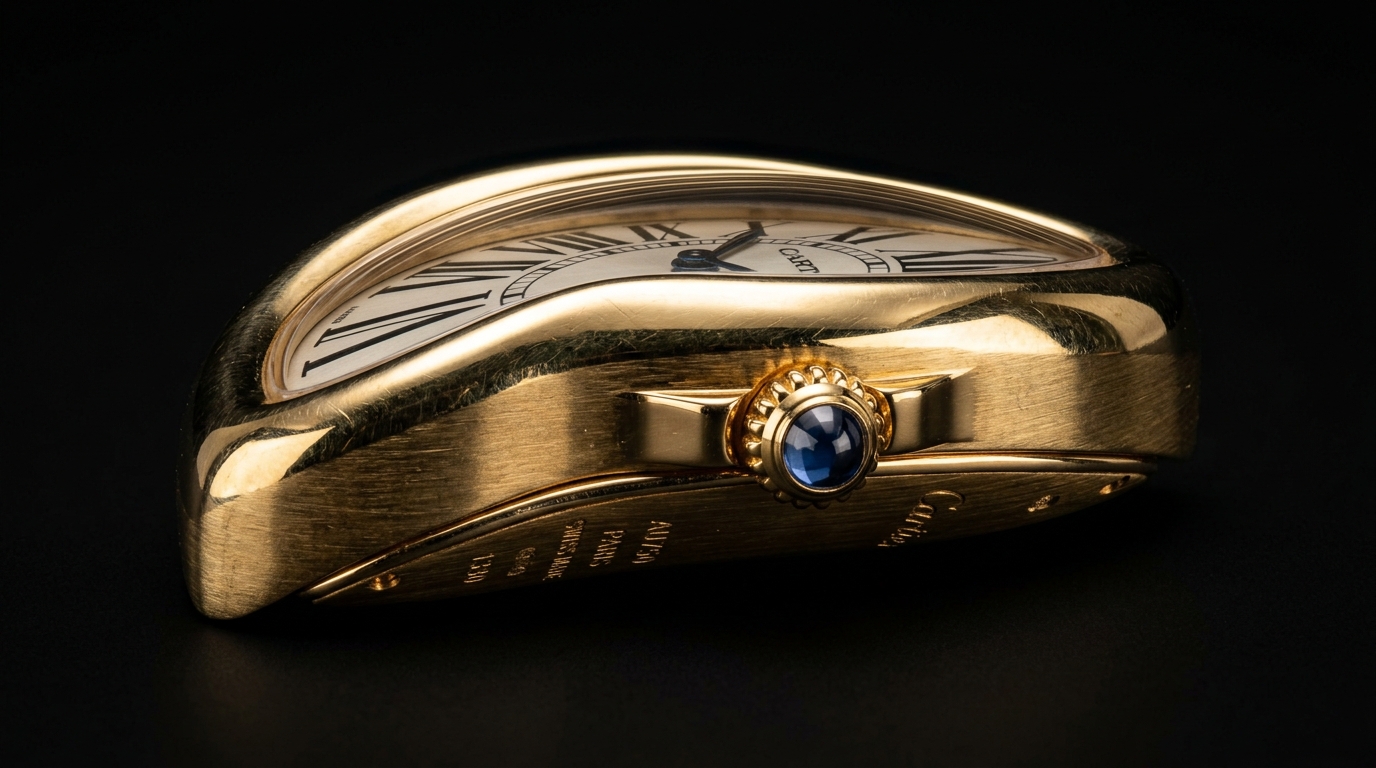
The crown is equally important. Cartier’s beaded crown with a blue sapphire cabochon normally signals order and symmetry, especially on the Tank Louis Cartier or Baignoire. On the Crash it sits at the edge of a deformed case, almost absurdly proper. That tension is central to the design. Remove the cabochon, simplify the dial, or make the case too large, and the watch loses the internal contradiction that makes the original compelling.
Collectors often focus on case outline because the Crash has been reinterpreted several times. The 1991 Paris limited edition, produced in yellow gold in 400 pieces, is one of the most important post-London versions. It is smaller and more regular than the earliest London watches, but historically significant because it reintroduced the model to a collector base that had largely seen the Crash as an obscure London oddity. The later Cartier Privé Crash of 2019, made in a limited edition of 67 pieces in yellow gold, used a case measuring approximately 38.5 mm by 25.5 mm and brought the watch into the modern high-collecting cycle. These watches are not substitutes for a 1960s London Crash, but they are legitimate chapters in the same line.
Movement and Finishing: The Case Is the Complication
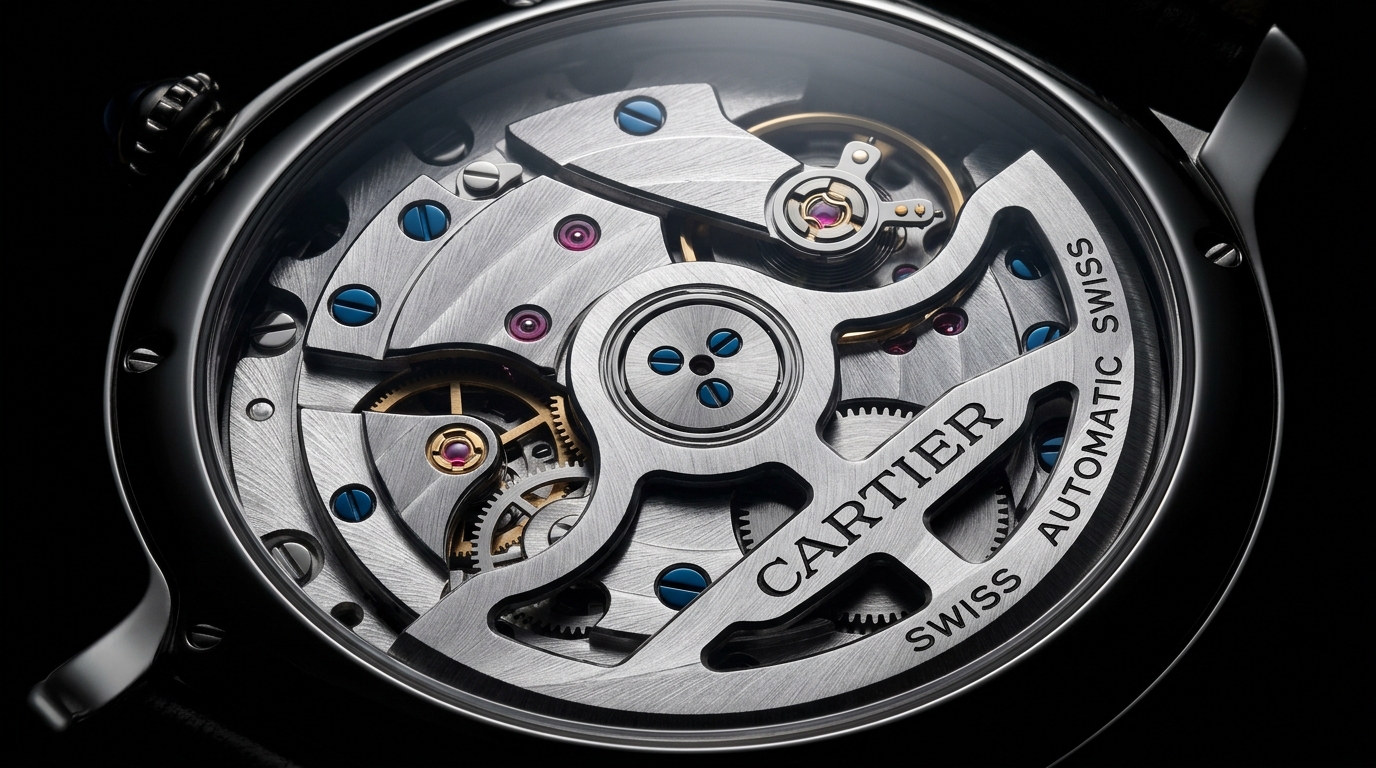
The Crash is often discussed as if the movement were irrelevant. That is too blunt, but the model does reverse normal collecting priorities. In an early London Crash, the mechanical movement is not the point of authorship in the way a Valjoux 72 defines a Daytona or a calibre 321 defines an early Speedmaster. The original watches used small hand-wound movements supplied through the Swiss network available to Cartier at the time, commonly associated with Jaeger-LeCoultre ébauches in Cartier production of the period. They were housed behind closed casebacks; the drama was on the wrist-facing side.
The 1991 Paris limited edition is commonly associated with Cartier’s hand-wound calibre 160, a small manually wound movement appropriate to the narrow case. The finishing should be judged for what it is: competent, discreet, and secondary. The movement is not a display calibre and does not pretend to be one. Cartier’s strategic choice was correct. A shaped watch as visually demanding as the Crash does not need a visible mechanical argument competing with the dial.
The modern Cartier Privé Crash uses the manual-winding calibre 8970 MC, a compact movement used by Cartier for shaped watches where thickness and reliability matter more than spectacle. It runs at 21,600 vibrations per hour and offers a power reserve of around 38 hours. Finishing is conventional for Cartier’s high-end, closed-back dress watches: clean bridges, striping, polished screw heads, and industrial precision rather than artisanal theatre. Again, that is appropriate. The Crash is a case-design achievement, not a movement-design achievement.
The exception is the Crash Skeleton, introduced in 2013 in platinum as part of Cartier’s Fine Watchmaking program. Its calibre 9618 MC was not merely placed inside the case; it was shaped and skeletonised to echo the Crash outline, with bridges forming distorted Roman numerals. The platinum version was limited to 67 pieces, a deliberate nod to 1967. It is a technically more ambitious watch than the closed-dial Crash, but also a different proposition. The skeleton version turns the Crash into a horological object. The classic Crash, especially in yellow gold with a white dial, remains closer to a design object that happens to tell time.
Proportions and Wearability: Smaller Than the Market Imagines
On paper, the Crash can sound long. In practice, it wears much smaller than its length suggests because the case is narrow and the lugs fall irregularly rather than extending like conventional horns. A 38.5 mm by 25.5 mm modern Crash does not behave like a 38.5 mm round watch. It behaves closer to a small elongated dress watch, with most of the visual weight concentrated in the gold case outline and distorted dial.
The original London proportions are more dramatic. The case has a more fluid, less regular distortion, and the spacing between dial, bezel, and lugs gives it a stronger hand-made character. This is part of the reason collectors pay such a premium for London-signed examples. The irregularity is not a defect; it is the evidence of the model’s origin. Modern production necessarily refines the object, and refinement can reduce danger.
The Crash is not a daily watch in the contemporary sports-watch sense. It is manually wound, precious-metal, usually fitted to a narrow leather strap, and visually assertive despite its modest dimensions. It sits best on the wrist when worn slightly loose, allowing the case to rotate just enough to emphasize its asymmetry. Too tight, and it becomes mannered. Too formal a strap can also flatten it. The watch needs texture and restraint around it because the case already carries the argument.
Legibility is adequate but not excellent. The distorted Roman numerals and warped minute track are readable once the eye adjusts, but nobody should pretend the Crash is more functional than a Tank. That limitation is acceptable because the design is honest about its priorities. The Crash does not disguise a utilitarian watch as art; it openly places form ahead of utility.
The Collector Market: Scarcity, Signature, and the Price of Authorship
The Crash’s market position changed dramatically between roughly 2018 and 2022. Before that, it was respected by Cartier specialists and shaped-watch collectors, but it was not the broad-market trophy it later became. The rise of Cartier collecting, the fatigue around steel sports watches, and the increasing sophistication of younger collectors all contributed to a reassessment. The Crash benefited more than almost any other Cartier model because it offered rarity, recognisability, and genuine design authorship in one object.
London-signed examples are the top of the hierarchy. Their rarity, period production, and direct link to Jean-Jacques Cartier’s London workshop place them in a different category from later reissues. Public auction results have reflected that. In 2022, a 1967 Cartier London Crash sold through Loupe This for more than US$1.5 million, confirming what the private market had already understood: the best Crash watches were no longer simply vintage Cartier curiosities. They had entered the same collecting conversation as important Patek Philippe, Rolex, and Audemars Piguet references, though for entirely different reasons.
The 1991 Paris limited edition of 400 pieces occupies the next important tier. It is not as rare or as historically immediate as the London watch, but it has become the most legible vintage-period alternative for collectors who want a closed-dial Crash with direct Cartier production history. The 2019 Cartier Privé edition of 67 pieces brought a younger collector base into the model and is now treated as a modern benchmark, particularly because Cartier has avoided turning the Crash into a standard catalogue object.
Condition is unusually difficult to assess. On a conventional round watch, polishing can often be judged by lug thickness and bezel definition. On the Crash, the entire case is contour. A softened edge, overbright polish, or distorted lug transition can change the character of the watch. Dials also require careful scrutiny: printing quality, signature placement, the stretched chemin-de-fer track, and the relationship between numerals and case opening are all material to value. A Crash is one of the few watches where a millimetre of proportion can be a five- or six-figure issue.
Why the Crash Endures
The Crash endures because it occupies a rare position: it is radical without being illegible as Cartier. Many avant-garde watches age poorly because they depend on novelty. The Crash depends on distortion of an established code. Its source language is stable — Roman numerals, gold case, cabochon crown, dress-watch scale — so the deformation remains intelligible decade after decade.
It also endures because it cannot be easily democratized without losing the point. Cartier has been disciplined, perhaps more disciplined than the market would like, in keeping the Crash scarce. That restraint protects the model. A large regular-production Crash in steel, quartz, or oversized format would almost certainly sell, but it would weaken the intellectual structure of the watch. The Crash needs precious metal, limited production, and slight impracticality. Those qualities are not incidental; they are part of the design’s credibility.
The comparison often made is to Salvador Dalí’s melting clocks, but that reference is too easy and not especially useful. The Crash is less surrealist painting than London workshop object. Its success lies in the fact that it remains a watch: wound by hand, strapped to the wrist, read through hands and numerals, governed by Cartier’s formal vocabulary. It is not a joke about time. It is a controlled failure of symmetry.
The editorial verdict is straightforward. The Cartier Crash is one of the most important shaped watches of the twentieth century, but not every Crash carries equal weight. The original London watches are the purest expression and the market is right to treat them as such. The 1991 Paris edition is historically meaningful and increasingly central to serious collections. The 2019 Cartier Privé version is the strongest modern closed-dial interpretation, while the Skeleton is best understood as a parallel technical exercise rather than a replacement.
What should be resisted is the lazy idea that the Crash is valuable merely because it is unusual. Many unusual watches are trivial. The Crash matters because its irregularity is disciplined, its lineage is specific, and its best executions preserve the tension between Cartier classicism and formal collapse. That is why the model has moved from insider curiosity to auction headline without becoming conceptually exhausted. In a market often obsessed with specifications, the Crash remains a reminder that proportion, authorship, and restraint can be more decisive than complication.