Audemars Piguet Royal Oak Perpetual Calendar 26574ST: The Steel QP That Reframed the Modern Royal Oak

Audemars Piguet Royal Oak Perpetual Calendar 26574ST: The Steel QP That Reframed the Modern Royal Oak
The Audemars Piguet Royal Oak Perpetual Calendar 26574ST is not important because it is a complicated Royal Oak. Audemars Piguet had been making those for decades. It matters because, in 2015, it clarified where the modern Royal Oak was heading: larger, technically confident, overtly collectible, and still disciplined enough to keep the 1972 design from becoming mere luxury theatre. In stainless steel, at 41 mm and only 9.5 mm thick, reference 26574ST took one of the manufacture’s most historically significant complications and placed it inside the most commercially powerful case shape in contemporary watchmaking.
That combination sounds obvious now. It was not. The Royal Oak perpetual calendar sits at the intersection of two Audemars Piguet identities: the Gerald Genta-designed sports watch that changed the category in 1972, and the ultra-thin automatic perpetual calendar tradition that helped the company navigate the quartz crisis. Reference 26574ST is where those two lines converged in a format suited to the post-2010 collector market.
Origin: a 2015 watch with 1970s and 1980s DNA
Audemars Piguet introduced the Royal Oak in 1972 as reference 5402ST, a 39 mm stainless-steel watch powered by the calibre 2121, itself derived from the Jaeger-LeCoultre 920 ébauche family used by Audemars Piguet, Patek Philippe, and Vacheron Constantin. The essential Royal Oak grammar was there from the beginning: octagonal bezel, exposed hexagonal screws, integrated bracelet, hard transitions between brushed planes and polished bevels, and a case profile thin enough to keep the aggressive geometry elegant rather than heavy.
The perpetual calendar story is equally important. In 1978, Audemars Piguet launched an ultra-thin self-winding perpetual calendar calibre, the 2120/2800, based on the same family of extra-thin automatic movements. That movement was strategically decisive. At a moment when mechanical watchmaking was under pressure from quartz, Audemars Piguet leaned into high complication, thinness, and traditional finishing rather than competing on accuracy or price. The Royal Oak perpetual calendar arrived in the 1980s, most famously through references such as the 25554 and later 25820, where the complication was housed in the Royal Oak architecture without abandoning slenderness.
Reference 26574ST, launched at SIHH 2015, is the modern expression of that lineage. It replaced the relative modesty of the 39 mm perpetual calendar with a 41 mm case and introduced calibre 5134, an automatic perpetual calendar movement adapted from Audemars Piguet’s ultra-thin base architecture. The watch was not a nostalgic reissue of the earlier 39 mm pieces. It was a deliberate scaling-up of the Royal Oak perpetual calendar for a market that had begun to treat complicated steel sports watches as apex collecting territory.
Case and proportions: 41 mm, but the thickness is the point
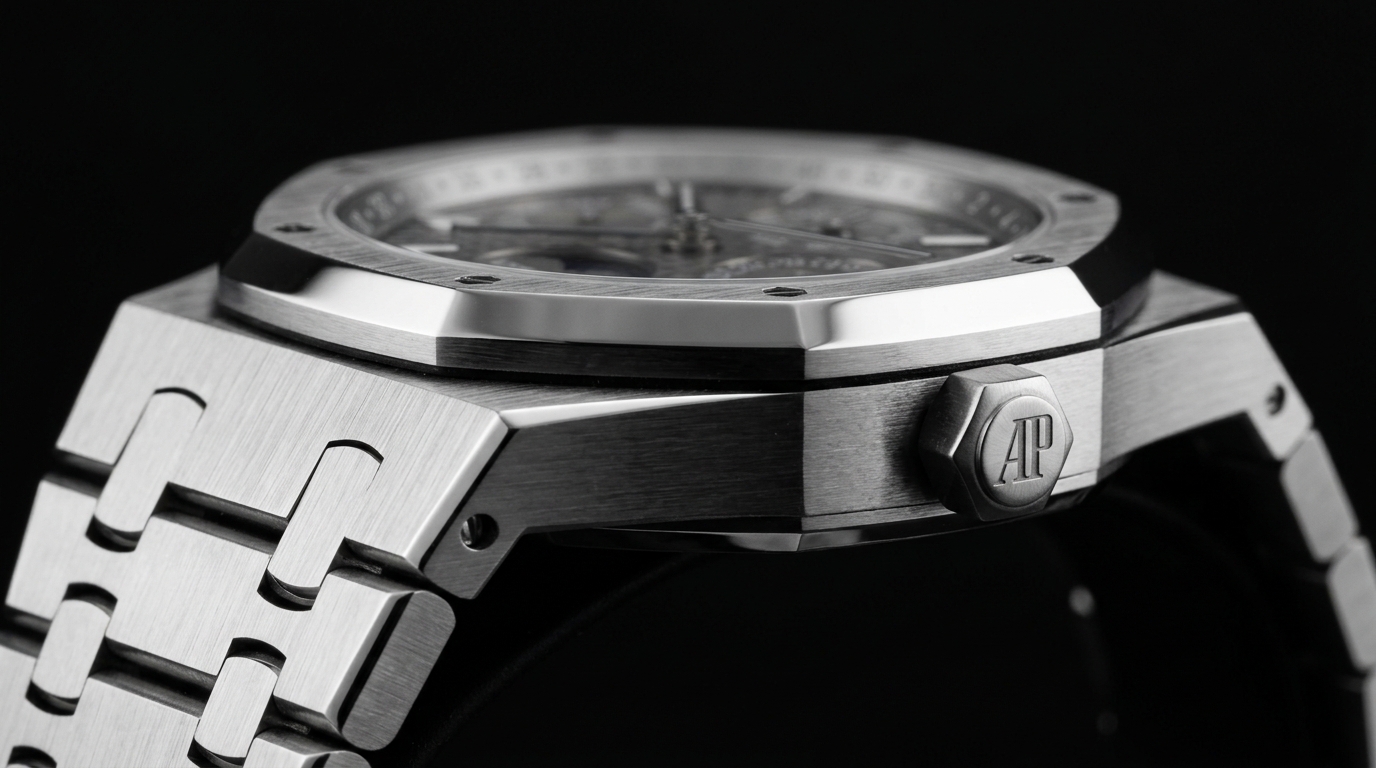
The 26574ST measures 41 mm in diameter and approximately 9.5 mm thick. Those two figures must be read together. A 41 mm Royal Oak can wear assertively because the integrated bracelet and broad case shoulders extend the visual footprint beyond the nominal diameter. But at under 10 mm thick, the 26574ST avoids the slab-like presence that compromises many modern complicated sports watches. It is broad, not bulky.
The stainless-steel case follows the established Royal Oak construction: octagonal bezel, eight white-gold hexagonal screws, a brushed top surface, mirror-polished bevels, and sharply stepped case flanks. The bracelet is central to the watch rather than an accessory. Each link continues the same contrast of satin brushing and polished chamfering, and the taper helps the case settle rather than dominate. This is one reason the 26574ST wears better than its specification suggests. The geometry is large, but the mass is visually distributed through the bracelet.
The 20-metre water-resistance rating is the watch’s least convincing practical specification. No serious owner is buying a perpetual calendar Royal Oak as a marine instrument, but the limitation matters because the case language still borrows from the steel sports-watch category. The 26574ST is a luxury complication in sports-watch clothing, not a watch built for actual sporting use. That tension is part of its appeal, but it should not be ignored.
The dial: Royal Oak architecture applied to a full calendar display
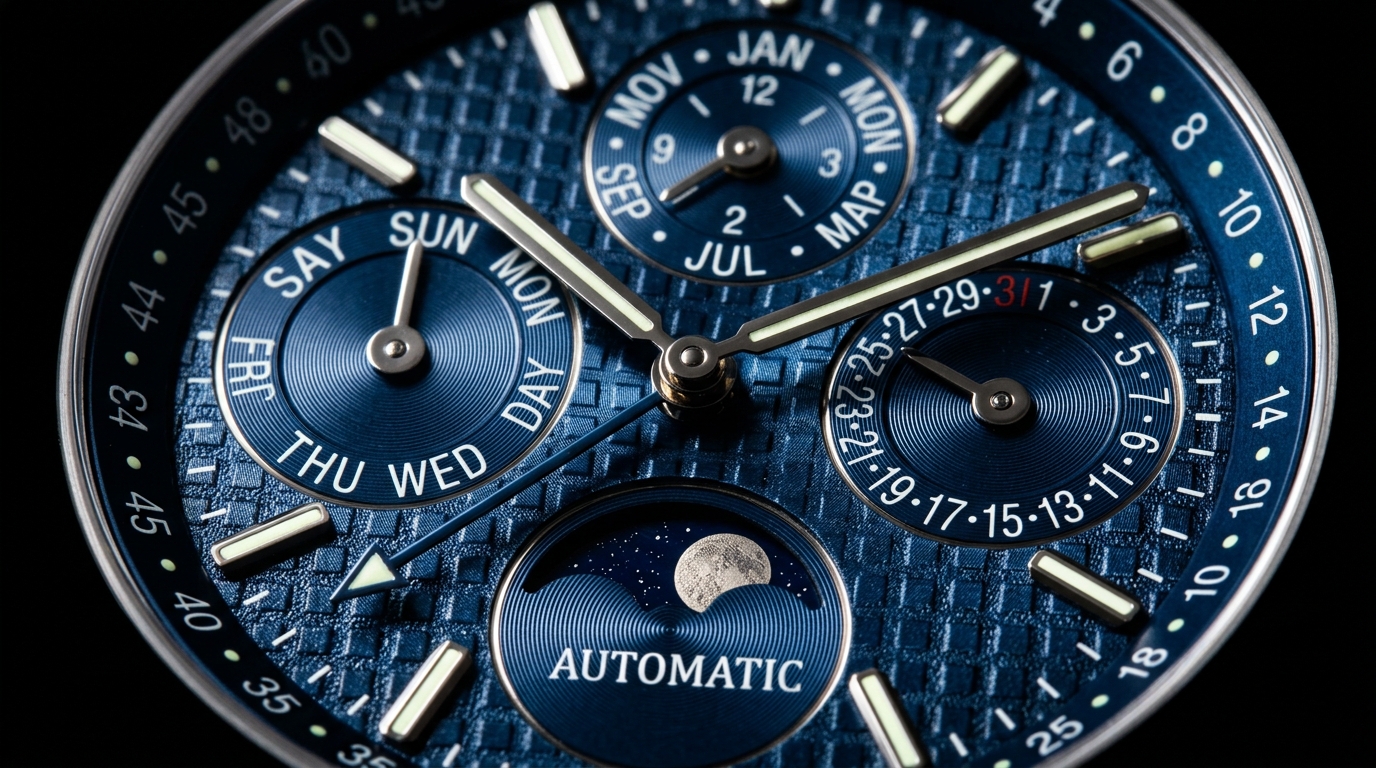
The most recognisable version is reference 26574ST.OO.1220ST.01, with the blue Grande Tapisserie dial. Other dial executions exist within the 26574ST family, but the blue steel model is the one most closely associated with the reference. The dial layout is classical perpetual calendar logic adapted to the Royal Oak grid. Day is at 9 o’clock, date at 3 o’clock, month and leap year at 12 o’clock, and the moon-phase display sits at 6 o’clock. Around the outer perimeter is a week-of-the-year scale, indicated by a central hand.
That week indication is not decorative. It changes the dial’s meaning. Many perpetual calendars are legible primarily as month-date-day instruments, with leap year tucked away as a technical necessity. The 26574ST turns the dial into a more complete civil calendar display. The consequence is density. There is no pretending this is an austere watch. Between the four sub-dials, moon phase, central hands, week scale, applied baton markers, and the textured tapisserie surface, the 26574ST asks the eye to work.
That density is handled better than it has any right to be. The sub-dials are recessed cleanly into the tapisserie field, the hands are thin enough not to obscure the indications, and the white printing against the blue dial keeps the information hierarchy clear. Still, this is not as serene as the earlier 39 mm Royal Oak perpetual references. The 26574ST belongs to a different era: more assertive, more legible at a glance, and more willing to show complication as presence.
Calibre 5134: the old ultra-thin idea, made modern
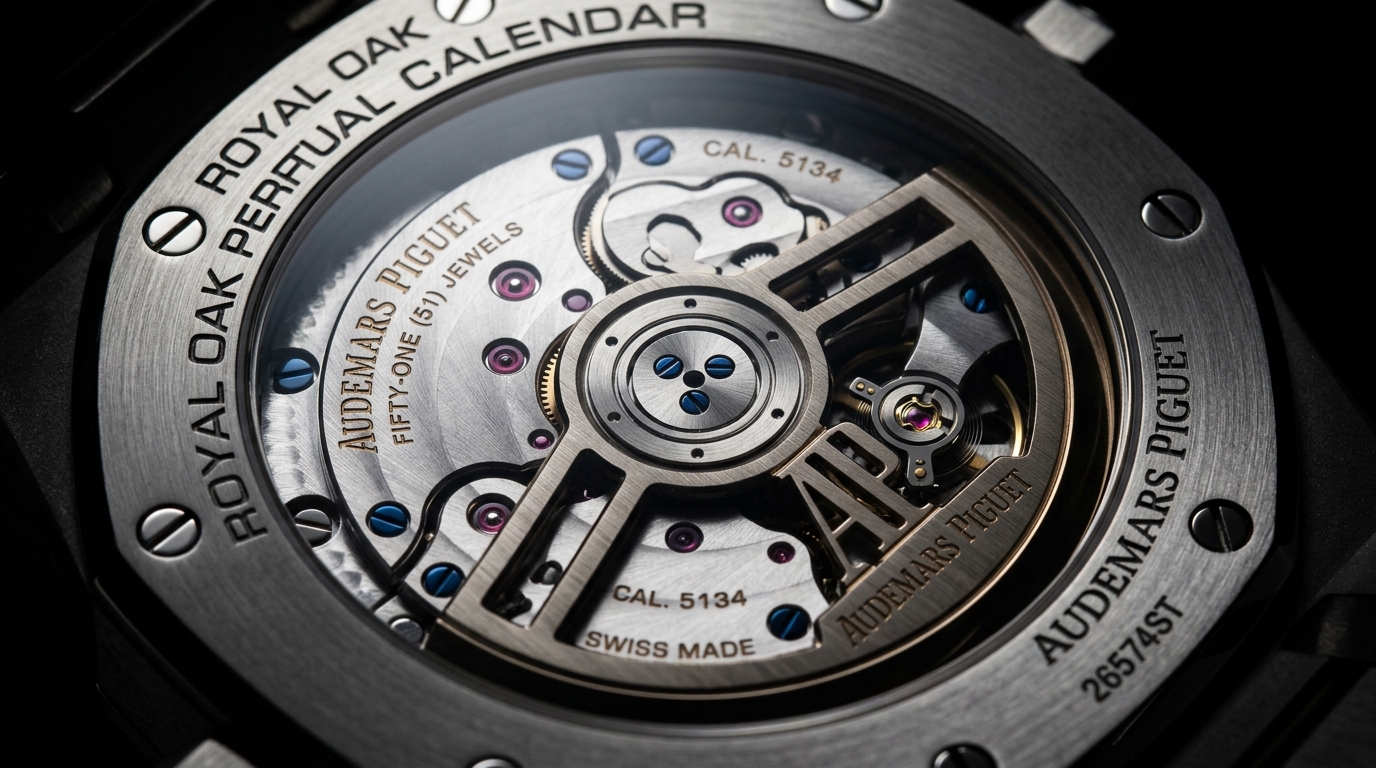
Inside the 26574ST is Audemars Piguet calibre 5134, an automatic perpetual calendar movement measuring approximately 4.31 mm thick. It runs at 19,800 vibrations per hour, uses 38 jewels, contains 374 components, and offers a power reserve of about 40 hours. The architecture descends from the manufacture’s ultra-thin automatic perpetual calendar lineage rather than from a modern high-frequency industrial base movement. That matters because the watch’s thin case is not achieved by reducing the complication to a novelty module. It is the result of a long-standing thin automatic perpetual calendar architecture.
The movement displays hours, minutes, day, date, month, astronomical moon phase, leap year, and week number. Corrections are made through recessed correctors in the case, the traditional solution for a perpetual calendar of this type. It is not as user-friendly as a crown-operated annual calendar or modern system with integrated safety mechanisms, and owners who allow the watch to stop will need either patience or a watchmaker’s caution. But the 26574ST was never intended to democratise the perpetual calendar. It preserves the ritual, including the inconveniences.
Finishing is visible through the sapphire caseback: Geneva stripes, perlage, polished bevels, circular graining, and a 22-carat gold rotor. Audemars Piguet’s movement finishing at this level is precise and attractive, though it should be judged realistically. The calibre is not finished with the overt artisanal flamboyance one expects from independent haute horlogerie, nor does it try to be. The appeal is architectural thinness, heritage, and disciplined industrial haute horlogerie finishing. On those terms, calibre 5134 is exactly the right engine for this reference.

How it wears: more assertive than elegant, but not oversized
The 26574ST is sometimes described as a large Royal Oak perpetual calendar, which is true but incomplete. The better description is that it is a wide and thin Royal Oak perpetual calendar. The 41 mm case gives the bezel, tapisserie dial, and calendar registers more breathing room than the older 39 mm models, while the 9.5 mm thickness keeps the watch close to the wrist. The integrated bracelet does not pull the case downward like a leather strap would; it spreads the watch across the wrist, which can be either flattering or unforgiving depending on wrist shape.
On wrists below about 17 cm, the 26574ST can feel broad. On average to larger wrists, it has the presence collectors associate with the modern Royal Oak without the thickness penalty of many complicated watches. This is the key wearing argument for the reference. It offers a full perpetual calendar, central week indication, automatic winding, and steel bracelet construction in a profile thinner than many simple sports watches.
The bracelet finishing also changes the wearing experience. The Royal Oak bracelet catches light aggressively because every link includes alternating brushed surfaces and polished edges. On the 26574ST, that visual energy competes with an already information-rich dial. This is not a discreet perpetual calendar in the Patek Philippe 3940 sense. It is a public, architectural, steel perpetual calendar. That is either the point or the problem, depending on the collector.
Market position: the steel complication before the market overheated
When the 26574ST arrived in 2015, the market had not yet reached the full speculative intensity that would define steel integrated-bracelet watches from roughly 2018 to 2022. Its retail price was in the region of the low-to-mid US$60,000 range, expensive but coherent for a steel Royal Oak perpetual calendar with an ultra-thin automatic movement. In the years that followed, the reference became a beneficiary of three overlapping trends: the surge in Royal Oak demand, the rise of complicated steel sports watches, and the scarcity model around Audemars Piguet allocations.
Secondary-market pricing moved well beyond retail during the peak period of 2021 and early 2022, with blue-dial steel examples commanding substantial premiums. The subsequent correction brought prices down from the most speculative levels, but the 26574ST has generally remained a six-figure watch in strong condition with box and papers. That persistence is revealing. Many Royal Oak references rose because they were Royal Oaks. The 26574ST retained collector focus because it combined the Royal Oak case with one of Audemars Piguet’s defining complications.
Its competitive set is narrow. Patek Philippe’s Nautilus Perpetual Calendar 5740/1G, introduced in 2018, is white gold rather than steel and uses calibre 240 Q. Vacheron Constantin’s Overseas Perpetual Calendar Ultra-Thin occupies a related integrated-bracelet complication space, but again largely in precious metal. Within Audemars Piguet’s own catalogue, the ceramic Royal Oak Perpetual Calendar 26579CE and later openworked or ceramic variants attract a different collector: one drawn to material innovation and visual drama. The 26574ST remains the more foundational watch because stainless steel is historically central to the Royal Oak idea.
Why collectors keep returning to reference 26574ST
The collector appeal of the 26574ST is not merely scarcity. It has a stronger argument than that. The watch connects the 1972 Royal Oak, the 1978 ultra-thin automatic perpetual calendar, the 1980s Royal Oak perpetual references, and the modern era of integrated-bracelet collecting. Few references carry that much Audemars Piguet history without becoming self-consciously archival.
It also lands at an important point in the Royal Oak timeline. The 26574ST predates the brand’s more recent emphasis on ever more graphic materials, openworking, ceramic cases, and high-impact limited editions. It is modern, but not maximalist. Its dial is complex, but not theatrical. Its case is larger than purists would prefer, but the thin profile preserves the essential Royal Oak discipline. In that sense, it is one of the last Royal Oak complications that feels both contemporary and directly connected to the original design logic.
The weaknesses are real. The 41 mm case will not satisfy collectors who believe the Royal Oak’s ideal proportion is 39 mm. The dial is busy. The water resistance is modest. The movement’s 40-hour power reserve feels short by current expectations, particularly for a perpetual calendar that is inconvenient to reset. None of those issues is fatal, but they prevent the 26574ST from being a perfect watch. More importantly, they keep it intellectually interesting. It is not a generic trophy object; it is a watch with trade-offs rooted in lineage and design choices.

The editorial view: the definitive modern steel Royal Oak perpetual calendar
The Audemars Piguet Royal Oak Perpetual Calendar 26574ST endures because it is not just another desirable Royal Oak reference. It is a structurally important model: steel case, integrated bracelet, 41 mm modern proportions, calibre 5134, full perpetual calendar, week indication, and a profile thin enough to honour the lineage from which it came. It marks the moment when Audemars Piguet translated its historic perpetual calendar expertise into the dominant collecting language of the 2010s.
There are more restrained Royal Oak perpetual calendars. There are more spectacular ones. The 25820 has stronger vintage-adjacent proportions; the 26579CE black ceramic has greater material drama; the openworked references offer more visual theatre. But the 26574ST is the clearest statement of the modern steel Royal Oak perpetual calendar as a complete proposition. It is complicated without being exotic, assertive without being oversized, and historically grounded without being nostalgic.
That is why reference 26574ST remains one of the most consequential Royal Oak models of the last decade. It did not invent the Royal Oak perpetual calendar, and it did not invent the ultra-thin automatic QP. Its achievement was more specific and more valuable: it made both traditions legible to a new generation of collectors without severing the link to Audemars Piguet’s most important technical and design histories.