MB&F Legacy Machine Perpetual: The Perpetual Calendar Rebuilt From First Principles
MB&F Legacy Machine Perpetual: The Perpetual Calendar Rebuilt From First Principles
Most perpetual calendars are conservative machines wearing ambitious dials. They calculate the irregularity of the Gregorian calendar through mechanisms that largely descend from a 31-day assumption, then correct the surplus days with levers, cams and compromises. The MB&F Legacy Machine Perpetual, introduced in 2015, matters because it did not merely repackage that tradition under a domed sapphire crystal. It challenged the architecture itself. For a watch that looks theatrical at first glance, its lasting significance is mechanical, not cosmetic.
Origin: A Legacy Machine With A Real Reason To Exist
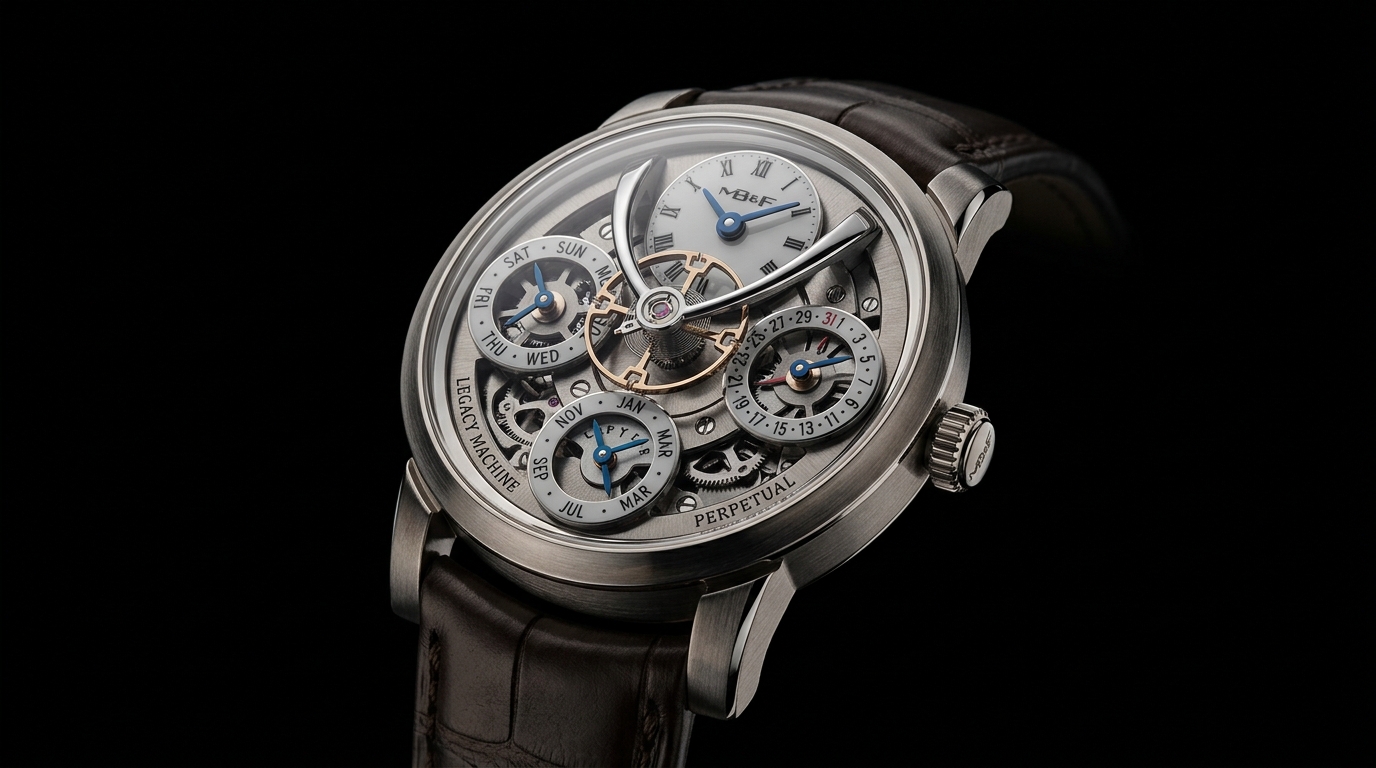
The Legacy Machine Perpetual sits within MB&F’s Legacy Machine family, the round-cased line that began with the LM1 in 2011 after years of more overtly science-fictional Horological Machines. The Legacy Machines asked a deliberately counterfactual question: what would MB&F have made if it had existed during the high pocket-watch era? The answer was not nostalgia in the conventional Swiss sense, but a classical case, a domed crystal, lacquered sub-dials, broad polished bridges, and a large balance wheel suspended above the dial.
By 2015 that design language had already been established through the LM1, LM2 and LM101. The LM Perpetual needed more than a floating balance to justify itself. MB&F, led by Max Büsser, turned to Northern Irish watchmaker Stephen McDonnell, who developed a new perpetual calendar calibre specifically for the project. The first editions were launched in 18k red gold and platinum, each limited to 25 pieces, with the watch measuring 44 mm in diameter and approximately 17.5 mm thick. Later executions in white gold, titanium and yellow gold broadened the material palette, but the essential watch remained the 2015 concept: a fully integrated perpetual calendar designed around a new mechanical logic.
That distinction is important. Many perpetual calendars, including respected references from Patek Philippe, Vacheron Constantin and Audemars Piguet, are built either as modules over base calibres or as traditional integrated calendars using inherited switching systems. The Legacy Machine Perpetual was not trying to become a thinner, more discreet alternative to a Patek Philippe 3940 or 5140. It was attempting to solve a different problem: the vulnerability and awkwardness embedded in the classic perpetual calendar mechanism.
The McDonnell Architecture: 28 Days First, Not 31
The essential mechanical idea is simple to state and difficult to execute. A conventional perpetual calendar generally treats each month as if it has 31 days, then advances past redundant dates at the end of shorter months. February becomes a special case requiring additional intervention, and the whole system depends on precisely timed levers and cams. McDonnell inverted the premise. The LM Perpetual assumes that every month has 28 days and then adds the required extra days according to the month and leap-year cycle.
MB&F described the system as a “mechanical processor”, and for once the phrase is not empty branding. The processor sits at the heart of the calibre and coordinates the day, date, month and leap-year displays. Its purpose is not simply to indicate information, but to prevent the calendar from entering mechanically unsafe states. The watch incorporates security systems that disengage the quickset pushers during the changeover period, reducing the risk of damage if an owner attempts to adjust the calendar at the wrong time. This is not a minor convenience; calendar damage from ill-timed correction is one of the most common ownership anxieties with traditional perpetual calendars.
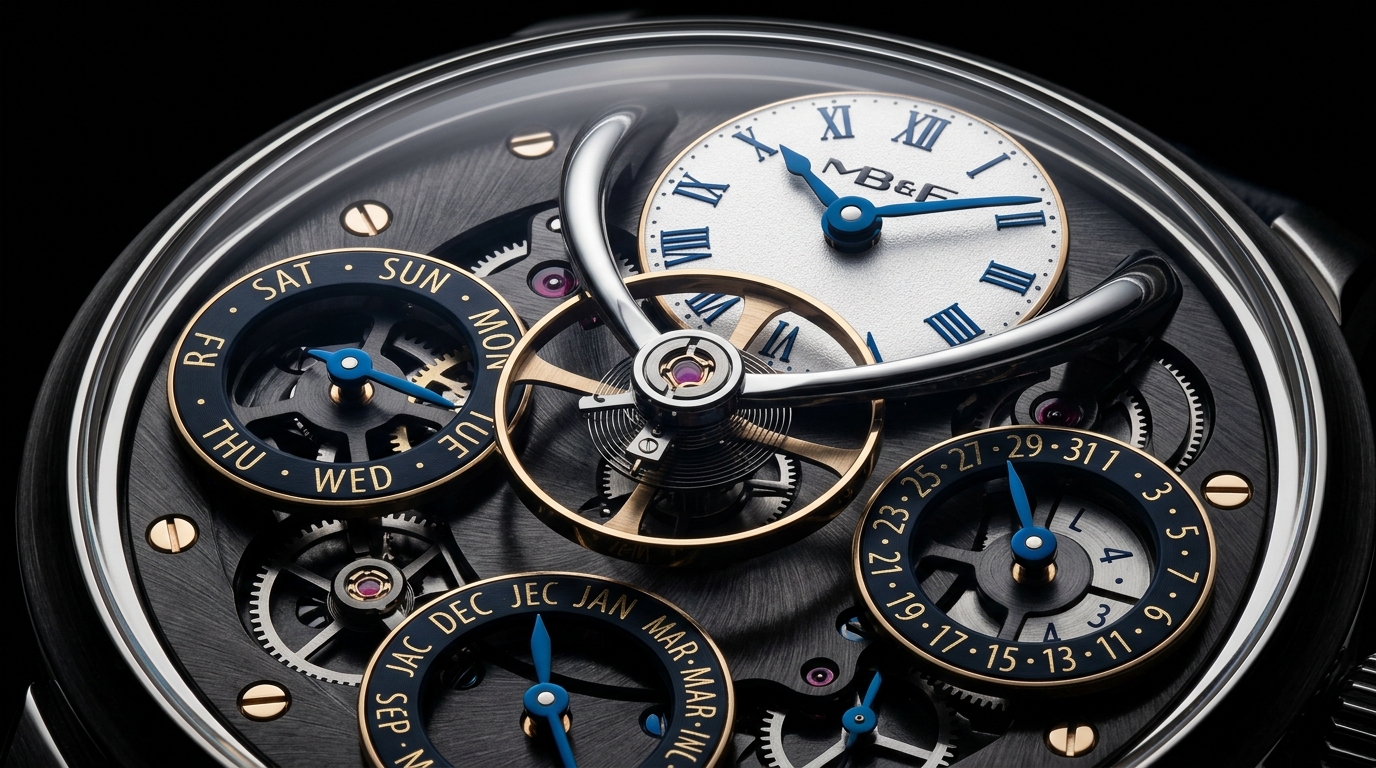
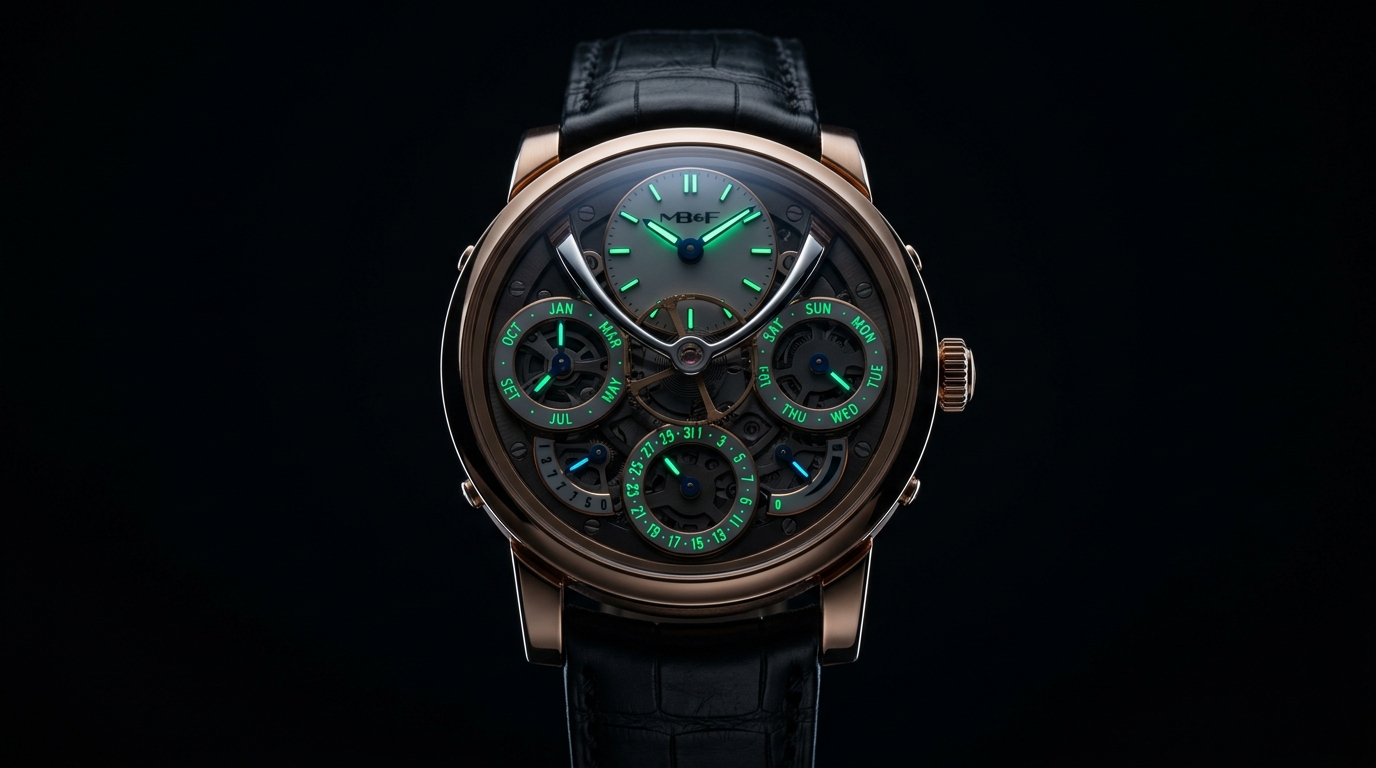
The display is arranged across the dial with hours and minutes at 12 o’clock, day at 3 o’clock, month at 6 o’clock, date at 9 o’clock, a retrograde leap-year indication around 7 o’clock, and a power-reserve indication between roughly 4 and 5 o’clock. The layout could easily have become illegible, especially under a suspended balance wheel. Instead, MB&F uses raised sub-dials and open negative space to make the system readable. It is busy, but not chaotic; the complication is exposed without becoming a skeletonised diagram for its own sake.
Calibre: Manual, Integrated, And Intentionally Visible
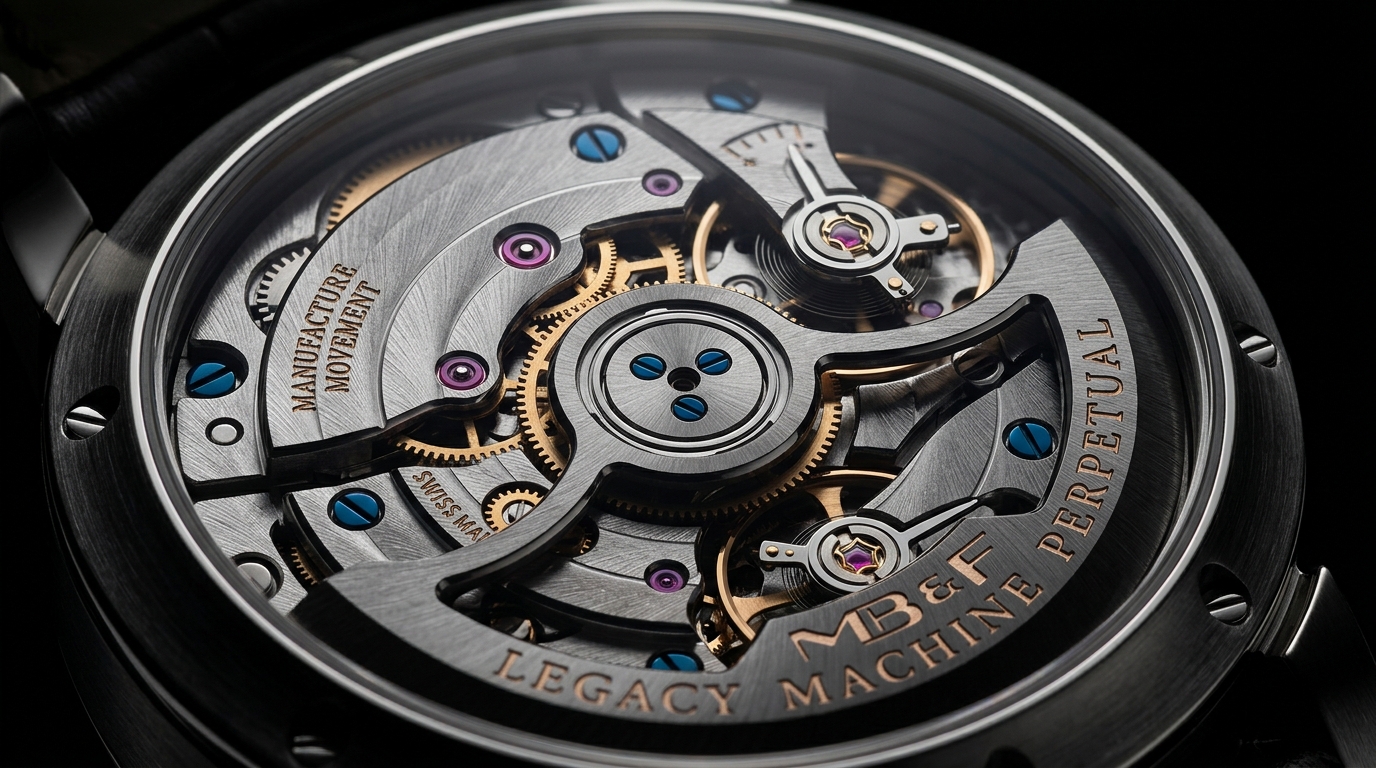
The LM Perpetual calibre is manually wound and comprises 581 components. It uses 41 jewels, runs at 18,000 vibrations per hour, and provides approximately 72 hours of power reserve from twin barrels. Those figures are not incidental. The lower 2.5 Hz frequency suits the visual rhythm of the large balance wheel, while the three-day autonomy is practical for a watch whose calendar should ideally be kept running. The balance, around 14 mm in diameter, is suspended above the dial by a polished arched bridge, making the regulating organ the visual centre of the watch rather than something hidden behind the movement.
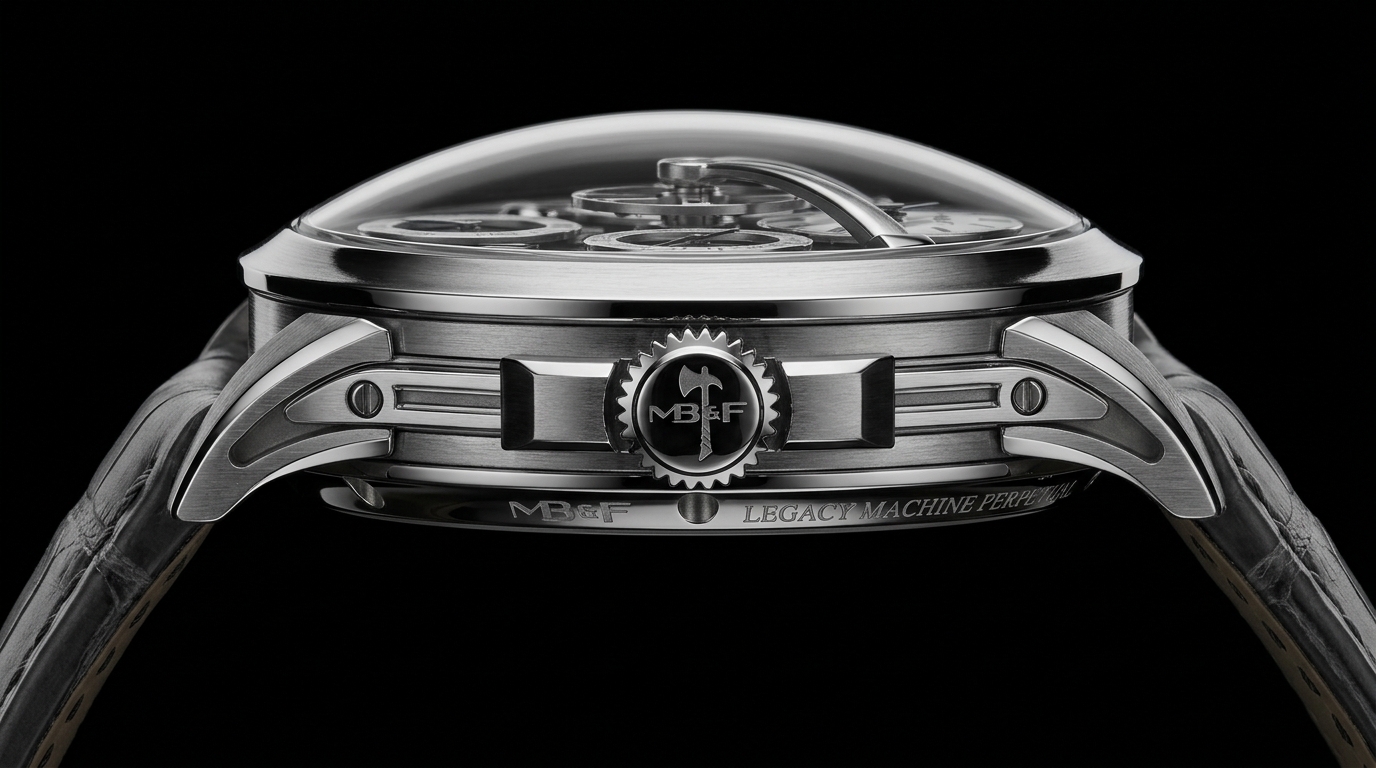
This architecture also explains the watch’s thickness. At about 17.5 mm, the LM Perpetual is not pretending to be an ultra-thin dress watch. The domed sapphire crystal is not decorative excess; it creates the vertical space required for the flying balance and layered indications. The case is 44 mm, large by classical perpetual-calendar standards, but close to inevitable given the dial architecture and movement diameter. The watch should be judged against other independent high complications rather than against a slim 36 mm perpetual calendar from the late twentieth century.
Finishing is serious, though not the only point of the watch. The movement visible through the sapphire back is decorated with Geneva waves, polished bevels, countersinks, gold chatons and hand-finished steel components. There are internal angles and polished surfaces that reward inspection, but the calibre’s value is more architectural than artisanal in the Philippe Dufour sense. That is not a criticism. The LM Perpetual is strongest when understood as an engineered calendar system with high-level finishing, rather than as a finishing exercise with a complication attached.
Design Codes: Classical Vocabulary, Independent Grammar
The Legacy Machine Perpetual uses familiar watchmaking language but refuses to speak it politely. The round case, stepped bezel, white lacquered sub-dials and Roman numerals on some editions all refer to traditional horology. Yet the watch does not read as retro. The suspended balance makes the dial a three-dimensional stage, and the calendar indications sit below it like instruments in a visible mechanism rather than applied complications on a closed dial.
Proportion is the central tension. A 44 mm perpetual calendar will always divide collectors, particularly those whose benchmark is Patek Philippe’s 3940 at 36 mm or even the later 5140 at 37.2 mm. But MB&F’s case is not oversized in the casual luxury-watch sense. The diameter is used to separate six indications without forcing them into a cramped register pattern. The height is used to create a vertical hierarchy: balance above, calendar beneath, movement below. The watch is large because its idea is large.
The best editions make that hierarchy legible. The original platinum and red-gold versions established the model’s identity; the titanium edition, limited to 50 pieces, gave the watch a noticeably more technical wearing character; later precious-metal editions brought warmer or more saturated dial treatments. MB&F does not frame the model through conventional public reference-number culture in the way Patek Philippe does with references such as 5270 or 5320. Collectors tend to identify the LM Perpetual by case metal, dial colour and edition size. That is appropriate for a watch produced in small runs, but it also makes scholarship on individual variants more dependent on production context than on reference shorthand.
On The Wrist: Not Discreet, But More Controlled Than Expected
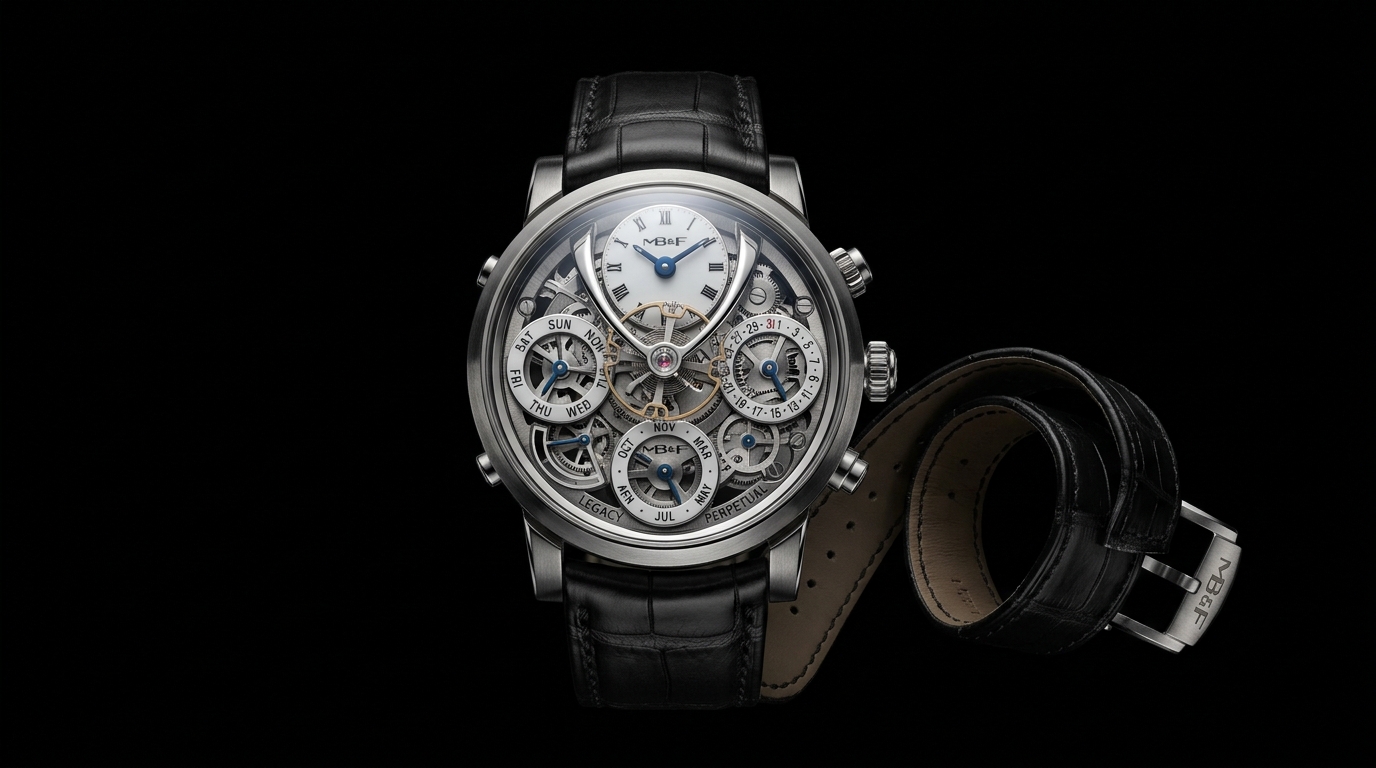
The LM Perpetual wears as a high-complication object, not as an everyday calendar pretending to disappear under a cuff. The 44 mm case has presence, and the domed crystal adds visual height even before the measured thickness is considered. In red gold or platinum, the watch has real mass. In titanium, the same architecture becomes easier to wear for longer periods, and the reduced weight arguably suits the engineering character of the movement better than the heavier precious-metal cases.
Despite the dimensions, the watch is not ungainly. The lugs are relatively short, the strap pulls the case down securely, and the case profile avoids the slab-sided bulk that makes some complicated watches feel crude. Water resistance is not the point; this is a mechanically dense perpetual calendar, not a sports watch. The later LM Perpetual EVO would address shock resistance and more casual wearability, but the original Legacy Machine Perpetual remains the purer expression: formal enough to be coherent, experimental enough to be unmistakably MB&F.
Legibility is better than photographs suggest. The floating balance draws the eye first, but the actual reading sequence is logical once the owner learns the dial. The time sub-dial at 12 o’clock is deliberately isolated, while the calendar registers occupy fixed positions around the lower architecture. The power-reserve indicator is especially useful because a stopped perpetual calendar is never merely a stopped watch; it is a correction session waiting to happen.
Market Position: A Collector’s Perpetual, Not A Safe Perpetual
The Legacy Machine Perpetual occupies a specific market position. It is not the liquid, broadly understood perpetual calendar of the Patek Philippe universe, nor the discreet establishment choice represented by Vacheron Constantin’s Patrimony or Traditionnelle perpetual calendars. It is an independent high complication for collectors who already understand the category and want to own a watch that alters the conversation. Its natural peers are not only perpetual calendars, but also independent mechanical statements from Greubel Forsey, Urwerk, De Bethune and later high-end F.P. Journe complications.
The model’s collector appeal rests on more than scarcity. The early 25-piece red-gold and platinum editions created immediate exclusivity, but scarcity alone is common in independent watchmaking. The stronger argument is that the LM Perpetual contains a named, identifiable contribution to horology: McDonnell’s rethinking of the perpetual calendar’s operating principle. That gives the watch a technical narrative durable enough to survive changes in taste. It also explains why the model won the Calendar Watch Prize at the 2016 Grand Prix d’Horlogerie de Genève. Awards do not make watches important, but in this case the jury recognised the correct thing.
On the secondary market, the LM Perpetual behaves differently from mainstream perpetual calendars. It does not have the universal buyer base of a Patek Philippe perpetual calendar chronograph, but it also is not interchangeable with conventional dress calendars. Prices depend heavily on metal, edition, condition, completeness and the specific dial execution. The buyer pool is narrower and more informed, which means the watch can require patience to sell but commands attention when the right collector appears. That is typical of serious independent watchmaking: less liquidity, more conviction.
Why It Endures
The MB&F Legacy Machine Perpetual endures because it earns its drama. The suspended balance, domed crystal and exposed indications could have been theatrical packaging around a conventional calendar module. Instead, they are wrapped around one of the few modern perpetual-calendar mechanisms with a credible claim to original thinking. The watch is large, expensive, mechanically complex and aesthetically assertive. Those are not incidental drawbacks; they are part of the bargain.
Its limitations should be stated plainly. It is not a classic dress watch. It is not ideal for collectors who want thinness, anonymity or universal resale liquidity. It requires an owner comfortable with independent servicing infrastructure and with the responsibilities of a 581-component perpetual calendar. But judged as a single model, the LM Perpetual is one of MB&F’s most convincing watches because its design and engineering are inseparable.
The perpetual calendar is an old complication often treated with excessive reverence. The Legacy Machine Perpetual showed that reverence was not enough. By rejecting the inherited 31-day logic and building a new integrated calibre around a 28-day mechanical processor, MB&F and Stephen McDonnell produced a watch that is more than a spectacular object. It is a genuine argument in metal: that even the most established complications can still be reconsidered from first principles.