Zenith Chronomaster Original El Primero: The 38mm Chronograph That Makes the A386 Relevant Again
Zenith Chronomaster Original El Primero: The 38mm Chronograph That Makes the A386 Relevant Again
The Zenith Chronomaster Original El Primero is not another vintage-inspired chronograph trading on nostalgia. It is a more difficult proposition: a modern watch that asks whether Zenith’s most important 1969 design can still function as a serious contemporary chronograph without being enlarged, softened, or visually over-explained. The answer is mostly yes, and the reason is specific. The Chronomaster Original keeps the 38mm architecture of the El Primero A386 but replaces the historical calibre 3019 PHC with the modern El Primero 3600, a movement that turns the watch from a handsome tribute into one of the most technically legible chronographs in its price class.
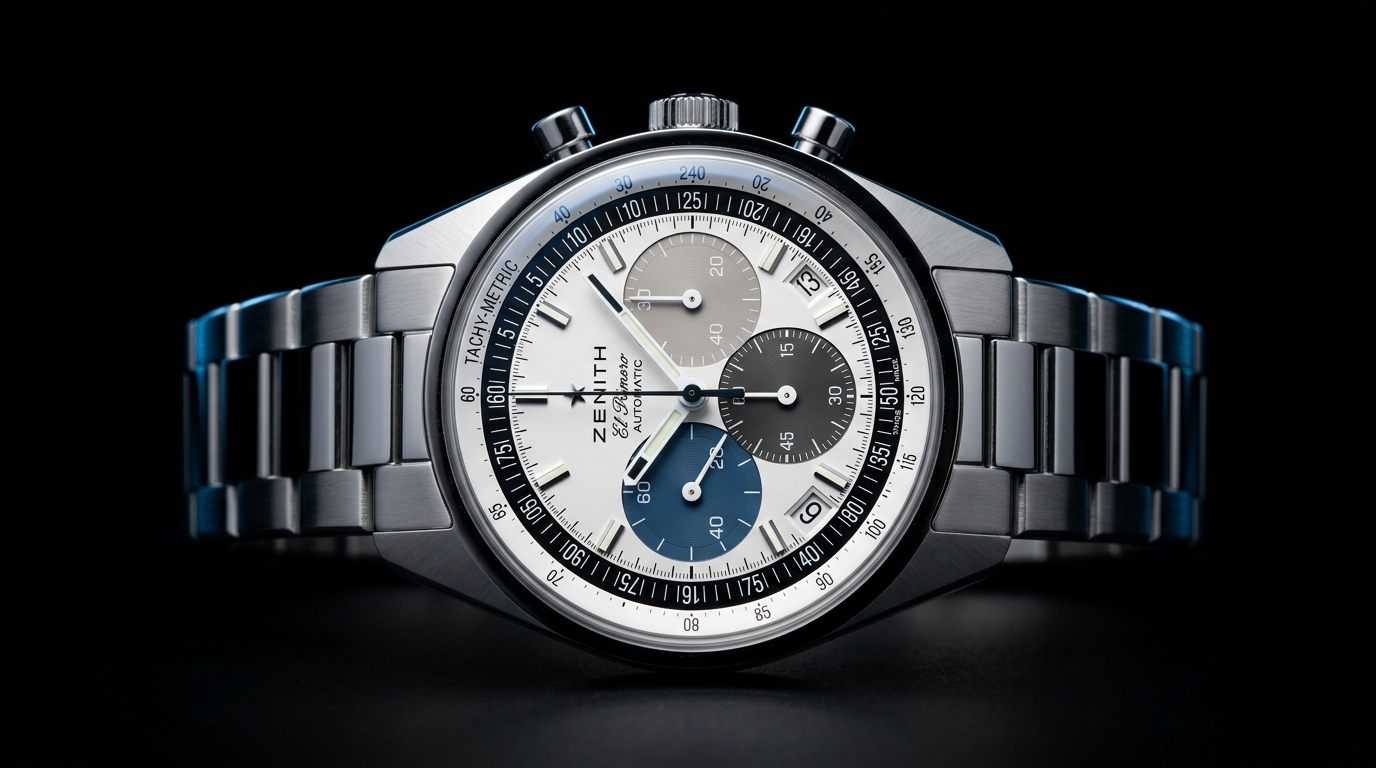
Zenith introduced the Chronomaster Original in 2021, with the steel tricolour version carrying reference 03.3200.3600/69.C902 on strap and 03.3200.3600/69.M3200 on bracelet. There were also sharper, less historically coded executions, including the reverse-panda reference 03.3200.3600/21.C903. But the core of the model is the white-dial, overlapping-register, tricolour configuration: the one that most directly engages with the 1969 A386, and the one by which the watch should be judged.
Origin: A386 Lineage Without Museum Fetish
The Chronomaster Original exists because Zenith has one chronograph design that matters more than all the others. In 1969 the brand launched the El Primero alongside references including the A384, A385 and A386. The A386 was the cleanest and most enduring of the group: a round 38mm case, pump pushers, date at 4:30, and three overlapping sub-dials in blue, dark grey and light grey. Inside was the calibre 3019 PHC, an integrated automatic chronograph beating at 36,000 vibrations per hour. That frequency allowed timing to one-tenth of a second, even if the original dial layout did not dramatise that capability in the way the modern watch does.
The A386 was not produced in huge numbers; estimates usually settle around 2,500 pieces between 1969 and the early 1970s. Its later importance grew partly because the El Primero almost disappeared. During the quartz crisis, Zenith Radio Corporation ownership pushed the company away from mechanical chronographs, and Charles Vermot famously preserved the tooling, plans and specialist equipment needed to restart production. The movement returned in the 1980s, supplied to Ebel and later adapted by Rolex for the automatic Daytona from 1988 to 2000 as calibre 4030. That history matters here because the Chronomaster Original is not borrowing a dead aesthetic. It is attached to a movement line that actually survived industrial interruption and returned to relevance through use, not mythology alone.
Zenith has revisited the A386 before, sometimes with great fidelity and sometimes with too much reverence. The 2019 A386 Revival pieces were effectively anniversary recreations. The Chronomaster Original is more commercially significant because it is not a limited archival exercise. It is a regular-production model that takes the A386 case profile and gives it a current calibre, a sapphire construction, modern water resistance, and a chronograph display that genuinely exploits the El Primero’s high-frequency architecture.
Case and Proportions: 38mm Is the Point
The decision to keep the case at 38mm is the central editorial choice of the Chronomaster Original. Zenith could easily have made it 40mm or 41mm and sold the increase as modernity. Instead, it preserved the A386’s approximate diameter and case language: no external bezel, faceted lugs, a domed crystal, straight pump pushers, and a compact stance on the wrist. The watch is approximately 12.6mm thick, with a 19mm lug width, and it carries 50 metres of water resistance. These specifications do not make it a sports watch in the contemporary bracelet-integrated sense; they make it a daily chronograph with historical proportions and enough mechanical integrity to avoid fragility.
The case shape is more complex than the diameter suggests. The lugs are angular and sharply defined, the polished bevels catch light without becoming ornamental, and the thin bezel allows the dial to feel larger than 38mm. This is why the Chronomaster Original wears with more presence than a mid-century dress chronograph but less mass than most modern automatic chronographs. Compared with the 42mm Omega Speedmaster Professional, the Zenith feels denser and more compact. Compared with the 39mm TAG Heuer Carrera Glassbox, it is less theatrical. Compared with the 40mm Rolex Daytona, it is more historically literal and mechanically more exposed in its intentions.
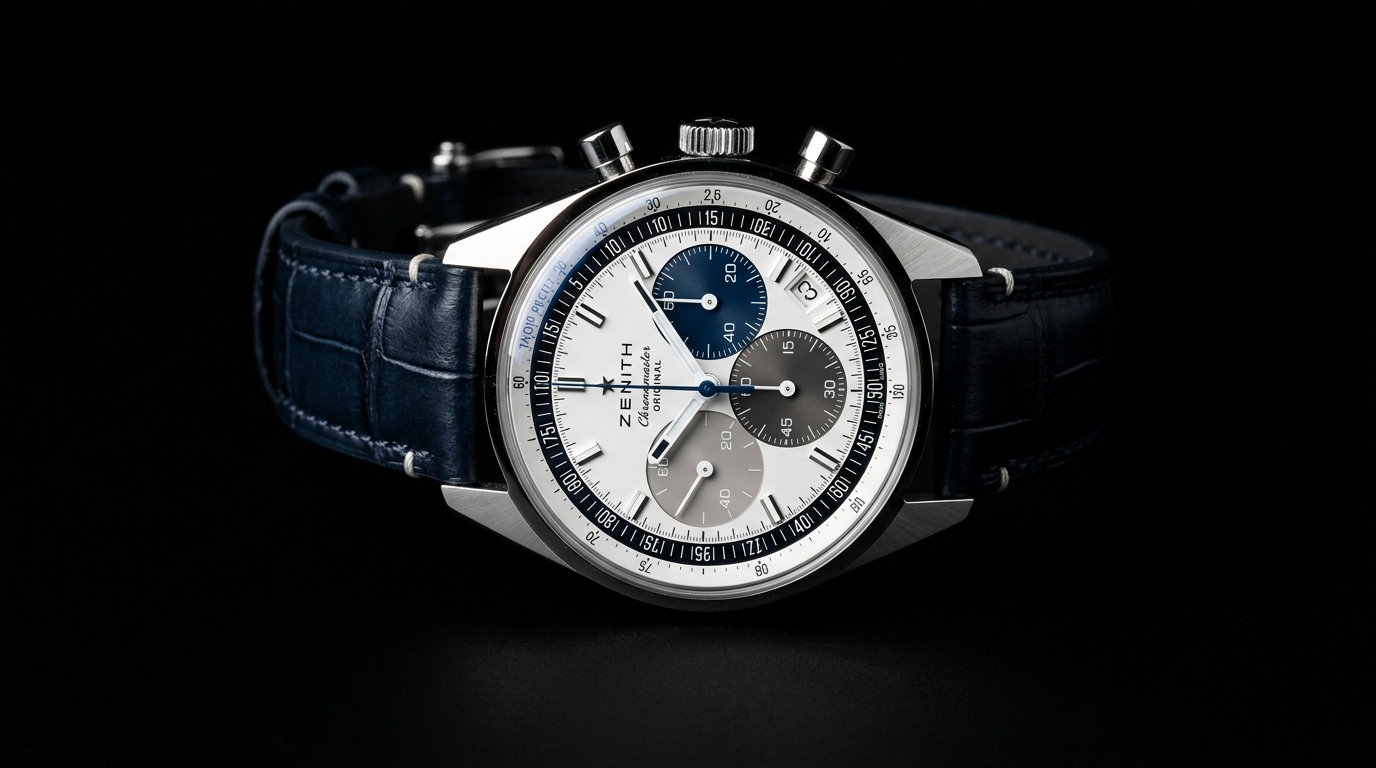
The bracelet is the one area where the watch is competent rather than inspired. The solid three-link steel bracelet gives the watch practicality, but it does not have the identity of the old Gay Frères ladder bracelets associated with early El Primero references. Zenith’s modern bracelet is well made, yet visually generic. On the calf strap, the case and dial breathe better, and the 19mm lug width becomes less irritating. If the goal is to use the Chronomaster Original as a daily watch, the bracelet makes sense. If the goal is to understand the model at its best, the strap is the cleaner choice.
The Dial: Historic Codes, Modern Timing Logic
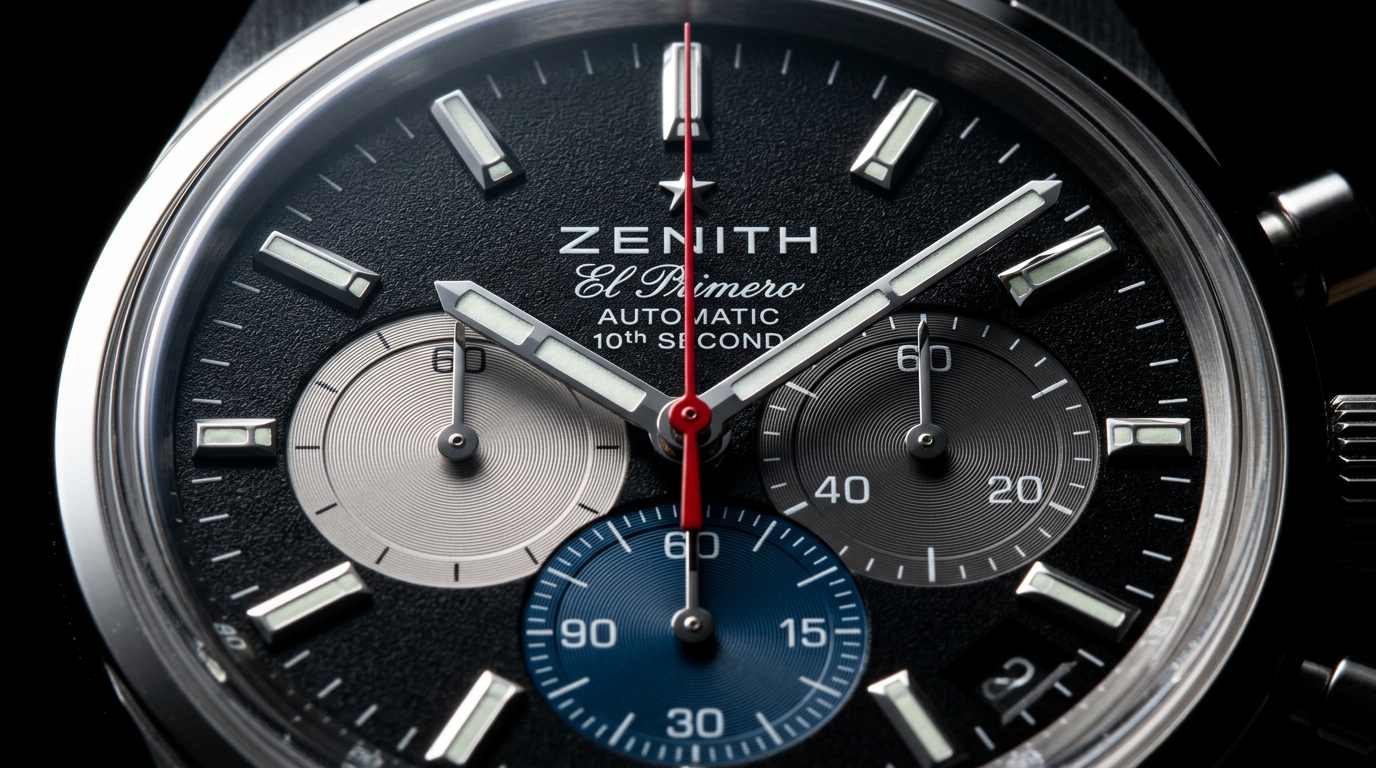
The tricolour dial is the obvious signature, but its success comes from restraint rather than colour alone. The overlapping registers at 3, 6 and 9 o’clock are inherited from the A386, and Zenith wisely keeps the tones specific: blue at 3, dark grey at 6, light grey at 9. The red central chronograph hand provides the only strong accent, and the applied baton markers keep the dial from sliding into retro pastiche. The date remains at 4:30, which is historically correct but still visually debatable. It interrupts the lower-right quadrant, though less damagingly than on many chronographs because the El Primero architecture has always made that position part of the watch’s grammar.
The important update is the peripheral one-tenth-of-a-second scale. On older El Primero models, the 36,000 vph frequency was often an invisible technical advantage. On the Chronomaster Original, calibre 3600 drives the central chronograph hand around the dial once every ten seconds, allowing the hand to read directly against a 1/10th scale. This is not a gimmick in the usual sense, because it connects the visual behaviour of the hand to the movement’s actual beat rate. It changes the watch’s character: starting the chronograph is no longer a slow sweep around a conventional minute track, but a fast mechanical demonstration of what Zenith has claimed since 1969.
There is a trade-off. The ten-second central chronograph hand is less intuitive for timing long intervals at a glance than a standard sixty-second chronograph seconds hand. Zenith compensates with sub-dials: the 3 o’clock register counts 60 seconds, the 6 o’clock register counts 60 minutes, and running seconds sit at 9. Once understood, the system is logical, but it demands a short period of recalibration. This is the kind of functional eccentricity collectors tend to forgive because it is mechanically justified. It is not decorative complication; it is the high-frequency El Primero finally being displayed on its own terms.
Calibre 3600: The Real Upgrade Over the Vintage Formula
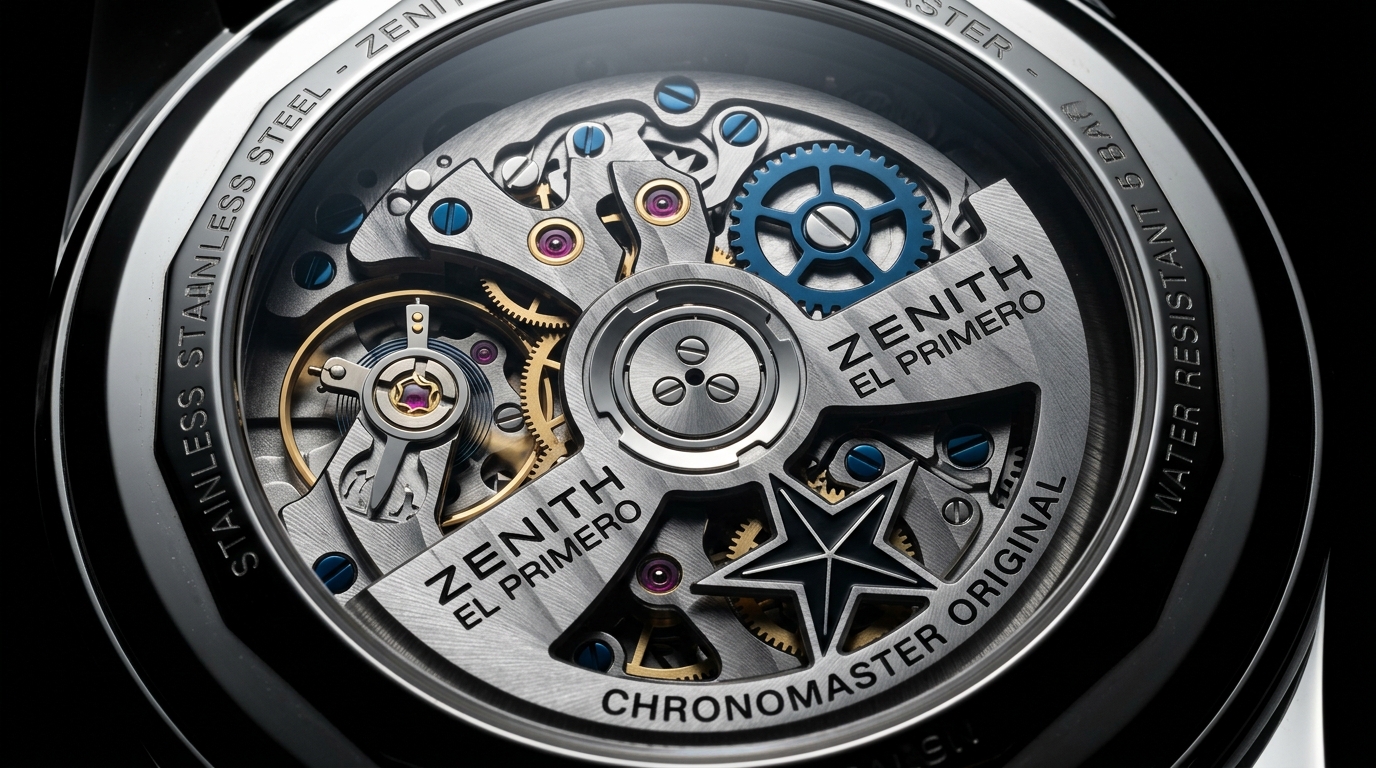
The Chronomaster Original is powered by the El Primero 3600, an automatic integrated column-wheel chronograph operating at 36,000 vibrations per hour. It offers approximately 60 hours of power reserve, a meaningful improvement over the older El Primero 400 family, which traditionally sat around 50 hours. The movement is visible through the sapphire caseback, with the blue column wheel, openworked star rotor, and modern finishing clearly presented. This is not artisanal finishing in the Lange or Vacheron sense, and it should not be judged as such. It is industrial high-grade chronograph finishing: clean, consistent, attractive, and appropriate to a watch positioned below haute horlogerie but above standard modular chronographs.
The strategic importance of calibre 3600 is that it modernises the El Primero without diluting it. Zenith retained the high beat rate and integrated automatic chronograph architecture, but improved the user experience with hacking seconds and longer reserve. The chronograph feel is crisp, as expected from a column-wheel system, though not as buttery as some lower-frequency luxury chronographs tuned for tactile softness. The Zenith prioritises precision language over sensuality. That is the correct choice for this watch.
It is also worth noting what the movement does not pretend to be. It is not a hand-wound purist chronograph like the Omega calibre 3861 in the Speedmaster Professional. It is not a vertical-clutch, sealed-case status object like the Rolex Daytona’s calibre 4130 or 4131. It is not a modular chronograph hiding behind case thickness. The El Primero 3600 is an integrated, high-frequency, automatic chronograph with a visible technical identity. In a market where many watches sell ambiguity, the Chronomaster Original has an unusually clear mechanical thesis.
On the Wrist: Compact, Busy, and More Serious Than Flashy
The Chronomaster Original wears best on wrists that appreciate compact proportions but do not want delicacy. At 38mm, the watch avoids the overextended lug span that makes many modern chronographs feel larger than their nominal size. The domed sapphire adds vintage height, but the case flank is controlled enough that the watch does not feel top-heavy. The pump pushers are easy to operate, and the crown sits proportionally within the case rather than becoming a nostalgic ornament.
The dial is busy by nature. The overlapping registers, date aperture, fractional track and multiple colours produce more information than a Speedmaster or a Carrera. That busyness is not a flaw, but it does define the watch’s personality. The Chronomaster Original is not minimalist, and it is not trying to be. Its strength is that each element has lineage or function. The colour comes from the A386; the scale comes from the 1/10th-second display; the date comes from the El Primero layout. The watch can look dense in photographs, but on the wrist its small diameter and strong dial contrast make it easier to read than static images suggest.
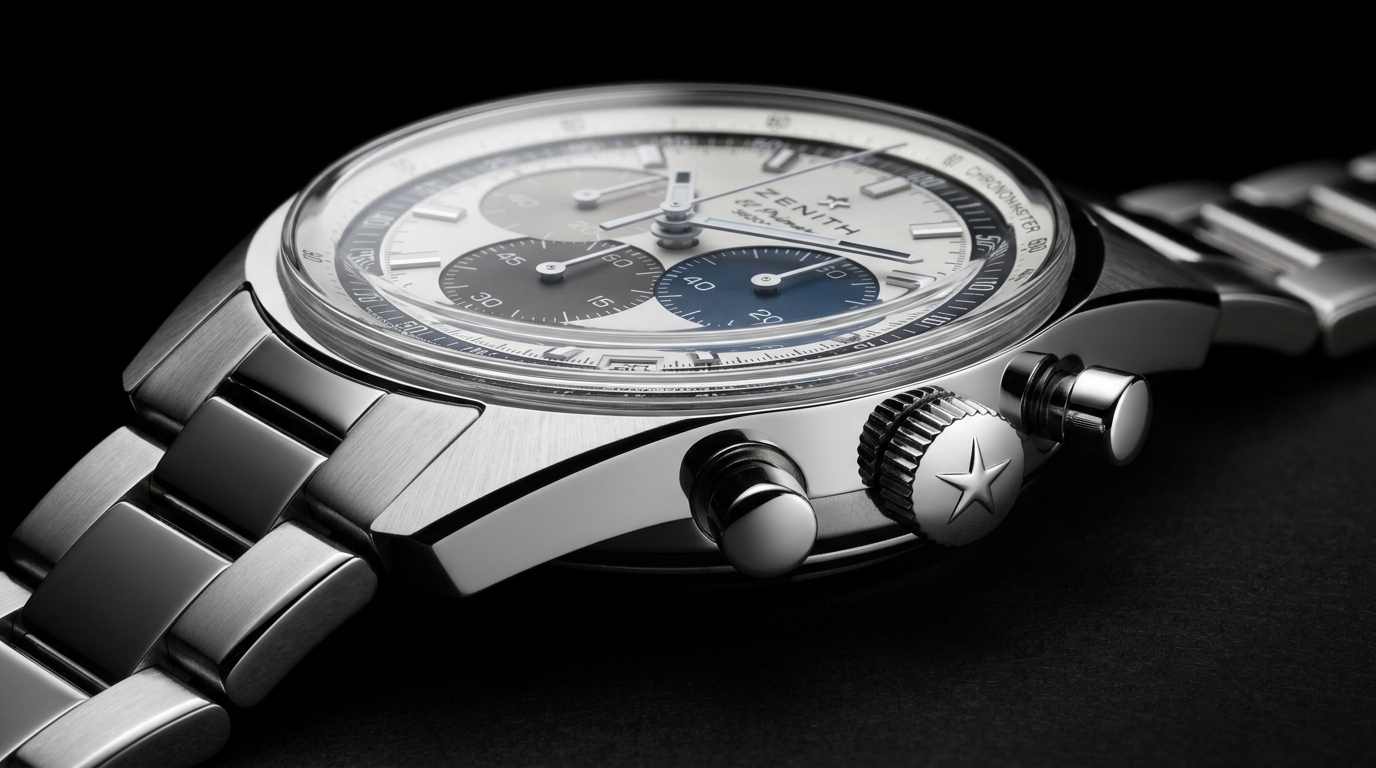
The bracelet version increases visual weight and gives the watch a more contemporary stance, but it also pushes the model slightly toward a generic luxury-sports look. The strap version better preserves the chronograph identity. Zenith’s deployant and leather options are not the final word in refinement, yet the pairing suits the case. Collectors who rotate watches rather than wear one piece every day will likely find the strap version more satisfying.
Market Position: Undervalued, but Not Without Reasons
The Chronomaster Original occupies an unusual market position. At retail, the steel models have sat broadly in the high four-figure to low five-figure range depending on year, market and strap or bracelet configuration; the launch pricing in the United States was around the mid-$8,000 range on strap, with bracelet versions higher. On the secondary market, steel examples commonly trade below retail, often materially so. That discount is not a sign that the watch lacks merit. It reflects Zenith’s weaker pricing power compared with Rolex, Omega’s broader cultural footprint with the Speedmaster, and the fact that the Chronomaster Original is regular production rather than scarce by allocation policy.
For collectors, that creates a useful asymmetry. The watch has serious movement content, direct historical lineage, and wearable proportions, yet it does not require participating in artificial scarcity. The downside is equally clear: anyone buying new should expect depreciation unless purchasing at a meaningful discount. Zenith has improved its product discipline under LVMH ownership, but the brand still releases enough variations and limited editions that the market rarely treats standard models as scarce. The Chronomaster Original is collectible because it is good, not because it is hard to buy.
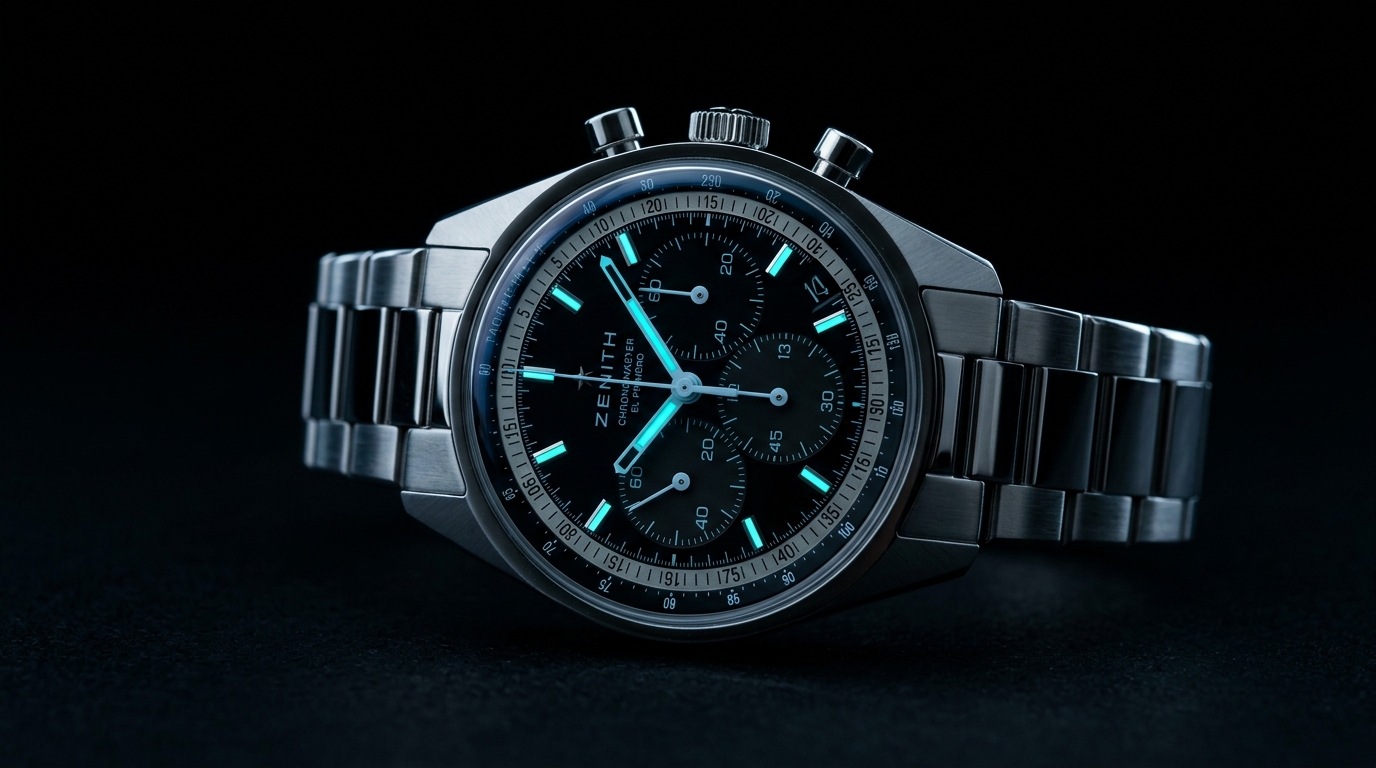
Against its peers, the Zenith’s argument is specific. The Speedmaster Professional has the stronger cultural story and a more legible chronograph layout, but it is manual-wind, larger, and far more common. The Daytona has unmatched market strength, but its secondary pricing has long been detached from comparative horological content. The TAG Heuer Carrera Glassbox is a strong design competitor at 39mm, particularly with the TH20 automatic calibre, but it does not carry the same uninterrupted movement lineage. The Zenith sits between these worlds: less iconic than the Omega, less socially weaponised than the Rolex, more historically grounded than most modern Carreras.
Why the Chronomaster Original Endures
The Zenith Chronomaster Original El Primero endures because it is not merely faithful to the A386; it corrects the one thing vintage-inspired watches often get wrong. It does not freeze the past. It uses the past as a chassis for a modern mechanical display. The 38mm case, tricolour registers and 4:30 date establish continuity with 1969, while calibre 3600 gives the watch a reason to exist in 2021 and beyond. The central hand’s ten-second rotation is the clearest expression yet of the El Primero’s 36,000 vph frequency, and it turns a familiar design into a more intellectually convincing object.
There are weaknesses. The bracelet should have had more identity. The date will always divide opinion. The dial is too information-rich for those who want chronograph austerity. Zenith’s resale performance remains softer than the technical quality of the watch deserves. But these are not fatal objections. They are the conditions that make the Chronomaster Original interesting: a historically important chronograph that is neither a museum replica nor a hype product.
The strongest version remains the steel tricolour reference derived from the A386 formula, particularly on strap. It is the model that best explains why Zenith still matters in mechanical chronographs. Not because the brand was first in 1969, a claim that has always depended on how one defines “first,” but because the El Primero remains mechanically distinct and visibly so. The Chronomaster Original succeeds because it makes that distinction clear at 38mm, without inflating the case, diluting the dial, or pretending that heritage alone is enough.