IWC Portugieser Chronograph: The Dress Chronograph That Refused to Become a Sports Watch
IWC Portugieser Chronograph: The Dress Chronograph That Refused to Become a Sports Watch
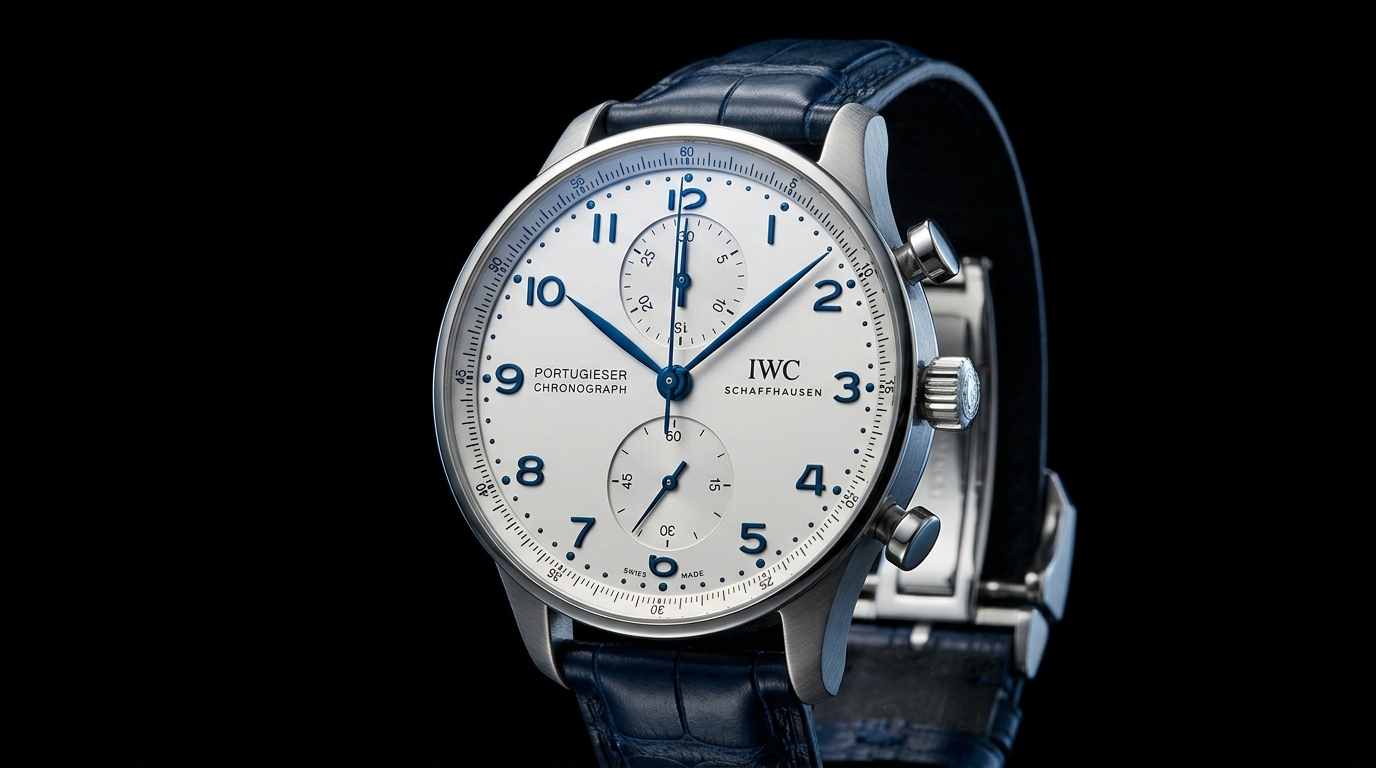
The IWC Portugieser Chronograph endures because it made a difficult choice and has largely stayed loyal to it: it is a chronograph without the usual costume of speed. No tachymeter, no screw-down pushers, no bezel numerals, no forced motor-sport mythology. Since the reference IW3714 appeared in 1998, the model has occupied a narrow but durable position in the market: a mechanically serious, visually formal chronograph built around the architectural clarity of the Portugieser dial. The current IW3716, introduced with IWC’s in-house calibre 69355, did not reinvent that proposition. It corrected the one point collectors could most easily criticise while preserving the reason the watch mattered in the first place.
From Pocket-Watch Logic to the 1998 Chronograph
The Portugieser line traces its format to 1939, when Portuguese importers Rodrigues and Teixeira asked IWC for a wristwatch with the precision and legibility associated with marine chronometers. IWC’s answer, the reference 325, used pocket-watch movements including calibres 74 and 98 inside a large wristwatch case. That origin matters because the Portugieser Chronograph is not a chronograph grafted onto a sports-watch template. Its proportions come from the opposite direction: a large, open dial, thin bezel, Arabic numerals, leaf hands and a railway minute track.
The modern Portugieser revival began in 1993 with the Jubilee reference 5441, a 42 mm hand-wound watch made for IWC’s 125th anniversary. The chronograph lineage followed quickly. In 1995, IWC released the Portugieser Chrono-Rattrapante reference 3712, powered by the hand-wound calibre 76240, a split-seconds movement developed with Richard Habring from the Valjoux 7760 architecture. The simpler automatic Portugieser Chronograph reference 3714 arrived in 1998. That is the decisive model. It removed the rattrapante complication, kept the vertical two-register dial layout, and turned the Portugieser into a watch IWC could sell consistently rather than ceremonially.
The Reference IW3714: The Template That Still Governs the Watch
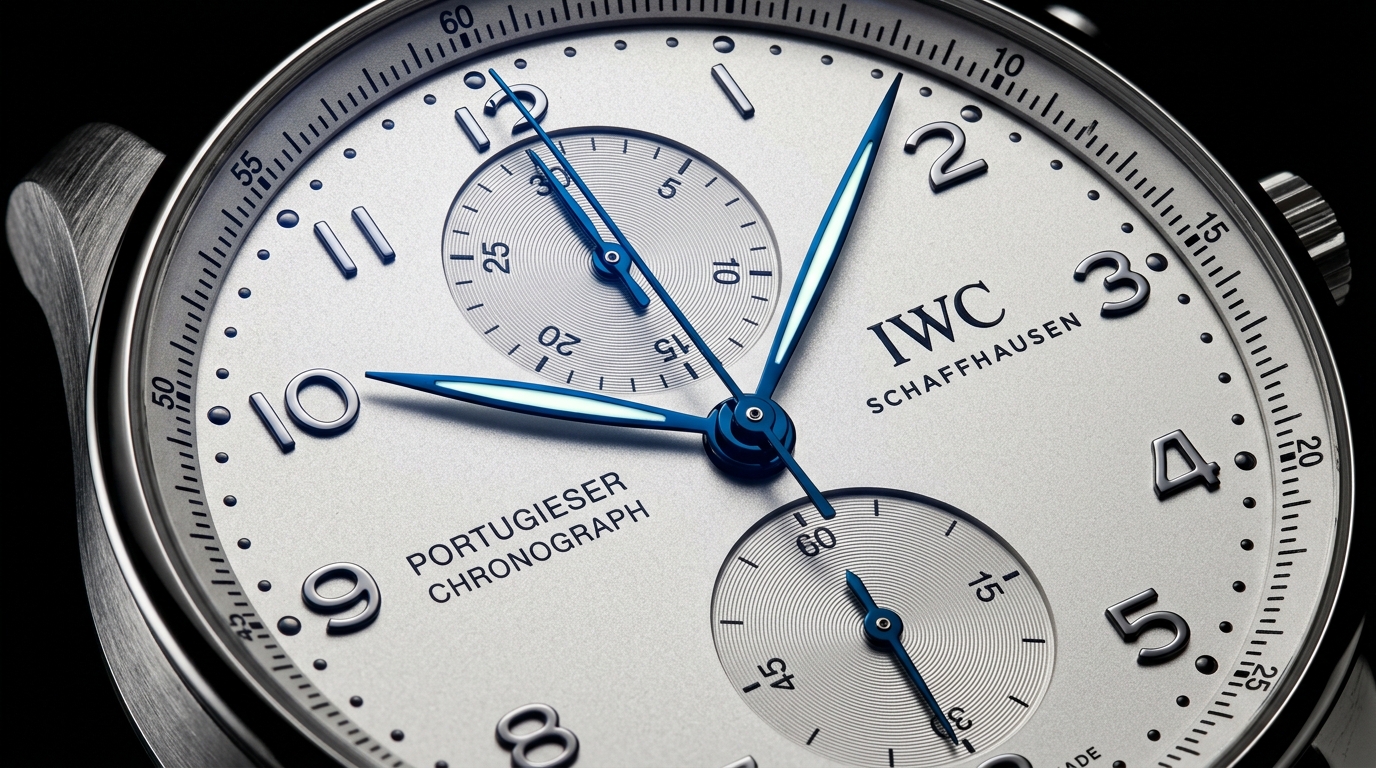
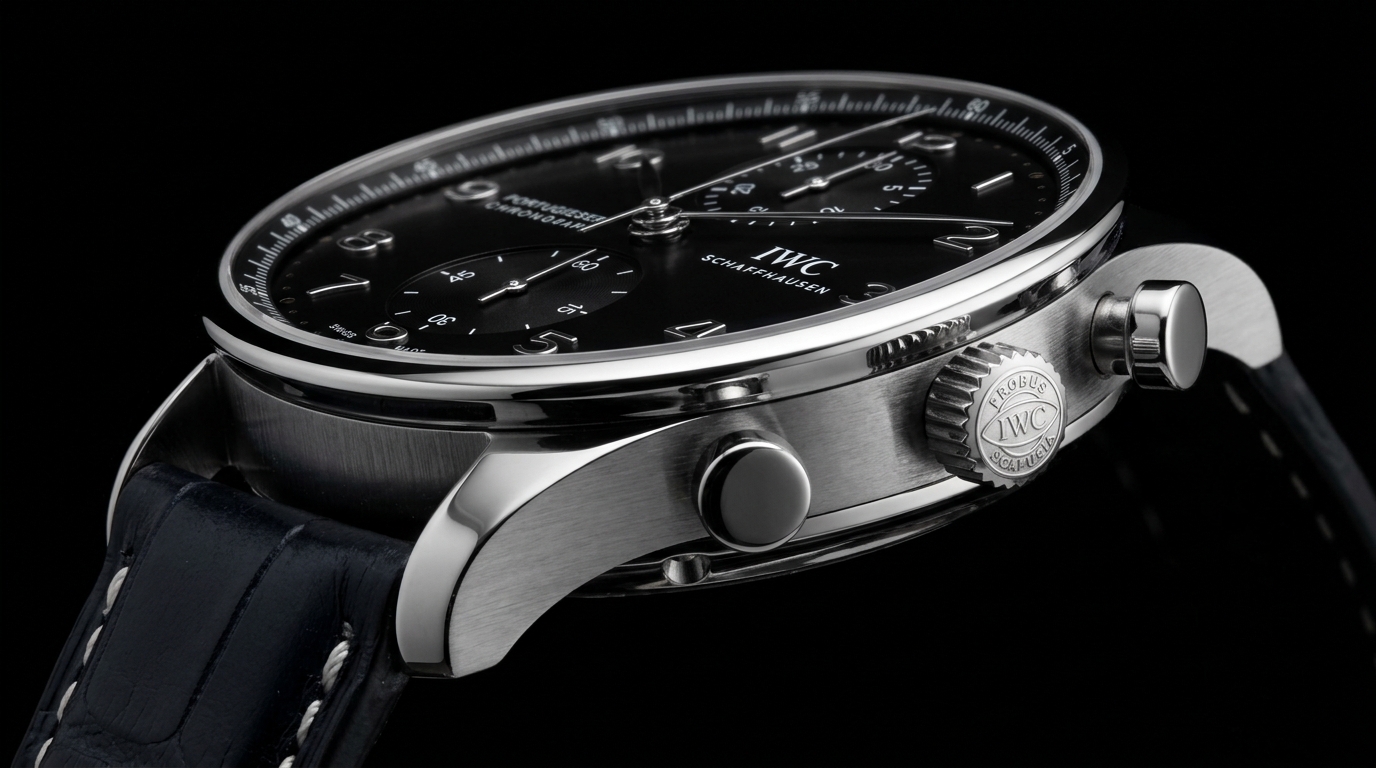
The IW3714 established the watch’s modern grammar. The steel case measured 40.9 mm in diameter and roughly 12.3 mm thick, with a narrow bezel that made the dial read larger than the dimensions suggest. The layout was stark: 30-minute chronograph register at 12 o’clock, running seconds at 6 o’clock, applied Arabic numerals, slim feuille hands, and no date. This last omission is not incidental. On a watch whose effect depends on symmetry and negative space, a date window would have been a concession to showroom practicality at the expense of design coherence.
The best-known IW3714 executions are the silver-plated dial with blue numerals and hands, the silver dial with gold-toned furniture, and the black dial variants. The model has also appeared in stainless steel, rose gold and limited editions, but the core identity is strongest in steel. The case finishing is simple by design: polished bezel and case flanks, restrained lugs, and pump pushers. The watch does not pretend to be physically robust in the way a Speedmaster Professional or Daytona does. Its 3 bar water resistance and alligator strap configuration define it as a formal chronograph for daily civilian use, not as an instrument watch.
This restraint is the reason the IW3714 became one of IWC’s most recognisable modern references. It arrived in a late-1990s market increasingly receptive to larger watches, yet before the excess of the mid-2000s oversized era. At 40.9 mm it was assertive for its time, but not absurd. More importantly, the dial carried the diameter. The long minute track and outer numerals create a sense of precision without visual noise. Many chronographs look smaller because their subdials consume space; the Portugieser Chronograph looks open because its registers are aligned on a vertical axis and the rest of the dial is left alone.
The Movement Question: Valjoux-Based Honesty, Then In-House Correction
For most of its production life, the IW3714 used IWC’s calibre 79350, derived from the Valjoux 7750 family. Earlier examples are often associated with calibre 79240; the broader point is that the 3714 was not powered by a proprietary IWC chronograph movement. IWC modified the base architecture substantially for the Portugieser display: the standard 7750 arrangement was reworked into a two-register layout with the 30-minute counter at 12 and small seconds at 6, with the 12-hour counter and calendar functions absent. The movement ran at 28,800 vibrations per hour and offered around 44 hours of power reserve.
Collector criticism of the 3714 has often centred on this movement, and not without reason. A premium-priced watch from Schaffhausen with a closed caseback and a heavily modified industrial ébauche required buyers to value design and execution over movement exclusivity. That bargain was defensible in the 2000s, less so as retail prices climbed and competitors made “manufacture movement” a central selling point. Still, dismissing the 3714 as “just a 7750” is too easy. The calibre was robust, serviceable, and altered to serve the dial rather than the other way around. In practical ownership, that counts for more than romantic movement rhetoric.
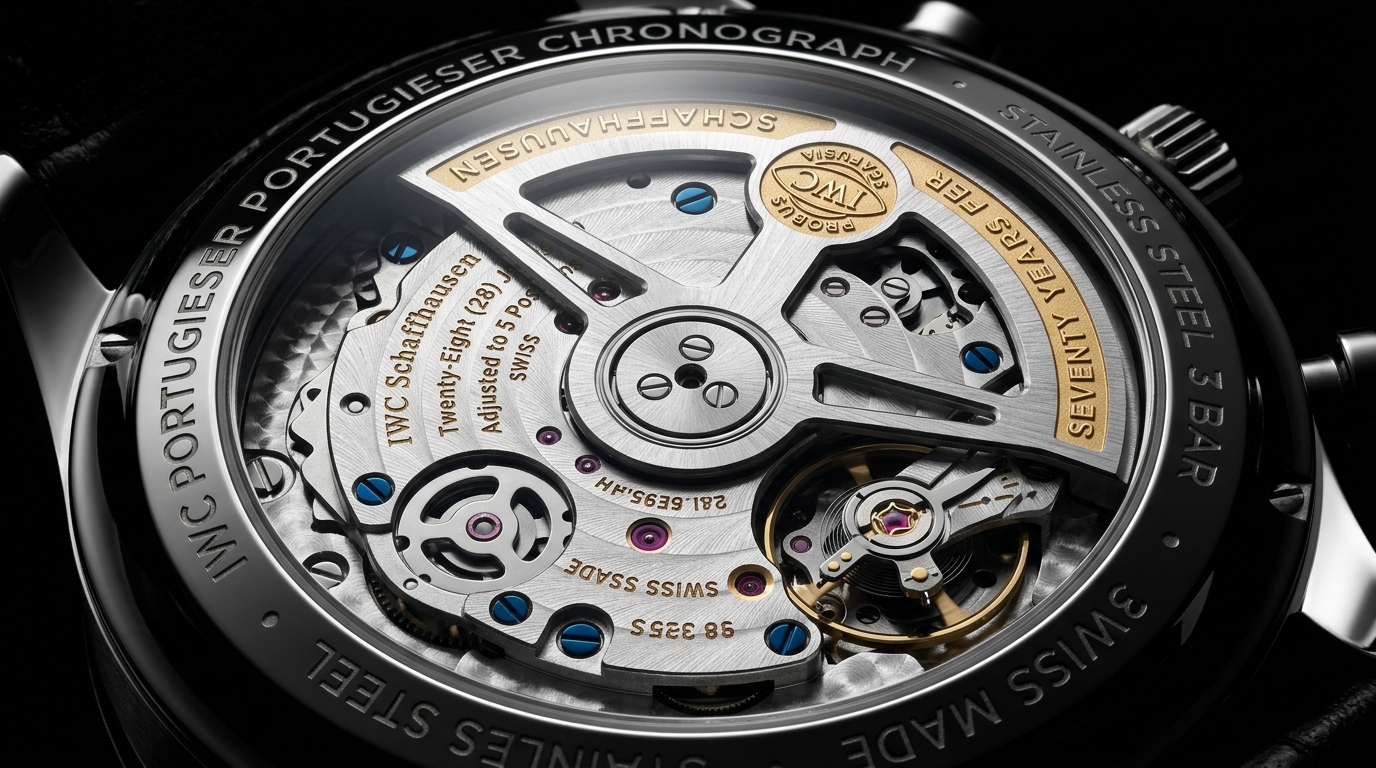
IWC addressed the issue in 2020 when the Portugieser Chronograph reference IW3716 replaced the long-running 3714 as the main production model. The new watch uses the IWC-manufactured calibre 69355, part of the 69000 calibre family first seen in the brand’s chronographs in the second half of the 2010s. It is an automatic, integrated column-wheel chronograph running at 4 Hz, with 46 hours of power reserve. It is visible through a sapphire caseback, unlike the closed-back IW3714. The finishing is industrially neat rather than artisanal: perlage, circular Geneva stripes, blued screws and a skeletonised rotor. It is exactly what one should expect at this level—credible, clean, not haute horlogerie.
The IW3716: Same Watch, Better Argument
The transition from IW3714 to IW3716 was unusually disciplined. IWC did not add a date, enlarge the watch dramatically or impose contemporary dial clutter. The current Portugieser Chronograph retains the essential 41 mm case diameter, though thickness increases to about 13.1 mm because of the 69355 and display back. The dial architecture remains the same: vertical registers, Arabic numerals, railway minutes, leaf hands and pump pushers. The change is most apparent from the rear, where the new calibre gives the owner a visible answer to the question collectors had asked for two decades.
That does not mean the IW3716 is automatically the superior watch in every respect. The earlier IW3714 has a slightly slimmer profile and, with its closed back, a more old-fashioned sense of density on the wrist. Some collectors also prefer the typography and dial tone of specific 3714 references. But strategically, the IW3716 is the cleaner proposition in today’s market. A buyer paying modern retail for an IWC chronograph no longer has to explain why the movement is based on a third-party platform. The design stayed intact; the mechanical narrative caught up.
The calibre 69355 also changes the feel of ownership. The column-wheel actuation gives the pushers a more deliberate engagement than the older cam-operated Valjoux-derived calibre, though one should not overstate this into mystical language. It is a tactility improvement, not a transformation. The watch is still defined more by dial architecture than by chronograph theatrics. That is appropriate. The Portugieser Chronograph is a watch for timing a conversation, a flight connection or a coffee extraction, not for pretending the wearer is qualifying at Le Mans.
Proportions and Wear: Large Dial, Formal Case, Limited Versatility
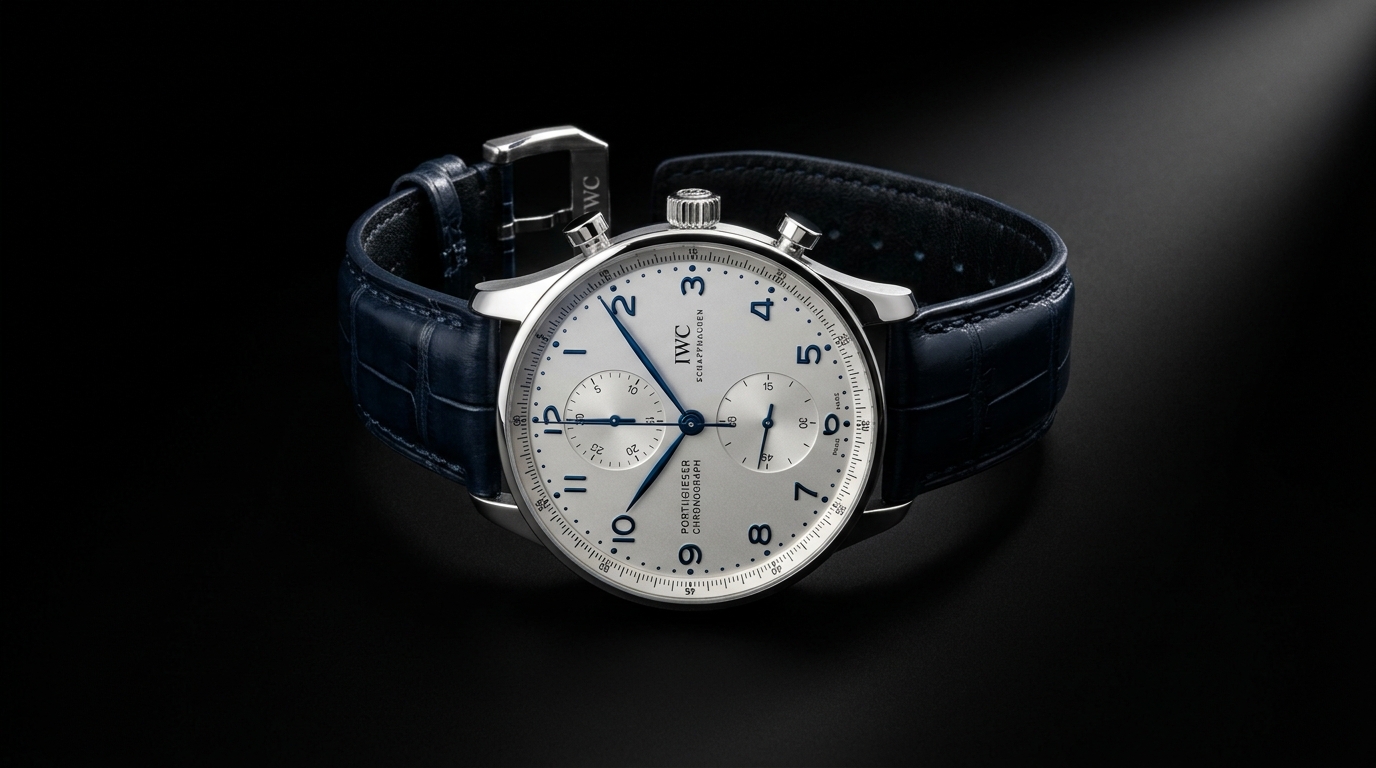
On the wrist, the Portugieser Chronograph is less compact than its 41 mm specification suggests. The bezel is thin, the dial is broad, and the lugs are fairly long and defined. The lug-to-lug span is commonly measured around the high-40 mm range, depending on method, and the watch presents with more surface area than a 41 mm sports chronograph with a bezel would. This is why the model can look superb on a medium wrist when worn as a dress-leaning statement, yet slightly expansive if the owner expects a discreet formal watch.
The thickness is manageable because the case sides are polished and rounded rather than slab-like. The watch slides under many cuffs, though the IW3716’s additional height makes it less elegant than the earliest impression of the dial might imply. Strap choice matters. On glossy alligator, the watch reads as formal and almost ceremonial. On calf or suede, especially with darker dials, it becomes more relaxed without becoming casual. It is not naturally a bracelet watch, and attempts to force it into sportier territory tend to dilute its best qualities.
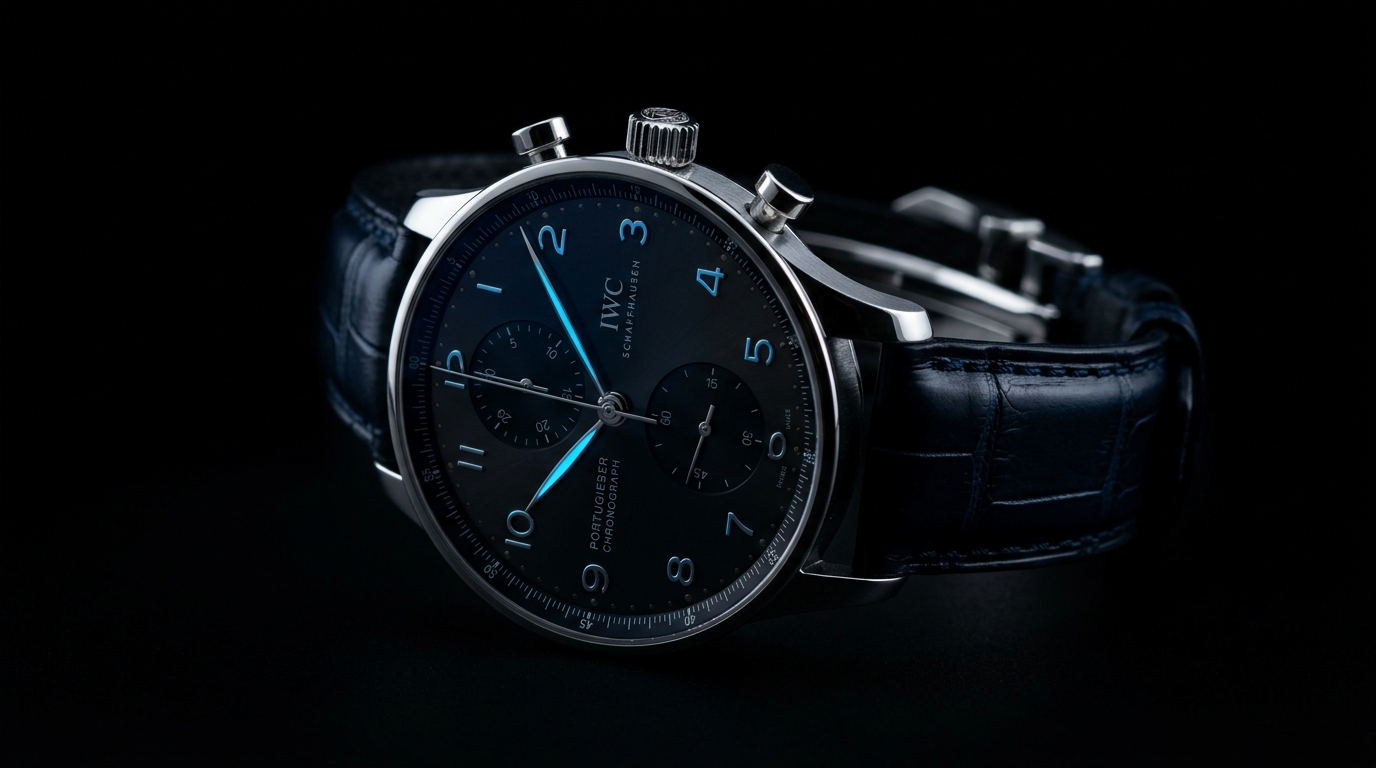
Legibility is excellent in daylight. The contrast between the printed minute track, applied numerals and elongated hands gives the watch genuine functional clarity. Night legibility is a weakness because lume is either absent or minimal depending on execution. Water resistance remains 3 bar, which is acceptable for a dress chronograph but limiting for a modern daily watch at this price. These limitations are not defects if understood correctly. They are evidence that the Portugieser Chronograph has not chased the all-purpose category, where many watches become visually compromised.
Market Position: Not a Daytona Alternative, Not a Speedmaster Substitute
The Portugieser Chronograph occupies a specific market lane. It is often cross-shopped with the Omega Speedmaster Professional, Zenith Chronomaster lines, Breitling Premier B01, Jaeger-LeCoultre chronographs and, at a distance, Rolex Daytona references. That comparison can mislead. The IWC is not a tool chronograph in the Speedmaster sense, nor a high-frequency historical proposition like Zenith’s El Primero, nor a scarcity-driven status asset like the Daytona. Its argument is architectural: it gives the buyer a chronograph in a dress-watch format without surrendering mechanical credibility.
On the secondary market, steel IW3714 examples have typically traded below current retail and often in the mid-four to mid-six-thousand-dollar range depending on dial, condition, box and papers. IW3716 examples command more because of the in-house calibre and younger production age, commonly sitting higher but still below list in many configurations. Precious metal versions are more volatile and generally less liquid, as is often the case with gold chronographs outside Rolex and Patek Philippe. The market is rational here. It recognises the design importance of the model but does not treat it as a speculative asset.
That relative stability is healthy. The Portugieser Chronograph has never needed auction mania to justify itself. Collectors tend to value clean, early or well-preserved IW3714 examples, especially classic silver-and-blue configurations, while practical buyers often prefer the IW3716 for its calibre 69355 and sapphire back. Limited editions can be interesting, but they are not the core story. The strongest version of the watch is usually the one closest to the original formula: steel case, uncluttered dial, two registers, no date.
Why the Portugieser Chronograph Still Works
The reason the IWC Portugieser Chronograph endures is not mystery. It is disciplined product design sustained over more than 25 years. The original IW3714 translated the Portugieser’s pocket-watch-derived dial codes into a chronograph without making the result look technical for the sake of it. The IW3716 then repaired the movement argument with calibre 69355 while resisting the temptation to redesign a watch that did not need redesigning. Few long-running chronographs have been handled with that degree of restraint.
There are compromises. The watch is not especially water resistant, not compact, not luminous in any meaningful sports-watch sense, and not finished to haute horlogerie standards. The older Valjoux-based references require a buyer to accept a historically common but well-executed movement solution. The newer in-house references are thicker and costlier. None of these points should be hidden. They are the boundaries of the model.
Within those boundaries, the Portugieser Chronograph remains one of the most coherent chronographs in serial production. It is formal without being fragile, mechanically legitimate without being obsessed with specification theatre, and recognisable without relying on artificial scarcity. The watch has survived because it refuses to become something else. In a chronograph market crowded with borrowed racing narratives and overdesigned dials, that refusal is not modesty. It is the model’s strongest strategic asset.