Nomos Glashütte: The Independent Manufacture That Turned Restraint Into Strategy

Nomos Glashütte: The Independent Manufacture That Turned Restraint Into Strategy
Nomos Glashütte is easy to underestimate because its watches do not shout. That is partly the point. In a market where independent watchmaking often means six-figure finishing, Swiss heritage often means paid-for nostalgia, and entry-level luxury increasingly means outsourced industrial competence, Nomos has built a more unusual proposition: a privately owned German manufacture producing sharply designed mechanical watches with genuine movement autonomy at prices that still sit, mostly, below the psychological ceiling of major Swiss prestige brands.
The company was founded in 1990 by Roland Schwertner, shortly after German reunification, in Glashütte, Saxony. That date matters. Nomos did not inherit an uninterrupted 19th-century lineage in the way older Glashütte names like A. Lange & Söhne or Glashütte Original often frame their legitimacy. It was a post-reunification start-up using a historic location, a tightly controlled design language, and eventually a serious investment in calibres to establish credibility. Its achievement is not antiquity. Its achievement is strategic discipline.
The Glashütte Advantage, Without the Glashütte Burden
Glashütte is not merely an address on a dial. Under German rules, a watch may use the Glashütte designation when a significant part of its value creation occurs there, generally understood as at least 50 percent of the movement’s added value. For Nomos, this framework became a competitive advantage. The brand could claim a precise manufacturing geography while avoiding the heavy ornamental burden carried by older Saxon watchmaking: engraved balance cocks, gold chatons, three-quarter plates as historical theatre, and prices to match.
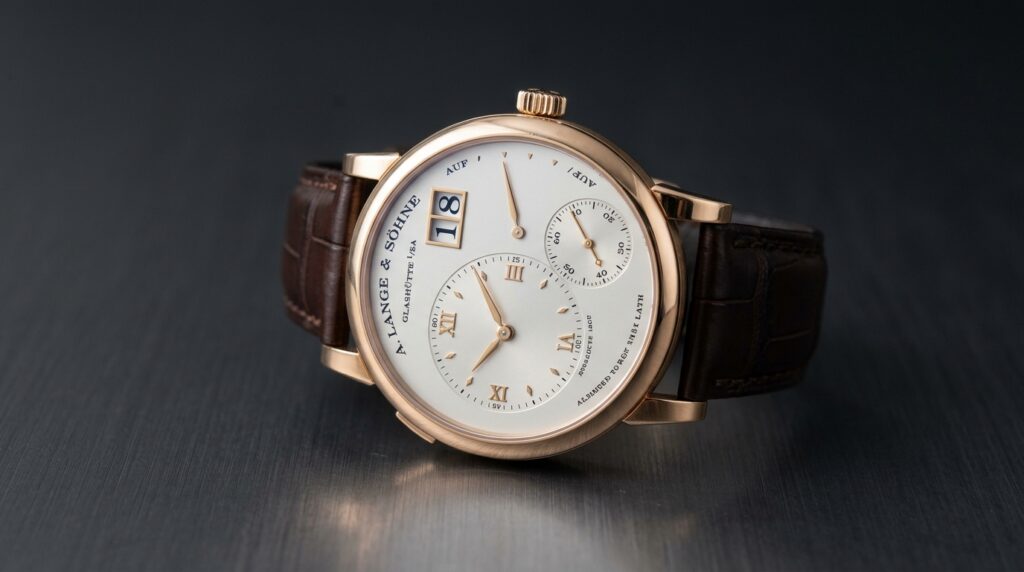
Nomos adopted some Glashütte conventions, including three-quarter plates and blued screws, but translated them into a more industrial, less aristocratic language. This distinction is important. A Lange calibre is constructed as an object of finishing spectacle. A Nomos calibre is constructed as a rational product, with visible architecture, clean anglage where appropriate, and decoration that supports price discipline rather than overwhelms it. That makes Nomos arguably the clearest modern expression of Glashütte as a manufacturing ecosystem rather than a museum of Saxon luxury.
The early watches, launched in the 1990s, used the hand-wound Peseux 7001 as a base, modified and regulated in Glashütte. The aesthetic was already set: the Tangente with its thin bezel, Arabic numerals, small seconds and narrow lugs; the Orion with a softer, almost domed minimalism; the Ludwig with Roman numerals; and the square Tetra. These references established the brand’s grammar before the brand had full technical independence. That sequence — design clarity first, movement independence later — remains essential to understanding Nomos.
Tangente: The Watch That Became a Business Model
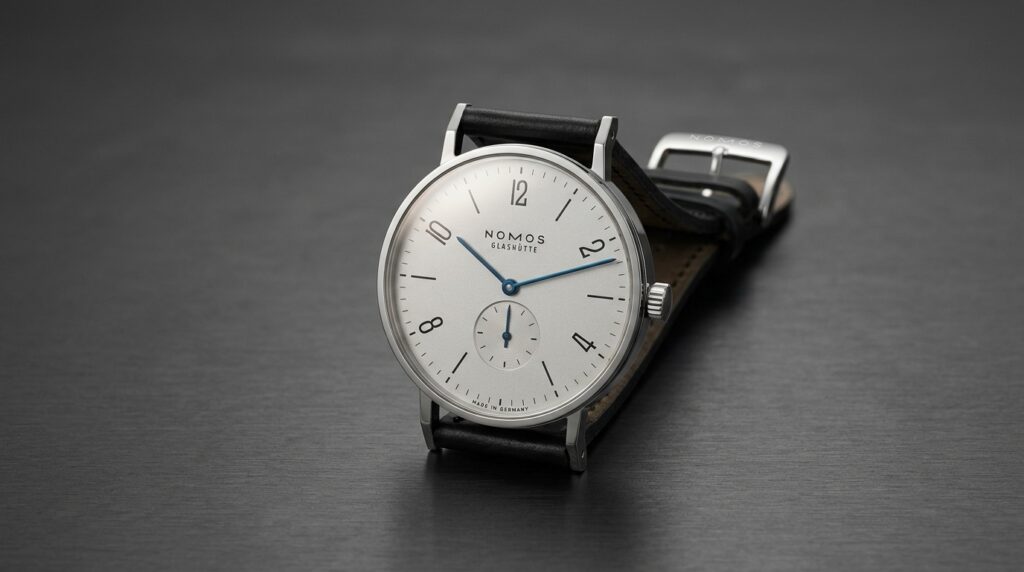
The Tangente is not simply Nomos’s most recognisable watch. It is the commercial platform on which the company built its identity. Introduced in the early 1990s, the basic Tangente 35, now commonly associated with reference 101, remains one of the most coherent hand-wound watches near the lower end of the luxury mechanical market. Its case is modest in diameter, usually 35 mm in the classic version, but the long straight lugs create more wrist presence than the measurement suggests. That is both a virtue and a recurring Nomos complication: many of its watches wear longer than expected.
The Tangente’s design is often lazily called Bauhaus. The label is not useless, but it is imprecise. Nomos is closer to a synthesis of Deutscher Werkbund clarity, Berlin graphic design, and Glashütte horological pragmatism. The typography is not decorative; the minute track is functional; the small seconds placement is proportionally assertive. The watch succeeds because it has very few places to hide errors. A badly proportioned minimalist watch looks inexpensive immediately. The Tangente does not, because its dial spacing and case geometry have been refined rather than merely simplified.
Nomos has correctly allowed the Tangente to carry much of the brand’s experimentation. Date models, neomatik versions, larger diameters, limited colours and anniversary editions have all passed through the Tangente line. The risk is visible: too many variants can weaken the authority of the original. Yet Nomos has managed this better than most because the underlying form is strong. The 2024 Tangente 38 Date project, with 31 colour variants limited to 175 pieces each, could have felt opportunistic. Instead, it demonstrated that Nomos understands colour as a design system, not just a seasonal dial swap.

From Modified Ébauches to DUW: The Movement Question
The decisive shift came in 2005, when Nomos introduced its own manufacture calibres. The Alpha hand-wound calibre, descended conceptually from the Peseux 7001 architecture but produced under Nomos’s own programme, gave the brand a credible base movement. In the same era, the Epsilon automatic calibre powered the Tangomat, and the company began to move beyond the status of a design-led assembler. By 2014, Nomos had introduced the Swing System, its proprietary escapement assembly, including balance, balance spring, escape wheel and pallet fork. This was not a cosmetic milestone. Escapement supply is one of the most sensitive dependencies in mechanical watchmaking, long dominated by Swatch Group’s Nivarox.
The Swing System gave Nomos a stronger claim to independence than many brands several price categories above it. It also required capital discipline. Developing and industrialising an escapement is expensive, especially for a company without conglomerate backing. Nomos did not use the achievement to move dramatically upmarket. Instead, it embedded the technology into calibres designated DUW, short for Deutsche Uhrenwerke, and continued to compete in the €2,000 to €5,000 range for much of its catalogue.
The DUW 3001, introduced in 2015, remains central to the modern Nomos proposition. At approximately 3.2 mm thick, this automatic neomatik calibre allowed the brand to make slim automatic watches without sacrificing the thinness that defined its hand-wound pieces. The DUW 6101, introduced in 2018, added a notably practical date mechanism: quick-set forwards and backwards, with the date ring placed around the outside of the movement to preserve dial proportions. It is one of the more intelligent modern date calibres at its price point, especially because it addresses the common problem of dates that either distort minimalist dials or sit awkwardly near the centre.

Design Consistency as Competitive Moat
Nomos’s most valuable asset is not any single calibre. It is consistency. The brand has resisted the industry’s usual temptations: oversized sports watches in borrowed vintage costumes, aggressive ambassador strategies, and artificial scarcity games. Its catalogue has expanded, sometimes too widely, but the centre holds. A Club, an Orion, a Metro and a Zürich Weltzeit are recognisably from the same house, even when their case constructions and use cases differ.
The Metro, designed by Mark Braun and launched in 2014, is the best example of intelligent extension. Its wire lugs, power-reserve indicator on early models, and more urban dial language could have looked like a separate design brand. Instead, it expanded the Nomos vocabulary while preserving the company’s restraint. The Zürich Weltzeit, powered by the DUW 5201, performs a similar function technically. It is not a traditional world timer in the Patek Philippe sense, but a pragmatic travel watch with a city disc and home-time aperture. It shows Nomos can handle complication without becoming theatrical.
The Club family is more contentious. Originally the youthful, more robust entry point, it has become the bridge to Nomos’s steel-sports ambitions. Club Campus models use California-style mixed numerals and offer strong value as first serious mechanical watches. Club Sport neomatik models, including 37 mm, 39 mm and 42 mm variants, pursue a more competitive everyday category with 200-metre water resistance, automatic DUW calibres and integrated-looking bracelets. They are good watches, but they place Nomos closer to crowded territory occupied by Tudor, Longines, Oris and entry-level Omega on the secondary market. Nomos is strongest when it does not try to answer Switzerland on Swiss terms.

The Bracelet Problem and the Case for Practicality
For years, Nomos was fundamentally a strap brand. Thin cases, flat dials and clean lugs looked right on shell cordovan leather. The transition into bracelets has been uneven but necessary. The deployant Sport bracelet and later steel bracelet options improved wearability, yet some still feel more engineered than luxurious. That matters because the market increasingly expects a watch above €3,000 to work as a full daily object: water resistance, bracelet comfort, clasp quality and scratch tolerance are no longer secondary concerns.
This is where Nomos faces its most practical challenge. The watches are often intellectually convincing before they are physically irresistible. A Tangente on leather is graphically superb, but its long lugs can overhang smaller wrists. A Club Sport is technically robust, but its case and bracelet must compete with brands that have spent decades refining steel sports-watch ergonomics. Nomos’s design purity sometimes resists the compromises that improve comfort. Collectors should treat diameter figures with suspicion and prioritise lug-to-lug measurements. A 35 mm Tangente can wear like a 38 mm watch; a 41 mm Ahoi or Club Sport can feel considerably larger.
The Ahoi, introduced as a more water-resistant automatic line, illustrates the tension. Its 200-metre rating, crown guards, textile strap and luminous dial elements make it the practical Nomos. But the brand’s thin, flat visual language is not naturally aquatic. The result is interesting rather than inevitable. The Ahoi is a credible watch, yet not the purest expression of Nomos. That honour still belongs to the manually wound Tangente and Orion, and to the neomatik pieces where slimness is central rather than incidental.

Where Nomos Sits in the Market
Nomos occupies an awkward and valuable price position. Below it sit microbrands and Japanese mechanical watches offering specifications for less money. Around it are Oris, Longines, Sinn, Mühle-Glashütte, Junghans and entry-level Tudor. Above it are Omega, Grand Seiko, Cartier and the more prestigious Swiss manufactures. Nomos cannot win every specification comparison. Sinn will often beat it on tool-watch toughness. Longines may offer more mainstream recognition. Tudor brings Rolex-adjacent confidence and stronger resale. Grand Seiko brings case finishing and dial craft at a higher but still comparable level.
Nomos’s argument is different: independent ownership, Glashütte production, proprietary calibres, distinctive design and pricing that has not yet detached from reason. This combination is unusually rare. Many brands offer one or two of these attributes. Few offer all of them with the same clarity. The company’s independence also matters more in an era of consolidation. Swatch Group, Richemont, LVMH and Rolex dominate large areas of the luxury watch landscape. Nomos remains privately owned, with Roland Schwertner’s founding role and Judith Borowski’s long-standing influence on brand and design culture still central to how the company is perceived. That independence has commercial constraints, but it gives the watches a point of view.
Secondary-market performance is respectable but not spectacular. A buyer should not approach Nomos as an investment object. Depreciation on some models is real, especially larger or less canonical references. The safest purchases tend to be core designs in wearable sizes: Tangente 35 and 38, Orion 35 and 38, Metro neomatik, Club Campus in conservative dimensions, and selected Zürich or Weltzeit references for collectors who value the complication. Limited colours can attract enthusiasm, but the long-term market usually returns to proportion, calibre and recognisability.

What Nomos Gets Right — and What It Must Avoid
Nomos gets three things right with unusual consistency. First, it treats design as structure rather than surface. The best Nomos watches are not attractive because they are minimal; they are attractive because their typography, hand length, sub-dial placement and case thickness are controlled. Second, it invested in movement independence when it could easily have remained an ébauche-based design company. The Alpha, Epsilon, DUW 3001, DUW 6101 and DUW 5201 portfolio gives the brand technical credibility beyond its price. Third, it has maintained a recognisable identity without leaning on invented heritage.
The risks are equally clear. Nomos must avoid becoming too cute with colour, too broad with case sizes, or too eager to fight the steel-sports war against brands with deeper experience in that category. It should also continue improving bracelets and clasps, because the modern collector’s tolerance for mediocre hardware is low. A beautiful dial cannot compensate indefinitely for a watch that does not sit correctly on the wrist.
The most compelling Nomos remains the one that understands its own discipline. A hand-wound Tangente is not a lesser watch because it lacks automatic winding. An Orion is not too simple because it has no date. A Metro is not more successful when it becomes busier. Nomos is at its best when it trusts reduction, but supports that reduction with serious engineering. That is the distinction between minimalism as styling and minimalism as manufacturing philosophy.
The Collector’s Verdict
Nomos Glashütte is one of the few modern watch brands whose importance is not properly captured by prestige ranking. It is not haute horlogerie in the Lange sense. It is not a mass luxury status machine in the Omega or Tudor sense. It is not a microbrand disrupting from below. It is a disciplined independent manufacture that has made accessible mechanical watchmaking more intellectually credible.
For collectors, the strongest case for Nomos is not that it offers “good value,” a phrase that often reduces watches to spreadsheet logic. The stronger case is that Nomos has a coherent answer to why it exists. It builds in Glashütte. It designs with a recognisable German graphic intelligence. It invested in its own calibres and escapement. It sells watches that, in their best forms, have no need to imitate Switzerland.
That does not make every Nomos a great purchase. Fit is critical, larger cases should be approached carefully, and the sportier models deserve comparison against tougher competitors. But the core proposition remains unusually persuasive. In a watch market crowded with borrowed pasts and inflated positioning, Nomos has built something more durable: a contemporary manufacture identity with technical substance, aesthetic discipline and just enough stubbornness to remain interesting.