A. Lange & Söhne: The Strategic Discipline Behind Glashütte’s Most Important Modern Watchmaker
A. Lange & Söhne: The Strategic Discipline Behind Glashütte’s Most Important Modern Watchmaker
A. Lange & Söhne is often discussed as if it were an uninterrupted nineteenth-century institution. That is useful romance, but poor analysis. The more important truth is sharper: modern Lange is a post-1990 reconstruction, launched into the Swiss-dominated high-watchmaking market in 1994 with no living continuity of production, no deep global dealer base, and no reason to be taken seriously beyond the quality of its watches. Three decades later, it has become the clearest alternative to Patek Philippe in traditional high horology, not by copying Geneva, but by building a distinct Saxon grammar of engineering, finishing, and restraint.
That distinction matters because Lange’s strength is not simply movement decoration or Teutonic case design. It is strategic coherence. The brand has resisted the temptation to become everything at once: it remains small, expensive, technically ambitious, and deliberately narrow. Under Richemont ownership, it has also become more controlled, more boutique-driven, and more assertive in how it allocates important watches. The result is a manufacture that occupies an unusual position in the collector market: less liquid than Rolex or Patek Philippe, but often more intellectually compelling than either.
The Restart: 1990 Was the Real Beginning
Ferdinand Adolph Lange founded his watchmaking company in Glashütte in 1845, with support from the Saxon state and a mandate to industrialise precision watchmaking in the Ore Mountains. That origin remains central to the brand’s identity, but modern Lange cannot be understood without the interruption. After the Second World War, the Lange family business was expropriated in 1948 under the East German regime and absorbed into Volkseigener Betrieb Glashütter Uhrenbetriebe, better known as GUB. The A. Lange & Söhne name effectively disappeared as an independent manufacturer for more than four decades.
The decisive act came after German reunification. Walter Lange, great-grandson of Ferdinand Adolph Lange, re-registered the company on 7 December 1990 with Günter Blümlein, then the formidable executive behind LMH — Les Manufactures Horlogères, which also included IWC and Jaeger-LeCoultre. Blümlein’s role is sometimes underplayed in sentimental accounts, but his contribution was structural. He understood that the revived Lange could not win by nostalgia alone. It needed watches that were recognisably German, technically serious, and finished at a level that could withstand direct comparison with Geneva’s best houses.
The first modern collection, presented on 24 October 1994 at Dresden Castle, was unusually focused: Lange 1, Arkade, Saxonia, and Tourbillon “Pour le Mérite.” The Lange 1 was the commercial and design breakthrough, but the Tourbillon “Pour le Mérite” established the technical argument. Its fusée-and-chain transmission, executed in a wristwatch, was not a decorative complication. It was a statement that Lange would use historical chronometric ideas as mechanical substance rather than packaging.
The Lange 1: Asymmetry as Corporate Identity
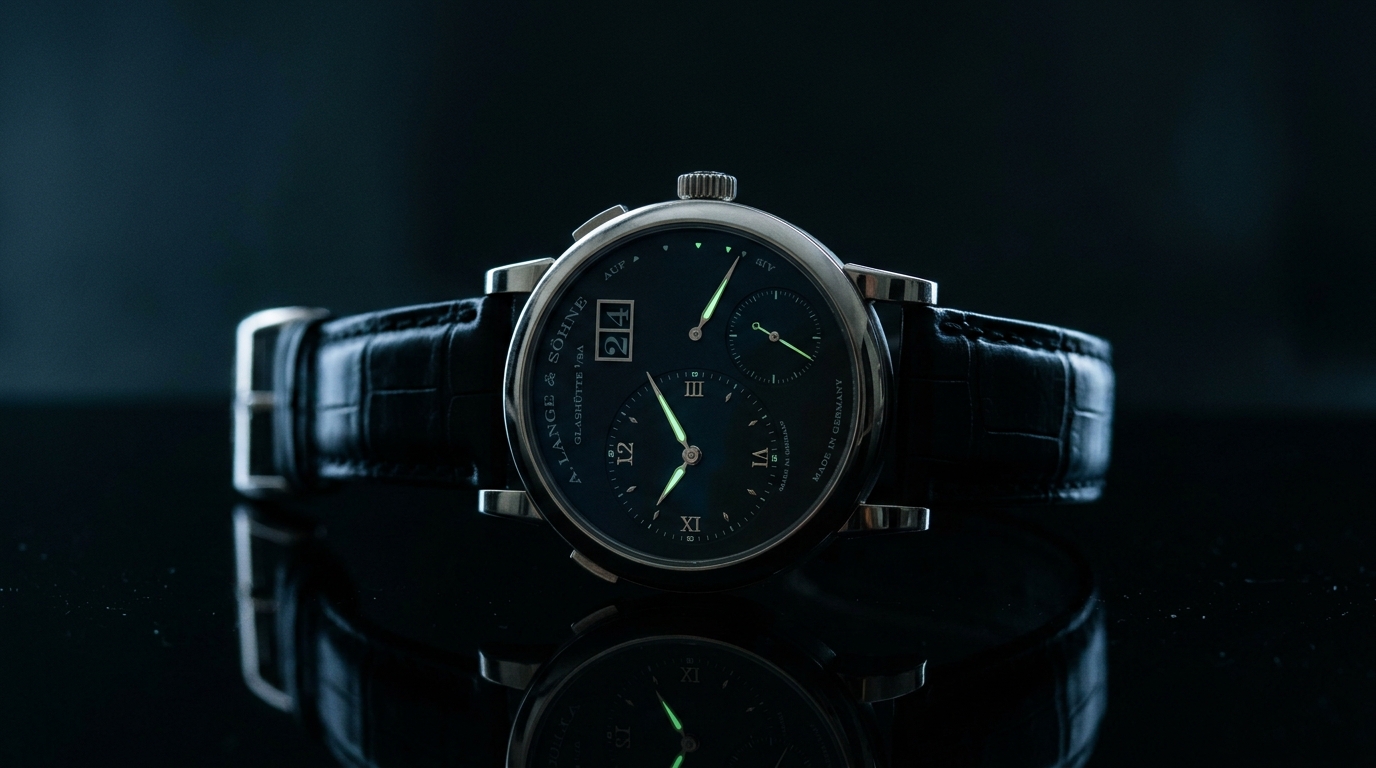
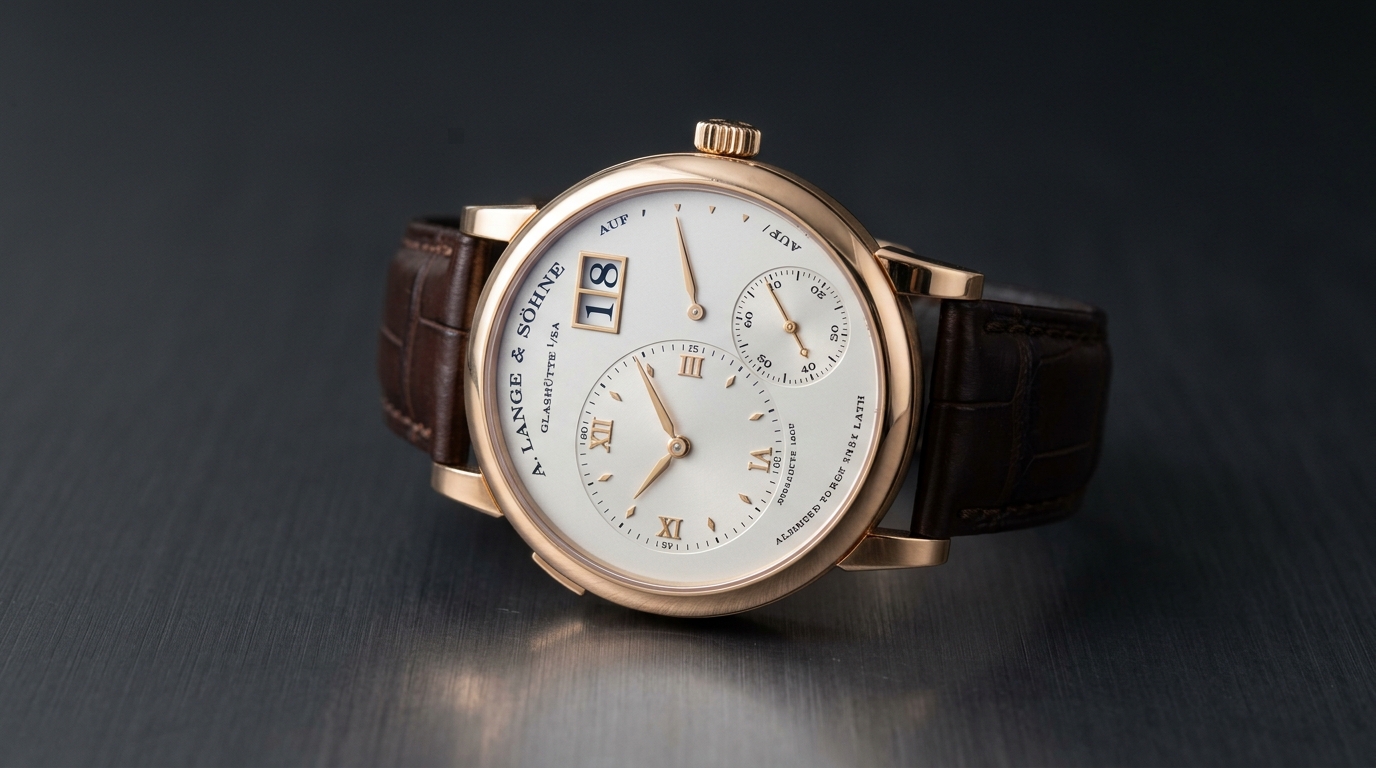
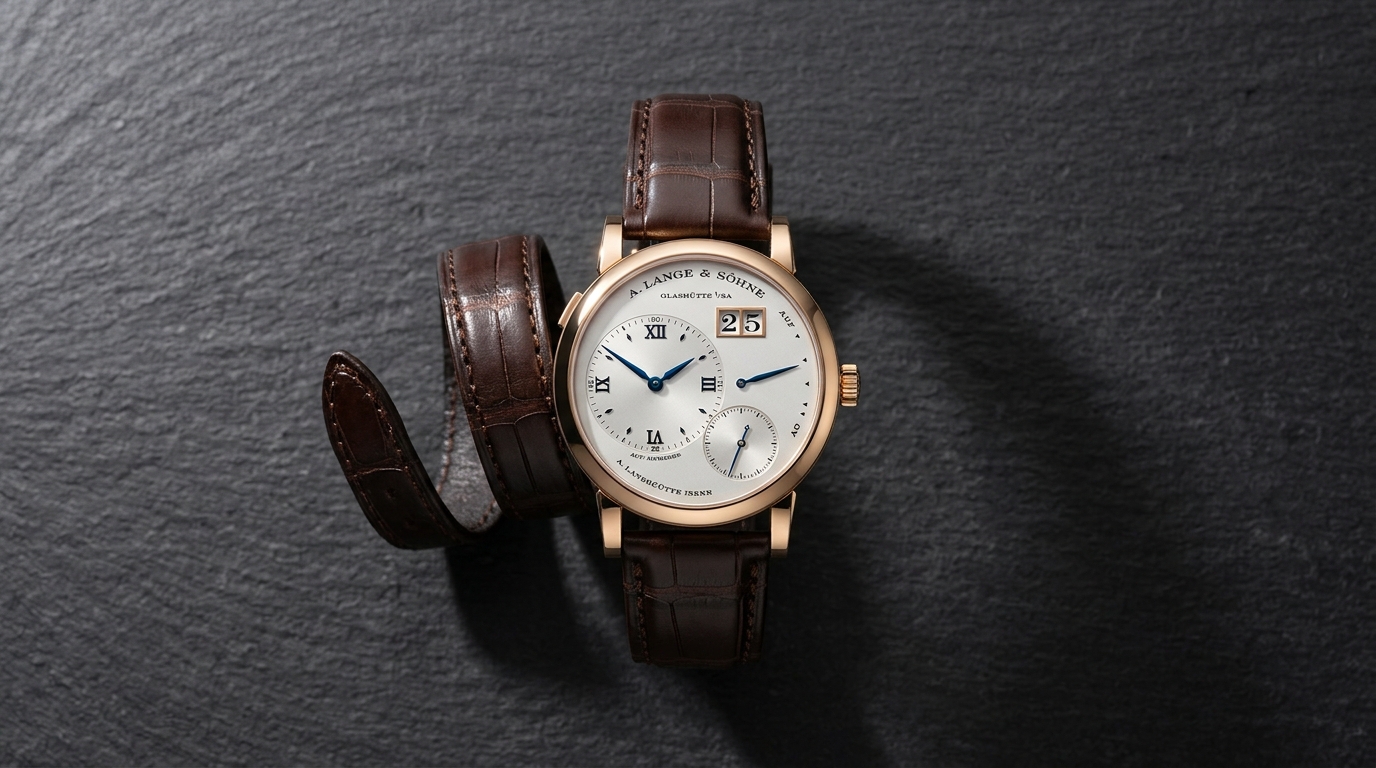
The Lange 1, reference 101.001 in yellow gold, remains the most important wristwatch the company has made. Introduced in 1994 with calibre L901.0, it gave the revived manufacture an instantly recognisable face: off-centre hours and minutes, subsidiary seconds, oversized date, and power-reserve indicator arranged according to a disciplined, non-overlapping visual architecture. It looked neither Swiss nor retro. That was the point.
The outsized date, inspired by the Five-Minute Clock at Dresden’s Semper Opera House, gave Lange a practical signature that was legible and defensible. The three-quarter plate in untreated German silver connected the calibre to Glashütte pocket-watch construction. The hand-engraved balance cock made each movement individually identifiable. The screwed gold chatons and blued screws were historical references, but they were also visual anchors. Lange developed a movement language that could be recognised through a display back from across a table.
The Lange 1 has evolved without losing its argument. In 2015, Lange introduced the updated Lange 1 with calibre L121.1, replacing the original L901.0. The changes were meaningful: a proprietary free-sprung balance, an instantaneous date change, and a more contemporary architecture while preserving the case diameter at 38.5mm. That continuity is exactly where Lange is strongest. It does not need to redesign its pillars every five years because the original proposition was sufficiently robust.
The Datograph and the Movement That Changed the Conversation
If the Lange 1 established the brand’s identity, the Datograph established its authority. Launched in 1999, the Datograph reference 403.035 in platinum used calibre L951.1, a manually wound, in-house, column-wheel flyback chronograph with a precisely jumping minute counter and outsized date. At the time, many high-end chronographs from prestigious names still relied on outsourced ébauches or heavily modified Lemania architecture. Lange’s decision to build a chronograph calibre from the ground up was commercially risky and strategically brilliant.
The L951.1 remains one of the defining chronograph movements of the modern era. Its depth, visible lever geometry, black-polished chronograph bridge, and lateral clutch architecture created a level of theatre that was mechanical rather than cosmetic. The Datograph was thick at 12.8mm and not especially discreet in platinum, but that was secondary to the point: it forced collectors to recalibrate expectations for what a manually wound chronograph movement should look and feel like.
The 2012 Datograph Up/Down, reference 405.035, introduced calibre L951.6, expanding the case to 41mm and increasing the power reserve to 60 hours, indicated on the dial. Purists often prefer the original 39mm Datograph for its proportions and historical importance, and that preference is reasonable. The Up/Down is more usable and more legible, but the first-generation Datograph has the cleaner strategic impact. It was the watch that made Lange unavoidable.
Complications Without Theatrical Excess
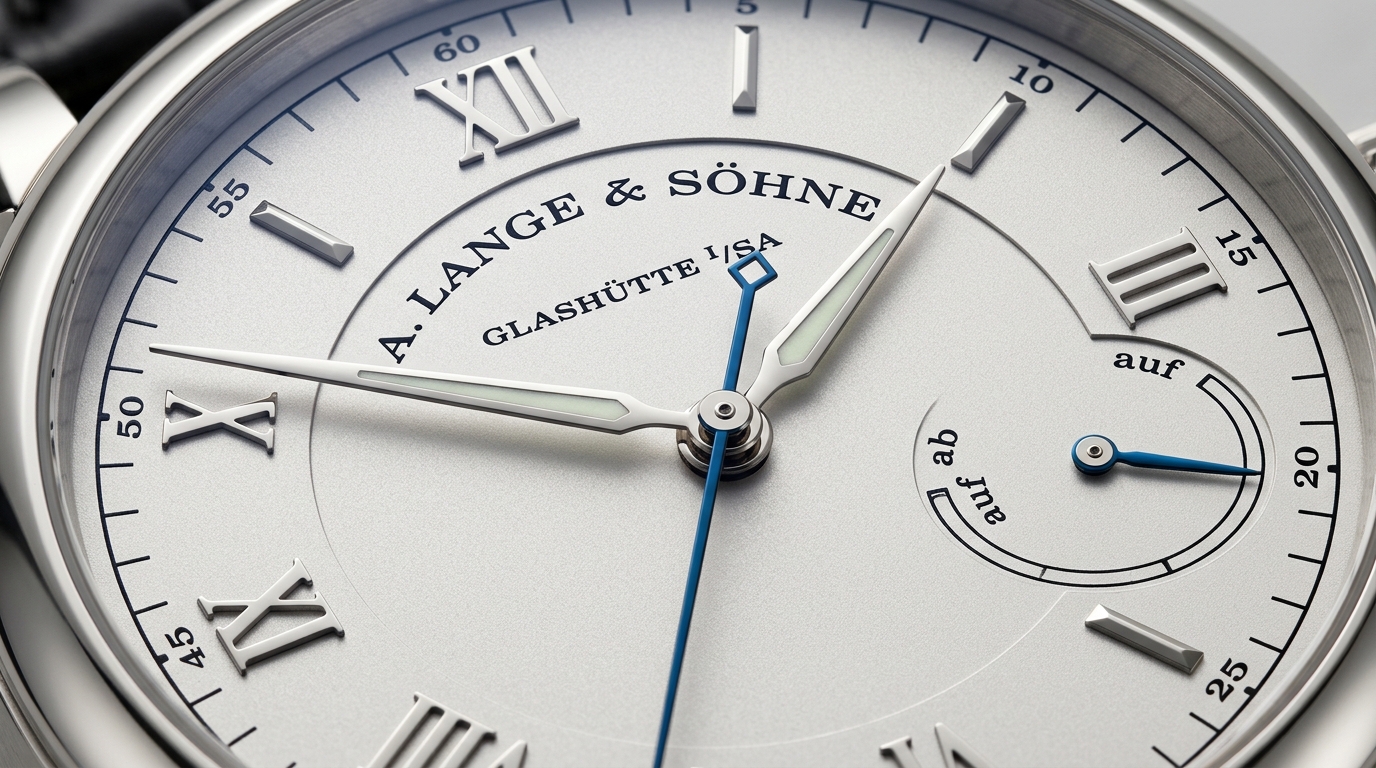
Lange’s complicated watches are not uniformly beautiful, and that is part of their credibility. The Double Split, introduced in 2004 with calibre L001.1, remains a landmark: the first mechanical wristwatch capable of split-seconds timing for both seconds and minutes up to 30 minutes. The Triple Split followed in 2018 with calibre L132.1, extending that principle to hours. These are not complications invented to fill a catalogue slot. They address a real mechanical limitation in the traditional rattrapante chronograph.
The Zeitwerk, launched in 2009 with calibre L043.1, was a different kind of risk. Its jumping digital display for hours and minutes, controlled by a constant-force mechanism, rejected the safe conservatism of the Lange 1 and Saxonia families. Early versions had modest power reserve and a polarising dial, but the watch gave Lange a credible modern complication. The Zeitwerk is especially important because many heritage manufactures struggle when leaving classical formats. Lange managed to produce something contemporary without becoming design-led in the superficial sense.
The brand’s most ambitious statement remains the Grand Complication of 2013, reference 912.032, produced in six pieces, with grande and petite sonnerie, minute repeater, split-seconds chronograph with jumping seconds, and perpetual calendar. At 50mm, it was never a normal wristwatch. It was a capability demonstration. More relevant to collectors are pieces such as the 1815 Rattrapante Perpetual Calendar, Lange 1 Tourbillon Perpetual Calendar, and the Richard Lange Pour le Mérite, all of which express the brand’s preference for mechanical density over visual spectacle.
Finishing as Architecture, Not Decoration
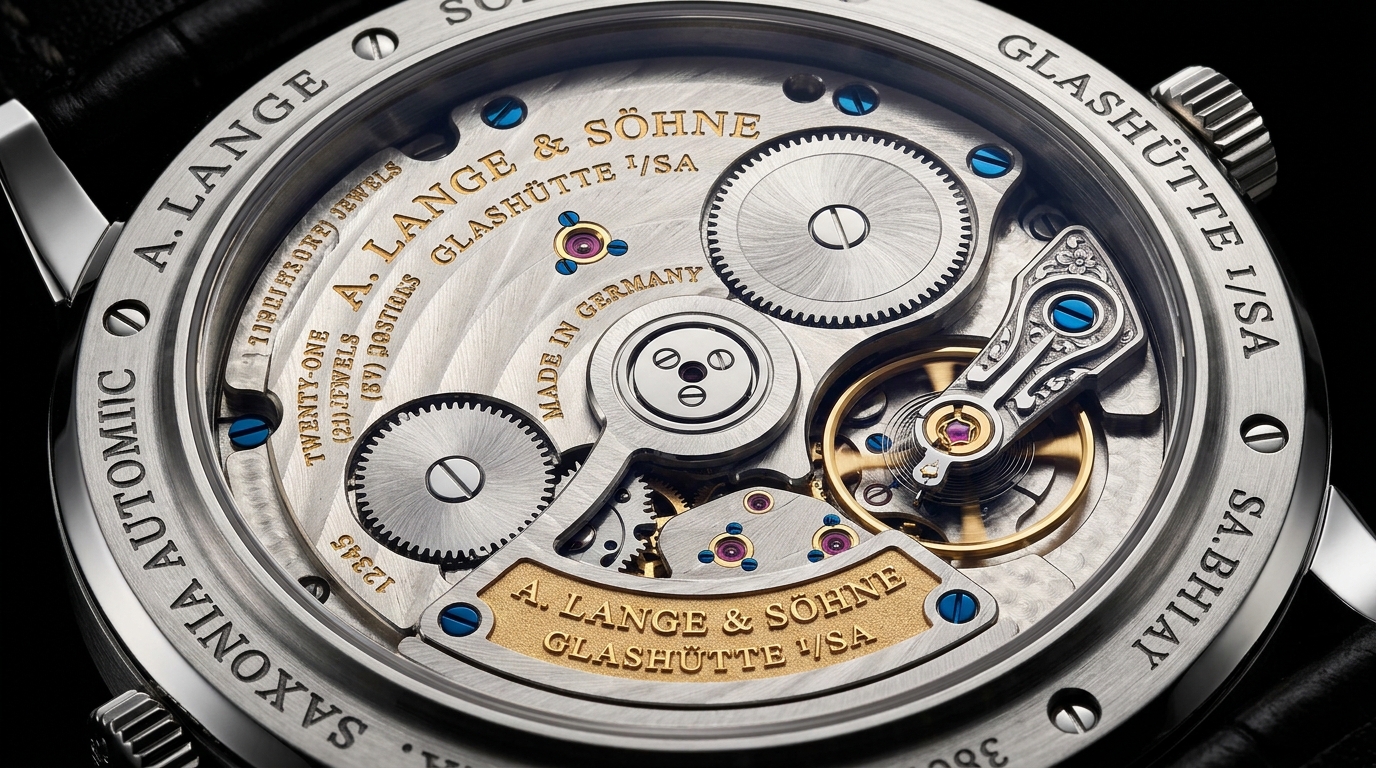
Lange finishing is often reduced to a checklist: German silver plates, Glashütte ribbing, polished bevels, gold chatons, blued screws, engraved balance cocks. The checklist is accurate but incomplete. What separates Lange from many high-end competitors is the integration between construction and finishing. The movements are built to be viewed, and the engineering surfaces are arranged with the display back in mind. This is not accidental ornament; it is architecture.
The twofold assembly process is central to the manufacture’s reputation. Movements are first assembled, adjusted, disassembled, cleaned, decorated, and then assembled again. That is laborious and expensive, but its importance is not merely romantic. Untreated German silver is visually warm but sensitive to handling; it develops patina and marks more readily than rhodium-plated brass. Lange’s process reflects the material choice. It also reinforces a culture in which finishing is part of production discipline rather than final embellishment.
There are legitimate criticisms. Lange cases historically lacked the sculptural nuance of the best Patek Philippe and Vacheron Constantin cases, especially in smaller dress references. The brand’s thick movements often produce thick watches: the Datograph, Zeitwerk, and many complicated pieces wear with more mass than their nominal elegance suggests. Yet these compromises are tied to the mechanical proposition. Lange generally chooses movement depth and visual calibre architecture over ultra-thin refinement. That is a strategic choice, not an oversight.
Richemont, Scarcity, and the Modern Collector Market
Richemont acquired LMH in 2000, bringing A. Lange & Söhne, IWC, and Jaeger-LeCoultre into the group. For Lange, the consequences were substantial: global distribution, capital investment, manufacturing stability, and a more deliberate retail strategy. The brand’s current production is widely estimated in the low thousands annually — commonly cited around 5,000 to 6,000 watches, though Lange does not publish exact figures. That scale is critical. Lange is not a mass luxury brand with haute horlogerie at the top. It is structurally small.
The shift toward boutique-controlled distribution has changed the buying experience. Highly demanded pieces — particularly steel Odysseus references, limited editions, Handwerkskunst models, and certain complicated watches — are effectively relationship products. This is not unique to Lange; Patek Philippe, Audemars Piguet, and Rolex have all normalised allocation hierarchies. The difference is that Lange’s market remains narrower. Its scarcity is real, but its global demand pool is more specialist. That makes the brand both fascinating and less forgiving on the secondary market.
During the 2020–2022 market surge, Lange benefited from collectors searching beyond the obvious integrated-bracelet sports watches. The Odysseus in steel, introduced in 2019 with calibre L155.1 Datomatic, traded at substantial premiums, helped by limited supply and the novelty of a Lange sports watch. Since the broader market cooled from 2022 onward, premiums have compressed, as they should have. The Odysseus remains significant, but not because every Lange should become a sports watch. Its importance is that it proved the brand could enter casual luxury without abandoning movement seriousness.
The Odysseus Problem
The Odysseus is the most disputed Lange of the modern period. The steel reference 363.179 introduced an integrated bracelet, 120 metres of water resistance, a day-date display, and an automatic movement with a partially openworked rotor. It was the first regular-production Lange in stainless steel and immediately became the brand’s market proxy, whether Lange wanted that or not.
Collectors who dismiss the Odysseus as opportunistic miss the point. Lange needed a watch that could speak to contemporary wear patterns without sacrificing its identity. But collectors who treat it as the brand’s central achievement are equally wrong. The Odysseus is strategically useful, not spiritually central. The essential Lange remains a precious-metal watch with a movement that justifies ownership under a loupe: Lange 1, Datograph, 1815, Saxonia, Richard Lange, Zeitwerk.
The more delicate concern is allocation distortion. When a brand known for intellectual watchmaking becomes partially defined by a steel sports model, it risks attracting buyers who value access more than substance. Lange has so far managed this better than some peers because production remains limited and the core catalogue stays serious. But the risk is real. The brand’s long-term credibility depends on collectors continuing to see the Odysseus as an extension, not a replacement thesis.
What to Buy: The Serious Lange Shortlist
For a collector approaching Lange with discipline, the shortlist is clear. The Lange 1 is the brand’s essential watch, preferably in a configuration that preserves the original design strength: 38.5mm case, balanced dial contrast, and precious metal. Early references with calibre L901.0 have historical appeal, while the post-2015 L121.1 models offer technical refinement and improved daily usability. Neither is automatically superior; the better choice depends on whether one values origin or execution.
The Datograph remains the connoisseur’s chronograph. The original 39mm reference 403.035 in platinum is the canonical version, especially for collectors who want the watch that altered modern chronograph expectations. The 41mm Up/Down is easier to live with and mechanically improved, but it lacks some of the compact intensity of the first model. Both are serious purchases, and neither should be bought merely because the market recognises the name. The Datograph rewards close study; it does not flatter casual ownership.
The 1815 line is arguably the most underrated entry into Lange’s worldview. The 1815 Up/Down offers symmetry, historical cues, and a manually wound movement without the visual assertiveness of the Lange 1. The 1815 Chronograph, especially later versions with cleaner dials and calibre L951.5, delivers much of the Datograph’s movement architecture without the oversized date. For some collectors, it is the purer chronograph. For others, the absence of the date removes the very tension that makes the Datograph distinctive.
Why Lange Matters More Than Its Output Suggests
A. Lange & Söhne matters because it changed the competitive standard for modern haute horlogerie. Before Lange’s return, the upper end of fine watchmaking was largely defined by Swiss continuity, Geneva Seal culture, and inherited prestige. Lange entered from Saxony with a broken history and made that rupture a strength. It did not pretend to be Swiss. It built a counter-language: three-quarter plates, German silver, outsized dates, engraved balance cocks, visible mechanical depth, and a seriousness that could feel almost severe.
That severity is not universally appealing. Lange watches can be heavy, thick, expensive to service, and conservative in case vocabulary. Secondary-market performance is uneven outside the best-known references, and the brand’s limited production does not automatically guarantee liquidity. These are not minor caveats. They are part of the ownership equation. Lange is a poor choice for the buyer who wants maximum recognisability or frictionless resale. It is a strong choice for the collector who values movement architecture, historical reconstruction, and a brand culture that still appears governed more by watchmaking logic than merchandising breadth.
The modern luxury watch market increasingly rewards symbols: steel scarcity, bracelet recognition, dial colour, waitlist status. Lange’s best watches resist that simplification. They ask to be evaluated from the back as much as the front, through calibre decisions as much as case diameter, through origin story as much as auction result. That is why the brand occupies a rare strategic position. It is not the oldest continuous manufacture, not the most commercially powerful, and not the easiest to explain across a dinner table. It is something more interesting: the most persuasive proof that high horology can be rebuilt from first principles.