F.P. Journe: The Strategic Genius and Market Risk of Modern Independent Watchmaking
F.P. Journe: The Strategic Genius and Market Risk of Modern Independent Watchmaking
F.P. Journe is not important because it is small. It is important because, in less than three decades, François-Paul Journe built what most independent watchmakers never achieve: a coherent technical language, a controlled commercial system, and a market that treats recent wristwatches with the seriousness usually reserved for mid-century Patek Philippe, early Breguet, or complicated Dufour. That combination is rare, fragile, and increasingly difficult to separate from financial speculation.
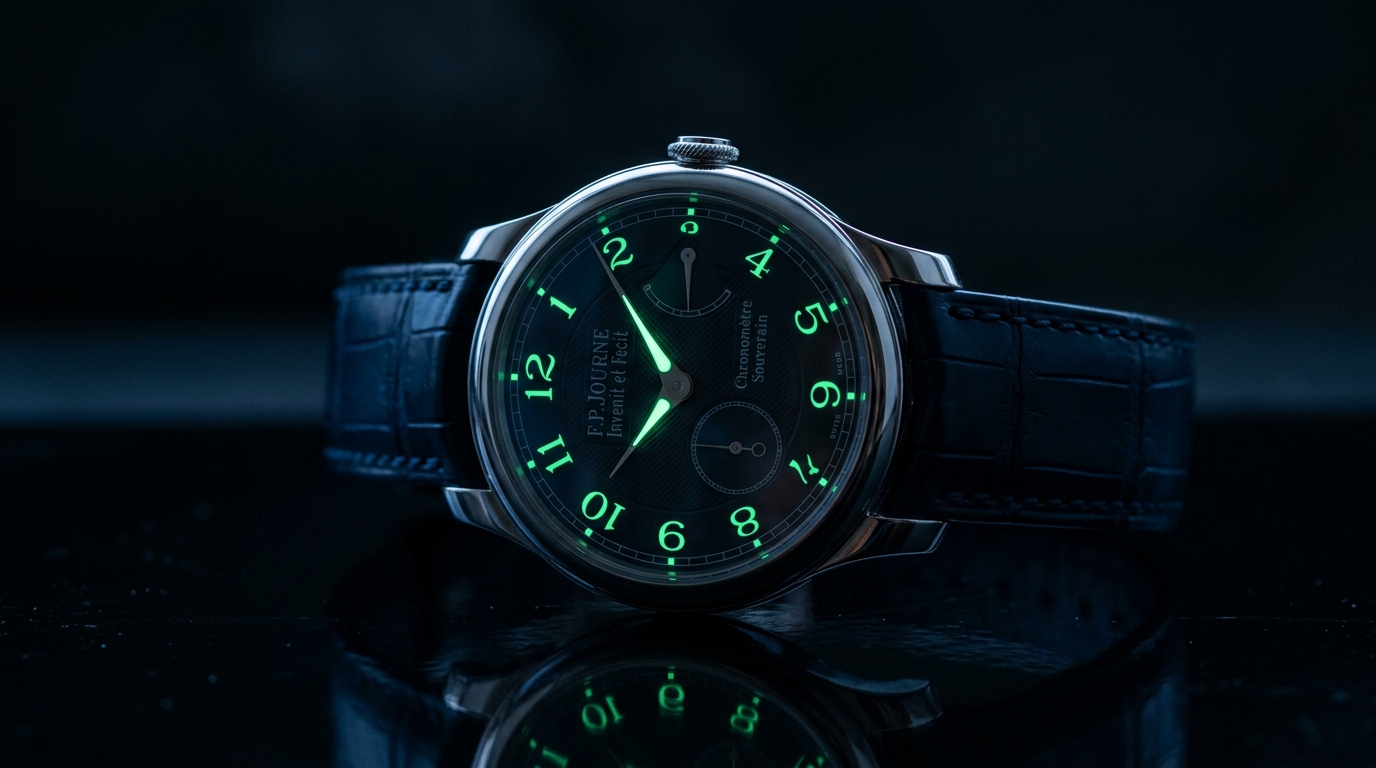
The brand’s power lies in a specific proposition: contemporary watchmaking with identifiable authorship. The inscription on the dial, “Invenit et Fecit” — invented and made — is not decorative Latin. It is the operating thesis of the company. Journe’s watches are not anonymous luxury objects assembled around generic complications. They are arguments in mechanical form: about resonance, constant force, autonomy, compactness, chronometric stability, and the historical duty of a modern watchmaker to improve rather than merely reproduce.
From Restoration Bench to Geneva Manufacture
François-Paul Journe was born in Marseille in 1957 and trained at the École d’Horlogerie de Paris before spending formative years restoring important historical clocks and watches. That matters because the brand is often discussed as if it appeared fully formed during the independent boom of the 2000s. It did not. Journe’s early career was rooted in Breguet, Janvier, marine chronometry, and the mechanics of precision timekeeping before electronic convenience made such problems commercially irrelevant.
His first pocket watch, completed in the early 1980s, was a tourbillon with remontoir d’égalité inspired by George Daniels’ work and by nineteenth-century chronometry. This was not a schoolboy exercise in finishing. It established the theme that would later define the brand: take an old chronometric problem, reduce it to its mechanical essence, then make it wearable. In 1999, Montres Journe SA was founded in Geneva. The timing was almost perfect. Mechanical watch collecting was globalising, the internet was making niche expertise portable, and collectors were beginning to look beyond the holy trinity of Swiss maisons for originality.
The first commercial act was unusually sophisticated. The Tourbillon Souverain à Remontoir d’Égalité was launched through a subscription model: early supporters paid in advance, and the now-fabled Souscription pieces established immediate collector intimacy. The idea echoed Abraham-Louis Breguet’s historical subscription watches, but in 1999 it also solved a practical problem for an independent with limited industrial capital. Journe converted trust into production funding, and production funding into scarcity with provenance.
The Early Brass Movements: Foundation, Not Footnote
Collectors correctly obsess over early F.P. Journe watches with brass movements, but the premium is not simply nostalgia. Until 2004, Journe used rhodium-plated brass movements. The later move to 18k rose-gold calibres became one of the brand’s signatures, but the brass era is the purer historical record: Tourbillon Souverain, Chronomètre à Résonance, Octa Réserve de Marche, Octa Calendrier and early Chronomètre Souverain configurations that show the manufacture still formalising its codes.
The 1999 Tourbillon Souverain with remontoir d’égalité set the pattern. It was not merely a tourbillon, a complication already overused by the early 2000s. The remontoir was the point. By delivering more consistent force to the escapement, Journe tied the visual theatre of the tourbillon back to chronometry. That distinction still separates serious Journe collecting from generic complication collecting. The mechanism had a reason to exist.
The Chronomètre à Résonance, introduced in 2000, made an even stronger claim. Inspired by Antide Janvier and Abraham-Louis Breguet, it used two independent movements placed close enough for the balances to influence each other through resonance, with the aim of greater rate stability. Whether every owner has the patience or instruments to observe the effect is almost secondary. The watch matters because it proposed a wristwatch-scale solution to one of horology’s most intellectually seductive phenomena. Early examples with 38mm cases and brass movements are now among the keystones of modern independent collecting.
The Octa Was the Business Masterstroke
If the Tourbillon and Résonance gave Journe credibility, the Octa gave the company structure. Introduced in 2001, the automatic Octa calibre 1300 delivered a long power reserve — around five days — from a compact architecture designed to host multiple indications without changing the fundamental movement dimensions. This was a strategic decision as much as a technical one. Small manufactures survive when they can develop families, not isolated masterpieces.
The Octa Réserve de Marche, Octa Calendrier, Octa Lune, Octa Chronographe and later variations allowed Journe to build variety while preserving manufacturing discipline. The system created recognisable asymmetry: off-centre time displays, large date indications, power reserve sectors, moon phases and calendars arranged with a logic that is unmistakably Journe. The designs are not classically balanced in the Patek Philippe sense; they are architecturally balanced in the Journe sense, which is more interesting and sometimes less immediately comfortable.
This is also where Journe’s commercial intelligence becomes clear. Many independents make watches that collectors admire but boutiques struggle to sell consistently. The Octa line gave the brand daily-wear relevance without diluting the intellectual capital of the Tourbillon and Résonance. It is the reason F.P. Journe became a manufacture rather than a cult workshop.
Gold Movements and the Creation of a House Code
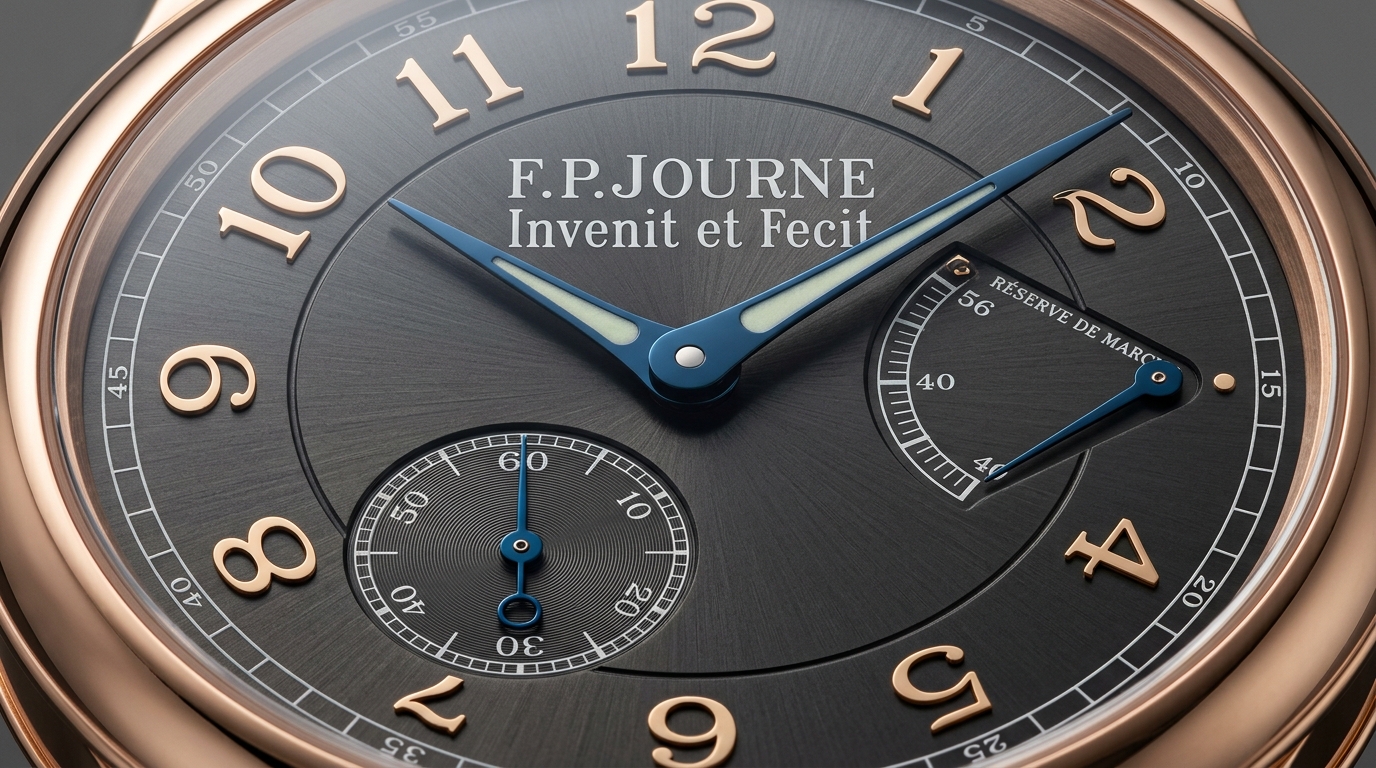
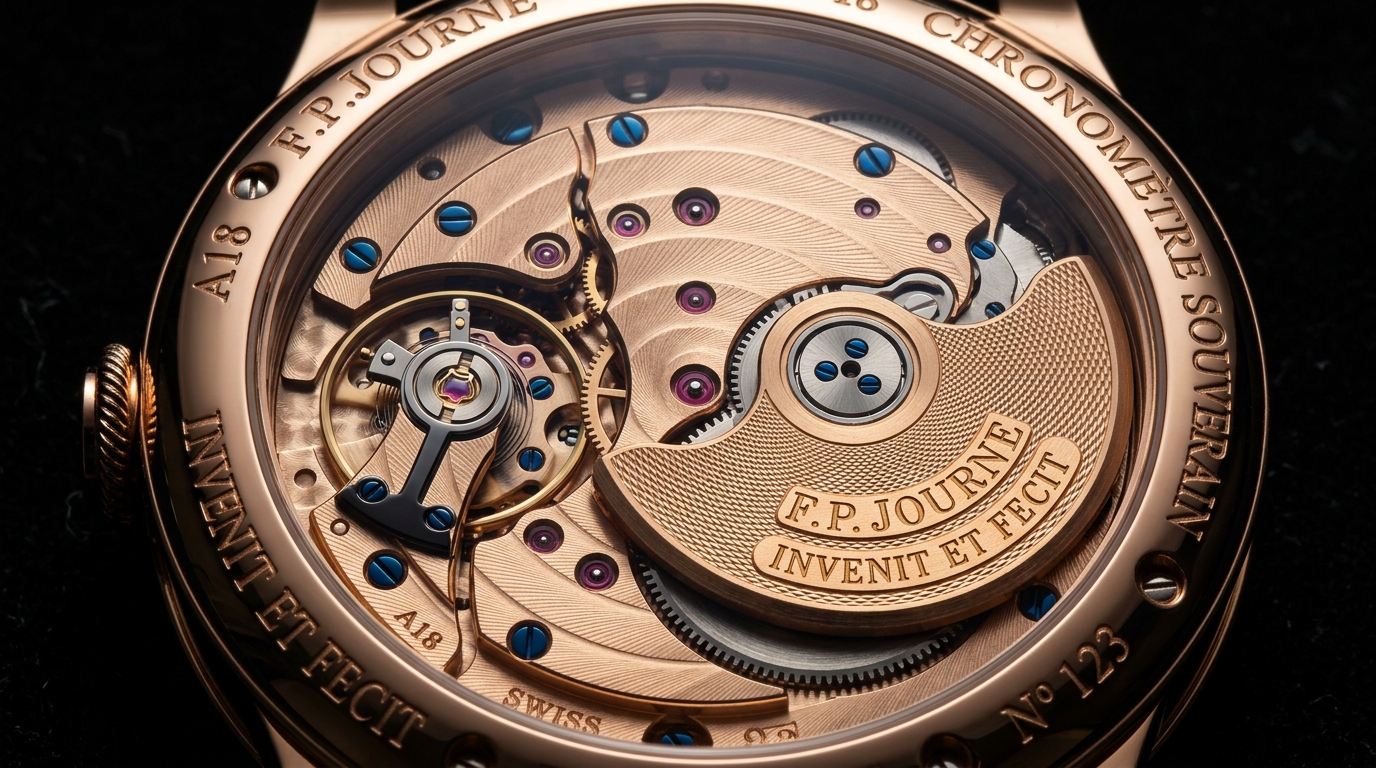
In 2004, Journe began producing movements in 18k rose gold, an expensive and technically less forgiving material than brass. The decision is often described as romantic, but its brand logic was exact. A rose-gold calibre made the product harder to imitate, immediately recognisable through a display back, and materially aligned with the price architecture of the maison. It turned the movement itself into identity.
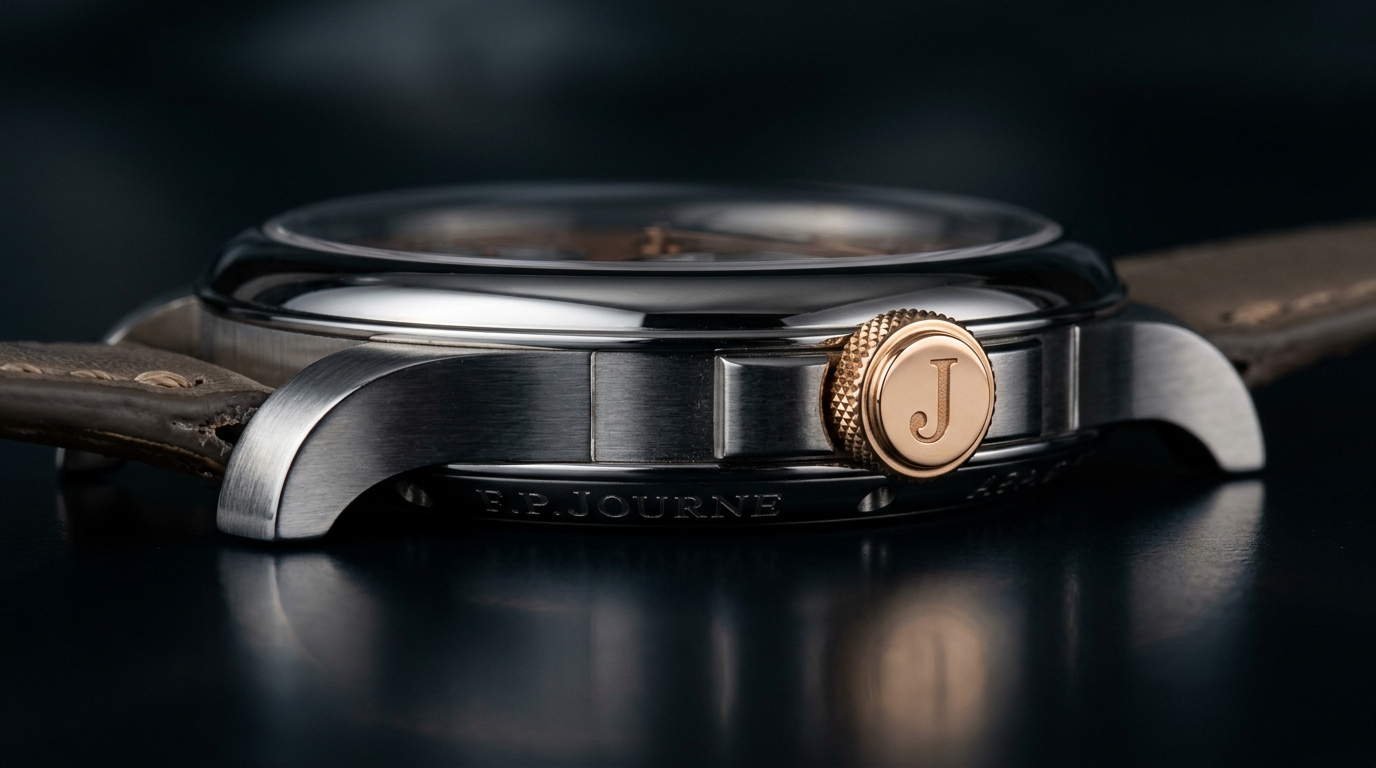
This period also refined the case and dial grammar: flat bezels, elegant but slightly severe typography, offset indications, blued hands, guilloché or matte dial textures, and cases usually ranging from 38mm to 42mm. The best Journe watches have a tension between warmth and austerity. They are precious without being soft. The brand’s platinum-cased watches, especially with white-gold or ruthenium dials, can feel almost academic; rose-gold cases with gold movements are richer, sometimes more persuasive, but occasionally less sharp.
The Chronomètre Souverain, introduced in 2005, remains one of the clearest expressions of Journe’s philosophy. Its calibre 1304 is manually wound, slim, symmetrical enough to satisfy traditionalists, and equipped with twin barrels for stable delivery rather than headline power reserve. It is not the most exotic Journe, but it may be the most disciplined. In a catalogue full of conceptual watches, the Chronomètre Souverain asks a harder question: can a simple watch justify itself through execution and chronometric seriousness? In this case, yes.
Complication as Argument: Sonnerie, Centigraphe, Astronomic
Journe’s complicated watches are strongest when they avoid complication for its own sake. The Sonnerie Souveraine, launched in 2006 after years of development, is the clearest example. Grande sonnerie wristwatches are notoriously difficult because the mechanism must manage sound, energy, safety and user error. Journe’s solution used multiple security systems to prevent mishandling and won the Aiguille d’Or at the Grand Prix d’Horlogerie de Genève in 2006. It was a commercial impossibility by mass-market standards, but a reputational necessity: it placed the brand in the small circle of modern makers capable of truly difficult horology.
The Centigraphe Souverain of 2007 was more controversial and arguably more Journe. The calibre 1506 displayed elapsed times down to one-hundredth of a second, with dials for one second, twenty seconds and ten minutes. It did not function like a conventional high-frequency chronograph, and that is partly why it remains misunderstood. The watch is less a sports chronograph than a mechanical essay on reading fractions of time. Its rocker-style chronograph actuator at two o’clock, patented architecture and extreme dial layout make it one of the most distinctive chronographs of the modern era, even if legibility is not its strongest virtue.
The Astronomic Souveraine, derived from the Astronomic Blue unique piece sold at Only Watch 2019 for CHF 1.8 million, shows Journe at maximal density: tourbillon, remontoir d’égalité, minute repeater, annual calendar, equation of time, sidereal time, sunrise and sunset indications, moon phase and second time zone. The production Astronomic is not subtle, but it is important because it demonstrates the brand’s ability to scale from chronometer to grand complication without outsourcing its intellectual centre.
The Chronomètre Bleu Problem
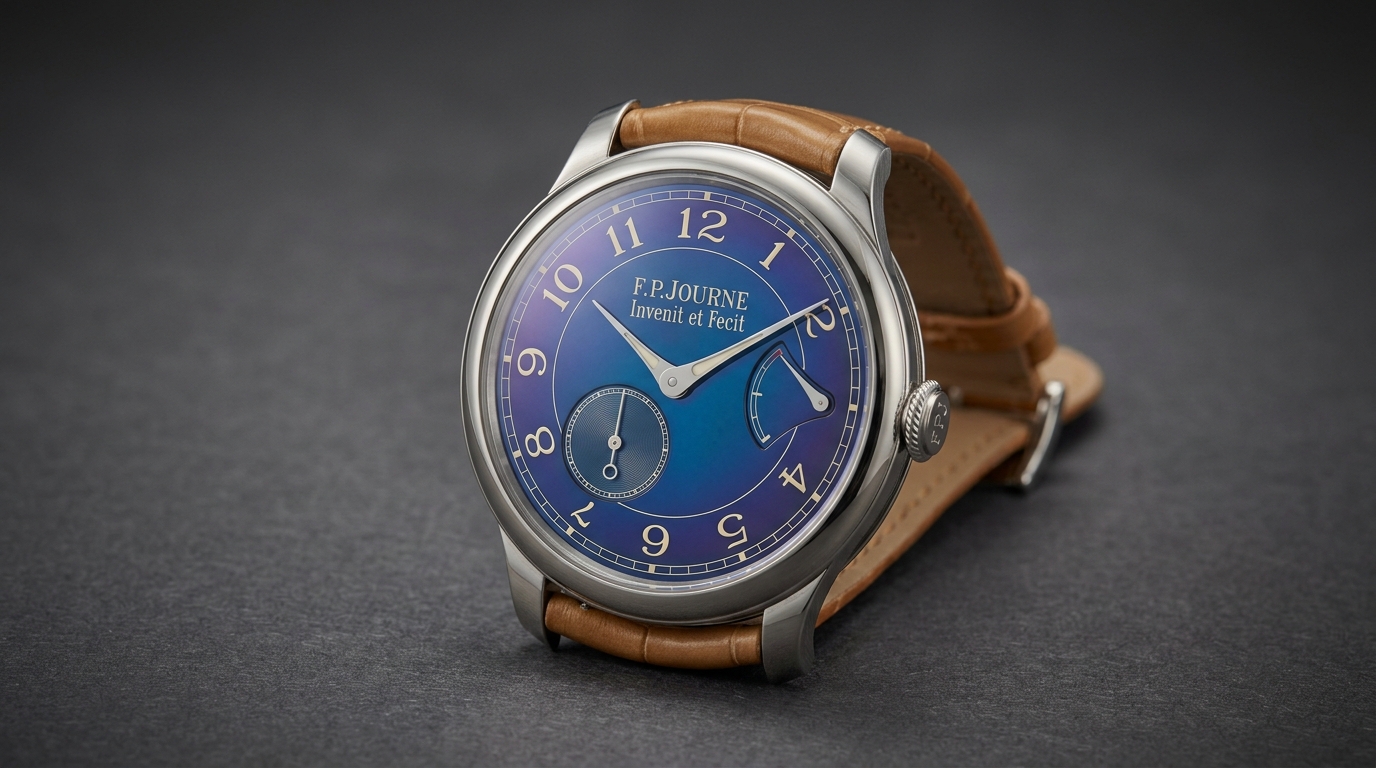
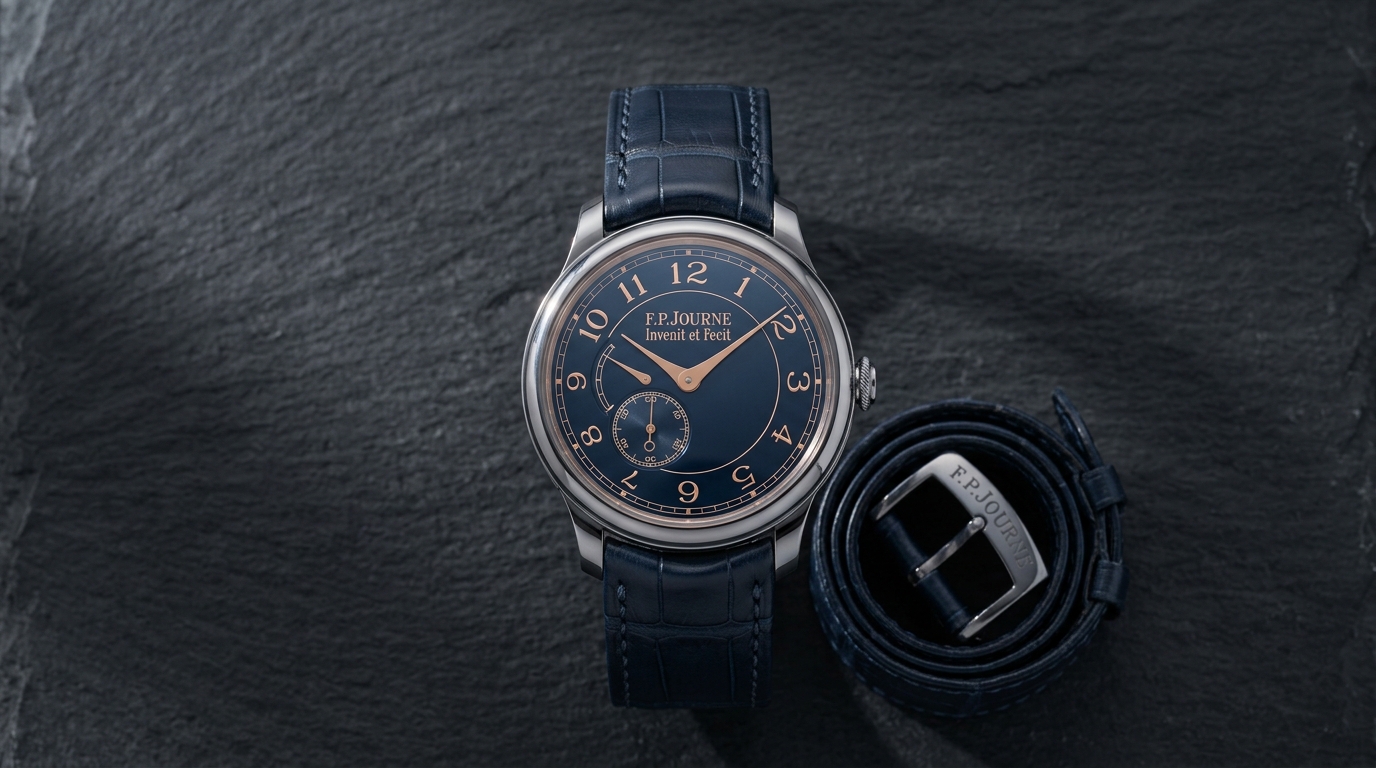
No modern F.P. Journe better illustrates the brand’s success and its risks than the Chronomètre Bleu. Introduced in 2009, it pairs a tantalum case with a reflective blue dial and the manually wound calibre 1304.2 in rose gold. On paper, it was a relatively accessible entry into the brand. In the market, it became a symbol of scarcity, taste and speculation.
The watch is excellent. Tantalum is dense, difficult to machine and gives the case a grey-blue tone that suits the dial. The movement is serious, the 39mm size is right, and the design manages to be recognisable without relying on complication. But the secondary-market escalation of the Chronomètre Bleu — especially during the 2020–2022 independent-watch surge — distorted the watch’s meaning. When a three-hand chronometer trades primarily as a supply-constrained asset, the conversation risks moving from horology to allocation politics.
This is not unique to Journe. Philippe Dufour Simplicity, early De Bethune, Kari Voutilainen and certain Rexhep Rexhepi pieces have all been pulled into the same collector economy. The difference is that Journe has enough production scale and brand infrastructure to look partly like a maison and partly like an independent atelier. That hybrid status amplifies demand. Buyers feel they are acquiring both a personal watchmaker’s authorship and an institutional brand with durability.
Ownership, Chanel and the Question of Independence
In 2018, Chanel acquired a minority stake in F.P. Journe, widely reported at 20 percent. This caused predictable anxiety among collectors, but the reaction was mostly misplaced. Chanel’s watch investments have generally been more patient than interventionist; the company also owns stakes in Romain Gauthier and Bell & Ross and has developed serious manufacturing capabilities through G&F Châtelain. The important point is not that Journe ceased to be independent. It is that independence, at this level, requires capital discipline.
Journe’s production is commonly estimated at under 1,000 watches per year, often cited around 900, though the brand does not treat volume disclosure as a public ritual. That scale is large enough to sustain boutiques in Geneva, Paris, Tokyo, Hong Kong, New York and other strategic cities, but small enough that allocation remains central to the ownership experience. Chanel’s minority position gives the company stability without obviously changing the product language. So far, the watches still read as Journe, not as luxury-group output.
The more interesting issue is succession. F.P. Journe is a founder-led brand whose desirability depends heavily on the living authority of François-Paul himself. Chanel’s involvement can be read as an insurance policy against the fragility that haunts independent watchmaking. Collectors may prefer the romance of total autonomy, but brands require payroll, service capacity, inventory control, legal protection and long-term parts support. A watch bought for six figures should not depend on myth alone.
Design Discipline and the Limits of Eccentricity
F.P. Journe’s design is often called idiosyncratic, which is accurate but insufficient. The better description is disciplined eccentricity. The dials are asymmetrical, but not random. The typography is slender and recognisable. The cases are restrained enough to keep the mechanics central. Even the Élégante, launched in 2014 with an electro-mechanical quartz movement and motion-detection sleep function, fits the broader logic: efficiency, autonomy and wearability expressed through an unconventional technical solution.
The Élégante is worth taking seriously because it shows Journe refusing a simplistic mechanical purism. The calibre 1210 and its larger variants stop after a period of inactivity and reset to the correct time when moved, preserving battery life for years. It is not a mechanical watch, but it is a Journe solution to a practical problem. For some collectors, that makes it inadmissible. For a more rigorous observer, it proves that the brand is interested in horological reasoning, not just in traditional escapements.
Still, the catalogue is not beyond criticism. Some dials are busier than they need to be. Some LineSport models, despite impressive aluminium and titanium case experiments, have never carried the same intellectual force as the Souveraine pieces. The rubber inserts, aggressive bracelets and high-performance positioning can feel like an answer to a question Journe did not need to ask. The best F.P. Journe watches are not sporty; they are intense.
The Market: Scholarship, Scarcity and Speculation
The secondary market for F.P. Journe has matured quickly, perhaps too quickly. Early brass-movement pieces, Souscription Tourbillons, Souscription Résonance watches, ruthenium-dial limited series and rare boutique editions command serious auction attention. Phillips, Christie’s and Sotheby’s have all played roles in institutionalising the category. The result is greater transparency, but also greater financialisation.
The key distinction for collectors is between scarcity that reflects horological importance and scarcity that reflects distribution friction. A 38mm brass-movement Chronomètre à Résonance is historically important because it belongs to the formation of the brand’s central idea. A discontinued dial variant may be desirable, but not necessarily consequential. The market does not always separate those categories cleanly, especially when new collectors enter through price charts rather than mechanical understanding.
Journe has also benefited from a broader shift away from establishment maisons. During the last decade, many experienced collectors became fatigued by industrial luxury: endless steel sports-watch waiting lists, anniversary editions with minor cosmetic changes, and corporate storytelling inflated beyond the watches themselves. Journe offered authorship, scarcity and real mechanical content. That appeal was justified. The danger is that the brand now attracts some of the same behaviour it originally provided an escape from.
What to Collect, and Why
The strongest F.P. Journe collecting strategy begins with the idea, not the colour. The Tourbillon Souverain matters because of constant force. The Chronomètre à Résonance matters because of dual independent regulators and the pursuit of resonance. The Octa matters because it created a modular automatic platform with long autonomy. The Chronomètre Souverain matters because it distils precision watchmaking into a restrained manual-wind form. The Centigraphe matters because it rethinks elapsed-time display. These are durable reasons.
Within that framework, early brass movements deserve their premium, especially in original condition with correct dials, cases, buckles, certificates and service history. Case size matters: 38mm examples often carry stronger collector appeal because they reflect the original proportions before the market moved toward larger watches. Rose-gold movement pieces should not be treated as lesser; in many cases they are better daily ownership propositions, and they define the mature house style. But they are different objects historically.
Condition scrutiny is essential. Journe dials can be expensive and consequential to replace. Polishing can damage the flat geometry that gives the cases their character. Service documentation from F.P. Journe is particularly important because independent complicated watches require specialist care. A bargain complicated Journe without clear service history is rarely a bargain. It is deferred risk in platinum or gold.
The Editorial Verdict
F.P. Journe is the most strategically complete independent watch brand of the modern era. Philippe Dufour may represent a higher ideal of artisanal finishing; Voutilainen may offer more classical handcraft; De Bethune may be more daring in materials and case architecture; Greubel Forsey may pursue finishing and three-dimensional complication with greater extravagance. Journe’s advantage is synthesis. He built a language, a manufacture, a distribution model and a collector culture around a set of technical convictions.
That achievement should not be softened into admiration without critique. The brand’s market has become expensive enough that some watches are now judged less by what they do than by how difficult they are to obtain. That is unhealthy, though not fatal. The remedy is to return to the mechanics. Journe watches are most convincing when collected as inventions, not trophies.
The enduring value of F.P. Journe will not rest on blue dials, boutique access or auction theatre. It will rest on whether future collectors still see the Tourbillon Souverain, Chronomètre à Résonance, Octa calibre 1300, Chronomètre Souverain and Sonnerie Souveraine as serious contributions to watchmaking history. On that question, the evidence is already substantial. Journe did not merely join the independent movement. He gave it a business model, a visual grammar and a technical spine.
For collectors, the conclusion is clear: buy F.P. Journe only when the watch’s mechanical argument is legible to you. The brand rewards knowledge and punishes fashion. At its best, it offers something still uncommon in contemporary luxury watchmaking — not the illusion of heritage, but the creation of it in real time.