Casio and the Strategic Value of the Anti-Luxury Watch
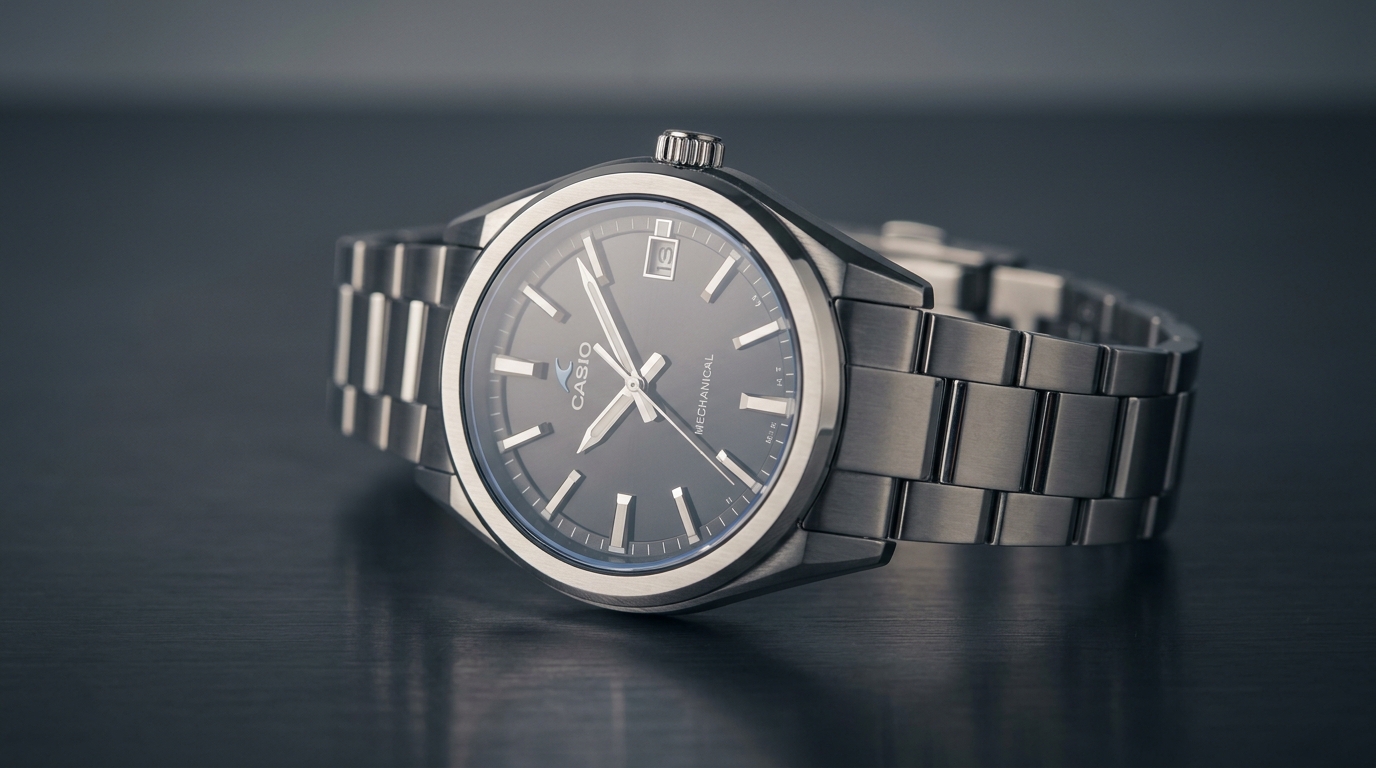
Casio and the Strategic Value of the Anti-Luxury Watch
Casio is not a mechanical watchmaker, which is precisely why it matters to serious watch collecting. The Japanese company has spent five decades doing something most luxury brands only claim to do: making watches that earn loyalty through function, price discipline, technical consistency and cultural endurance. A Casio F-91W is not prestigious in the conventional sense, and a G-Shock DW-5600E will not satisfy anyone looking for anglage or column wheels. But if the purpose of a watch is to survive daily use, keep time accurately, and remain legible in a world where most expensive watches are now symbolic objects, Casio is one of the most strategically important names in horology.
That is not a sentimental argument. Casio’s strength is structural. The company is an independent Japanese electronics manufacturer, founded as Kashio Seisakujo in 1946 and incorporated as Casio Computer Co., Ltd. in 1957 by the Kashio brothers. Unlike Seiko, Citizen or Swatch Group, Casio did not enter watches from a traditional horological base. It approached the wrist as a problem of electronic miniaturisation, display, shock protection, sensor integration and mass production. Its best watches are not substitutes for mechanical watches. They are a critique of them.
From Calculator Company to Wrist Utility
Casio’s first wristwatch, the Casiotron QW02 of 1974, arrived at the correct moment. The Swiss watch industry was already under pressure from quartz technology, and Japanese firms were rewriting the economics of timekeeping. Seiko had launched the Astron in 1969; Citizen was pushing quartz at scale; LCD displays were becoming viable. Casio’s angle was not the quartz analogue watch, but the digital watch as a computer-like object. The QW02’s selling point was not merely accuracy. It could automatically account for months of different lengths, a practical calendar function that signalled where Casio would go: the wristwatch as a small programmable instrument.
This matters because Casio’s watch identity was formed outside the grammar of Swiss prestige. There was no need to imitate Geneva, Glashütte or Le Locle. The company had already built calculators, including the 14-A relay calculator in 1957 and a long run of compact electronic models in the 1960s and 1970s. By the time Casio placed digital technology on the wrist, it was extending an existing competence rather than chasing a trend. That explains the coherence of the catalogue: calculator watches, Databank models, world timers, sensor watches, radio-controlled solar models and connected G-Shocks all come from the same corporate habit of turning electronic functions into inexpensive, durable products.
The C-80 calculator watch of 1980 and the CD-40 Databank of 1983 look quaint now, but they were not novelty watches in their own market context. They represented a period when the wrist was still a plausible place for personal data and calculation. Today they are collected partly for nostalgia, but their real historical significance is clearer: Casio normalised the idea that a watch could do more than display time without becoming precious, fragile or expensive.
G-Shock: A Better Idea Than a Luxury Sports Watch
If Casio has one defining invention, it is G-Shock. The original DW-5000C, released in April 1983, was developed under engineer Kikuo Ibe after he broke a watch given to him by his father. The “Triple 10” target is now well known: 10-year battery life, 10-bar water resistance and survival from a 10-metre fall. More important was how Casio achieved it. The DW-5000C used a hollow case structure, floating module and protective resin exterior to manage shock. Its stainless-steel inner case and screw-back construction gave the first model a seriousness that later inexpensive resin models sometimes obscure.
The original DW-5000C used module 240 and established the square G-Shock form that remains Casio’s most disciplined design. The modern collector does not need to romanticise this watch to understand its importance. It created a design language where function dictated the silhouette: raised bezel to protect the crystal, recessed pushers, legible digital display, strap integrated into the case structure. Most luxury sports watches are sold through associations with athleticism and durability. G-Shock made durability the engineering premise rather than the advertising premise.
This is why the square G-Shock remains Casio’s strongest collector proposition. The DW-5600C of 1987 continued the square lineage, while the DW-5600E, introduced in the 1990s and long sold with module 1545, became the affordable standard. The Japanese-market GW-5000 series restored a more substantial screw-back case with solar charging and radio control; the GW-5000U, using module 3495, is arguably the modern purist’s G-Shock because it preserves the original architecture while eliminating the weaknesses of battery dependency and non-synchronised quartz drift. It is not luxurious, but it is deeply resolved.
The Cheap Casio Is Not a Joke
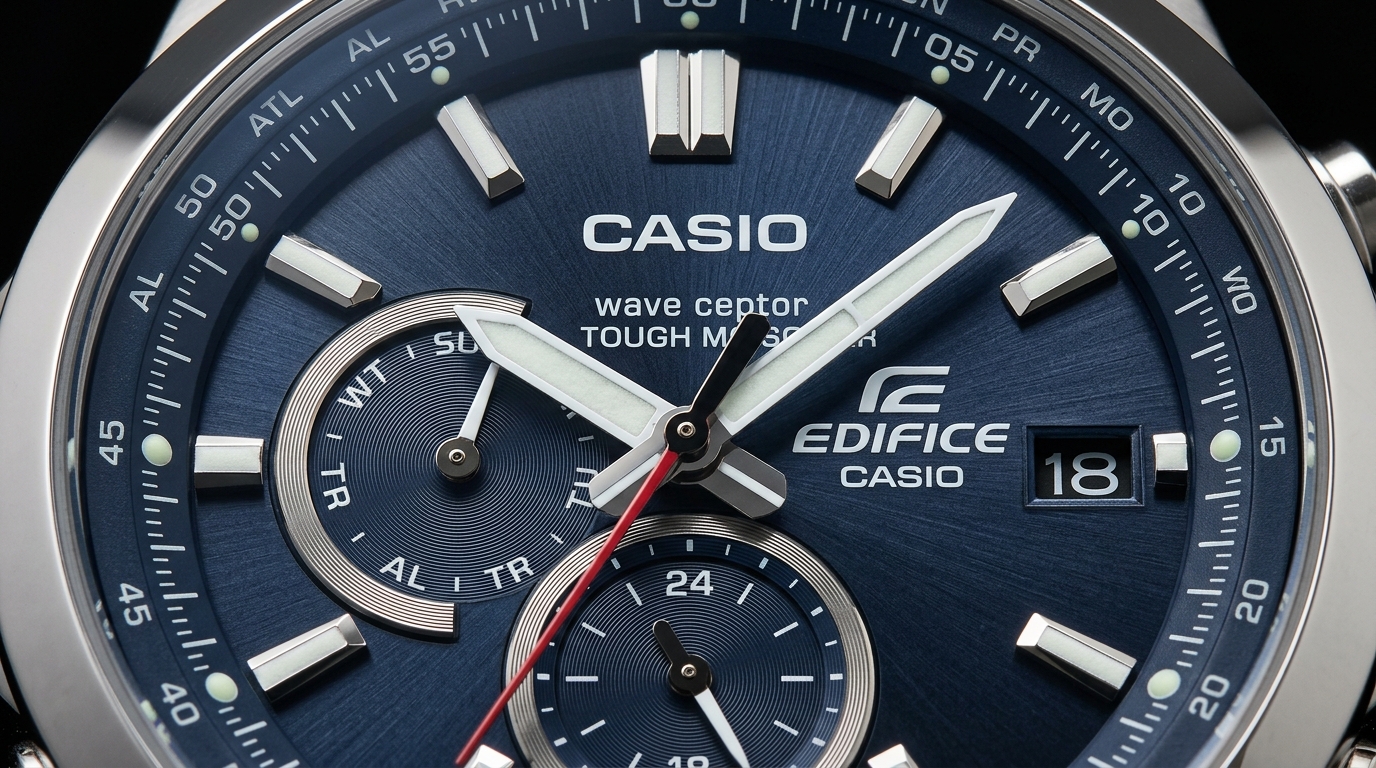
The mistake many collectors make is treating inexpensive Casios as ironic accessories. The F-91W, introduced in 1989 and associated with module 593, deserves more rigorous treatment. It is a thin resin-cased digital watch with stopwatch, alarm, calendar and LED light, usually available for under 25 dollars. Its water resistance is modest, its illumination is poor by modern standards, and its strap is not romantic. Yet it has achieved something most watch brands would pay heavily to manufacture: global recognisability without dependency on luxury distribution.
The F-91W is an industrial object that exposes the difference between cost and value. It is inexpensive because Casio mastered scale, module standardisation and resin manufacturing, not because it lacks identity. Its design has barely changed because it does not need to. The same logic applies to the A158W and A168W metal-look digital models, which package similar digital utility into plated resin or stainless-steel bracelet forms that became visual shorthand for late-20th-century electronics. These are not heirloom watches, but neither are they disposable in the cultural sense. Their persistence is a form of validation.
Casio’s low-cost catalogue also contains one of the least pretentious cult watches of the last decade: the AE-1200WH, commonly nicknamed the “Casio Royale.” Using module 3299, it offers world time, alarms, stopwatch, countdown timer and a distinctive multi-window display at a price that often sits below 40 dollars. The James Bond nickname is unserious, but the watch itself is not. It shows Casio’s continuing ability to make functional complexity legible and cheap. In an industry where a second time-zone often becomes a four-figure complication, the AE-1200 is a useful corrective.
Casio’s Serious Technical Lineage: Solar, Radio, GPS and Sensors
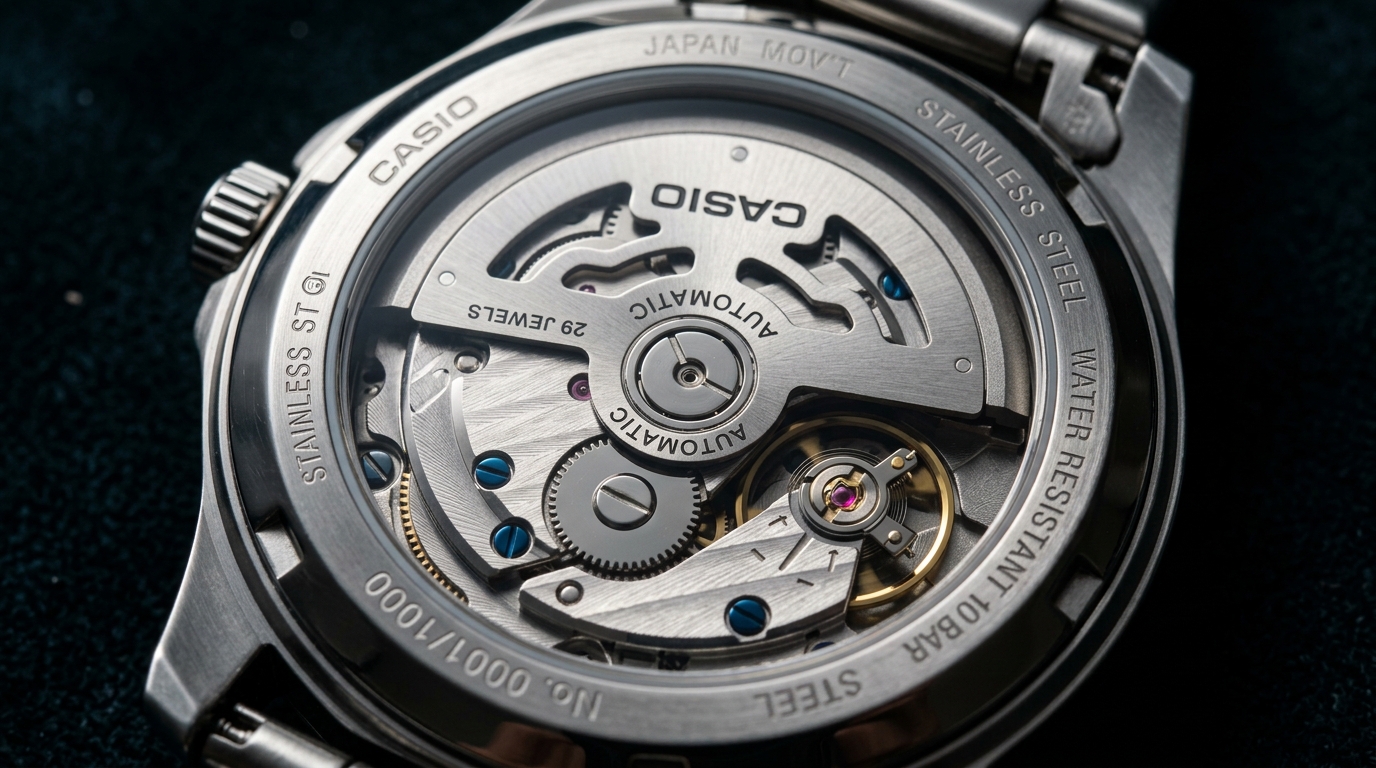
Casio’s technological development after the first G-Shock is sometimes reduced to a sequence of features, but the pattern is strategic. The company identified the main weaknesses of quartz watches — battery replacement, isolated accuracy, environmental limitations and limited analogue display utility — and addressed them incrementally. Tough Solar reduced battery maintenance. Multi Band radio control corrected timekeeping through terrestrial signals in Japan, North America, Europe and China. Bluetooth and GPS later provided alternatives when radio coverage was insufficient. None of this is romantic, but it is practical engineering directed at ownership convenience.
The Pro Trek line, introduced in the 1990s, took Casio’s sensor strategy into the outdoor category. The 1994 ATC-1100, one of the earliest Triple Sensor models, combined altimeter, barometer/thermometer and compass functionality. Later Pro Trek references refined the package with improved sensors, solar charging and more wearable cases. These watches are not substitutes for dedicated instruments in extreme professional contexts, but they are credible field tools. They also demonstrate a distinction often missed in luxury watch discussions: a watch can be technically ambitious without being mechanically complex.
G-Shock’s technical branch followed the same logic at higher durability thresholds. Frogman models, beginning with the DW-6300 in 1993 and followed by the titanium-cased DW-8200 in 1995, built a specialist identity around ISO-rated diving capability and asymmetric case protection. The Rangeman GW-9400 of 2013 became a benchmark for solar, radio-controlled, sensor-equipped G-Shock utility. The GPR-B1000 Rangeman of 2018 added GPS navigation with solar-assisted operation, a technically interesting but bulky watch that showed both Casio’s ambition and the ergonomic limits of feature accumulation.
Oceanus and MR-G: The Problem of Premium Casio
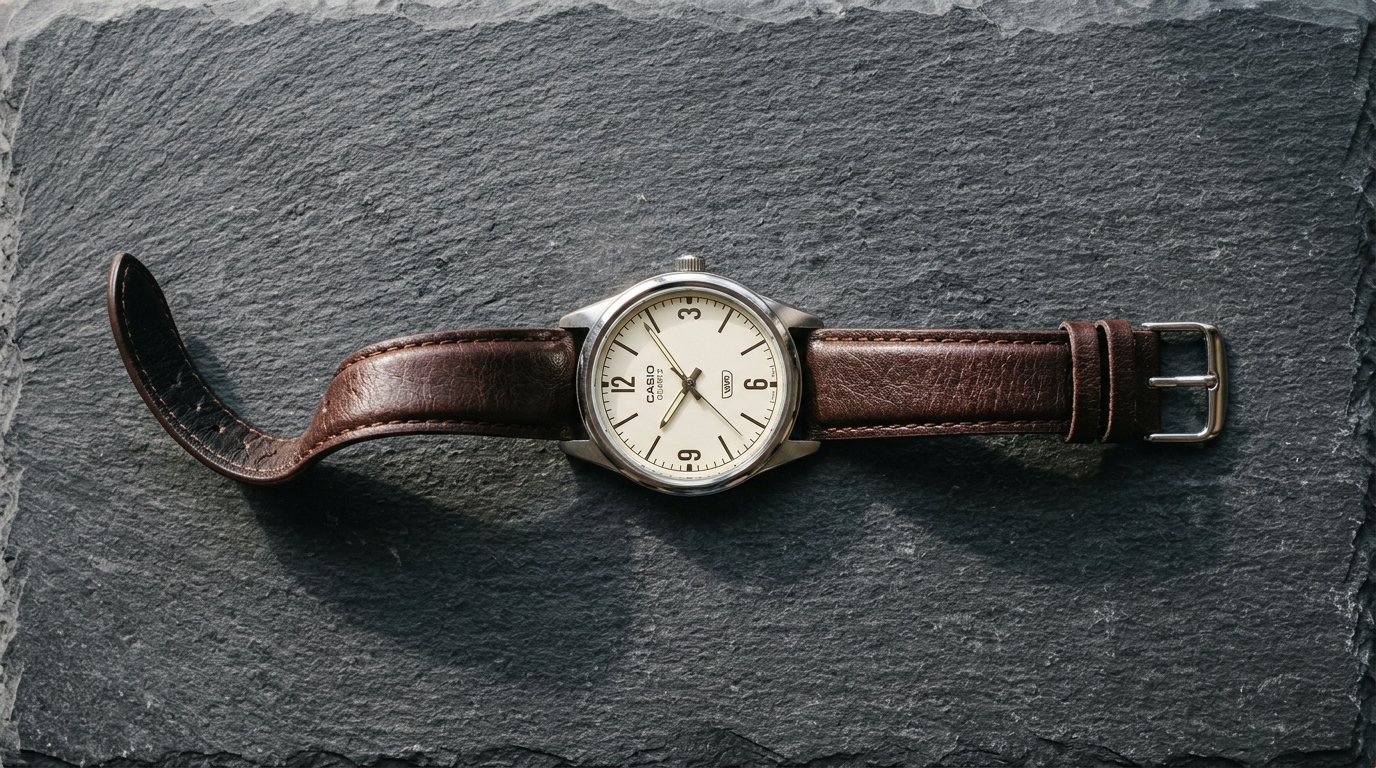
Casio’s move upmarket is more complicated. Oceanus, launched in 2004, is Casio’s cleanest attempt at a premium, adult watch line without the aggressive armour of G-Shock. Models such as the OCW-S100 and OCW-T200 combine titanium or steel cases, sapphire crystals, solar charging and radio-controlled or Bluetooth-corrected timekeeping. The design language is restrained by Casio standards, and the finishing is often better than sceptics expect, particularly in the Japanese domestic market. Oceanus is not a Grand Seiko rival, and Casio should not pretend otherwise. Its case finishing lacks the hand-finished drama of Zaratsu-polished Grand Seiko cases, but its value lies in trouble-free precision and low maintenance rather than artisanal finishing.
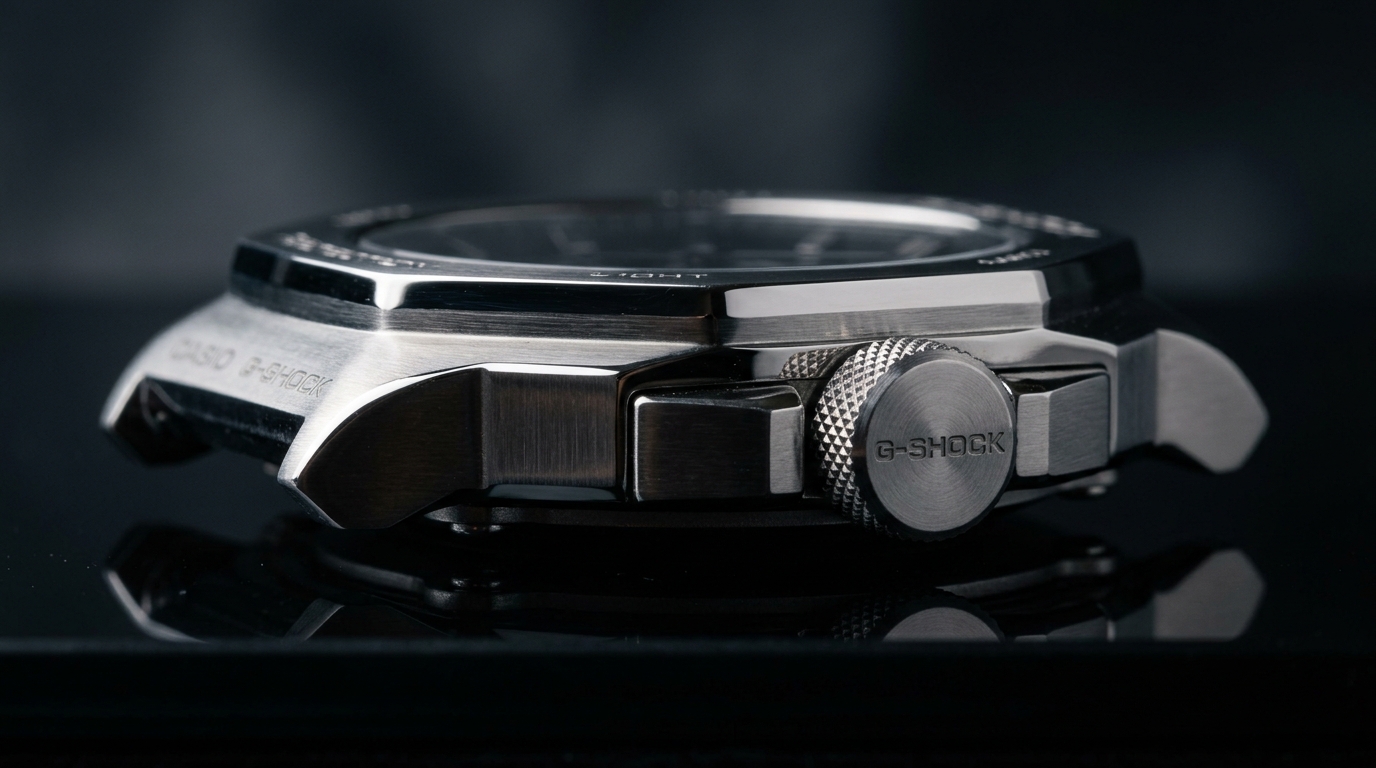
MR-G is the more provocative proposition. The line attempts to turn G-Shock into a high-end object through titanium cases, complex surface hardening, meticulous assembly and references to Japanese metalsmithing. The MRG-B5000, launched in 2022 and using module 3506, is the clearest example: a square G-Shock reconstructed with a multi-part titanium bezel rather than a single resin protective shell. Retail prices around the 4,000-dollar level place it in uncomfortable territory, directly against strong mechanical watches from Tudor, Grand Seiko, Omega’s secondary market and a long list of independents or microbrands with Swiss movements.
The editorial judgement is mixed. MR-G is technically legitimate, and the manufacturing challenge of translating a resin shock structure into a premium multi-part metal case is real. But the appeal is narrow. The best G-Shocks derive their authority from the absence of preciousness. When Casio makes a G-Shock expensive, it risks weakening the philosophical clarity that made the concept powerful. The MRG-B5000 is impressive, but the GW-5000U may be the more intellectually honest watch.
The Duro, Edifice and Casio’s Uneven Analogue Identity
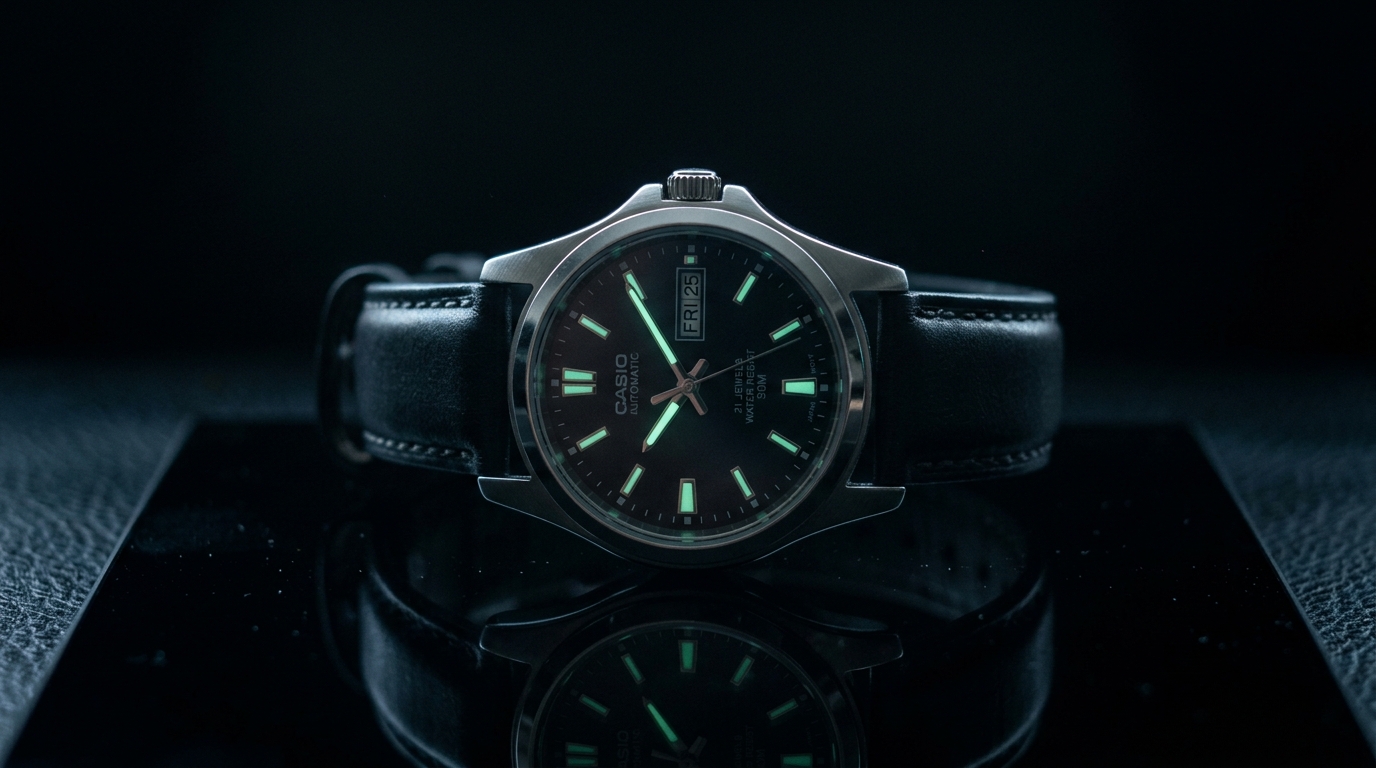
Casio’s analogue watches are less coherent. The MDV-106 “Duro,” a 200-metre quartz dive-style watch with the marlin logo, became a collector favourite because it delivered honest specifications at an absurdly low price. Its appeal is not mystery: a stainless-steel case, rotating bezel, screw-down crown, mineral crystal and reliable quartz movement in a case that often sells around 50 to 80 dollars. It is not refined, and at roughly 44 mm it is too large for many wrists, but it is a rare example of a cheap analogue watch that feels purposeful rather than generic.
Edifice sits differently. The line often combines motorsport styling, chronograph layouts, Bluetooth connectivity and solar charging. Some references are effective; others suffer from visual congestion. Casio is at its best when complexity becomes usable. Edifice sometimes confuses instrumentation with crowded dials. That said, references with Smartphone Link and Tough Solar show Casio’s ability to give analogue watch buyers connected accuracy without entering smartwatch territory. The line has commercial logic, especially in markets where a sporty metal chronograph remains the default masculine watch purchase, but it lacks the design permanence of G-Shock or the singular charm of the F-91W.
This unevenness reveals an important truth about Casio. The company is not strongest when imitating conventional watch categories. Its analogue divers, chronographs and dress-adjacent models can be good, but they rarely define their categories. Casio becomes exceptional when it behaves like Casio: digital displays, resilient cases, solar power, atomic or connected accuracy, sensors and functional cost discipline.
Why Collectors Should Take Casio Seriously
The secondary market understands Casio in a fragmented way. Vintage G-Shock squares such as the DW-5000C have become collectible because early examples are finite, often heavily worn, and historically important. Limited-edition collaborations can spike, though many are more graphic products than horological milestones. Japanese domestic references, especially screw-back squares and Oceanus models, attract informed buyers precisely because they are less distorted by global marketing. At the low end, the F-91W and AE-1200 are not investment pieces and should not be forced into that language. Their value is ownership value, not asset value.
Casio’s broader role is to keep the watch industry honest. A 10,000-dollar mechanical watch can offer beauty, craft, history and emotional satisfaction, but it cannot credibly claim to be the most rational way to tell time. Casio makes that contradiction visible. It also serves watch culture by providing entry points that are not humiliatingly compromised. A young buyer can purchase a DW-5600E, a Duro or an AE-1200 and own a watch with a real lineage rather than a fashion-label derivative. That matters more than the luxury industry likes to admit.
The brand’s weakness is also clear. Casio’s catalogue is too broad, and its design discipline varies sharply by line. Some models are exercises in feature stacking without enough attention to proportion or interface. Premium Casio remains a delicate balancing act: raise quality too far and the brand collides with mechanical competitors; keep prices low and the finishing ceiling remains obvious. The company’s best strategy is not to chase prestige, but to refine the categories it already owns.
Casio has earned a place in serious horological discussion not because it competes with mechanical watchmaking on traditional terms, but because it wins on different terms. The DW-5000C, F-91W, GW-5000U, AE-1200, Rangeman and selected Oceanus models form a body of work defined by utility, engineering clarity and industrial intelligence. For collectors, that is the point. Casio is the anti-luxury watch brand that became culturally permanent by refusing to need luxury at all.