A. Lange & Söhne: The Modern Manufacture That Turned a Ruptured History Into a Collector’s Argument

A. Lange & Söhne: The Modern Manufacture That Turned a Ruptured History Into a Collector’s Argument
A. Lange & Söhne is often discussed as if it were an uninterrupted Saxon answer to Geneva. That is convenient, but not accurate. The more interesting truth is that Lange’s current authority was not inherited intact from 1845; it was rebuilt after a 45-year industrial and political rupture, then made credible through one of the strongest opening collections in modern watchmaking. The brand’s power lies in that contradiction: it sells continuity, but its real achievement is reconstruction.
For collectors, this matters. Lange is not merely a maker of finely finished watches from Glashütte. It is a case study in how a modern manufacture can create legitimacy without leaning on continuous production, celebrity mythology, or sports-watch scarcity as its primary argument. Since its 1994 relaunch, the brand has built its standing on calibre architecture, disciplined design codes, and a refusal to treat movement finishing as decorative afterthought. Its weaknesses are equally specific: thick cases, uneven market liquidity, a sometimes conservative design language, and the pressures of Richemont-era distribution. But measured against the low signal-to-noise ratio of contemporary high watchmaking, Lange remains one of the few maisons where the caseback is not a consolation prize.
The Glashütte Origin, and the Break That Cannot Be Edited Out
Ferdinand Adolph Lange founded his manufacture in Glashütte in 1845, supported by the Saxon government’s ambition to create a precision watchmaking industry in a poor mining region. The original A. Lange & Söhne became known for high-grade pocket watches, three-quarter plates, screwed gold chatons, precision regulation, and chronometer-grade finishing. Those details are not marketing inventions; they are the vocabulary that the modern company deliberately reactivated.
The break came after the Second World War. Lange’s main production building was bombed on 8 May 1945, and in 1948 the company was expropriated under the Soviet occupation authorities. The name was folded into East Germany’s state-controlled Glashütte watchmaking structure, later VEB Glashütter Uhrenbetriebe. Walter Lange, great-grandson of Ferdinand Adolph Lange, left for the West. For decades there was no independent A. Lange & Söhne manufacture producing watches in the sense collectors understand today.
This interruption is not a defect in the story; it is the central fact. When Walter Lange registered the company again in 1990 with the support of Günter Blümlein and Les Manufactures Horlogères, the challenge was not simply to restart production. It was to make collectors believe that a dormant Saxon name could stand next to Patek Philippe, Vacheron Constantin and Audemars Piguet without asking for historical sympathy. The answer arrived on 24 October 1994, when Lange presented its first four wristwatches of the new era: the Lange 1, Saxonia, Arkade and Tourbillon “Pour le Mérite.” Few relaunches in any luxury category have been as strategically coherent.
The Lange 1 Was Not Retro; It Was a Manifesto
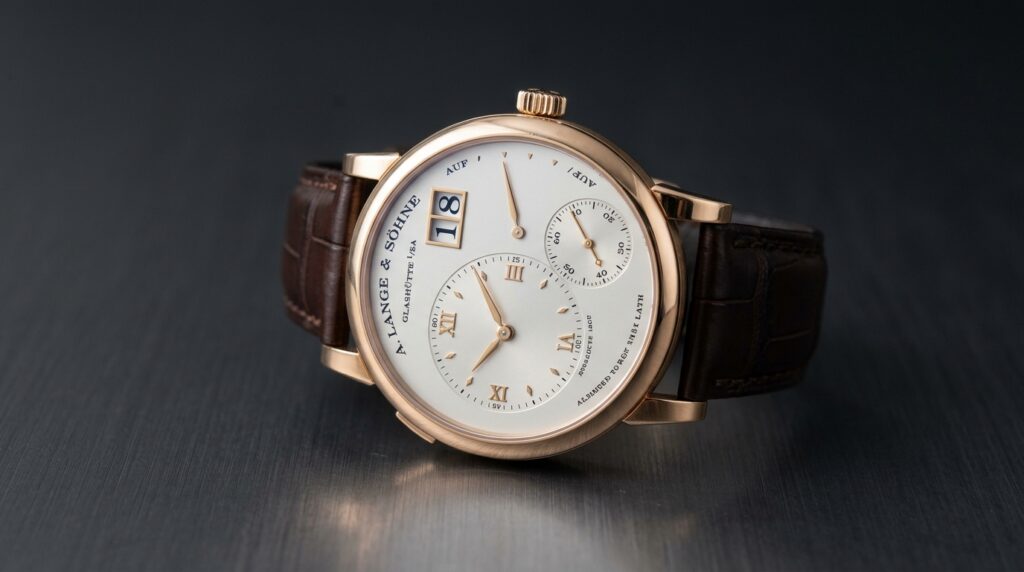
The Lange 1, reference 101.001 in yellow gold, did the heavy lifting. Its asymmetrical dial, outsize date inspired by the Five-Minute Clock at Dresden’s Semper Opera House, and hand-wound calibre L901.0 established a design language that avoided both Swiss classicism and German austerity cliché. The watch looked strange in 1994 because it was not trying to pass as an inherited mid-century dress watch. It proposed a new icon from a revived manufacture, which was a dangerous and unusually confident move.
The calibre L901.0 also set a pattern. It used a three-quarter plate in untreated German silver, screwed gold chatons, a hand-engraved balance cock, a twin mainspring barrel for a 72-hour power reserve, and a level of visible finishing that became central to Lange’s proposition. The movement was not thin and the watch was not delicate by Geneva dress-watch standards, but the industrial logic was persuasive. The Lange 1 did not rely on a generic ébauche hidden behind a precious-metal case. It made the movement the claim.
The model’s 2015 update to calibre L121.1 was important because Lange did not visibly disturb the watch. The new movement introduced an instantaneous jumping outsize date at midnight and a free-sprung balance with an in-house hairspring, while preserving the dial architecture. That is how Lange tends to improve successful references: mechanically rather than cosmetically. It is an approach that has frustrated trend-driven collectors, but it has also protected Lange from the sort of reference inflation that has weakened other catalogues.

The Datograph and the Moment Lange Became Impossible to Ignore
If the Lange 1 made the revived company credible, the Datograph made it formidable. Introduced in 1999, the Datograph reference 403.035 in platinum with a black dial housed calibre L951.1, a hand-wound, column-wheel, flyback chronograph with outsize date and precisely composed three-dimensional architecture. Its importance is sometimes overstated in casual collector speech, but the basic claim stands: at the end of the 1990s, when many elite brands still relied on Lemania-based chronograph movements, Lange built one of the most convincing in-house chronograph calibres in series production.
The Datograph’s tactical brilliance was visual. The case measured 39 mm, comparatively restrained, but the movement side looked like an argument won in advance: levers, springs, column wheel, black-polished steel parts, gold chatons and luminous German silver bridges arranged with unusual clarity. Philippe Dufour’s public admiration for the Datograph has been repeated so often that it risks becoming a substitute for analysis. The more relevant point is that the watch changed expectations. After the Datograph, a high-end chronograph with an anonymous or inherited calibre became harder to defend at a similar price level.
Lange later expanded that chronograph logic with the Double Split in 2004, calibre L001.1, which split both seconds and minutes, and the Triple Split in 2018, calibre L132.1, which added split hours. These were not volume pieces; they were technical positioning statements. They also revealed Lange’s engineering bias. The brand prefers mechanisms that can be explained through mechanical consequence rather than poetic complication. That makes Lange occasionally dry, but rarely frivolous.

Finishing as Structure, Not Surface
Lange finishing is often praised in broad terms, but its real value is consistency across architecture. The untreated German silver plates develop a warmer tone over time, distinguishing them from rhodium-plated brass movements common in Swiss production. The hand-engraved balance cock means each movement carries a small human signature, although collectors should avoid romanticising this into uniqueness on the level of independent atelier work. A Lange balance cock is individual, but it is also part of a controlled production system.
The brand’s signature finishing details include Glashütte ribbing, polished bevels, polished screw heads, blued screws, screwed gold chatons, perlage on hidden surfaces and black polishing on selected steel components. More consequential is the depth of movement construction. Many Lange calibres are layered to show function, not merely to create spectacle. This is especially visible in the Datograph family, the Zeitwerk and the high-complication pieces. The finishing supports the architecture; it does not rescue a dull calibre.
There are limits. Lange watches are frequently thick. The original Datograph was around 12.8 mm, the Datograph Up/Down reference 405.035 grew to 41 mm and approximately 13.1 mm, and the Zeitwerk family has never been mistaken for ultra-thin watchmaking. The heft is part of the brand’s personality, but also a constraint. Collectors who prize the elegance of a Patek Philippe 3940, Vacheron Constantin Patrimony or vintage Audemars Piguet perpetual calendar will not always find Lange’s proportions persuasive. Lange is high watchmaking with a heavy engineering accent.

The Zeitwerk: The Best Proof That Lange Can Still Take Risks
The Zeitwerk, introduced in 2009, remains Lange’s most important post-relaunch design after the Lange 1. Its calibre L043.1 powered a digital jumping hour and minute display using mechanical discs, regulated by a constant-force mechanism to handle the energy demands of the jumps. A watch with a large time bridge and digital display could easily have looked like a novelty. Instead, the Zeitwerk became a serious modern Lange because its design was inseparable from the mechanical problem it solved.
The second-generation Zeitwerk, updated in 2022 with calibre L043.6, increased the power reserve from 36 to 72 hours and added a pusher at 4 o’clock for rapid hour correction. This was a practical improvement, not a cosmetic facelift. The Zeitwerk Minute Repeater, introduced in 2015 in platinum, went further by creating a decimal repeater that chimes hours, ten-minute intervals and minutes, matching the watch’s digital logic. It is one of the rare modern repeaters where the complication and display concept feel intellectually aligned.
Lange’s Lumen series, including the Grand Lange 1 Lumen of 2013 and Zeitwerk Luminous earlier in 2010, occupies a different territory. Semi-transparent sapphire dials and luminous treatments are not natural Lange language, yet they work because they expose the mechanisms behind the outsize date or jumping numerals. The best Lumen watches are not “sporty” Langes. They are X-rays of Lange’s most distinctive displays.
Ownership, Production and the Richemont Question
A. Lange & Söhne has been part of Richemont since 2000, when the group acquired Les Manufactures Horlogères, which also included IWC and Jaeger-LeCoultre. The Blümlein era remains central to the brand’s identity; Günter Blümlein, who died in 2001, understood positioning with unusual precision. He did not revive Lange as an affordable German alternative. He placed it directly into the highest segment and forced the watches to justify that ambition mechanically.
Richemont ownership has brought stability, distribution power and capital, but also the usual group-brand tensions. Lange production is generally estimated around 5,000 watches per year, far below Rolex, Omega or Cartier and also below many assumptions about large luxury groups. The brand has used scarcity carefully, but not innocently. In recent years, access to certain pieces — especially the Odysseus in steel — has been shaped by boutique relationships and purchase history. Lange is not unique in this, but it complicates the brand’s cultivated image of quiet meritocracy.

The Odysseus, launched in 2019 as reference 363.179 in stainless steel with calibre L155.1 Datomatic, was Lange’s direct entry into the luxury sports-watch category. Its integrated bracelet, 120-metre water resistance, day-date display and automatic movement were commercially necessary, if aesthetically divisive. The bracelet finishing and movement quality were serious; the case design and dial typography split collectors. The later white-gold and titanium versions did not erase the central issue: the Odysseus is a competent Lange, but not yet an inevitable one in the way the Royal Oak 15202, Nautilus 5711 or Overseas 4500V became for their brands.
That may be healthy. Lange should not be judged primarily by whether it can win the integrated-bracelet contest. Its strongest work remains in pieces where engineering, dial layout and movement architecture form a single proposition: Lange 1, Datograph, 1815 Chronograph, Zeitwerk, and selected complicated references. The Odysseus broadens the business, but it does not define the manufacture.
The Market: Undervalued Is Too Simple
The secondary market for Lange requires more discrimination than the phrase “undervalued” allows. For years, many Lange references traded below retail, especially in precious metal dress categories where broader collector demand was soft. That made the brand attractive to serious buyers who prioritised movement quality over resale theatre. The market changed during the 2020–2022 surge, when steel sports watches, independent brands and limited high-complication pieces pulled attention into narrower lanes. Lange benefited selectively, not universally.
Original Datograph references, early Lange 1 examples, limited Handwerkskunst editions, certain “Pour le Mérite” pieces and complicated Zeitwerks have developed durable collector interest. The Tourbillon “Pour le Mérite” of 1994, with its fusée-and-chain transmission, remains historically essential because it was part of the relaunch collection and technically ambitious at a moment when the brand still had everything to prove. The 1815 Chronograph, particularly later references such as 414.026 and 414.028, offers much of Lange’s chronograph appeal in a cleaner package than the Datograph, though without the outsize date that made the original so distinctive.
At the same time, many regular-production Saxonia and 1815 time-only references remain relatively soft compared with equivalent Geneva signatures. That is not irrational. Lange’s case proportions, Germanic design restraint and high service costs narrow the buyer pool. Servicing a complicated Lange is not a casual expense, and collectors should treat factory maintenance as part of the ownership calculation. The upside is that softness in less fashionable references can still create rational entry points for buyers who understand what they are buying.

Where Lange Stands Now
Lange’s current catalogue is strongest when it resists the temptation to chase broader luxury codes. The Lange 1 remains a rare modern watch that became iconic without being a sports watch. The Datograph remains a benchmark because its movement is not hidden behind brand prestige. The Zeitwerk remains proof that Lange can be modern without becoming unserious. The 1815 line, when kept restrained, connects most directly to pocket-watch heritage without lapsing into costume design.
The risks are clear. Lange can become too solemn. Its design discipline sometimes turns into sameness across precious-metal dress watches that differ more in complication than emotional temperature. Limited editions in Honeygold, a proprietary gold alloy introduced in 2010, and Handwerkskunst executions can be superb, but the strategy must be used sparingly if it is to remain meaningful. The brand’s credibility has always rested on substance; overplaying rarity would weaken the very argument that made Lange compelling.
The fairest judgement is that A. Lange & Söhne is not the old Saxon manufacture miraculously preserved. It is the most successful resurrection in modern watchmaking, made legitimate by what it built after 1990 rather than what it lost in 1948. That distinction should increase, not diminish, collector respect. Heritage is common in watchmaking; disciplined reconstruction is rarer. Lange’s best watches do not ask to be admired because they come from Glashütte. They show, bridge by bridge and lever by lever, why Glashütte still matters.