Baltic Watches: How a French Microbrand Turned Vintage Restraint into a Modern Strategy
Baltic Watches: How a French Microbrand Turned Vintage Restraint into a Modern Strategy
Baltic is the rare young watch brand whose most important asset is not a movement, a complication, or a manufacturing claim, but taste deployed with unusual discipline. Founded in Paris in 2017 by Etienne Malec, the company entered a market already crowded with Kickstarter-funded vintage divers, mecha-quartz chronographs, and derivative sector dials. Seven years later, Baltic has achieved what most microbrands do not: it has made its design language recognisable without owning a manufacture calibre, without leaning on celebrity endorsement, and without pretending that “heritage” can be manufactured overnight.
That makes Baltic strategically interesting. It is not a pure horological play in the manner of a movement-led independent. Nor is it simply an affordable nostalgia label. Baltic’s success sits in the gap between those categories: it understands that collectors below the Tudor, Longines, Oris, and Nomos price bands are increasingly literate, visually critical, and suspicious of inflated backstories. The brand’s answer has been consistent proportion, restrained references to mid-century watchmaking, transparent movement choices, and pricing that generally leaves room for the buyer to feel the object has been intelligently specified rather than aggressively monetised.
The Parisian Microbrand That Avoided the Usual Trap
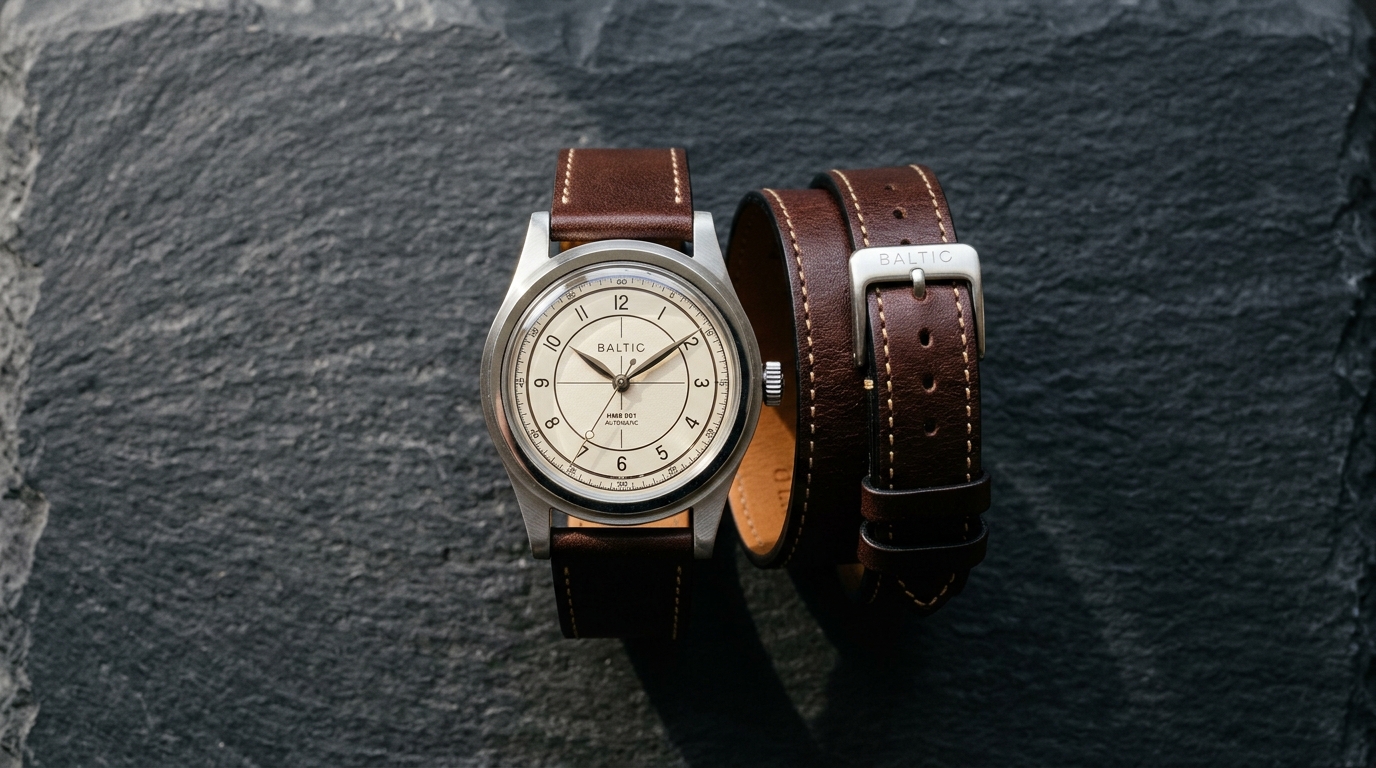
Baltic began with two watches: the HMS 001 and the Bicompax 001, launched through Kickstarter in 2017. Both were 38 mm, both leaned into vintage codes, and both made clear that Malec was building from a collector’s memory rather than from industrial inheritance. The HMS 001 used the Miyota 821A, a reliable but basic Japanese automatic calibre. The Bicompax 001 used the Sea-Gull ST1901, the hand-wound Chinese column-wheel chronograph derived from the Venus 175 architecture acquired by Tianjin Watch Factory in the 1960s. These were not prestige movements, but they were honest choices for the price segment.
The important point is that Baltic did not overstate them. Many microbrands in the late 2010s treated movement sourcing as a marketing liability to be obscured. Baltic made the opposite calculation: state the calibre, manage expectations, and spend the remaining credibility on external execution. Case diameter, dial texture, typography, domed crystals, and bracelet design mattered more to its audience than another vague claim about “Swiss inspiration”. That approach gave the brand an early collector legitimacy that was disproportionate to its youth.
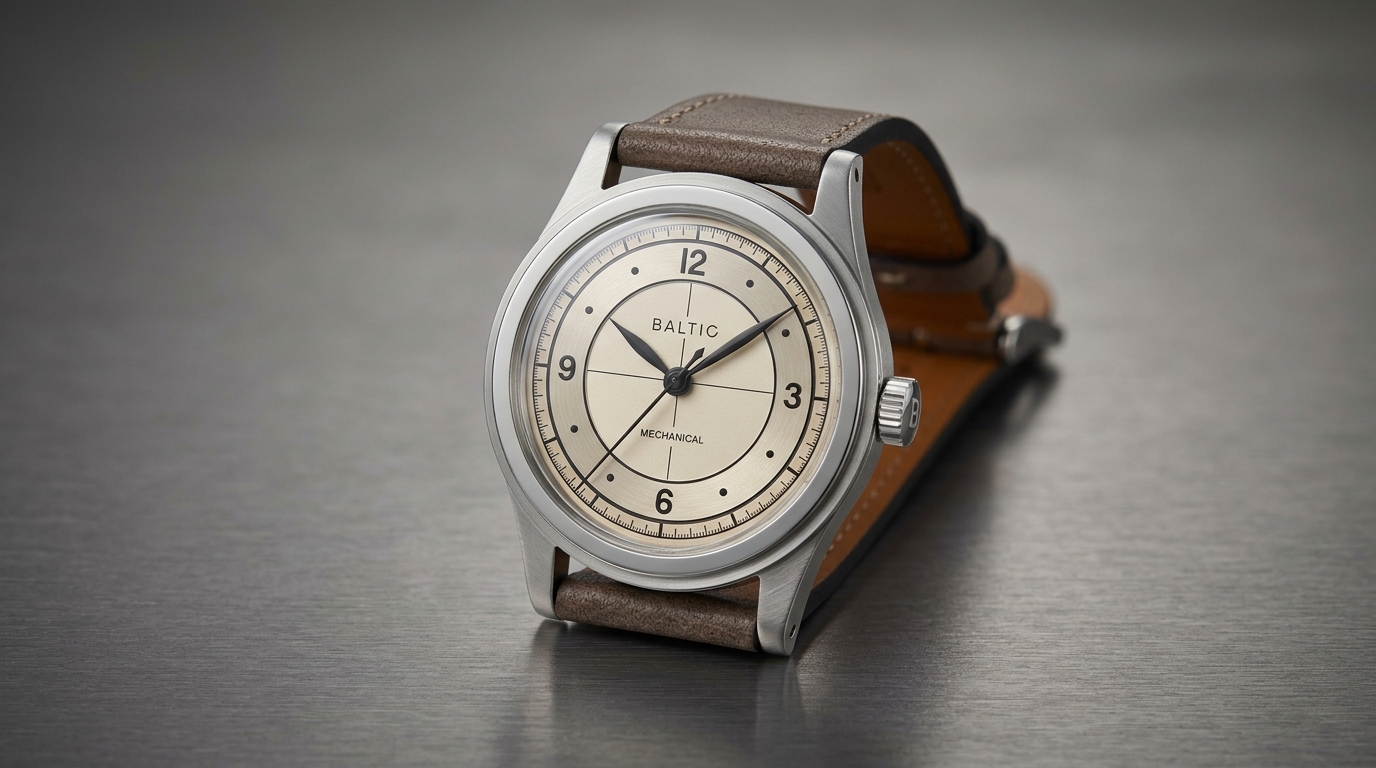
The first Baltic references were not free of derivation. The sector dial, leaf hands, applied numerals, and bi-compax chronograph layout all came from familiar mid-century vocabularies. But Baltic’s gesture was closer to editing than copying. The watches did not pretend to be lost archival references. They looked like the output of a brand that had studied why 1940s and 1950s watches felt balanced, then translated those rules into accessible modern production.
Aquascaphe: The Model That Made Baltic More Than a Kickstarter Name
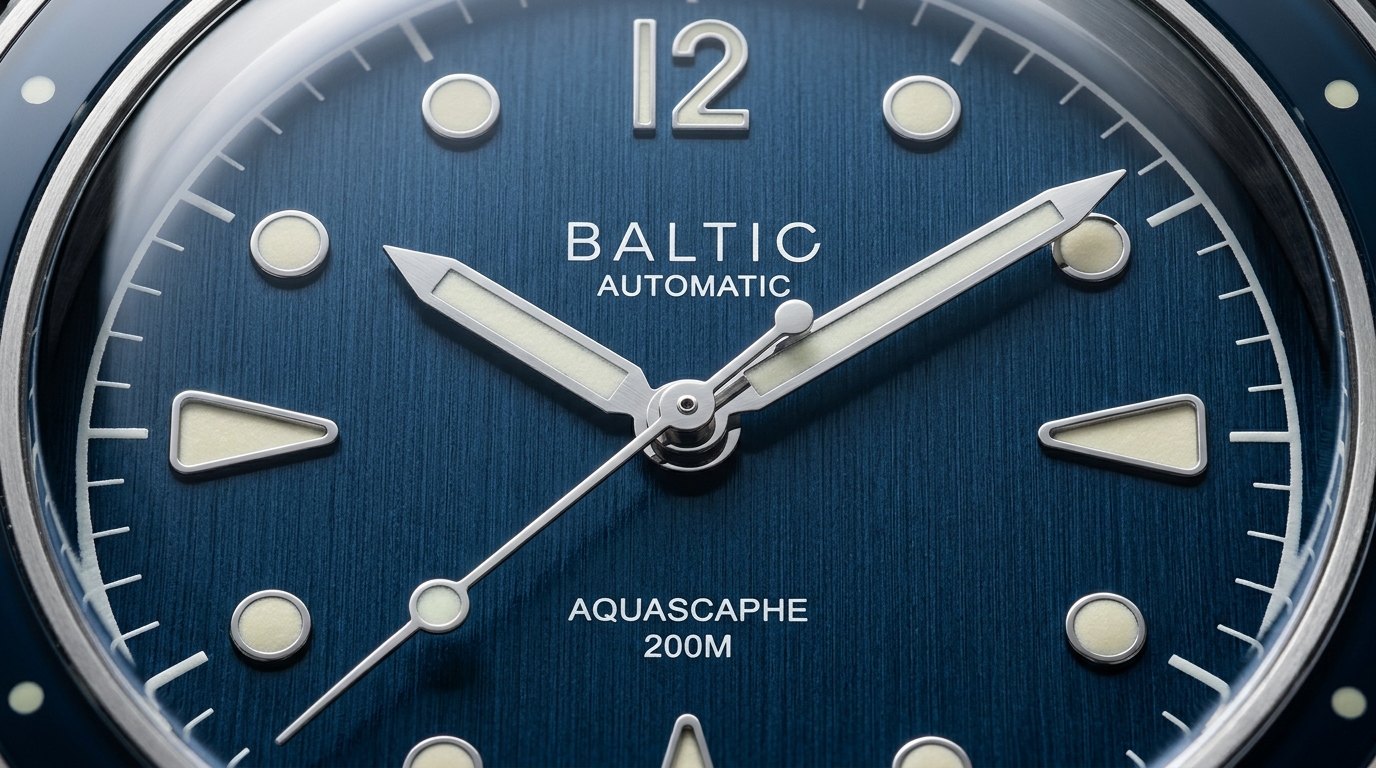
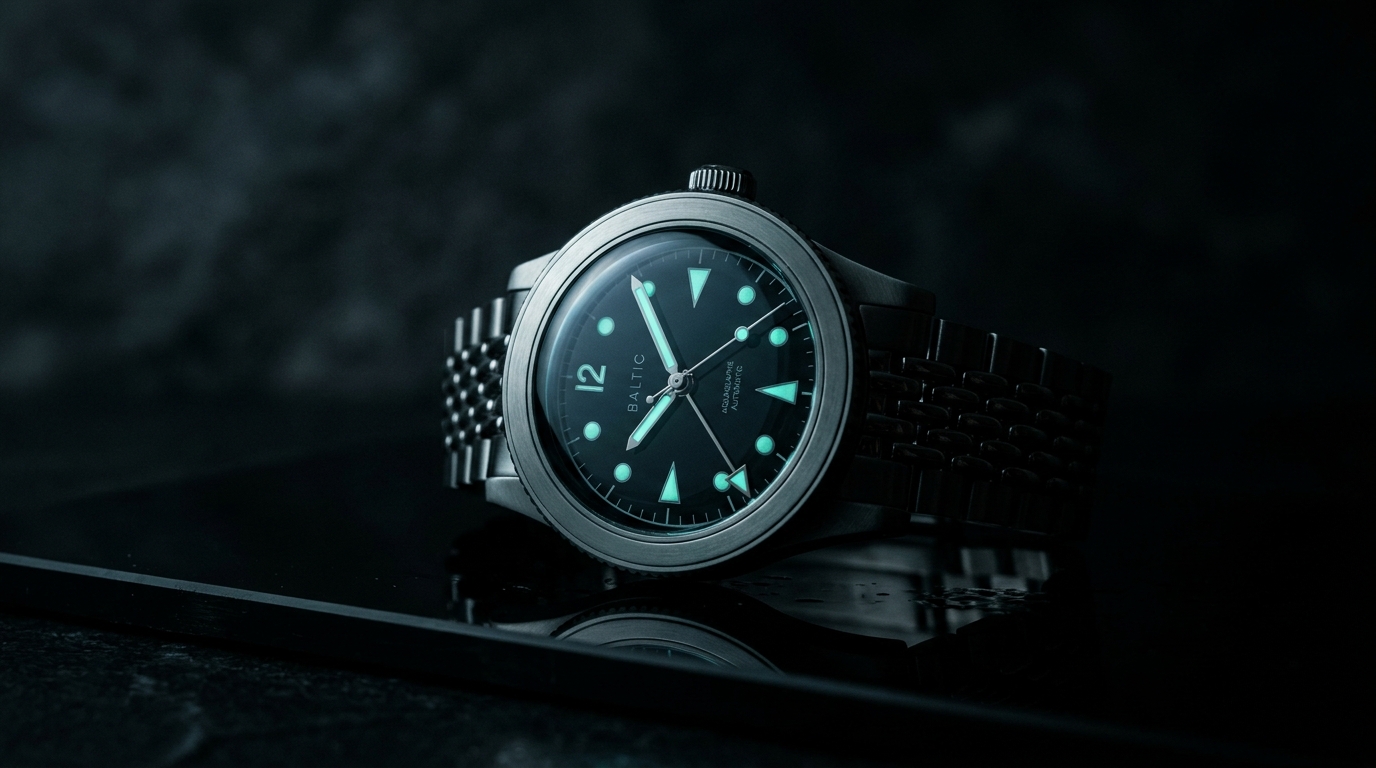
The Aquascaphe, introduced after the initial dress and chronograph models, was the watch that gave Baltic scale. On paper, it was another compact vintage-inspired diver: 39 mm case, approximately 47 mm lug-to-lug, 200 metres of water resistance, screw-down crown, double-domed sapphire crystal, and sapphire bezel insert. In practice, it arrived at the right moment. The market was full of large sports watches, while collectors were rediscovering the appeal of smaller divers from Blancpain, Tudor, Longines, and early skin-diver references. Baltic did not invent the compact neo-vintage diver, but it executed one at a price and size that made sense.
The standard Aquascaphe’s use of the Miyota 9039 was a material improvement over entry-level automatics. The 9039, part of Miyota’s 9000 series, is thinner and more refined than the 8000-series movements used by many low-cost mechanical watches, beats at 28,800 vibrations per hour, and allows a no-date dial without the inelegance of a ghost date position. That matters. A brand claiming visual and functional restraint should not leave an unused date setting hidden in the crown sequence. Baltic’s decision here was not glamorous, but it was correct.
The Aquascaphe also showed Baltic’s understanding of bracelets. The beads-of-rice option became part of the watch’s identity rather than an accessory afterthought. Many microbrand bracelets at this price feel like concessions to a product sheet. Baltic’s are not Grand Seiko or Rolex components, and no serious collector should confuse them as such, but the articulation, taper, and visual fit with the case have been central to the brand’s perceived value. For a watch retailing far below most established Swiss divers, those details are where trust is built.
The GMT and the Limits of Specification-Led Value
The Aquascaphe GMT expanded the line into travel-watch territory using the Soprod C125, a Swiss automatic GMT calibre. The choice was significant because it moved Baltic beyond the purely Japanese and Chinese movement sourcing that defined much of its early catalogue. The C125 is not a “true GMT” in the Rolex GMT-Master II sense, where the local hour hand jumps independently. It is an office-style GMT, with independent adjustment of the 24-hour hand. That distinction matters to collectors, and Baltic’s audience is informed enough to notice it.
Still, the Aquascaphe GMT made strategic sense. It retained the 39 mm case language, used a 24-hour sapphire bezel, and gave buyers a Swiss-powered travel watch at a price that undercut the mainstream Swiss competition. The problem is not execution; it is category pressure. GMT watches have become one of the most crowded segments in the market, especially after Tudor’s Black Bay GMT, Longines’ Spirit Zulu Time, and later smaller-format GMTs raised consumer expectations. Baltic’s GMT succeeds as a design object, but it is less disruptive than the original Aquascaphe because the category now rewards movement functionality as much as aesthetics.
This is where Baltic’s strategic ceiling becomes visible. The brand is strongest when movement choice supports a visual idea. It is weaker when the complication itself becomes the primary purchase argument. A Baltic buyer accepts a pragmatic calibre in a beautifully judged three-hander or diver. In a GMT, the collector starts asking harder questions about jumping hours, thickness, service networks, and price proximity to established Swiss houses.
MR01: Baltic’s Cleverest Watch, and Its Most Revealing Compromise
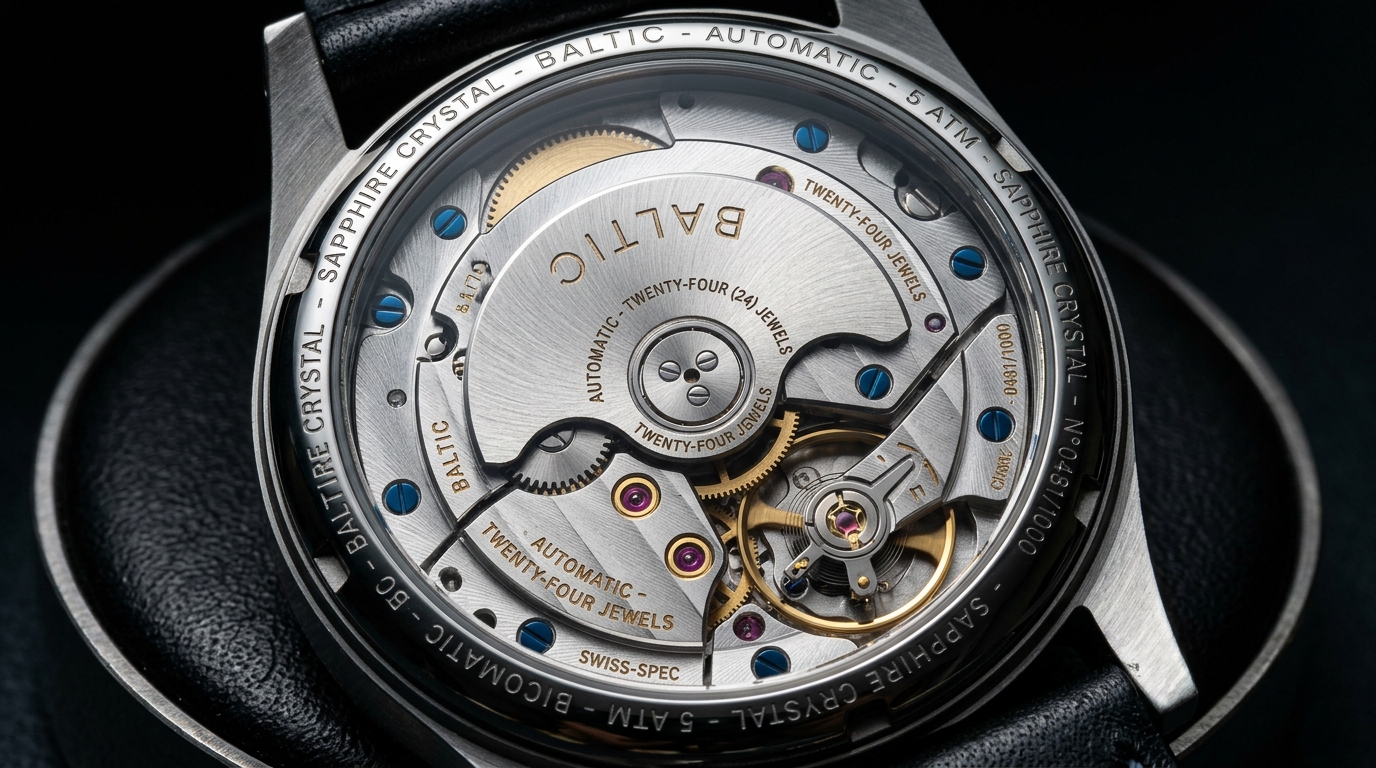
The MR01, launched in 2021, remains Baltic’s most consequential watch from an editorial perspective. A 36 mm dress watch with Breguet-style numerals, small seconds, leaf hands, and a micro-rotor automatic movement, it offered a visual proposition that was almost nonexistent at its price. The watch used the Hangzhou CAL5000A, a Chinese micro-rotor calibre visible through the caseback. In an industry where the micro-rotor is associated with Universal Genève, Buren, Patek Philippe, Chopard L.U.C, and contemporary independents, Baltic’s deployment of the architecture at an accessible price was bold.
It was also divisive. The MR01’s movement finishing is industrial, and the calibre does not belong in the same conversation as Swiss or German high-end micro-rotor movements. But that criticism, while technically valid, misses the commercial intelligence of the watch. Baltic was not selling haute horlogerie. It was selling access to a layout, thickness profile, and romantic mechanical architecture that larger brands generally reserve for much higher price points. The MR01 made collectors discuss Baltic not merely as a maker of attractive vintage-inspired watches, but as a brand willing to take calibrated risks.
The watch is not above critique. Its design is heavily informed by early twentieth-century pocket-watch and dress-watch codes, with an aesthetic proximity to far older Breguet and Patek language that Baltic obviously does not own. Yet the 36 mm case, micro-rotor display, and modest retail positioning created a sufficiently coherent product. The MR01 demonstrated that Baltic’s true competence is orchestration: knowing which historical signals, movement architecture, and price point can be combined without tipping into absurdity.
Chronographs: Baltic’s Strongest Link to Enthusiast Culture
The Bicompax line has remained central to Baltic because the hand-wound chronograph is one of the few formats where the brand’s vintage grammar feels especially natural. The Sea-Gull ST1901 is not perfect; servicing can be uneven depending on location, and quality control consistency has historically varied across watches using the calibre. But it is a visually engaging column-wheel chronograph with a legitimate historical lineage through the Venus 175. At Baltic’s price level, there is no Swiss equivalent with comparable mechanical charm.
The Bicompax 002 and Bicompax 003 refined the original formula rather than replacing it. Baltic reduced clutter, improved case and dial execution, and retained the sub-40 mm proportions that define the brand. The result is not a competitor to a Zenith El Primero or a Breitling Premier B09. It is a different proposition: a hand-wound chronograph for collectors who understand that tactile engagement can matter more than automatic convenience.
The more ambitious Tricompax models, particularly the limited editions associated with historic motorsport events such as Tour Auto, pushed Baltic into a higher price and specification bracket using the Sellita SW510-M hand-wound chronograph movement. The SW510-M is a robust Swiss cam-operated calibre descended from the Valjoux 7750 architecture, adapted for manual winding. Here Baltic’s positioning becomes more complex. Once prices rise, buyers naturally compare the watch with offerings from Hamilton, Longines, Sinn, and pre-owned chronographs from larger houses. Baltic’s advantage remains proportion and design coherence; its disadvantage is brand weight.
That trade-off is acceptable, but only up to a point. Baltic should be careful not to drift too far into price territory where its independence becomes less of a virtue and more of a risk premium borne by the buyer. The brand’s credibility has been built on alignment between design ambition and movement reality. If that alignment weakens, the collector audience will notice quickly.
Hermétique, Prismic, and the Move Beyond Retro
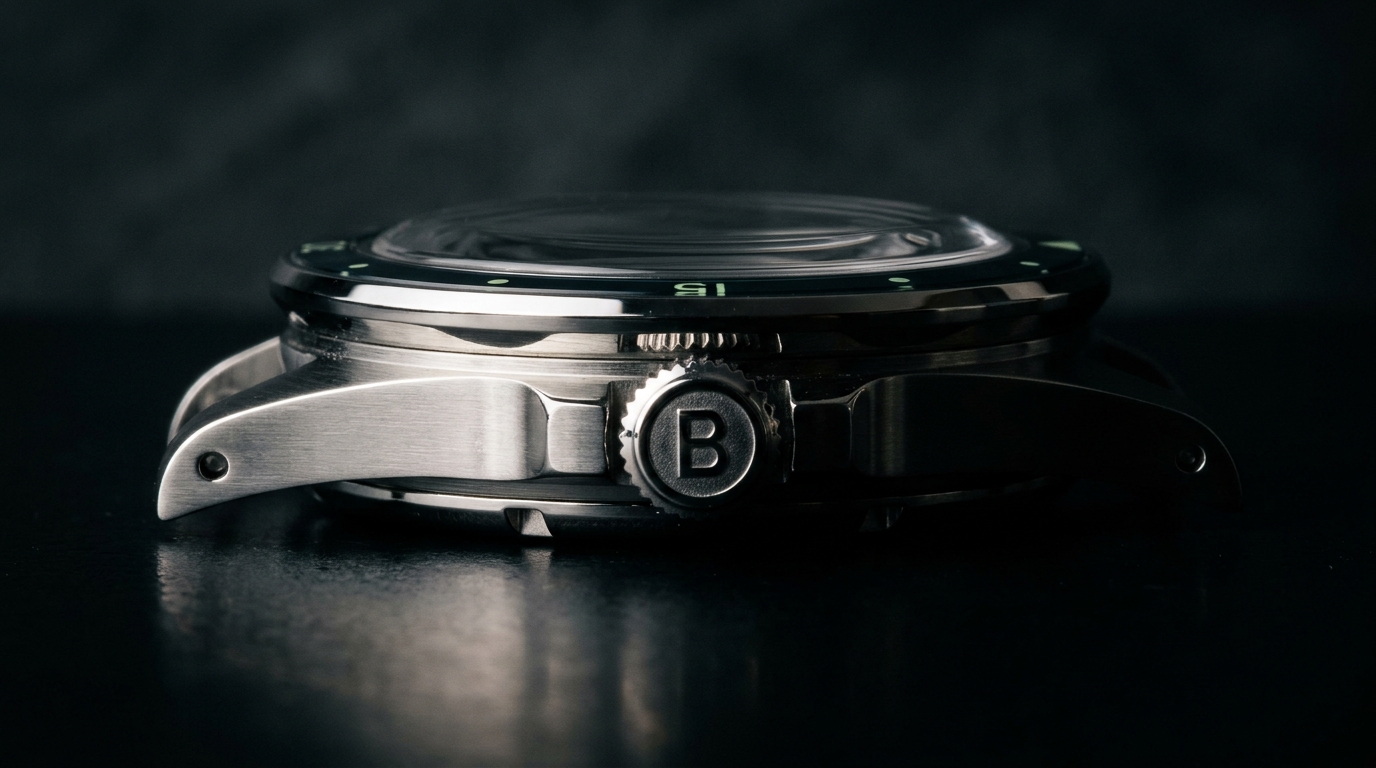
The Hermétique Tourer, introduced in 2023, is one of Baltic’s most important recent watches because it suggests a way out of pure vintage revival. At 37 mm, with the Miyota 9039 automatic movement, 150 metres of water resistance, and a field-watch format, it is still historically literate. But it is less tied to one obvious archival template than the Aquascaphe or MR01. Its recessed crown design and compact tool-watch stance give it a more contemporary identity.
This matters because the microbrand market has matured. In 2017, a well-proportioned vintage-inspired mechanical watch under €1,000 felt fresh. By 2024, the category is saturated. Brands such as Lorier, Nivada Grenchen, Furlan Marri, Serica, Farer, and Unimatic have each claimed adjacent territory. Baltic can no longer win simply by being tasteful and affordable. It must now prove that it can evolve without abandoning the design intelligence that made it credible.
The Prismic, launched in 2024, is a strong indication that Baltic understands this pressure. With a 36 mm case and the hand-wound ETA Peseux 7001, it moves into a thinner, more architectural dress-watch space. The Peseux 7001 is a distinguished ultra-thin manual-wind calibre, historically used across a range of refined dress watches and respected for its slimness rather than brute modern specifications. Baltic’s use of it is telling. Instead of chasing power reserve or water resistance, the brand prioritised profile and elegance. That is the sort of decision a design-led mechanical watch company should make.
The Prismic also shows Baltic trying to raise perceived craft through case construction, dial finishing, and material contrast rather than through inflated mechanical claims. This is a smarter route for the brand than pretending it can compete with manufacture-led maisons. Baltic’s future depends on becoming more sophisticated in execution while remaining candid about what it is not.
Where Baltic Sits in the Market
Baltic occupies a narrow but valuable position between low-cost enthusiast brands and the entry level of established Swiss watchmaking. Below it sit many microbrands competing primarily on price and specifications. Above it sit Tissot, Hamilton, Mido, Longines, Oris, Nomos, Tudor, and Sinn, each offering deeper industrial infrastructure, broader servicing networks, and stronger resale recognition. Baltic’s advantage is agility. It can produce small runs, test design ideas quickly, and speak directly to collectors without committee-driven conservatism.
The weakness is equally clear. Baltic does not own its movements, does not have a long archive, and cannot rely on heritage in the conventional sense. Its watches are assembled from intelligent sourcing and coherent design rather than vertical integration. That is not a criticism unless the brand pretends otherwise. So far, Baltic has mostly avoided that error. Its best watches are persuasive because they are proportionate in every sense: case size, movement choice, design reference, and price.
The collector should approach Baltic with clear expectations. These are not investment watches in the conventional secondary-market sense, although limited editions can trade strongly when demand exceeds supply. They are not substitutes for high-end Swiss or German finishing. They are watches for buyers who value design discipline and mechanical variety, and who are comfortable with a brand whose authenticity comes from curatorial intelligence rather than inherited prestige.
The Editorial Verdict
Baltic’s achievement is not that it made vintage-inspired watches; many brands have done that, often lazily. Its achievement is that it made restraint commercially powerful. From the HMS 001 and Bicompax 001 to the Aquascaphe, MR01, Hermétique Tourer, and Prismic, the brand has shown a consistent ability to identify the emotional centre of a watch type and remove most of the excess around it.
The best Baltic watches are not the most technically advanced pieces in their categories. They are the ones where the brand’s decisions feel inevitable: the Aquascaphe with a no-date Miyota 9039, the MR01 with its accessible micro-rotor theatre, the Bicompax with a hand-wound chronograph calibre, the Prismic with a slim Peseux 7001. In each case, Baltic understands which compromise the collector will accept because the overall object remains coherent.
That coherence is fragile. As Baltic grows, the temptation will be to raise prices, expand references, and turn scarcity into strategy. The brand should resist the worst version of that path. Its authority has been earned through proportion, not prestige. If Baltic remains disciplined, it can become one of the defining independent watch brands of its generation. If it chases the status cues of the larger Swiss houses, it risks losing the very clarity that made collectors pay attention in the first place.