Citizen and the Everyday Watch That Outthinks Luxury
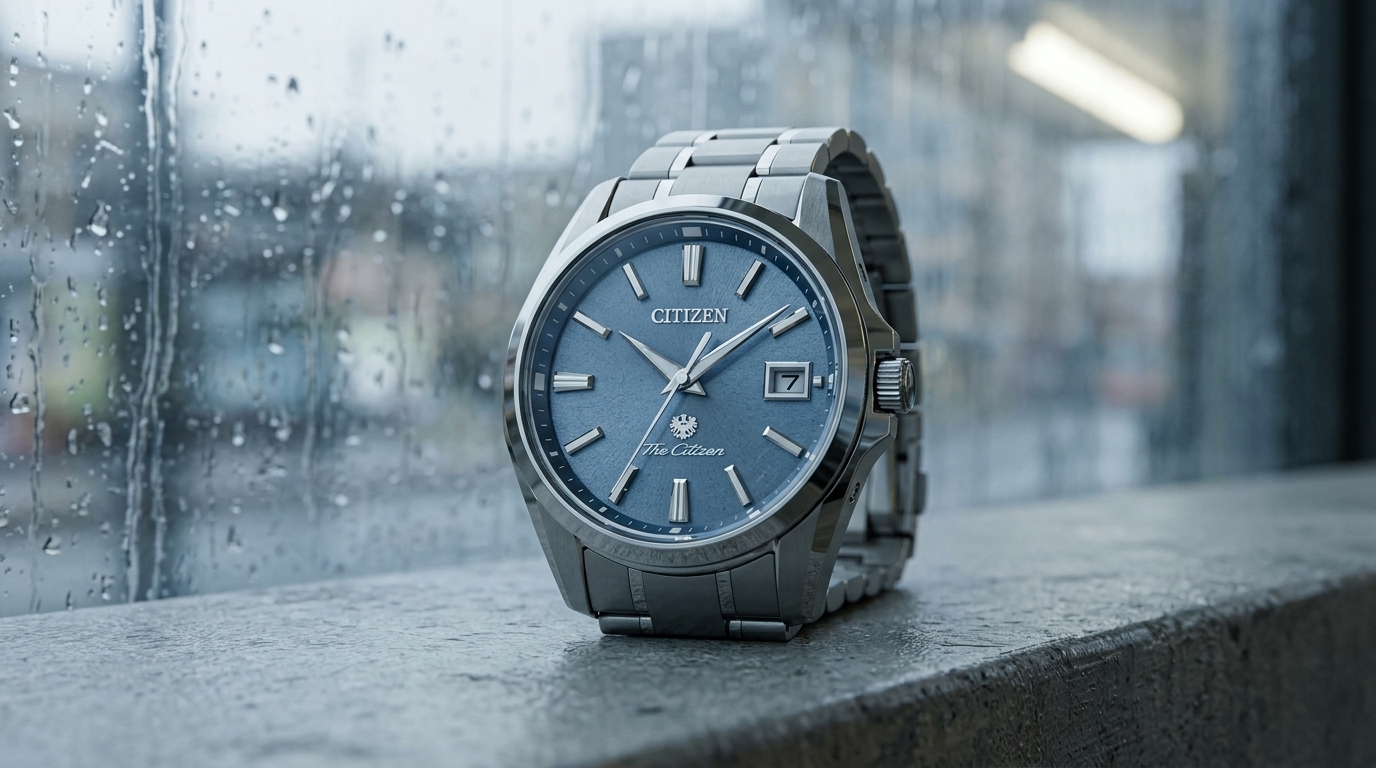
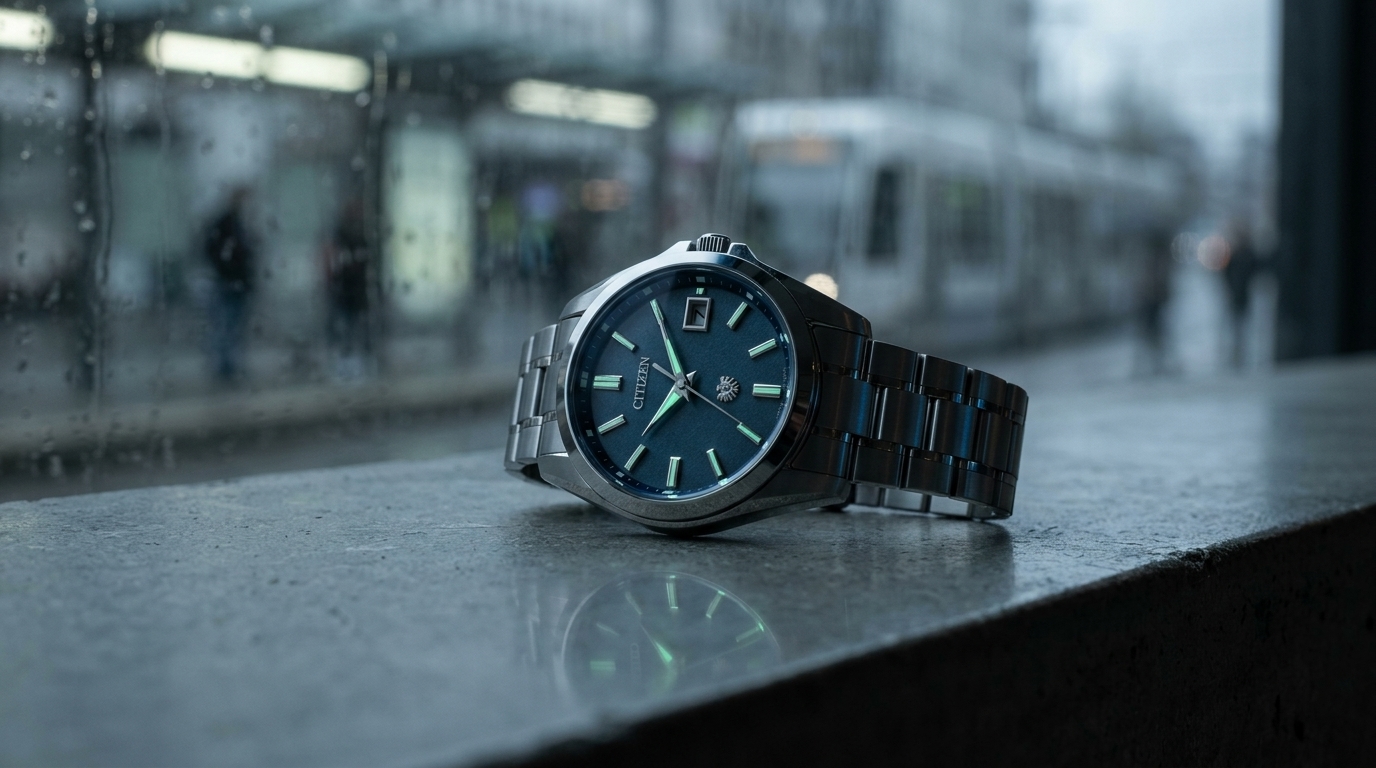
At 7:03 on a wet weekday morning, the second hand moves with its little quartz certainty across a dark Citizen dial, stepping over the minute track as if crossing paving stones. The watch is not asking for ceremony. It has not been wound before coffee, has not been laid crown-up on a bedside table in hope of gaining back a few seconds, has not been polished into theatrical importance. It sits close to the wrist, its case catching the grey light from a kitchen window, and performs the old task without drama: it tells the truth of the hour.
There is a particular quietness to a good Citizen that can be difficult to describe in the language usually reserved for watches. Luxury horology often speaks in visible labour: anglage shining along a bridge, black polish disappearing into ink, a balance wheel breathing beneath sapphire. Citizen’s strongest everyday watches speak in a different register. They conceal their intelligence. A photovoltaic cell hides under the dial. A rechargeable cell waits beneath the movement. A perpetual calendar remembers the short cruel logic of February. In some references, atomic time signals arrive silently in the night, correcting what human hands need never notice. The watch does not seduce by showing its mind. It seduces, if that is even the word, by behaving as though practical brilliance were ordinary.
This is not an accident of modesty. Citizen’s history has always had a civic edge to it, suggested even in the name. The company grew from the Shokosha Watch Research Institute, and the name Citizen, associated with a pocket watch in 1924, carried a democratic promise: a watch not for a court, not for a club, but for the person moving through ordinary life. That promise has survived better than many slogans because it has been expressed in mechanisms rather than in romance. In 1956 came Parashock, Japan’s first shock-resistant watch. In 1959, Parawater, an early Japanese water-resistant wristwatch. By 1970, Citizen had produced the X-8, a titanium-cased watch at a time when the metal still felt closer to aerospace than to the jeweller’s tray. The pattern is legible: endurance before prestige, usefulness before mystique.
To understand why a Citizen can feel so disarming beside more expensive watches, one must look at what it refuses to dramatise. An Eco-Drive watch does not present its mainspring as a miniature storehouse of tension. It absorbs light. Sunlight, office light, the thin blue wash near a window in winter: all of it becomes motion. Citizen introduced its first light-powered analogue quartz watch in 1976, the Crystron Solar Cell, and Eco-Drive would later turn that idea into the company’s defining language. The accomplishment is partly technical and partly philosophical. The watch becomes less dependent on intervention. It does not need a fresh battery every few years, does not need a winder, does not need to be indulged. It simply asks to see light.
On the wrist, that changes the relationship between owner and object. A mechanical watch often cultivates intimacy through attention. Its charm lies in the small duties it imposes: winding, setting, noticing the drift of time. Citizen’s solar quartz discipline removes those gestures. Some collectors mistake this for a lack of soul, but that assumes soul must be theatrical. There is another kind of character in a watch that vanishes into the day and returns only when required. It reflects a strain of Japanese watchmaking that values resolution over display. The problem is considered, reduced, solved, and then hidden under a clean dial.
The dial itself is where Citizen often does its most careful disappearing act. On a simple Eco-Drive field watch, the surface may appear matte and plain, numerals printed with military directness, hands filled with luminous compound broad enough to be read in a hallway before dawn. On a higher-grade model such as The Citizen AQ4091-56M, the dial becomes more poetic without abandoning function: a washi paper texture diffuses light so the solar cell beneath can drink while the surface keeps its fibrous softness. That watch uses the A060 calibre, a high-accuracy quartz movement rated to within five seconds a year, with an independently adjustable hour hand and perpetual calendar. Such details sound dry when isolated. Inside the watch, they are acts of courtesy.
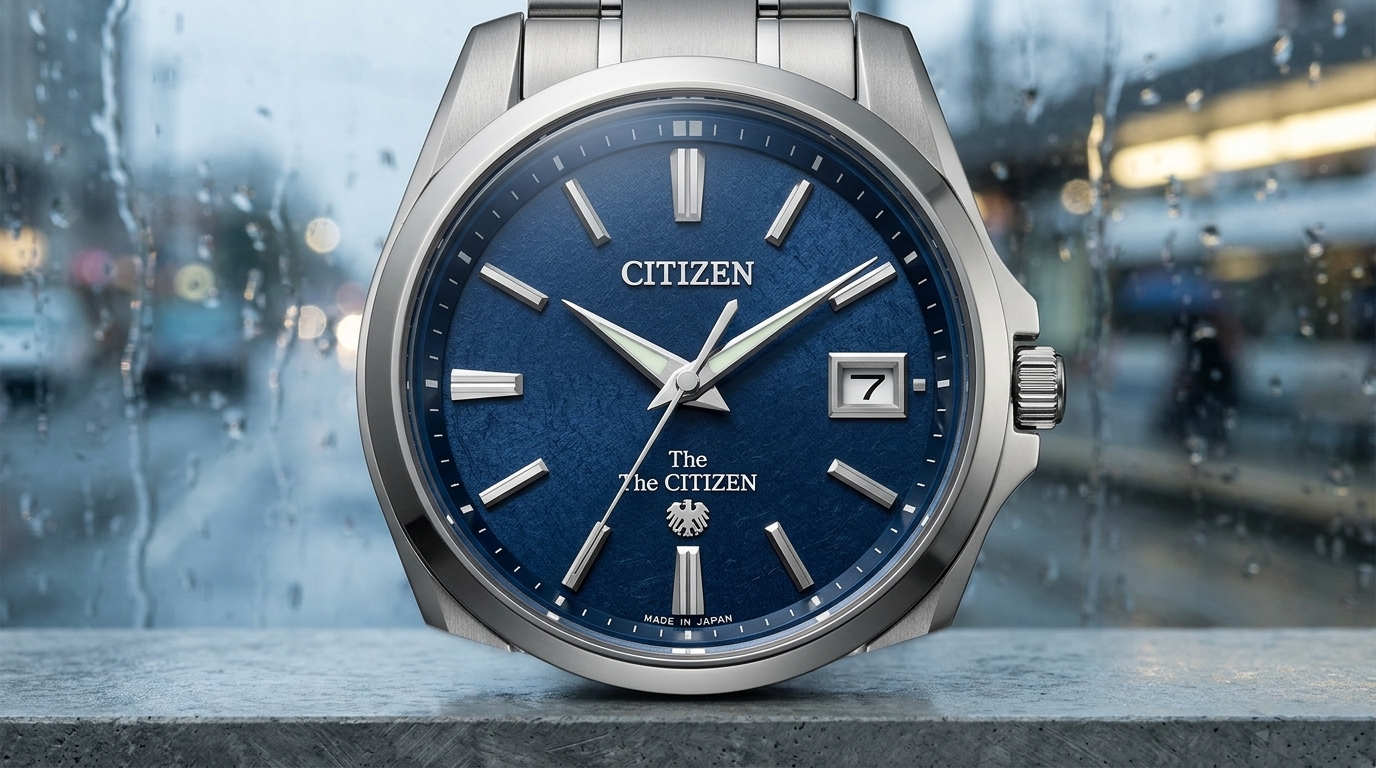
The casework tells a similar story. Citizen’s long work with titanium is not merely a matter of lightness. Titanium in its untreated form scratches easily, which would make it a poor everyday companion if left naïve. Citizen answered with surface-hardening technologies under the Duratect name, part of what it calls Super Titanium. The result, in models across the Attesa, Promaster and The Citizen families, is a case that can be startlingly light yet more resistant to the abrasive humiliations of door frames, laptop edges and desk corners. The watch does not feel substantial in the old luxury sense. It does not sink the wrist with proof of cost. It feels almost absent, and that absence is a form of design.
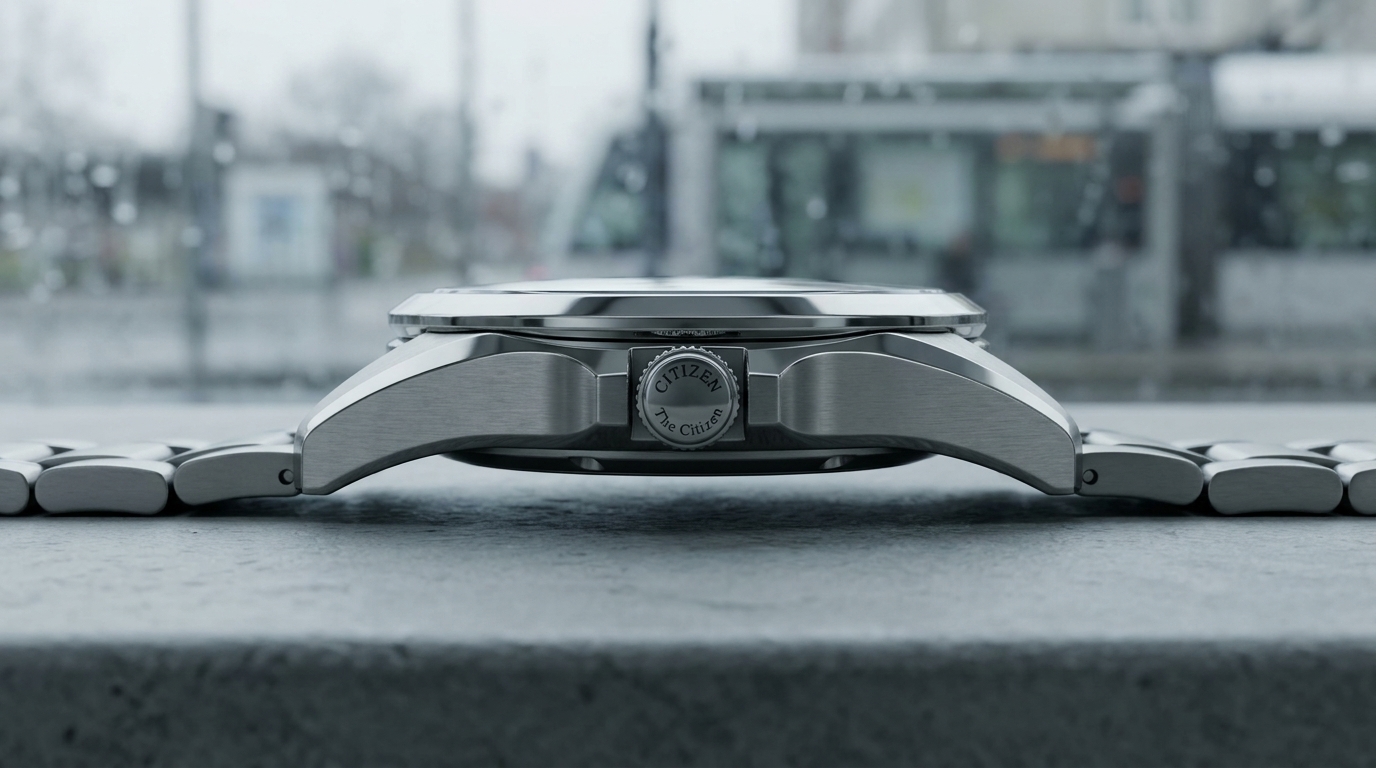
Luxury has long made weight feel meaningful. Gold teaches the hand its price. Steel sports watches, especially those descending from the 1970s integrated-bracelet ideal, often rely on the density of metal and the sharpness of finishing to communicate seriousness. Citizen’s best everyday pieces take a different wager. They suggest that comfort is not a concession. A watch worn twelve hours a day gains authority not by impressing at the boutique counter but by failing to irritate at 4:30 in the afternoon. The clasp must not bite. The crown must not carve a mark into the hand. The crystal must survive the careless motion of modern life. Sapphire helps. So does a case profile kept honest.
There are Citizens that lean into this ethic with almost severe clarity. A Promaster Tough, for example, is less a luxury object than an argument made in steel or titanium: solar-powered, water-resistant enough for real use, legible, resistant to magnetism and shock, with a monocoque or reinforced case construction depending on the reference. It belongs to the same broad family of thought as the early tool watches that once accompanied divers, pilots and engineers before their descendants became symbols of leisure. The Promaster line itself, launched in 1989, carries the memory of Citizen’s professional watches, including the Aqualand of 1985, whose electronic depth gauge gave the dive watch a new kind of instrumentality. The point was not nostalgia. The point was data, survival, accuracy under pressure.
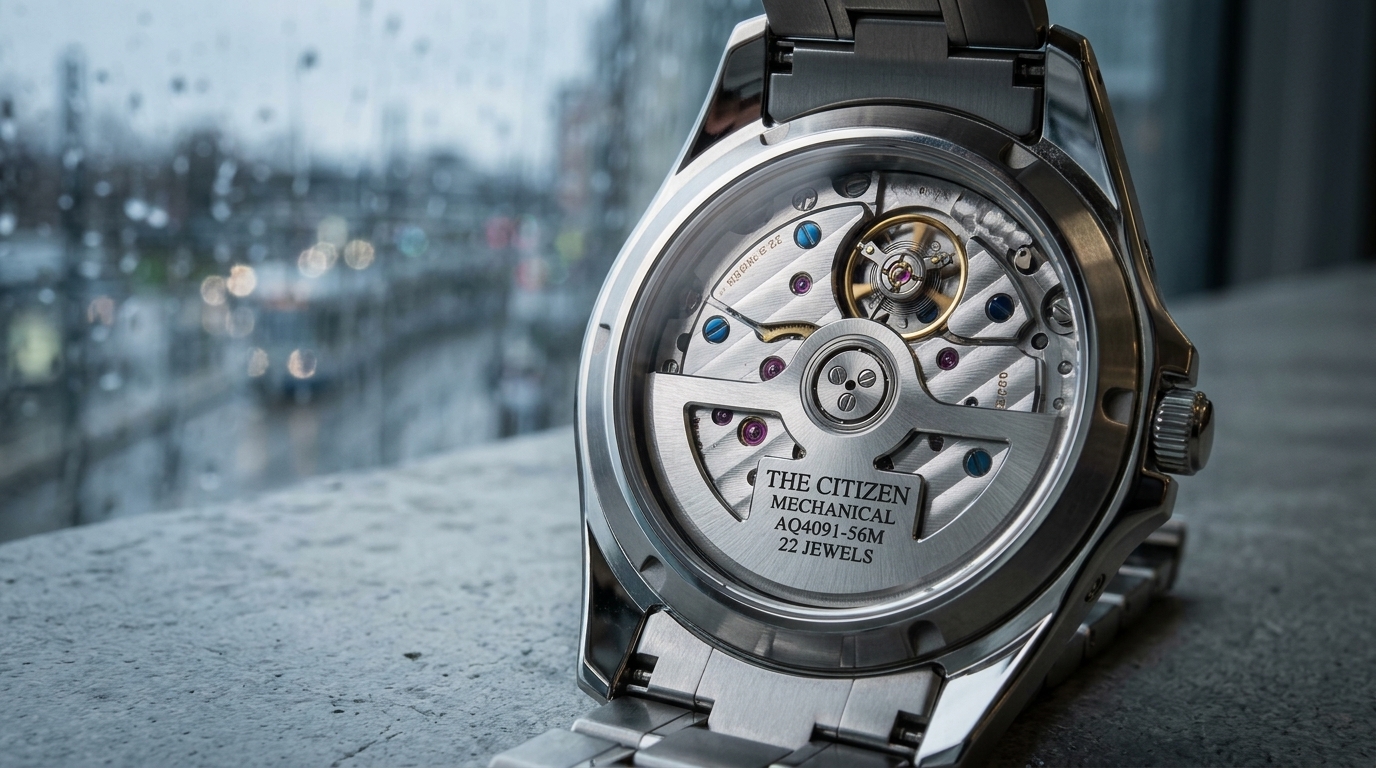
Accuracy is the word that keeps returning, though luxury watch culture has often treated it with selective seriousness. Mechanical precision is heroic because it is difficult. A chronometer-regulated movement, adjusted across positions and temperatures, remains a feat of old-world craft. Yet the everyday wearer experiences time less as a contest of romance than as a series of appointments, trains, school gates, ovens, calls and departures. In that realm, Citizen’s quartz intelligence is not a compromise. It is a solution. A basic Eco-Drive calibre may run to around fifteen seconds a month. A radio-controlled Citizen can correct itself against atomic signals where reception allows. The A060 narrows annual error into a margin so small that it becomes almost conceptual. Citizen’s Caliber 0100, unveiled to mark the brand’s centenary, pushed the matter further still, to an accuracy of one second per year without relying on radio or satellite correction. It was rarefied, expensive, and deliberately exceptional, but it revealed the direction of the company’s mind.
That mind does not reject beauty. It simply approaches beauty through order. The seconds hand should meet the markers cleanly. The hands should be long enough. The date should be readable without wrecking the dial. A bracelet should articulate without sounding hollow. Finishing need not advertise itself from across a room, but it should reward proximity: a brushed lug plane cut by a polished bevel, a bezel satin-finished in a different grain, a crown guarded but usable. Citizen does not always achieve this equally across its enormous catalogue. Some models are crowded, some over-lettered, some caught between markets. But when the design is disciplined, the whole object acquires a quiet force.
The most interesting part of Citizen’s position is that it has never needed the old Swiss mythology to argue for itself. It has its own mythology, less alpine and more urban, closer to factory light and commuter platforms than mountain passes. Japanese watchmaking in the twentieth century was shaped by a different hunger: to make precision reproducible, durable, available. Seiko often receives the broader collector reverence, especially for Grand Seiko’s finishing and the mechanical achievements of its high-beat calibres. Citizen’s genius has sometimes been less visible because it has been so widely distributed. Miyota movements, including the ubiquitous 8200 family and the slimmer 9000 series, have powered watches far beyond Citizen’s own name. The company became not just a maker of watches but a supplier of timekeeping infrastructure.
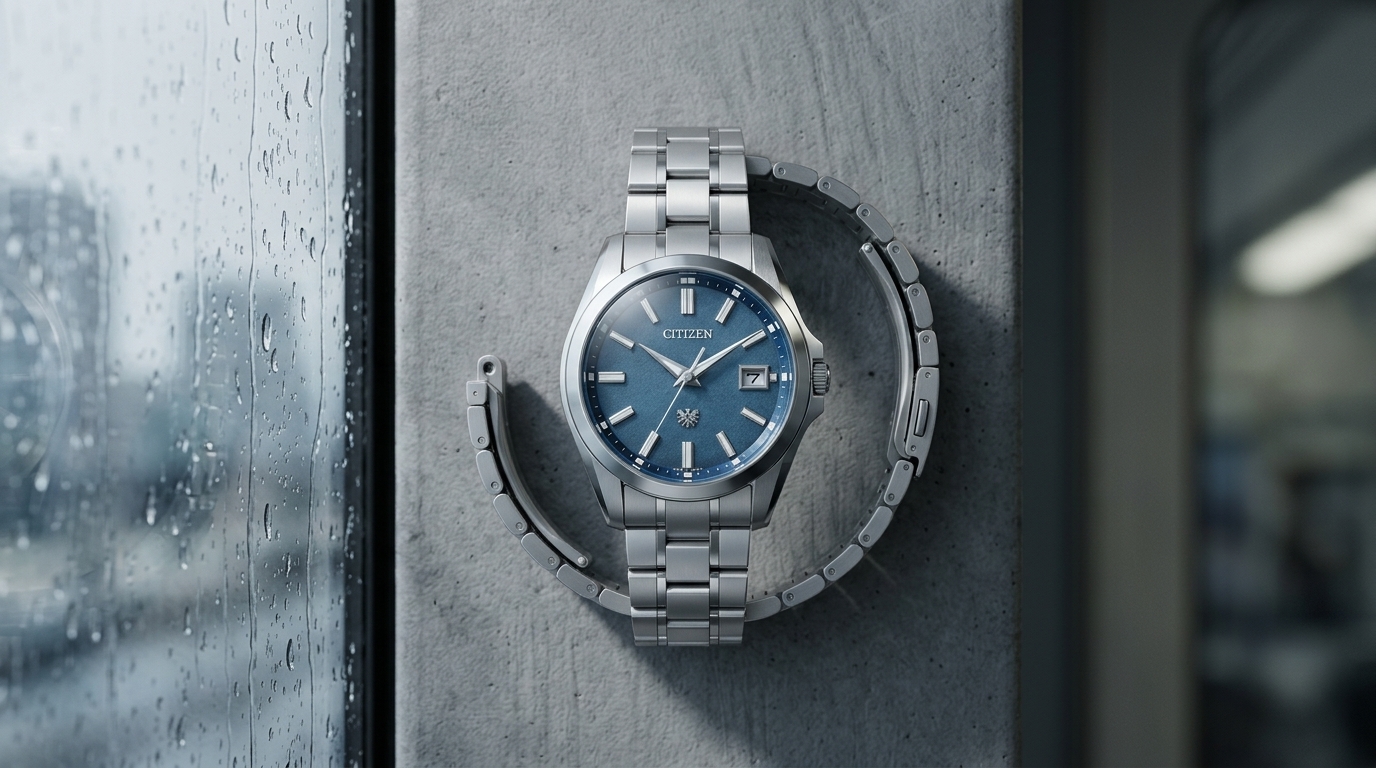
That industrial breadth matters. A luxury watch can afford to be singular. An everyday watch must survive multiplication. Its greatness is tested not in rarity but in repetition: thousands of crowns, crystals, gaskets, coils, rotors, bracelets, modules, all expected to behave. Citizen’s strongest claim is not that it can make one extraordinary watch, though it can. It is that it can embed uncommon thought into objects that do not require guarded lives. The wearer can forget the watch in sunlight on a windowsill, knock it against a train pole, wear it through rain, set it down for a week, and return to find time still arranged.
There is something almost moral in that restraint, though watches should not be made to bear too much moral weight. Still, in an age when luxury often confuses elaboration with meaning, Citizen’s better everyday watches suggest another definition of value. The value is not in scarcity alone, nor in decoration alone, nor in the approval of a secondary market that turns steel into theatre. It is in the accumulation of avoided inconveniences. No battery change. No daily reset. No anxiety over a scratch because the case was made to meet scratches. No need to explain the watch at dinner. It remains there, doing what it was built to do.
This does not make Citizen superior to fine mechanical watchmaking. The two traditions answer different human desires. A hand-finished calibre from Geneva or Glashütte can carry a depth of craft that a sealed solar quartz movement does not attempt. The slow sweep of a mechanical seconds hand, the architecture of bridges, the old pleasure of a crown winding against resistance—these are real pleasures, not illusions. But Citizen asks a harder question than enthusiasts sometimes admit: how much of daily watch ownership is improved by romance, and how much by intelligence? The answer shifts with the day. During a quiet evening, romance may win. During a missed train, intelligence has sharper teeth.
The phrase “everyday watch” is often used carelessly, as though everydayness were a lesser category. In truth, it is the harshest test. A dress watch may wait in its box for anniversaries. A complicated watch may appear for admiration and retreat before the weather changes. An everyday watch must be present when hands are washed, bags lifted, sleeves pulled, rain starts, light fades, batteries die in other devices, and human plans fray. It must be legible when the mind is elsewhere. It must be accurate when nobody is watching. It must carry enough design to feel chosen, but not so much fragility that choice becomes burden.
Citizen has spent decades becoming fluent in that territory. The brand’s design language can be uneven because its catalogue is vast, stretching from mall-counter simplicity to high-accuracy quartz pieces with hand-assembled seriousness. Yet the through-line remains: technology in service of wear. Even complications are usually practical. Perpetual calendars prevent the small annoyance of date correction. World timers and radio control serve travellers without requiring horological study. Dive bezels, luminous plots and screw-down crowns appear not as costume when done well, but as traces of actual use. Citizen’s world is populated less by collectors at safes than by wrists in motion.
A close look at such a watch reveals how little it needs to announce. The minute hand reaches toward the hash marks with proper intent. The date sits square in its aperture. The case flank is brushed to hide the small abrasions of days. On titanium, the warmth of the metal against skin is different from steel, less cold at first contact, less insistent as hours pass. On a solar dial, the surface may carry a faint depth not because it is decorative but because light must pass through it. The intelligence is material, not metaphorical.
Perhaps this is why Citizen can unsettle conventional ideas of luxury. Luxury often depends on excess time: the time required to make, to acquire, to maintain, to explain. Citizen’s everyday watchmaking is concerned with returning time. It reduces maintenance, reduces fuss, reduces the gap between owning a watch and living with one. That reduction is not poverty of imagination. It is imagination turned toward the ordinary, which may be the more difficult subject. Anyone can design for an occasion. Designing for Tuesday requires humility.
The wet morning moves on. The watch under the cuff keeps stepping, or gliding if it is one of Citizen’s higher-end quartz executions with more refined hand motion, but always with that sense of private competence. Somewhere inside, a tiny reserve of harvested light is being spent with almost absurd thrift. The owner may not think about the movement, the cell, the hardened surface, the history of Japanese resistance to shock and water, the century-long ambition folded into a name. That is partly the point. The watch has been engineered so attention can be spent elsewhere.
In the end, Citizen’s everyday brilliance is not that it imitates luxury at a lower price, nor that it rejects luxury with puritanical pride. It stands aside from the old contest and solves a different problem. It understands that most time is not ceremonial. Most time is walked through, worked through, waited through. A good Citizen respects that plain fact. It brings accuracy without theatre, durability without bulk, technology without spectacle, and leaves behind the faint but lasting impression of an object that has thought carefully about the life around it. Luxury may still own the room when the lights are warm and the wrist is turned for admiration. But outside, under a low sky, when the hour matters and the day is already moving, the Citizen has already done the clever thing. It has made itself useful.