Baltic and the Art of Making the Past Feel Earned
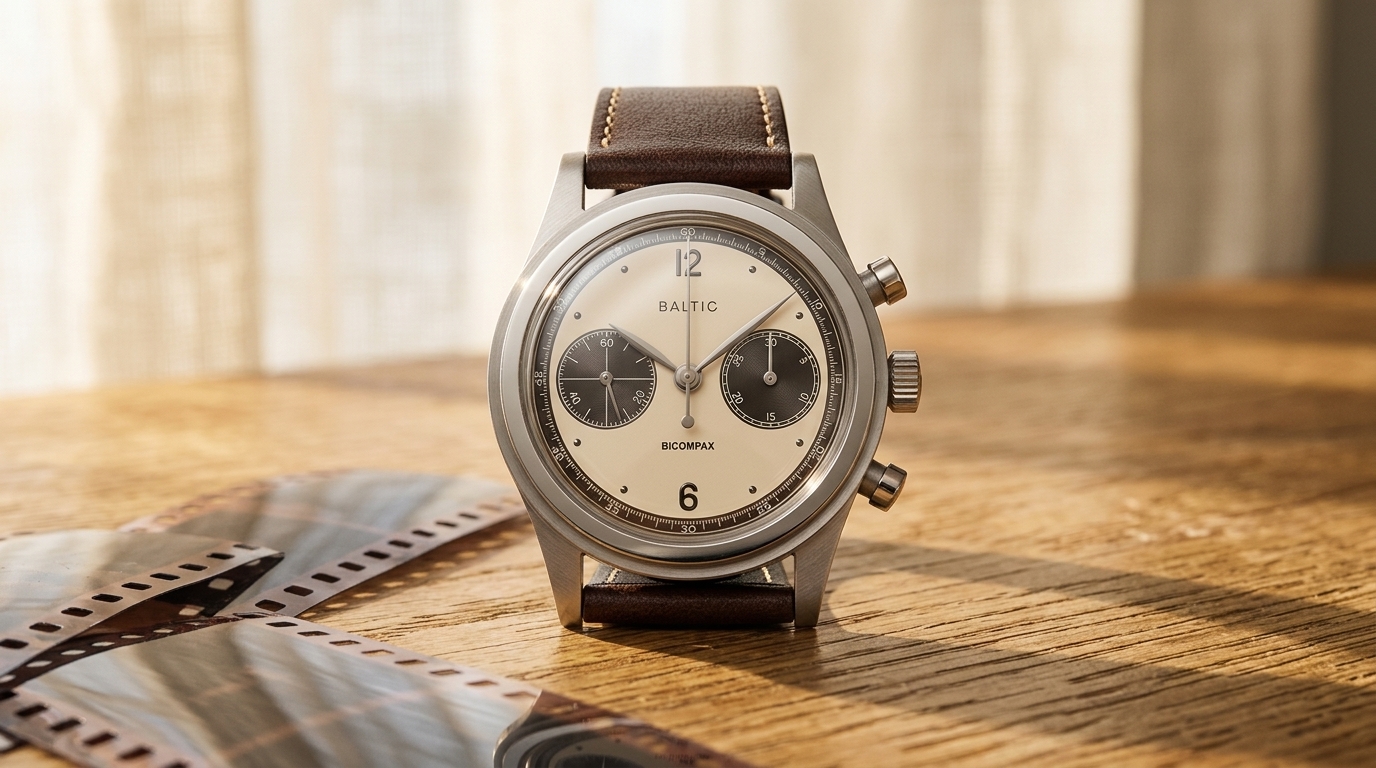
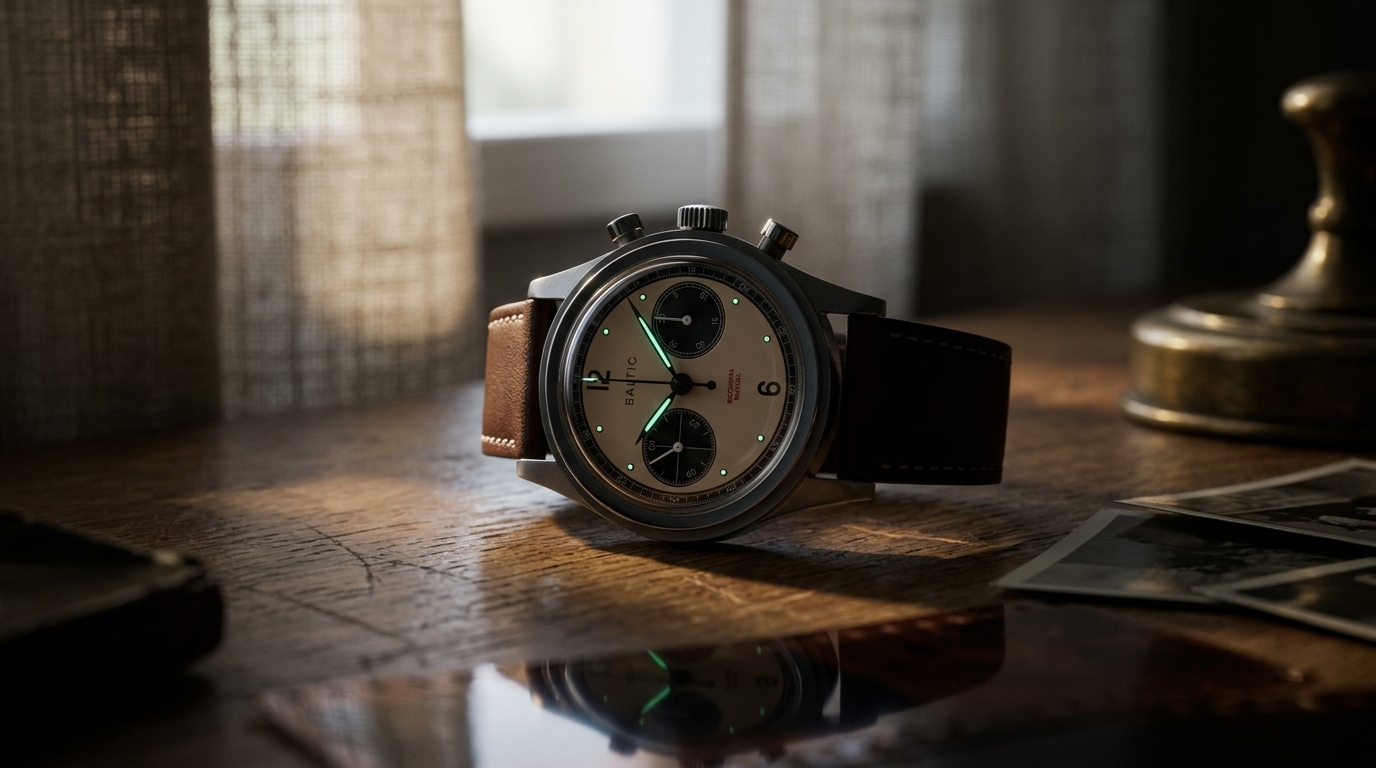
The dial catches first as a small arrangement of decisions: a raised minute track, a pair of numerals held in tension, the thin sweep of a seconds hand crossing a surface that seems to have been aged not by force but by memory. Nothing about it shouts. A Baltic watch tends to arrive quietly, as if it has entered through the side door of horology rather than the marble foyer, carrying with it a sense of the past that is neither inherited nor stolen outright. It is there in the case steps, in the domed crystals, in the proportions that stop before becoming costume. It is there most of all in the discipline of knowing how little is needed for an old idea to feel alive again.
Baltic was founded in Paris in 2017 by Étienne Malec, at a moment when the watch world was already crowded with nostalgia. Vintage watches had become a language of taste; tropical dials and gilt printing had long since escaped auction catalogues and entered mood boards. Many young brands looked backward because the past offered ready-made emotion. Baltic’s difference was not that it avoided this appetite, but that it treated it with unusual care. The brand’s early Bicompax and HMS models, launched through crowdfunding, did not pretend to be rediscovered military watches or lost chronometers from a closed manufacture. They were contemporary watches making plain reference to mid-century forms: sector dials, leaf hands, stepped cases, hand-wound chronograph architecture. The honesty mattered. The illusion was not total, and that was part of the charm.
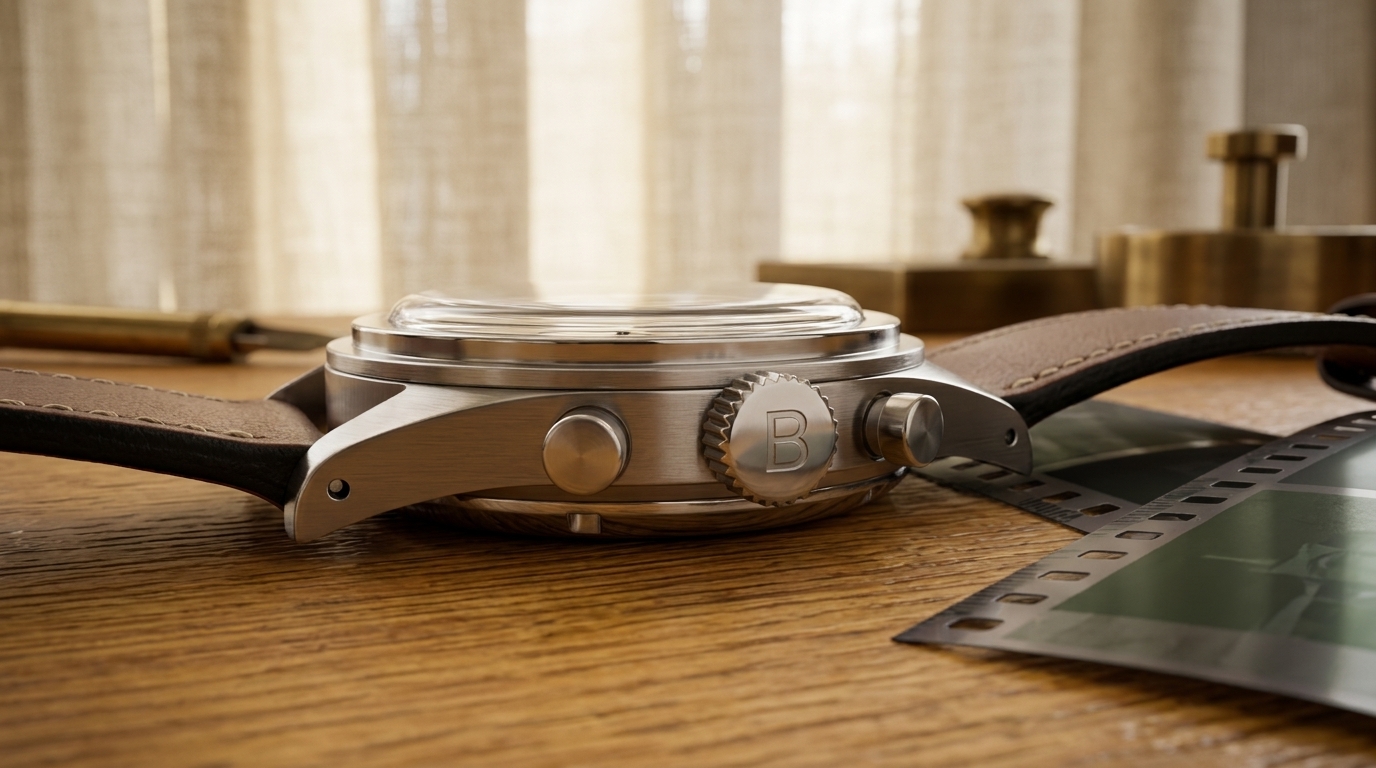
There is a particular danger in vintage design when it becomes merely surface. A beige lume, a boxed crystal, a smaller case diameter, and the work appears finished. But a watch changes character through less obvious choices. The distance between the bezel and the dial. The height of the mid-case. The curve of a lug as it leaves the case band. A crown too large can turn restraint into theatre; a subdial too close to the edge can make a watch feel as though it is wearing another century’s clothes without understanding the body beneath them. Baltic’s better watches succeed because they often begin from proportion rather than ornament. They seem to ask not what a vintage watch looked like in a photograph, but why it sat the way it did on a wrist, why a dial breathed, why a tool watch could still possess a kind of civility.
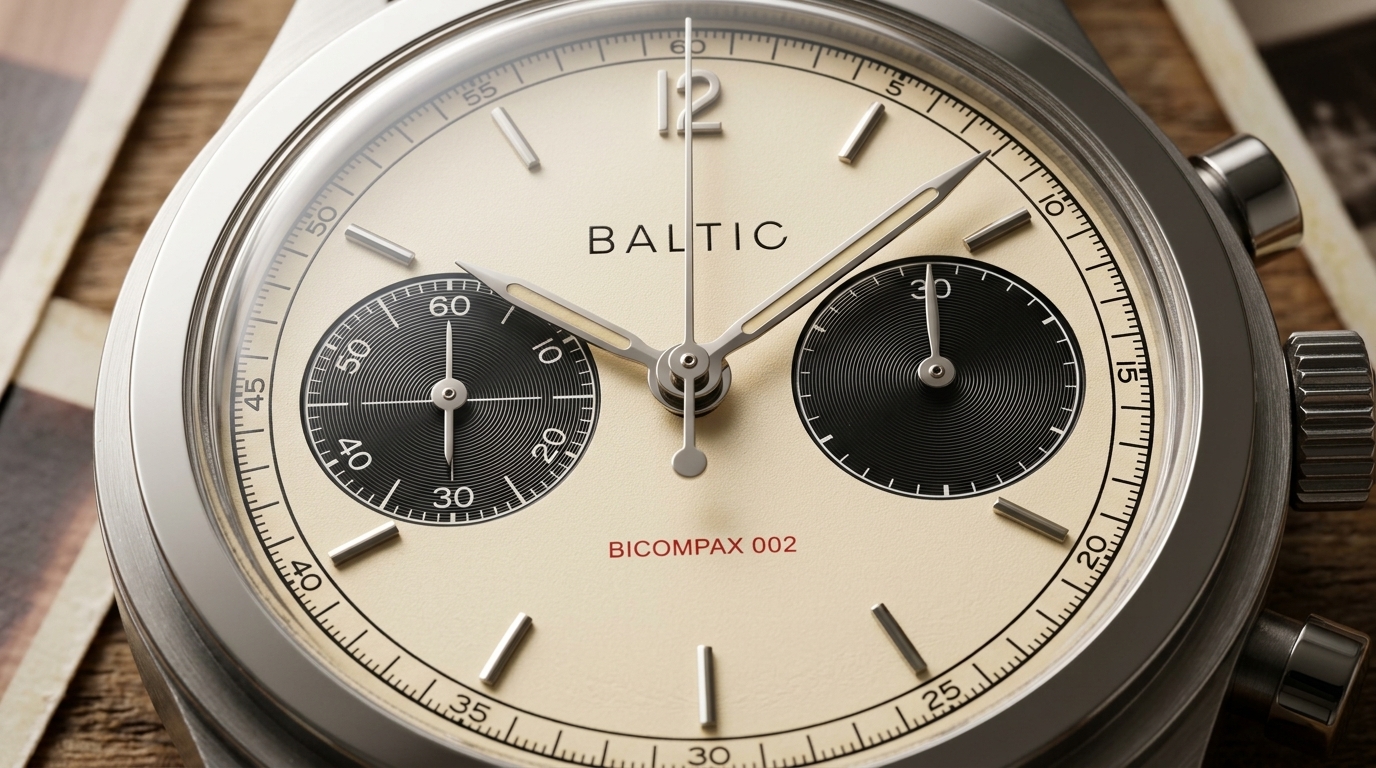
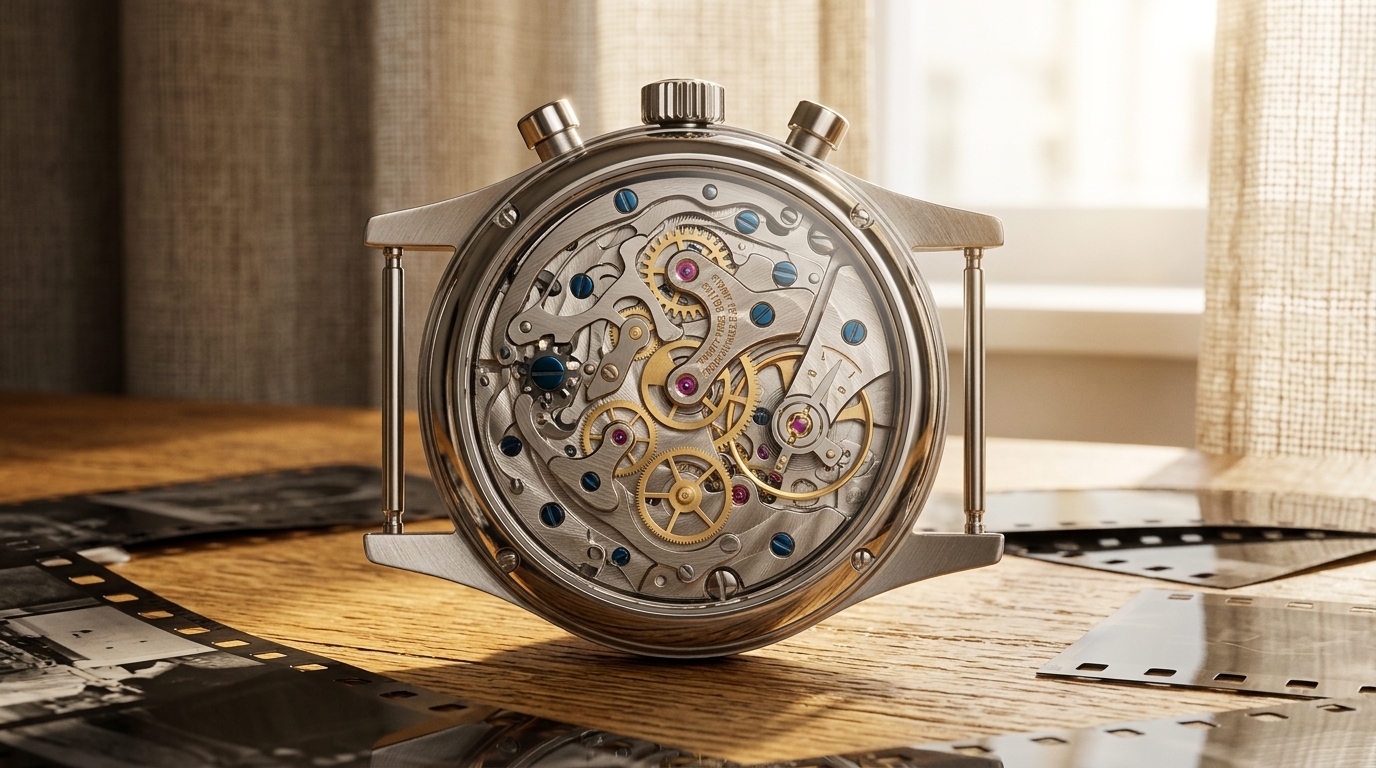
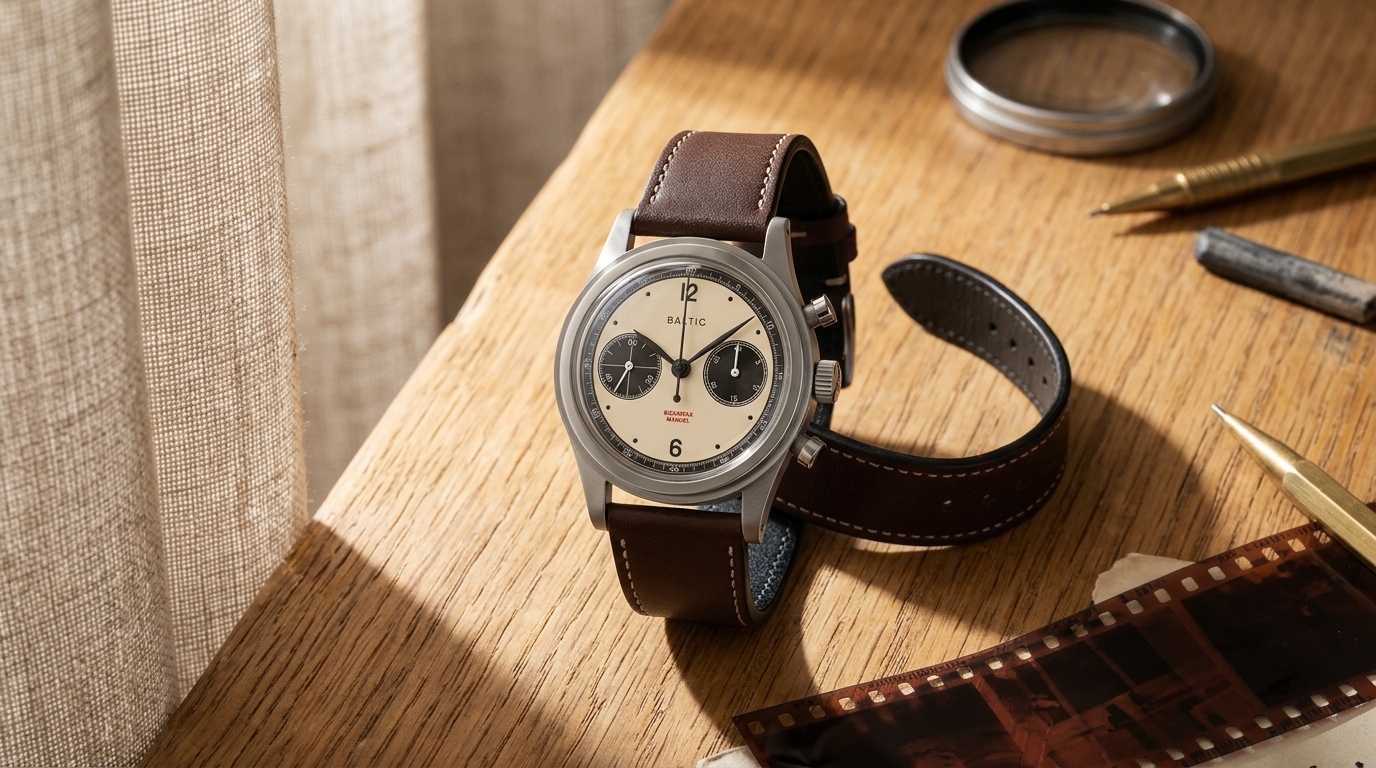
The Bicompax is the clearest early expression of that instinct. Its layout reaches back to the two-register chronographs of the 1940s and 1950s, watches built for measuring intervals before the chronograph became a symbol of motorsport glamour or instrument-panel aggression. Inside, Baltic used the Seagull ST1901, a Chinese hand-wound column-wheel chronograph movement descended from the Venus 175 architecture that made its way to China in the 1960s. The movement is not a prestige object in the Swiss sense, and Baltic did not disguise it as one. But it has a visible mechanism, a tactile cadence, and a historical strangeness that suits the watch. A column wheel turning beneath a transparent back, screws catching light, levers moving when the pusher is pressed: here the past is not simply printed on the dial. It is present in the mechanical grammar, imperfect and physical.
That choice reveals something important about the brand. Baltic’s watches have rarely been about claiming unbroken lineage. They have none to claim, and this frees them from the burden that traps older names into repeating themselves solemnly. Instead, Baltic assembles references with the eye of a collector who has studied auction photos, service dials, military specifications, and the softened edges of watches that survived ordinary lives. The watches do not belong to the 1950s, but they understand the 1950s as a design problem: how to make legibility beautiful, how to give a case presence without mass, how to leave enough emptiness on a dial for silence to do some work.
The Aquascaphe carries this problem into the language of the dive watch. On paper, it fits a familiar pattern: roughly 39 millimetres in diameter, a rotating bezel, luminous markers, a screw-down crown, water resistance suited to real use rather than merely to suggestion. But the watch avoids the swollen confidence that overtook many divers in the late twentieth century. Its case is compact, with a restrained thickness and lugs that shorten the visual span. The sapphire bezel insert gives depth without the brittleness of imitation bakelite, and the domed sapphire crystal nods to acrylic without asking the wearer to accept acrylic’s vulnerabilities. It is a negotiation rather than a reproduction. The watch knows that modern owners expect reliability, water resistance, and scratch protection, but it also knows that those expectations need not flatten the romance of a tool watch.
Baltic has a particular affection for the bracelet as an emotional object. The beads-of-rice bracelet, used across several models, has become one of its signatures not because it is novel but because it changes the mood of the watch so completely. A steel diver on a flat-link bracelet can feel technical; on beads-of-rice it becomes more social, almost coastal, recalling the lighter bracelets that once accompanied skin divers and everyday watches worn without anxiety. The links catch light in small fragments rather than broad panels. There is a softness to the articulation, a slight jewellery quality that does not feminise the watch so much as civilise it. This, too, is part of making the past feel earned: knowing that the bracelet is not an accessory afterthought, but a continuation of the case’s argument.
The brand’s MR01 perhaps best explains why Baltic has attracted attention beyond the usual circle of affordable mechanical enthusiasm. A 36 millimetre watch with Breguet-style numerals, a small seconds subdial, and a micro-rotor automatic movement is a risky proposition. It could have collapsed into pastiche immediately. The numerals could have become too sweet, the dial too ornate, the case too precious. Instead, the MR01 walks a narrow line. Its dial has texture and depth; the small seconds rests low, in a position that introduces a pleasing asymmetry of balance rather than disorder. The hands are fine enough to respect the numerals. The case is slim in impression, and the movement visible through the back makes the watch feel less like a static drawing and more like a small machine with a private room inside it.
The calibre, sourced from Hangzhou, is itself a subject of modern horological unease. A micro-rotor has long carried associations with high craft, from Universal Genève’s Polerouter movements to later Swiss and haute horlogerie executions where thinness, winding efficiency, and architecture become expressions of technical refinement. To place such a movement in a comparatively approachable watch disrupts the usual hierarchy. It also invites scrutiny. The finishing is not haute horlogerie, and no serious observer should pretend otherwise. But the architecture matters. The off-centre rotor, the revealed bridges, the compact theatricality of the mechanism: these give the MR01 a sense of mechanical occasion that a closed caseback could not. Baltic’s achievement lies not in elevating the movement beyond its station, but in choosing a calibre whose character serves the watch’s emotional purpose.
That phrase, emotional purpose, is not accidental. Baltic’s work is best understood not as nostalgia itself but as the shaping of nostalgia into something wearable. Watches have always been good at carrying invented memory. A new watch can make a person think of a grandfather’s drawer, a railway clock, a harbour, a pilot’s logbook, a university room with bad heating and good books. Most such images are borrowed, and there is no shame in that. Objects often begin their lives by borrowing atmosphere before they earn their own. The difficulty is avoiding false patina, the kind that insists too loudly that a watch has already lived. Baltic’s better pieces leave room for the owner’s years to accumulate. They suggest age without simulating damage. They offer a door into the past, not a stage set of it.
Here the brand’s youth becomes an asset. Established houses often speak of heritage as though history itself were a department. Their archives are real, their achievements considerable, but the weight of legacy can turn design into ceremony. Baltic has no observatory trials from 1910 to protect, no moon landing to repackage, no royal warrant to burnish. Its relationship to history is elective. It chooses what it admires and then submits those choices to the constraints of price, supply, movement availability, and modern expectation. The result is sometimes uneven, as one would expect from a young independent brand working across categories. But even the unevenness feels revealing. Baltic is not manufacturing inevitability. It is learning in public how to make watches that respect old forms without becoming trapped inside them.
The Hermétique line shows this learning in a different register. With its field-watch bearing and integrated-looking case architecture, it shifts away from the overt romance of sector dials and chronographs toward something more compact and sealed. The crown is placed unusually, tucked around the four o’clock position and partially protected by the case shape, giving the watch a specific silhouette rather than generic military utility. Its dial emphasises clarity: Arabic numerals, strong luminous plots, a straightforward minute track. Yet it does not feel like a blunt instrument. There is still that Baltic concern for edge, surface, and scale. The watch suggests that vintage influence need not always mean mid-century dress or aquatic romance; it can also mean the practical seriousness of an object designed to be read quickly and used without ceremony.
The Prismic moves closer to the dress watch, and with it comes another test. Dress watches are unforgiving because there is so little room to hide. A dive watch can absorb thickness; a chronograph can justify busyness; a sport watch can make aggression seem functional. A small, refined watch must survive through proportion, texture, and the relationship between dial and case. When Baltic works in this register, its interest in older forms becomes more architectural. The case is not merely a container but a sequence of planes. The dial is not merely coloured but arranged. Numerals, indices, and hands must seem inevitable, though nothing in watch design ever truly is. The danger is preciousness; the reward is intimacy.
Part of Baltic’s appeal lies in how it treats price without letting price become the story. The watches occupy a space where enthusiasm often becomes anxious, where every discussion risks collapsing into value, specifications, and comparisons. Baltic benefits from accessible positioning, but its strongest pieces are not strong because they are inexpensive versions of something else. That would make them shadows. They are strong when the design logic holds at their own level: when the movement choice makes sense, when the case finishing is appropriate, when the dial carries enough detail to reward looking but not so much that it begs for attention. A watch does not become serious by pretending to cost more than it does. It becomes serious by understanding its own means.
Finishing, in this context, must be discussed soberly. Baltic cases often use brushed and polished surfaces to create definition, with polished bezels or chamfered edges catching light against more muted case flanks. The effect is not the deep, liquid finishing of more expensive Swiss work, nor should it be described as such. But the distinction between surfaces is important because it gives the watch structure. A fully polished case can become sentimental; a fully brushed one can become dull. The alternation gives the eye a path to follow. Likewise, printed dials can feel flat when poorly done, but Baltic’s sector layouts, applied details, and grain or texture often give enough relief to keep the face from becoming a mere graphic exercise.
The brand is part of a broader change in modern collecting. For much of the twentieth century, legitimacy flowed downward from manufactures, patents, retailers, military contracts, and famous owners. In the digital era, legitimacy can also gather laterally, through communities, photographs, forums, and the slow consensus of people who care about lug-to-lug measurements and hand length. Baltic emerged from this world. Its watches made sense on screens, but not only on screens. Their appeal depended on details that digital culture had trained collectors to notice: the right diameter, the absence of a date window where it would disturb symmetry, the curve of a domed crystal at the edge of a dial. The internet did not cheapen this attention. It sharpened it.
Still, the central question remains whether a young brand leaning so openly on historical design can produce objects of lasting interest. The answer, if Baltic’s best watches are considered carefully, is that originality may not be the only virtue available. Watches have always been iterative. The great forms themselves were rarely born whole. The dive watch, the field watch, the dress watch, the chronograph: each is a sediment of solutions, patents, suppliers, accidents, and fashion. A rotating bezel becomes familiar because it works. A sector dial returns because it organises information beautifully. A 36 or 39 millimetre case feels right because the wrist remembers what the industry forgot during years of expansion. Baltic’s task is not to invent the wristwatch again. It is to choose well from the accumulated material and make those choices feel considered rather than scavenged.
This is where the word “earned” becomes useful. The past in Baltic’s watches feels earned when reference is matched by restraint. It feels earned when a micro-rotor is not simply a display-back trick but part of a watch’s inner charm. It feels earned when a chronograph movement carries a complicated history of Swiss design and Chinese manufacture, and the watch allows that history to remain visible rather than smoothing it into fiction. It feels earned when a bracelet changes how the watch lives on the body. It feels earned when the case is small not because smallness is fashionable again, but because the dial, lugs, bezel, and movement all support that size. Earning the past means accepting that memory has weight.
There is also, beneath the design language, a quiet democratic impulse. Vintage watches of the sort Baltic admires have become increasingly inaccessible in their original forms. The handsome chronographs once found in drawers now sit beneath auction lights. The simple divers that were used hard and serviced casually have either vanished, been over-restored, or become too expensive to treat with the informality they once invited. Baltic does not replace those watches, and it should not be asked to. But it offers an adjacent pleasure: the ability to inhabit some of their design intelligence without participating in the market’s more feverish rituals. A new watch can be worn in rain, on trains, at desks, near salt water, in the ordinary abrasion of days. It can begin without the anxiety of preserving someone else’s history.
That may be the truest measure of the brand’s success. Baltic’s watches do not ask to be worshipped. They ask to be noticed slowly. The hand-wound pause in a Bicompax before the day begins. The cool rim of an Aquascaphe bezel turning with measured resistance. The small seconds of an MR01 making its quiet circuit below numerals that seem older than the brand itself. These are not grand horological events. They are smaller than that, and perhaps more durable. They belong to the scale at which watches actually live: a glance, a winding crown, a clasp closed in the morning, a crystal catching a window’s light.
The past is always available to watchmakers, but it is not always forgiving. It exposes laziness, because old designs were often clearer than new ones. It exposes excess, because proportion cannot be faked indefinitely. Baltic’s art has been to approach that past without trying to own it. The brand borrows, certainly, but it also edits. It studies silhouettes, but it does not always embalm them. It understands that a modern watch inspired by history must remain modern in the ways that matter: dependable enough, wearable enough, honest enough about its origins and compromises.
By the time the eye returns to the dial, to the minute track and the polished edge and the hand moving over its small field of colour or grain, the illusion has done its work without becoming deceit. The watch has not travelled from another decade. It was made now, with contemporary suppliers, contemporary constraints, contemporary taste. Yet it carries an older rhythm, not as inheritance but as discipline. Baltic’s finest watches make the past feel earned because they do not treat it as decoration. They treat it as a standard to be met in miniature, one proportion, one movement, one line of print at a time.