Nomos Glashütte: The Independent German Watchmaker That Made Restraint a Business Model
Nomos Glashütte: The Independent German Watchmaker That Made Restraint a Business Model
Nomos Glashütte is often reduced to a neat phrase: the Bauhaus watchmaker from Germany. That description is convenient, search-friendly, and not entirely wrong, but it misses the more important story. Nomos is not interesting because its watches are minimal. Nomos is interesting because it built one of the most coherent independent watch companies in Europe by refusing to behave like a typical luxury brand.
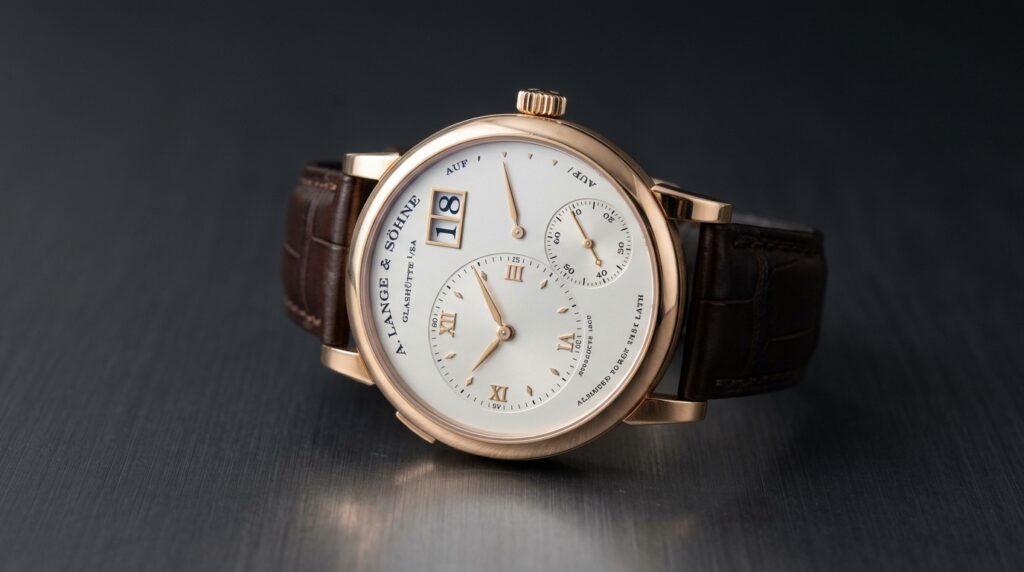
Founded in 1990 by Roland Schwertner, shortly after German reunification, Nomos entered Glashütte at a moment when the town’s watchmaking identity was being rebuilt almost from scratch. A. Lange & Söhne was revived in 1994 under Walter Lange and Günter Blümlein. Glashütte Original emerged from the former state-owned conglomerate. Nomos, by contrast, began as a lean private company with a design-led proposition and outsourced ébauches, then spent the next three decades pulling more of the watch inside its own walls. That trajectory matters. It explains why a Tangente at around the lower end of Swiss luxury pricing can carry a movement architecture, escapement strategy, and production identity that many larger brands would struggle to justify at similar levels.
The Real Nomos Origin Story Is Post-Reunification Industrial Strategy
The year 1990 is not cosmetic history for Nomos. It defines the brand’s opportunity and its constraint. Glashütte, in Saxony, had been a watchmaking centre since Ferdinand Adolph Lange established his manufacture there in 1845, but the post-war division of Germany and the later nationalisation of local producers under the GDR changed its industrial structure completely. When reunification arrived, the Glashütte name had cachet but also needed reconstruction in legal, commercial, and technical terms.
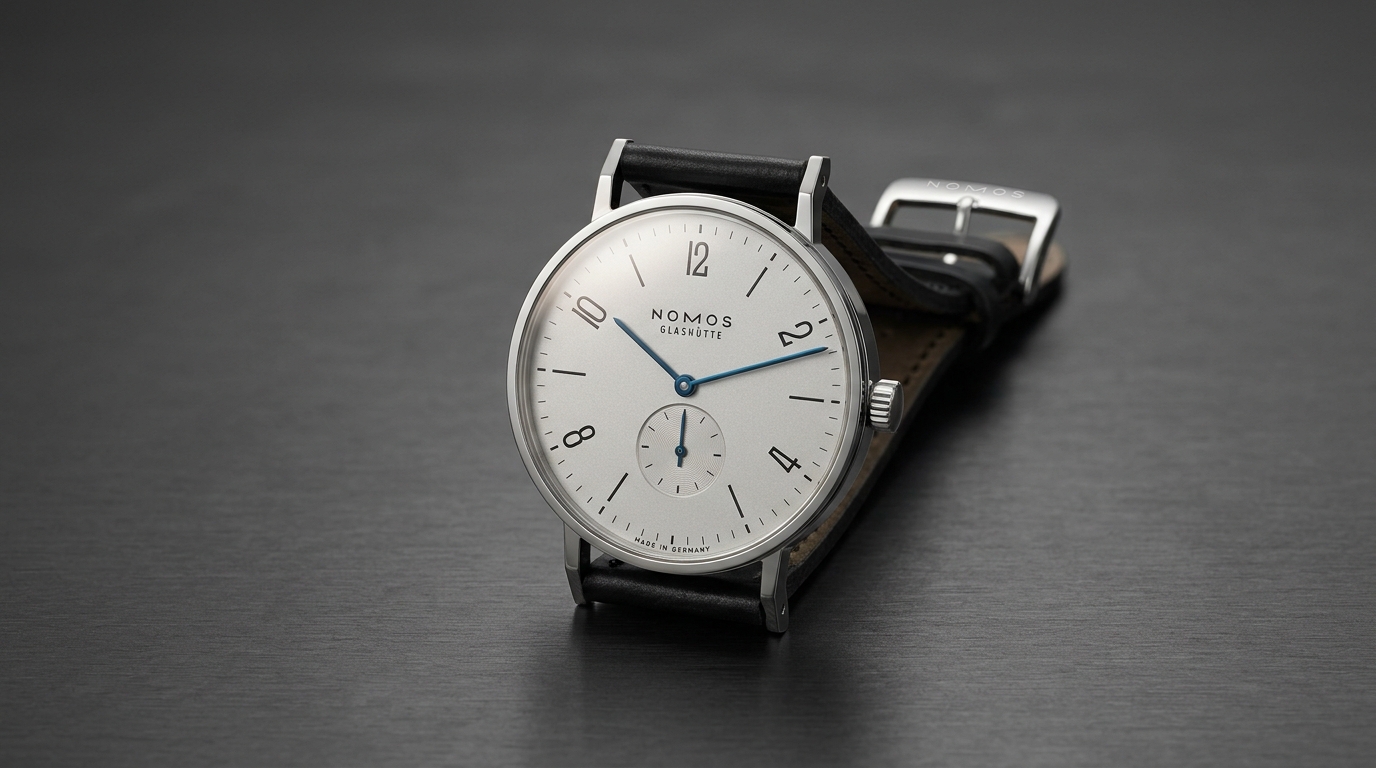
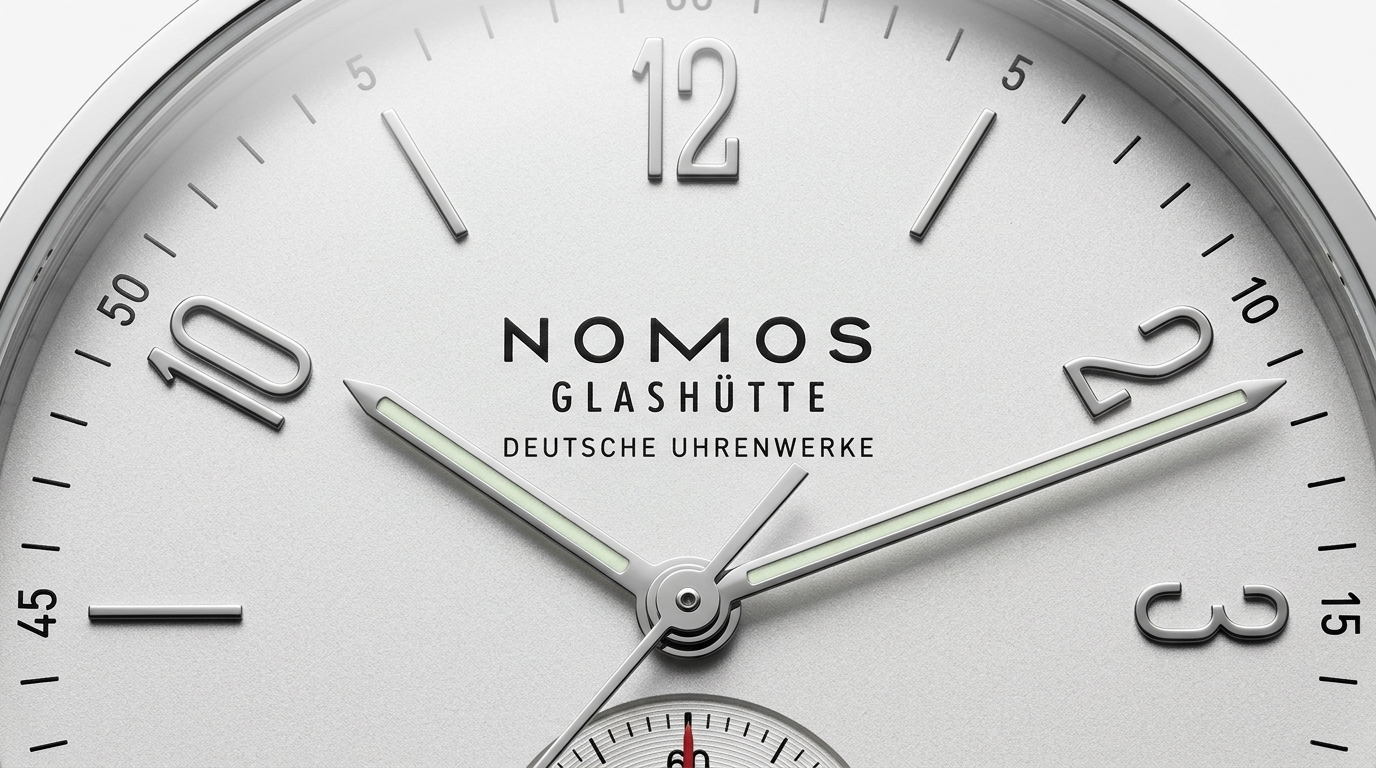
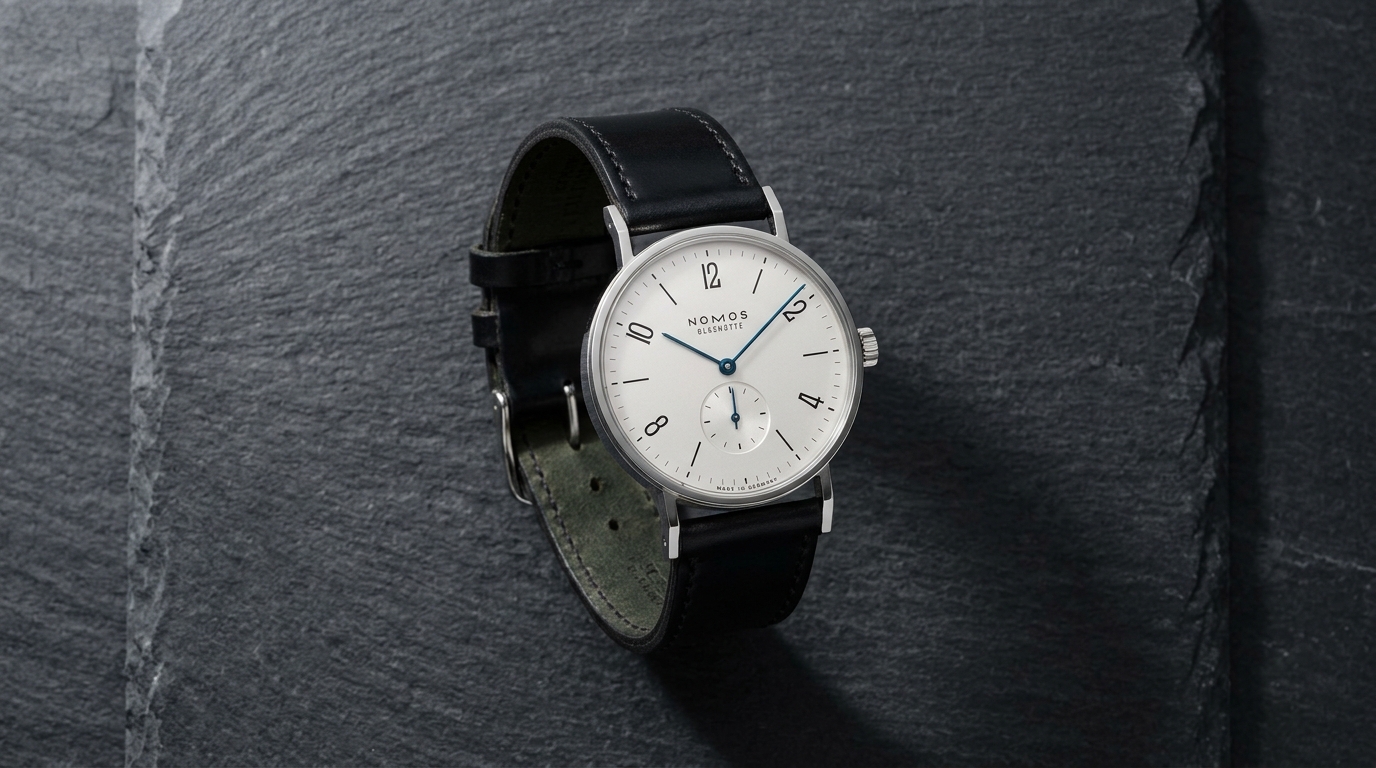
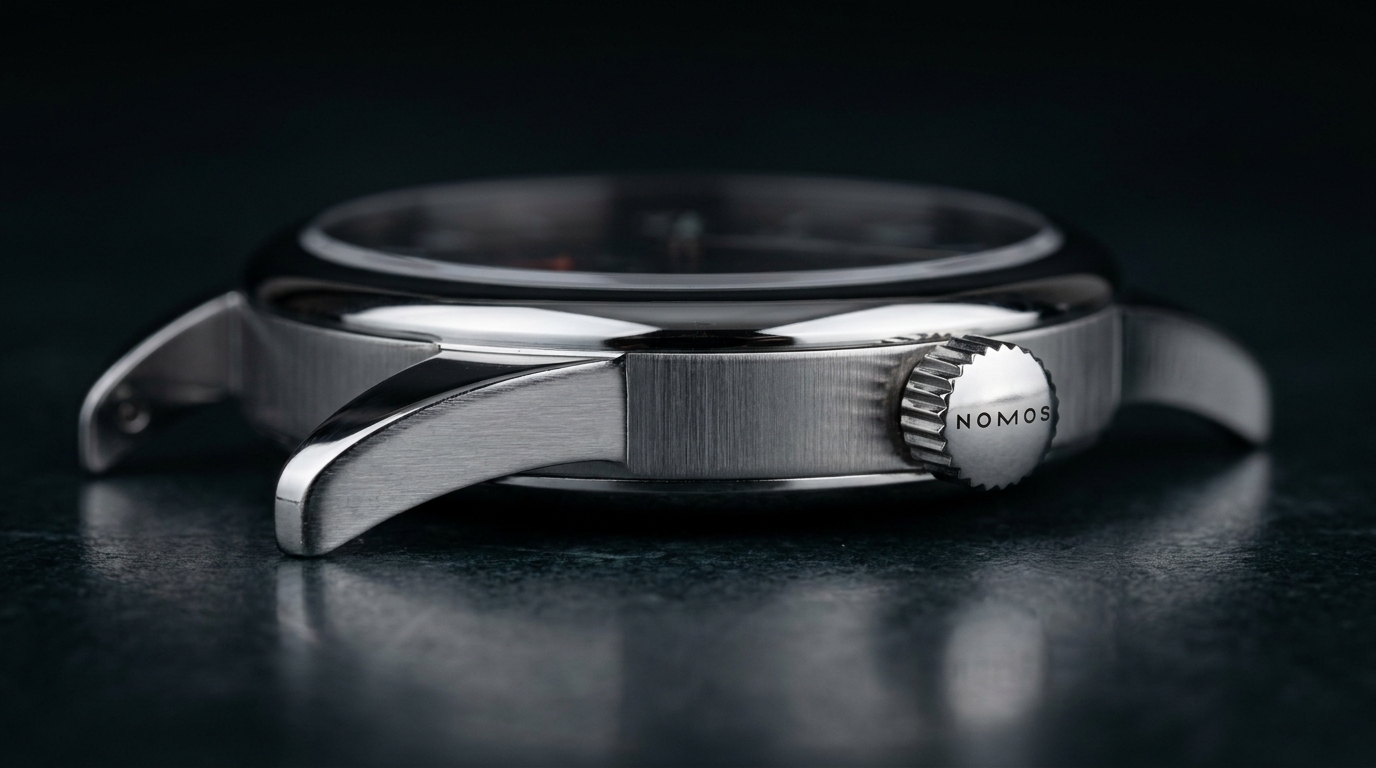
Nomos registered early in that period and began selling watches in 1992. The original collection consisted of Tangente, Orion, Ludwig, and Tetra: four models that still define the brand more than thirty years later. That continuity is not accidental. Nomos never had the capital base of Richemont, Swatch Group, or LVMH. Its advantage had to be recognisability, not seasonal novelty. The Tangente, especially reference 101 in hand-wound 35 mm form, became the grammar of the company: thin bezel, long angular lugs, printed Arabic numerals, small seconds, and a case that deliberately leaves no hiding place for poor proportions.
There is a tendency to call this Bauhaus, but the label is blunt. The Tangente owes at least as much to German Werkbund rationalism, interwar Glashütte dial layouts, and Berlin graphic culture as to Dessau. The point is not academic. A Bauhaus cliché implies decorative minimalism. Nomos design, at its best, is more disciplined than that: typography, case diameter, lug length, and movement thickness are treated as one system. When Nomos gets those relationships right, the watches look inevitable. When it gets them wrong, as some larger Club and Autobahn executions arguably do on smaller wrists, the same design language becomes unforgiving.
From Peseux to Manufacture: The Movement Story That Changed the Brand
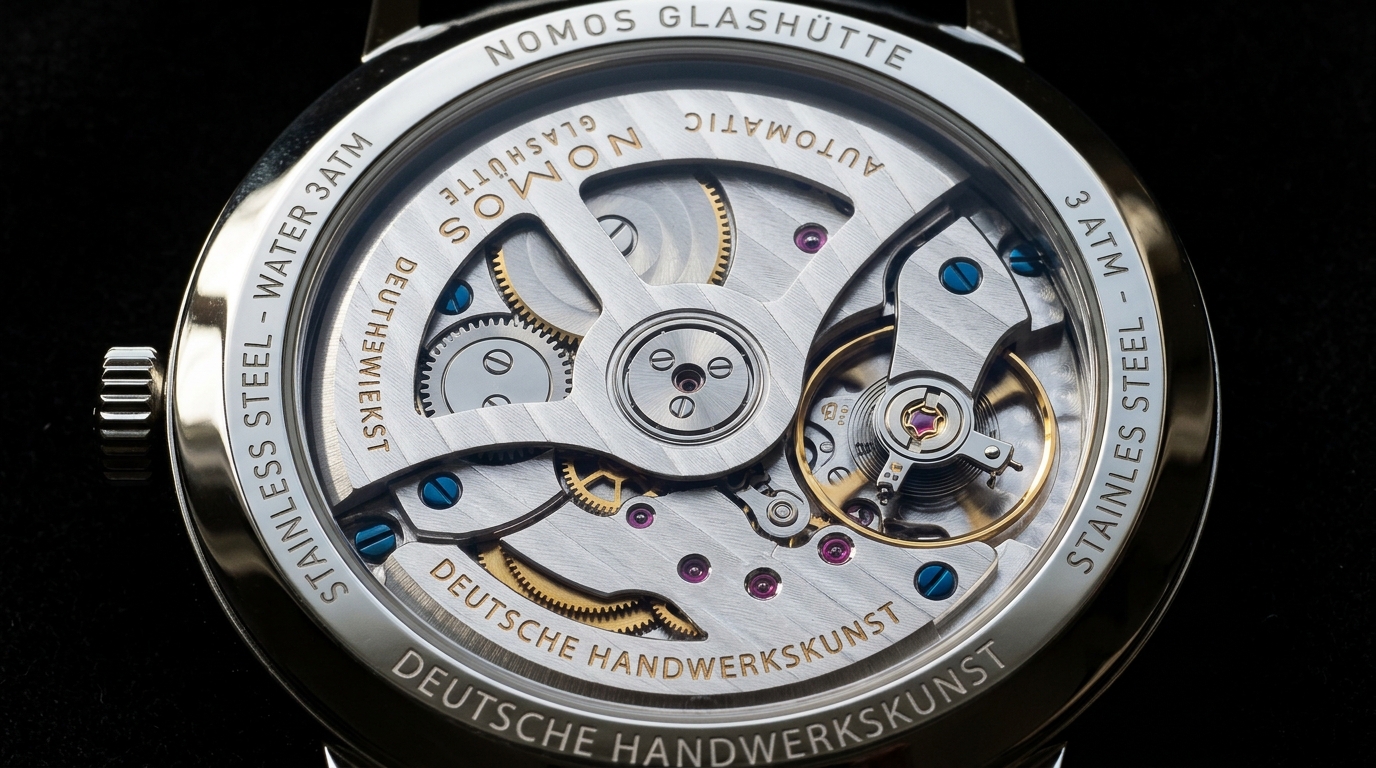
The first generation of Nomos watches used the ETA Peseux 7001, a thin hand-wound movement that suited the brand’s early cases. It was a sensible choice rather than a compromise: the 7001 was slim, reliable, and allowed Nomos to establish a design identity before it had the resources to manufacture calibres at scale. The turning point came in 2005, when Nomos introduced its own Alpha calibre, followed by Beta, Gamma, and Delta variants. These movements retained the broad architecture familiar from the 7001 tradition, but with Glashütte three-quarter plates, perlage, blued screws, ribbing, and increasingly extensive in-house production.
The more decisive shift arrived in 2014 with the Nomos Swing System, the company’s proprietary escapement assembly. Escapements are not romantic talking points; they are industrial barriers. The Swiss lever escapement depends on a balance, hairspring, escape wheel, pallet fork, and regulation system that are difficult to design, make, and standardise. For a small independent to move away from dependence on Swatch Group-related supply at this level was strategically important. Nomos developed the Swing System with the Dresden University of Technology and invested heavily in bringing the assortment under its own control. From a collector’s perspective, this gave substance to the word “independent.”
In 2015, Nomos introduced the DUW 3001, the ultra-thin automatic calibre used in the neomatik line. At approximately 3.2 mm thick, it allowed Nomos to make automatic watches with the visual lightness that had previously belonged mostly to its manual-wind models. The DUW 3001 is not simply a convenience calibre; it is the technical bridge between Nomos as a design brand and Nomos as a manufacture. It is also where the company’s pricing argument became most persuasive. A sub-4 mm automatic movement with in-house escapement, Glashütte finishing conventions, and series production reliability is meaningful in watches that often sit around the 3,000 to 4,000 euro range, depending on reference and market.
The Tangente Is the Anchor, but Not the Whole Fleet
The Tangente remains the commercial and symbolic centre of Nomos. It is the watch people buy when they want the clearest expression of the brand, and it is also the model collectors most often use to judge whether Nomos has lost or maintained its discipline. The hand-wound Tangente 35, powered by Alpha, remains perhaps the purest proposition: thin, legible, historically consistent, and priced in a segment where many Swiss competitors offer outsourced movements behind closed casebacks.
The automatic Tangente neomatik, using DUW 3001, is more technically ambitious but not always more emotionally compelling. The extra cost is justified on paper, especially given the movement, but the hand-wound version better reflects the original design logic. This is one of the recurring truths about Nomos: more specification does not always make the better watch. The brand’s strongest references are frequently those that accept restraint as a functional principle, not a style cue.
Orion is the connoisseur’s alternative. Its domed crystal, tapered markers, and softer case profile make it less graphic and more architectural than Tangente. Ludwig, with Roman numerals, leans more formal and occasionally risks stiffness. Tetra, the square-cased member of the original quartet, is important because it proves that Nomos did not build its identity only around round minimalism. The Tetra’s challenge is that square watches are inherently niche; its reward is that it remains one of the few rectangular or square modern watches below high luxury that feels intellectually designed rather than retrofitted.
Metro, introduced in 2014 and designed by Mark Braun, was the first major proof that Nomos could evolve without diluting itself. The original Metro Datum Gangreserve, with its power-reserve display, wire lugs, mint-green accents, and needle hands, was not a Tangente derivative. It was unmistakably Nomos but had a different rhythm. That is harder to achieve than it sounds, and several brands with far larger budgets have failed at precisely this task.
Pricing, Value, and the Pressure of Moving Upmarket
Nomos occupies a difficult price corridor. Its watches are too expensive to be treated as design objects in the Junghans Max Bill sense, yet generally below the psychological territory occupied by Rolex, Omega, Cartier, and Grand Seiko’s more visible mechanical models. The core competition is therefore mixed: Longines in heritage value, Oris in independent-adjacent positioning, Tudor in robustness and resale security, and Grand Seiko in movement finishing and dial craft. Nomos cannot win every comparison, nor should it try.
Its strongest argument remains manufacturing depth relative to price. A Tangente or Orion with Alpha offers a finished in-house hand-wound calibre in a watch that is genuinely thin and coherent. A neomatik model with DUW 3001 offers a technically interesting automatic calibre without the bulk that often afflicts entry-luxury automatics. The DUW 6101, launched in 2018, added a large, thin automatic date calibre with a date ring around the movement perimeter and quick correction in both directions. At 35.2 mm wide and around 3.6 mm thick, it was engineered to avoid the common problem of tiny date discs stranded near the centre of oversized dials. That is practical watchmaking, not brochure watchmaking.
The risk is that Nomos pricing has crept into more contested territory. Limited editions, sports models, bracelets, and larger automatic references can push buyers toward alternatives with stronger mainstream recognition or higher perceived durability. A Club Sport neomatik with 200 metres of water resistance, sapphire back, bracelet, and DUW 3001 or DUW 6101 depending on version is objectively more versatile than a hand-wound Tangente. But at its price, the buyer may also cross-shop Tudor Black Bay, Omega Aqua Terra pre-owned, or Grand Seiko quartz and mechanical models. Nomos then has to win on intelligence, not status. That is a narrower audience.
The Glashütte Claim Has Substance, but It Needs Context
The word “Glashütte” is protected under German rules requiring a significant share of value creation to take place in the town. Nomos has invested in production there, while maintaining design and administrative strength in Berlin. This split is part of the company’s character: Saxon movement culture combined with metropolitan visual discipline. It also keeps Nomos distinct from Glashütte Original, which is more traditional and vertically integrated in a classical manufacture sense, and from A. Lange & Söhne, which operates in a different universe of price, finishing, and complication.
Nomos movements use recognisable Glashütte traits: three-quarter plates, tempered blue screws, sunburst decoration, ribbing, and ratchet and crown wheels with visible finishing. These are not finished to Lange standards, and serious collectors should not pretend otherwise. Anglage is industrial rather than artisanal; decoration is clean rather than lavish. But that is exactly the point. Nomos is not selling hand-finished haute horlogerie at 30,000 euros. It is selling serially produced mechanical watches with enough engineering and finishing integrity to make the price feel rational.
The Lambda and Lux lines, introduced in 2013 in gold cases, showed that Nomos could operate above its normal tier. The DUW 1001 in Lambda, with twin mainspring barrels and an 84-hour power reserve, gave the brand a more elevated technical platform. Yet these watches remain peripheral in perception. Nomos can make precious-metal watches, but its cultural authority still sits in steel. That is not a weakness. It is a useful boundary.
Where Nomos Gets Sports Watches Right, and Where It Struggles
The Club line has become Nomos’s most accessible and physically robust family. The Club Campus, often positioned toward graduates and first serious watch buyers, uses playful dial colours and California-style numerals in some references. It is easy to dismiss these as entry-level lifestyle pieces, but the better Club models are important because they make Nomos less fragile. Water resistance, stronger cases, and more relaxed typography broaden the brand without severing its identity.
Ahoi, introduced in 2013, attempted a similar move with a more aquatic brief: crown guards, higher water resistance, textile strap, and luminous treatment. It never became as iconic as Tangente, but it established that Nomos did not have to remain trapped in dress-watch minimalism. The more recent Club Sport models have pushed this further with steel bracelets, 100 to 200 metres of water resistance depending on reference, and more conventional daily-wear proportions.
Still, Nomos sports watches face a structural problem: the brand’s cases were originally designed around thinness, flatness, and long lugs. Increase the diameter and add water resistance, and those same lugs can make watches wear larger than their measurements suggest. A 42 mm Nomos is rarely a quiet 42 mm. The best contemporary Nomos cases tend to sit around 35 to 39 mm, where the geometry has room to breathe without dominating the wrist. The brand has improved here, but collectors should still buy by lug-to-lug reality, not case diameter.
The Collector Case for Nomos
The strongest reason to buy Nomos is not resale value. Secondary-market performance is uneven, and the brand does not benefit from the artificial scarcity dynamics that shaped Rolex, Patek Philippe Nautilus, or Audemars Piguet Royal Oak discourse in the late 2010s and early 2020s. That is healthy. Nomos watches are usually available, broadly rationally priced, and not dependent on authorised-dealer theatre.
The collector case rests instead on coherence and substance. Few independent brands at this scale have maintained such a consistent design language while also investing in proprietary calibres and escapement production. Fewer still have done it from Germany, outside the Swiss industrial network, while keeping prices within reach of professionals rather than only high-net-worth enthusiasts. Nomos is not a microbrand, and it is not a luxury conglomerate asset. It occupies a rarer middle ground: independent, industrialised, design-literate, and technically credible.
The best buys remain the watches closest to the brand’s core competence. Tangente 35 hand-wound for purity. Orion 35 or 38 for elegance without nostalgia. Metro neomatik for a more contemporary expression. Club Campus for a first mechanical watch with character. Tangente Update with DUW 6101 if the date execution matters and the larger dial works on the wrist. The Zurich World Time, originally designed by Hannes Wettstein and using the automatic world-time calibre, is also one of the brand’s more underrated complicated references, though its size and dial busyness make it less universally wearable than a Tangente.
The Strategic Question: Can Restraint Keep Scaling?
Nomos’s central challenge is that its greatest strength resists aggressive growth. A brand built on restraint cannot endlessly multiply colours, limited editions, case sizes, and sport variants without weakening the signal. At the same time, a modern independent manufacture needs volume, visibility, and product breadth to fund movement development and global distribution. This tension is visible across the catalogue. Some references feel exact; others feel like the brand testing how far its language can stretch.
The company’s ownership structure gives it more freedom than most competitors. Nomos is not being managed to fill a portfolio gap under a luxury conglomerate. It does not need to become the German Tudor, the affordable Lange, or the minimalist Omega. Its strategic value lies precisely in not being those things. But independence also removes excuses. When Nomos releases a model with awkward proportions or unclear pricing, there is no conglomerate machinery to blame. The judgment falls directly on the brand.
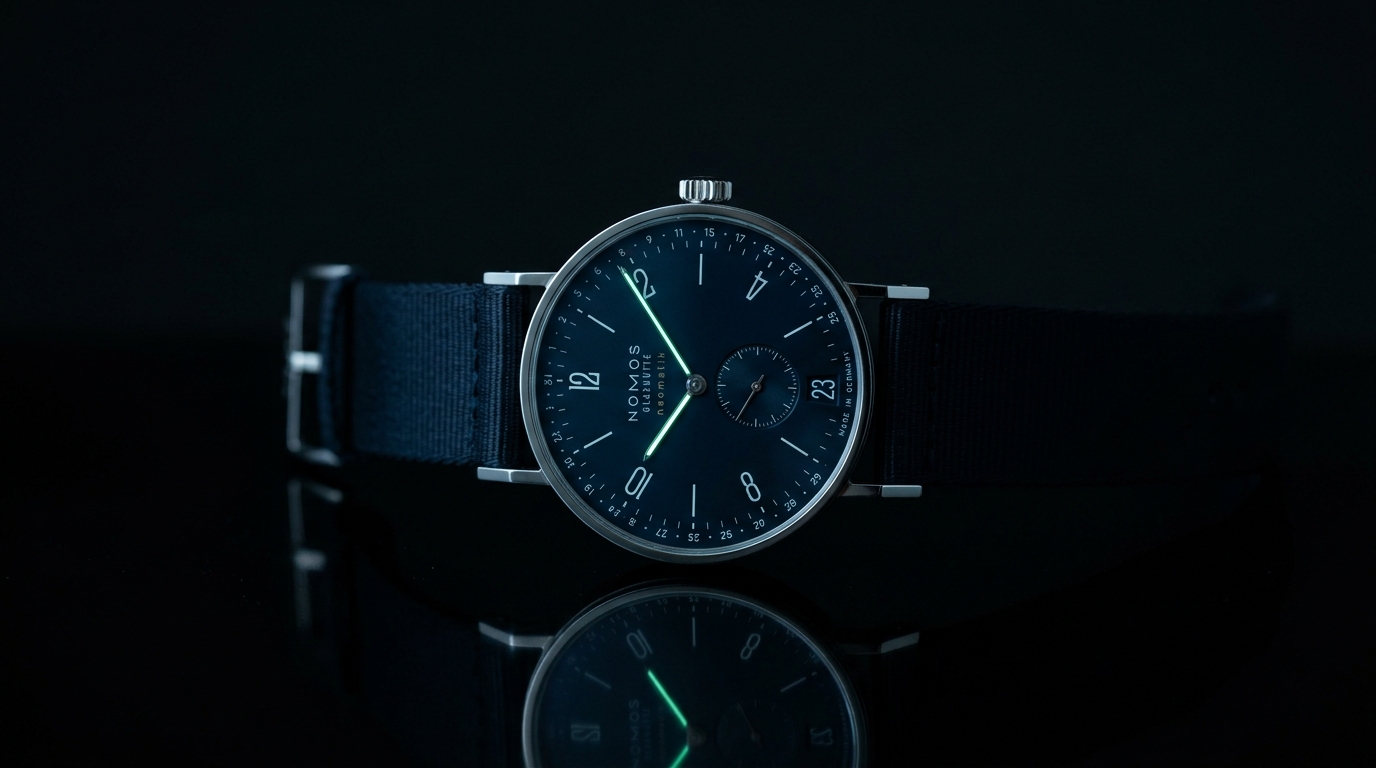
The editorial verdict is straightforward: Nomos Glashütte is one of the most important mechanical watch companies founded after 1990, not because it reinvented watchmaking, but because it proved that independent industrial watchmaking in Europe could be design-led, technically serious, and commercially durable. Its best watches are not loud achievements. They are disciplined objects with real movements, real manufacturing choices, and a point of view.
For collectors, that makes Nomos unusually easy to respect and occasionally difficult to love. The watches can be austere. The long lugs are not for every wrist. The brand’s modern colour work can be charming in one reference and forced in another. But the underlying proposition remains rare: an independent Glashütte maker with proprietary calibres, an in-house escapement, a coherent design archive, and prices that still make mechanical sense. In a market crowded with borrowed heritage and inflated claims, Nomos is valuable because it is specific. It knows what it is. The task now is to keep knowing when to stop.