Cartier and the Strange Power of a Watch That Refuses to Look Like One
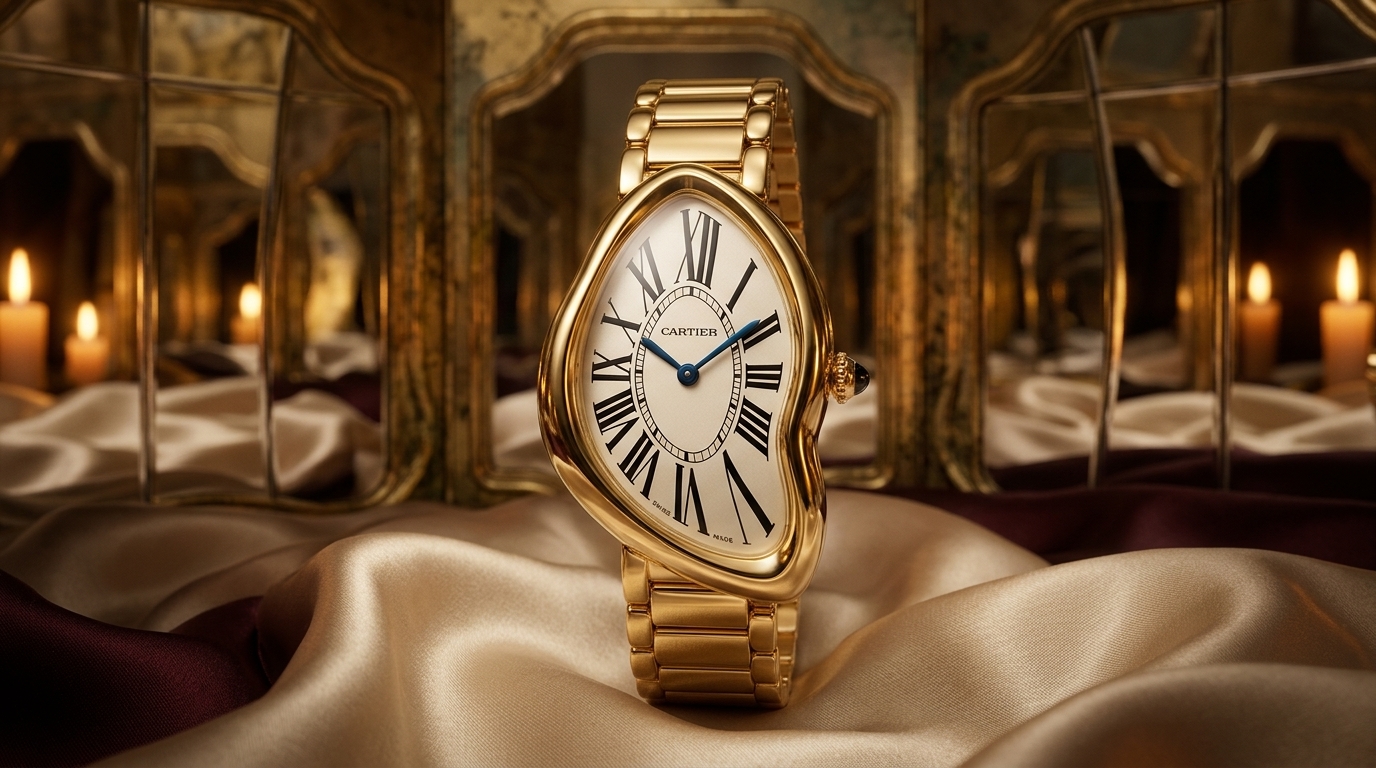
On the dial, the Roman numerals appear to have slipped from their posts in the night. The twelve leans forward as if listening. The six has been pulled down into a long, theatrical bow. The case does not frame time so much as disturb it: gold drawn into a soft, irregular oval, then pinched, dragged, and released. A crown, ordinary in its purpose, sits on the right-hand flank like a small bead of sanity. The hands still turn from the center. Minutes still pass. Yet the Cartier Crash seems less like an instrument than the evidence of something that happened to an instrument.
That has always been its peculiar force. A watch is usually expected to declare its function before anything else. Round cases, balanced lugs, clean tracks, a legible dial: these are the manners of the trade. Even when watchmaking becomes luxurious, it tends to preserve the grammar of measurement. The Crash breaks that grammar without abandoning it. It keeps the crown, the hands, the numerals, the strap, the buckle, the small ticking engine hidden beneath the dial. But it bends the sentence until meaning comes from distortion. It is a wristwatch that behaves like a memory of a wristwatch.
The old story says the design came from a Cartier Baignoire or Maxi Oval damaged in a car accident, its case warped by heat and impact, brought back to the London workshop as a ruin. It is a useful story because it explains the object in one image: a watch rescued from wreckage, made beautiful by trauma. Useful stories, however, often become too neat for the things they try to contain. The more sober account places the Crash in the late 1960s at Cartier London, under Jean-Jacques Cartier, when the firm’s English branch was working with a freer hand than the Parisian mythology usually allows. London in 1967 did not require an automobile accident to imagine a deformed watch. It had enough appetite for rupture on its own.
Cartier had already spent half a century teaching the wristwatch to leave the circle. The Santos, made for Alberto Santos-Dumont in the early years of the twentieth century, gave the wrist a square case with visible screws and a practical purpose tied to flight. The Tank, introduced in 1917, turned armored vehicles into rectilinear calm. The Tortue softened the rectangle into an animal curve; the Cintrée stretched the Tank along the wrist until it seemed architectural; the Baignoire made an oval severe and feminine without surrendering its geometry. Cartier’s real contribution to horology was never only decoration. It was the ability to make shape carry thought.
The Crash arrived as the thought turned unstable. The original London pieces were produced in tiny numbers, with cases made by hand in yellow gold, their asymmetry not printed on after the fact but built into the object. That distinction matters. A distorted dial inside a normal case would have been a joke. A melted case around a stable dial would have been a prop. The Crash works because everything participates: the bezel swells and narrows, the lugs seem to have migrated from their proper positions, and the Roman numerals are drawn to obey the case’s nervous perimeter. Even the chemin de fer minute track, that bourgeois railway of punctuality, is made to stagger around the edge.
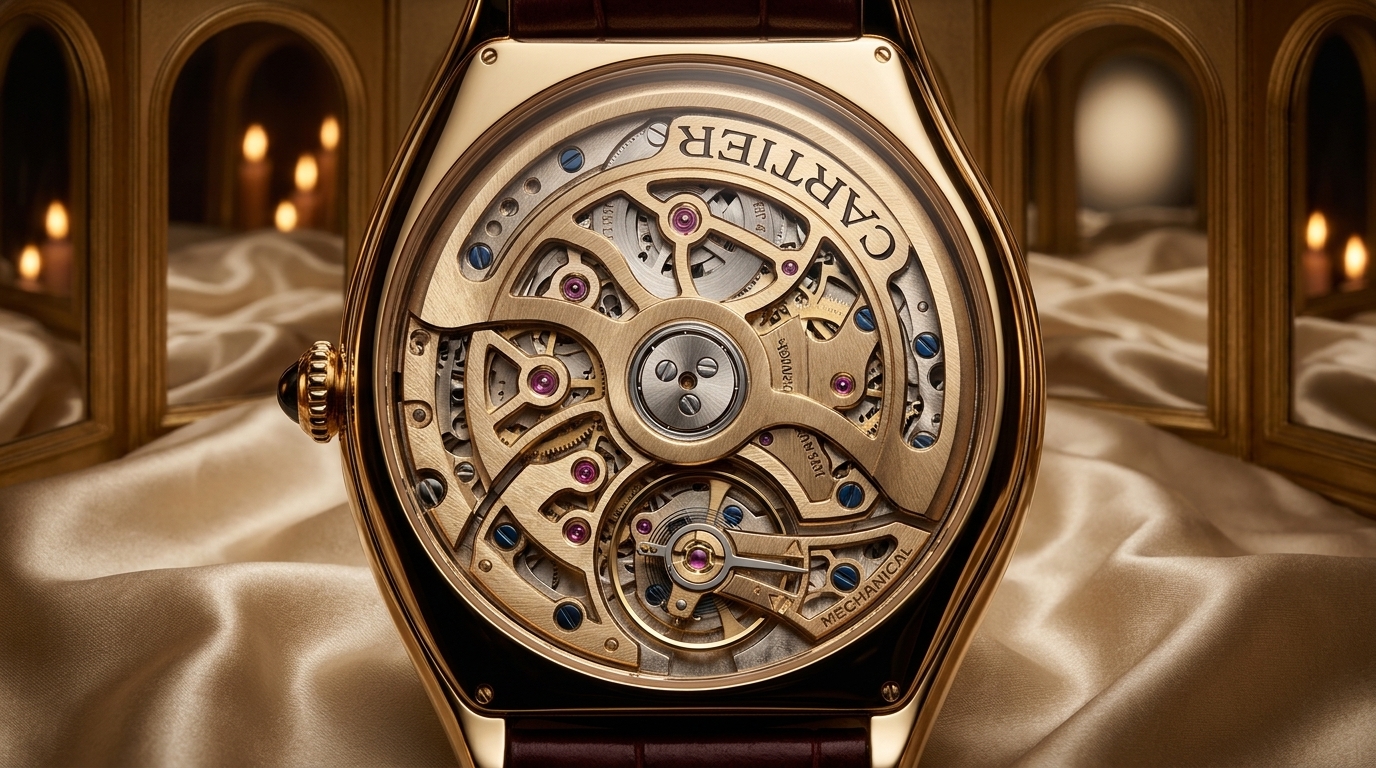
Inside, of course, there had to be discipline. The early watches relied on small manual-wound movements, compact enough to sit within the strange envelope. Later versions would use calibres such as Cartier’s 8970 MC, a hand-wound movement modest in diameter and thickness, chosen not to dominate but to permit the sculpture above it. In the skeletonized Crash, Cartier’s calibre 9618 MC turns the joke inward: the bridges themselves become distorted Roman numerals, the movement no longer hidden beneath surrealism but made to perform it. That version is less secretive, perhaps less haunting, but it reveals something essential. The Crash is not anti-watchmaking. It is watchmaking forced into an unnatural posture and made to survive there.
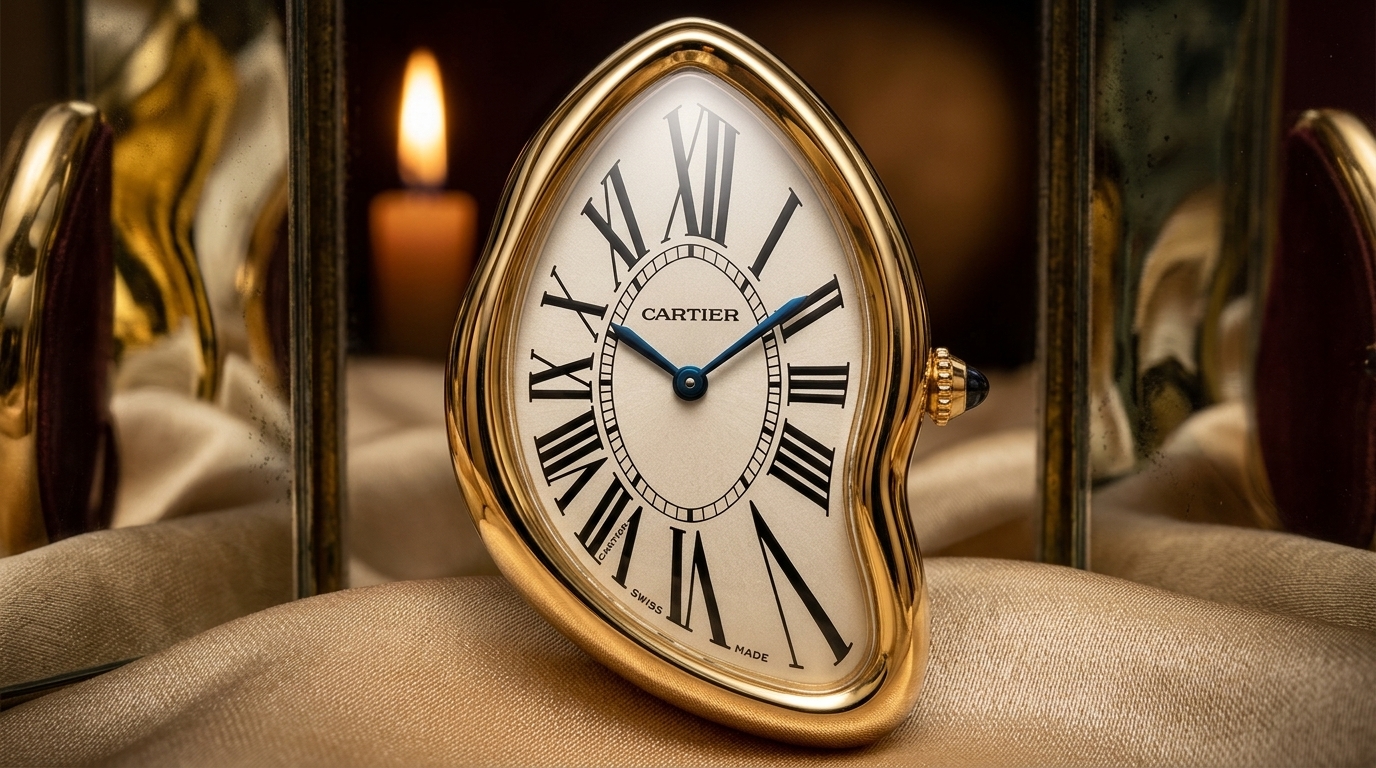
The dial is the place where its rebellion becomes most intimate. Cartier’s Roman numerals are among the most recognizable in watchmaking, but on the Crash they lose their usual civic order. They are not randomly scattered; randomness would be easier. They are stretched according to an internal pressure, as if the dial were a sheet of enamel or paper softened by heat. The secret Cartier signature, often tucked within a numeral on the dial of the maison’s watches, becomes almost comic in this setting: a mark of institutional control hidden inside a design that appears to have escaped control. The sword hands, blued or dark depending on the reference, remain poised at the center. They make the whole thing more unsettling. A mad clock with mad hands would merely be theatrical. A mad clock with rational hands is harder to dismiss.
There is a temptation to place the Crash beside Salvador Dalí’s limp watches, and the comparison is inevitable enough to feel weary. Both appear to soften time. Both use distortion to make measurement feel human, unreliable, dream-sick. But the Crash is not a painting of a watch collapsing over a branch. It is a mechanical object asked to keep working after the collapse. Its case must close. Its crystal must fit. Its movement must be secured. Its stem must reach the crown. A strap must attach at angles no practical designer would choose first. The difference between image and object is the difference between imagining an impossible doorway and cutting one into a wall.
Cartier’s genius was to let the watch remain polite in scale. The Crash does not need mass to make its argument. Many examples sit on the wrist with an almost jewelry-like presence, their gold cases narrow enough to disappear under a cuff if the cuff is forgiving. Even later enlargements preserve the impression of compression rather than bloat. The proportions are strange but not loose. The lower half falls away; the upper half tightens near the crown; the dial swells where a conventional watch would seek symmetry. The result is not a large gesture. It is a small disturbance carried close to the pulse.
That smallness partly explains the intensity of its modern reputation. The Crash was never common. The 1967 London pieces were scarce from the beginning, and scarcity has a way of feeding myth until myth begins to feed price. Cartier Paris revisited the design in the 1990s, and the Collection Privée Cartier Paris years brought renewed attention to shaped cases and mechanical seriousness. Later limited editions in gold and platinum, along with the skeleton models, turned the Crash into one of the most watched unusual watches in the auction room. Results hardened its status. Collectors who once concentrated on steel sports watches began to look again at Cartier’s shaped-case vocabulary, and the Crash stood at the far end of that language, the word no one else could pronounce convincingly.
But auction heat explains only the market, not the object. Plenty of rare watches remain inert beyond their scarcity. The Crash has another energy. It questions the agreement between timekeeping and order. Most watches soothe the wearer with repetition: hour markers evenly spaced, seconds advancing cleanly, cases balanced around a central axis. They reduce time to a system the eye can manage. The Crash keeps the system but makes it look wounded. It suggests that time may still be measurable even when experience refuses symmetry. In that sense it is less whimsical than it first appears. Its comedy is edged with recognition.
The case finishing deserves more attention than the legend usually permits. On a conventional watch, polishing can emphasize geometry: a sharp bevel, a flat plane, a crisp transition between brushed and polished surfaces. On the Crash, the polished gold acts differently. It catches light along curves that do not resolve into familiar profiles. Reflections pool and stretch across the bezel. The crystal, shaped to follow the case, adds another layer of distortion. Viewed obliquely, the dial seems to move before the hands do. Gold, often accused of softness in both metal and meaning, becomes here the correct material precisely because it can look poured, pressed, and cooled.
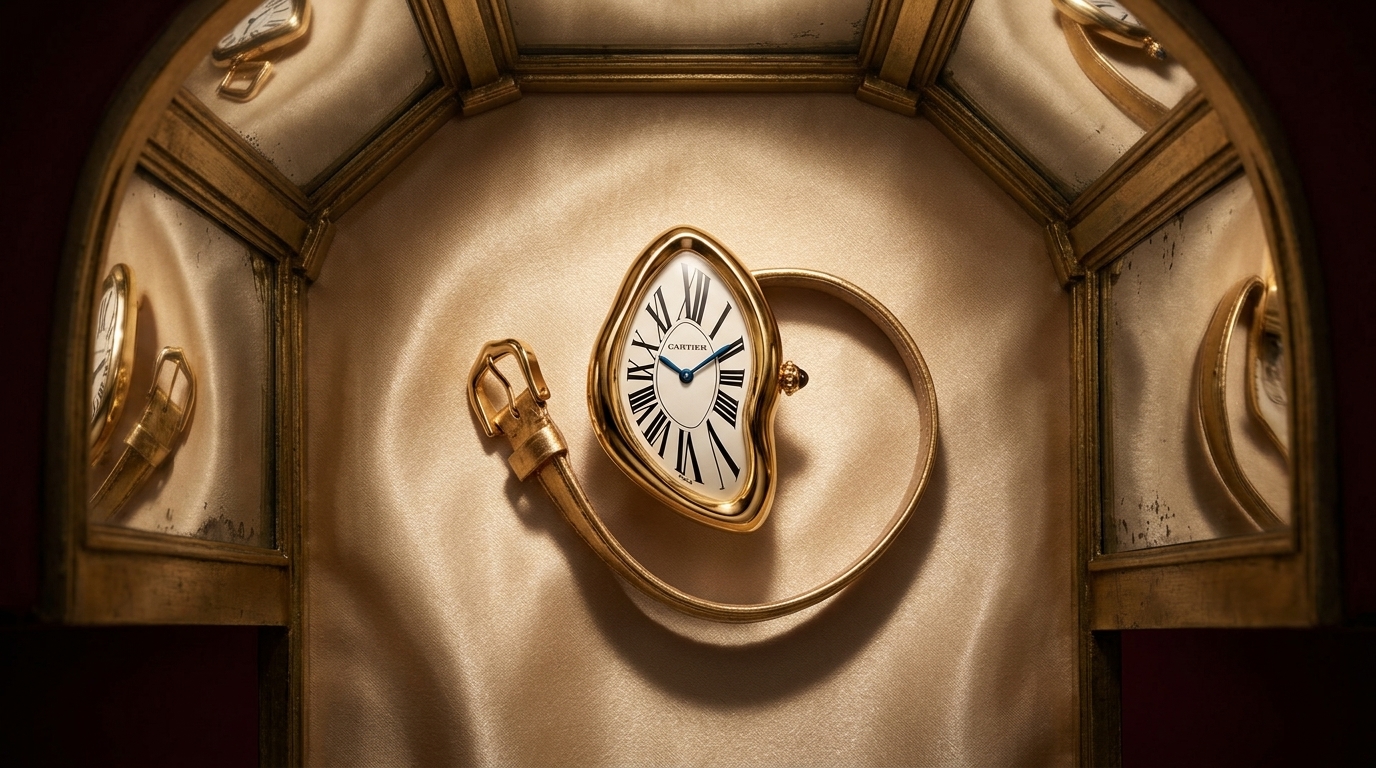
The strap is almost an afterthought and also indispensable. Leather reins the watch back toward etiquette. On a black or dark brown strap, the Crash returns just enough to the language of evening watches and dress formality to sharpen its disobedience. It is not a sports watch, not a tool watch, not a pilot’s watch, not a diver, not a chronograph built around task and proof. Its water resistance is not the point; its elapsed-time capability is nonexistent; its legibility is adequate but not generous. Everything useful about it could be done better by a cheap round watch. That is precisely why it matters. It exists in the territory where usefulness has been satisfied and something more ambiguous begins.
Cartier has always understood that a wristwatch sits between machine and ornament. Swiss horology often tries to resolve that tension by displaying mechanical virtue: hand finishing, complications, Geneva stripes, black polishing, inward angles, column wheels, tourbillons, perpetual calendars. Cartier approaches from the other shore. It asks what happens when the case, the dial, and the cultural memory of form become as important as the calibre. That does not mean the movement is irrelevant. A poor movement would cheapen the spell. But in the Crash, mechanical credibility is a foundation, not the visible argument. The watch does not point first to its escapement. It points to its outline.
This is why imitations fail so quickly. A distorted watch is easy to sketch badly. Bend the case, stretch the numerals, call it surreal. But the Crash is not merely bent. Its imbalance is composed. The distances between numerals, the placement of the crown, the thickness of the bezel, the way the lugs seem both accidental and inevitable — these are the difference between deformation and design. Cartier’s best shaped watches possess that quality. The Tank Cintrée is not just a Tank made longer; the Baignoire is not just an oval; the Crash is not just a melted watch. Each depends on proportion so exact that the unusual form begins to feel older than its date of birth.
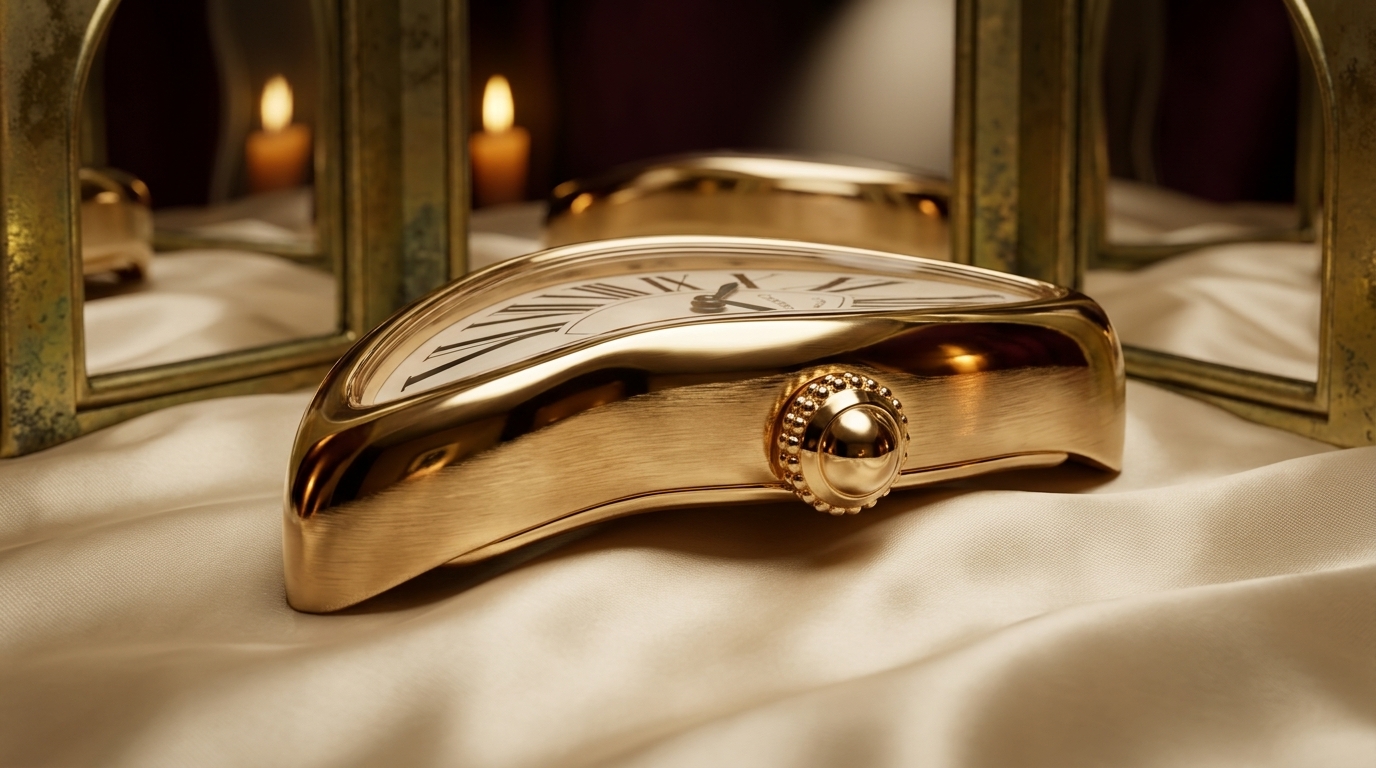
There is also something almost private about the way the Crash tells time. From across a room, it may read as jewelry, a flash of gold with a warped silhouette. Up close, the dial reveals its discipline. The minute track remains, the numerals remain, the hands continue their ordinary labor. The wearer receives a functional answer from an irrational face. This intimacy separates it from objects made only to provoke. A provocation spends itself quickly. The Crash can be read again because it never stops being a watch, however much it appears to resist the category.
Its place in Cartier’s history is therefore stranger than simple rebellion. It does not reject the maison’s codes; it depends on them. Without the Roman numerals, without the cabochon crown, without the heritage of the Tank and the Baignoire, the Crash would be less powerful. It is not an outsider object storming the gates of taste. It is a house style placed under pressure until its bones show. That makes it more radical, not less. Revolt from inside a tradition carries a particular charge. It knows exactly what it is undoing.
The modern fascination with the Crash may say as much about the present as about 1967. Contemporary watch culture is crowded with competence. Cases are machined to microscopic tolerances; dials are flawless; movements are tested, certified, photographed, enlarged, debated. Much of it is admirable. Much of it also moves toward sameness. The Crash offers no escape from luxury, no moral purity, no democratic correction. It is rare, expensive, and deeply tied to the privileges of craft and precious metal. Yet it offers an escape from a narrower kind of perfection — the perfection that mistakes symmetry for intelligence and technical order for emotional force.
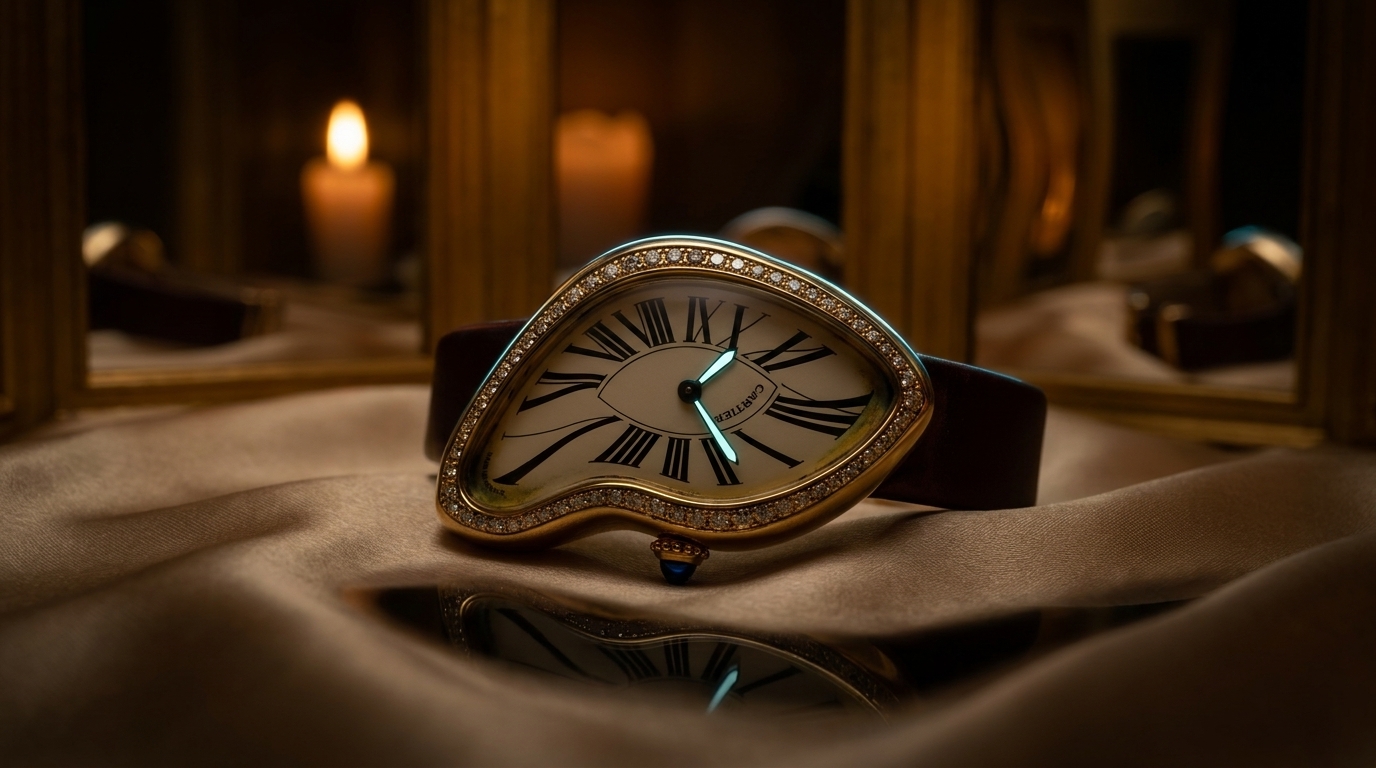
A watch that refuses to look like one must still answer the oldest question in horology: does it make time visible? The Crash does, but it makes time visible as instability. Its hands cross a dial that seems to have already endured the future. Its numerals cling to their identities while losing their posture. Its case preserves the outline of a wristwatch at the very moment that outline appears to liquefy. The result is not chaos. It is controlled damage, the kind art sometimes requires and craftsmanship rarely permits.
That is the strange power Cartier found, whether through accident, invention, or some mixture of both polished into legend. The Crash does not flatter time by making it clean. It does not flatter the wearer by pretending taste is obedience. It offers instead a small gold contradiction: a serious watch in unserious shape, a jewel with a movement, a distortion made with discipline. On the wrist, in a display case, under auction lights, or in the flat silence of a photograph, it keeps presenting the same impossible proposition. Time can be measured by something that looks as though time has already broken it.