Bulova and the Second Hand That Learned to Sing
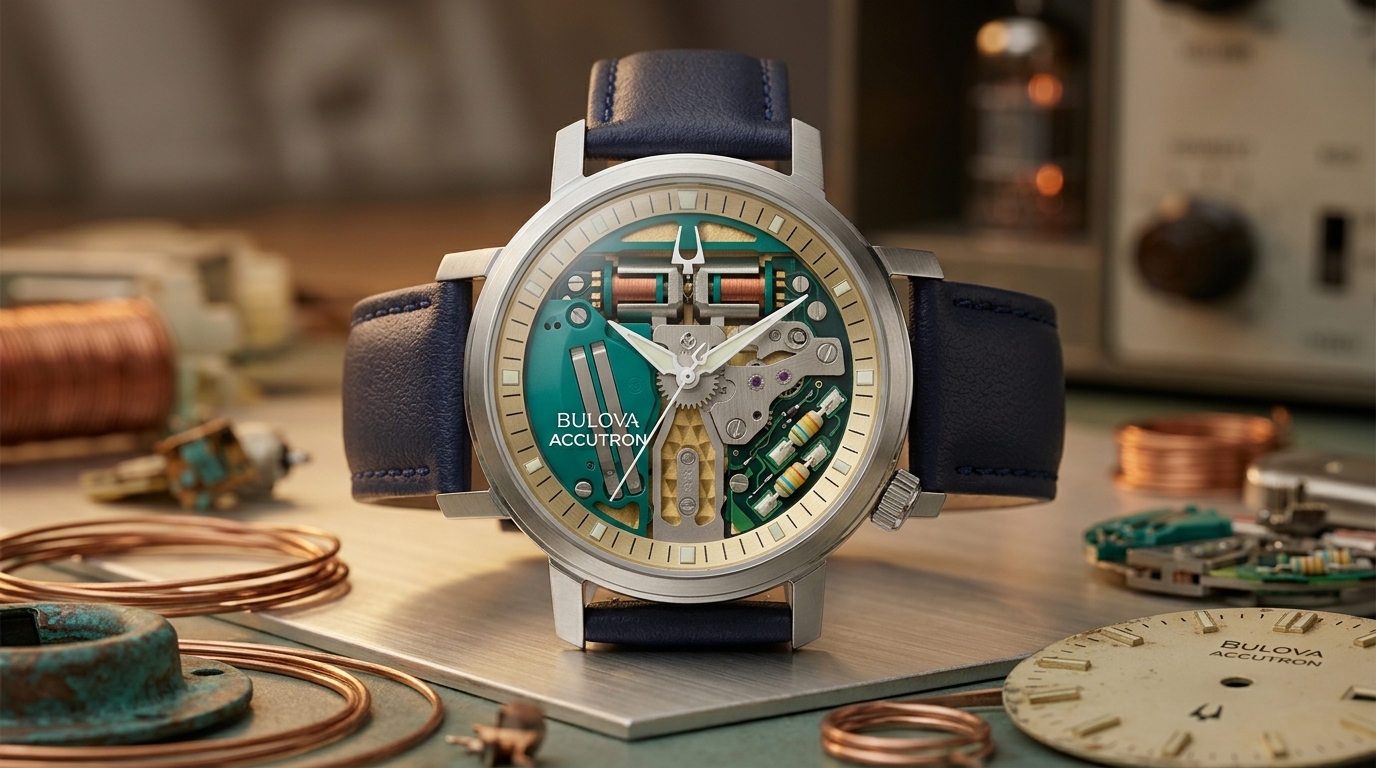
At the edge of the dial, the seconds hand does not step so much as proceed, a thin red line crossing the minute track with the composure of something released from ordinary machinery. Beneath it, hidden in the small architecture of bridges, coils, jeweled pivots and a wheel almost too delicate for belief, a fork is vibrating. It is not loud. It is not meant to be music. Yet the watch has a voice: a faint, dry hum at 360 cycles per second, more felt than heard, the sound of mid-century confidence reduced to wrist size.
This is the strange achievement of Bulova’s Accutron, and the reason it has never quite left the horological imagination. Many watches measure time; a few perform it. The Accutron performed it with a note. In an era when a good mechanical wristwatch advanced its seconds hand in five or six small jumps per second, Bulova’s electronic tuning-fork watch gave the hand a new manner of travel. It seemed to glide, calmly and continuously, as though the dial were no longer divided into instants but drawn as a single line. The eye noticed first. The ear followed.
By the late 1950s, the Swiss lever escapement had been refined to an extraordinary degree. Its tick was not a flaw but a signature: impulse, lock, unlock, recoil, recovery. A balance wheel breathed back and forth, typically at 18,000 beats per hour in many wristwatches of the period, each vibration translated through wheels and hands into civil time. Accuracy depended on poise, lubrication, temperature, shock, adjustment, and the skill with which tiny metal parts were persuaded into constancy. Watchmaking was still a craft of controlled imperfection. Bulova, founded in New York by Joseph Bulova in 1875, knew that world well. It made conventional watches, advertised them vigorously, and understood better than most that precision could be both an engineering problem and a public dream.
The Accutron arrived publicly in 1960, after years of development led by the Swiss engineer Max Hetzel, whom Bulova had brought into its orbit in the 1950s. Hetzel’s idea was radical not because it abandoned wheels, hands, jewels, and bridges, but because it displaced the regulating organ at the heart of the watch. In place of a balance and hairspring, the Accutron used a tiny tuning fork. Electromagnetic coils, governed by a transistor circuit and powered by a miniature battery, kept the fork vibrating at 360 hertz. One tine carried the delicate indexing system that translated those vibrations into rotation. The result was both simple to describe and nearly absurd to contemplate: a humming fork inside a watch, dividing time with far greater frequency than a mechanical escapement could manage in daily wear.
The famous calibre 214 remains the purest expression of that idea. It is a movement of peculiar beauty, not in the manner of Geneva stripes and polished bevels, but in the exposed logic of a machine designed around a sound. Its coils sit prominently, copper-colored and purposeful. The fork frames the movement like a wishbone made scientific. The index wheel, a marvel of miniature manufacture, is often described with numbers because language struggles with its scale: roughly 2.4 millimetres across, cut with 320 teeth, each tooth almost impossibly small. A jeweled pawl finger nudges this wheel forward with each vibration. Another finger prevents retreat. From there, the familiar train resumes its work and carries the motion to the hands.
Such a mechanism altered the character of the seconds hand. The hand did not become truly continuous in the mathematical sense, but the increments were so fine and so frequent that the human eye read them as flow. In this visual smoothness lay the watch’s seduction. A mechanical sweep seconds hand had always possessed charm, but it still betrayed its escapement if watched closely. The Accutron concealed its counting in speed. It made the intervals too small to see, and then, with the hum of its fork, gave those invisible intervals an acoustic trace.
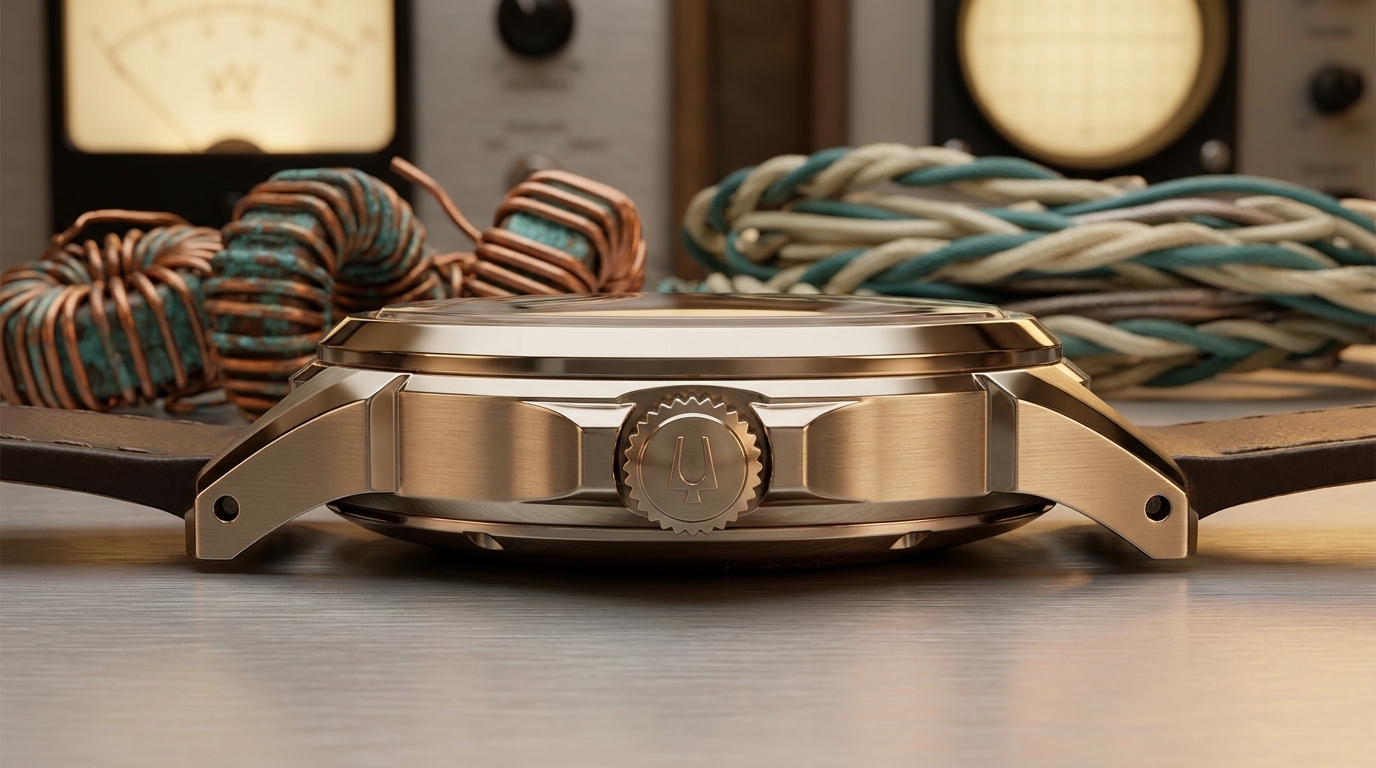
The case forms that housed early Accutrons were often sober by comparison with the invention inside them. The 214 appeared in gold-filled dress cases, stainless steel cases, asymmetrical designs, railroad-approved configurations, and the now-canonical open-dial versions known as Spaceviews. Many 214 watches carried no conventional crown at three o’clock. Time-setting was often done from the back, where a small recessed bow could be lifted and turned, leaving the case flank clean and slightly uncanny. The absence of the crown suited the technological message. This was a watch that did not wish to look wound. It wanted to appear energized.
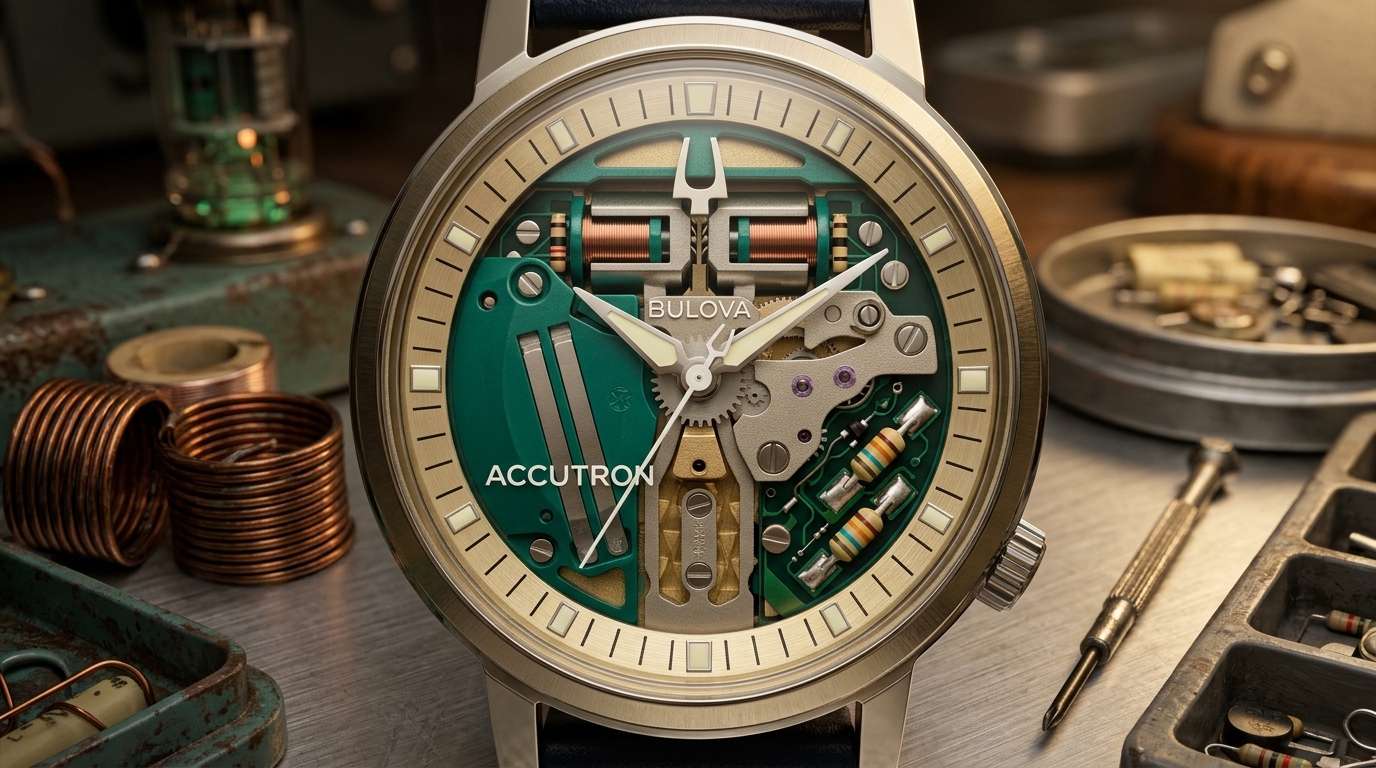
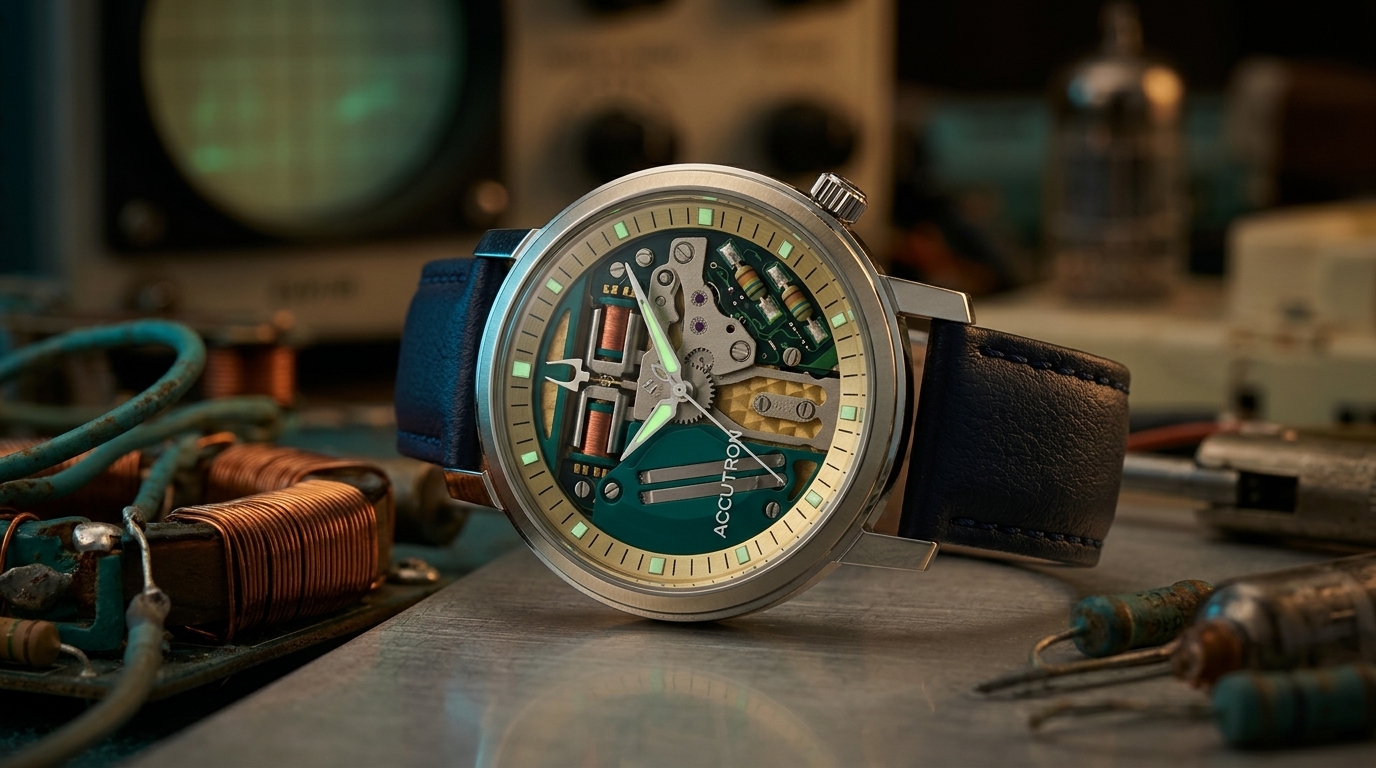
The Spaceview, perhaps the most remembered Accutron of all, began less as a formal model than as a revelation. Retailers displayed demonstration watches with the dial removed so customers could see the electronic movement that otherwise remained hidden. The exposed coils, fork, and circuitry proved more compelling than many printed dials. Demand followed. Bulova recognized that the view into the machine was itself a design, and the Spaceview became a legitimate watch rather than merely a salesman’s aid. Its chapter ring floated around the periphery; its hands crossed over copper coils and green or jeweled accents; its movement ceased to be backstage apparatus and became the face.
There was a risk in this exposure. A mechanical skeleton watch often turns its transparency into ornament, showing bridges and wheels in decorative layers. The Spaceview is different. It shows a working argument. The viewer can read the watch from battery to coil, from coil to vibrating fork, from fork to index mechanism, from index mechanism to the ordinary wheels that finally carry the hands. It is not mysterious in the way a tourbillon is mysterious to many observers, rotating with theatrical complexity. It is mysterious because it appears too slight for its responsibility. A tiny fork sings, and the seconds hand obeys.
Bulova understood the cultural moment into which the Accutron was released. America was moving toward the space age with a mixture of discipline, dread, and appetite. Electronics promised a cleaner future than springs and gears, even when that promise was oversold. The transistor was no longer merely a laboratory curiosity; it was entering radios, instruments, military systems, and consumer life. Accuracy had become part of modern citizenship, tied to broadcasting, aviation, computation, navigation, and the enormous choreography of rockets. A watch whose regulating organ hummed at an audible frequency seemed to belong to that atmosphere. It sounded less like a clock than like equipment.
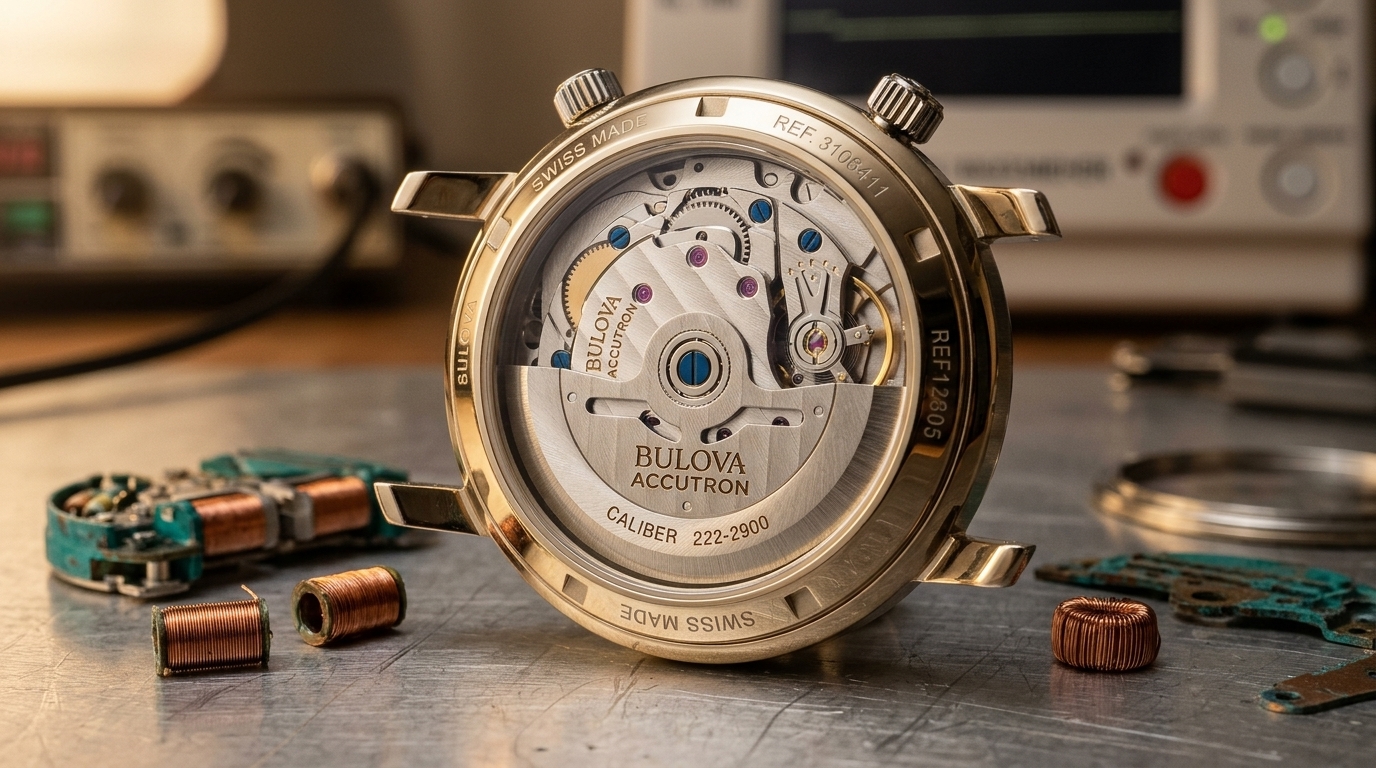
Accutron timing devices found their way into satellites and spacecraft instrument systems, and Bulova’s advertising drew heavily on that association. Care is necessary here, because the mythology of space has a way of gathering watches into its gravity. The Accutron was not the hand-wound chronograph worn on the lunar surface. Its role was elsewhere: in panels, timers, and systems where dependable electronic regulation mattered. That distinction makes its achievement no smaller. If anything, it clarifies the nature of the watch. The Accutron was not a romantic survival of mechanical craft in the age of rockets. It was a participant in the new instrumentation.
On the wrist, the Accutron belonged to both worlds. It still had a dial with hands, still wore lugs, crystal, caseback, markers, and strap. It still needed servicing, and it still contained tiny parts that could wear, drift, or fail. Batteries leaked. Coils could be damaged. Index wheels required expertise and gentleness. The movement’s precision did not abolish the watchmaker; it asked for a different kind of watchmaker, one comfortable with meters as well as tweezers, circuits as well as pivots. The Accutron did not end horology. It widened the bench.
Its advertised accuracy was extraordinary for its time: commonly stated as within a minute a month, at a period when many mechanical watches wandered by that much in a week if not adjusted carefully. This was not quartz precision, not yet. The quartz crisis would arrive later with a colder, more absolute economy. Quartz would vibrate at far higher frequencies, divide time electronically, and eventually reduce the seconds hand once again to a one-second step in countless inexpensive watches. The Accutron sits in the interval before that conquest, after the classical mechanical age but before quartz made electronic accuracy ordinary. It is therefore not simply a transitional object. It is the sound of the transition itself.
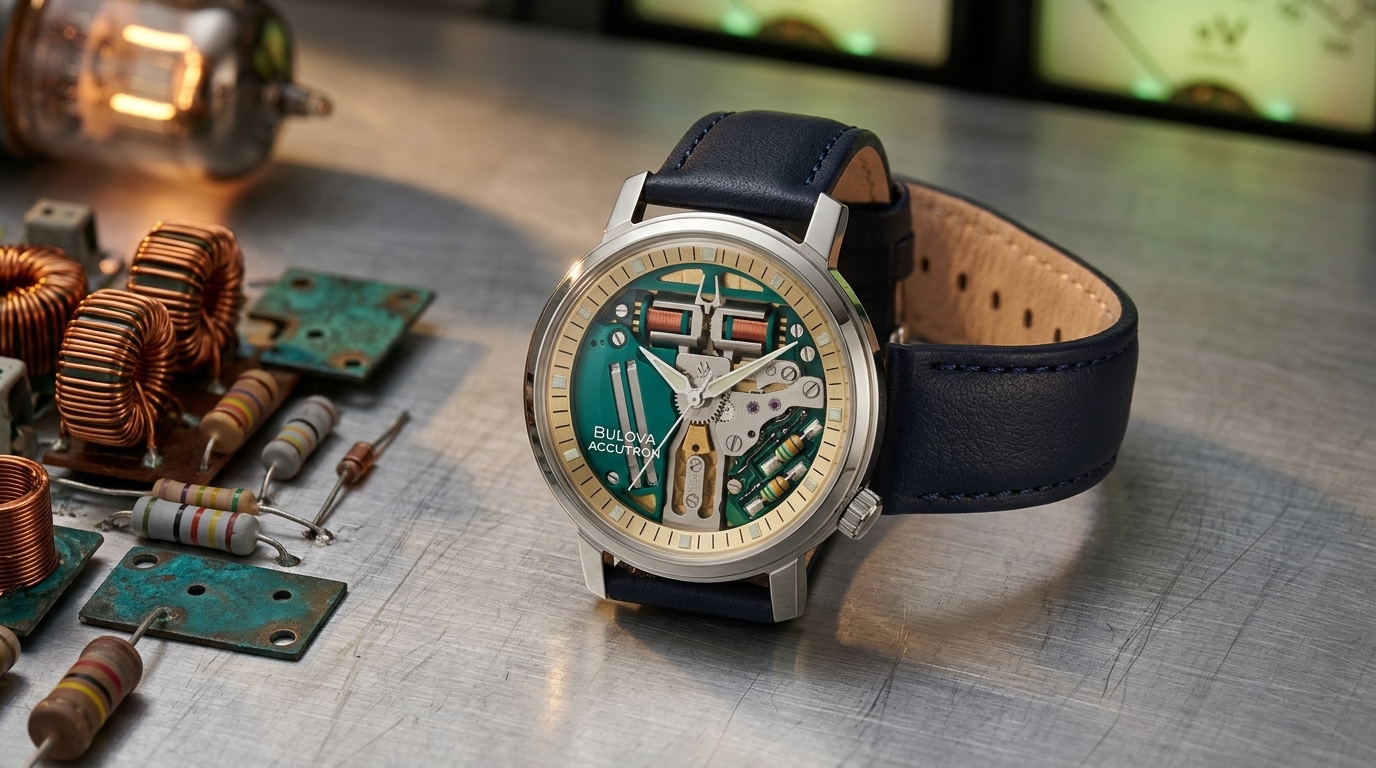
There is a melancholy to that position. The tuning-fork watch was a triumph that could not reign for long. Bulova introduced later Accutron movements, including the 218 with a more conventional crown arrangement, and the technology spread into many case styles through the 1960s and early 1970s. Other makers adopted tuning-fork systems under licence, most notably in certain Omega f300 models and other Swiss watches that carried the same high hum beneath different names. For a brief period, the tuning fork looked like the future of wristwatch precision. Then quartz arrived with fewer moving parts, greater accuracy, easier mass production, and a silence that suited the economics of the next age.
Yet obsolescence has never been the same as disappearance. The Accutron survived because its solution was sensuous. Quartz is astonishing as physics, but on the wrist it often hides its wonder behind a circuit board and a stepping motor. The Accutron announces its principle. It hums. Its seconds hand moves in a way directly linked to that hum. Its exposed versions show the organs of the act. The wearer may not understand the angle of the pawl jewel or the tooth geometry of the index wheel, but the watch offers evidence at every level: sight, sound, touch, reasoning. It makes precision intimate.
The design details of individual examples tell their own stories. A 1960s Accutron dress watch in a slim gold-filled case may present a champagne dial so restrained that only the seconds hand hints at the disturbance beneath. A Railroad Approved model may carry heavy Arabic numerals, stark minute divisions, and a utilitarian clarity born from the demands of schedules and safety. A Spaceview may seem almost naked, its colored chapter ring and applied markers framing the circuitry like a scientific display. Some cases are compact by contemporary standards, often in the mid-30 millimetre range, yet their presence is sharpened by the absence of conventional dial furniture. Others take on the broader, more geometric shapes of the late 1960s, when watch cases began to stretch, cushion, and flatten in response to changing tastes.
Finishing on these watches should not be judged by the criteria applied to haute horlogerie. The Accutron’s beauty is industrial. Screws, plates, coils, insulating components, and printed markings serve the operation rather than courting the loupe. Even so, there is refinement in how much had to be manufactured correctly for the system to function. The index mechanism in particular belongs to the category of parts that make grand language seem clumsy. To move a wheel tooth by tooth hundreds of times per second requires consistency at a scale where dust becomes an event. That the system could be produced in quantity, sold internationally, and serviced in ordinary cities is part of its seriousness.
The second hand remains the visible narrator. Mechanical watches often place drama in the balance, hidden on the back or under the dial; chronographs place it in the central seconds hand only when commanded; automatics sometimes advertise themselves through the slow swing of a rotor. The Accutron gives the ordinary passing second a changed grammar. No jump. No hesitation. No theatrical complication. Just motion so finely divided that it becomes nearly serene. The hand’s path is not decorative. It is a direct consequence of the regulating system, and that honesty gives it force.
The sound matters because watches have always been listened to. Before timing machines, a watchmaker heard faults in beat and amplitude with trained attention. A pocket watch held near the ear was not merely being admired; it was being interrogated. The Accutron changed the question. Instead of the tick of intermittent impulse, it offered a continuous note, closer to an electrical appliance or laboratory instrument than to a mantel clock. The hum could reassure or disturb, depending on the listener. It made the watch feel alive in a distinctly non-organic way. Not breathing. Vibrating.
In later decades Bulova would revisit high-frequency smoothness through other means, including quartz movements under the Precisionist line, whose 262 kHz oscillator allowed a sweeping seconds hand uncommon among quartz watches. The corporate history of Accutron itself would also continue to evolve, eventually becoming a separate brand identity in modern revivals using electrostatic technology. These later chapters are interesting, but they do not erase the original drama of the 214. The first Accutron belongs to a narrower, charged moment when electronics had not yet become invisible. Its components remained legible. Its sound remained discoverable. Its promise had not hardened into routine.
That is why collectors often forgive the Accutron its complications of ownership. Vintage examples require knowledge: correct batteries or voltage management, careful servicing, respect for fragile coils, and a technician familiar with tuning-fork regulation. Cosmetic originality can be difficult to parse, especially with Spaceviews, where conversions, replacement chapter rings, and refinished parts complicate the field. The best examples retain not only their components but their coherence, the sense that case, movement, dial or chapter ring, hands, and era still speak the same language. A polished case may still charm; a perfect one may still disappoint if the watch has lost its internal truth.
Bulova’s genius was to understand that precision alone would not be enough. The company gave precision a behavior. It allowed the public to see and hear the difference between the old regulator and the new one. A dry chart of rate performance might have impressed engineers, but the seconds hand persuaded civilians. The hum did the rest. Together they made accuracy theatrical without making it gaudy. The watch did not need to shout. It simply refused to tick.
The phrase “the second hand that learned to sing” is not strictly technical, but it reaches toward the right fact. The hand itself sings only by proxy. It is a baton following the fork’s invisible tempo, sweeping across applied markers and printed hash marks while the movement below maintains its note. Still, metaphor becomes permissible when it is anchored in mechanism. In the Accutron, song is not an imposed romance. It is the audible by-product of regulation. The lyric is electrical, the rhythm mechanical, the performance visual.
At a glance, an Accutron can appear like an artifact from a future that has already expired. Its fonts, case lines, and dial furniture often carry the optimism of the 1960s, when miniaturized electronics seemed capable of civilizing uncertainty. But to leave it there would be too easy. The watch is not valuable only as period design. It remains compelling because it solved an old problem in a way that was practical, strange, and beautiful enough to be remembered after superior solutions displaced it. In horology, those are often the objects that endure in conversation: not the longest-lived technologies, but the ones whose principles can still be sensed.
The hand continues its slow circuit. Twelve, three, six, nine; the familiar geography of the dial is unchanged. Yet each passage is carried by a fork vibrating too quickly for sight, by a wheel whose teeth approach invisibility, by a battery feeding coils in measured pulses, by an idea born when watchmaking stood with one foot in the age of steel springs and the other in the age of circuits. Bulova did not abolish the tick forever. It did something more particular. It taught a wristwatch to hum, and in that hum the seconds hand found a new way to move through time.