Casio Watches: The Japanese Powerhouse That Made Accuracy the Baseline
Casio Watches: The Japanese Powerhouse That Made Accuracy the Baseline
The most disruptive watch company of the late twentieth century was not Swiss, not mechanical, and not trying to be romantic. Casio won because it made the traditional watch argument feel technically obsolete: a cheap, battery-powered object could be more accurate, more durable, more legible, and more useful than a finely adjusted mechanical movement. That position still matters in 2026, not because collectors have abandoned escapements, but because Casio established the modern floor beneath the entire watch market. If a watch cannot justify itself beyond timekeeping, Casio has already beaten it.
This is the uncomfortable fact that makes Casio unusually important to serious collectors. The brand is often treated as an entry point, a nostalgic side purchase, or a rugged digital tool kept beside more expensive watches. That understates the achievement. Casio did not merely participate in the quartz crisis; it industrialised a new definition of value. From the 1974 Casiotron to the 1983 G-Shock DW-5000C, from the F-91W to the MR-G line, Casio’s best watches are arguments in product strategy: module first, function over finishing, scale over scarcity, and credibility earned through use rather than theatre.
From Calculators to Wrist Instruments
Casio’s origins explain its watchmaking more clearly than most brand histories. The company began as Kashio Seisakujo in 1946, founded by Tadao Kashio in post-war Tokyo, and became Casio Computer Co., Ltd. in 1957 after the success of the 14-A, an electric compact calculator developed by the Kashio brothers. The watch division was therefore not born from case-making, escapement regulation, or jewellery retail. It came from electronics, miniaturisation, displays, and mass production. That difference remains visible in every serious Casio line.
The key moment came in 1974 with the Casiotron QW02, generally recognised as Casio’s first wristwatch. Its significance was not only that it displayed hours, minutes, seconds, month, date, and day. The more important detail was its automatic calendar, programmed to account for month lengths. In a mechanical context, calendar sophistication typically creates cost and service complexity. Casio approached it as a computational problem. This set the template: the module was the product, and the case was the delivery mechanism.
That philosophy produced watches that traditional horology still struggles to categorise. Casio modules are not “calibres” in the Swiss sense, but dismissing them as mere electronics misses the point. A module such as the 593 in the F-91W, the 3229 in many DW-5600E variants, the 3495 in the GW-5000U, or the Bluetooth-enabled 5611 in the GA-2100 family is a complete operating system for the wrist. It determines the watch’s interface, energy consumption, alarm logic, calendar behaviour, lighting, radio reception, and user experience. Casio’s collector culture is therefore organised around references, modules, displays, and case formulas rather than jewel counts or finishing grades.
The G-Shock Was Not a Styling Exercise
Casio’s most important watch arrived in 1983: the G-Shock DW-5000C, engineered under Kikuo Ibe’s “Triple 10” brief — resistance to a 10-metre fall, 10-bar water resistance, and 10-year battery ambition. The original reference used a square case architecture with the module suspended inside a protective structure, shielded by resin and metal. Its design language has been copied, softened, inflated, miniaturised, and dressed in premium materials, but the strategic idea remains intact: durability as engineering, not decoration.
The DW-5000C was not an immediate fashion phenomenon. Its credibility built through the 1980s and 1990s, particularly in the United States, where the watch’s shock resistance and utilitarian profile suited military, police, construction, and action-sports use. Casio’s later “toughness” claim worked because the original product had already proved coherent. The line did not begin as a luxury watch trying to look robust; it began as an inexpensive instrument designed to survive careless ownership.
The square G-Shock remains the purest expression of the idea. The DW-5600 lineage preserves the outline, while the GW-5000U, introduced with module 3495, is arguably the modern collector’s reference point: screw-back case, Tough Solar charging, Multi Band 6 radio timekeeping, upgraded user interface, and a resin strap that feels materially better than the cheapest models. It is not the most expensive square and not the most flamboyant, but it is the one that best preserves the engineering integrity of the original DW-5000C while correcting the weaknesses of earlier everyday digitals.
Casio’s premiumising of the square, especially through the full-metal GMW-B5000 series launched in 2018 and the MRG-B5000 family launched in 2022, is more complicated. The GMW-B5000D gave the steel rectangle a new market position, combining Bluetooth, solar charging, and radio control in a watch that could sit in a collector’s box without apology. The MRG-B5000, built with titanium components, hardened finishes, and separate bezel elements, is technically impressive but strategically provocative. It asks whether a G-Shock can remain philosophically honest when priced against mechanical watches from established Swiss makers. My answer is qualified: yes for the engineering-led MR-G buyer, less convincingly for those buying it as a luxury substitute.
The F-91W and the Ethics of Cheap Accuracy
No Casio better demonstrates the company’s market power than the F-91W. Introduced in 1989 and still widely sold, it uses the simple module 593, offers a stopwatch, alarm, calendar, backlight, and quoted accuracy of approximately ±30 seconds per month. It weighs roughly 21 grams and often retails for less than the cost of a mechanical watch strap. The F-91W is not beloved because it is refined. It is important because it reduces the wristwatch to a functional minimum and still works.
Collectors sometimes treat the F-91W as irony, but that is too easy. The watch exposes the economic fragility of much entry-level mechanical watchmaking. A hand-wound or automatic watch under a few hundred dollars can be charming, but in pure timekeeping terms it is outperformed by a resin Casio assembled at immense scale. The F-91W’s weak greenish LED and lightweight case are not hidden compromises; they are the plainly visible terms of the bargain. Casio tells you exactly what has been spent and what has been saved.
The better comparison is not with luxury mechanical watches, which operate in a different symbolic economy, but with low-cost fashion watches. Against those, Casio is ruthless. A cheap analogue fashion watch typically offers design as surface. The F-91W, A158, A168, W-59, and W-800H offer actual competence. The A168’s electroluminescent backlight, the W-800H’s longer battery life and 100-metre water resistance, and the AE-1200WH “World Time” with module 3299 all provide concrete utility at prices where many brands provide only branding.
Modules, Not Movements: Casio’s Real Horological Language
The strongest case for Casio among collectors is that its watches reward technical specificity. A mechanical enthusiast distinguishes between an ETA 2824-2, Sellita SW200-1, Seiko 6R35, Miyota 9015, or Rolex 3235. The Casio equivalent is understanding modules and power systems. Tough Solar changes ownership by removing the battery-replacement cycle for many users. Multi Band 6 matters if the owner lives within radio signal range from Japan, China, North America, the UK, Germany, or compatible regions. Bluetooth on models such as the GMW-B5000 and GA-B2100 adds practical synchronisation, though it ties a nominally independent watch to an app ecosystem.
This matters because Casio’s model is modular in the strategic sense as well. The company can deploy a proven module across multiple cases, colours, and regions, extracting scale while letting the consumer choose the form factor. That is why the catalogue can appear chaotic: hundreds of references, regional releases, collaborations, limited colourways, and small variations in display polarity or strap material. The downside is real. Casio has often allowed SKU proliferation to blur the hierarchy of its own products. A new buyer entering G-Shock encounters a wall of references rather than a clear ladder.
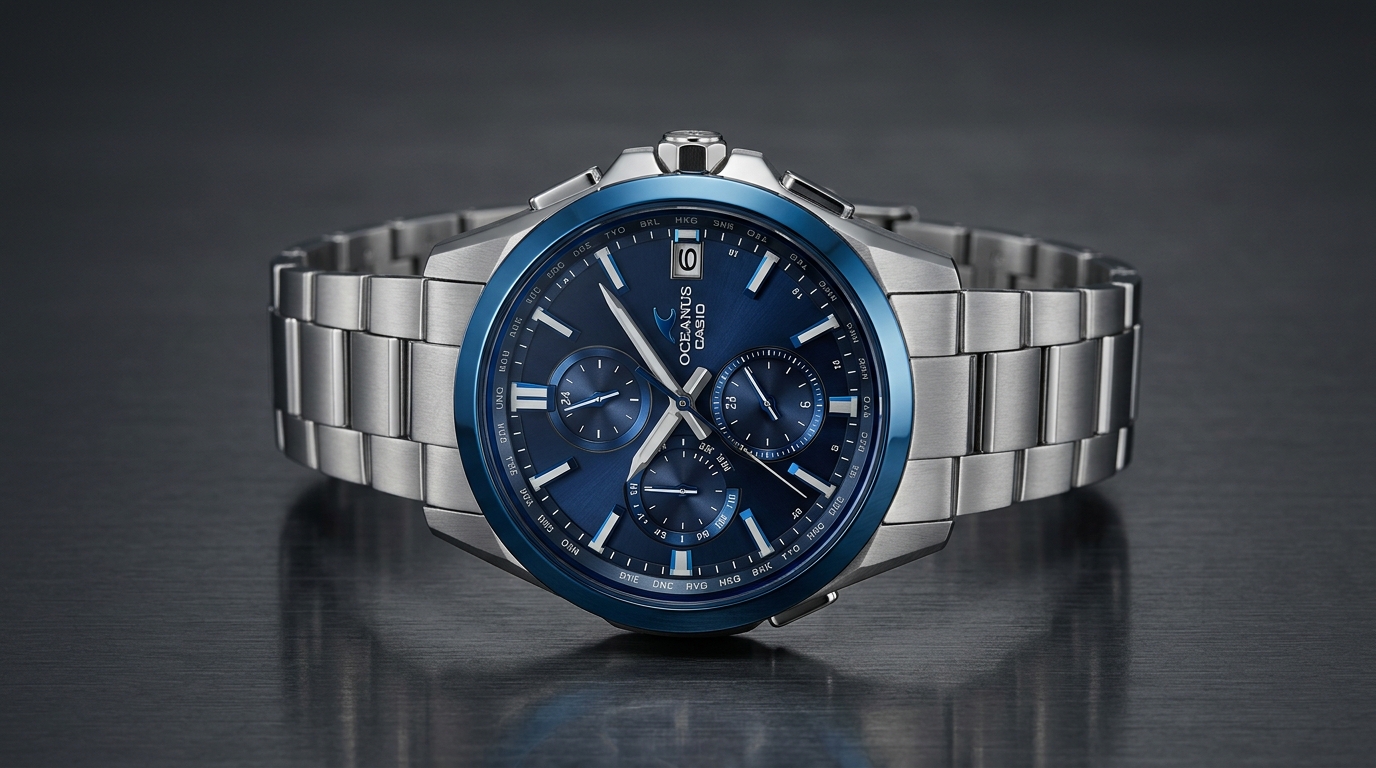
Yet the structure works because the underlying functional families are legible. Basic digital Casio covers extreme value. G-Shock covers shock resistance. Baby-G serves smaller wrists and a different style market. Pro Trek, formerly Pathfinder in some markets, addresses outdoor instrumentation with altimeter, barometer, compass, thermometer, and solar power in references such as the PRW and PRG series. Edifice covers motorsport-adjacent analogue quartz and Bluetooth chronographs. Oceanus, particularly Japan Domestic Market models such as the OCW-S100 and OCW-T200, offers titanium or steel cases, solar power, radio control, and zaratsu-like polished surfaces without pretending to be Swiss haute horlogerie.
Oceanus, MR-G, and the Question of Premium Casio
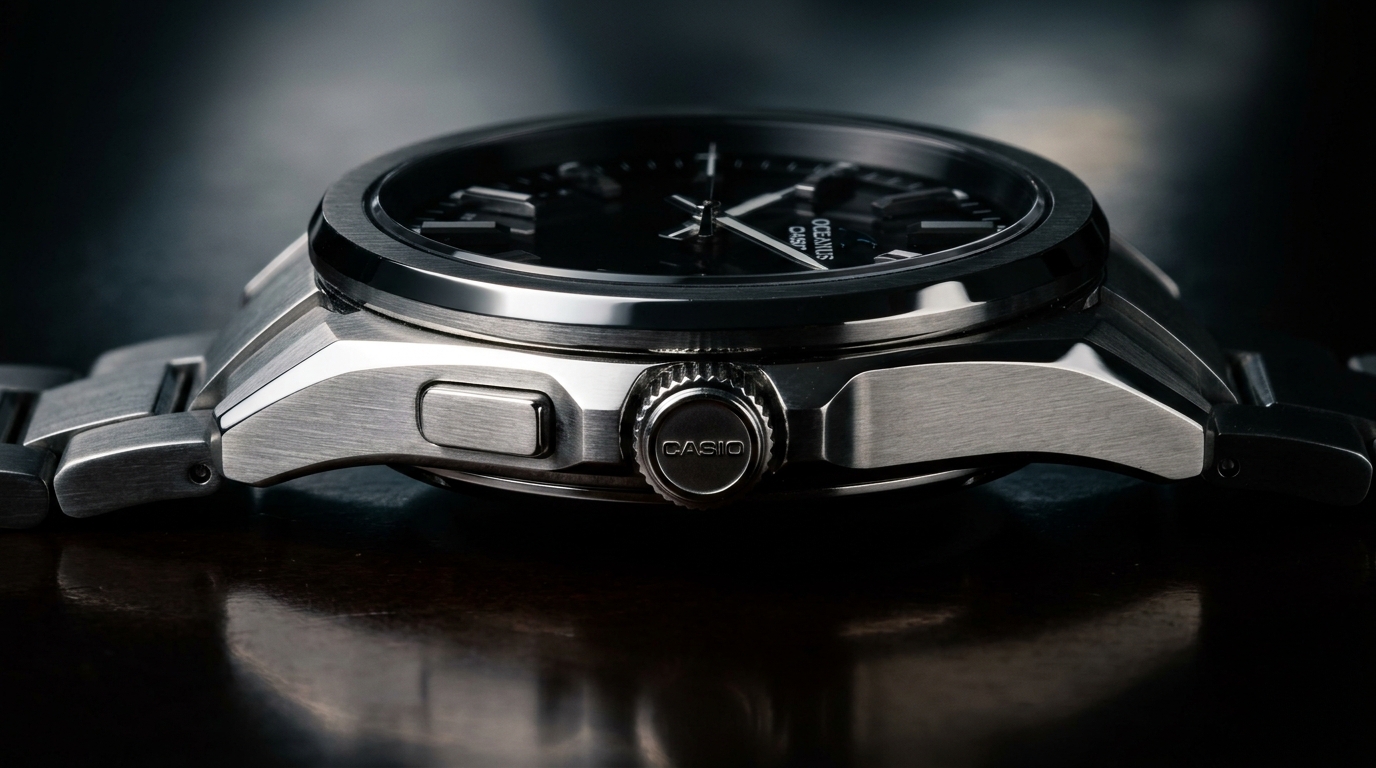
Casio’s upper ranges are where editorial judgment becomes necessary. The company’s value proposition is clearest under $200, still strong between $200 and $600, and more contested above $1,000. Oceanus is the most persuasive premium Casio line because it does not abandon the brand’s technical identity. The OCW-S100 is a compact solar radio-controlled titanium watch with practical finishing and a restrained dial. The OCW-T200 adds Bluetooth and a more contemporary steel case. These watches are not luxury objects in the Swiss sense; they are highly competent Japanese instruments with enough finishing to justify wearing them beyond utility contexts.
MR-G is more ambitious. The MRG-G1000, MRG-G2000, and later MRG-B5000 series place G-Shock engineering in titanium, with hardened coatings, GPS or Bluetooth depending on generation, solar charging, radio control, and elaborate case construction. The craftsmanship is real, especially in the multi-component bezels and surface treatments. But MR-G lives in a difficult market band. At several thousand dollars, buyers cross-shop Grand Seiko quartz, Tudor tool watches, Omega pre-owned pieces, and high-grade Citizen The Citizen models with A060 annual-accuracy quartz movements. Casio can compete technically, but it cannot rely on traditional luxury signals.
That is not necessarily a weakness. Casio’s best premium watches appeal to a buyer who values engineering confidence over inherited prestige. The problem arises when limited editions or decorative collaborations push prices without adding functional substance. Casio has earned the right to charge for advanced materials, improved bracelets, titanium construction, solar-radio modules, GPS, and careful finishing. It is less convincing when novelty colourways are treated as collector-grade importance. The brand’s discipline is strongest when the specification sheet and the object say the same thing.
Casio in the Post-Smartwatch Market
The arrival of the Apple Watch in 2015 changed the low and mid-market more severely than many mechanical collectors admit. Smartwatches absorbed the consumer who wants notifications, fitness metrics, app integration, and frequent upgrades. Casio’s response has been mixed. The company experimented with Wear OS outdoor watches under the Pro Trek Smart and G-Squad lines, but those products never defined the brand as convincingly as G-Shock digitals or solar-radio analogue models. Casio is strongest when it avoids becoming a second-rate smartwatch maker and instead offers durable, low-maintenance autonomy.
This is where Casio’s strategic advantage remains unusually durable. A solar G-Shock with radio timekeeping does not need nightly charging, software updates, or annual replacement psychology. A GW-M5610U, GW-5000U, or GMW-B5000 can be put on the wrist after weeks in a drawer and return to accuracy with minimal drama. That proposition is not nostalgic. It is an explicit alternative to connected-device fatigue. In market terms, Casio owns the space between disposable fashion watches and rechargeable wrist computers better than almost any company.
Mechanical watches increasingly justify themselves through craft, heritage, scarcity, and ritual. Casio justifies itself by refusing to need those arguments. This is why the brand sits oddly but legitimately in a serious collection. A Rolex Submariner, Omega Speedmaster, Grand Seiko Spring Drive, or Cartier Tank may carry stronger cultural capital, but none of them makes a GW-5000U redundant. Casio’s function is not replaced by luxury; it is clarified by it.
The Collector’s Casio: What Actually Matters
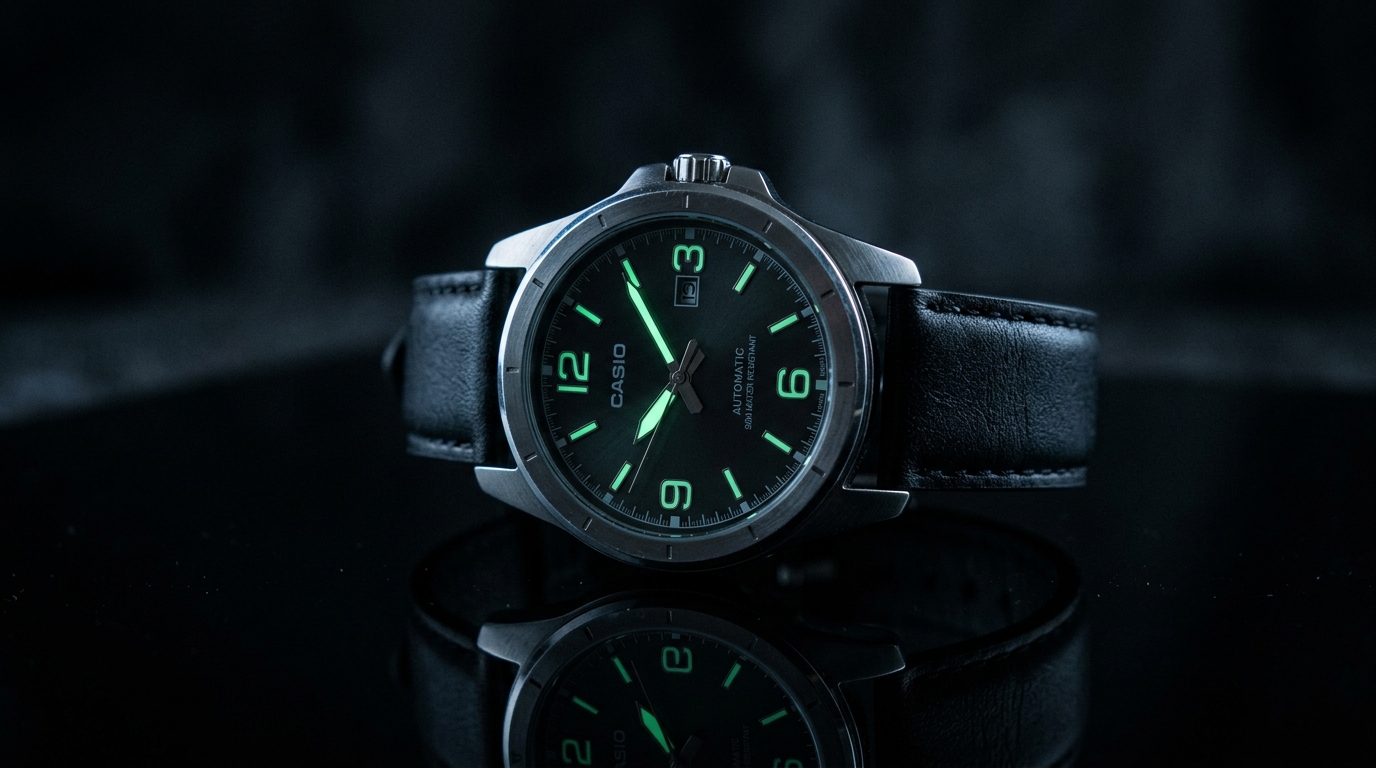
A rational Casio collection does not require chasing every collaboration or limited colourway. The stronger approach is architectural. Start with a square G-Shock: a DW-5600E for the cheapest expression, a GW-M5610U for solar and radio control, or a GW-5000U for the more substantial screw-back case and upgraded build. Add an F-91W or A168 to understand Casio’s democratic end of the market. Consider an AE-1200WH if world-time utility appeals. For analogue-digital design, the GA-2100 introduced in 2019 remains important because its octagonal thin case opened G-Shock to a new audience, though the solar Bluetooth GA-B2100 is the more complete ownership proposition.
For premium Casio, choose carefully. The full-metal GMW-B5000 is still the cleanest bridge between G-Shock legitimacy and modern finish. Oceanus is the connoisseur’s alternative, particularly for buyers willing to source Japan Domestic Market references. MR-G should be bought for materials, construction, and affection for the G-Shock idea, not as an investment thesis. Casio limited editions can appreciate, especially culturally resonant collaborations, but the brand’s natural strength is availability, not scarcity.
Casio’s weakness is also part of its character. The catalogue is sprawling, model names are opaque, negative displays are often less legible than they look in photographs, and resin straps can age poorly under heat, sweat, and ultraviolet exposure. Some analogue hands obscure digital sub-displays. Some Bluetooth functions add complexity without enough benefit. These are not fatal flaws, but they prevent a lazy conclusion that Casio is universally excellent. It is not. Casio is at its best when the watch has a clear technical reason to exist.
Why Casio Still Belongs in Serious Watch Writing
Casio forces the watch industry to distinguish between value and luxury. That distinction is useful. The company founded by the Kashio brothers did not preserve classical watchmaking; it made much of classical watchmaking commercially uncomfortable. The 1974 Casiotron reframed the calendar as software. The 1983 DW-5000C reframed toughness as product architecture. The 1989 F-91W reframed affordability as competence rather than compromise. The modern GW-5000U, GMW-B5000, Oceanus, and MR-G models show how far that logic can travel before it collides with luxury pricing.
The editorial position is straightforward: Casio is not a substitute for mechanical horology, and it should not be judged by mechanical criteria. It is a parallel authority. Its significance lies in precision, resilience, manufacturing scale, and the disciplined use of electronics on the wrist. The best Casios are not charming because they are cheap; they are compelling because they make their prices look rational. In a watch market often crowded with historical claims and inflated storytelling, that remains a rare achievement.