A. Lange & Söhne: The Strategic Power of German Restraint
A. Lange & Söhne: The Strategic Power of German Restraint
A. Lange & Söhne is not the oldest continuous manufacture in high watchmaking, nor the largest, nor the most visible in the auction theatre. Its modern existence begins not in the nineteenth century but, practically speaking, on 24 October 1994, when Walter Lange and Günter Blümlein presented four watches in Dresden after the brand had been dormant under East German state control for decades. That restart is the key to understanding Lange today: it is not a heritage brand that merely survived. It is a reconstructed manufacture that used history as discipline, not decoration.
This distinction matters. In a market crowded with claims of tradition, Lange’s authority comes from a narrower but more credible proposition: German horology, executed at the highest level, produced in controlled numbers, and defined by movement architecture rather than celebrity, retail theatre or inherited Swiss convention. The brand’s strongest watches are not successful because they are “beautiful”; they are successful because they express a coherent industrial and aesthetic system with unusual consistency.
Glashütte Before the Revival
Ferdinand Adolph Lange founded his workshop in Glashütte in 1845, backed by the Saxon government as part of an effort to develop precision industry in a poor mining region. The Glashütte model that followed was not simply a factory story. It was an ecosystem of specialist suppliers, finishers, escapement makers and dial makers, closer to a regional industrial project than a single maison myth. Lange’s pocket watches helped establish traits that still define the modern brand: three-quarter plates, screwed gold chatons, precise regulation, sober legibility and a distinctly Saxon sense of engineering order.
The rupture came after the Second World War. In 1948, the Lange company was expropriated, and Glashütte’s watchmaking assets were consolidated under the state-owned VEB Glashütter Uhrenbetriebe, later known as GUB. The Lange name effectively disappeared from commercial watchmaking. This is why the modern brand’s continuity should be treated carefully. The lineage is authentic through family, place and technical vocabulary, but the modern company is also a post-reunification creation, registered again in 1990 by Walter Lange with the decisive strategic and operational force of Günter Blümlein, then head of IWC and Jaeger-LeCoultre under LMH.
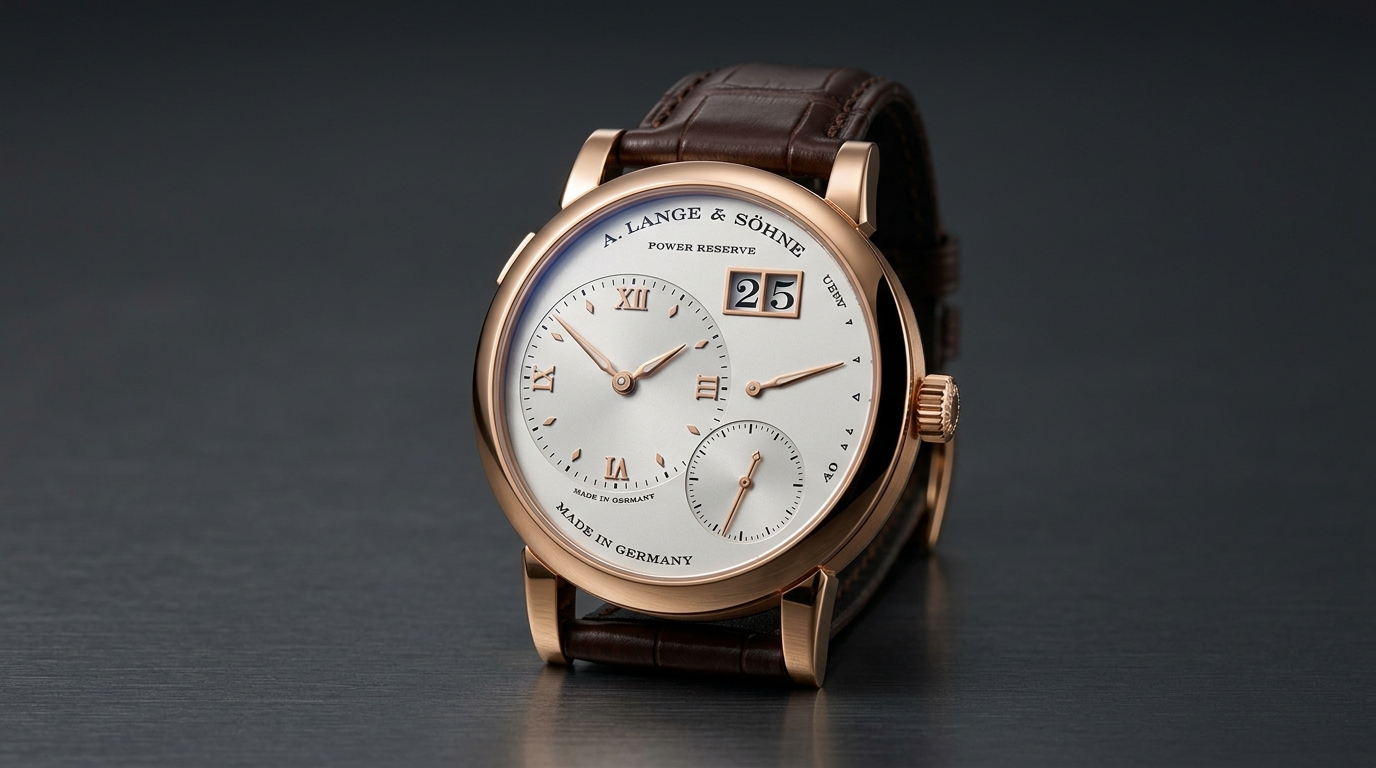
That modern restart gave Lange an unusual advantage: it could select its traditions rather than inherit all of them. When the first collection appeared in 1994, the brand did not attempt a broad catalogue. It launched with four pieces: the Lange 1, the Saxonia, the Arkade and the Tourbillon “Pour le Mérite”. Each had a defined role. The Saxonia established restraint. The Arkade tested design flexibility. The Tourbillon “Pour le Mérite” announced technical ambition with a fusée-and-chain transmission. The Lange 1 became the identity.
The Lange 1 Was a Strategic Statement, Not a Dress Watch
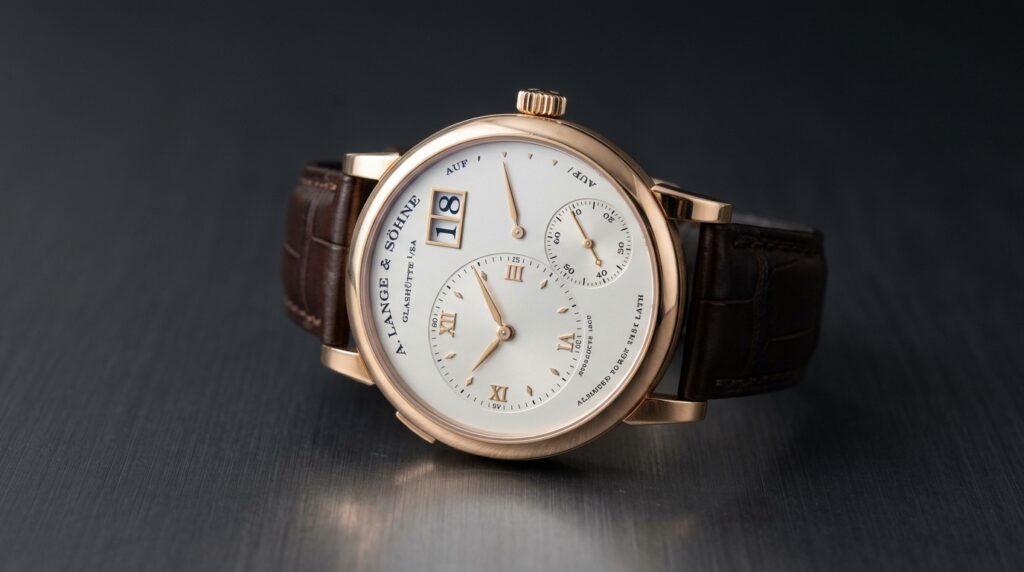
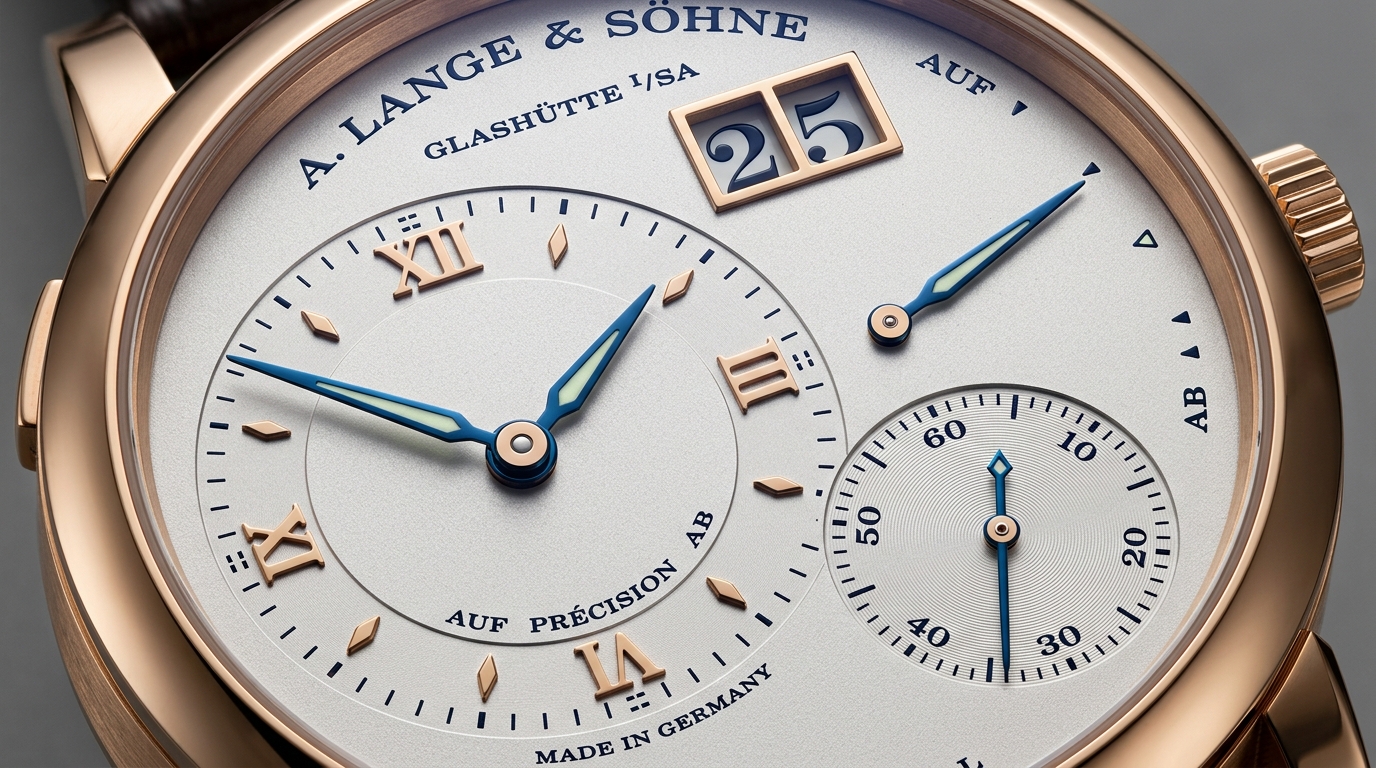
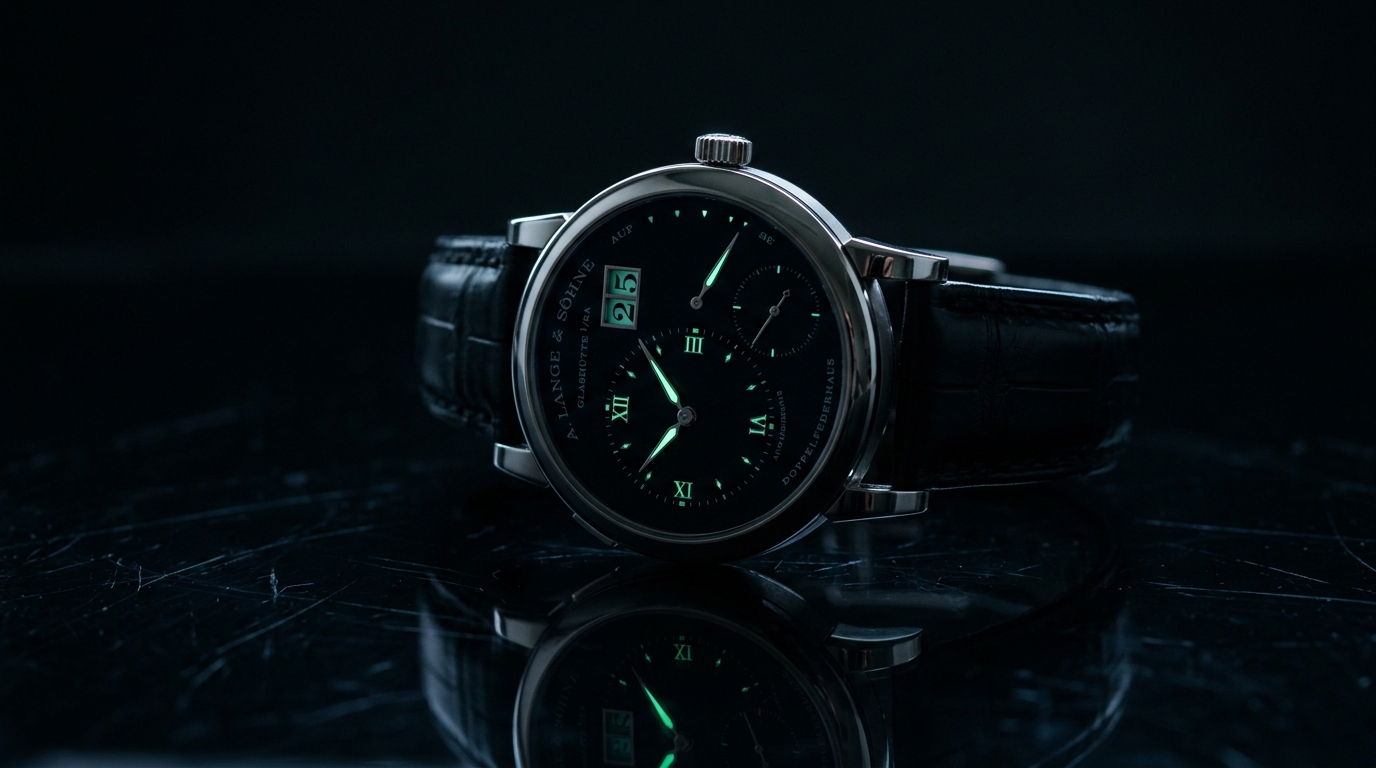
The original Lange 1, reference 101.001 in yellow gold, carried calibre L901.0, a manually wound movement with a three-day power reserve and an asymmetric dial that looked almost provocative in 1994. The outsize date, inspired by the five-minute digital clock at Dresden’s Semper Opera House, gave the watch a signature visible from across a room without relying on a loud case or decorative excess. Its off-centre time display, power reserve indicator and subsidiary seconds formed a layout often described as governed by the golden ratio; whether or not one buys the mathematical romance, the commercial fact is clear: Lange created a modern icon immediately, not gradually.
The smarter point is that the Lange 1 allowed the brand to avoid imitating Patek Philippe. A conventional Calatrava competitor would have made Lange a younger German alternative to a Swiss category leader. The Lange 1 created its own category: asymmetrical, formal, mechanically serious, recognisable but not flamboyant. The 2015 update to the Lange 1, with calibre L121.1 replacing the long-serving L901.0, showed the brand’s conservative confidence. The case remained 38.5 mm; the dial architecture was preserved; the movement gained a free-sprung balance, in-house hairspring and an instantaneous outsize date switching mechanism. Lange changed what mattered and left the silhouette alone.
The Movement Is the Product
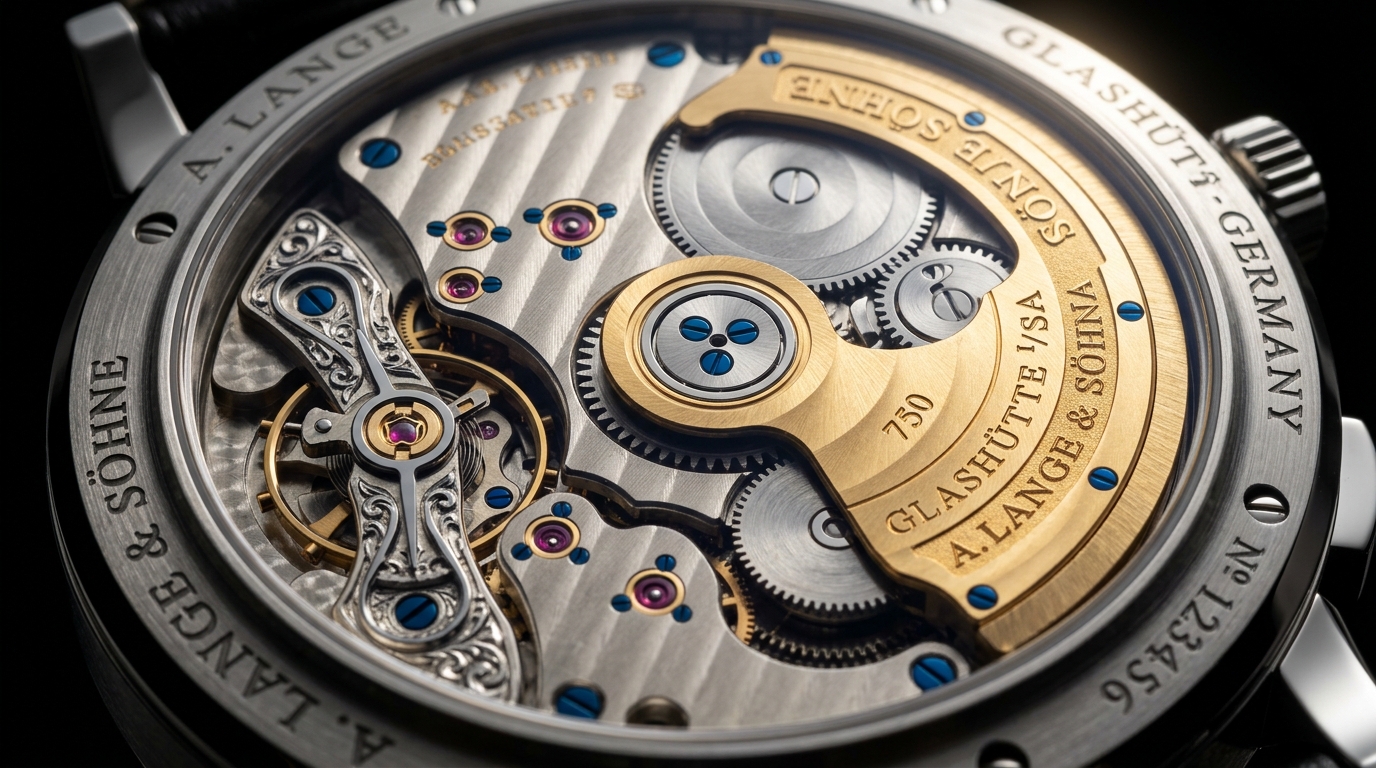
Collectors often say Lange makes the world’s best-looking serially produced movements. That claim is subjective, but it is at least based on observable work. The untreated German silver plates develop a warm tone over time, quite different from rhodium-plated brass. The screwed gold chatons recall nineteenth-century pocket-watch construction, though in modern use they are as much aesthetic and cultural markers as technical necessities. The hand-engraved balance cock ensures that no two movements are visually identical. The blued screws, polished chamfers, black-polished steel components and Glashütte ribbing create a recognisable grammar across the catalogue.
More important is Lange’s practice of double assembly. Movements are assembled, adjusted, disassembled, cleaned and then assembled again after finishing. The process is inefficient, expensive and difficult to scale, which partly explains why annual production is generally estimated in the low thousands rather than tens of thousands. Lange does not publish precise current production figures, but industry estimates commonly place output around 5,000 watches per year. That scale is central to the brand’s positioning: large enough to support serious development, small enough to preserve scarcity and finishing standards.
The criticism is that Lange can be visually repetitive from the back: three-quarter plate, engraving, German silver, impeccable finish. But that is also the point. Lange’s movements project institutional discipline. Where some brands use movement design to create spectacle, Lange uses it to reinforce identity. The result is cumulative: a Lange 1815, a Lange 1, a Datograph and a Zeitwerk are very different watches from the front, but unmistakably part of the same manufacture from the rear.
The Datograph Changed the Chronograph Argument
In 1999, Lange introduced the Datograph, reference 403.035 in platinum, powered by calibre L951.1. It is difficult to overstate its importance. At the time, many high-end chronographs still relied on supplied or heavily modified Lemania-based movements. Patek Philippe’s celebrated perpetual calendar chronographs, for example, used Lemania-derived calibres until later in the 2000s. The Datograph arrived as a fully integrated, in-house, manually wound, column-wheel flyback chronograph with precisely jumping minute counter and outsize date. It was not the first great chronograph; it was the watch that made the old excuses harder to defend.
The Datograph’s movement architecture remains one of the most persuasive case studies in modern horology. The levers, springs, column wheel and chronograph works are not hidden beneath a module; they are staged in a three-dimensional construction that rewards close inspection. The original 39 mm platinum version has become a benchmark, while the 2012 Datograph Up/Down, reference 405.035, introduced calibre L951.6 with a longer 60-hour power reserve and a 41 mm case. Some collectors prefer the original for its density and proportions; others value the Up/Down for usability. The editorial position here is straightforward: the first-generation Datograph is the purer object, but both remain stronger horological arguments than most modern luxury chronographs priced around them.
The 1815 Chronograph, particularly in later references such as 414.028 and 414.032, extracts much of the Datograph’s chronograph seriousness in a more classical format, without the outsize date. It is sometimes described as the “thinking collector’s” Lange chronograph, which is only partly fair. The Datograph is not less intellectual because it is more famous. But the 1815 Chronograph does reveal how strong Lange’s chronograph platform is when stripped of the Datograph’s defining asymmetry.
Complication Without Swiss Theatrics
Lange’s best complicated watches tend to be technically assertive but emotionally restrained. The Tourbillon “Pour le Mérite” of 1994 used a fusée-and-chain transmission in a wristwatch, a direct link to marine chronometer and pocket-watch tradition. The Lange 31, introduced in 2007 with calibre L034.1, offered a 31-day power reserve using two stacked mainspring barrels and a constant-force escapement to manage torque. The Triple Split, introduced in 2018 with calibre L132.1, extended the rattrapante concept to seconds, minutes and hours, allowing comparative timing events up to twelve hours. These are not minor complications rebranded by case material; they are movement projects with clear mechanical premises.
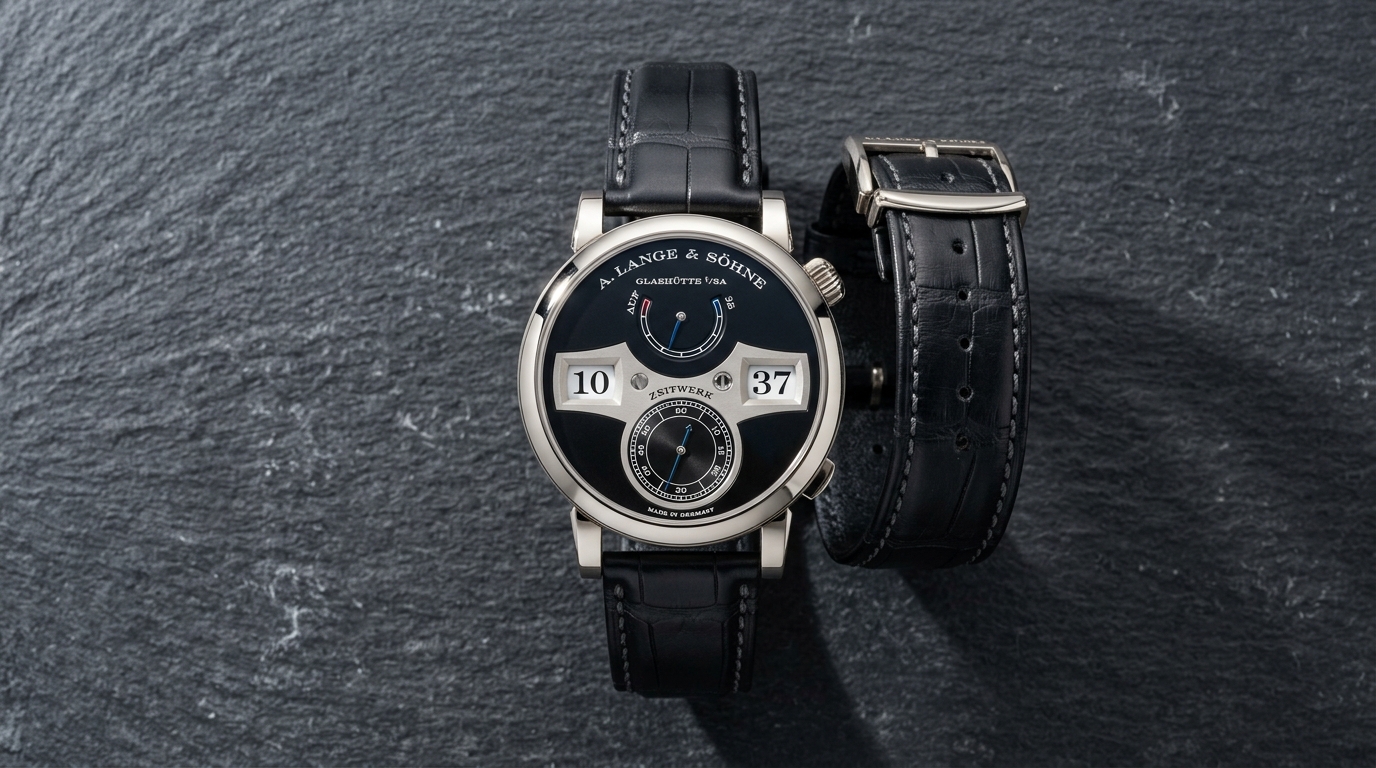
The Zeitwerk, launched in 2009 with calibre L043.1, is perhaps the purest expression of modern Lange contrarianism. A mechanical digital watch with jumping hours and minutes could easily have become a novelty. Instead, its constant-force mechanism, outsized time bridge and rigorous display turned it into a second pillar beside the Lange 1. The Zeitwerk Minute Repeater, introduced in 2015, chimed the displayed time in decimal format: hours, ten-minute intervals and minutes. That is not merely a complication added to a platform; it is a complication conceptually aligned with the watch’s digital time display.
Not every experiment has been equally convincing. The Grand Complication of 2013, with grand and petite sonnerie, minute repeater, split-seconds chronograph with flying seconds and perpetual calendar, was an impressive technical summit but more symbolic than central to Lange’s identity. Extremely limited, extremely expensive and practically irrelevant to most collectors, it served as evidence of capability. Lange is more persuasive when ambition remains wearable and legible: Datograph, Zeitwerk, Lange 1 Time Zone, 1815 Rattrapante, or the perpetual calendar variants that balance technical weight with visual order.
Cases, Metals and the Discipline of Scarcity
Lange has historically resisted the steel sports-watch economy, which makes the 2019 Odysseus especially revealing. The Odysseus, reference 363.179 in stainless steel, introduced calibre L155.1 Datomatic, an automatic movement with day and date displays, 120-metre water resistance and an integrated-bracelet architecture. It was Lange’s first regular-production steel watch. The reaction was divided for good reason. The bracelet and case language were not instantly graceful, and the dial’s day-date architecture felt more Lange than sports watch. Yet strategically, it was necessary. Lange could not ignore the integrated-bracelet segment forever while Patek Philippe Nautilus and Audemars Piguet Royal Oak demand distorted the market.
The Odysseus also exposed the brand’s challenge outside precious-metal dress and complication watches. Lange’s authority is rooted in movement finishing and formal German watchmaking, not in lifestyle versatility. The 2020 white-gold Odysseus on strap and the 2022 titanium reference 363.117, limited to 250 pieces, broadened the line, but the collection remains less inevitable than the Lange 1 or Datograph. It is credible, but not yet essential.
Material strategy has been more successful in precious metals. Lange’s Honeygold, introduced in 2010 in the “Homage to F. A. Lange” pieces, is a proprietary gold alloy harder than standard gold and warmer than conventional yellow or rose gold. It functions well because it is not merely a colour variant; it is tightly rationed and associated with historically significant or technically elevated editions. Lange has also used platinum effectively, particularly for the Datograph, Lange 1 and 1815 lines, where weight and visual restraint suit the brand’s temperament.
Ownership, Distribution and the Richemont Question
A. Lange & Söhne became part of Richemont in 2000 when the group acquired Les Manufactures Horlogères, which included Lange, IWC and Jaeger-LeCoultre. Richemont ownership has given Lange stability, capital and global distribution, but the brand has avoided the overextension that can weaken group-owned maisons. Its boutique network has grown, and allocation policies have tightened, especially for high-demand pieces and limited editions, but Lange has not been inflated into a mass luxury brand.
The risk is not volume but access. As with Patek Philippe, F.P. Journe and selected Audemars Piguet models, Lange’s most desirable watches can become tools of client segmentation. The brand’s move toward boutique-led distribution has commercial logic: it protects margins, captures client data and limits discounting. But collectors notice when relationship management begins to matter as much as horological interest. Lange’s advantage is that its core catalogue still contains serious watches without requiring speculation as the primary justification. A manually wound Saxonia Thin, a Lange 1, or an 1815 Annual Calendar does not need a waiting-list mythology to make sense.
The Secondary Market Is Rational, By Luxury Standards
Lange’s secondary-market behaviour has historically been more rational than that of the most overheated Swiss steel icons. For years, many Lange models traded below retail, including complicated references that were objectively expensive to make. That created opportunities for informed collectors but also reflected a market bias: Swiss names carried stronger auction gravity, and Lange’s German identity made it less obvious to status-led buyers. The post-2020 market shifted this somewhat, with stronger demand for the Datograph, early Lange 1 references, steel Odysseus pieces and limited editions in Honeygold or platinum.
Still, Lange is not a uniform investment category. An early Datograph in platinum, a first-series Lange 1 in desirable configuration, or a scarce Zeitwerk variant carries a different market profile from a less sought-after Saxonia automatic or certain oversized complications. Condition, completeness and servicing history matter materially, especially because Lange servicing is not inexpensive and movement finishing is unforgiving of careless intervention. The brand rewards collectors who buy references, calibres and proportions rather than logos.
What Lange Does Better Than Its Rivals
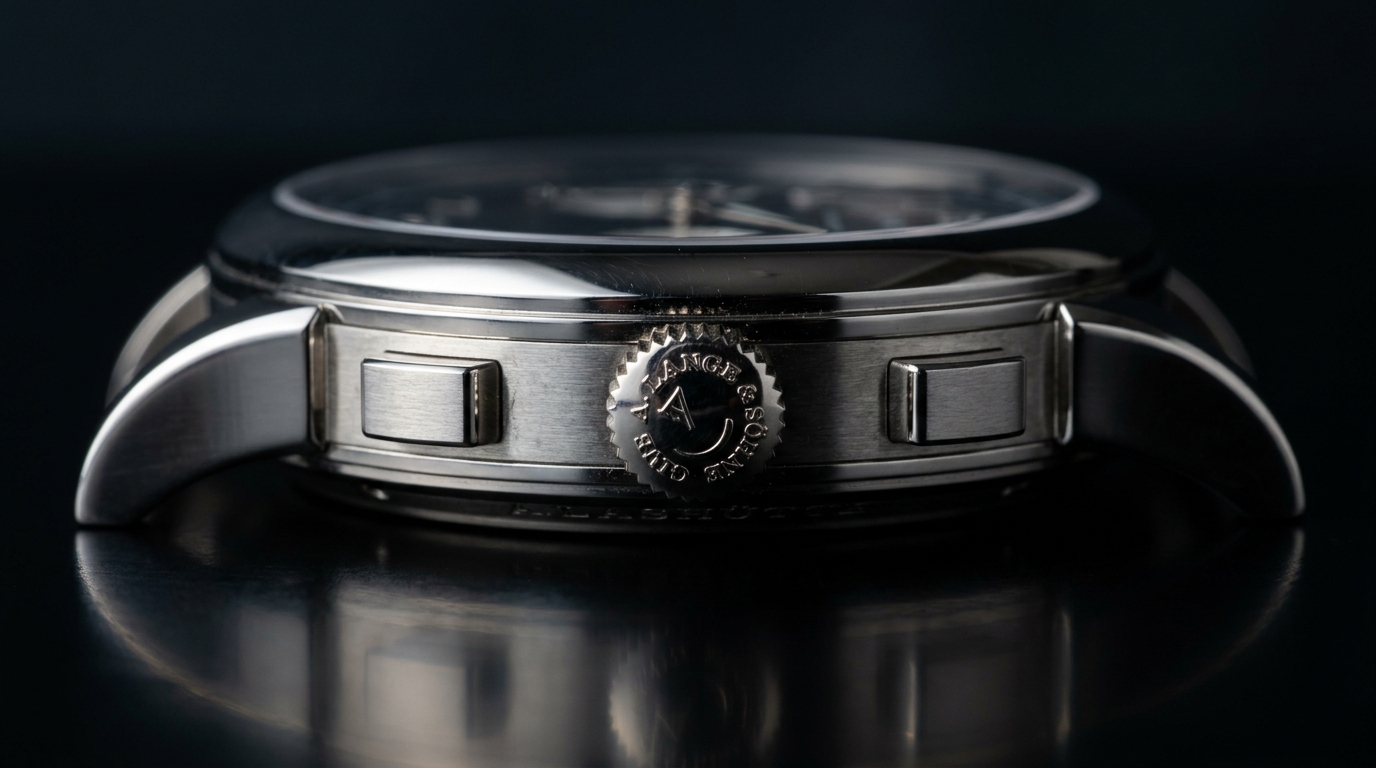
Against Patek Philippe, Lange lacks uninterrupted continuity and the same auction mythology. Against Vacheron Constantin, it has a narrower stylistic range. Against Audemars Piguet, it has less cultural visibility and no Royal Oak-scale commercial engine. Against independent watchmakers, it cannot offer the same intimacy or eccentricity. Yet Lange’s strength is the combination of manufacture depth, finishing consistency, design identity and controlled production. It occupies a rare middle ground: institutional enough to be reliable, small enough to feel deliberate.
The comparison with Patek is unavoidable, but often lazy. Patek’s greatness lies in breadth, lineage and complication history across pocket watches, perpetual calendars, minute repeaters and shaped cases. Lange’s modern greatness lies in the intensity of a smaller vocabulary. The Lange 1, Datograph and Zeitwerk are not attempts to rewrite Genevan history. They are modern German objects that established their own rules within three decades. That is a more impressive achievement than another century-old maison producing another tasteful round watch.
The Collector’s Lange
If the purpose is to understand the brand through ownership, the clearest starting points are not necessarily the most expensive. A Lange 1 with calibre L121.1 gives the essential modern identity with improved mechanics. A first-generation reference 101.001, 101.025 or other early configurations offers historical importance but requires sharper condition analysis. The 1815 line, especially in 38.5 mm cases, delivers the most classical expression of the brand’s pocket-watch inheritance. The Saxonia Thin is the purest study in restraint, though some may find it almost too austere for the price.
For chronograph collectors, the Datograph remains the central object. The original reference 403.035 is the connoisseur’s choice if wrist size and budget allow; the Datograph Up/Down is more practical and still mechanically exceptional. For futurist Lange, the Zeitwerk is the better answer than the Odysseus. It is more distinctive, more intellectually connected to the brand’s obsession with display mechanics, and less dependent on the integrated-bracelet market cycle.
The Verdict: A Modern Manufacture With an Old Soul, Used Carefully
A. Lange & Söhne’s achievement is not that it revived a name. Many brands have revived names. The achievement is that Walter Lange, Günter Blümlein and the Glashütte teams built a manufacture whose products were coherent from the first day of the modern launch. The 1994 Lange 1 was not a tentative comeback piece. The 1999 Datograph was not a derivative chronograph. The 2009 Zeitwerk was not a design exercise. Each expanded the brand’s grammar without diluting it.
The brand is not beyond criticism. Some cases wear thick. Some dials favour Teutonic order at the expense of warmth. The Odysseus remains strategically important but aesthetically unresolved. Allocation practices, like much of high horology, risk alienating the very collectors who built the brand’s credibility before broader demand arrived. Yet the core proposition remains unusually strong: Lange makes watches for people who care what the movement looks like, how the mechanism is organised and why the design exists.
In a luxury market increasingly fluent in scarcity but less fluent in substance, Lange’s best watches still feel earned. They are not Swiss watches with German casebacks. They are Saxon mechanical arguments, built with a level of consistency that has made a thirty-year-old modern manufacture stand beside houses with centuries of uninterrupted mythology. That is not nostalgia. It is strategy, executed in German silver, gold chatons and a refusal to look like everybody else.