Longines Is the Most Strategic Watch Brand Under CHF 5,000

Longines Is the Most Strategic Watch Brand Under CHF 5,000
Longines is easy to underestimate because it does not ask to be mythologised. It neither performs the scarcity theatre of Rolex nor the technical self-dramatisation of Omega. Yet in the current watch market, where entry prices have drifted upward faster than mechanical substance, Longines occupies one of the most strategically important positions in Swiss watchmaking: it is the industrial, historically credible, globally distributed brand that still makes mechanical watch ownership feel rational.
That is not faint praise. It is a more useful way to understand the company than repeating the familiar line that Longines has “heritage”. Many brands have archives; fewer have archives deep enough to support modern watches without inventing a personality. Founded in Saint-Imier in 1832 by Auguste Agassiz, industrialised under Ernest Francillon from 1867 at the Les Longines factory, and protected by the winged hourglass trademark registered in 1889, Longines has one of the strongest uninterrupted identities in Swiss watchmaking. The strategic question is how that identity is being used inside the Swatch Group today.
The Swatch Group Positioning Is the Point
Longines has to be read through ownership. Since the consolidation of SSIH and ASUAG into SMH in 1983, later renamed the Swatch Group in 1998, Longines has operated inside the most vertically integrated Swiss watch structure. That means ETA movements, Nivarox hairsprings, Comadur ceramics, and group-controlled distribution are not incidental advantages. They define what Longines can do at scale between roughly CHF 1,000 and CHF 5,000.
This also defines what Longines cannot do. It is not permitted to compete too directly with Omega, whose modern identity rests on METAS certification, co-axial escapements, costly case engineering, and a higher average transaction price. Nor can Longines become a low-price volume brand without colliding with Tissot, Hamilton, and Mido. Its zone is narrow but lucrative: mechanically serious watches with recognisable provenance, upgraded ETA-based calibres, and enough finishing restraint to keep the hierarchy intact.
Industry estimates underline the importance of that zone. Morgan Stanley and LuxeConsult have repeatedly placed Longines among the largest Swiss watch brands by revenue; their 2023 estimates put the brand at around CHF 1.1 billion in sales and roughly 1.6 million watches. Those numbers are not romantic, but they matter. Longines is not a boutique heritage label. It is a mass-premium instrument in the Swatch Group portfolio, and its achievement is making that industrial reality feel acceptable to collectors rather than merely commercial.
The Archive Is Not Decoration
Longines’ archive is unusually useful because it is broad rather than dependent on one model. Aviation, chronographs, high-frequency observatory work, military-adjacent field watches, dress watches, and dive watches all have legitimate precedents. This breadth gives the modern catalogue a flexibility that many mid-tier Swiss brands lack.
The chronograph history is particularly serious. The calibre 13.33Z, introduced in 1913, was among the first wristwatch chronograph movements made in series. The 13ZN, patented in 1936, remains one of the most important vintage flyback chronograph calibres, with column-wheel architecture and a reputation that still drives strong auction results. The 30CH, launched in 1947, continued that lineage after the Second World War and is still respected by movement collectors for its architecture and reliability. When Longines sells the Avigation BigEye today with the L688 column-wheel automatic calibre, it is not borrowing chronograph prestige from elsewhere; it is returning to ground it once owned.
Aviation is equally embedded. The Weems Second-Setting Watch of the late 1920s and the Lindbergh Hour Angle Watch, developed after Charles Lindbergh’s 1927 transatlantic flight and commercialised by Longines in 1931, are not invented heritage stories. They sit within Longines’ long relationship with navigation timing and sports timing. Modern reissues can therefore be judged on proportion, legibility, and execution rather than on the legitimacy of the reference point. That is a privileged position.
The Modern Movements Are More Interesting Than Their Marketing
The most persistent mistake collectors make with Longines is dismissing its modern calibres as “just ETA”. That phrase is technically lazy. Many current Longines movements are ETA-derived and group-produced, but several are materially different from off-the-shelf Sellita or ETA equivalents available to independent brands.
The L888 family, used widely across the Master Collection, Spirit, and Heritage models, is derived from the ETA 2892 architecture but modified for a lower 25,200 vph frequency and a longer power reserve, often around 64 to 72 hours depending on version. Many recent executions incorporate silicon balance springs, improving resistance to magnetism without placing the watch into the price territory of Omega’s Master Chronometer calibres. The result is not haute horlogerie, but it is a practical mechanical upgrade in the price class.
The L688 column-wheel chronograph, derived from the ETA A08.L01, is even more consequential. It gives Longines a proprietary-group automatic chronograph calibre with column-wheel operation at prices where many competitors still use modular chronographs or standard cam-operated 7750 variants. The Avigation BigEye, Heritage Classic Chronograph, and various Master Collection chronographs are not finished like Zenith El Primeros or Omega 9900-series chronographs, but that is not the relevant comparison. Against most CHF 3,000 to CHF 4,000 chronographs, the Longines proposition is unusually strong.

The Spirit Zulu Time introduced another important movement: the L844.4, an automatic true GMT calibre with an independently adjustable local hour hand, 72-hour power reserve, and silicon balance spring. That matters because many watches sold as GMTs in this segment are caller GMTs, where the 24-hour hand is independently adjusted rather than the local hour. For frequent travel, the flyer GMT architecture is more useful. Longines brought it to the Spirit Zulu Time in 2022 and then to the HydroConquest GMT in 2023, putting pressure on competitors that had treated true GMT functionality as a higher-price privilege.
Where Longines Gets the Product Right
The best modern Longines watches share a discipline that is often absent in the mid-market: they know what historical reference they are using and they translate it into contemporary reliability without pretending to be museum objects. The Legend Diver, first revived in 2007 and based on the 1959 reference 7042 super-compressor-style diver, remains one of the clearest examples. Its internal rotating bezel, dual crowns, and elongated case silhouette are distinctive without being affected. The later 39mm version corrected the size issue that made earlier 42mm models too expansive for many wrists.
The Heritage Classic Sector dial is another strong case study. Based on a 1930s Longines sector-dial reference, the modern watch avoids the worst aspects of faux-aged design. At 38.5mm, with the L893 automatic movement and restrained printing, it proves that Longines can execute vintage-informed dress watches without turning them into costume pieces. It is arguably more convincing than many more expensive “heritage” watches because it does not over-finish itself into incoherence.
The Spirit line is strategically different. It is not a reissue but a synthesis of aviation cues: large Arabic numerals, diamond-shaped hour markers, oversized crowns, and chronometer-certified calibres in many versions. The five applied stars on the dial divide opinion, and not without reason; the motif risks looking nostalgic rather than functional. But the Spirit 37mm and the Spirit Zulu Time 39mm show Longines improving its case sizing and listening to the market. In a segment where lug-to-lug measurements often ruin otherwise competent watches, that matters.

Where the Brand Still Undershoots
Longines’ weaknesses are not mysterious. The brand still tolerates too many date windows that disturb otherwise excellent dial designs. It also has a habit of offering attractive concepts in multiple sizes and references until the catalogue becomes harder to navigate than necessary. The Master Collection, commercially successful and mechanically credible, can feel diffuse: moonphases, chronographs, annual calendars, guilloché-style dials, open-heart models, and Roman numerals all coexist in a way that sells breadth but weakens editorial clarity.
Finishing is another boundary. Cases are generally well machined, bracelets have improved, and ceramic bezels on HydroConquest models are competitive. But clasps, micro-adjustment systems, hand finishing, and case flank refinement are not consistently at the level of Tudor, which remains Longines’ most obvious strategic rival above CHF 3,000. Tudor benefits from Rolex-group aura and increasingly from its own Kenissi-linked movement story. Longines counters with stronger dress and heritage legitimacy, more accessible pricing, and broader distribution, but it cannot yet match Tudor’s perceived solidity across the entire sports-watch range.
The HydroConquest illustrates the tension. It is a capable modern dive watch, particularly in ceramic-bezel form and now as a GMT, but it has never developed the same collector identity as the Legend Diver. The design is competent rather than inevitable. At around this price point, buyers compare it with the Tudor Black Bay, Oris Aquis, Seiko Prospex higher-end models, and Doxa Sub 300 variants. Longines wins on movement value and brand infrastructure, but not always on personality.
The Vintage Market Explains the Modern Opportunity
Vintage Longines remains one of the most intellectually rewarding areas of collecting, precisely because the brand’s modern pricing has not fully monetised its historical importance. A good 13ZN or 30CH chronograph is no longer inexpensive, but compared with equivalent mid-century chronographs from Patek Philippe, Vacheron Constantin, Universal Genève, or early Heuer, Longines can still look under-recognised relative to calibre quality and historical significance.
Time-only vintage Longines watches are also instructive. Movements such as the 12.68Z, 23Z, 30L, and automatic 22A show why Longines was considered a serious manufacture before the quartz crisis compressed the Swiss industry. The 30L, introduced in the late 1950s, is particularly admired for its robustness and clean architecture. The high-frequency calibre 360, developed for observatory chronometer competitions in 1959, and the later Ultra-Chron calibre 431 at 36,000 vph from 1967, demonstrate that Longines was not merely a maker of elegant cases and good dials. It competed technically.

This matters because modern Longines can draw from legitimate technical history, not only aesthetic history. The 2022 Ultra-Chron reissue, with the L836.6 high-frequency automatic movement running at 36,000 vph, was one of the more intellectually coherent launches from the brand in recent years. It was not flawless: the cushion case and vintage diver styling were always going to narrow its audience. But the concept had unusually strong historical grounding, connecting a modern movement to a documented Longines pursuit of high-frequency precision.
Longines Versus the Market It Actually Faces
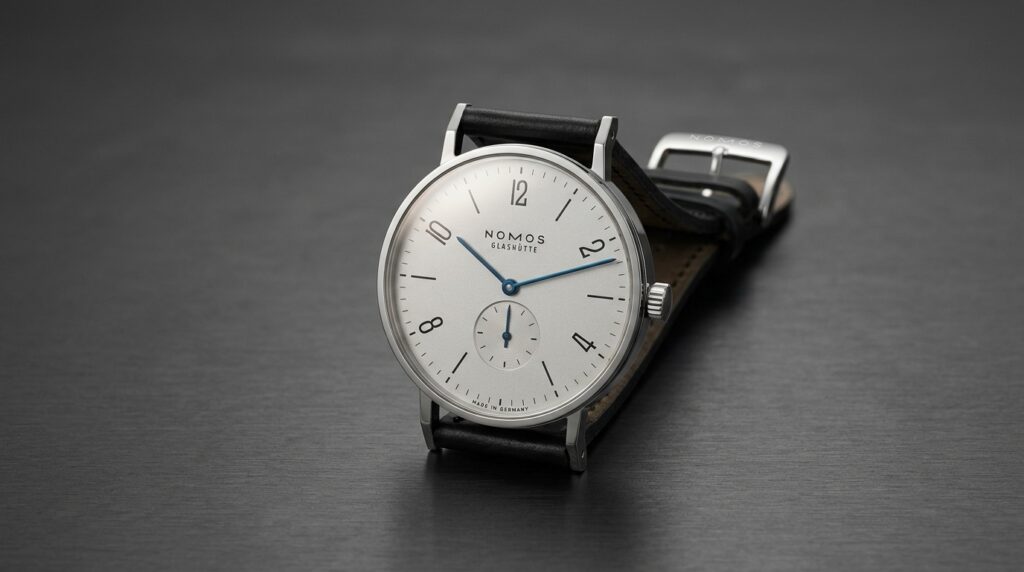
The current Longines buyer is not simply choosing between Swiss brands. They are also choosing between categories. At CHF 2,000, a buyer can consider a Longines Spirit, a Nomos Club, a Oris Big Crown Pointer Date, a higher-end Seiko Presage or Prospex, or a microbrand with a Swiss movement and aggressive specifications. At CHF 4,000, they encounter Tudor, Sinn, Grand Seiko quartz or entry mechanical references, pre-owned Omega, and even discounted luxury pieces from the overstocked grey market.
Longines’ answer is scale with legitimacy. It cannot offer Nomos’ in-house purism, Grand Seiko’s finishing, or Tudor’s sports-watch cachet. What it offers instead is a low-risk proposition: long serviceability, global retail presence, stable design codes, meaningful archive depth, and group-exclusive calibres that are better than the generic movement discussion suggests. This is not romantic, but it is a powerful ownership case.
The secondary market reinforces the point. Longines watches generally do not behave like speculative assets, and that is healthy. Depreciation from retail exists, especially on less focused references, but the entry price is not inflated by scarcity games. For collectors who actually intend to wear their watches, this is a virtue. A pre-owned Spirit, Heritage Classic, Legend Diver, or Master Collection moonphase often represents stronger value than the equivalent new purchase. Longines is best approached as a watchmaker, not as an asset class.

The Best Longines Collections Today
The Spirit Zulu Time 39mm is probably the most strategically complete modern Longines. It combines a useful true GMT calibre, wearable sizing, strong water resistance at 100 metres, a coherent aviation identity, and a price that undercuts many comparable Swiss GMTs. The watch still carries the five-star dial signature, but the overall execution is strong enough to absorb that flourish.
The Legend Diver 39mm is the most distinctive everyday Longines for design-led buyers. It avoids the derivative dive-watch problem because its dual-crown case and internal bezel give it an identity outside the Submariner template. The smaller case size made the design sharper and more wearable. Its main limitation is that internal bezels are inherently less practical than external rotating bezels for actual diving, but that is more relevant in theory than in daily use.
The Heritage Classic Sector remains one of the most refined dress-adjacent watches under CHF 3,000. It is not a formal dress watch in the narrow sense, but a balanced daily watch with enough historical intelligence to satisfy collectors. The Avigation BigEye is the chronograph to examine if movement value is the priority; the L688 column-wheel calibre gives it mechanical seriousness that many competitors cannot match at the price.
The Master Collection is more complicated. Its annual calendar, moonphase, and chronograph variants can offer remarkable complication density for the money, but buyers need to be selective. The strongest references are those with disciplined dial layouts and restrained case sizes. The weakest are those that treat complication count as a substitute for design judgement.
The Editorial View: Longines Wins When It Stops Apologising
Longines does not need to become more “luxury” in the contemporary sense. That path would damage what makes the brand important. The market already has enough watches priced according to brand ambition rather than mechanical content. Longines is strongest when it accepts its role as the serious, historically grounded, industrially capable Swiss brand for buyers who want substance without ceremony.
The danger is dilution. Too many references, too many compromised date placements, and too much decorative nostalgia can make Longines look less disciplined than its best watches prove it can be. The brand’s future should be simple: better sizing, fewer but stronger references, more no-date options where the dial demands it, continued use of silicon-equipped Longines-exclusive calibres, and selective revivals from the archive that connect to real movement or functional history.

Measured against the inflated rhetoric of modern watch collecting, Longines can seem almost modest. Measured against what a mechanical watch should deliver for the money, it is one of the most important brands in the industry. The company’s best watches do not depend on artificial scarcity, celebrity mythology, or speculative resale. They depend on Saint-Imier history, Swatch Group industrial capacity, ETA-derived engineering, and a catalogue that, at its sharpest, understands the difference between heritage and theatre.
That is why Longines deserves collector attention. Not because every model is exceptional; many are merely competent. But because the brand’s strongest watches occupy a space that has become rarer than it should be: mechanically credible, historically anchored, serviceable, wearable, and priced with some relationship to reality. In the present market, that is not a compromise. It is a strategy.