Blancpain: Why the Oldest Name in Watchmaking Still Has Something to Prove

Blancpain: Why the Oldest Name in Watchmaking Still Has Something to Prove
Blancpain has one of the strongest origin stories in Swiss watchmaking, yet the brand’s modern importance does not rest on being old. Founded in 1735 in Villeret by Jehan-Jacques Blancpain, it can plausibly claim the longest continuous name in the industry, but continuity is not the same as relevance. The more interesting Blancpain is the one rebuilt in the 1980s, sharpened under Swatch Group ownership, and now forced to compete in a luxury market that rewards instant recognition more than mechanical depth. That tension defines the brand today: technically serious, historically credible, often undervalued, and not always commercially disciplined.
Among major Swiss houses, Blancpain occupies an unusual position. It is not an auction-room myth machine like Patek Philippe, not a design monopoly like Audemars Piguet’s Royal Oak, and not a cultural default like Rolex. Its best watches ask for a collector who reads calibres, case construction and lineage before reading Instagram. That is both its strength and its limitation. Blancpain makes compelling mechanical watches, but the market no longer automatically rewards mechanical seriousness unless it is paired with unmistakable product architecture. Blancpain has that architecture in the Fifty Fathoms. Elsewhere, its case is more complicated.
The Brand That Was Rebuilt, Not Merely Preserved
The modern Blancpain story begins not in 1735 but in 1983, when Jean-Claude Biver and Jacques Piguet acquired the dormant name from SSIH, the group that would later become part of SMH and then Swatch Group. The quartz crisis had damaged Swiss mechanical watchmaking’s industrial base and its confidence. Biver’s strategic move was simple and audacious: position Blancpain as a purely mechanical manufacture at a moment when electronics had become the rational answer. The famous line that Blancpain had never made a quartz watch and never would was not just marketing; it was a counter-cyclical thesis.
That thesis mattered because Jacques Piguet brought access to Frédéric Piguet, one of the most capable high-grade movement makers of the period. The reborn brand did not only sell nostalgia. It sold thin automatic calibres, perpetual calendars, split-seconds chronographs, minute repeaters and complete calendar moonphases at a time when many historic Swiss names were still regrouping. In 1992, SMH acquired Blancpain for a reported CHF 60 million, bringing it into the group now known as Swatch Group. This ownership matters because Blancpain has since benefited from industrial depth while retaining access to high-end movement engineering through what became Manufacture Blancpain in Le Brassus.
The key point is that Blancpain’s modern legitimacy is earned, not inherited. The 1735 foundation date gives the brand a headline. The Biver-Piguet resurrection gives it substance. Collectors who reduce Blancpain to “oldest watch brand” miss the more valuable observation: it was an important participant in the mechanical renaissance, and it helped establish the idea that complicated mechanical watches could be culturally and commercially desirable after quartz had won the utilitarian argument.
Fifty Fathoms: The Asset Blancpain Must Continue to Protect
The Fifty Fathoms is Blancpain’s strategic centre of gravity because it has what most luxury watch lines lack: a real originating use case. In 1953, Blancpain developed the Fifty Fathoms for French combat swimmers under Captain Robert “Bob” Maloubier and Lieutenant Claude Riffaud. Its broad luminous bezel, automatic winding and highly legible dial were not ornamental choices; they addressed underwater timing, reliability and readability. The name referred to approximately 91 metres, a depth then aligned with practical diving limits rather than modern spec-sheet theatrics.
Blancpain’s early dive-watch credibility was strengthened by military and professional adoption, including French naval use and U.S.-connected Tornek-Rayville TR-900 examples supplied in the 1960s. Rayville, an anagrammatic workaround tied to the Blancpain name, is now collector shorthand for one of the most desirable military dive watches of the period. The Fifty Fathoms also had civilian distribution through Lip in France, which gives vintage examples an ecosystem of dial signatures, case types and bezels that specialists can actually study. This is the kind of history that survives scrutiny.
The modern Fifty Fathoms, particularly references built around calibre 1315, is a materially strong proposition. Calibre 1315 is an automatic movement with three series-coupled barrels, roughly 120 hours of power reserve, a free-sprung balance and silicon balance spring in contemporary configurations. It is not merely an outsourced engine hidden behind heritage styling. The standard 45mm Fifty Fathoms has long been too large for many wrists, but the watch is technically coherent: 300 metres of water resistance, a robust movement architecture, and finishing materially above the utilitarian dive-watch category.
Blancpain’s problem has been sizing and segmentation. The 2013 Fifty Fathoms Bathyscaphe gave the line a more restrained, mid-century-adjacent expression, with 43mm cases and later 38mm variants, but the core Fifty Fathoms remained visually and physically imposing. The 2023 70th Anniversary Act 1 in 42mm steel and later 42mm titanium models suggested that Blancpain understands the issue. A 42mm Fifty Fathoms is not merely a smaller watch; it is a commercially necessary correction. In a market where the Rolex Submariner, Omega Seamaster Diver 300M and Tudor Pelagos already cover broad price ladders, Blancpain cannot rely on history alone. It must offer proportion as well as pedigree.

The Swatch Collaboration Was Not the Disaster Purists Claimed
The 2023 Blancpain x Swatch Scuba Fifty Fathoms was predictable controversy. After the MoonSwatch proved that Swatch Group could turn an inaccessible luxury icon into a retail spectacle, the Blancpain collaboration applied the formula to a dive watch using SISTEM51 automatic movements and bioceramic cases. Purists objected that a high-end mechanical brand had been diluted. That critique is understandable but incomplete.
Strategically, the collaboration solved a visibility problem. Blancpain has high credibility among committed watch buyers but limited recognition outside them. A CHF 400 plastic-cased Swatch did not compete with a CHF 15,000 Fifty Fathoms. It introduced the name to people who might otherwise only know Rolex, Omega and TAG Heuer. The real risk was not price dilution; it was aesthetic trivialisation. The execution leaned heavily into playful ocean themes, with nudibranch imagery and bright colourways, which made sense for Swatch but sat awkwardly beside Blancpain’s disciplined military-diver heritage.
On balance, the collaboration was more rational than damaging. The Fifty Fathoms is strong enough to survive a Swatch derivative, just as the Speedmaster survived the MoonSwatch. But Blancpain must not mistake exposure for conversion. A mass-market collaboration creates awareness; it does not build collector conviction. That still has to be earned through the permanent collection, especially through correctly sized, mechanically serious Fifty Fathoms references that do not feel like commemorative one-offs.

Villeret: Technically Strong, Commercially Under-Defined
If the Fifty Fathoms is Blancpain’s clearest public asset, Villeret is its private argument. The line carries the name of the brand’s birthplace and represents Blancpain’s classical dress and complication language: double-stepped bezels, Roman numerals, leaf hands and slim cases. At its best, Villeret is one of the most quietly accomplished collections in the Swatch Group hierarchy. At its weakest, it proves that good watchmaking does not automatically create a memorable watch.
The calibres are often excellent. The calibre 1151, an ultra-thin automatic descended from Frédéric Piguet architecture, offers around 100 hours of power reserve from twin barrels. The calibre 13R0, used in hand-wound references such as the Villeret 8 Jours, provides an eight-day reserve and visible finishing that exceeds what many buyers expect from a brand more commonly discussed for dive watches. Blancpain’s complete calendar moonphase watches, including Villeret Quantième Complet models, draw directly from the neo-traditional complicated watch revival of the 1980s and 1990s. Those watches are central to Blancpain’s modern identity.
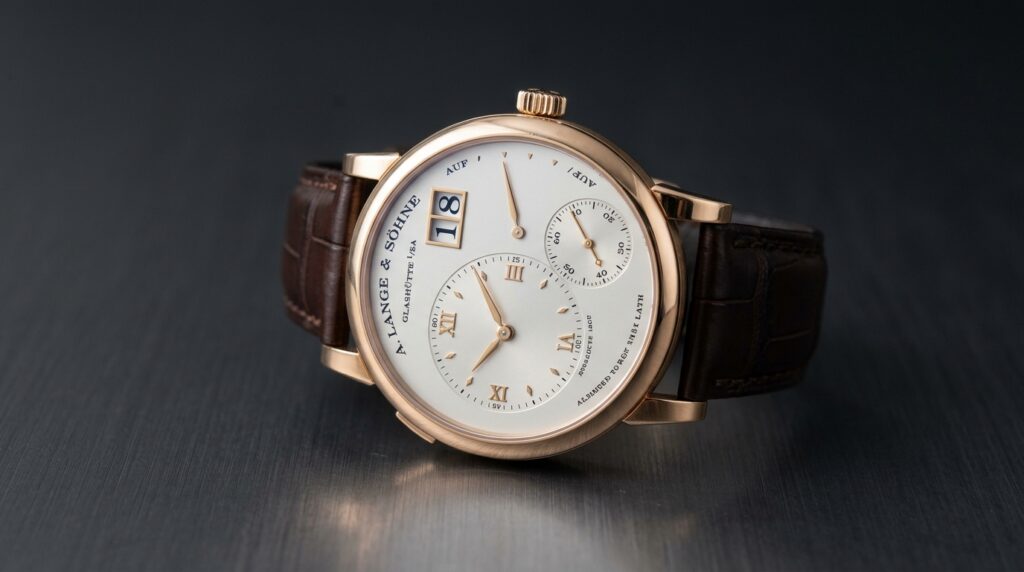
The commercial challenge is that Villeret competes in a dress-watch segment where design codes are extremely crowded. A white dial, Roman numerals and moonphase aperture can be technically satisfying yet visually interchangeable to non-specialists. Patek Philippe, Jaeger-LeCoultre, Breguet, A. Lange & Söhne and even Glashütte Original all occupy nearby territory depending on price and complication. Blancpain’s finishing and movement credentials are credible, but the line lacks a single instantly identifiable case or dial architecture equivalent to a Calatrava hobnail bezel, a Lange outsize date or a Breguet fluted caseband and guilloché dial.
This is where Blancpain’s understated approach becomes double-edged. Collectors can find real substance, especially on the secondary market, where Villeret complications often trade at meaningful discounts to retail. But the discount exists for a reason: the market is not paying a scarcity premium for designs it does not immediately recognise. For buyers who value mechanics over resale optics, that can make Blancpain compelling. For the brand, it is evidence that Villeret needs sharper product identity, not necessarily more complications.

Air Command and the Problem of Too Many Histories
The Air Command is a useful case study in Blancpain’s broader strategic tension. The original 1950s Air Command is a rare flyback chronograph associated with military aviation proposals, far less publicly established than the Fifty Fathoms but fascinating to specialists. Blancpain revived the model in recent years with vintage styling and calibre F388B, a high-frequency automatic flyback chronograph beating at 5 Hz, derived from the modern Frédéric Piguet/Blancpain chronograph platform.
As an object, the contemporary Air Command is persuasive: ceramic or precious-metal cases, a rotating countdown bezel, sharp dial symmetry and a technically interesting chronograph movement. As a brand pillar, it is less secure. The market already has deeply entrenched aviation chronographs: the Omega Speedmaster, Breitling Navitimer, IWC Pilot’s Chronograph, Zenith El Primero and Type XX lineage from Breguet. Blancpain can make a better-than-expected aviation watch, but it cannot easily claim the category.
This does not mean the Air Command should not exist. It means Blancpain must treat it as a connoisseur’s extension rather than a second identity. The Fifty Fathoms gives Blancpain a mainstream anchor. Villeret gives it haute horlogerie continuity. Air Command adds texture, but if overdeveloped it risks making Blancpain look like a brand shopping through mid-century military archives. The better strategy is restraint: fewer variants, stronger calibre storytelling, and enough scarcity to preserve the model’s specialist appeal.

Complications: Blancpain’s Most Underrated Advantage
Blancpain’s highest watchmaking is often under-discussed because the brand does not generate the same auction mythology as Geneva’s most visible independents and family-owned houses. That is a market perception issue, not an absence of capability. The brand has produced minute repeaters, tourbillons, carrousels, perpetual calendars and equation-of-time pieces. The calibre 1735 grande complication, introduced in the 1990s, combined a minute repeater, tourbillon, perpetual calendar, split-seconds chronograph and moonphase in an automatic wristwatch. Whether or not one likes the aesthetics, it was a serious mechanical statement from the post-quartz revival era.
The carrousel is another Blancpain signature worth taking seriously. Unlike the tourbillon, a carrousel uses a different gear train arrangement to rotate the regulating organ, historically developed by Bahne Bonniksen in the late 19th century as a more robust alternative. Blancpain revived and elevated the mechanism in wristwatch form, including pieces that combined carrousel and minute repeater or carrousel and tourbillon concepts. These are not volume products, but they support the brand’s claim to mechanical depth more convincingly than broad heritage advertising ever could.
Still, complications alone do not solve positioning. In today’s market, high complications sell through narrative, finishing reputation and perceived rarity. Blancpain has the mechanics and the institutional capacity, but it is not always discussed in the same breath as Patek Philippe, Vacheron Constantin, Audemars Piguet or Lange. Some of that is unfair; some of it is self-inflicted. Blancpain’s visual language in complicated watches can appear conservative without being unmistakable. The brand needs to make its difficult watches more identifiable from across a room, not because collectors are shallow, but because iconography now carries economic weight.

The Collector Case for Blancpain
The sensible collector’s case for Blancpain is not that every reference is overlooked genius. It is that the brand offers pockets of asymmetric value where movement quality, case execution and historical credibility exceed market heat. Pre-owned Villeret complete calendars, Léman-era complications, Bathyscaphe models and certain Fifty Fathoms references can be bought at levels that look rational compared with less elaborate watches from more socially dominant brands. Blancpain is rarely a momentum trade. It is more often a conviction purchase.
The Léman collection, now discontinued, is particularly interesting for collectors willing to move beyond current-catalogue visibility. Produced during a period when Blancpain leaned into complicated sport-luxury and integrated case thinking, Léman references can look dated in some configurations but mechanically strong in others. Split-seconds chronographs, perpetual calendars and alarm watches from this era reflect the brand’s late-1990s and early-2000s confidence. They are not easy watches to generalise, which is precisely why careful reference-by-reference analysis matters.
For modern buyers, the safest Blancpain proposition remains the Fifty Fathoms in wearable sizes, especially titanium or Bathyscaphe variants for those who want daily usability without the theatrical thickness and diameter of the 45mm core model. The dress-watch buyer should look hardest at Villeret pieces where calibre quality is the main attraction and resale expectations are conservative. The complication buyer should be selective, prioritising mechanical interest and condition over theoretical rarity. Blancpain rewards homework. It does not reward lazy brand-name buying.
Blancpain’s Real Test
Blancpain does not need to become louder. It needs to become clearer. Its history is deep enough, its movement base is strong enough, and its ownership gives it more industrial security than most independent brands can claim. The issue is strategic focus. The Fifty Fathoms should be treated as a permanent, proportionally disciplined icon rather than a platform for anniversary excess. Villeret needs recognisable design authority, not just well-finished complications. Air Command should remain tightly edited. High complications should be used to demonstrate horological competence, not to compensate for unclear visual identity.
The luxury watch market of the 2020s is less forgiving than the market that welcomed Blancpain’s mechanical revival in the 1980s. Buyers have more information, more alternatives and more sensitivity to resale value. In that environment, Blancpain’s strengths are real but not self-executing. The brand has one of the few dive watches with genuine pre-Submariner-era credibility, a serious archive of complicated watchmaking, and access to some of the best movement know-how inside Swatch Group. It also has a habit of letting those assets speak too softly.
That makes Blancpain one of the most interesting major Swiss brands to assess today. It is neither a sleeper in the simplistic sense nor an obvious trophy brand. It is a manufacture with substance, gaps and unfinished strategic work. For collectors, that is precisely the appeal. Where the market has already agreed, prices tend to be efficient. Where the market is still undecided, judgment matters. Blancpain remains a brand for people willing to exercise judgment.