Breguet Watches: The Most Important Name in Horology Still Has to Prove Its Modern Case

Breguet Watches: The Most Important Name in Horology Still Has to Prove Its Modern Case
Breguet has a problem most watch brands would kill for: its history is too strong for its current market position. Abraham-Louis Breguet is not merely a founding name in Swiss watchmaking; he is one of the few individuals whose inventions still define the mechanical wristwatch. The tourbillon patent of 1801, the pare-chute shock protection system, the overcoil balance spring, the tact watch, the subscription watch, engine-turned dials, open-tipped hands and secret signatures are not decorative talking points. They are part of the grammar of watchmaking. Yet in the modern collector market, Breguet is often priced not as the author of high horology, but as a respected, slightly under-loved manufacture within the Swatch Group portfolio.
That disconnect is the central issue. Breguet is not short of legitimacy, engineering or manufacturing depth. It is short of heat, which is a different and more fragile currency. The brand’s strongest pieces are among the most intellectually satisfying watches available from any major maison. Its weaker ones show how dangerous inherited prestige can be when the contemporary message is not sharp enough.
The Historical Claim Is Not Marketing Decoration
Founded in Paris in 1775, Breguet’s historical record is unusually concrete. Abraham-Louis Breguet worked for the French court, sold to European aristocracy, supplied technical instruments and built watches whose solutions were not merely ornamental. The 1795 development of the Breguet overcoil improved concentric breathing of the balance spring. The pare-chute, developed in the late eighteenth century, was an early answer to shock damage. The tourbillon, patented on 26 June 1801, was intended to average positional errors in pocket watches carried vertically. Whether the tourbillon is functionally necessary in a wristwatch is secondary; the relevant point is that Breguet invented the complication, and almost every brand that sells one is drawing on his work.
The famous watch No. 160, commissioned for Marie Antoinette and completed after her death in 1827, is not important because of the mythology alone. It was important because it aggregated the most advanced horological functions of its time: perpetual calendar, minute repeater, equation of time, power reserve, jumping hours, bimetallic thermometer and independent seconds. Few modern brands can point to a comparable object in their own archive without exaggeration.
This matters because luxury watchmaking is full of borrowed authority. Breguet does not need to borrow. The challenge is that contemporary buyers no longer reward historical authority automatically. Patek Philippe converts continuity into scarcity and family ownership. Audemars Piguet converts the Royal Oak into cultural dominance. Vacheron Constantin has turned archival scholarship into sharper product strategy, particularly with Historiques and Les Cabinotiers. Breguet’s task is harder: it owns perhaps the deepest technical origin story in watchmaking, but it must express that story in watches that feel urgent now.
Swatch Group Ownership: Strength and Constraint
The modern Breguet cannot be understood without ownership. After a complicated twentieth century, the brand was acquired by Investcorp in 1987. Nouvelle Lemania, the movement specialist with chronograph depth and military-watch credibility, was brought into the same orbit in the early 1990s. In 1999, Nicolas G. Hayek’s Swatch Group acquired Breguet and Nouvelle Lemania, giving the brand industrial security and movement capacity that many prestige houses would envy.
Hayek treated Breguet as a crown asset. The manufacture at L’Abbaye in the Vallée de Joux became central to its modern technical identity. This is why Breguet is not a dial-and-case brand. It has serious movement substance: high-end chronographs, ultra-thin tourbillons, silicon escapements, magnetic pivots, minute repeaters and perpetual calendars sit within its catalogue. The advantage of Swatch Group ownership is obvious: capital, manufacturing depth, research capacity and patience. The disadvantage is equally clear: Breguet has sometimes lacked the ruthless brand focus that independent maisons or single-watch phenomena have used to dominate collector attention.
This is not a matter of quality. It is a matter of strategic legibility. Breguet is simultaneously a classical dress-watch house, a tourbillon authority, a naval chronometer inheritor, an aviation chronograph maker, a ladies’ complication specialist and a precious-metal guilloché boutique. Each claim is defensible. Together, they can diffuse the message.

The Classique Line Is the Core — and the Test
The Classique collection is where Breguet most clearly looks like Breguet. Coin-edge cases, welded lugs, slim bezels, Breguet hands, fluted cases, secret signatures and hand-guilloché dials are not nostalgic add-ons; they are the brand’s visual code. References such as the Classique 5157, 5177 and 7787 show the range of that code from austere two-hand dress watch to moon-phase calendar.
The 5157 is arguably the purest modern Breguet for the disciplined collector. Its extra-thin case, traditional dial architecture and automatic calibre 502.3 place it in a category that competes less with trendy steel sports watches than with the formal side of Patek Philippe, Vacheron Constantin and A. Lange & Söhne. The problem is not the object. The problem is market conviction. A gold Classique often trades at a meaningful discount to retail, while equivalent emotional capital attached to a Calatrava can support stronger residual pricing. That is not because the Breguet is mechanically unserious. It is because the market has been trained to read Patek as the default formal watch and Breguet as the connoisseur alternative.
The Classique 5177, particularly with grand feu enamel dial, makes a more assertive case. It uses calibre 777Q, an automatic movement with silicon balance spring and lever, and it carries date functionality without abandoning the old-world posture. The enamel version also avoids one of the risks of ornate guilloché: visual saturation. Breguet is at its best when the watch retains air and proportion. Some Classique references cross into decorative density; the strongest ones allow the architecture to breathe.

Tradition Is the Most Original Modern Breguet
If the Classique line preserves Breguet’s surface language, the Tradition line translates the historical mechanics into a modern wristwatch concept. Introduced in 2005, the Tradition 7027 was inspired by Breguet’s subscription watches, with the gear train, barrel and bridges exposed on the dial side. Unlike many openworked watches, Tradition is not skeletonization for spectacle. It is an architectural inversion: the movement becomes the dial because the historical reference supports it.
The Tradition 7057 and 7097 deserve more attention than they receive. The 7097, with retrograde seconds and calibre 505SR1, turns an eccentric layout into a coherent display. The 7077 chronograph is even more interesting technically. Its calibre 580DR uses two independent gear trains: one for timekeeping and one for chronograph operation, with different frequencies and an intentionally dramatic chronograph power reserve. This is the kind of watch that should be central to Breguet’s modern reputation because it cannot be easily substituted by another brand’s product.
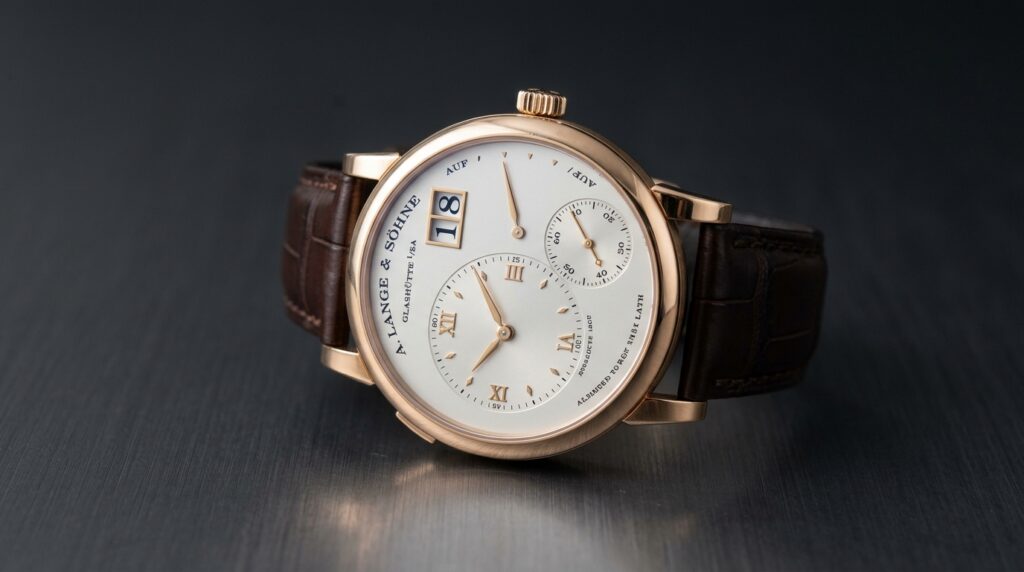
Tradition also reveals Breguet’s commercial hesitation. The line is too distinctive to be treated as a niche curiosity. In a market where collectors reward recognizable architecture — Royal Oak bezel, Nautilus case flank, Lange outsize date, Cartier Tank geometry — Tradition gives Breguet an immediately identifiable modern platform. It is historically grounded, visually proprietary and mechanically credible. If Breguet has a contemporary icon, it is not the Marine and not the Type XX. It is Tradition.

The Tourbillon Remains a Birthright, Not a Shortcut
Breguet’s tourbillon watches carry unusual legitimacy because the complication begins with Breguet. The modern danger is that tourbillons have become overproduced across the industry, often deployed as price justifications rather than horological arguments. Breguet avoids that trap when it uses the tourbillon with discipline.
The Classique Tourbillon Extra-Plat 5367 is a strong example. Its automatic calibre 581 is only about 3 mm thick, uses a peripheral rotor, offers an 80-hour power reserve and runs at 4 Hz. The watch is not merely a tourbillon on display; it is an ultra-thin automatic tourbillon with technical restraint. The earlier 5377 occupied similar territory with more dial texture, while the 5367 enamel version sharpened the proposition by reducing ornament.
The Classique Chronométrie 7727 is another important modern Breguet, and arguably more intellectually relevant than many tourbillons. Its calibre 574DR runs at 10 Hz, uses silicon components and incorporates magnetic pivots to stabilize the balance staff. It won the Aiguille d’Or at the Grand Prix d’Horlogerie de Genève in 2014. That was not a sentimental award. It recognized a serious attempt to address chronometry through contemporary physics rather than inherited complication theatre.
This is where Breguet’s technical identity should be strongest: not simply repeating eighteenth-century inventions, but extending the problem-solving spirit behind them. Silicon, magnetism, high frequency and ultra-thin construction are credible successors to Breguet’s historical work. They are more persuasive than any anniversary engraving or boutique-only dial colour.

Type XX and Marine: Necessary, but Uneven
The Type XX family gives Breguet a legitimate tool-watch story. The original Type 20/Type XX chronographs were made for French military aviation in the 1950s, with flyback functionality central to cockpit use. The late twentieth-century Type XX references, including the 3800 Aeronavale and 3820 Transatlantique, gave Breguet a sportier access point and remain among the most wearable modern Breguets on the secondary market.
The 2023 return of the Type 20 reference 2057 and Type XX reference 2067 was strategically important. Both introduced new automatic flyback chronograph movements, calibres 7281 and 728, operating at 5 Hz with column-wheel architecture and vertical clutch construction. The military-style 2057 and civilian 2067 split the historical narrative sensibly. The criticism is case execution: at roughly 42 mm, these are not timid watches, and Breguet’s decision to modernize strongly will not satisfy collectors who wanted a more compact vintage interpretation. Still, the movement investment is real, and that matters more than nostalgia.
The Marine collection is more complicated. Breguet has historical authority in marine chronometry, particularly through Abraham-Louis Breguet’s appointment as chronometer-maker to the French Royal Navy in 1815. The modern Marine line, redesigned in 2018 with references such as the 5517, 5527 chronograph and 5547 alarm, tries to convert that heritage into a luxury sports-watch language. It is technically sound and often well finished, but strategically it faces brutal competition. A high-end sports watch without a deeply established bracelet icon must fight the Royal Oak, Nautilus, Overseas and Laureato on unfavourable terrain. The Marine is not a bad watch; it is simply not Breguet’s most convincing battlefield.

The Market Misprices Breguet, but Not Blindly
Breguet is frequently described as undervalued, and the statement is broadly correct only if it is made carefully. Not every discounted watch is a hidden opportunity. Some are discounted because demand is thin, sizing is awkward, design is overworked or the brand message is unclear. Breguet has examples of all four. But the market does under-reward the best Breguet references relative to their technical content and historical authority.
On the secondary market, modern gold Classique and Tradition references commonly trade well below retail, especially compared with Patek Philippe dress watches or Lange’s core Saxonia and 1815 models. A Tradition 7097 or Classique 5177 can offer serious movement architecture, hand-finishing cues and unmistakable brand identity at prices that look rational rather than inflated. The same is true of older Type XX models, which often remain more accessible than comparable military-adjacent chronographs from brands with less horological substance.
The collector should be selective. The strongest Breguet purchases are those where the brand’s historical and mechanical claims align: Classique in restrained configurations, Tradition references with visible architectural logic, serious tourbillons such as the 5367, the Chronométrie 7727, and Type XX models with genuine flyback relevance. The weaker buys are those that rely mainly on the name while offering design bulk, derivative luxury-sport positioning or excessive dial complication without proportional clarity.
Breguet’s Strategic Future Depends on Discipline
Breguet entered its 250th anniversary period with more assets than almost any maison in watchmaking: a founder of canonical importance, Swatch Group manufacturing power, deep movement competence, a recognizable design language and several underexploited modern platforms. Since late 2024, leadership under CEO Gregory Kissling has inherited not a broken brand, but a strategically under-leveraged one. That distinction matters. Breguet does not need reinvention. It needs concentration.
The priority should be obvious. Make Tradition the modern intellectual icon. Keep Classique disciplined, thin and proportionally elegant. Treat the tourbillon as a birthright that must be technically justified. Use Type XX as a serious flyback chronograph platform rather than a generic vintage play. Be cautious with Marine, because heritage in marine chronometry does not automatically create a contemporary sports-watch icon. Above all, stop assuming that history will do the work by itself.
Breguet remains one of the few brands whose archive can embarrass the industry. But modern collecting is not an archive competition. It is a contest of relevance, scarcity, design coherence, movement credibility and cultural memory. Breguet has the hardest part already: authentic importance. What it still needs is sharper editing. For collectors, that creates the opportunity. The best Breguet watches are not merely respectable alternatives to better-known prestige names. They are often better intellectual purchases, provided one buys the references where the old genius has been translated rather than merely cited.