Two Ways to Wear a Ferrari, More Expensive than Driving One!
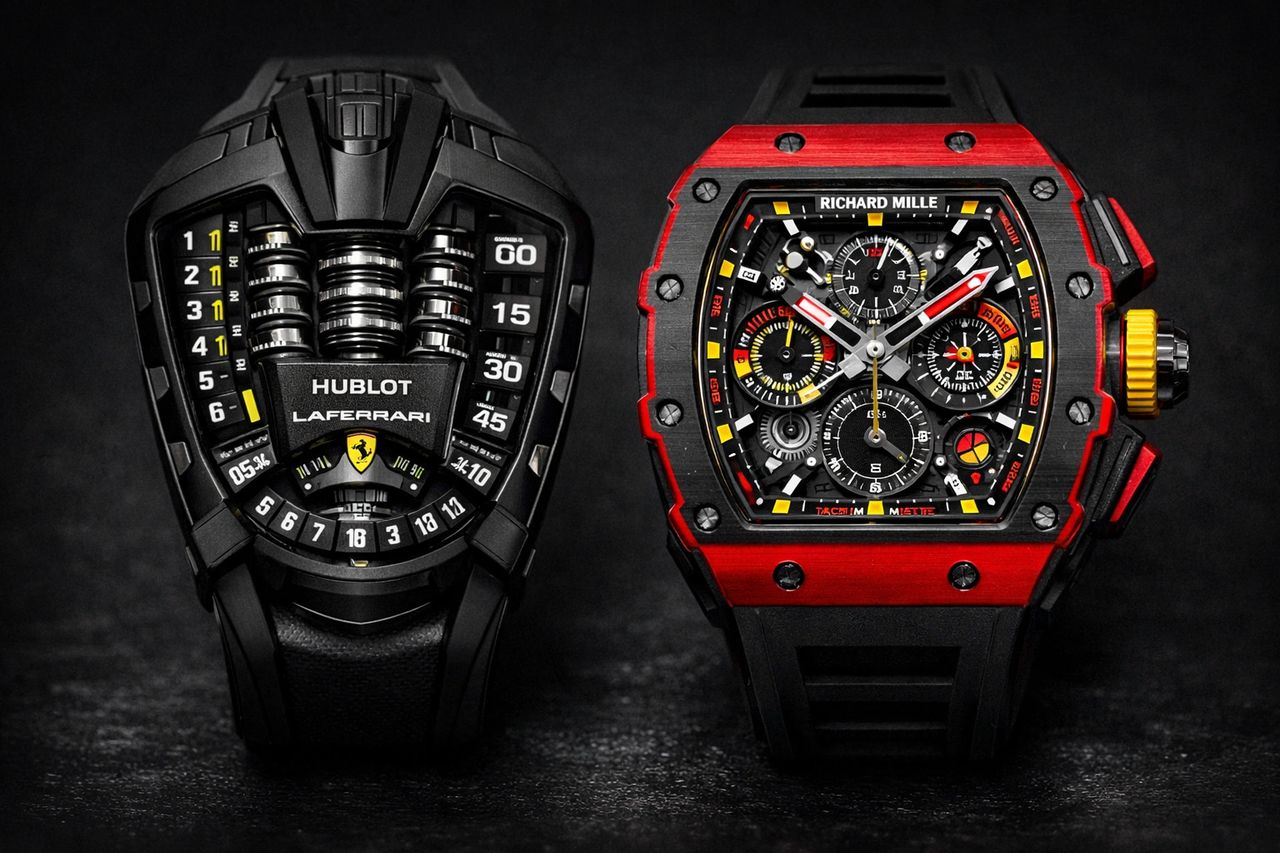
Only a few watches wear the weight of automotive identity as deliberately as those born from Ferrari collaborations. When Ferrari enters horology, it does not do so lightly — and neither do the watchmakers it chooses to work with. Over the past decade, two names have interpreted Ferrari’s spirit in very different ways: Hublot and Richard Mille. Both claim authenticity. Both are uncompromising. But the stories they tell are remarkably different.
Hublot’s LaFerrari feels like a declaration made out loud. From the first glance, it announces itself as a machine. The case is sculpted, layered, and unapologetically industrial, as if milled rather than shaped. The skeletonized dial reveals its mechanics without restraint, inviting the wearer to observe the movement in motion — gears turning, energy transferring, time unfolding. It is the visual equivalent of lifting the engine cover on a supercar and being encouraged to look inside.
This openness is intentional. Hublot has never been interested in quiet craftsmanship. The LaFerrari reflects a philosophy where performance is meant to be seen, not hidden. Materials like carbon fiber, titanium, and sapphire are not subtle cues; they are structural statements. The watch feels built, assembled, and engineered — very much in the spirit of modern Ferrari design, where form follows performance rather than tradition.
Richard Mille’s interpretation of Ferrari arrives from a different direction. Where Hublot speaks in volume, Richard Mille speaks in precision. The first impression is not one of visual aggression, but of controlled complexity. The case architecture feels lighter, more skeletal in a structural sense, less about revealing everything and more about reducing everything to its absolute minimum.
With Richard Mille, Ferrari’s influence is less about visual drama and more about engineering discipline. The movements feel closer to laboratory instruments than expressive machines. Ultra-thin profiles, extreme material science, and obsessive weight reduction mirror Ferrari’s pursuit of performance through efficiency. This is not the Ferrari of cinematic spectacle; it is the Ferrari of wind tunnels, lap times, and marginal gains.
Wearing the two watches tells an even clearer story. The Hublot LaFerrari occupies space confidently. It has presence, mass, and a physicality that reminds the wearer it is there. It appeals to collectors who want to experience mechanics visually and emotionally — who enjoy the sensation of wearing a machine that refuses to be discreet.
The Richard Mille Ferrari, by contrast, often surprises. Despite its complexity, it can feel almost weightless. The comfort is engineered, not incidental. It wears like a piece of advanced equipment rather than jewelry. For some collectors, this restraint — this refusal to overstate — is precisely what makes it compelling.
What’s fascinating is that neither watch contradicts Ferrari’s identity. Instead, each highlights a different side of it. Hublot reflects Ferrari’s visible power, its drama, its emotional pull. Richard Mille reflects Ferrari’s obsession with performance metrics, materials, and engineering purity. One celebrates the spectacle of speed; the other celebrates the science behind it.
Choosing between a Hublot LaFerrari and a Richard Mille Ferrari is not about which is better. It is about which Ferrari you recognize. The one that demands attention, or the one that earns respect quietly. The one that shows you the engine, or the one that perfects it out of sight.
Both are machines. Both are uncompromising.
And neither is pretending to be anything else.