Hamilton Watches: How American Heritage and Swiss Precision Built the Ultimate Everyday Mechanical Watch Brand
Hamilton occupies a space few watch brands can claim: born on the American railroad, refined by Swiss watchmaking, battle-tested in military service, and immortalized on cinema screens from Elvis Presley to Interstellar. In an era where luxury often means distance and exclusivity, Hamilton’s appeal lies in something more enduring—the romance of purposeful watches that still feel attainable, wearable, and real.
The Unusual Strength of Being Both American and Swiss
Hamilton’s identity is not clean in the way marketing departments often prefer. It is layered, slightly contradictory, and all the better for it. The brand was founded in Lancaster, Pennsylvania in 1892, at a time when accurate timekeeping was not a lifestyle accessory but a matter of industrial safety. Its earliest reputation was built not through celebrity endorsement or boutique scarcity, but through the American railroad network, where reliable pocket watches helped coordinate movement across a vast and increasingly mechanized country.
That foundation still matters. Many watch brands claim heritage, but Hamilton’s heritage is unusually practical. Its story begins with instruments made to solve real problems: railroad timing, military coordination, aviation navigation, and later, screen storytelling. The Swiss chapter, which followed after Hamilton joined what would become the Swatch Group ecosystem, did not erase the American one. Instead, it gave the brand access to modern Swiss production, robust mechanical movements, and a scale of manufacturing that allows Hamilton to occupy its most compelling position today: serious watches at prices that still feel rational.
This is the core of Hamilton’s modern appeal. It is not trying to be an independent haute horlogerie atelier. It is not selling waiting-list mythology. It is not pretending every steel sports watch is an investment vehicle. Hamilton is strongest when it makes mechanical watches that feel rooted in purpose, priced for use, and expressive without becoming theatrical.
Gateway Luxury Without the Usual Compromises
The phrase “gateway luxury” is often used dismissively, as if accessibility automatically implies dilution. Hamilton proves otherwise. In watches, the entry point matters. It shapes taste. It teaches proportions, movement types, case finishing, dial design, and the difference between a watch that merely looks expensive and one that has substance. Hamilton has become one of the few brands capable of initiating new collectors without patronizing them.
At its best, Hamilton offers the mechanics, history, and design literacy that make watch collecting rewarding. A Khaki Field Mechanical does not need precious metal or extreme finishing to justify itself. Its value lies in restraint: a manually wound movement, clean military-derived dial, compact dimensions, and a case that invites daily wear rather than preservation. It is a watch that teaches the pleasure of winding, the usefulness of legibility, and the quiet confidence of design that does not require explanation.
The same is true of models like the Khaki Field Auto, Khaki Aviation Pilot Pioneer, and Murph. These are not anonymous entry-level products with a heritage badge attached. They work because they connect recognizable Hamilton codes to modern usability. The cases are wearable, the movements are dependable, and the styling avoids the glossy overstatement that too often compromises affordable Swiss watches. Hamilton understands that entry-level luxury buyers are not necessarily looking for shortcuts. Many are looking for authenticity without financial absurdity.
The Railroad Origin: Precision Before Prestige
Hamilton’s early connection to American railroads is more than a decorative origin story. In the late nineteenth and early twentieth centuries, railroad-grade timekeeping carried technical and social weight. A poorly synchronized watch could contribute to disaster. Accuracy, legibility, and reliability were not abstract virtues; they were operational necessities. Hamilton earned trust in this environment, and that trust informed the brand’s character long before wristwatches became personal style objects.
This matters because it explains why Hamilton rarely feels convincing when it is overly polished or ornamental. The brand’s best watches retain some memory of utility. Even when adapted for modern collectors, Hamilton design is strongest when it appears to have a job. The railroad watches gave way to military watches, pilots’ watches, and field watches, but the line of thinking remained consistent: dial clarity, mechanical dependability, and value measured by use rather than status.
That historical pragmatism gives Hamilton a credibility many modern “heritage-inspired” brands struggle to manufacture. The company does not need to invent a backstory around exploration, aviation, or service. It has lived through those categories in ways that remain visible in the collection. The collector may not need a field watch for combat or a railroad watch for duty timing, but the design logic still carries emotional force.
Military Service and the Modern Khaki Formula
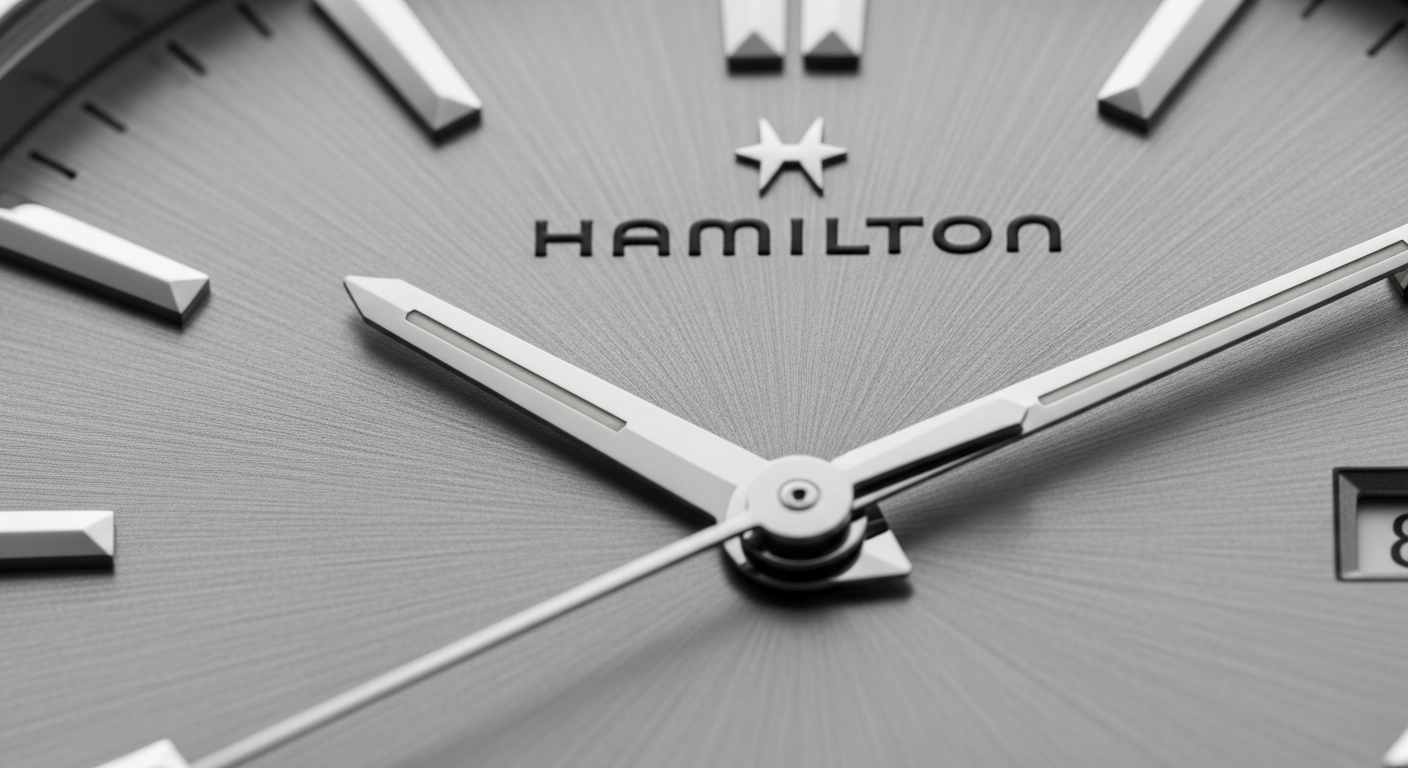
If one collection defines Hamilton today, it is the Khaki. The name now covers several families, from Field to Aviation to Navy, but the center of gravity is clear: robust, military-inflected watches with honest proportions and broad usability. The Khaki Field Mechanical, especially in its 38 mm form, has become a reference point in the affordable mechanical category because it avoids two common mistakes. It is neither a costume vintage watch nor a bland modern field watch stripped of character.
The design language is direct: Arabic numerals, strong minute track, syringe or sword-style hands depending on the reference, and cases that resist unnecessary bulk. The best examples feel disciplined. They do not try to flatter the wearer with artificial luxury cues. They offer a more durable satisfaction: the sense that every element has a reason to exist.
Hamilton’s military history deepens that effect. The brand supplied watches to the U.S. military and produced significant quantities of timepieces during wartime, including marine chronometers and wristwatches designed around practical requirements. That experience still informs the brand’s legitimacy in field-watch territory. Many companies make military-inspired watches. Hamilton’s advantage is that the inspiration is not remote or borrowed.
There is also a strategic benefit to the Khaki line: it gives Hamilton a clear identity at a price level where many brands are indistinct. For a collector considering the first serious mechanical watch, the Khaki is often the answer because it is not just affordable. It is coherent. It communicates taste without extravagance and heritage without nostalgia becoming sentimental.
Swiss Movements, Sensible Engineering
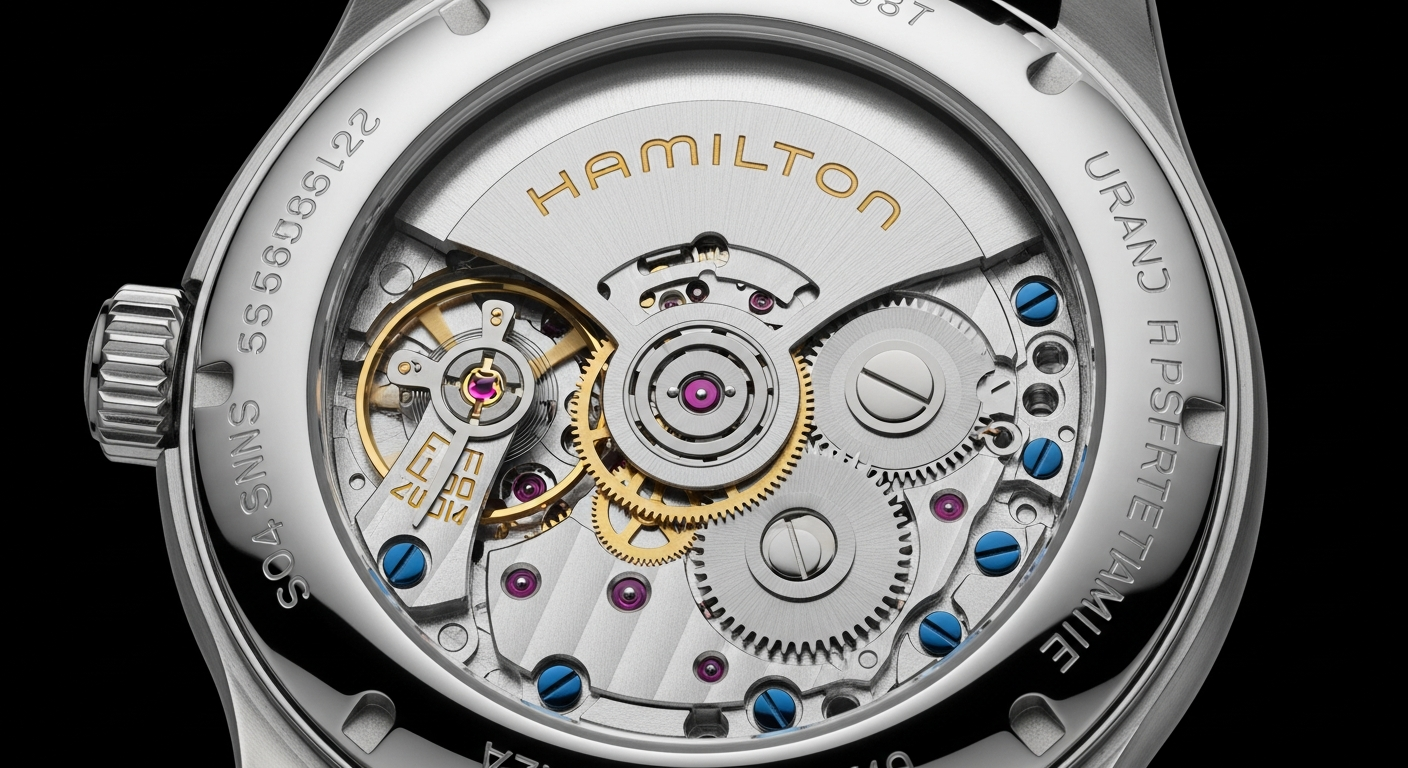
Hamilton’s modern Swiss production is central to its credibility. Within the Swatch Group, Hamilton benefits from access to ETA-derived movements, many customized under the H-series designation. The H-10, with its extended power reserve, has become particularly important. Based on the architecture of the ETA 2824 family and adapted for longer autonomy, it allows many Hamilton automatics to offer approximately 80 hours of power reserve, a practical advantage in everyday ownership.
Collectors can debate the trade-offs. Some versions use lower beat rates than their predecessors, and finishing remains industrial rather than decorative. But Hamilton is not pretending otherwise. The value proposition is clear: proven Swiss mechanical architecture, meaningful power reserve, strong servicing logic through a major group, and pricing that remains competitive. In a market where spec sheets are often inflated by marketing language, Hamilton’s engineering proposition is refreshingly grounded.
This is why the brand’s watches make sense as daily mechanical companions. They are not fragile expressions of artisanal excess. They are built to be worn, rotated, scratched, serviced, and kept. That is an underrated luxury. The modern watch industry often frames desirability around rarity, but for many owners, the deeper pleasure comes from a watch that enters daily life without anxiety. Hamilton understands that.
Hollywood as Cultural Capital, Not Mere Sponsorship
Hamilton’s relationship with cinema is one of the most effective in watchmaking because it rarely feels forced. The brand’s screen presence dates back decades, with notable appearances connected to Elvis Presley and a long list of films across genres. Unlike brands that appear on screen primarily as visible product placement, Hamilton often feels integrated into character and narrative. Its watches tend to look like objects that belong to the world of the film.
The Ventura is the clearest early example of Hamilton’s pop-cultural power. Introduced in 1957 as the world’s first electric watch powered by a battery, it was radical in design and technology. Its triangular case remains one of the most distinctive watch silhouettes ever produced. Elvis Presley’s association with the Ventura gave it glamour, but the watch already had substance. It was futuristic at a moment when the future still had sharp edges, chrome surfaces, and a sense of optimism.
Decades later, Interstellar gave Hamilton a different kind of cinematic relevance. The Murph, originally created as a prop and later produced for the public, succeeded because it combined accessible emotional storytelling with credible watch design. Many film-associated watches feel like merchandise. The Murph feels like a Hamilton first and a film object second, which is precisely why it works. It has warmth, restraint, and enough narrative resonance to attract both collectors and non-collectors.
The Ventura, the Murph, and the Power of Recognizable Design
Hamilton’s catalogue is broader than many casual observers realize, but the Ventura and Murph demonstrate two of its most important strategic strengths. The Ventura shows that Hamilton can be bold without becoming frivolous. Its asymmetry and triangular geometry remain divisive, yet that divisiveness is part of its value. In a world of endlessly similar round watches, the Ventura still looks like a decision.
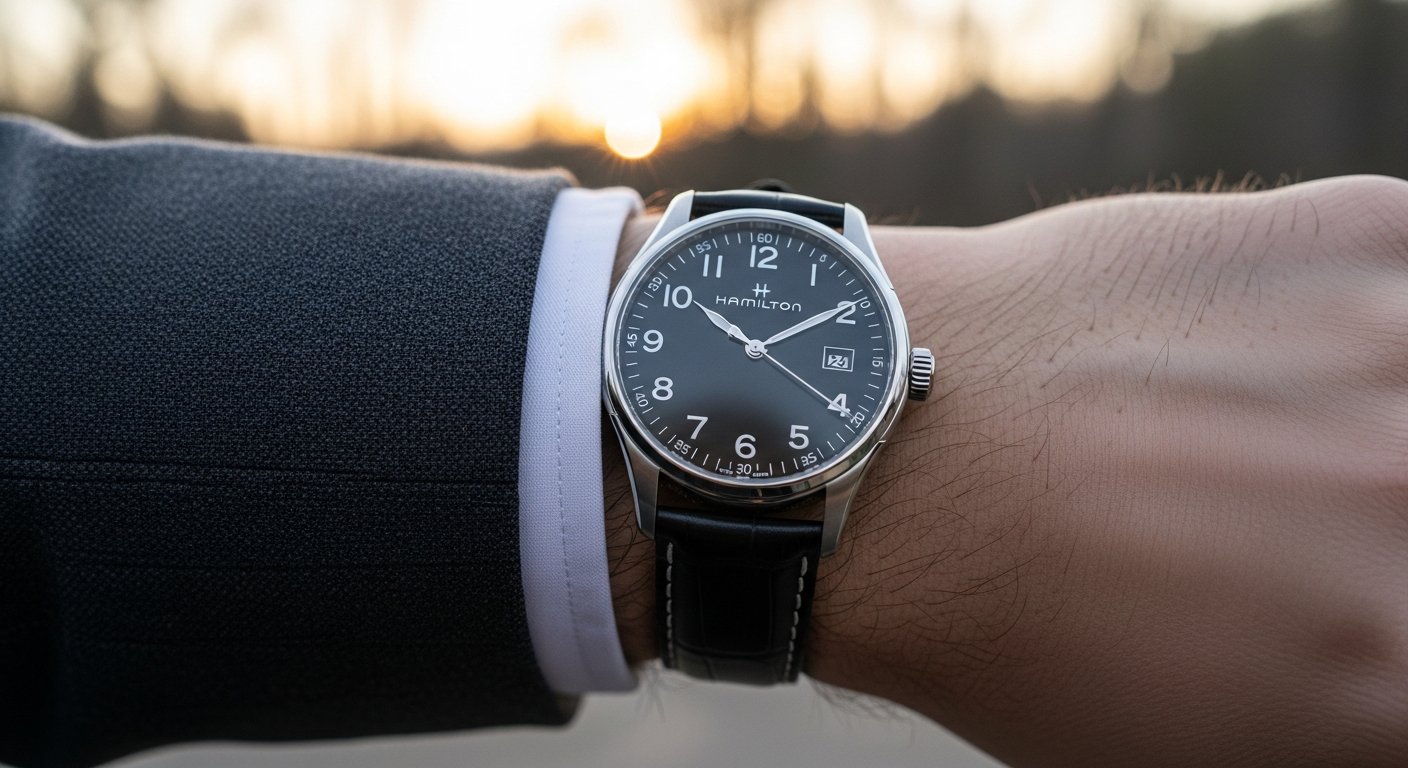
The Murph represents the opposite kind of power: familiarity refined into emotional clarity. Its round case, black dial, cathedral-style hands, and vintage-adjacent proportions are not radical. Yet the watch is deeply effective because the restraint is disciplined. It does not overplay the film connection. It simply offers a handsome, versatile mechanical watch with enough story to feel personal.
This balance between recognizability and wearability is difficult to achieve. Many brands can make a watch that is recognizable because it is loud. Fewer can make watches that are recognizable because their design language has been earned over decades. Hamilton has both types of icons: the eccentric Ventura and the quietly cinematic Murph, each serving a different collector psychology.
Why Hamilton Feels Honest in a Market Obsessed With Status
The contemporary watch market has become increasingly distorted by scarcity, speculation, and status signaling. Hamilton largely sits outside that economy, and this is one of its strengths. Its watches are generally available. They are priced to be purchased by people who intend to wear them. They do not require a relationship with a dealer, a secondary-market premium, or a performance of loyalty before ownership becomes possible.
That accessibility should not be confused with lack of desirability. In fact, Hamilton’s desirability is strengthened by its refusal to participate too aggressively in the theater of unattainability. The brand’s cultural capital comes from history, cinema, and design utility, not from artificial shortage. For many collectors, especially those who have become fatigued by the luxury watch industry’s self-importance, Hamilton offers a useful corrective.
It is also a brand with unusually low embarrassment risk. A Hamilton on the wrist rarely feels like an attempt to impress the room. It suggests interest rather than insecurity. That may sound modest, but it is a powerful advantage. The best everyday watches are not those that dominate every outfit or conversation. They are the ones that integrate naturally and reveal their depth over time.
The Collection: Where Hamilton Is Strongest
Hamilton’s strongest territory remains the everyday mechanical watch. The Khaki Field line is the obvious starting point, especially for buyers who value legibility, restrained dimensions, and military provenance. The manually wound versions provide the purest connection to traditional ownership. The automatics offer convenience and power reserve, making them easier for everyday rotation.
The Khaki Aviation models broaden the appeal with pilot-watch cues, larger dials, and a slightly more instrument-like personality. The Navy line adds dive-watch utility, though Hamilton is generally more convincing as a field and aviation brand than as a pure dive-watch specialist. The Jazzmaster collection covers dressier ground, with uneven results but several strong references for those seeking a Swiss mechanical watch that is versatile in office or formal settings.
The American Classic line is where Hamilton’s mid-century and archival instincts come forward. This includes pieces that lean into vintage proportions, railroad heritage, and cinematic associations. It can be a rich part of the catalogue, though buyers should be selective. Hamilton is at its best when the design remains disciplined. When the brand adds excessive dial detail or case complexity, the clarity that defines its best work can soften.
The Collector Case for Hamilton
For experienced collectors, Hamilton is not merely a beginner’s recommendation. It is a useful reminder of what mechanical watches can be when freed from status pressure. A Khaki Field Mechanical can sit in the same collection as a Rolex Explorer, Tudor Ranger, IWC Mark series, or vintage military watch without embarrassment. It will not match them in finishing, prestige, or long-term market mythology. It does not need to. It offers its own form of integrity.
Hamilton’s role in a collection is often practical, but not anonymous. It can be the watch taken on a trip because it is reliable and replaceable enough to wear freely. It can be the manual-wind field watch that reconnects the owner to the basic ritual of mechanical timekeeping. It can be the film-linked watch that carries personal meaning without becoming a novelty. These are not minor roles. They are often the watches that receive the most wrist time.
The brand’s weakness is also clear. Hamilton cannot compete with higher-end finishing houses, and some references suffer from thickness, long lugs, or over-expanded case sizes. Not every dial execution is equally refined. But these are manageable flaws, not identity crises. The core of the brand remains strong because the value proposition is not built on fantasy. It is built on credible history, competent Swiss mechanics, and designs that people actually wear.
The Ultimate Everyday Mechanical Watch Brand
Hamilton’s achievement is that it makes mechanical watch ownership feel both meaningful and sensible. That combination is rarer than it should be. Many brands can offer history. Many can offer Swiss movements. Many can offer attractive pricing. Fewer can combine those elements with genuine cultural visibility and a design language that spans railroad precision, military function, aviation utility, and Hollywood mythology.
This is why Hamilton remains one of the most important brands in the attainable mechanical category. It gives new collectors a serious place to begin and experienced collectors a reason to stay interested. Its watches do not depend on scarcity to feel desirable, nor do they rely on excessive luxury cues to feel legitimate. They are confident because their foundations are real.
In a market increasingly tempted by price inflation and manufactured exclusivity, Hamilton’s restraint feels almost strategic. The brand wins by staying close to purpose: watches with history, mechanical credibility, screen presence, and daily usability. That is not the loudest form of luxury. It may be the more durable one.