Hamilton: The Swiss-American Watchmaker with Hollywood DNA

There’s a particular kind of magic in objects that have lived more than one life. Not the forced, museum-glass kind of reverence, but the everyday sort of legend that comes from being useful in one era, symbolic in another, and unexpectedly relevant again when tastes swing back toward authenticity. Hamilton is one of those rare names that doesn’t just belong to a watch dial. It belongs to a railroad timetable, a cockpit checklist, a prop master’s inventory sheet, and the shared mental scrapbook of movie scenes where time does more than pass. Time warns, time tempts, time saves, time betrays. Hamilton has been there for all of it, wearing a distinctly Swiss-American identity that sounds like branding until you realize it’s the literal story of how the company became what it is.
Hamilton begins in Lancaster, Pennsylvania, in 1892, at a moment when America was trying to synchronize itself into a modern nation. Cities were growing, industries were humming, and railroads were stitching everything together. The rail system brought possibility, but it also brought danger: when trains share tracks and schedules, a small timing error can become catastrophe. So pocket watches weren’t jewelry; they were safety equipment. Hamilton’s early reputation was forged in that world, where accuracy wasn’t a luxury and trust had a steel edge to it. The legend of “railroad-grade” timekeeping has been romanticized, but it was ruthlessly practical. A watch that couldn’t be relied upon didn’t just disappoint; it endangered lives. In that sense, Hamilton’s first act wasn’t glamorous. It was disciplined.
Yet discipline is often the raw material for myth. It’s easy to imagine those early watches—solid, legible, serious—tucked into the vests of conductors, checked against station clocks, consulted with the kind of certainty we now outsource to phones and satellites. From the start, Hamilton was tied to the idea that time is a public good, shared and synchronized. The notion matters later, when Hollywood comes calling, because films are also about synchronization: light and sound, performance and edit, suspense and release. A watch is a prop, yes, but it’s also a metronome for a scene’s heartbeat.
As the twentieth century accelerated and warfare cast its shadow across the globe, Hamilton followed the next major demand for trustworthy time. In the Second World War, the brand shifted its production to support the effort, supplying timepieces and marine chronometers that helped coordinate operations where the margin for error was even thinner. It’s a less often quoted part of the story, perhaps because it isn’t as tidy as the romance of cinema, but it’s essential to understanding why Hamilton has always felt slightly “professional” even when it’s being stylish. The company’s background isn’t rooted in the salon; it’s rooted in situations where being off by a little bit is unacceptable. That attitude seeps into the designs, into the legibility, into the way Hamilton rarely looks like it’s trying too hard even when it’s being bold.
Then the plot takes a turn that could only happen in the twentieth century: the American watchmaker becomes Swiss. The quartz crisis and the restructuring of the watch industry didn’t spare anyone, and Hamilton ultimately became part of the Swatch Group. Manufacturing moved to Switzerland, and with it came the modern definition of the brand: Swiss-made watches carrying an American-born name and sensibility. If that sounds like an identity crisis, it plays more like casting done perfectly. Switzerland gave Hamilton the infrastructure and continuity of the world’s watchmaking capital. America gave it a backstory that wasn’t aristocratic or aloof, but grounded in work, transport, military precision, and blue-collar ingenuity. The combination is what makes Hamilton feel different from brands that are purely Swiss in tone. Hamilton can wear heritage without feeling like it’s wearing costume.
That hybrid DNA is where the Hollywood connection starts to feel inevitable. Film loves objects with a past. It loves tools that look like they were designed for a reason, not merely styled for a shelf. Hamilton watches carry the cues of function—clear indices, purposeful cases, designs that suggest they were made to be read quickly, in motion, under pressure. On camera, that reads as truth. A character wearing a Hamilton often looks like someone who made a choice rather than someone who was dressed.
Hamilton’s relationship with Hollywood is not just an accident of exposure; it’s a long collaboration between storytelling and industrial design. The brand has appeared in hundreds of productions over decades, sometimes as an unobtrusive accessory that simply fits the character, sometimes as something closer to a co-star. What’s striking is how often Hamilton is used not to scream luxury, but to signal competence, reliability, and a kind of quiet confidence. In the visual language of film, a flashy watch can be shorthand for vanity or status. A restrained, purposeful watch can be shorthand for seriousness. Hamilton tends to be cast in the second role, which perhaps explains its enduring screen presence even as trends change.
There’s also something deliciously meta about a watch brand whose foundational story is about synchronizing railroads now being part of an industry that literally runs on timing. Films are made of beats: the pause before a confession, the cut that arrives a frame earlier than expected, the montage that compresses time into meaning. When a watch appears in that context, it isn’t just a watch. It’s a symbol of the rules time imposes and the ways humans try to negotiate with those rules. Hamilton’s designs have often leaned into that narrative potential, whether intentionally or by virtue of being so visually readable.
The most famous example of Hamilton’s Hollywood DNA is also one of the most modern: the Murph, created for Christopher Nolan’s Interstellar. In the film, time is not merely a plot device; it’s the plot. It stretches, fractures, becomes cruel, becomes intimate. A watch becomes a medium of connection between a father and daughter, a tiny machine carrying something like a prayer. The “Eureka” moment of the story is not only scientific but emotional, and the watch is where those threads knot together. For viewers, the Murph isn’t just a piece of product design; it’s a relic of narrative, a physical token that can be worn on the wrist and still whisper the feeling of that film. This is the rare instance where a movie watch doesn’t feel like merchandise; it feels like an artifact that escaped the screen.
The Murph also illustrates what Hamilton does best in the modern era: it creates watches that nod to heritage without impersonating it. The design feels classic, but not fragile. It’s legible, but not sterile. It has warmth, but not sentimentality. In other words, it behaves like good storytelling. It gives you enough detail to believe in it, enough restraint to let you project your own life onto it. People don’t just buy the Murph because it was in Interstellar. They buy it because it looks like something that would have existed even if no camera had ever pointed at it.
Where Interstellar gave Hamilton its most emotionally resonant screen identity, other appearances have reinforced its range. Military-inspired pieces, aviation watches, and rugged field styles show up naturally in stories where characters move through danger or uncertainty. A Hamilton on a wrist can suggest that the person wearing it is practical, grounded, maybe slightly old-fashioned in the best sense—someone who values tools that work. That’s potent casting in an era when so many accessories feel designed to be noticed rather than used.
Yet Hollywood DNA doesn’t mean Hamilton is only about big cinematic moments. Part of the brand’s charm is how well it performs in smaller scenes: the quick glance at the time before a rushed goodbye, the watch visible as someone grips a steering wheel, the subtle glint when a hand reaches for a doorknob. These micro-moments are where costume design becomes character design. A Hamilton doesn’t pull focus, but it supports the believability of the world. And because it sits in that sweet spot between aspiration and accessibility, it can plausibly belong to a wide range of characters: a pilot, an engineer, a detective, a young professional who saved for one good watch, a veteran who prefers something familiar.
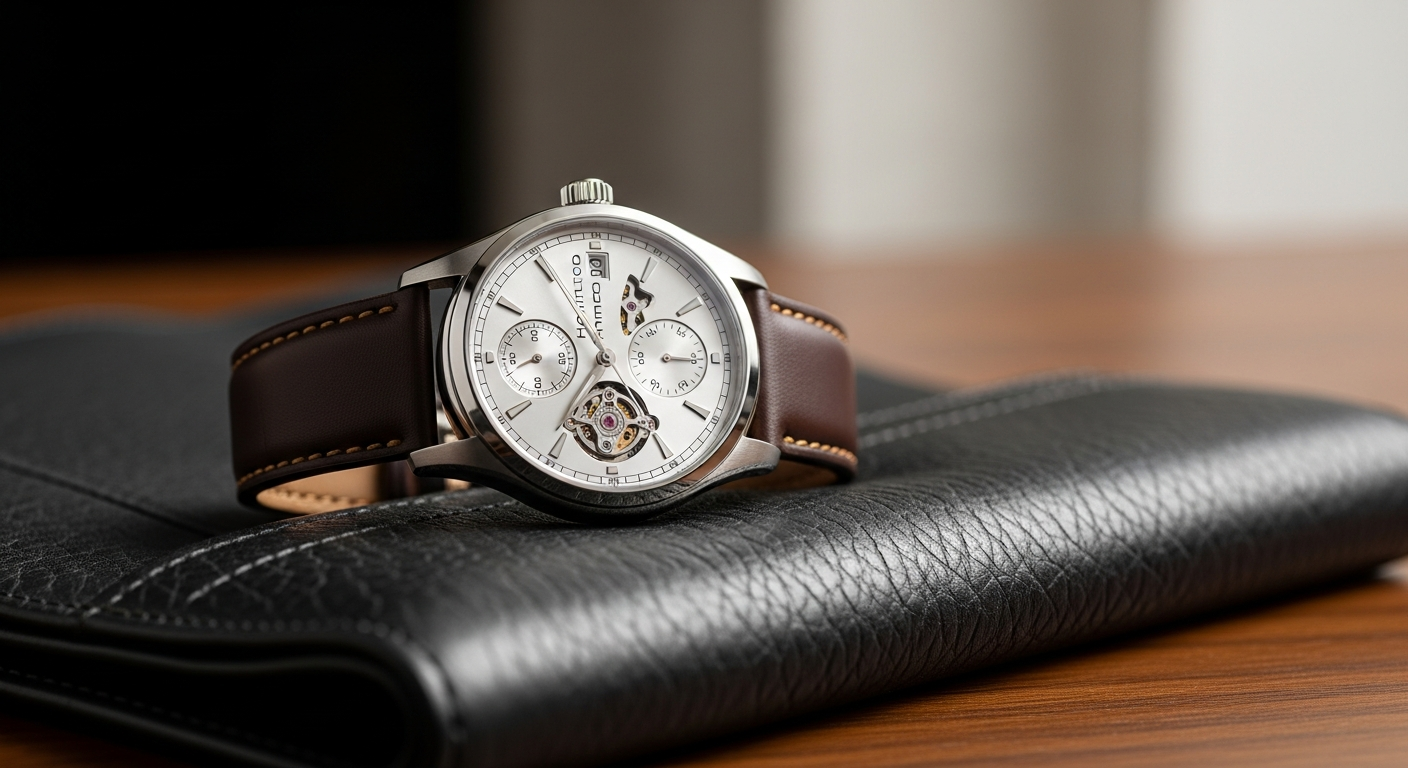
That accessibility is important. Hamilton is not positioned as an untouchable luxury brand, and that might be its greatest strength as a cultural object. The watches are often the “first real mechanical watch” for many people, which is its own kind of narrative. There is a special significance to the first time someone chooses a mechanical watch: it’s the moment they decide to keep time in a way that is, frankly, less convenient. Mechanical watches are tiny machines that require maintenance, that drift a little, that demand a relationship. Choosing one is a declaration that you value craft, continuity, and physicality. Hamilton sits right at the entry to that world, offering designs that feel historically informed and mechanically respectable without demanding the kind of budget that turns a watch into a guilt object.
And because the brand has both American roots and Swiss mechanics, it functions as a bridge. For an American wearer, there’s something satisfying about a heritage that starts in Pennsylvania rather than only in the valleys of Switzerland. For a global wearer, there’s reassurance in modern Swiss production and the ecosystem of movements and service that comes with it. The watch becomes a small cosmopolitan statement: tradition without stuffiness, engineering without coldness, nostalgia without stagnation.
Hamilton’s design language has long traded in archetypes—field, pilot, diver, dress—yet it rarely feels generic. The Khaki line, in its various forms, has become almost synonymous with the modern everyday tool watch: straightforward, readable, and honest. The Ventura, on the other hand, is Hamilton’s reminder that it can be strange and stylish when it wants to be. Introduced in the 1950s with its distinctive asymmetrical case, it carries mid-century futurism like a signature. If the Khaki is a well-worn leather jacket, the Ventura is a piece of modernist architecture you can wear. Different moods, same brand, each with a strong sense of purpose.
That range is part of why Hamilton fits so well in film. Movies need visual shorthand. A field watch tells you a character likes function. A geometric oddity tells you a character likes risk. A clean, simple dial tells you someone is understated. Hamilton has options that can be deployed without the audience needing to consciously notice. And for those who do notice, the watch becomes a little reward, a secret handshake between the film and the viewer.
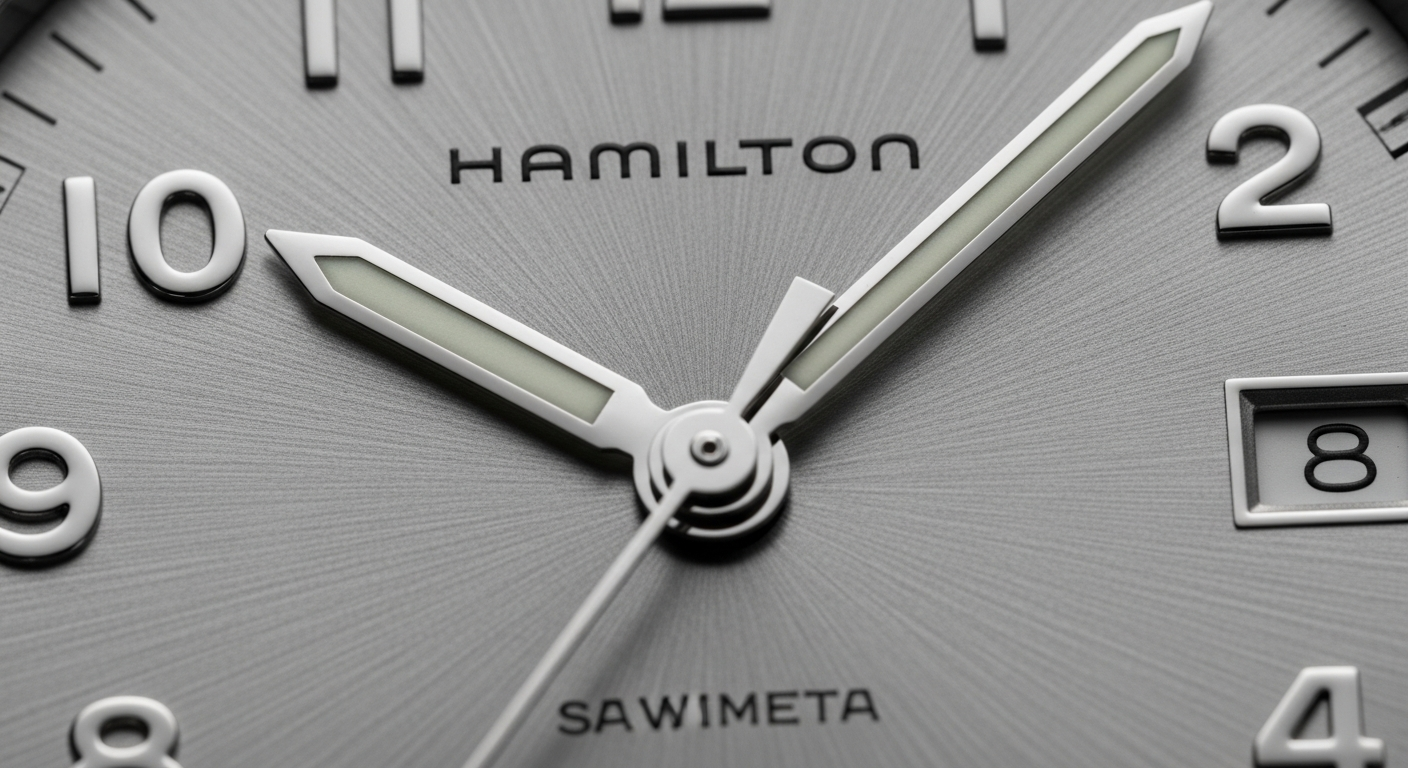
There’s also the matter of scale. In a world where time is displayed everywhere—phones, laptops, dashboards, ovens—the wristwatch has become less necessary and more intentional. That means the watch on a character’s wrist is rarely random. Even in real life, the decision to wear a watch is increasingly about identity. It’s about how you want to feel, what you want to remember, what kinds of rituals you keep. Hamilton understands that psychology. Its watches often feel like they come with a story already attached, even if you’ve never seen the film they appeared in. You put one on and it suggests a certain posture toward the day: alert, capable, slightly romantic about machinery.
The Swiss-American aspect deepens that identity. A purely Swiss brand can sometimes feel like it’s inheriting a narrative of European luxury whether it wants to or not. A purely American brand can sometimes feel trapped between nostalgia and reinvention. Hamilton, sitting between those poles, gets to borrow the best qualities of both and avoid some of the clichés. It can be precise without being precious. It can be historical without being elitist. It can be cinematic without being costume.
And “Hollywood DNA” is not just about cameos; it’s about the brand behaving like cinema in its own evolution. Film is collaborative, industrial, and artistic at once. Watches are the same. There is artistry in the dial design, industrial rigor in the movement, collaboration in the supply chain, and a final performance on the wrist that depends on the wearer. Hamilton occupies a place in watch culture that mirrors a certain kind of filmmaking: accessible but not simplistic, popular but not disposable, rooted in craft even when it participates in mass appeal.
It’s tempting to treat Hamilton’s film appearances as a marketing triumph, and in some sense they are. But the deeper truth is that Hamilton works on camera because it works as an idea. It’s the watch you can believe someone would wear. In cinema, believability is a currency. A single wrong detail can snap the spell. Hamilton tends to strengthen it. The watches look like tools, and tools in a story are never neutral. Tools reveal intention. Tools suggest readiness. A watch, perhaps more than any other accessory, suggests a relationship to time itself—whether you’re someone who respects it, fights it, wastes it, or tries to master it.
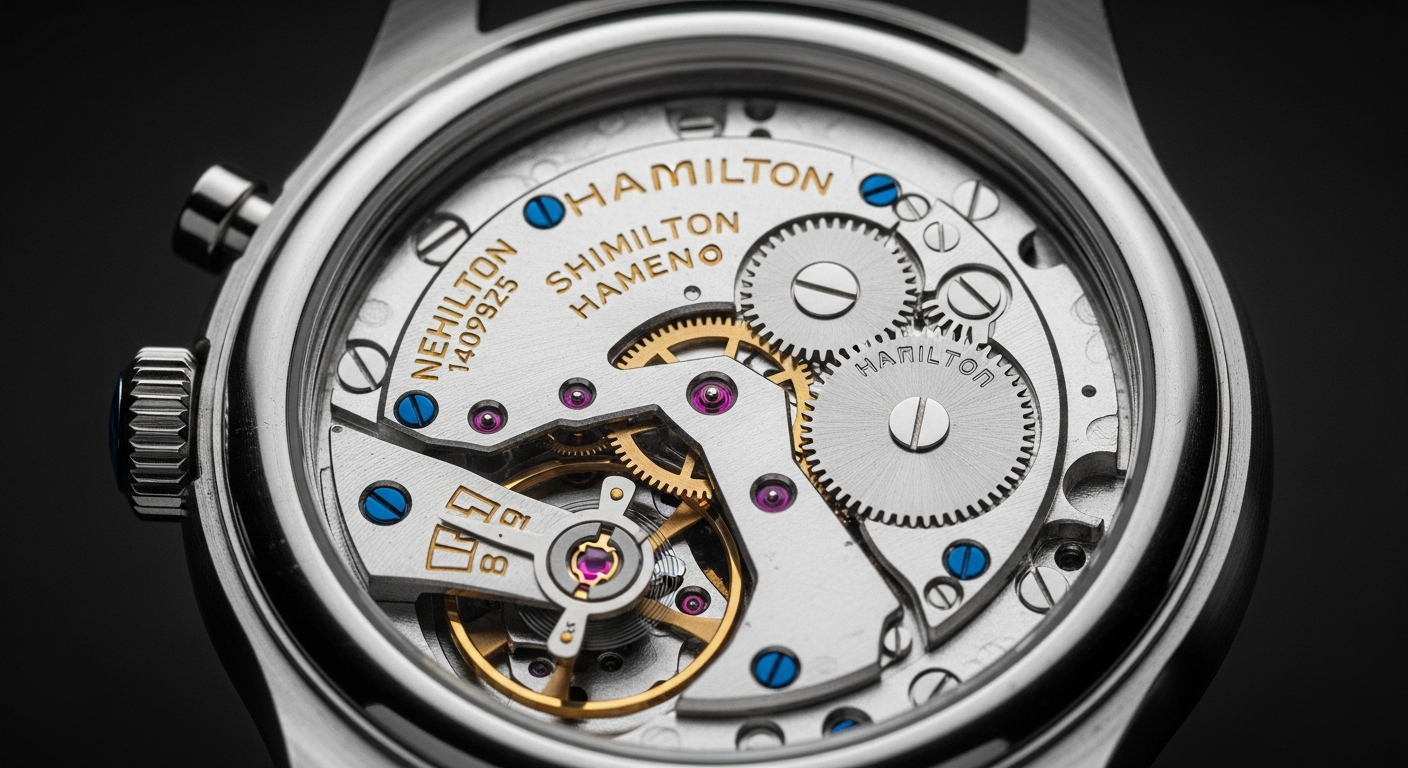
That’s why Hamilton’s story feels so satisfying when told as a kind of American-to-Swiss-to-Hollywood journey. It begins with the railway’s demand for shared precision, moves through the brutal necessities of wartime coordination, survives an industry crisis by relocating its manufacturing heart, and then finds itself embedded in the world’s most influential storytelling machine. Along the way, it becomes a brand that can live comfortably in the space between the practical and the poetic.
The most compelling part is that none of these chapters cancel the others out. The railroad heritage still echoes in the insistence on legibility. The military chapter still shows up in the field watch aesthetic. The Swiss chapter shows in the confidence of modern manufacturing. The Hollywood chapter shows in the way certain models feel infused with narrative. Hamilton isn’t pretending to be something it isn’t; it’s simply accumulated identities the way a good character does, through experience rather than reinvention for its own sake.
So when someone says Hamilton has Hollywood DNA, it’s not only because you’ve seen the name in credits or spotted a familiar case shape in a close-up. It’s because Hamilton watches function like props even in real life. They help you play a role—not a false one, but a chosen one. Wearing a Hamilton can make an ordinary commute feel like a scene with stakes, can make a meeting feel like a mission, can make a quiet evening feel like a moment worth marking. That’s not silliness; that’s the human urge to turn time into meaning.
And maybe that’s the final reason Hamilton endures. In a culture obsessed with speed and novelty, Hamilton offers a measured kind of cool. Not the loud cool of status, but the calm cool of a device that does its job elegantly and carries a story without shouting it. A Hamilton on the wrist is a reminder that time is not only something we consume. It’s something we inhabit. It’s something we share. It’s something we shape into narrative, whether we’re conducting a train, flying a plane, filming a scene, or simply living a day we’d like to remember.
(contains VID1, IMG1 IMG2 IMG3 IMG4)