Glashütte Original: Saxon Craftsmanship Beyond the Spotlight
The train ride into Saxony has a way of dimming the world down to essentials. Cities fall away, the rhythm of stations becomes predictable, and the landscape settles into an older, quieter language of forests and low hills. Somewhere in that calm, you begin to understand why Glashütte Original feels like it does. Not because you’ve arrived at the town yet, not because you’ve seen a watch, but because the pace of the place teaches you what the brand has been saying all along: precision doesn’t have to announce itself. It can simply endure.
There are names in watchmaking that fill a room the moment they’re spoken, names that carry the glamour of sunlit shop windows and celebrity wrists. Glashütte Original has never seemed particularly interested in that kind of presence. It belongs to a different tradition: one that grew in a small German valley where watchmaking was less about social theater and more about a stubborn commitment to making something correctly, even when nobody was looking. Saxon watchmaking, at its best, is not louder than Swiss watchmaking, just differently tuned. The notes are sharper, the architecture more visible, the seriousness worn with an almost provincial pragmatism. In that tuning, Glashütte Original has built its identity.
You feel that identity in the town itself. Glashütte is not a metropolis of horology; it’s a working place. The story began in the nineteenth century when Ferdinand Adolph Lange’s efforts helped convert a struggling mining region into a watchmaking center. That origin matters because it sets the tone. These were not ateliers born to serve courts and salons. They were workshops meant to create livelihoods, and the craftsmanship that emerged was tied to a kind of civic purpose: make precise instruments, train hands to do it, and build a local economy around the discipline. It’s a romantic story, yes, but it’s also stubbornly practical, which is perhaps the most Saxon thing about it.
Glashütte Original, as it exists today, is the inheritor of multiple lines of that local history. The twentieth century did what the twentieth century always does to delicate traditions: it interrupted them. War, borders, nationalization, and ideological reshuffling turned private craft into state enterprise. Then came reunification and another transformation, not merely of ownership but of self-understanding. Glashütte Original emerged with the kind of continuity that isn’t clean, but is real. It does not pretend there were no breaks. Instead, it quietly insists that the skills remained in the valley, the eyes and hands trained to certain tolerances remained in the valley, and the desire to do it properly remained, too.
That’s the first thing often missed when people treat the brand like a “German alternative” to Swiss icons. In Glashütte, the alternative isn’t a marketing pose; it’s a geographic and cultural reality. There is a specific grammar here. The three-quarter plate, for example, is not just a visual signature to be admired through a caseback; it’s a structural philosophy. Covering most of the gear train under a single plate offers stability and makes assembly and servicing feel like a different sort of engineering decision compared to more segmented bridge layouts. It lends the movement an architectural solidity, like a building whose load-bearing elements are cleverly concealed rather than proudly exposed. And yet the movement finishing, when you look closely, is anything but concealed: ribbing across German silver, polished bevels, blued screws, gold chatons in certain references, and that calm, deliberate sense that every surface had a reason to be touched.
There’s a particular pleasure in realizing that Glashütte Original’s romance is not primarily about complication counts or trophy wins, but about the way the watches are made to feel inevitable. Take the Pano line, with its off-center time display and that signature asymmetric balance. On paper, it’s simply a design decision. On the wrist, it’s an expression of the brand’s temperament: slightly unconventional, quietly confident, and more interested in harmony than in symmetry for symmetry’s sake. The PanoMaticLunar, for many enthusiasts, becomes the point of entry into Glashütte Original because it makes this philosophy legible. The moonphase is there, the date is there, the movement is there, but nothing is pleading for attention. The watch reads like an object that already knew what it was supposed to be.
Underneath that ease is an in-house insistence that can sometimes be overlooked in the larger conversation about luxury. Glashütte Original manufactures a substantial portion of its components itself, including hair springs in modern times for some calibers—an undertaking that is rarely trivial and never cheap. It operates in a town where the craft is not outsourced as a matter of convenience, because the ecosystem exists to keep things close. Even the dials, a component many brands quietly source elsewhere, are produced with a level of internal control that feels almost anachronistic. In an era when global supply chains are celebrated for “efficiency,” Glashütte Original’s model reads like a deliberate refusal to detach making from meaning.
If you could stand in the dial manufactory and watch the process unfold, you would see why the word “craftsmanship” becomes inadequate. It’s too blunt a term for something that is part chemistry, part patience, part micro-sculpture. A dial is a face, yes, but it’s also a surface where light is negotiated. The grain of a finish, the depth of a lacquer, the way an applied index throws a shadow at four o’clock, these are tiny decisions that determine whether a watch feels alive after a decade or merely expensive. Glashütte Original dials often have that restrained vitality. They don’t sparkle so much as they glow, and if you’ve ever tilted one under an overcast sky, you know the sensation: not fireworks, but a steady, convincing warmth.
It is tempting to describe Glashütte Original as “under the radar,” but that phrase has become a trope, a shorthand that suggests obscurity as an aesthetic choice. The truth is more complicated. The brand is well known among people who care about watchmaking as watchmaking, but it doesn’t behave like a brand trying to win popularity contests. It doesn’t force you to participate in an identity campaign. Instead, it asks you to participate in attention. This is an important distinction. A Glashütte Original watch is not a billboard for your taste; it is, more often, an invitation to slow down and notice what’s in front of you.
Consider the Senator line, which carries the sobriety of traditional dress watches without feeling like a museum piece. The Senator Excellence models, for instance, are designed around durability and serviceability as much as refinement. There is something almost quietly radical about that in modern luxury, where the seduction is often immediate and the long-term relationship is an afterthought. The Excellence concept brings a longer power reserve, a robust construction, and an emphasis on chronometric stability, but it packages those virtues behind a calm dial and a case profile that doesn’t need to be aggressive to feel contemporary. You can sense a German engineering mentality here, but tempered by an artisan’s eye.
And then there is the SeaQ, part of the Spezialist collection, which might be the most easily “spotlight-friendly” line Glashütte Original makes. It’s a dive watch, after all—a genre that thrives on recognition and instant readability. Yet even here the brand’s temperament comes through. The SeaQ is sturdy, beautifully finished, and historically grounded, but it doesn’t chase the loudest possible silhouette. It’s as if Glashütte Original is saying: yes, we can do sport; no, we do not need to shout about it. Turn the watch over and the difference becomes literal. Where many dive watches hide their movements behind steel casebacks, Glashütte Original is confident enough to offer a sapphire view of a movement that looks more like a dress watch’s engine, finished to a level that suggests the ruggedness is not an excuse to be careless.
That interplay—between the utilitarian and the exquisite—is a recurring theme in Saxon watchmaking. It comes from a history in which watches were instruments before they were ornaments. In Glashütte Original, you see it in the way complications are handled. The signature Panorama Date, for example, is not merely a large date; it’s executed in a way that keeps the numerals centered and clean, using two discs on the same plane to avoid a visible dividing line. It’s a solution that feels characteristically German: solve the problem with engineering elegance, then make the solution beautiful without turning it into a circus act.
Beauty, in this context, isn’t about maximal decoration. Glashütte Original finishing tends to reward the patient viewer rather than the casual one. The bevels are crisp, the striping is even, the polished edges catch light like thin blades. The engraved balance cock, in certain movements, carries a human signature—literally, in the sense that the engraving is done by hand. This is a detail that can sound like marketing until you realize what it means: two watches can share a reference number and still contain a minute difference, a small line of individuality hidden on a component most people will never see. It’s the opposite of mass spectacle. It’s private artistry.
The brand’s relationship to time is similarly private. A Glashütte Original doesn’t generally feel like a “moment” purchase, something acquired in a rush of excitement to mark a promotion. It feels more like something you arrive at after you’ve owned other watches and discovered what you actually value. Perhaps you’ve grown tired of perpetual scarcity games and the awkward pride of being seen with what everyone else wants. Perhaps you’ve realized that the most satisfying watch is the one that continues to interest you when the novelty wears off. Glashütte Original thrives in that stage of collecting, when attention shifts from logos to execution.
And yet it would be unfair to suggest that Glashütte Original is only for the initiated or only for collectors. Part of its appeal is that it can be worn without any need for explanation. In a world where luxury often feels like a test of insider knowledge, there is something liberating about a watch that doesn’t demand recognition. It frees you to wear it for yourself. The pleasure becomes tactile: the way the crown turns, the way the hands glide, the way the case sits, the way the movement looks in evening light. These are small pleasures, but they add up to something lasting.
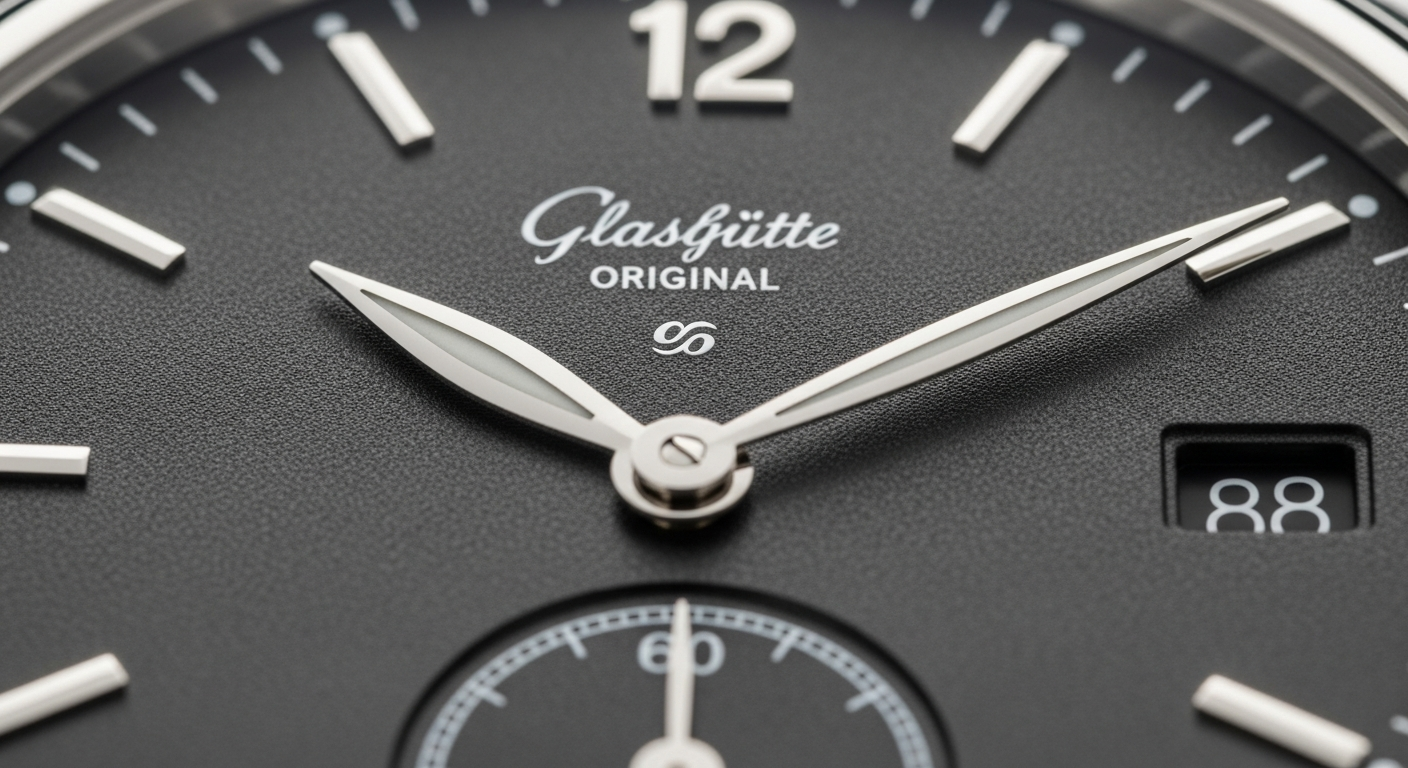
I think of Glashütte Original as a brand that understands the virtue of the second glance. Many watches try to win you in the first second. They rely on bold shapes, aggressive colors, attention-grabbing materials. Glashütte Original can do color and presence when it wants to, but its native language is subtler. It’s the watch you notice after a conversation has already started, the watch that makes you pause mid-sentence because you’ve caught an unexpected detail: the concavity of the subdial, the gentleness of a chamfer, the way a date window is framed so it reads like part of the dial’s architecture rather than a cut-out. That second-glance quality is not an accident. It is the visible face of invisible discipline.
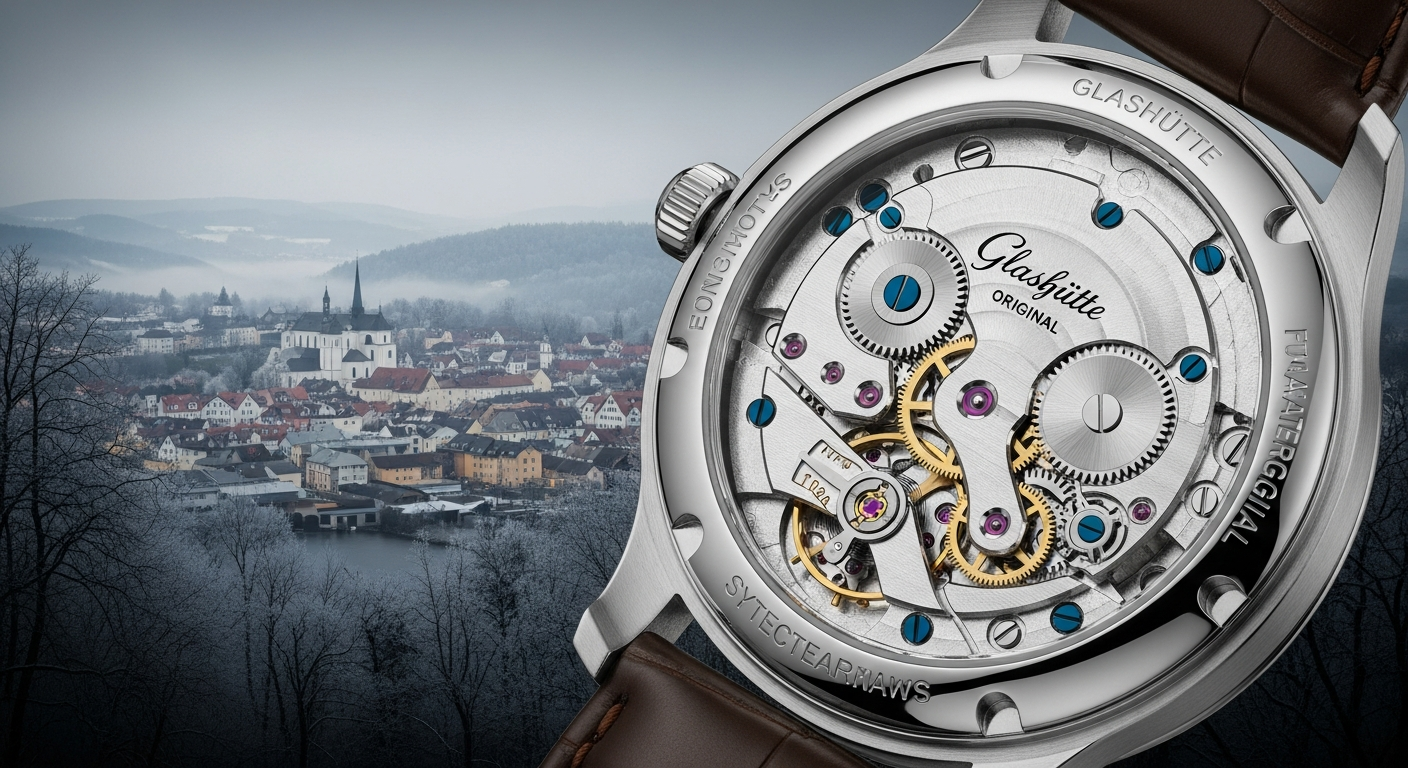
There is also, in Glashütte Original, a sense of responsibility to place. This is a brand whose name carries its town, and that naming is not cosmetic. It implies accountability. If you put the town on the dial, you are tethering yourself to a standard and a heritage that lives outside your marketing department. It means that the watch is, in a way, a small ambassador of a region’s competence. That tether can be limiting, but it can also be clarifying. It keeps the brand from drifting into whatever is trendy this year. It keeps it honest.
Honesty in watchmaking is not a simple virtue. Luxury is inherently theatrical, and every brand—no matter how sincere—participates in storytelling. But there are degrees of theater. Glashütte Original’s theater, if we can call it that, is the theater of the workshop: the sound of machines, the smell of oil, the silence of concentration, the slow satisfaction of a part fitting as it should. It is less about “lifestyle” and more about labor made visible. When you look at a Glashütte Original movement, you are, in a sense, looking at time turned into architecture, and architecture turned into a kind of moral statement: this is how carefully we chose to do it.
What does it mean, then, to be “beyond the spotlight”? It doesn’t mean obscure. It means unbothered. It means a brand can continue to pursue a specific kind of excellence without constantly translating itself into headlines. It means the watches can be designed to age rather than to trend. It means that a collector can wear one for ten years and still find a corner of it that feels freshly understood. It means that, in a category where so much energy goes into being seen, Glashütte Original invests its energy in being solid.
If you ever find yourself in Glashütte, you might notice how quickly the romance becomes normal. There is no grand boulevard of glittering boutiques, no need for mythology to hang in the air. There is a town where people go to work, where skills are passed along, where precision is not a brand attribute but a daily requirement. And when you leave, the memory that lingers is not of spectacle, but of steadiness.
In the end, that steadiness is what makes Glashütte Original compelling. It is not trying to be the watch you buy to impress someone across a table. It is trying to be the watch you buy to meet your own standard, the one you wear when you want to feel grounded, the one that reminds you that the best kind of luxury is not always the loudest. Saxon craftsmanship, when it is true, doesn’t chase the spotlight. It keeps working until the work itself becomes impossible to ignore.