F.P. Journe and the Ethics of Precision
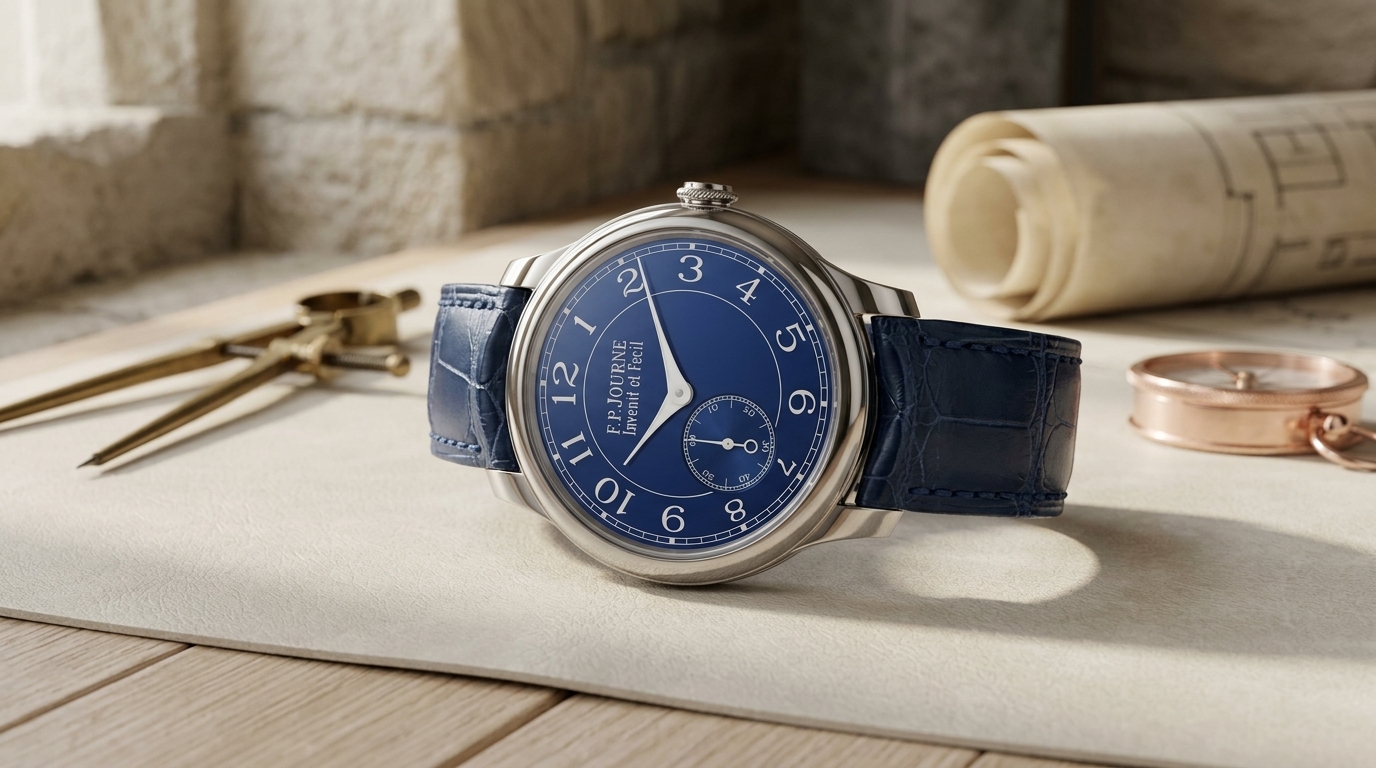
At six o’clock, the small seconds hand advances with a severity that can feel almost verbal: one measured step, then another, each pause a silence held under tension. On the dial of an F.P. Journe Tourbillon Souverain, that seconde morte is not theatre in the usual sense. It does not sweep to flatter the eye. It ticks because a remontoir d’égalité has intervened between the mainspring and the escapement, gathering force, releasing it, and making visible the old anxiety of watchmaking: that energy is never innocent once it begins travelling through wheels.
Precision, in this world, is rarely a simple matter of accuracy. A quartz movement can be accurate with little visible effort, and a radio-controlled clock can submit itself to an authority beyond the room. Mechanical precision is different. It is an argument conducted inside a closed case, under changing temperature, position, lubricant, amplitude, shock, age. It is a pact made with instability. F.P. Journe’s best watches have always seemed preoccupied not merely with showing the time, but with showing the terms under which time is being kept. That is where their ethic begins.
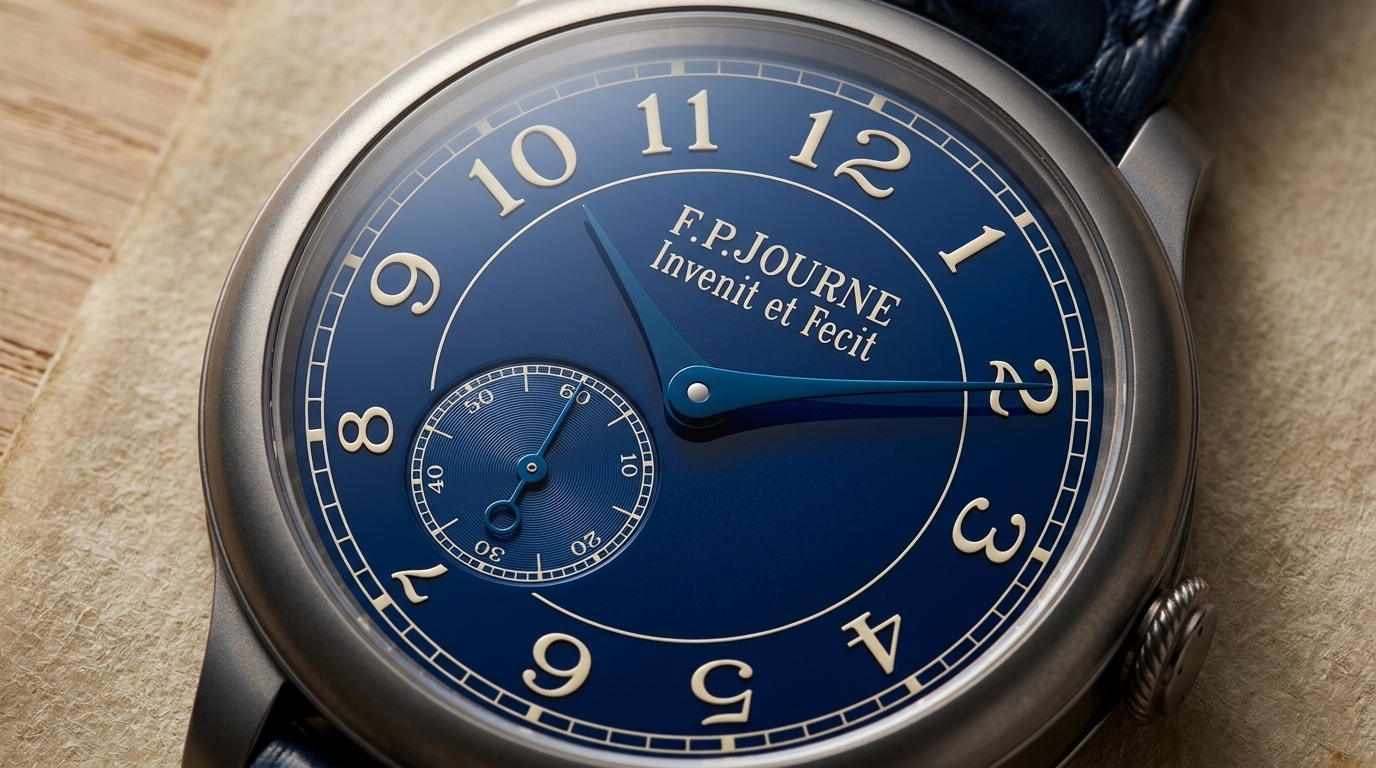
The name on the dial, “Invenit et Fecit,” is easily mistaken for a flourish. It is not modest, nor is it meant to be. “Invented and made” belongs to an older horological vocabulary, closer to the signatures of makers who understood authorship as responsibility rather than branding. In Journe’s case, the phrase carries weight because the watches so often behave like propositions. The dial may be quiet, the case no larger than necessary, the typography almost severe, yet behind the hands there is usually a question being asked with mechanical stubbornness. How steadily can force be delivered? Can two oscillators influence one another inside a wristwatch? Can autonomy be extended without making the movement lazy? Can complexity be made legible without becoming decorative noise?
François-Paul Journe’s route to this language did not begin with the rituals of luxury retail. It began in restoration, with old mechanisms already darkened by time, and with the long shadow of the eighteenth and nineteenth centuries. Abraham-Louis Breguet, Antide Janvier, marine chronometers, resonance clocks, tourbillons built for pocket watches rather than windows in a dial: these were not historical references in the superficial sense. They were problems left behind by men who had worked before synthetic oils, CNC machines, computer modelling, and climate-controlled boutiques. To restore such objects is to learn that beauty in watchmaking often appears after necessity has done its work.
That is why the early Journe watches retain a peculiar moral charge. They do not hide their debts to history, but neither do they behave like reproductions. The first wristwatch tourbillon with a remontoir d’égalité, conceived before the manufacture became the modern entity known to collectors, was not simply a tourbillon because tourbillons were prestigious. In a pocket watch, the tourbillon had been a response to positional error in the vertical pocket. In a wristwatch, constantly moving, its justification becomes more complicated. Journe’s answer was to bind it to constant force. The rotating carriage remained, but the remontoir gave the watch its ethical centre: not just complication as display, but complication as correction.
A remontoir d’égalité is a small act of discipline. The mainspring, fully wound, pushes with confidence; near exhaustion, it weakens. A conventional gear train transmits this gradual decline toward the escapement, which then receives different impulses as the hours pass. The remontoir interrupts that decline by storing a small, discrete amount of energy and feeding the escapement more consistently. In the Tourbillon Souverain, the visible deadbeat seconds are tied to this regulating device, so the dial makes no apology for the mechanism’s intervention. The watch seems to say that timekeeping is not continuous grace, but repeated correction.
This matters because precision has an ethical dimension when it refuses concealment. Many watches promise accuracy while asking the owner not to think about the compromises involved. Journe’s watches often point toward the compromise itself. The offset dials, exposed screws, eccentric displays, and open tourbillon apertures are not always conventionally harmonious, yet they create a map of intention. A Chronomètre à Résonance, with its twin displays and twin oscillators, does not look symmetrical in the polite sense. It looks negotiated. Two balances occupy the same field of force, each alive to the other. The visual tension is part of the truth.
Resonance is one of the most poetic words in horology, and also one of the easiest to abuse. In physics, it is not romance; it is relationship. Two oscillating bodies, when close enough and sufficiently tuned, can influence each other’s rate. The old makers explored it in clocks and precision regulators. Journe brought the idea into the wristwatch with unusual audacity, first commercially at the turn of the millennium, when the independent watchmaking landscape was much smaller and less protected by today’s collector culture. The Chronomètre à Résonance used two independent trains and two escapements placed in proximity, requiring careful regulation if the promised interaction was to occur.
There is something almost severe about the concept. A resonance watch cannot rely only on one good oscillator. It must ask two to behave, and then to behave in relation. The dials often show separate hours and minutes, each with its own small seconds, so that the wearer sees both agreement and the possibility of divergence. Unlike a conventional dual-time watch, the drama is not simply practical. It is philosophical. The watch admits that precision may not be solitude. It may be a condition produced between systems, a discipline of proximity. That is a rarer thought than most complications are allowed to carry.
The proportions reinforce this seriousness. Early F.P. Journe cases, frequently around 38mm, have acquired a particular aura not because they are small by current fashion, but because they leave little room for error. A thin bezel, a flat-ish caseband, a crown with a rope-like grip, lugs drawn with restraint: nothing there can overwhelm the dial into obedience. Later 40mm cases offer a little more air, but the essential architecture remains compact. Journe’s watches do not usually depend on mass. They depend on the pressure created when a complicated idea is confined to a disciplined diameter.
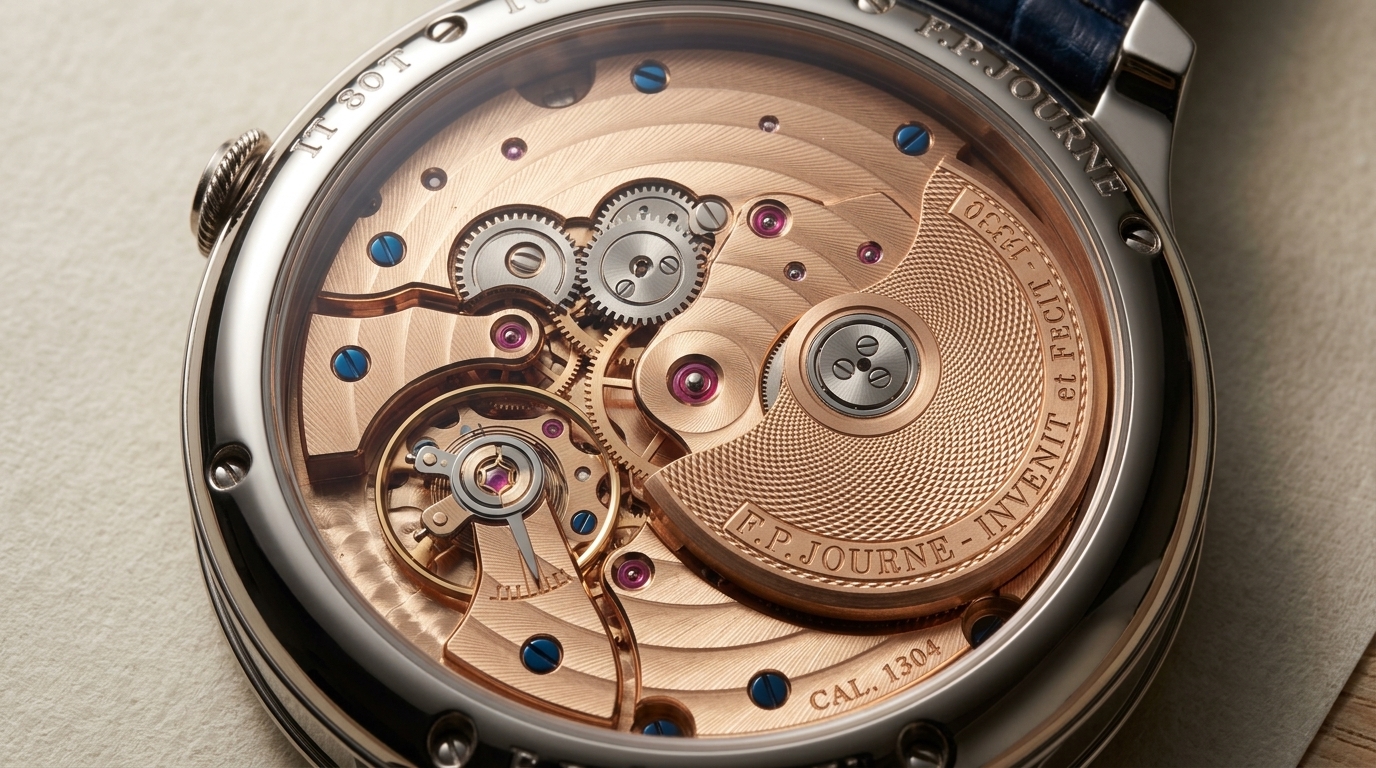
Inside, the change from brass movements to 18k rose gold movements in the early 2000s added another layer to the story. Gold is a strange material for a movement plate and bridges. It is not chosen because it is the easiest answer. It is dense, warm in colour, soft enough to demand care, and visually unforgiving in a different way from rhodium-plated brass or German silver. Through the caseback of a Chronomètre Souverain or Chronomètre Bleu, the rose-gold calibre does not glitter indiscriminately. Its bridges are broad, its stripes clean, its jewels set within a layout that privileges clarity. The finishing is not baroque. It is controlled.
This restraint is frequently misunderstood. In some corners of contemporary collecting, hand-finishing has become a spectacle of magnification, a theatre of black polish, inward angles, and chamfers described until the watch itself disappears beneath the vocabulary. Journe’s finishing can be very fine, but it rarely pleads for inspection. The surfaces serve the architecture. Screws sit where screws must sit. Bridges hold shapes that read as structural rather than ornamental. The eye discovers care, but not a craftsman begging for applause. In that sense, the finishing participates in the same ethic as the regulating organs: the work is visible, but not vain.
The Chronomètre Souverain expresses this with particular economy. Two large subdials, power reserve, small seconds, a manually wound calibre descended from a movement architecture shared with the Chronomètre Bleu: the watch is almost a study in what can be removed without diminishing seriousness. Its movement, calibre 1304, is thin, rose-gold, and traditionally arranged enough to be intelligible. The power reserve indication is not decorative; it reminds the owner that rate depends on energy, that winding is not a romantic gesture but an operational fact. The watch does not pretend that a mainspring is a mythic source. It is a spring, and it weakens.
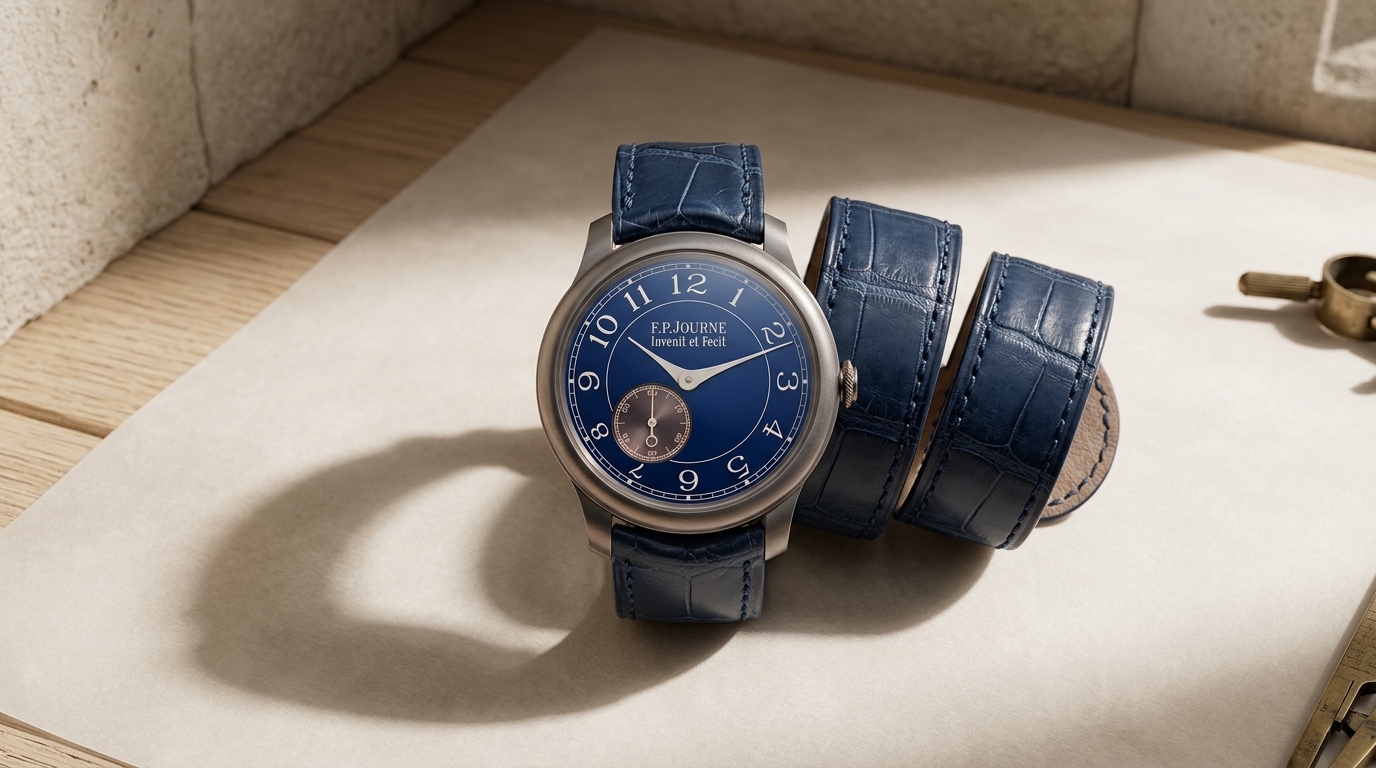
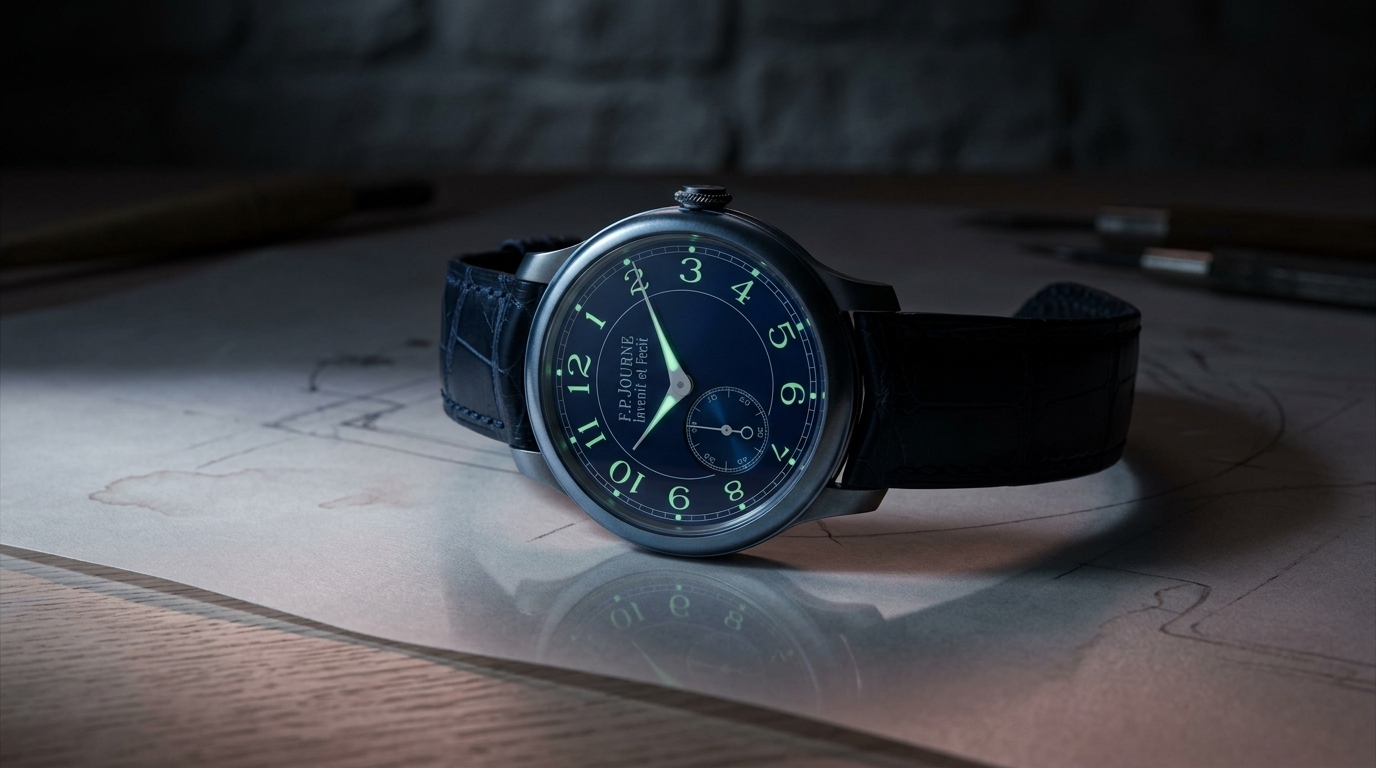
The Chronomètre Bleu complicates the matter by being beautiful in a more immediate way. Its tantalum case gives off a grey-blue density unlike steel, platinum, or white gold. Tantalum is difficult to machine and resistant to easy polish; it wears its industrial stubbornness openly. The blue dial, often discussed for its shifting surface, can draw attention away from the watch’s quieter achievement: a serious manually wound chronometer movement housed in a case that resists the familiar hierarchy of precious metals. Here again, the ethical question is not whether beauty is permitted. It is whether beauty has been allowed to obscure the reason the watch exists.
In the Octa line, Journe approached precision from the opposite direction: not the ritual of daily winding, but the challenge of useful autonomy. The automatic calibre 1300 was conceived with a long power reserve, roughly five days, without allowing the movement to become an inert storage device. An automatic watch with extended reserve risks encouraging indifference; it may keep running while attention wanders. Journe’s Octa movements make that reserve part of the architecture rather than an afterthought. The large mainspring barrel, the efficient winding system, the stable base calibre adapted for complications such as the Octa Réserve de Marche, Octa Calendrier, and Octa Lune: these watches suggest that convenience, too, must be engineered with conscience.
That word, conscience, may seem too heavy for objects made of gold, steel, rubies, and sapphire. Yet mechanical watchmaking has always carried a moral vocabulary. A watch can be honest or false in the way it displays effort. It can inflate difficulty, disguise industrial shortcuts, or dress ordinary engineering in inherited costume. It can also reveal enough of its logic to let judgment occur. Journe’s strongest work tends toward the latter condition. It does not always flatter. Some dials are divisive. Some arrangements feel abrupt until their logic becomes apparent. The watches ask for attention before admiration.
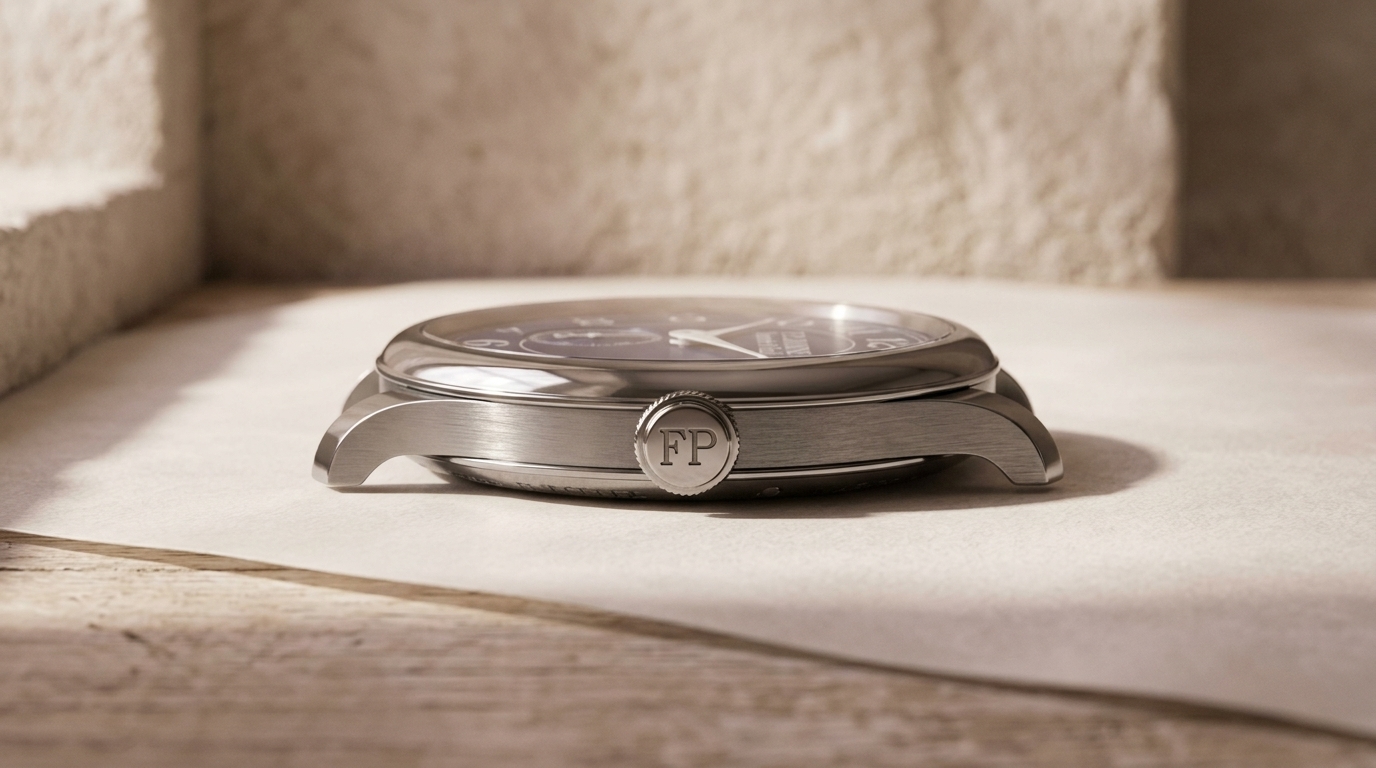
This is partly because Journe’s design language is not the soft language of consensus. The numerals, especially the distinctive printed Arabic forms used across many models, have a dry, almost instrument-like character. The hands are slim and purposeful. Subdials overlap or sit off-centre with an assurance that can feel nearly architectural. On certain brass-movement Résonance examples, the asymmetry is even sharper, the watch seemingly assembled around the requirements of its twin escapements rather than around a desire to soothe the eye. It is not ugliness, nor eccentricity for its own sake. It is the imprint of hierarchy: mechanism first, composition second, decoration last.
The market has sometimes made this difficult to see. Independent watchmaking, once sustained by small circles of patrons and enthusiasts, has become a theatre of scarcity, auction records, allocation rituals, and language polished smooth by repetition. F.P. Journe has not been immune to that transformation. Early brass-movement pieces, once simply the first chapter of a maker’s work, have become talismanic. Limited series are parsed, dial variants ranked, case metals weighed against mythology. Such attention can preserve knowledge, but it can also distort it. When prices become too loud, the watch becomes harder to hear.
The ethics of precision therefore requires a kind of resistance from the observer as well as from the maker. To look at a Journe properly is to look past the fever around it and return to the slower questions. What problem is being addressed? Is the solution mechanically coherent? Does the dial confess the movement’s priorities? Does the finishing preserve or interrupt the architecture? Does the watch respect the old pursuit of chronometry without pretending to be a laboratory instrument? These questions are not sentimental. They are the means by which a mechanical object is rescued from mere desirability.
Journe’s relationship with history is central here. The tourbillon, the remontoir, resonance, the dead seconds, the chronometer standard: none of these belongs to him alone. His originality lies in the pressure he applies to inherited ideas, forcing them into wristwatch proportions and contemporary manufacture without sanding away their difficulty. This is why the watches can feel austere even when made of precious metal. They carry memory, but not nostalgia. They do not invite one to imagine a vanished age of waistcoats and observatories. Instead, they suggest that old problems remain alive so long as someone is willing to restate them with sufficient exactness.
There is also the question of independence. In modern horology, independence is often treated as an aesthetic category, as if a watch becomes independent by looking unusual. For Journe, independence has been more technical than cosmetic. The manufacture in Geneva, the development of proprietary calibres, the insistence on a recognizable movement language, the vertical seriousness behind small production: these elements matter because they make authorship testable. If “Invenit et Fecit” is printed on the dial, then invention and making must be more than romance. They must be traceable through bridges, trains, escapements, cases, supply, adjustment, repair.
And adjustment may be the most revealing word of all. A mechanical watch is never finished in the abstract. After design, machining, decoration, assembly, oiling, and casing comes regulation: the quiet labour of persuading the oscillator to behave in positions and over time. This work is not easily photographed. It does not produce the drama of a tourbillon cage or the colour of a dial. Yet it is where precision becomes ethical rather than symbolic. The rate of a watch is the place where claims either survive contact with reality or dissolve into ornament.
The finest F.P. Journe watches seem aware of this vulnerability. They do not present precision as domination over time, because no mechanical watch dominates time. They present it as conduct under constraint. A balance breathes; a spring relaxes; oil migrates by degrees; metal expands and contracts; the wrist shocks and warms and abandons the watch on a table overnight. Against all this, the maker arranges levers, wheels, jewels, springs, screws, and surfaces. The result is not perfection. It is a disciplined imperfection, measured, corrected, and made durable enough to be lived with.
At the edge of the dial, the minute track continues its small work. A hand approaches a marker, crosses it, leaves it behind. Beneath, unseen except through sapphire, the movement spends its stored force according to laws older than the signature on the dial. The watch does not make time more precious by saying so. It makes its case through behaviour: through the steadiness of an impulse, the conversation of balances, the refusal to separate beauty from responsibility. In F.P. Journe’s work, precision is not a number printed on a certificate. It is a habit of mind made mechanical, and made answerable with every tick.