Cartier’s Secret: A Watch That Refuses to Be a Watch

The first thing I remember is not the diamonds, though there were enough of them to throw a small weather system across the table. It was the hinge. A thumbnail-width seam in yellow gold, almost impolite in its precision, caught my fingernail as the Cartier archivist turned the bracelet toward me. The object lay on a pad of grey suede, heavy in that particular way jewellery can be heavy, dense rather than large. From above it was a panther’s head, onyx nose polished to a wet point, emerald eyes set low and suspicious. Then the head lifted, not dramatically, not like a reveal in a shop window, but with the quiet resistance of well-made metal. Under it was a dial scarcely bigger than a shirt button.
I have handled watches that announce themselves from across a room: split-seconds chronographs bristling with pushers, dive watches built like portholes, perpetual calendars that turn their complications into public declarations of intelligence. This Cartier did the reverse. It had spent all its energy avoiding the category to which it technically belonged. The dial was signed, the hands were blued, the minute track was there, obedient and legible if you leaned close. Yet the watch itself seemed almost embarrassed by this concession. It wanted to be a bracelet first, an animal second, a private mechanism only as a last resort.
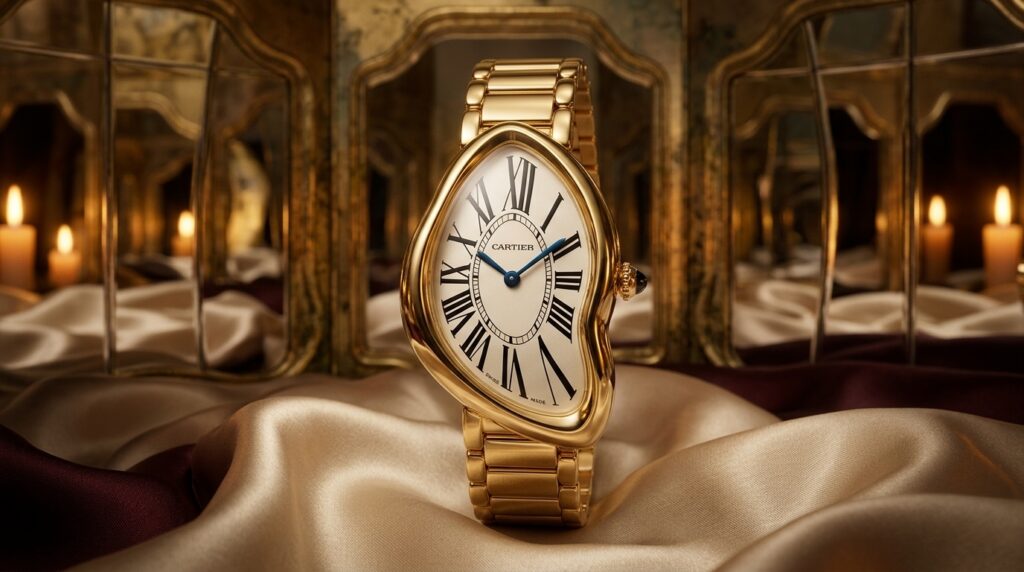
Cartier has always understood that a watch is never only an instrument. That may sound obvious now, after a century of wristwatch culture has taught us to read shape, thickness, metal and patina as forms of autobiography. But at Cartier the thought arrived early. The Santos of 1904 was not merely a practical solution for Alberto Santos-Dumont, who wanted to read the time without letting go of an aircraft control. It was also a square of modernity strapped to the wrist at a moment when most men still carried time in a waistcoat pocket. The Tank, drawn after the geometry of Renault tanks seen from above, made a case out of architecture rather than ornament. The Crash, whether born from accident, memory or the slow melting of Swinging London, turned distortion into a legitimate case shape. Cartier’s secret watches belong to that same family of refusals. They refuse the round case, the exposed dial, the straightforward contract between watch and wearer.
The secret watch is an old idea, older than the wristwatch’s dominance. In the first decades of the twentieth century, Cartier made brooches, pendants, sautoirs and bracelets whose timekeeping was concealed beneath enamel, carved hardstone, gem-set covers or articulated animal forms. They were not novelties in the cheap sense. They were part of a world in which a woman might require the time but not wish to consult it publicly, and in which jewellery could carry information without surrendering its mystery. A dial could be hidden beneath a carved jade plaque or tucked into a vanity case. A watch could be worn as a pendant and revealed only when the owner chose to bring it forward. Time was present, but socially veiled.
One of the archive pieces I was shown, from the late 1920s, had the stern composition of Art Deco reduced to something almost devotional. Black onyx, platinum, old-cut diamonds, a small rectangular dial with Roman numerals compressed into a space most brands today would use for a date window. The movement inside was a hand-wound calibre, narrow and obedient, from the era when Cartier relied on the European Watch & Clock Company, its joint concern with Edmond Jaeger, to translate Parisian forms into workable mechanics. The crown was not where the eye expected it. It had been recessed, diminished, made to serve the design rather than dominate it. That is one of the pleasures of early Cartier watchmaking: the watchmaker is always present, but rarely allowed to shout.
There is a modern habit of dividing watches into the serious and the decorative, as though jewels corrupt timekeeping and mechanics purify it. This is convenient and mostly false. A minute repeater can be vulgar. A diamond bracelet can be exacting. On a secret watch the technical problem is not always the complexity of the movement, though miniature calibres present their own cruelties. The harder task is choreography. How does a cover open without feeling loose? How does a dial remain readable after the jeweller has had his say? How does the crown avoid snagging silk? How does the caseback disappear against the wrist while still allowing access for service? The answers are not theoretical when the object is in your hand. You feel them in the click of a clasp, in the way a cover stays shut, in the fine scrape of metal interfaces that have been finished well enough to move but not so freely that they become careless.

The panther, of course, is never far away. Cartier’s association with the animal owes much to Jeanne Toussaint, who joined the house before the First World War and later became its creative director for jewellery. “La Panthère” was not a mascot pasted onto products but a temperament: feline, difficult, controlled. The famous 1948 brooch for the Duchess of Windsor, a gold panther crouched upon a cabochon emerald, is often treated as the origin point of the fully sculptural Cartier cat. But the animal had been stalking Cartier’s surfaces earlier, first in abstract spots of onyx and diamond, then in more literal forms. In a secret watch, the panther becomes doubly useful. It can guard the dial. It can also make the act of reading time feel like trespass.
I once opened a contemporary Panthère de Cartier secret watch under the flat white light of a Geneva appointment room, the kind of room in which everything is too clean for romance and yet romance persists because the objects insist on it. The bracelet was supple, not soft, each link carrying stones set with the kind of regularity that makes you forget a human hand has been there until you catch the slight life in the pavé. The panther’s head formed the cover. Press and lift, and a small quartz dial appeared beneath. There it was, the fact that will disappoint certain collectors: quartz. No bevelled bridge, no inward angle, no swan-neck regulator waiting under a loupe. But disappointment, in this case, says more about the collector than the watch. In a jewel that must be thin, stable, rarely disturbed and shaped around an animal’s skull, quartz is not an abdication. It is a decision. It allows the secret to remain secret.
This is where Cartier unsettles the mechanical fundamentalist in me. I care about movements. I care about the black polish on a steel cap, about anglage that catches light as a line rather than a blur, about lever geometry, tooth profiles, the absurd amount of thought contained in a well-made click spring. I have turned over a Cartier Privé piece and taken genuine pleasure in seeing a shaped mechanical calibre respect the case around it. The Tank Cintrée is not convincing only because it is long and curved; it convinces because the movement has been made to inhabit that curve without making the watch feel like sculpture pretending to function. The 1917 Tank was a drawing, yes, but the later watches lived or died by proportion: brancards clean enough to hold the dial, lugs integrated enough to make straps seem inevitable, cases thin enough not to break the line of the wrist.

And yet the secret watch asks for another kind of seriousness. It asks whether timekeeping must be visually available at all times to be legitimate. Most watch culture says yes. We photograph dials. We discuss symmetry. We complain when a date aperture interrupts a numeral, when the seconds hand is too short, when a logo sits a fraction too low. The dial has become the public square. Cartier’s secret watch closes the square and hands you a key.
There is intimacy in that gesture, but not sentimentality. Opening a secret watch is faintly awkward, especially the first time. You do not simply glance; you operate. The wrist must tilt. A finger finds the catch. The cover opens. For a second, the wearer’s attention narrows to a private aperture. The time appears as if retrieved from a drawer. Then it is gone again. I find this more faithful to lived time than many watches that advertise the hour with military clarity. Most of our days are not spent in continuous awareness of minutes. Time enters suddenly: before a train, after a conversation has gone too long, in the pause before leaving a room. A secret watch reproduces that interruption.
The best Cartier designs have always depended on proportion rather than scale. The company can make large objects, certainly, but its grammar was formed in millimetres. A Tank Louis Cartier that is two millimetres too broad loses the tension between case and strap. A Baignoire that stretches too far becomes costume. A Tortue must have enough curve in its flanks to avoid looking like a rectangle that has lost its nerve. Secret watches intensify this discipline because the watch is often only one chamber inside a larger object. On the archive bracelet, the hidden dial had to be small enough to preserve the panther’s form but large enough to be read without humiliation. The hands, scarcely more than threads, still needed contrast. The crystal could not sit proud. The surrounding gold had to frame the dial without making it look like an afterthought. It is easy to hide a watch badly. Cartier’s trick is to make concealment look inevitable.

There is also the matter of finishing, less discussed because these objects live partly in the jewellery department and partly in the watch department, and therefore fall between the vocabularies of both. A watch critic may praise Geneva stripes and ignore the setting. A jewellery writer may admire the stones and pass over the hinge. But on a good secret watch the two crafts meet at the points where failure would be most visible. The underside of a cover must be clean because it is seen only by the owner, and owner-only surfaces reveal a house’s conscience. The edges around a dial opening must be polished without rounding away the geometry. Gem setting must survive motion. A concealed watch is handled more intimately than a normal one; fingers press where eyes later go. Any roughness becomes knowledge.
Cartier’s mystery clocks offer a useful parallel. When Maurice Coüet began making them for Cartier in the early 1910s, adapting principles associated with the stage magician Jean-Eugène Robert-Houdin, the effect was simple and devastating: hands appeared to float in rock crystal, unattached to any visible mechanism. The first Model A mystery clock of 1912 did not merely hide its train; it turned absence into theatre. In later versions, with temple forms and carved hardstone bases, the mechanism was buried in architecture while transparent discs carried the hands. The owner knew there must be gearing somewhere. The pleasure came from not seeing it. Cartier’s secret watches perform a related act at wrist scale. They do not deny function; they postpone it.
This postponement is unfashionable in an age of constant display. Mechanical watches today often survive by making their mechanics visible: openworked dials, sapphire backs, tourbillons rotating like captive arguments. I understand the impulse. A fine movement concealed behind a solid back can feel like a letter never opened. But there are other pleasures. The Masse Mystérieuse, introduced by Cartier in 2022, is a rare modern example of the house thinking mechanically about concealment in a way that feels native rather than nostalgic. Its calibre 9801 MC places the entire movement in the oscillating mass, turning the mechanism itself into a rotor that circles the dial while the hands appear isolated at the centre. It is not a secret watch in the jewellery sense, but it belongs to the same philosophical family. It asks the eye to doubt what it knows.

Still, the secret watch that remains with me is not the complicated one. It is the small one beneath the panther’s head, almost absurd in its modesty once revealed. I liked the contrast between external confidence and internal restraint. Outside: teeth, stones, gold, an animal made of appetite and control. Inside: two hands, a Cartier signature, a dial asking for nothing except a moment. The watch did not try to compensate for its hiddenness by becoming ornate. It understood that once the cover opened, the drama had already occurred.
There is a moral risk in writing about such objects. They are expensive beyond reason. Many are unique or nearly so, made for clients whose lives do not resemble the lives of most people likely to read about watches during a lunch break. To pretend otherwise would be vulgar. But rarity does not make an object meaningless. Sometimes the most extravagant watch can clarify a question that ordinary watches obscure. What do we require from a watch beyond the hour? Visibility? Accuracy? Craft? Companionship? Permission to look at our own wrist and feel that the day has acquired a shape? Cartier’s secret watches answer with a kind of sidelong intelligence. They say that a watch may serve time better by refusing to be available to everyone at once.
I think of the women who first wore these objects, though one must be careful not to turn them into silhouettes. A pendant watch drawn from a bodice at dinner. A bracelet opened in a car. A dial hidden under jade, enamel, onyx, diamond. These were not merely ornaments for a passive wrist. They were instruments of control in rooms where control was often negotiated through manners. To know the hour without publicly consulting it is a small power. To conceal a watch inside jewellery is to decide who is allowed to see function. The secret was not only mechanical. It was social.

The modern wristwatch, especially in its masculine collector form, is often obsessed with legibility as virtue. Large numerals, luminous plots, hacking seconds, depth ratings printed with unnecessary pride. These have their place. A pilot’s watch should not require interpretation. A diver’s watch should not flirt with ambiguity underwater. But Cartier emerged from another set of needs, and its best work retains the memory of rooms rather than cockpits. The light is lower. The distances are shorter. The object is not shouted across a deck; it is lifted from a wrist, opened, read, closed.
When I handed the panther back, the archivist closed the cover with a sound so small it was almost not a sound at all. The dial vanished. What remained was a bracelet again, though that is not quite right. Once you know where the watch is hidden, the entire object changes. The panther’s head becomes a door. The seam becomes a sentence. The weight on the wrist becomes not decoration but withheld information. I have felt this with certain vintage Tanks too, the way a simple case can contain more tension than a complicated dial, but the secret watch literalises the feeling. It makes reticence mechanical.
That may be Cartier’s real secret: not that it hides watches inside jewellery, but that it understands how much power there is in refusal. Refusal to accept that a case must be round. Refusal to separate watchmaking from jewellery as if the wrist can be divided into professions. Refusal to make function visible just because function exists. The secret watch keeps time, but it does not submit to being only a watch. It waits under enamel, under gold, under the hinged head of an animal that seems to know something you do not. And when it opens, the hour is not announced. It is entrusted.