Cartier’s Other Kind of Tool Watch: Elegance Under Pressure
The screws catch first: eight small interruptions in the polished square, each turned into the bezel as if the watch were fastened shut against the air itself. Around them the steel holds a harder light. The dial is white, or close to white, with black Roman numerals bent by Cartier’s familiar discipline into a grid that is softer than geometry and stricter than ornament. At three o’clock a blue cabochon rises from the crown, not large, not shy, a trace of Parisian colour set against the metalwork. The bracelet flows directly from the case, its links brushing from satin to polish in narrow planes. Nothing here appears accidental, yet the watch refuses to look engineered in the severe manner of instruments. It looks designed, which is another kind of engineering.
Cartier’s Santos has always lived in that narrow strip between utility and poise. It is not the sort of tool watch that arrives wearing a black bezel, luminous plots, and a story of depth ratings. It does not ask to be imagined beside a decompression table or clipped over a wetsuit. Its pressure came from elsewhere: from early flight, from public modernity, from the exposed wrist of a man seated in a fragile machine over Paris at a time when aviation still looked like a wager against common sense. Before the Santos became a bracelet watch seen under shirt cuffs and in auction catalogues, it was an answer to a practical irritation. Alberto Santos-Dumont, aviator, boulevard figure, and restless technician of his age, needed to read the time without taking his hands from the controls. A pocket watch was elegant until it was useless.
Louis Cartier’s response in 1904 has been repeated so often that the story risks hardening into myth, but the object itself keeps bringing it back to earth. A watch fixed to the wrist was not new in the absolute sense; women had worn wristwatches, soldiers had improvised them, and the transition from pocket to wrist was already beginning in nervous, uneven steps. But the Santos gave the form a clarity that history could hold onto. It was a purpose-built wristwatch for a named modern problem, made not as a military expedient but as a Cartier object. It belonged to an age of lacquered propellers, tailored jackets, polished boots, and machines with exposed ribs. Its usefulness did not cancel its manners.
The first public Santos watches, commercialised in 1911, carried the signature grammar that still anchors the line: a square case with rounded corners, visible screws, Roman numerals, a chemin de fer minutes track, and proportions that made the watch feel architectural without becoming heavy. The screws mattered. They were functional in origin, or at least plausibly connected to the case construction of the early design, but they also became the watch’s most enduring visual argument. Where much of dress watchmaking tried to conceal assembly, the Santos acknowledged it. It placed the fastening points on the surface and made them part of the composition. Long before the language of luxury sports watches turned screws into design emblems, Cartier had already understood that hardware could be civilised without being hidden.
This is why calling the Santos a tool watch is not merely provocation. It asks what kind of tool is being described. A diver’s watch is a tool against water and darkness. A pilot’s chronograph is a tool against speed, fuel, distance, and the mathematics of navigation. A field watch is a tool against mud, shock, and legibility under poor light. The Santos is a tool against inconvenience, against the limits of the pocket, against the old ceremony of extracting the time when the body was suddenly doing something faster than etiquette allowed. It did not require bulk to solve its problem. It required placement, legibility, and a secure strap. The revolution was not that a watch could withstand the world; it was that it could move with the wrist through the world.
Cartier never treated that solution as a reason to abandon elegance. In the Santos, elegance is not decoration applied after the technical matter has been settled. It is the method by which the technical matter is made bearable to the eye. The square case gives the watch its order, but the softened corners keep it from becoming a diagram. The Roman numerals could have been stiff; instead they expand and compress around the dial with the confidence of typography accustomed to architecture. The sword hands, blued or blue-toned depending on the reference and period, cut cleanly across the field. The minute track steadies the whole arrangement, as though the dial were a small city plan drawn around a central square. The watch is legible, but it is legible in Cartier’s language.
The pressure that shaped the modern Santos is different from the pressure of 1904. By the late twentieth century, the wristwatch had acquired new anxieties. Quartz had unsettled the Swiss industry. Steel sport watches had established their own codes of integrated bracelets, water resistance, and casual luxury. Cartier, often spoken of first as a jeweller, understood the cultural movement perhaps better than many firms with deeper workshop identities. In 1978 the Santos de Cartier arrived in steel and gold, its bracelet secured by exposed screws, its bezel polished and warm against the steel case. The two-tone Santos was not a retreat from utility, nor a simple pursuit of glamour. It caught the texture of its decade with unusual accuracy: corporate, urban, slightly hard-edged, bright at the cuff, comfortable in places where a pure dress watch might look too delicate and a dive watch too blunt.
That watch, and the Galbée forms that followed, gave the Santos its second life. The case curved more naturally to the wrist. The bracelet became essential to the watch’s identity rather than merely a means of attachment. The screws multiplied into rhythm across the links, little marks of fastening turned into a surface pattern. In steel and gold, the watch could look nearly architectural under certain light, the polished bezel acting as a frame and the brushed case as structure. It did not possess the brute self-seriousness of a professional instrument, yet it had a resilience of image that was arguably more difficult to achieve. It could pass through a business lunch, an airport gate, a hotel bar, a weekend sleeve. Not invisibly, but fluently.
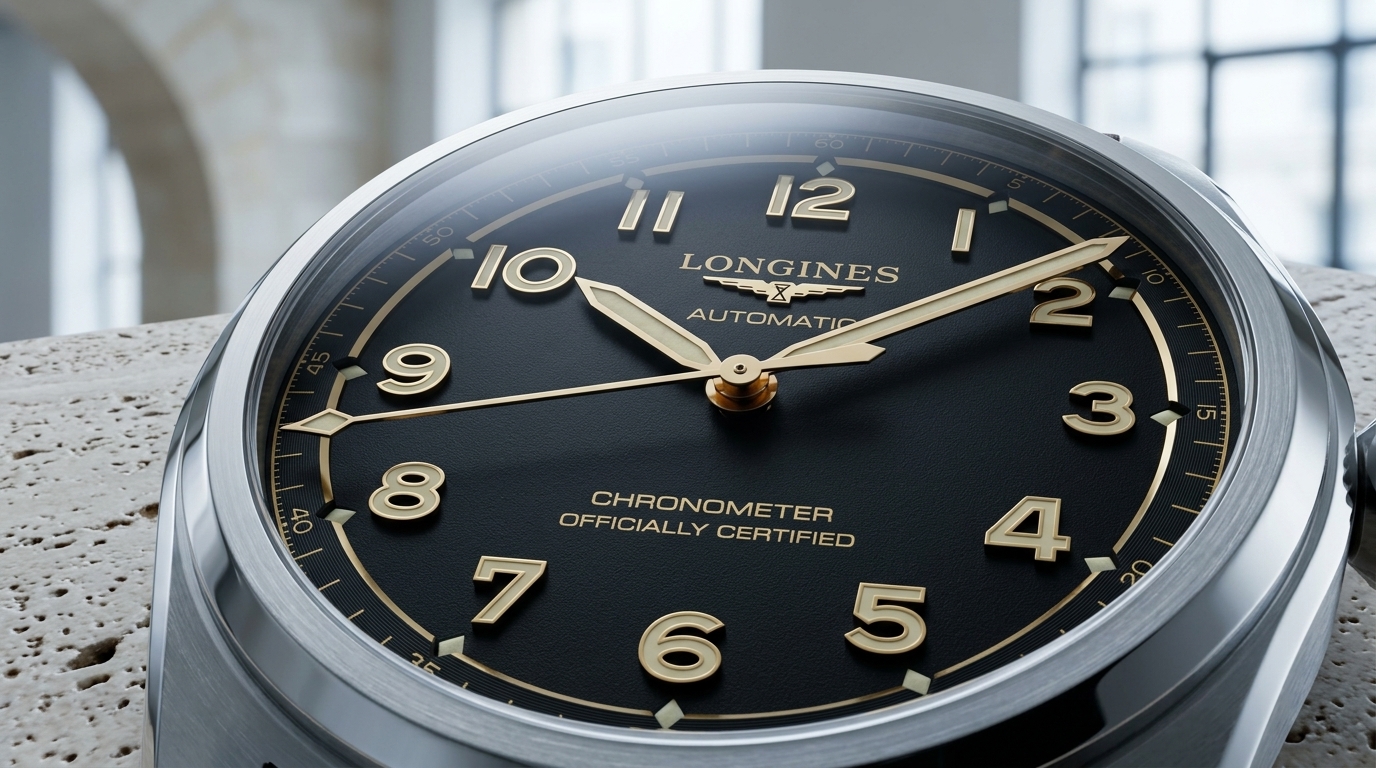
The contemporary Santos de Cartier, relaunched in 2018, refined that fluency rather than erasing the past. Its most obvious change lay in the way the bezel stretched into the bracelet. Earlier Santos bezels could feel like square islands placed upon the case; the modern version lets the polished metal lengthen at top and bottom, visually pulling the case into the first links. The effect is subtle at a glance and decisive over time. The watch looks less like a case mounted to a bracelet and more like one continuous system of planes. Cartier did not chase the sharpness of some integrated-bracelet competitors, where every bevel seems engineered to announce machining capability. The Santos remains more urbane. Its surfaces meet with clarity, but not aggression.
Inside, the automatic calibre 1847 MC carries the daily burden. It is not a movement intended to draw the loupe away from the dial for very long, and the closed caseback of many Santos models confirms the point. But it is an appropriate engine: modern, compact, and built for regular use. The calibre runs at 28,800 vibrations per hour and offers a power reserve of around 40 hours, with automatic winding and a practical architecture suited to Cartier’s larger production needs. Its name refers to the year of the maison’s founding, a reminder that Cartier’s watchmaking identity has often been expressed less through exposed movement theatre than through form itself. The 1847 MC also incorporates anti-magnetic considerations, including components and shielding intended to improve resistance to the ordinary magnetism of the contemporary world. That detail matters. A watch that presents itself with such surface grace still has to survive laptop clasps, phone cases, bag magnets, and the invisible hazards of modern rooms.
The case, water resistant to 100 metres in the current Santos de Cartier, gives the watch a more literal claim to pressure than its ancestors possessed. This does not make it a diver, and it should not be forced into that costume. Rather, it completes the idea of a city-proof instrument: rain, sinks, travel, summer heat, sudden practicalities. A Cartier capable of that resistance is not betraying its nature. It is fulfilling the old Santos bargain in a later century. The watch is meant to remain composed while life stops being ceremonial.
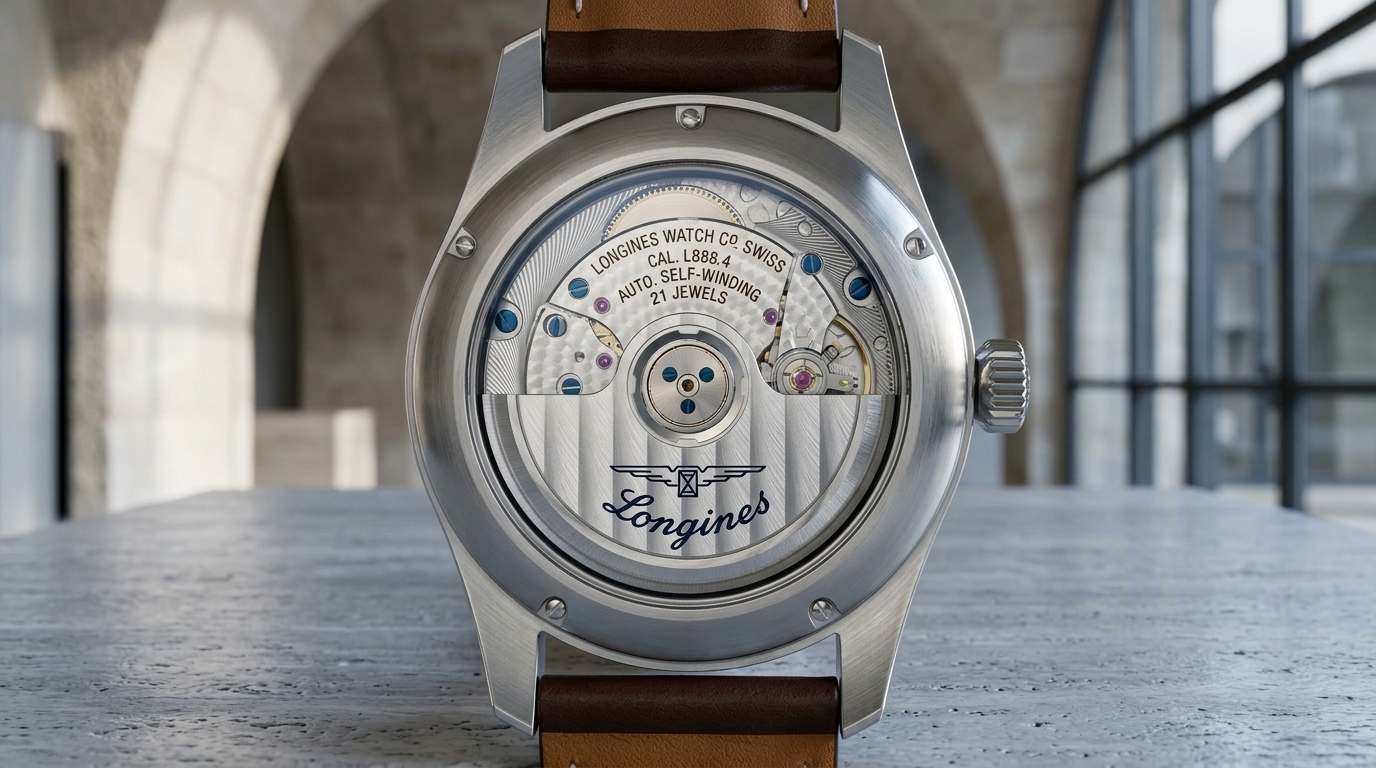
Cartier’s bracelet systems also reveal a particular understanding of usefulness. The QuickSwitch mechanism allows the bracelet or strap to be removed by pressing a concealed trigger at the back, and the SmartLink system lets individual bracelet links be released without the ritual of a screwdriver under a lamp. These are not romantic complications. They do not chime, split seconds, chart the moon, or measure elapsed time with theatrical authority. Yet as tools for ownership they are unusually intelligent. They acknowledge that the modern wearer lives without a valet and may want the watch on steel in the morning, leather in the evening, or simply sized correctly without a drawer full of pins and irritation. Cartier placed the mechanism where it belongs: out of sight, in service, with the visible form undisturbed.
That hidden practicality is central to the Santos. Many tool watches announce capability as identity. Their bezels turn with clicks loud enough to be reassuring. Their crowns are guarded, grooved, screwed down, sometimes oversized until the watch resembles a small machine part awaiting installation. Their lume is applied in slabs; their cases behave like pressure vessels. The Santos takes another path. Its capabilities are folded into the etiquette of the object. The wearer sees a square dial, a polished bezel, the screws, the cabochon, the Roman numerals. Beneath that civility are enough defences for ordinary life. It is protection without posture.
The dimensions of the modern line sharpen the question of character. The medium Santos de Cartier measures a little over 35 millimetres across the case and just under 42 millimetres lug to lug, though those figures are complicated by the integrated bracelet and square geometry. The large version, near 40 millimetres across and more than 47 millimetres in length, adds a date and greater wrist presence. On paper, the numbers suggest straightforward scaling. In reality, the Santos changes temperament with size. The medium is closer to the old language of Cartier, where form and proportion matter more than dominance. The large leans into the sports-watch field, more assertive, more contemporary, more willing to fill the wrist. Neither version is more authentic by measurement alone. The tension has always been there: instrument and jewel, machine and drawing, practical visibility and formal restraint.
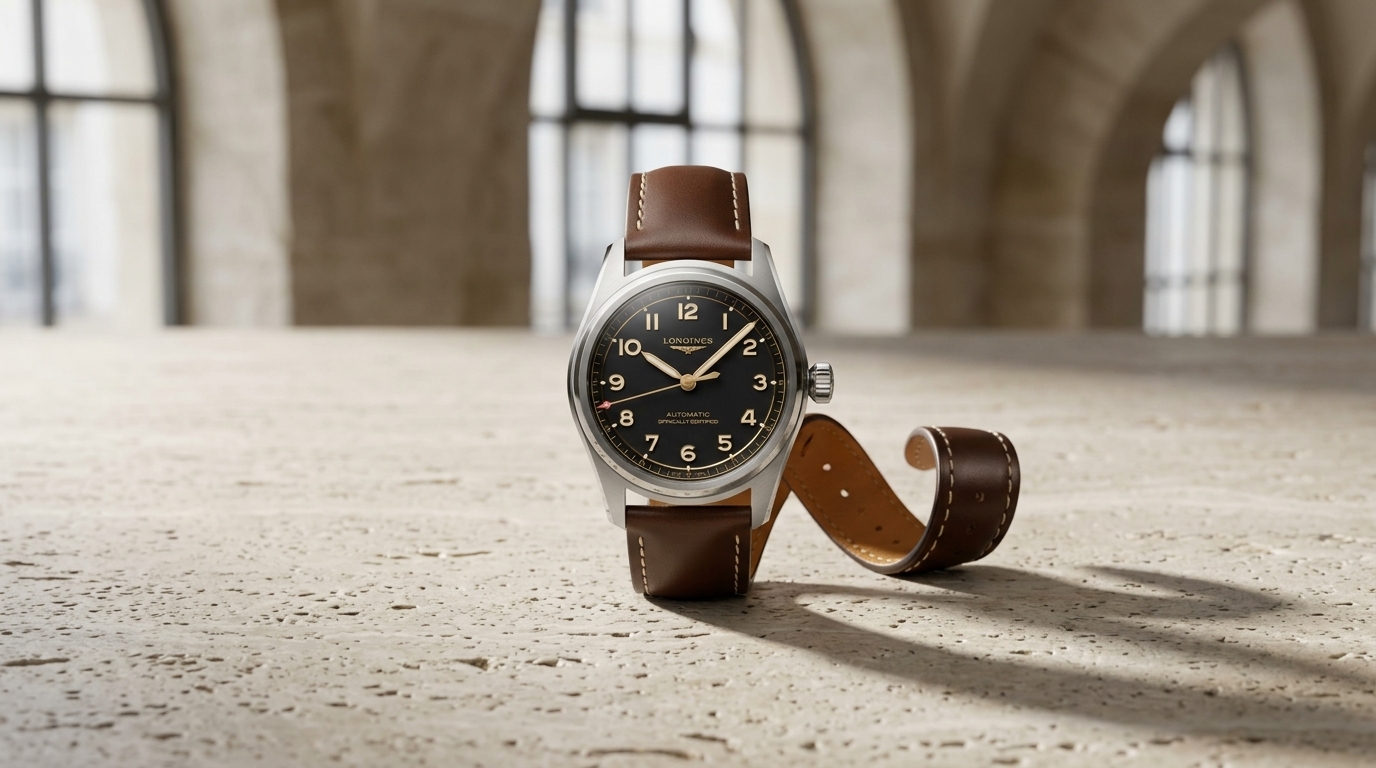
The Santos-Dumont branch of the family tells the story differently. Thinner, often hand-wound in its mechanical expressions, sometimes quartz in modern accessible forms, it moves closer to the memory of early aviation and dress. A Santos-Dumont with a manually wound calibre such as the 430 MC, derived from Piaget’s ultra-thin 430P architecture, is not a pressure watch in the same daily sense as the automatic Santos de Cartier. Its case is slimmer, its posture quieter, its relationship to the wrist more like a line drawn than a structure built. Yet it protects the origin story: the square, the screws, the Roman dial, the idea of a watch made because a man in flight needed time where his eyes could find it. The Santos de Cartier and Santos-Dumont are not rivals so much as two readings of the same sentence. One emphasises the tool; the other preserves the handwriting.
The deeper fascination is that the Santos has never looked nostalgic in the usual way. Many early wristwatch designs, however beautiful, remain visibly attached to their period. Wire lugs, enamel dials, cathedral hands, and small cushion cases carry the scent of old photographs. The Santos, despite its age, has an odd immunity. Its square form belongs to the early twentieth century and to the late twentieth century and to the present with equal plausibility. Part of this comes from Cartier’s willingness to revise without apology. The Santos has appeared in yellow gold, steel, two-tone, all-steel, skeletonised versions, chronographs, Dumont limited editions in lacquer and precious metals, and the more muscular Santos 100 of the 2000s. Some variants age better than others. But the essential design survives because it is not dependent on one era’s idea of luxury. It is dependent on a problem solved cleanly.
Finishing on the Santos is also part of its argument. The contrast between brushed planes and polished edges is not merely decorative; it makes the geometry readable. The bezel flashes because it is polished. The case withdraws slightly because it is brushed. The bracelet alternates in narrow measures, giving movement to what could otherwise become a slab of steel. The screws, aligned by design rather than by any implied mechanical necessity, create a rhythm that humanises the metal. On the dial, printing must be exact because Cartier’s Roman numerals leave little room for forgiveness. The secret signature, tucked into one numeral on many Cartier dials, is a small act of control: the house name hidden inside the house style.
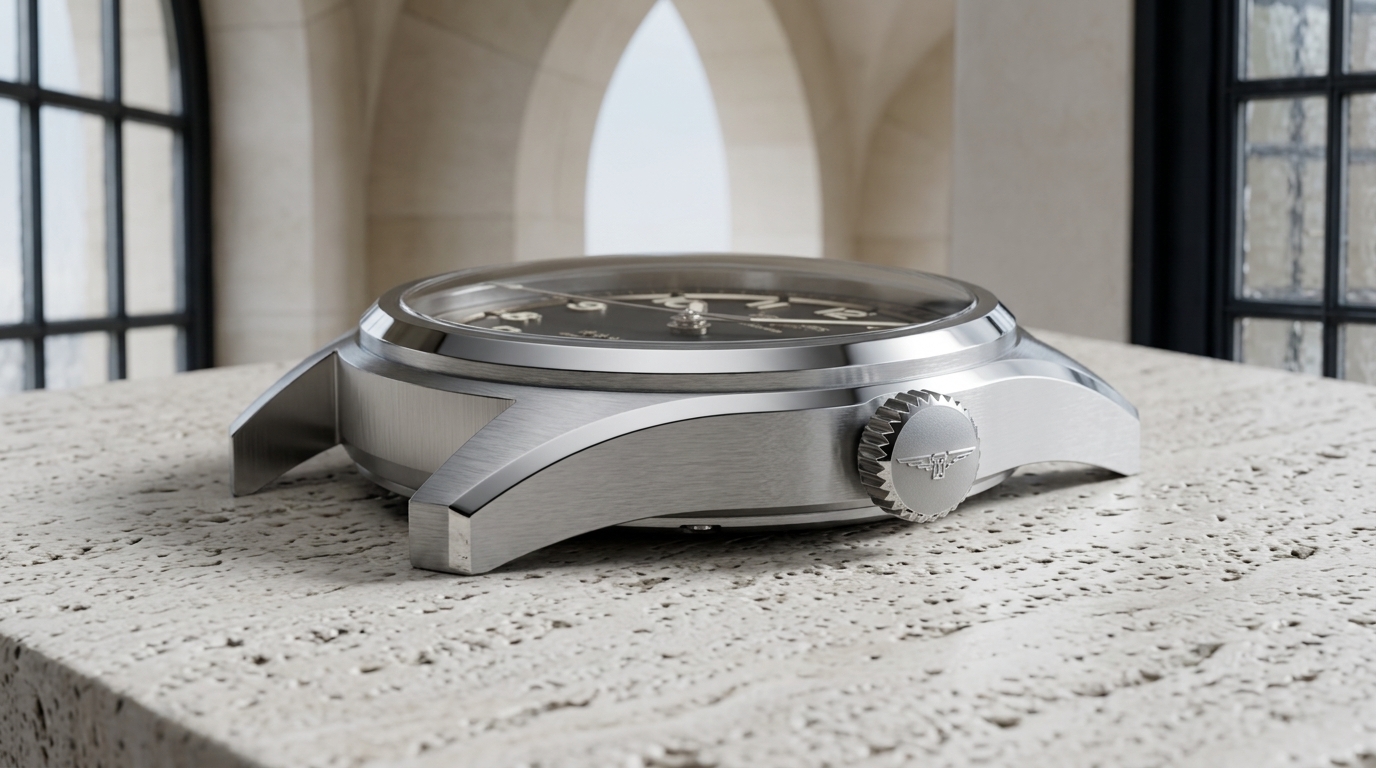
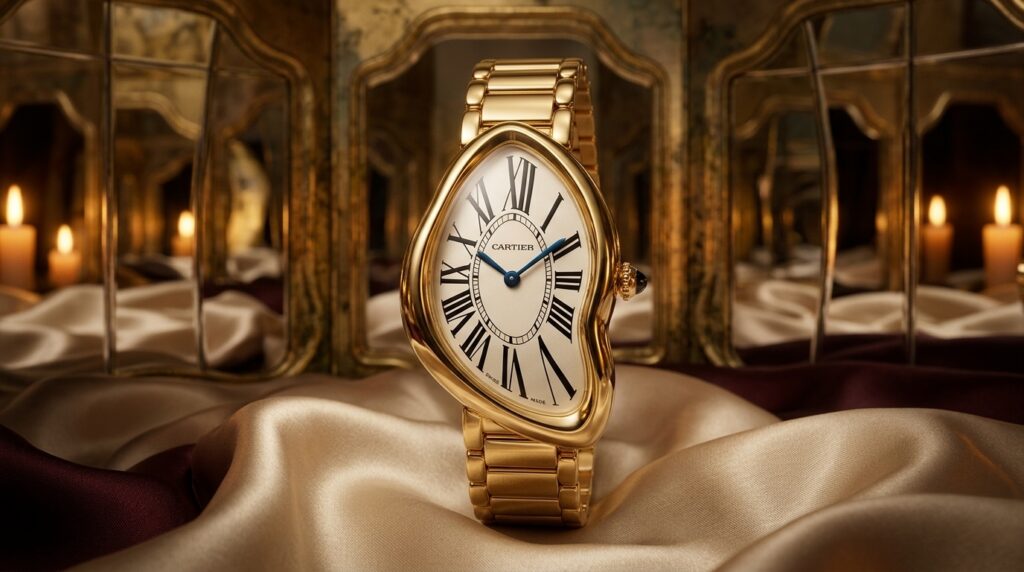
There remains, of course, the question of whether the Santos is too elegant to be a tool watch, or too practical to be considered purely elegant. The question rests on a false division. Elegance, in Cartier’s better work, is not fragility. It is pressure managed by proportion. A Tank does this through straight lines and emptiness. A Crash does it through distortion held in balance. The Santos does it through visible construction made socially acceptable, even desirable. It is a watch with screws on its face and a jewel on its crown. Either detail could have made the other ridiculous. Together, they form the whole point.
The title of tool watch has narrowed over time, largely because professional watches became a market category and then an aesthetic costume. The original tools were often plain because plainness served production and use. Later, plainness itself became a style to be purchased. The Santos complicates that history. It emerged from a practical need, passed through jewellery culture, helped define the luxury sports bracelet watch in Cartier’s own idiom, and now exists as a daily automatic with respectable water resistance and quick-change functionality. It is not pretending to be military issue or cockpit equipment. Its aviation history is not painted onto the dial as romance. It is baked into the format: time on the wrist, instantly visible, stable, and secured.
One can see the old airplane in it only if one looks carefully. Not in the literal manner of propeller logos or instrument-panel numerals, but in the square frame, the exposed fasteners, the marriage of craft and engineering that marked early machines before streamlining concealed their bones. Santos-Dumont’s aircraft were delicate and brave, all struts and fabric, their mechanics visible to anyone standing close enough. The watch made for him did something similar at wrist scale. It exposed enough of its construction to be modern, then dressed that exposure with Cartier’s discipline. That is why the design has endured without needing to shout about endurance.
Pressure changes objects. It reveals weak proportions, exposes decorative excess, and punishes designs that depend too much on novelty. The Santos has been under pressure for more than a century: the pressure of changing taste, of quartz disruption, of sports-watch dominance, of Cartier’s own reputation as a maker of beauty before machinery. It has absorbed each force without becoming unrecognisable. The modern Santos de Cartier is larger, tougher, more convenient, and more water resistant than the watch imagined for an aviator in 1904. Yet its face still belongs to that first practical gesture, when the time had to move from pocket to wrist because the world had begun to move faster.
In the end, Cartier’s other kind of tool watch is not defined by conquest. It does not descend, calculate, or time a racing lap with specialised authority. It performs a quieter labour. It keeps utility from becoming coarse. It keeps elegance from becoming helpless. It proves that a tool can be designed for the pressures of movement, work, travel, and public life without surrendering to the visual language of equipment. The screws remain visible. The Roman numerals remain exact. The crown still carries its blue point of ceremony. Beneath the polished frame, the mechanism continues its ordinary work, shielded from the small magnetic fields and wet interruptions of the day.
The Santos is therefore not an exception to Cartier’s identity but one of its clearest expressions. It shows how the maison turns necessity into form, and form back into necessity. A century after the pocket watch lost its argument in the cockpit, the square watch with screws still makes its case each time it appears at the edge of a cuff: not as a relic of early aviation, nor as a softened sports watch, but as an instrument that learned how to behave in society. Elegance, here, is not escape from pressure. It is what pressure leaves behind when the design holds.