Bremont After the Story: Can a Brand Outlive Its Origin Myth?
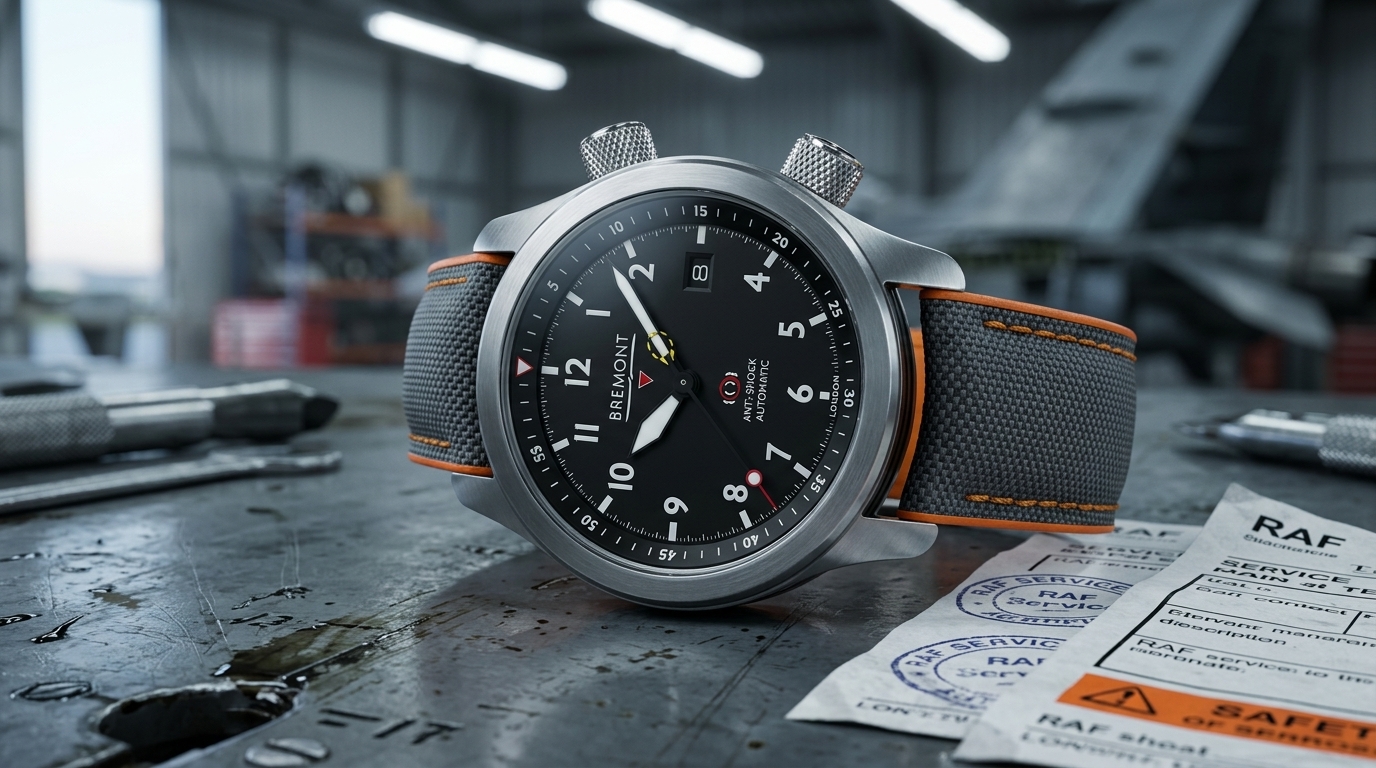
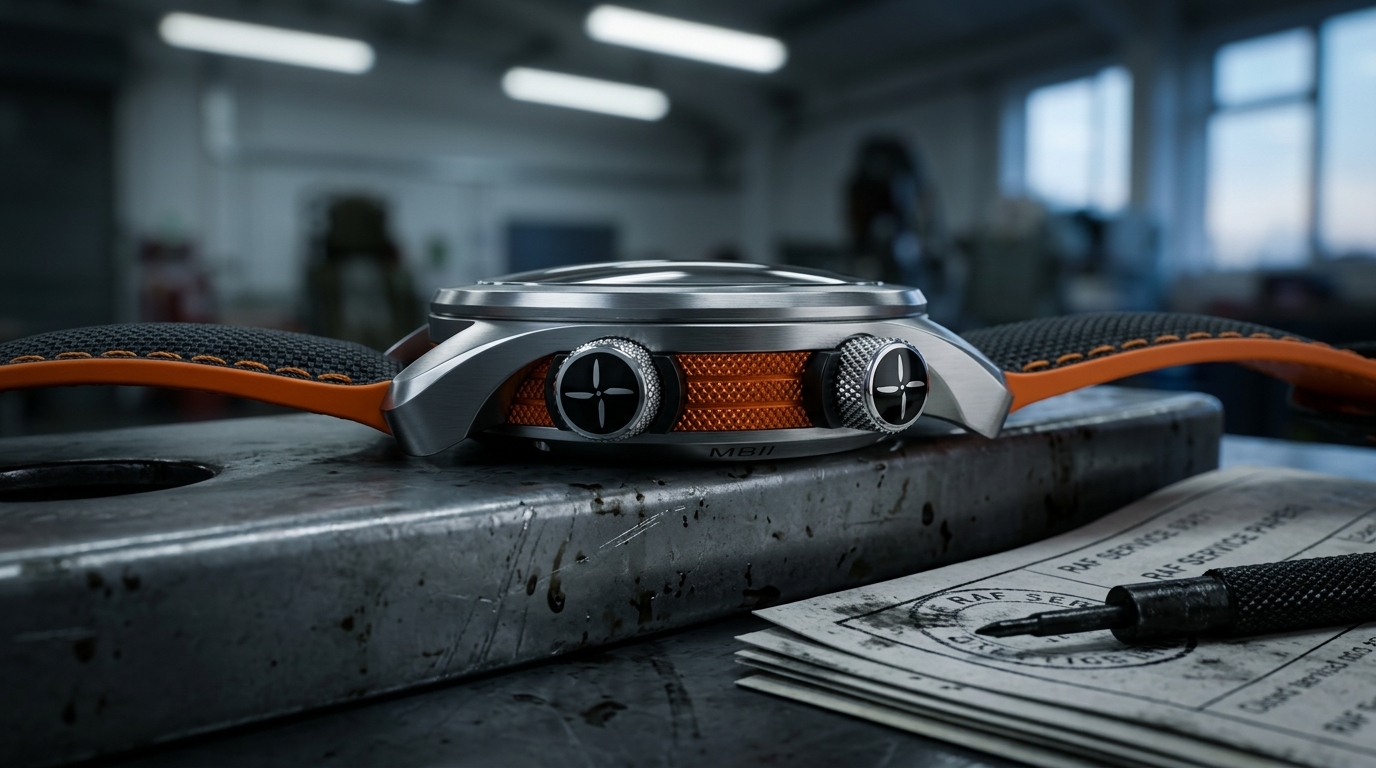
The orange barrel of a Bremont MBII catches light before the dial does. It appears first as a narrow ring between bezel and caseback, a band of colour locked inside the brand’s Trip-Tick case construction, neither decoration nor accident. The watch is thick, deliberate, and built around a premise that sounds almost absurd until one remembers the partner named on its flank: Martin-Baker, maker of ejection seats, a British company whose products are designed for the most violent exit a pilot may ever make. Inside the MB sits a chronometer-rated automatic movement, protected by an anti-shock mount and surrounded by a soft-iron Faraday cage. Outside, the hardened steel case has the faintly architectural confidence that once made Bremont feel unlike much else in the early 2000s: not Swiss in accent, not nostalgic in the usual way, and not afraid of being heavy.
For years, that weight belonged to more than the metal. Bremont was never merely selling watches; it was carrying a story. The company founded by brothers Nick and Giles English drew its emotional charge from aviation, family, accident, survival, and a borrowed name. Their father, Euan English, died in a flying accident in 1995; Nick survived. Before that wound hardened into company lore, there was the tale of an emergency landing in France, of a farmer and former wartime pilot named Antoine Bremont, of hospitality, mechanical sympathy, and a name that sounded as though it had been waiting in a drawer. When the brand arrived publicly in 2007, after its founding in 2002, it came with more narrative voltage than most new watch companies could manufacture in a decade.
The watches made sense within that frame. The ALT1-C chronograph, with its Valjoux 7750 base reworked and regulated to chronometer standard, did not pretend to be delicate. The Supermarine S500 put a 500-metre dive watch into a case shaped by the same cylindrical grammar as Bremont’s pilot watches. The U-2, the MB series, the Solo: all had the air of instruments built by men who could tell the difference between costume and equipment. Their dials were legible, their crowns substantial, their cases often hardened to around 2,000 Vickers through Bremont’s treatment process. The movements were, for the most part, familiar Swiss calibres made more exacting through regulation, finishing, and casing. The rotors carried propellers, the casebacks carried aircraft, squadrons, ships, fragments of history. It was not subtle, but it was coherent.
That coherence mattered because Bremont emerged at a moment when British watchmaking was still more memory than industry. The country that had given the marine chronometer to navigation and precision to empire had long since ceded volume production to Switzerland and elsewhere. George Daniels had made his watches almost alone; Roger Smith had inherited that solitary flame on the Isle of Man. But serial production of modern mechanical wristwatches in Britain was a harder claim, more exposed to scrutiny. Bremont stepped into that gap with energy and optimism. It talked of bringing watchmaking back, of Henley-on-Thames, of manufacturing, of apprentices, of the long road from assembly to true industrial capacity. The ambition was not small, and perhaps that was part of the problem. A small claim can be defended. A national revival invites measurement.
One of Bremont’s defining tensions has always lived between romance and calibres. The early watches depended on modified Swiss ébauches: ETA, Sellita, Valjoux, La Joux-Perret. There was nothing shameful in that. Much of modern watchmaking rests on shared architectures, revised components, careful regulation and intelligent casing. But Bremont’s language around Britishness sometimes walked close to the edge of what collectors would tolerate. The Wright Flyer controversy in 2014 exposed the danger. A limited edition containing material from the original Wright Flyer was presented with a new movement, the BWC/01, and the story grew larger than the engineering. When it became clear that the movement’s origins and development were tied substantially to La Joux-Perret in Switzerland, the debate was not only about parts. It was about trust, about the limits of narrative, about whether a beautiful story had outrun the truth of the watch.
That episode did not destroy Bremont. In some ways, it clarified the brand’s predicament. The company had built an audience that cared deeply about provenance, and provenance customers are rarely casual about words. A watch can survive a modified movement if the maker is plain about it. It can survive ambition if the stages are marked honestly. What it cannot easily survive is the sense that myth has been used to close the distance between aspiration and fact. Bremont learned, adjusted, and kept building. The Wing, its manufacturing and technology centre in Henley-on-Thames, became the physical expression of the promise: not merely a boutique with Union flags, but benches, machines, training, inspection, assembly, and eventually the ENG300 movement family, introduced with much significance and some renewed debate over what “manufactured” could mean in contemporary Britain.
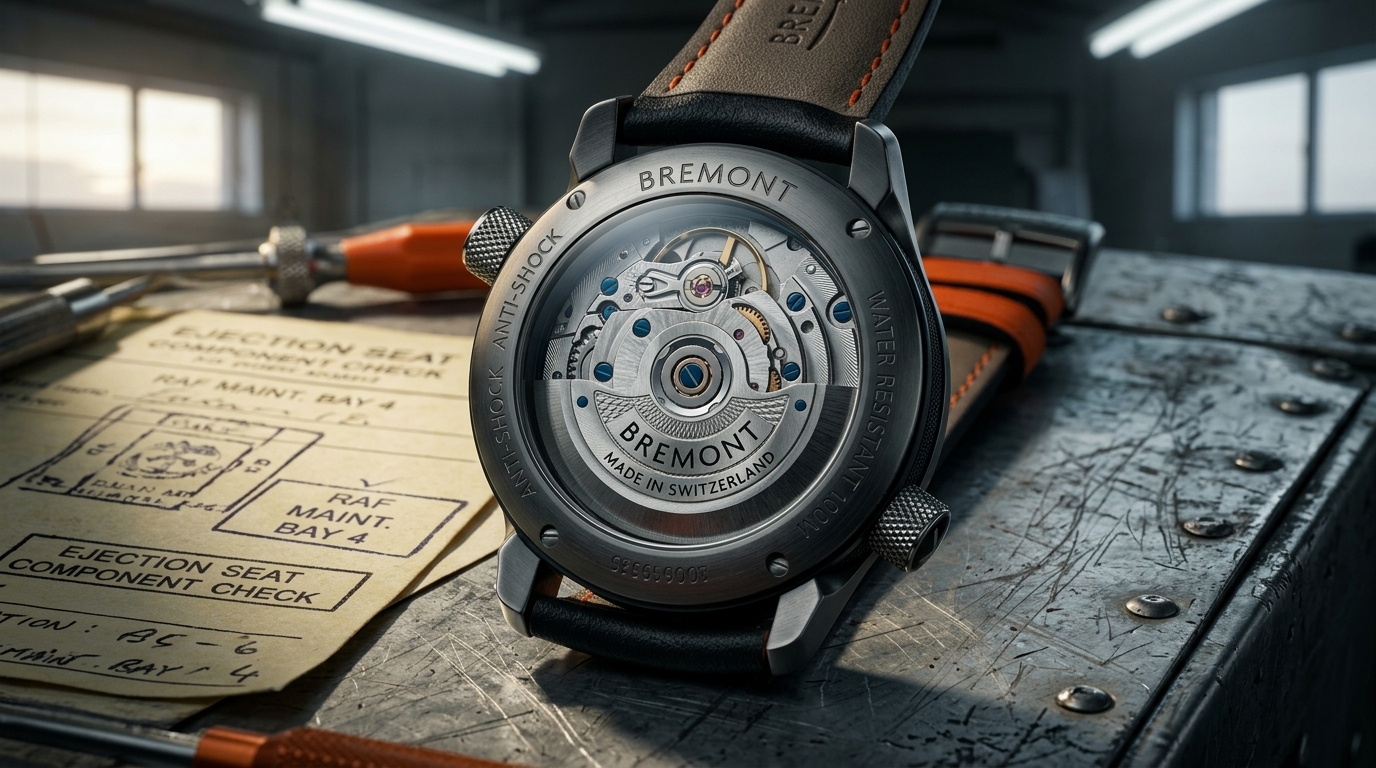
The ENG300 series deserves a calmer reading than either outrage or celebration usually allows. Its architecture was not born from blank paper in Henley; it drew upon an acquired Swiss movement platform, then became the basis for Bremont’s stated programme of British industrialisation. In watches such as the Longitude, its bridges, finishing, and construction stood for an attempt to move beyond dependence on off-the-shelf supply. The movement offered a 65-hour power reserve and modern tolerances, and it was positioned as a foundation rather than a final monument. Under a display back, it did not have the theatrical depth of haute horlogerie, nor did it need to. Its significance lay elsewhere: in the attempt to turn Bremont’s origin story into machinery, to convert memory and mission into repeatable production.
Yet stories age differently from steel. A case can be refinished, a movement serviced, a crystal replaced. An origin myth, once set in public, becomes harder to regulate. It demands loyalty long after the circumstances that created it have changed. In 2023 and 2024, with new investment, new leadership under Davide Cerrato, and a visible redesign of the brand language, Bremont entered its most uncomfortable chapter. The propeller motif, so closely tied to the English brothers’ aviation narrative, gave way to a new visual identity. Collections were reorganised. The emphasis shifted. Terra Nova field watches appeared with cushion-like cases, broader numerals, and a different relationship to British military design. Supermarine continued, but with a sharpened contemporary stance. The watches became less like objects built around the brothers’ biography and more like products designed for a company seeking scale.
For many brands, that would be ordinary evolution. For Bremont, it felt like a test of identity. When a company is founded on a story as intimate as grief, survival, and brotherhood, any deviation can look like abandonment. The old logo was not just typography. The propeller was a memorial symbol, a signal flare, a shorthand for the hangar doors and flight jackets and aircraft-grade language that had framed the brand for nearly two decades. To remove or diminish it was to ask buyers to believe that Bremont could still be Bremont without leaning so visibly on its founding image. That is a severe request. Collectors do not only buy metal and mechanics; they buy continuity. They want the line to hold.
The question, then, is not whether the new Bremont watches are competent. Competence is easier to judge. A Terra Nova 38, with its tighter diameter and field-watch discipline, can be measured against the wrist as an object of proportion. A Supermarine can be assessed for bezel action, case finishing, crown feel, legibility underwater, and whether its automatic movement has been regulated with care. Bremont has long understood tactile cues: the resistance of a crown thread, the clean snap of a clasp, the security implied by a thick case middle. Even when its designs divided opinion, the brand rarely made flimsy watches. The more difficult question is whether those watches still carry a reason to exist that is sharper than “British adventure luxury,” a phrase too broad to cut anything.
There is a small tragedy in the way watch brands become prisoners of their best tales. Blancpain must forever answer to 1953 and the Fifty Fathoms. Omega cannot escape the Moon. Panerai lives under the long shadow of Italian naval commandos and oversized cushion cases. Rolex, despite its vastness, still feeds from the springs of Everest, the Channel swim, COMEX, Daytona, and the crown’s own self-perpetuating authority. But those brands have had time to harden their myths into institutions. Bremont is younger. Its legend is still soft enough to bruise. The English brothers are not distant founders in sepia photographs; they are living figures whose departure from daily control makes the change feel immediate, almost domestic. The audience remembers the voices.
That remembrance cuts both ways. The old Bremont had warmth because it could sound like a conversation rather than a corporation. It also had vulnerability because the conversation sometimes promised more than the watches could prove. The new Bremont may gain discipline, sharper design governance, and broader commercial appeal. It may also lose some of the irregular pulse that made collectors forgive thickness, price, and the occasional overreaching limited edition. A brand built on personality often ages by tidying itself up. The danger is that, in removing the rough edges, it removes the grain.
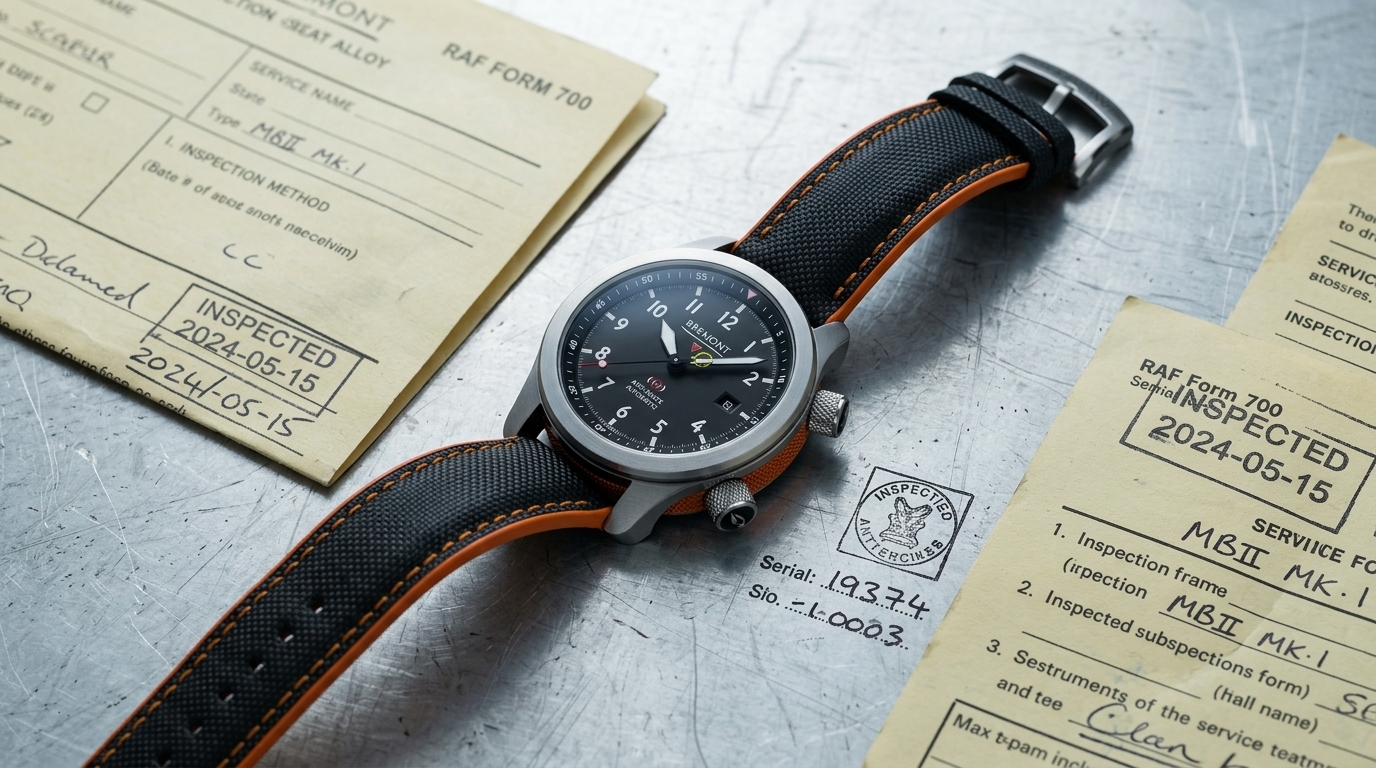
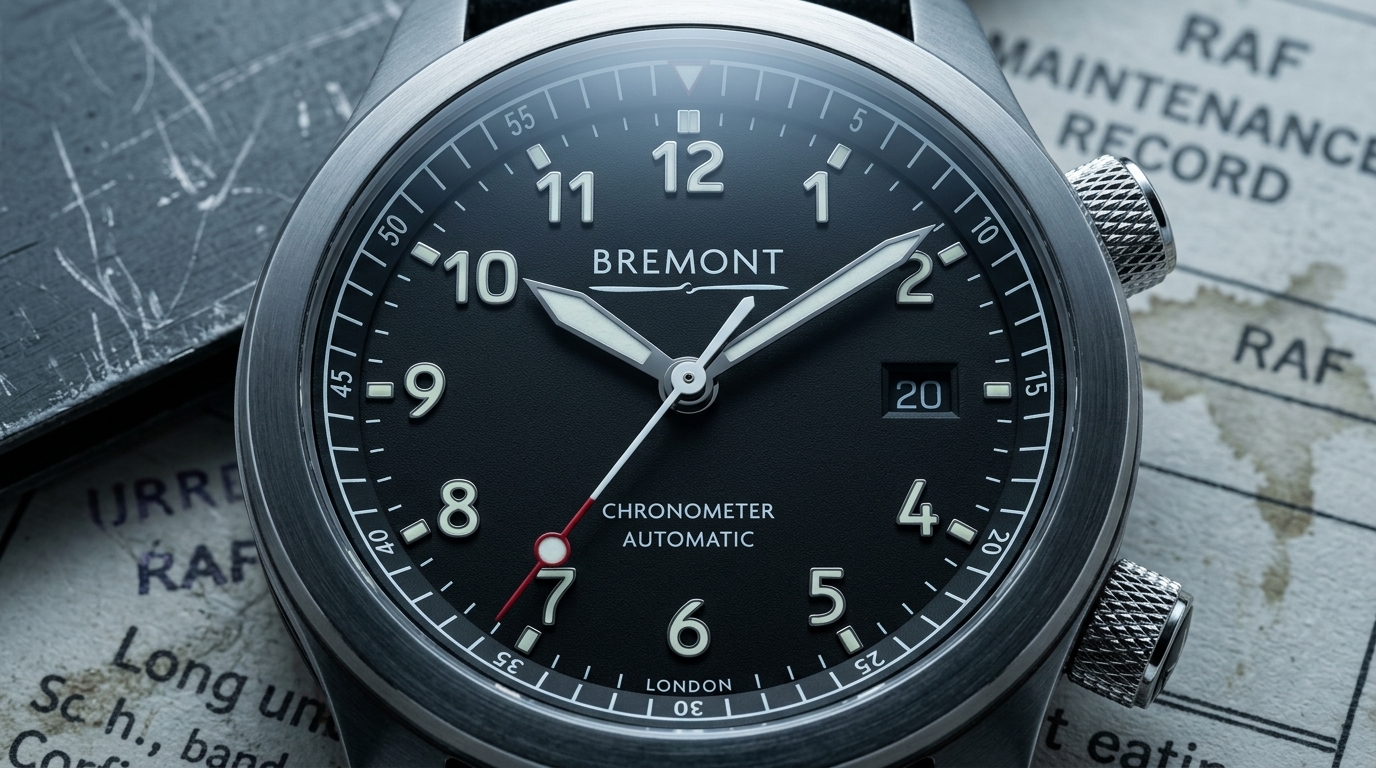
Still, watches have a way of resisting narrative control. Put the older MBII beside a newer field model and the difference is not simply past against present. The MBII remains almost stubbornly itself: a 43mm case with a coloured middle barrel, an inner rotating bezel operated by a crown at four o’clock, a dial designed for quick reading rather than decorative balance. Its movement, often a modified BE-36AE base derived from the ETA 2836/Sellita family depending on generation and supply, does not pretend to be exotic. But the total construction makes a particular argument: that a watch can be linked to a real testing regime, a real industrial partner, and a real field of risk. Martin-Baker’s involvement was not scenery. The watches underwent shock, vibration, temperature, altitude and salt-fog trials connected to the ejection-seat world. That gives the MB line a lasting authority no rebrand can easily erase.
The Terra Nova argument is different. It does not ask to be believed because it survived ejection-seat testing. It asks to be judged as a revived field-watch idea with modern casework and a British frame of reference. That is a quieter, more precarious proposition, because the field-watch category is crowded with honest things. Hamilton has history and price. Tudor has industrial muscle. Longines has heritage with increasingly refined execution. Vertex has a sharper British military line. For Bremont to succeed there, the design must do more than look rugged. It must feel inevitable after several years, not merely current in a launch window. The case proportions, handset, numerals, and bracelet or strap integration must settle into memory. Only time decides that.
This is where the origin myth becomes both asset and burden. Without the early story, Bremont might never have gained attention in a market indifferent to new names. The tale of the English brothers gave emotional force to watches that otherwise would have been expensive, well-built, Swiss-powered newcomers from Britain. But a myth that opens the door cannot remain the whole house. Eventually a brand must offer enough product truth that even a buyer indifferent to the founding tale can understand the watch. The case must justify its mass. The dial must justify its typeface. The movement must justify its price. The national claim must survive the screwdriver and the loupe.
Bremont’s future may depend on accepting that its story is no longer singular. There is the founding story: fathers and sons, aircraft, France, the name. There is the manufacturing story: Henley, The Wing, ENG300, the attempt to rebuild part of an industry more often invoked than practiced. There is the design story now being written under new stewardship: less personal, perhaps more systematic, still trying to determine whether the brand’s visual centre will hold. None of these stories cancels the others, but they do not automatically harmonise. A watch brand is not a novel; it cannot revise earlier chapters without consequences. Collectors keep copies of the first edition.
The best outcome would not be for Bremont to pretend nothing has changed. That would be false, and falseness is exactly what the brand cannot afford. Nor would it be wise to strip away every remnant of the old aviation world in pursuit of a cleaner corporate silhouette. The stronger path lies in admitting the inheritance and then building watches sturdy enough to stand beyond it. If the MB remains the hard spine of the catalogue, let it remain so without apology. If Terra Nova is to mark new ground, let it earn that ground through proportion, calibre choice, finishing, and restraint. If British manufacture is central, let the language be exact enough that no collector needs to parse it like a legal document.
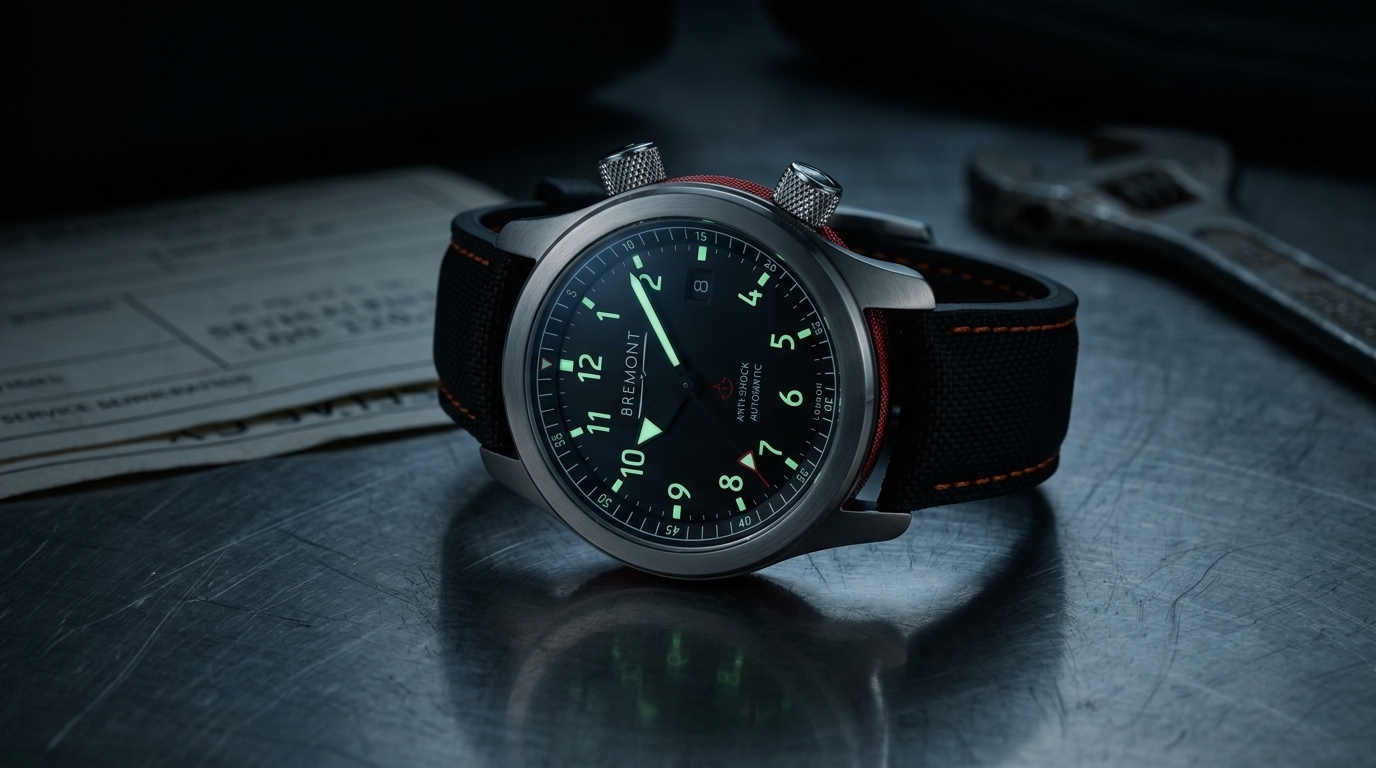
There is something fitting, almost severe, in Bremont facing this reckoning through watches rather than slogans. Mechanical watches are patient judges. They sit in drawers, safes, cockpits, offices, and service trays; they outlast launch campaigns and executive interviews. A case design that seemed forced will date quickly. A well-made movement will continue to beat at 28,800 vibrations per hour without caring who designed the logo. Lume will fade, bezels will mark, crowns will be replaced, and the market will decide which references retain meaning. The brand’s origin myth may bring someone to the glass, but only the watch can keep them there.
Can Bremont outlive its origin myth? It can, but not by killing it. Myths in watchmaking are not discarded; they are sediment. The danger is building too lightly on top of them, or digging them up so often that nothing new can take root. Bremont’s founding tale still has power because it was never a focus-group invention. It came from accident, family, machines, and the old human impulse to turn loss into form. But the next Bremont cannot ask that story to do all the work. The orange barrel of the MBII, the drilled lugs and broad cases, the Henley facility, the debated movements, the new field watches, the changed logo: these are now part of the same unsettled archive.
The watch on the table does not answer the question directly. No watch does. It offers instead the cold facts of its construction: steel, crystal, gaskets, screws, a balance oscillating in private. Around it gather all the things that cannot be machined: loyalty, disappointment, memory, suspicion, hope. Bremont once knew how to make those invisible forces feel close to metal. Its task now is harder and less romantic. It must make watches persuasive enough that the story becomes background rather than crutch, atmosphere rather than argument. If it succeeds, the name borrowed from Antoine Bremont will continue to travel. If it fails, the myth will remain brighter than the watches built beneath it, and that, for any brand, is a slow kind of silence.