Breguet and the Weight of Invention
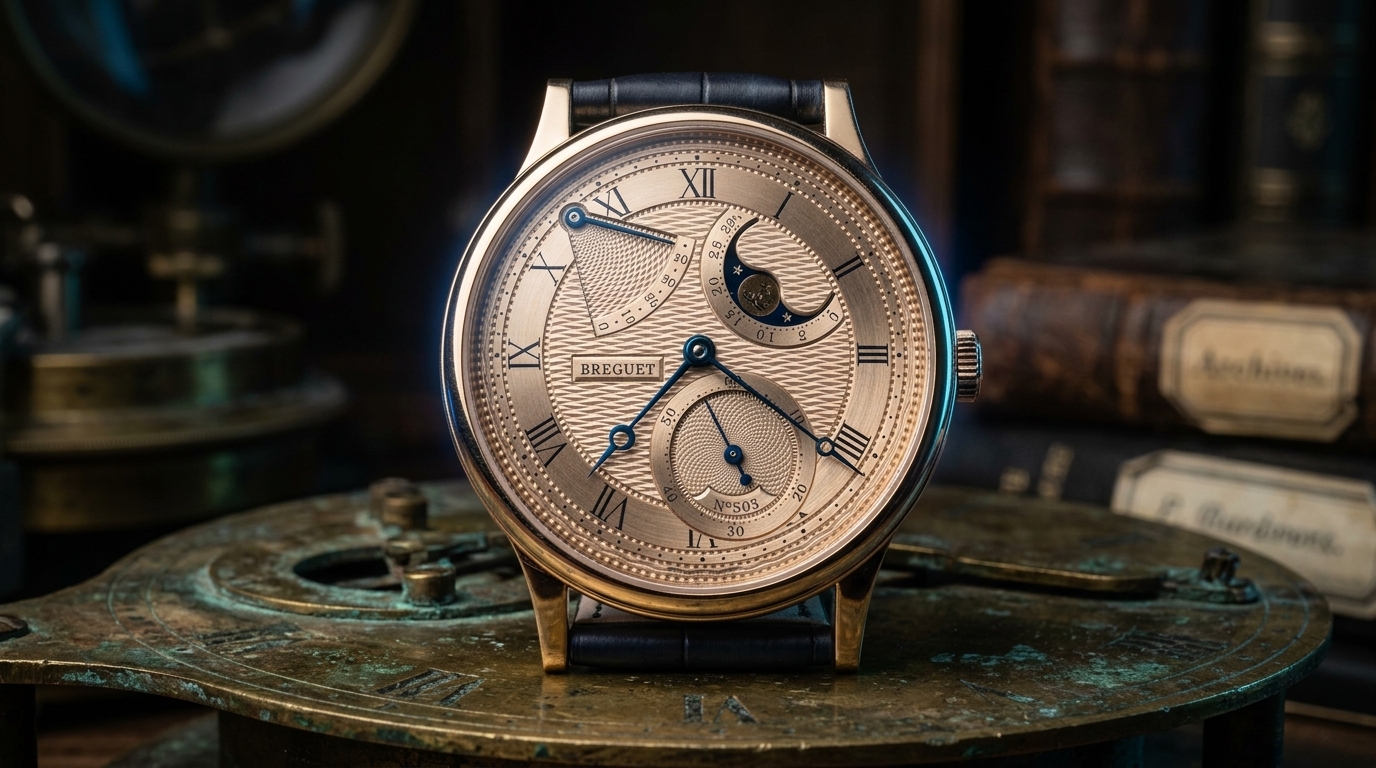
The chain lies under the sapphire like something recovered from a miniature hoist, a line of bright steel crossing the architecture of the dial with a patience that seems older than the wristwatch itself. In the Breguet Tradition 7047, it is not hidden beneath bridges or consigned to the imagination. It travels openly between barrel and fusée, link by link, performing a duty that belongs to the age of marine chronometers and coach clocks: evening out the force of a mainspring as it unwinds, giving the escapement a steadier ration of power than nature would otherwise allow.
Around it, the rest of the watch appears less assembled than suspended. The off-centre dial holds its place with a kind of deliberate restraint, leaving the eye to wander across the exposed movement plate, the wheel train, the darkened bridges, the tourbillon carriage turning with its minute-long respiration. Breguet’s usual codes are present, but they do not arrive as decoration alone. The fluted caseband catches the light in narrow vertical strokes. The welded lugs step outward with old-world severity. The hands, hollow-tipped and unmistakable, are not merely a house signature; they are a reminder that Abraham-Louis Breguet understood legibility as an invention in its own right.
There is a particular burden carried by any watch bearing this name. It is heavier than gold, heavier than the 41mm case that contains the 7047’s open construction, heavier even than the visible machinery that gives the watch its sense of mechanical consequence. Breguet is not a surname that can be worn lightly in horology. It brings with it the long shadow of Paris workshops, royal commissions, scientific ambition, and the particular loneliness of inventions that solve problems most people never knew existed.
Abraham-Louis Breguet was born in Neuchâtel in 1747, but Paris became the theatre of his seriousness. By the late eighteenth century, when watchmaking still belonged as much to astronomy and navigation as to adornment, his workshop produced objects that seemed to compress an entire intellectual climate into metal. The self-winding perpétuelle watches, the first reliable gong springs for repeaters, the pare-chute shock protection, the overcoil balance spring that improved concentric breathing, the tactile “montres à tact” that could be read by touch in the dark—these were not flourishes. They were arguments. Each suggested that the watch could be made more useful, more stable, more intimate with the human hand and eye.
The modern Breguet watch must therefore answer a difficult question before it answers any question of taste: how does inheritance become present without becoming costume? The Tradition line offers one of the more convincing replies because it does not quote the past from the surface inward. It begins with structure. Its inspiration comes from Breguet’s souscription watches of the 1790s, those practical single-hand pieces sold by subscription, with a down payment securing delivery. Their movements were direct, rational, almost architectural in their exposed clarity. The Tradition takes that idea and turns it toward the wrist, leaving the going train and regulating organs visible on the dial side, as if the case had been reversed to show the mind of the watch before its face.
The 7047 adds to this arrangement two mechanisms whose presence would be enough, in lesser hands, to overwhelm the whole. The tourbillon, patented by Breguet in 1801, was conceived for the pocket watch, not the wrist. In a pocket, a watch spent long hours upright in the same position, allowing gravity to impose its small but persistent errors on the balance and escapement. Breguet’s solution was to place the regulating organ inside a rotating cage, so that positional errors might be averaged out over time. It was an invention born of careful observation, not theatrical display. The modern wrist, constantly moving, has made the original problem less absolute, yet the tourbillon remains one of the clearest emblems of watchmaking’s desire to negotiate with gravity rather than merely endure it.
In the 7047, the tourbillon does not sit as a trophy planted at six o’clock. It is part of a broader mechanical conversation. Opposite the barrel and fusée, it gives the composition a sense of tension, the rotating carriage answering the slow transfer of torque across the chain. The calibre 569, manually wound and composed of more than five hundred parts, beats at a measured 18,000 vibrations per hour. That slower cadence suits the watch. It allows the tourbillon’s rotation, the advance of the wheels, and the breathing of the mechanism to be read without haste. A faster beat might have imposed nervousness where the design asks for gravity.
The fusée is the more archaic companion, and perhaps the more poetic. A mainspring does not deliver force evenly. Fully wound, it pulls strongly; near exhaustion, it weakens. The fusée counters this by using a cone-shaped pulley connected to the barrel by a chain. When the mainspring is strongest, the chain acts on the smaller diameter of the cone; as the mainspring relaxes, it draws from the larger diameter, preserving a more constant torque. It is an old answer to an old problem, laborious to make, delicate to adjust, and mostly absent from contemporary wristwatches because modern barrel design and materials have reduced the urgency of its task. Yet here it is, not as nostalgia alone, but as visible evidence of a philosophy: precision is not a single invention, but a series of compensations.
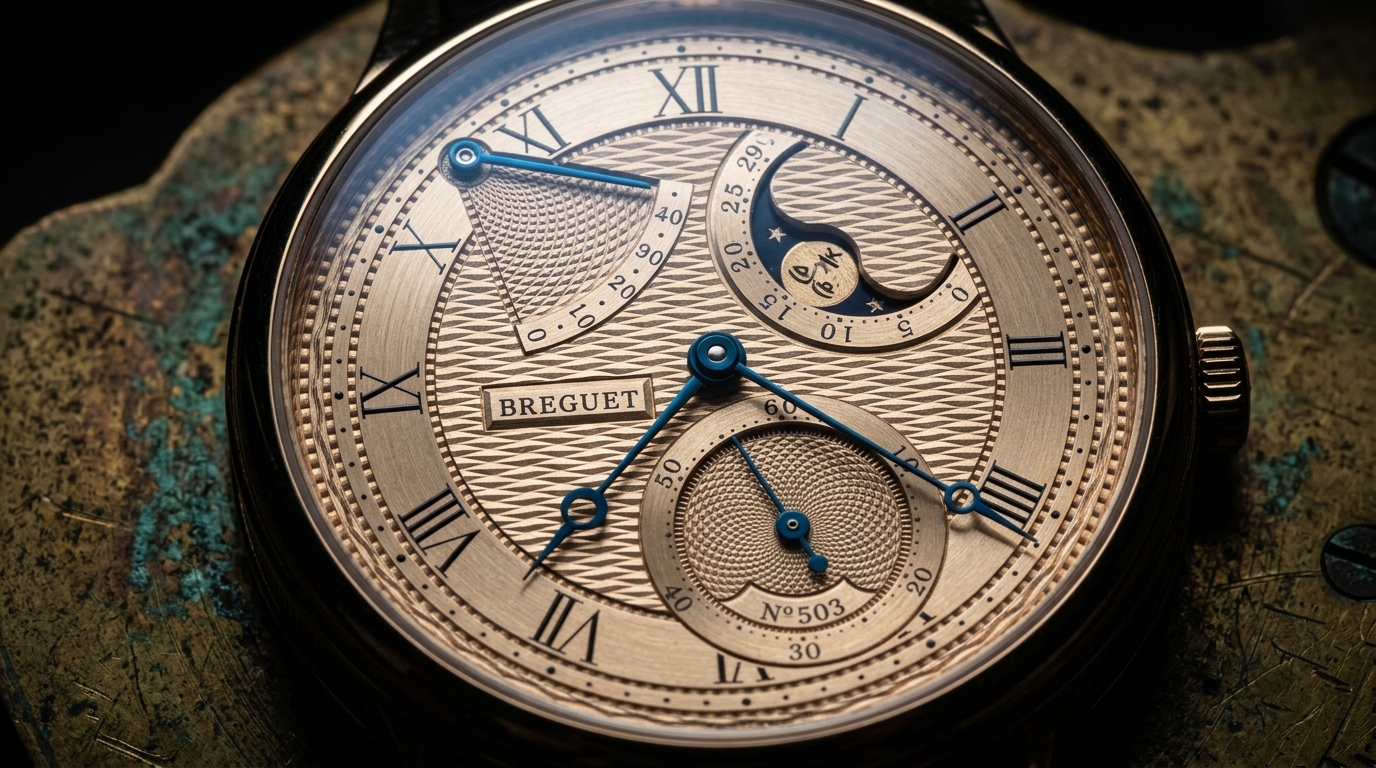
The eye returns again and again to that chain. Its scale makes belief difficult. Each link must articulate cleanly, carry force, and disappear into the rhythm of the mechanism without drama. It is not decorative in the way a pattern is decorative, though it has obvious beauty. It is beautiful because it works. That distinction matters in Breguet, where ornament has traditionally been asked to serve clarity. Engine-turning, for instance, was never simply a display of hand skill. On Breguet’s historical dials, different guilloché textures separated indications, reduced glare, and made time easier to read. The famous numerals, the slim seconds tracks, the open-tipped hands—all belong to a discipline of distinction.
This is where the weight of invention becomes most apparent. Invention does not merely add complexity; it creates obligation. Once a manufacture attaches itself to mechanisms with real historical consequence, it has to treat them with enough seriousness that they do not become props. The 7047 walks close to that edge by its nature. It is open, elaborate, almost didactic. Yet its saving grace is that the architecture is not arbitrary. The bridges have mass. The frosted and darkened surfaces give depth without resorting to glare. The bevels catch light along their edges, but they do not shout. The case, with its narrow bezel and fluted band, contains the spectacle rather than amplifying it.
Breguet’s historical watches often possessed this curious duality: they were advanced and reserved at once. No. 160, the watch later known as the “Marie-Antoinette,” remains the most myth-laden example, with its perpetual calendar, minute repeater, equation of time, thermometer, independent seconds, power reserve, and self-winding system. Commissioned before the Revolution and completed only in 1827, years after both the queen and Breguet had died, it became less a possession than a monument to unreasonable ambition. But Breguet’s genius should not be measured only by grand complications. It lies equally in the smaller refinements that changed how watches behaved: shock resistance, winding efficiency, dial legibility, acoustic improvement. He did not invent for spectacle first. Spectacle, when it came, was the residue of solutions pursued far enough.
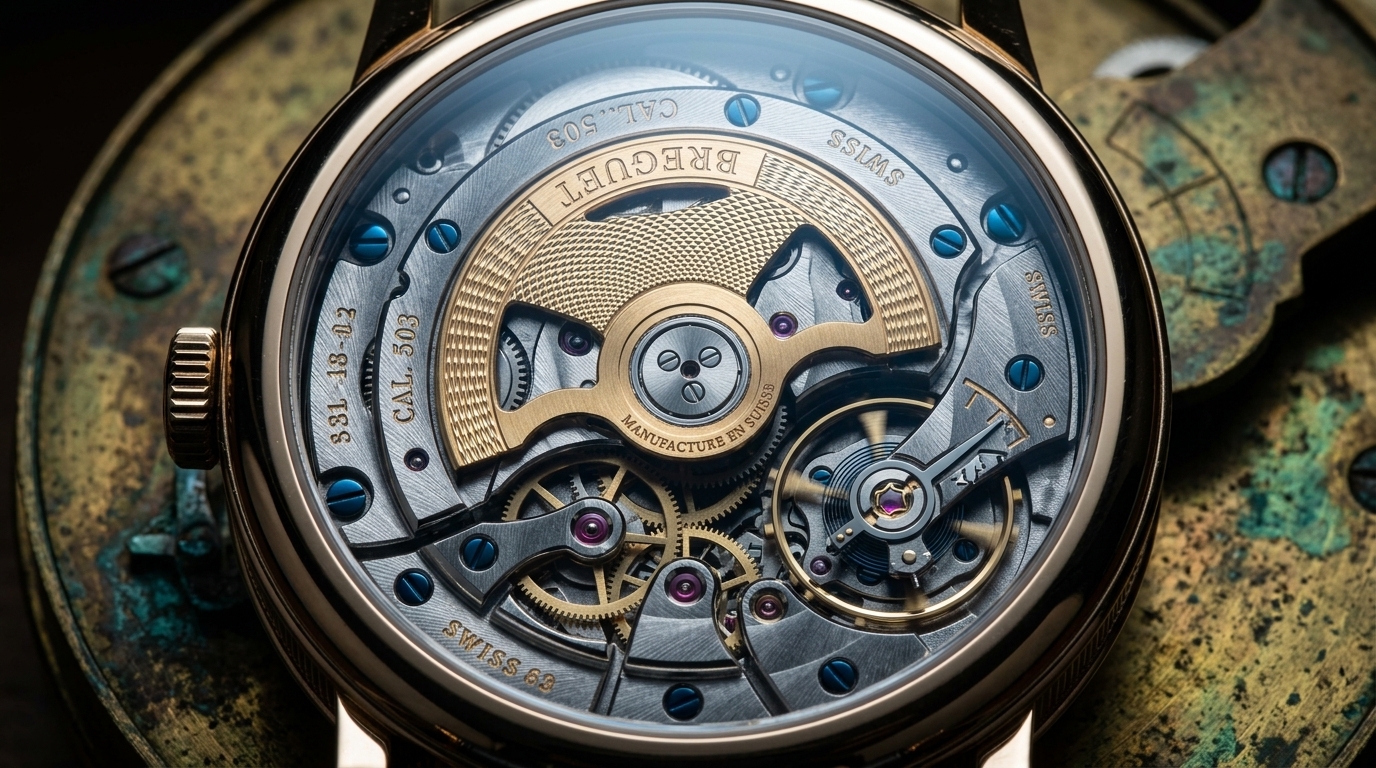
That is why a modern Breguet succeeds or fails in proportion to its discipline. The 7047 is not a quiet watch, but it is a controlled one. Its thickness, its visual depth, the mechanical layering from caseback to crystal, all remind the observer that historical watchmaking was never as slim or frictionless as contemporary memory sometimes imagines. There is weight here, both literal and intellectual. The watch does not try to vanish under a cuff or reduce Breguet to a pair of hands on a clean dial. It asks to be read mechanically, from the stored energy in the barrel to the equalising logic of the fusée, from the rotating tourbillon to the small dial that still insists time remains the purpose.
On the wristwatch scale, such mechanisms become acts of compression. The original tourbillon belonged to pocket chronometry, to observatory seriousness and positional correction. The fusée belonged to clocks, chronometers, and earlier watches built around the uneven temper of a coiled spring. To place both in a wristwatch is not simply to miniaturise old technology. It is to reframe it, to make the old problems visible in a world that has largely solved timekeeping by other means. Quartz solved accuracy. Phones solved distribution. Satellites solved reference time. Mechanical watchmaking survives not because it is necessary in the old sense, but because it continues to make thought tangible.
The danger in saying so is sentimentality. Mechanical watches are not rescued from irrelevance by romantic language alone. They require craft, proportion, and intellectual honesty. A watch such as the 7047 makes a case for itself through the coherence of its choices. Its manually wound nature matters because winding becomes the replenishment of the system one can see. Its power reserve, around two days, is sufficient rather than theatrical. Its cadence is traditional because the animation demands space. Its finishing is neither rustic nor sterile, but somewhere closer to instrument-making: deliberate, precise, touched by hand where handwork clarifies form.
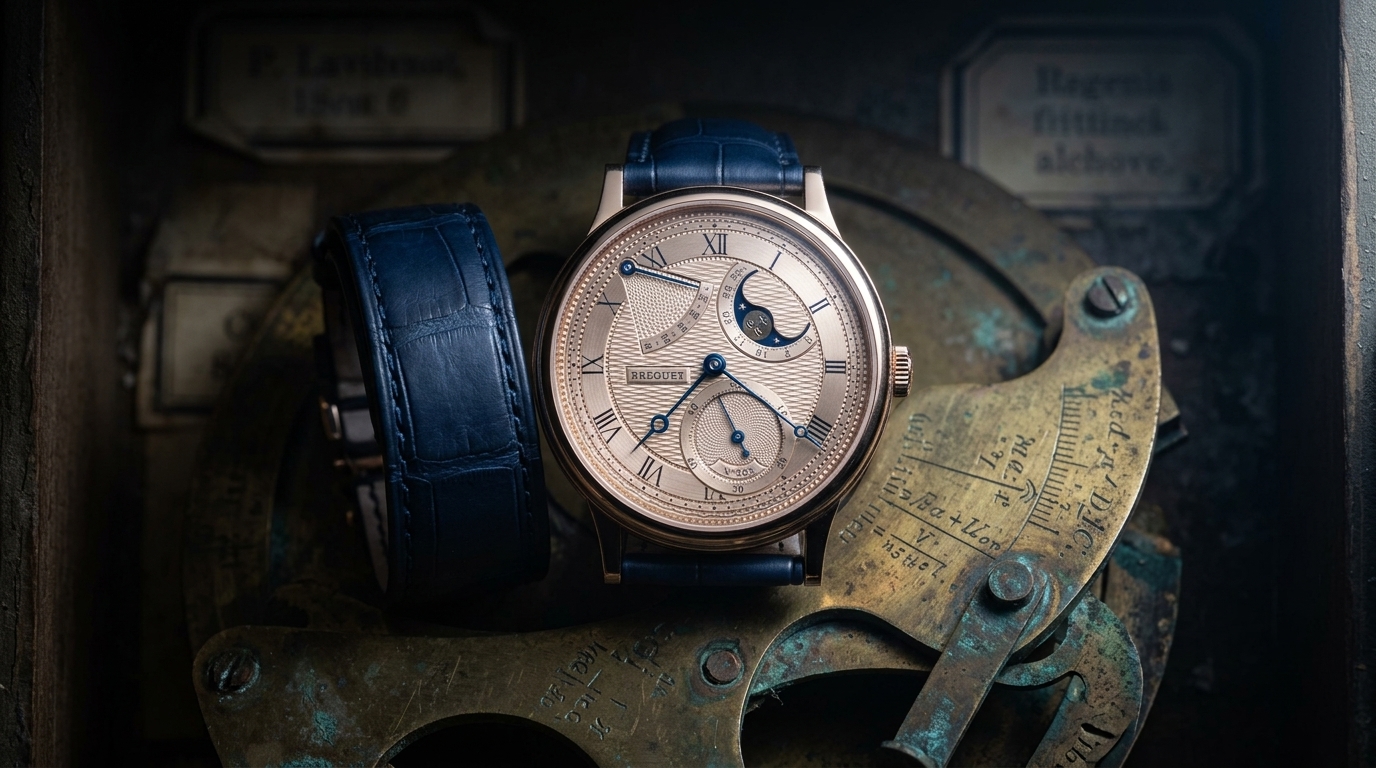
There is another Breguet weight, less discussed but always present: the weight of expectation created by names attached to collectors rather than mechanisms. Napoleon bought Breguet watches. Caroline Murat, Queen of Naples, commissioned what is often described as one of the earliest wristwatches, delivered in 1812. Scientists, diplomats, bankers, and courts all recur in the ledgers. Such history can become suffocating if repeated too often, turning watches into footnotes to famous owners. The better approach is to let the objects restore the balance. Breguet’s importance does not rest on proximity to power. Power came to Breguet because the work had authority.
The Tradition 7047 seems aware of this. It does not need a royal anecdote to justify the chain crossing its dial. It does not need a palace corridor behind the tourbillon. Its drama is horological and internal. Look closely at the way the time display is reduced to a small, almost modest register, and the priorities become clear. The watch tells time, but it also tells the story of timekeeping as a mechanical problem: force must be stored, force must be transmitted, force must be regulated, errors must be averaged, friction must be managed, and all of it must fit within a case small enough to accompany a human day.
That final condition is easy to overlook. The great inventions of horology were not abstract. They had to survive pockets, travel, temperature, shock, neglect, and the imperfect habits of owners. Breguet’s pare-chute, introduced in the late eighteenth century, addressed one of the simplest dangers: the broken balance pivot. A watch dropped onto a hard floor could be ruined. By giving the balance staff a form of elastic protection, Breguet acknowledged that refinement was useless if it could not withstand life. It is a lesson modern complicated watches still negotiate. Complexity must not appear too fragile for existence, even when it is fragile by nature.
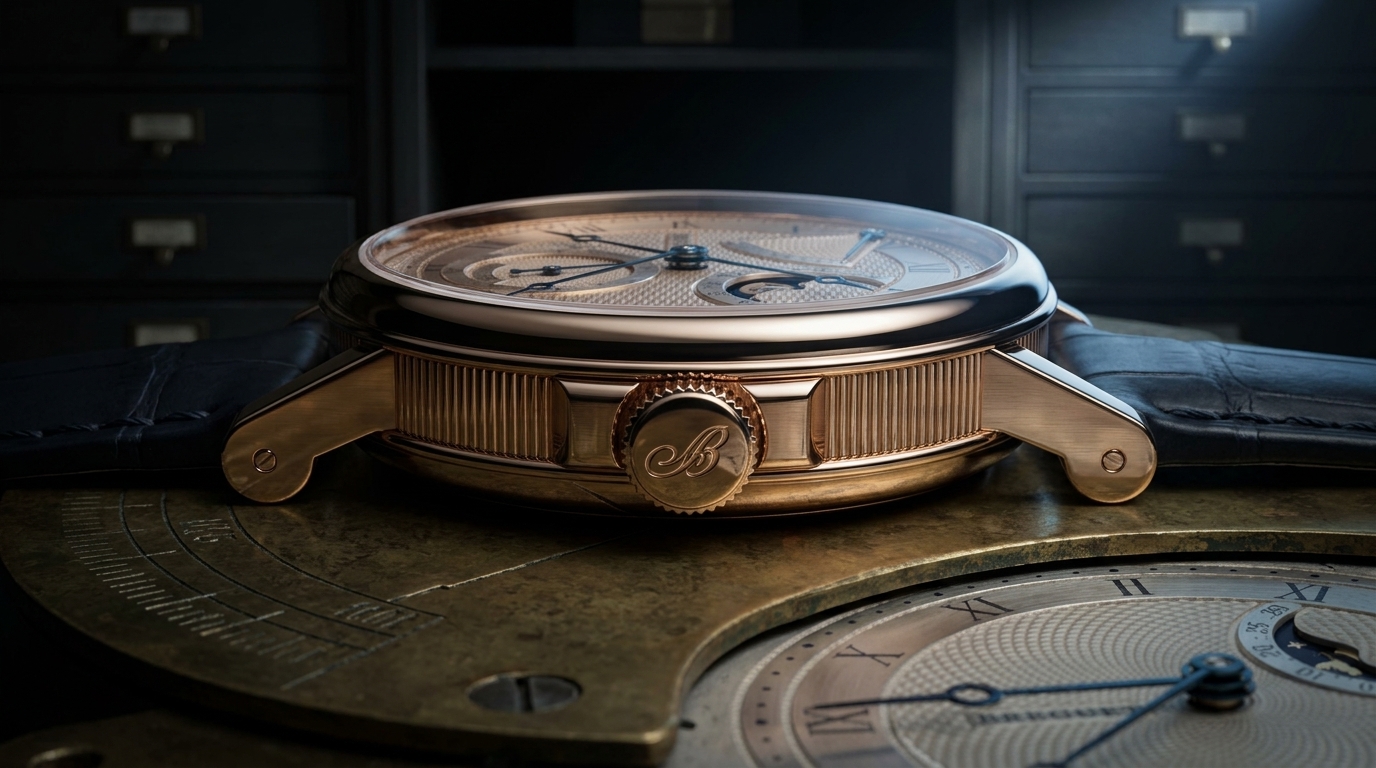
The 7047’s exposed construction makes fragility part of the visual field. Every wheel seems near the surface. Every bridge appears to hold back disorder by fractions of a millimetre. The rotating tourbillon carriage, viewed without the privacy of a closed dial, carries the balance with an almost ceremonial steadiness. The fusée chain suggests tension even when still. This is not the sealed confidence of a three-hand watch, where the mechanism may be imagined but not confronted. Here the owner is asked to live with the machine’s dependence on adjustment, jewel, spring, screw, and tooth.
Such openness can easily become theatrical excess. Many openworked watches mistake exposure for revelation, removing metal until the movement loses grammar. Breguet’s Tradition watches avoid that by preserving architecture. The layout remains legible because components are not merely displayed; they are arranged with functional hierarchy. The eye can follow energy. It can distinguish support from motion, indication from regulation. The result is not transparency for its own sake, but a kind of mechanical literacy.
This literacy is central to Breguet’s continuing relevance. The brand’s most recognisable details—the coin-edge caseband, the straight lugs, the guilloché dial, the secret signatures etched to deter counterfeiters, the hands with their eccentric moons—can be reproduced with ease compared to the difficulty of preserving the original spirit behind them. That spirit was not decorative conservatism. It was restlessness under control. Breguet’s best objects have always seemed to ask whether a watch could be made clearer, safer, more regular, more useful, more exact. The modern manufacture carries that question unevenly, as all historic houses do, but the Tradition line gives it a visible grammar.
The case of the 7047, especially in precious metal, introduces another tension. Gold is soft in meaning as much as material; it can warm a design or burden it. Against the dark mechanical surfaces of the movement, rose gold brings an old Parisian glow, while white gold or platinum cools the watch toward instrumentality. Yet in any metal the proportions must bear the same challenge: to frame complication without turning the wrist into a stage. The 41mm diameter is not small, and the watch does not pretend otherwise. But its size is tied to the mechanism’s need for air. Compressing the architecture further would risk turning comprehension into ornament.
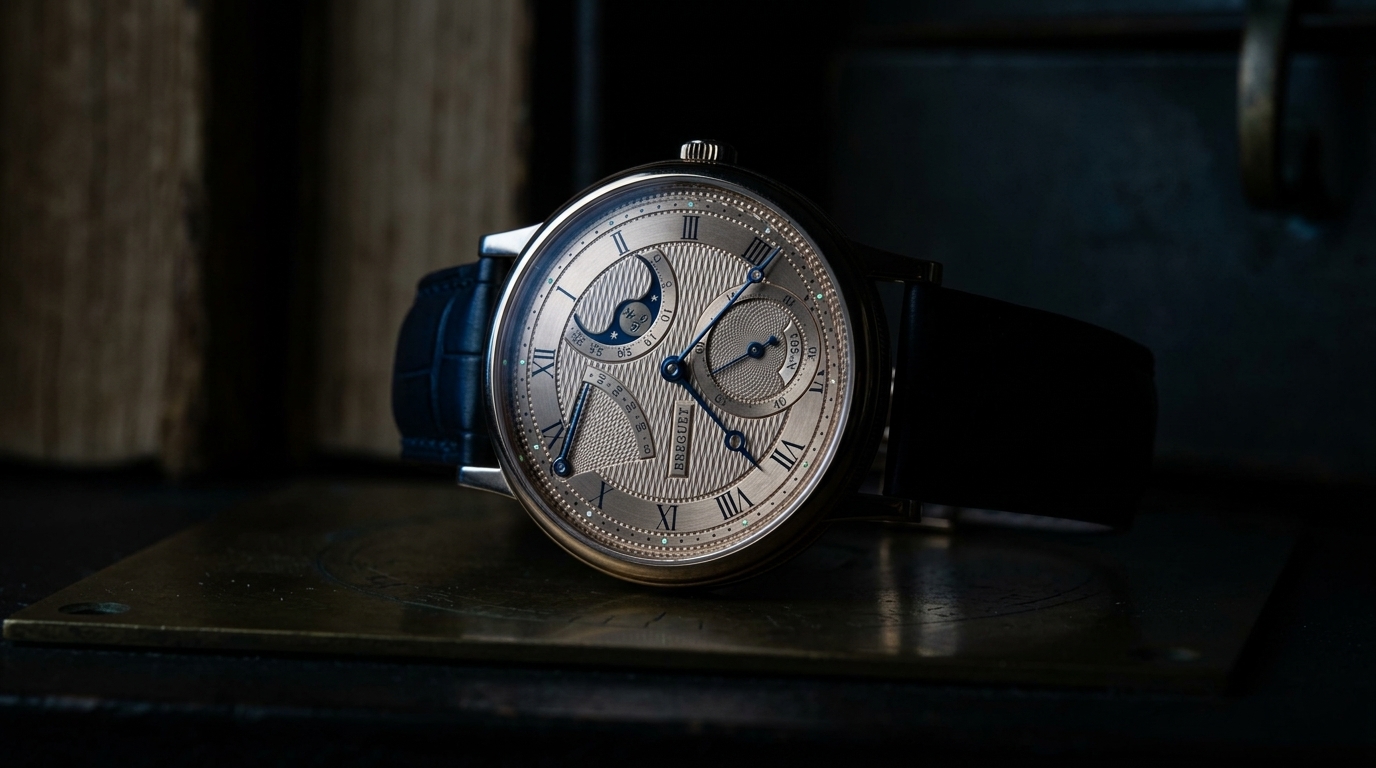
The most powerful thing about the watch may be that it refuses the modern fantasy of effortlessness. Contemporary luxury often tries to erase labour. Surfaces become seamless, tolerances invisible, convenience absolute. The 7047 does the opposite. It makes labour legible. The chain must be assembled. The tourbillon must be poised. The bevels must be drawn cleanly along awkward contours. The dial must remain readable despite being displaced by machinery. The watch does not say that timekeeping is simple; it says that timekeeping is difficult, and that difficulty has a form.
This is the weight of invention: not the invention itself, not the patent drawing, not the anniversary plaque, but the responsibility of carrying an idea forward without flattening it into symbol. The tourbillon has become one of watchmaking’s most overused emblems, frequently detached from its original purpose. The fusée, rarer and more stubborn, can become a nostalgic gesture if treated merely as antiquarian display. Together in the 7047, they recover some of their seriousness because the watch allows the observer to see why they exist. They are not magic. They are mechanical answers to mechanical weaknesses.
Breguet’s name will always invite reverence, and reverence is dangerous. It can dull judgment. It can make every fluted case seem profound and every guilloché dial seem inevitable. But the better Breguet watches withstand a colder gaze. They ask to be judged not only by ancestry but by execution, by whether the old codes still have pressure behind them. In the Tradition 7047, the pressure is visible in steel, gold, silicon, ruby, and brass; in the slow unwinding of stored force; in the cage that turns because gravity once mattered enough to provoke a new geometry.
At the edge of the dial, the hands continue their quieter duty. For all the displayed intelligence around them, they remain responsible for the ordinary answer: the hour, the minute, the portion of the day already spent. This humility is easy to miss. A complicated watch that forgets time becomes sculpture. A Breguet that remembers time, even while exposing the drama behind it, retains a connection to the workshop in which invention was never an end in itself.
The chain continues its small passage. The tourbillon turns. The barrel gives up its strength with measured reluctance. Nothing in the watch is weightless, not the metal, not the history, not the inventions brought forward from another century. Yet the purpose of all that weight is motion. Breguet’s burden, at its best, is not to preserve the past under glass, but to keep it working—link by link, tooth by tooth, one difficult second after another.