Blancpain in 2026: How the Fifty Fathoms and Ultra-Complications Reassert Luxury Watchmaking’s Quietest Power Brand
Blancpain doesn’t behave like a modern luxury brand—and that’s precisely why it still matters. While the industry chases visibility through collabs, waitlists, and viral design cues, Blancpain builds its case in a quieter courtroom: movement architecture, finishing discipline, and category-defining legitimacy that began with the Fifty Fathoms and extends deep into serious complications. The result is a manufacture whose influence is often felt more than it is shouted—an outlier strategy that looks increasingly deliberate in today’s hype-saturated market.
The 2026 Luxury Problem: Attention Abundance, Credibility Scarcity
By 2026, luxury watchmaking’s central contradiction is difficult to ignore. The category has never been louder, more photographed, more algorithmically distributed. And yet the supply of durable credibility—credibility that survives beyond a release cycle—remains scarce. Too many products now lean on external validation: celebrity adjacency, artificial scarcity, instantly readable design signaling, and contrived narratives that vanish the moment the next drop lands.
Blancpain sits almost provocatively outside this system. It does not compete for oxygen in the same way because it does not need the same kind of proof. Its proof is structural. The mythos around the Fifty Fathoms is not simply “heritage,” it is category authorship with technical follow-through. Its capability in classical complications is not a marketing side quest; it is a parallel pillar that has quietly been built into a coherent manufacture identity. In an era where many brands are strategically optimized for maximum attention with minimum explanation, Blancpain remains optimized for maximum explanation even if fewer people ask.
This is “quiet authority” in horology: the power of a brand whose confidence comes from repeatable in-house competence, not from social consensus. And it is increasingly relevant because the market is maturing. Collectors are not abandoning sport-luxury, but they are beginning to demand substance beneath it. Blancpain’s restraint—sometimes mistaken for absence—is better understood as strategic insulation from the attention economy.
The Fifty Fathoms as a Legitimacy Engine, Not a Nostalgia Product
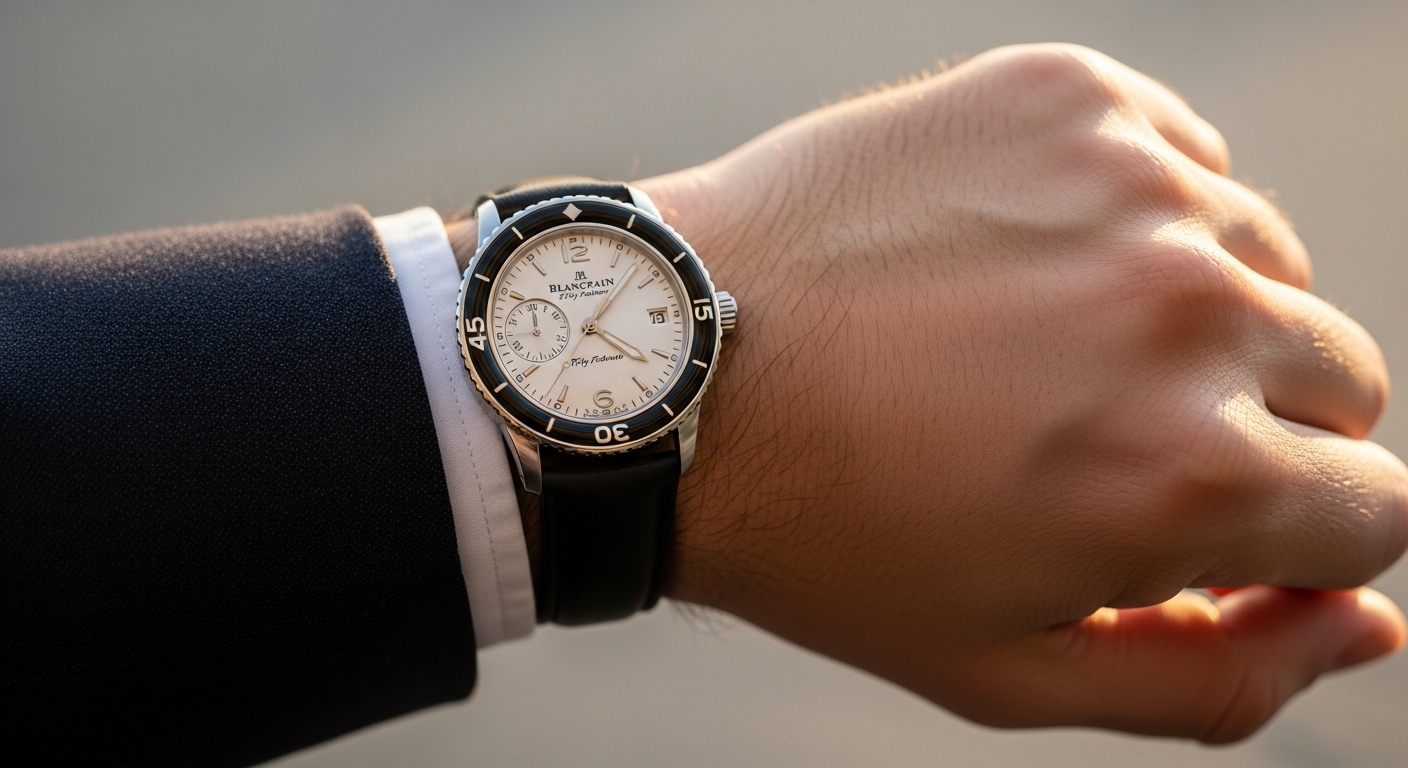
Most brands would kill for a single icon strong enough to anchor a modern portfolio. Blancpain has one, yet uses it differently. The Fifty Fathoms is often discussed as “the first modern dive watch,” but the more important point is what that origin enables today: legitimacy without theatrics. In the crowded 2020s dive-watch field, where design codes collapse into one another and differentiation becomes an exercise in bezel inserts and limited-color dials, Blancpain’s advantage is categorical authorship paired with a continuing technical position.
The Fifty Fathoms is also a case study in how a brand can be present in sport-luxury without being captive to sport-luxury trends. Blancpain has not tried to turn it into an omnipresent, endlessly collabbed canvas. Instead, it treats the line as a platform for excellence and restraint: serious water resistance, robust cases, and movements that prioritize durability and finishing rather than spec-sheet gimmickry. This is not the loud tool-watch posture of mass ruggedness; it is the quieter posture of a manufacture that expects its buyers to understand what they’re looking at.
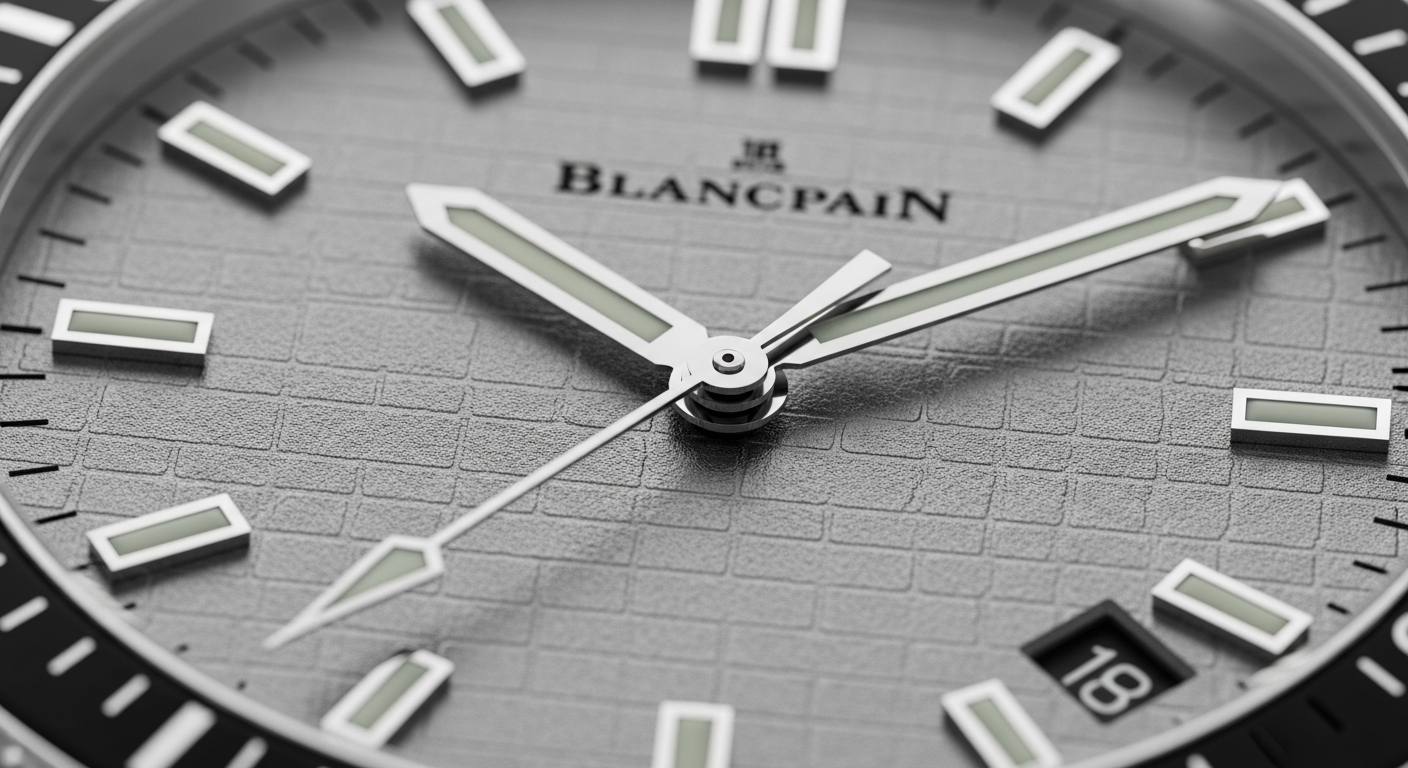
In 2026, that posture is strategically useful. The sport-luxury segment is saturated with watches that can be “recognized” from across a room. Recognition is not the same as respect. Blancpain’s Fifty Fathoms aims for respect first, and recognition second. It occupies a rarer lane: the dive watch as high horology object, where finishing quality and movement seriousness are not optional add-ons but part of the product’s core justification.
Why Blancpain’s Restraint Works: A Brand Built for the Second Look
Blancpain’s competitiveness in 2026 is not about fighting louder brands on their terms. It is about winning the second look: the moment a collector turns the watch over, examines the movement, and decides whether the manufacture’s competence is real. That is where Blancpain is disproportionately strong. Movement architecture and finishing discipline have long been the brand’s quiet argument, and it is an argument that compounds over time.
This is also where “quiet authority” becomes measurable. Plenty of brands can execute a handsome dial, a sharp case profile, an appealing vintage cue. Fewer can build a movement that reads as coherent and intentional—bridges shaped with compositional clarity, finishing that is consistent rather than concentrated only on photo-friendly edges, and a sense that the watch was engineered for longevity rather than for launch-day reviews.
Blancpain’s restraint also avoids one of the era’s biggest strategic traps: overexposure. The more a luxury product is pushed into ubiquitous visibility, the more it risks flattening into a commodity. Blancpain protects itself by remaining slightly less available in the cultural conversation. That “absence” actually functions like a filter, biasing the audience toward buyers who already care about watchmaking as craft. In market terms, Blancpain does not maximize top-of-funnel volume; it maximizes conversion quality.
Ultra-Complications: The Under-Discussed Pillar That Completes the Brand
If the Fifty Fathoms is Blancpain’s legitimacy engine in modern sport-luxury, its complication work is the narrative that makes the brand whole. This is where Blancpain’s identity becomes less about a single icon and more about an entire philosophy: classical watchmaking executed with modern manufacturing discipline.
The industry tends to sort brands into neat buckets—sport icons here, classical complications there. Blancpain refuses that categorization. It builds serious complications without using them purely as halo theater. The packaging is often conservative, even when the mechanics are not. That is consistent with a brand that does not need the complication to behave like a status broadcast.
This matters strategically because complicated watchmaking has become a battleground of spectacle. Too many pieces are designed for immediate digital impact: extreme dimensions, aggressive openworking, brightly colored components, and complication stacking that reads like an engineering résumé. Blancpain’s approach is closer to classical legitimacy: complications integrated into a coherent watch, with finishing and architecture that reward study rather than scrolling.
Collectors who spend time with Blancpain’s higher complications often come away with the same observation: the brand does not chase novelty for novelty’s sake. It aims for completeness—mechanical logic, aesthetic balance, and finishing quality that feels continuous across references. In 2026, as buyers grow more skeptical of “concept watch” fatigue, that completeness becomes an advantage.

Manufacture Credibility in 2026: Architecture, Finishing, and the Discipline of Consistency
Luxury watchmaking is full of claims. Manufacture credibility is about repeatable delivery. Blancpain’s strength is that it can articulate its value without leaning on a single trick. Movement depth remains central—not merely “in-house” as a label, but in-house as a capability: the ability to design, evolve, and sustain families of calibres across categories, from robust everyday pieces to complicated classical works.
Finishing discipline is where the brand’s quiet authority becomes most visible. Not finishing as a one-time flourish, but finishing as a standard. That distinction matters. Many watches photograph well because finishing is concentrated where the camera will go. Blancpain’s better work reads like it was finished for ownership, not for marketing. The collector-level difference is in the less visible areas: uniformity, care in transitions, and an avoidance of “good enough” surfaces that can betray a cost-optimized product.
Consistency is the least glamorous advantage and one of the most decisive. Blancpain’s product lines do not rely on constant reinvention to remain relevant. They rely on stable design language and mechanical seriousness. In volatile luxury cycles, stability is not stagnation; it is brand equity protected from trend risk. A collector buying in 2026 is not simply purchasing a watch, but making a bet on whether the brand’s identity will still look coherent in 2036. Blancpain’s restraint makes that bet easier.
The Competitive Landscape: When Quiet Becomes Contrarian
Blancpain’s strategy becomes clearer when contrasted with prevailing industry playbooks. The dominant model in the mid-2020s has been heat management: controlling supply narratives, creating demand surges through limited executions, and translating cultural visibility into price resilience. There are brands that execute this brilliantly. But the model introduces dependence: the product becomes partially hostage to the attention cycle that sustains it.
Blancpain offers a different proposition. It does not ask the collector to participate in a game of access. It asks the collector to participate in a standard of watchmaking. This is not altruism; it is positioning. Blancpain is effectively saying: if you value mechanics, finishing, and category legitimacy more than social validation, we are one of the few manufactures still speaking your language.
That contrarian posture can look understated in the moment, and that is the point. The market is full of watches that are optimized for the first year of ownership. Blancpain is optimized for the tenth. The Fifty Fathoms, in particular, has the rare ability to feel both historically grounded and contemporary without needing to shout. Its authority is embedded, not applied.
What to Watch in 2026: Where Blancpain’s Advantage Can Expand
Blancpain’s path forward is not about becoming louder. It is about being more legible to the right audience without compromising the core temperament that makes it valuable. There are three areas where the brand’s quiet authority can translate into clearer market strength.
First, continued refinement of the Fifty Fathoms as a modern sport-luxury benchmark. The opportunity is not to multiply variants indiscriminately, but to keep the line technically current while preserving its seriousness. The Fifty Fathoms should remain a watch that feels engineered, not themed. If Blancpain maintains that discipline, it will continue to attract collectors who want a dive watch with real horological dignity rather than a lifestyle prop.
Second, a more connected narrative between sport legitimacy and complication legitimacy. Blancpain already has both; the strategic move is to make the bridge more explicit through product coherence and communication that remains technical rather than theatrical. The brand is strongest when it treats complications as an extension of its identity, not a separate museum wing.
Third, leaning into long-horizon trust. In a market where many brands treat their customer base as an audience, Blancpain can treat its customer base as stewards—owners who keep watches, service watches, and build collections across decades. This favors aftersales seriousness, parts continuity, and mechanical platforms designed to endure. Quiet authority is not just how the watch looks; it is how the brand behaves after the sale.
Conclusion: The Quietest Power Brand Is Still a Power Brand
Blancpain’s relevance in 2026 is not a comeback story. It is a case study in strategic restraint. The brand has resisted the industry’s prevailing temptation to convert every asset into visibility. Instead, it continues to convert heritage into present-tense proof: the Fifty Fathoms as a living legitimacy engine, and a deep bench of classical complications that confirm the manufacture’s seriousness beyond sport-luxury.
“Quiet authority” is often used as a vague compliment in watch culture. With Blancpain, it can be read as an operating system. The brand’s power is not that it is everywhere. Its power is that when you pay attention, it delivers. And in a market increasingly saturated with noise, that form of power may be the last one that still compounds.