Baltic and the Modern Appetite for the Almost-Familiar
The watch appears first as a shape before it becomes a name: a round case with thin shoulders, a dial that seems to have been recalled rather than designed, numerals that carry the echo of another decade without being able to prove their origin in court. A Baltic often enters the room this way, not as a singular shock, but as a small disturbance in recognition. Something in it has been seen before. Something in it has not.
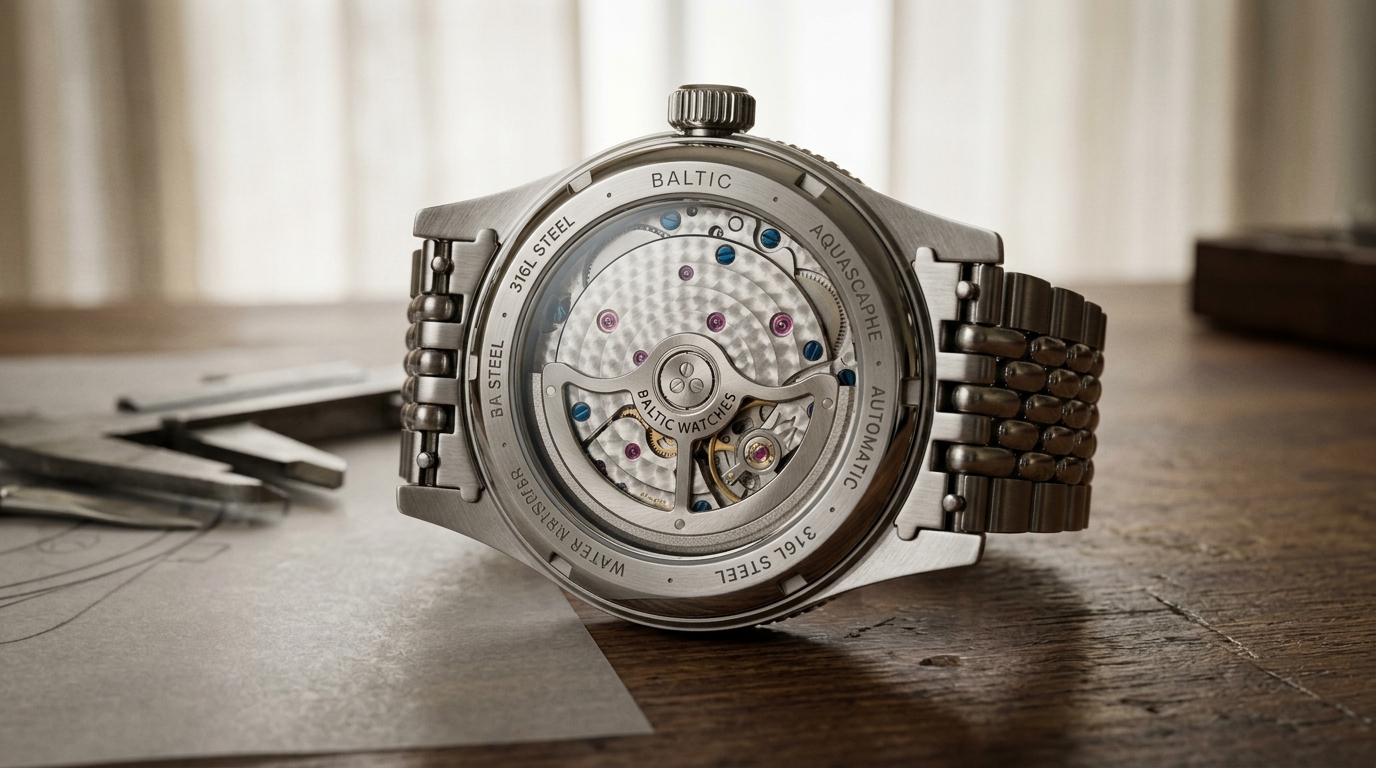
That is the particular territory Baltic has made its own. Not the replica, with its anxious fidelity. Not the avant-garde object, determined to escape lineage. The brand works in the softer, more dangerous middle ground where a watch can feel inherited even when it is new, where a sector dial can summon the order of the 1930s, a beads-of-rice bracelet can carry the temperature of mid-century steel, and a micro-rotor glimpsed through a caseback can make an affordable watch behave, for a moment, as though it had slipped loose from a vitrine in Geneva.
Baltic was founded in 2017 by Etienne Malec, and its story is by now well enough repeated to have acquired the polish of a family object: a son, his father’s watch collection, an affection for the mechanical grammar of earlier wristwatches. It is a neat origin, perhaps almost too neat, but the watches themselves have always been more persuasive than the anecdote. From the beginning, Baltic understood that vintage taste had changed. Collectors no longer wanted only the battered original, with radium-darkened plots and crowns polished down by other men’s fingers. Nor were they satisfied with large corporate reissues, those museum pieces with modern water resistance and the smooth manners of a legal department. There was a different hunger forming: for watches that carried resemblance lightly, that could suggest an archive without being trapped inside one.
This hunger says a great deal about contemporary watch enthusiasm. The modern collector lives amid images. A 38mm chronograph from the 1940s can be studied in high resolution on a phone in bed. A tropical gilt dial, once the private spoil of a few dealers and auction rooms, circulates endlessly. The past has become searchable, comparable, enlarged. Yet the real past is often difficult. It is fragile, expensive, compromised. A vintage watch may have a redial, a tired movement, a case softened by decades of careless refinishing. It may require knowledge that punishes the lazy and luck that rewards the reckless. The almost-familiar watch offers another route. It provides the silhouette of memory without the burden of complete historical ownership.
Baltic’s early Bicompax models made this proposition clear. A two-register chronograph is never innocent. It brings with it the dust of sector dials, telemeter scales, railroad minutes, and the long pre-war discipline of balanced subdials. Baltic’s Bicompax did not pretend to be a lost Longines or Universal Genève; its restraint was more interesting than that. With its compact case proportions, its hand-wound Seagull ST1901 visible beneath the back on some versions, and its careful dial architecture, it presented a familiar genre at a modern point of access. The ST1901 itself carries an unusual kind of history: a Chinese-made movement descended from the Venus 175 tooling acquired in the 1960s, a mechanically charming column-wheel chronograph whose journey from Switzerland to Tianjin complicates simple ideas of provenance. Inside a Baltic, it becomes part of the brand’s larger method. Heritage is not treated as a single bloodline. It is assembled, translated, made portable.
The same can be said of the HMS, whose name—Heure, Minute, Seconde—almost refuses poetry. Yet the watches often find it anyway. The HMS line has explored sector layouts, applied numerals, and clean three-hand forms with a certain old-world symmetry, usually housed in diameters that resist the swollen habits of the early twenty-first century. The point is not merely that these watches are smaller. It is that they understand why smaller watches feel different. A 38mm case with narrow bezel and long, calm indexes changes the relationship between dial and wrist. It leaves air around the object. It asks less of the room. It remembers an era when a watch did not need to announce that it was mechanical because mechanical timekeeping still formed the background of ordinary life.
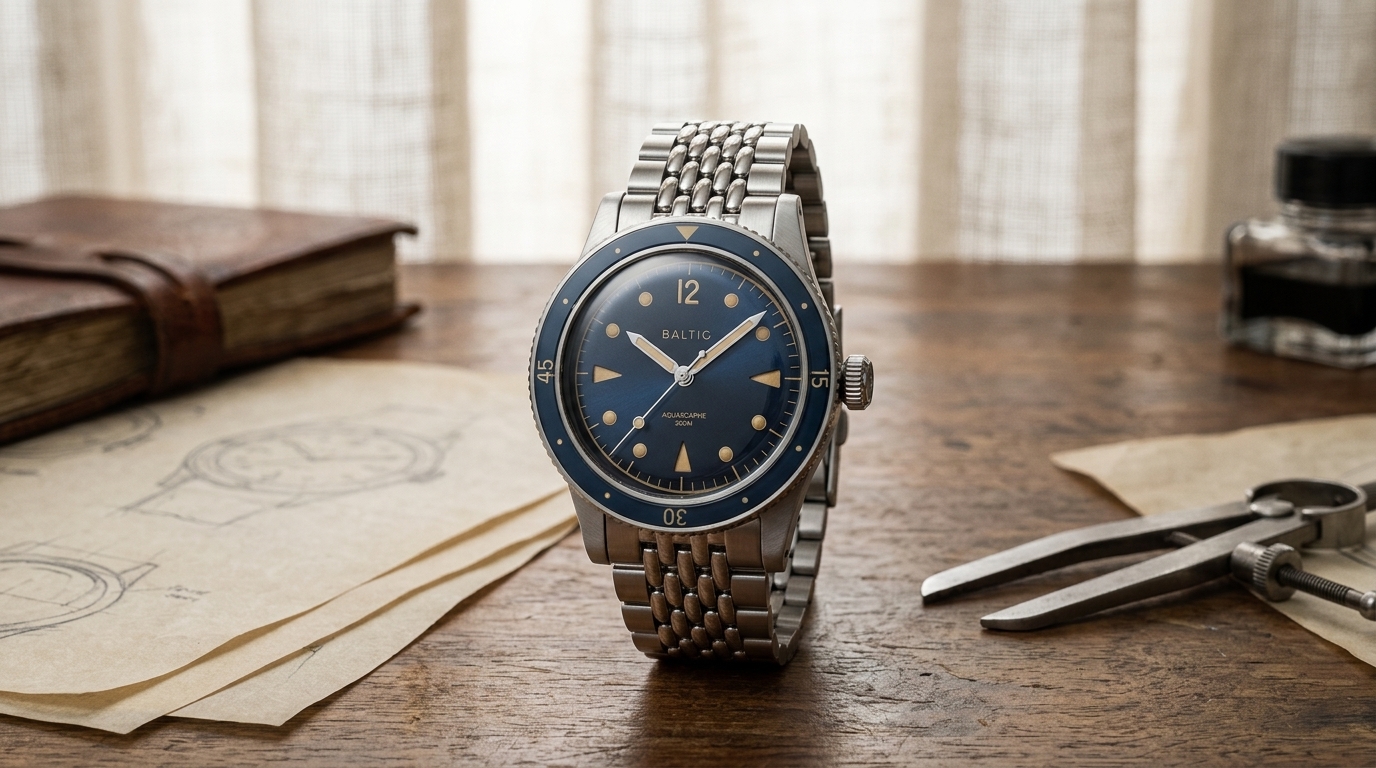
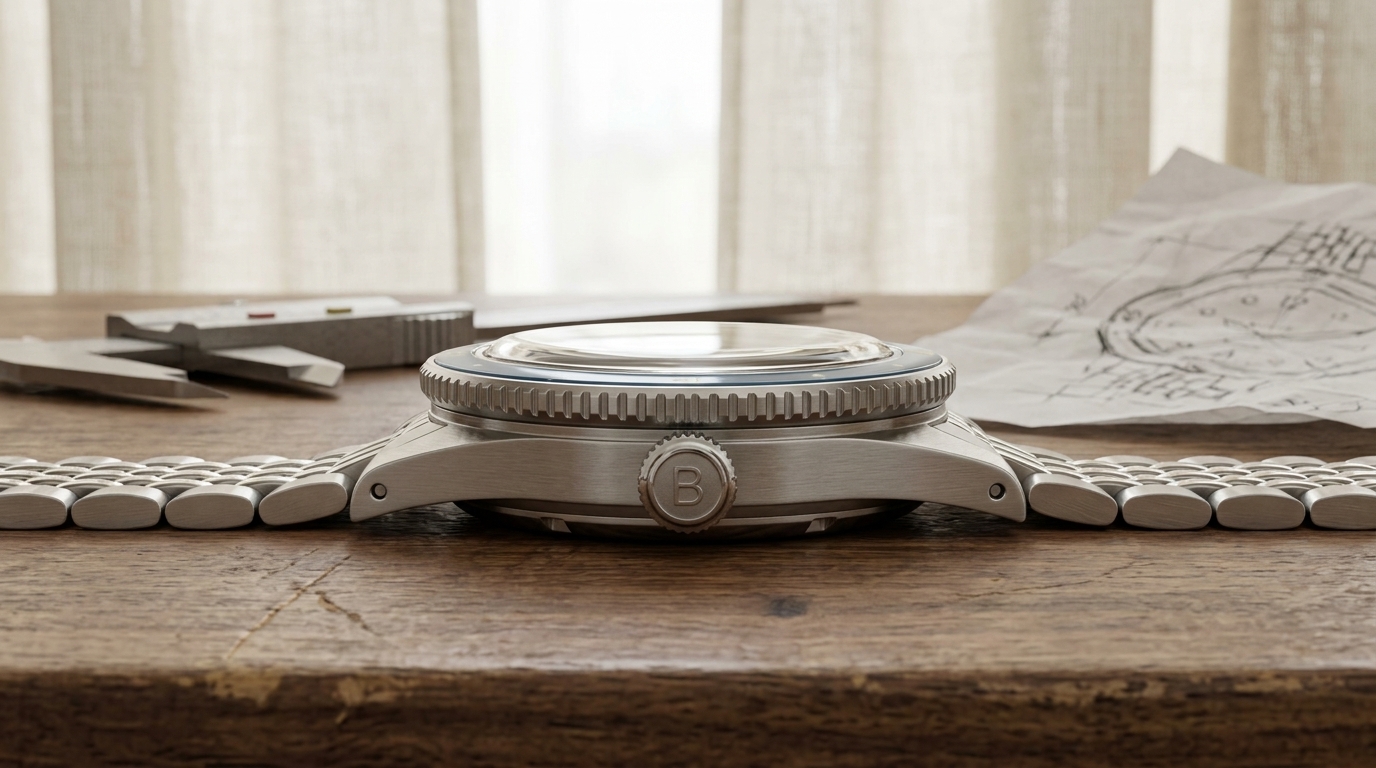
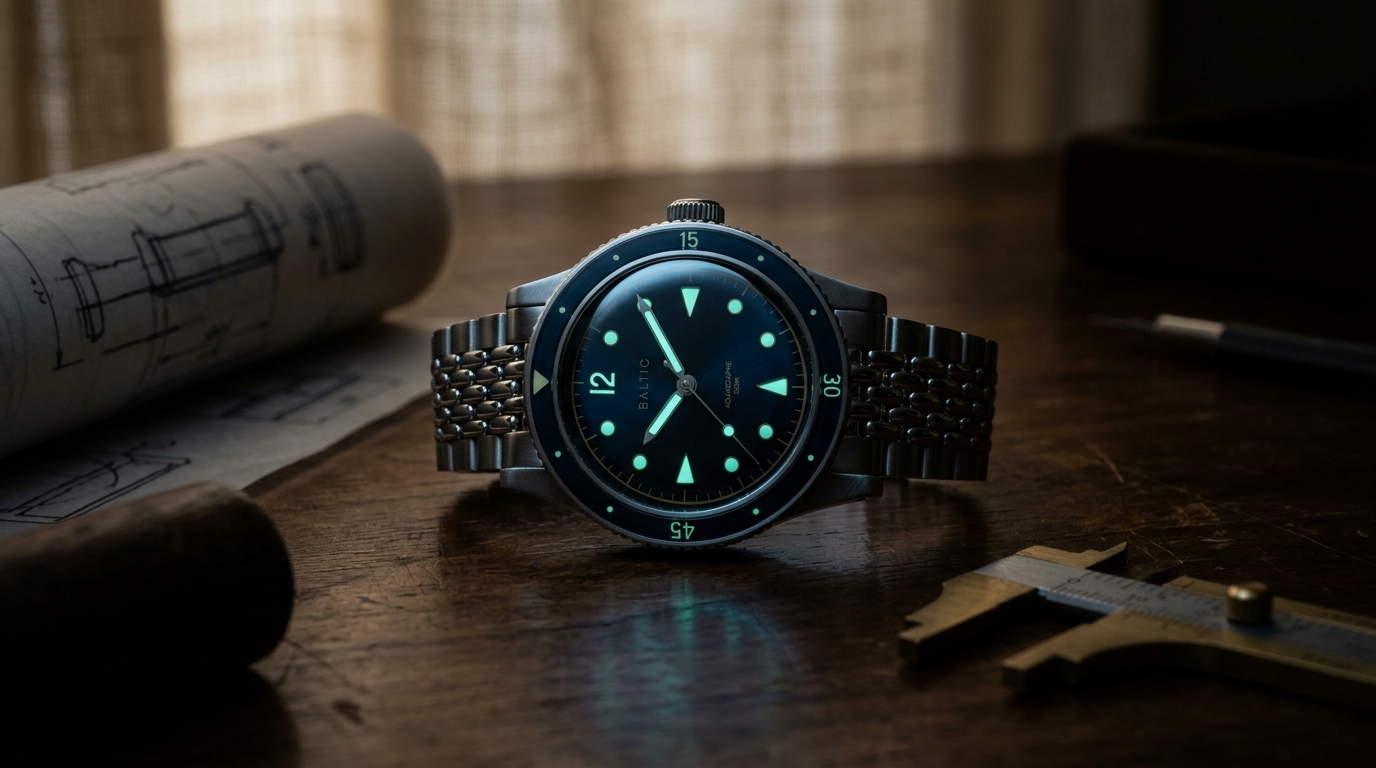
Baltic’s success depends on this ability to evoke practical antiquity. Its watches rarely feel like costume because they avoid the most theatrical forms of aging. The lume may be warm, the numerals may bend toward old typefaces, but the watches are not generally smeared with fake patina or burdened by anachronistic drama. Their cases are modern in manufacturing, their crystals often sapphire, their tolerances contemporary enough to be worn without indulgence. The Aquascaphe, perhaps the brand’s most recognizable model, is an instructive example. It belongs to the line of skin divers and early recreational dive watches: rotating bezel, legible dial, compact case, enough water resistance to take the romance seriously. Yet at roughly 39mm, with a restrained thickness and a Miyota 9039 automatic movement doing its quiet work inside, it avoids the inflated heroics of many modern divers. It looks backward, but it does not require the wearer to become a character in a naval film.
That distinction matters. Vintage inspiration is often discussed as though it were a visual category, a mood board of domed crystals, gilt accents, and serif numerals. But in watches, the past is also a matter of proportion. A bezel too wide, a lug too blunt, a date window inserted without discipline, and the spell fails. Baltic’s best watches are not always original in image; they are original in calibration. The Aquascaphe’s sapphire bezel insert can catch light with the glassy depth associated with bakelite, but it does so without demanding special care. Its beads-of-rice bracelet nods toward mid-century fitted bracelets while accepting the modern expectation of solidity. The watch is neither artifact nor simulation. It is a contemporary watch wearing the memory of a tool.
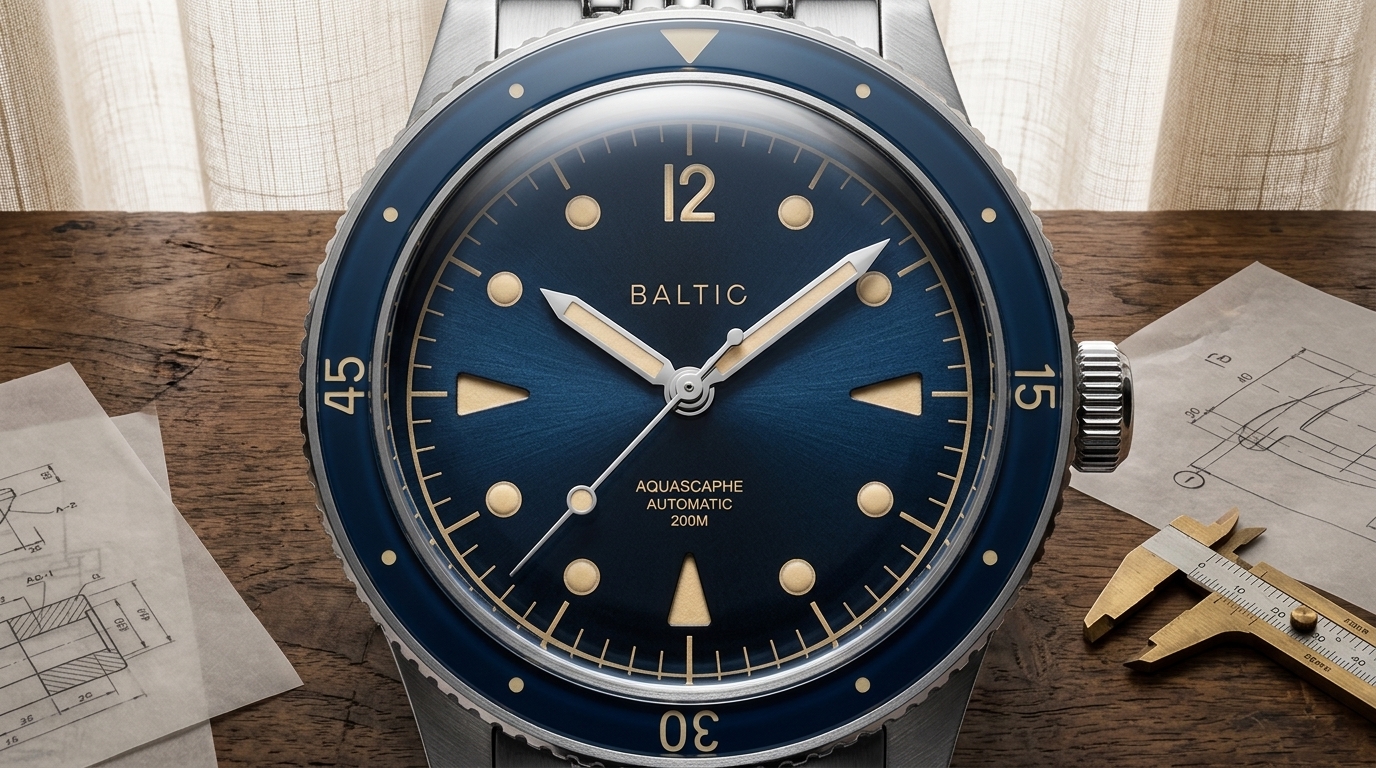
This is the appetite the title suggests: not for the familiar, but for the almost-familiar. The distinction is small and decisive. The familiar satisfies quickly. It confirms what the eye already knows. The almost-familiar lingers because recognition remains incomplete. Baltic often places its watches in that interval. A dial may recall Patek Philippe sector designs, but the case, movement, price, and context alter the sentence. A chronograph may suggest the golden age of two-register instrument watches, but its Seagull movement tells a history less often romanticized in Swiss auction catalogues. An MR01 may carry the air of Breguet numerals and small-seconds dress watches, then overturn expectation with a micro-rotor movement sourced from Hangzhou, visible through the back, its architecture improbable at the price and faintly dreamlike in scale.
The MR01 may be the purest example of Baltic’s gift and its risk. On the dial side, it is tender with references: leaf hands, applied Breguet-style numerals, a minute track of fine dots, a small seconds register that seems to settle slightly below center with the poise of a much older dress watch. The case, around 36mm, reinforces the impression. This is a size that today feels deliberate, almost ideological, in a market still haunted by bulk. Turn the watch over, and the story changes. The Hangzhou micro-rotor calibre is not finished like a Geneva prestige movement, and it would be foolish to pretend otherwise. But it offers the visual pleasure of off-center winding mass, bridges, screws, and motion arranged in a format normally associated with watches several economic floors above. The pleasure is not deception. It is access to an idea.
That access has always been central to Baltic’s position. The brand emerged alongside the rise of microbrands, crowdfunding, direct-to-consumer releases, and online communities that made enthusiasm faster and more democratic. In another period, a person drawn to sector dials, mechanical chronographs, or compact dive watches might have needed either inheritance or money. Baltic arrived with a different bargain: historically literate design, mechanical movements, moderate dimensions, and prices that turned curiosity into possibility. This has earned the brand genuine admiration, but also a particular scrutiny. When a modern watch borrows openly from the past, every curve becomes debatable. How much resemblance is intelligence? How much is convenience? Where does homage end and imagination begin?
Baltic’s answer has not been consistent in every model, and that imperfection is part of what makes the brand worth considering seriously. Some watches lean heavily on familiar codes. Some dial colors or layouts can feel like they were chosen because the market had already proved them safe. But the stronger pieces show how reference can become language rather than quotation. The Prismic, for instance, moves away from the simplest idea of vintage charm. Its faceted case, use of brushed and polished surfaces, and manually wound ETA Peseux 7001 movement suggest a more deliberate attempt to explore dress-watch architecture rather than merely dress-watch nostalgia. The Peseux 7001 is thin, long-lived, and historically respected; in a slim watch it matters not as trivia, but as structure. It permits a certain flatness on the wrist, a relationship between case and cuff that thicker automatics often lose.
In such watches, Baltic seems less interested in recreating a specific reference than in restoring certain sensations that modern watchmaking has neglected: thinness, modesty of diameter, legibility without shouting, decoration that does not confuse itself with opulence. These sensations are not accidental. They belong to a period when the wristwatch was still negotiating its identity between jewelry, instrument, and miniature machine. Contemporary luxury has often exaggerated all three. The instrument becomes oversized theater. The jewelry becomes brand posture. The machine disappears behind closed backs and slogans. Baltic, at its best, reduces the volume until the original grammar can be heard again.
The finishing tells its own story. No one would mistake most Baltic cases for the elaborate hand-work of old high horology. The brushing is industrial, the polishing clean, the movements selected as much for feasibility as romance. But this, too, protects the watches from overstatement. They do not ask to be judged by standards they cannot meet. Their appeal lies elsewhere: in the crispness of a printed track, the proportion of a subdial, the restraint of a crown, the slight dome of crystal over a dial arranged with care. The watcher’s eye moves over them not to find miracles, but to find decisions. More often than not, the decisions have been made with attention.
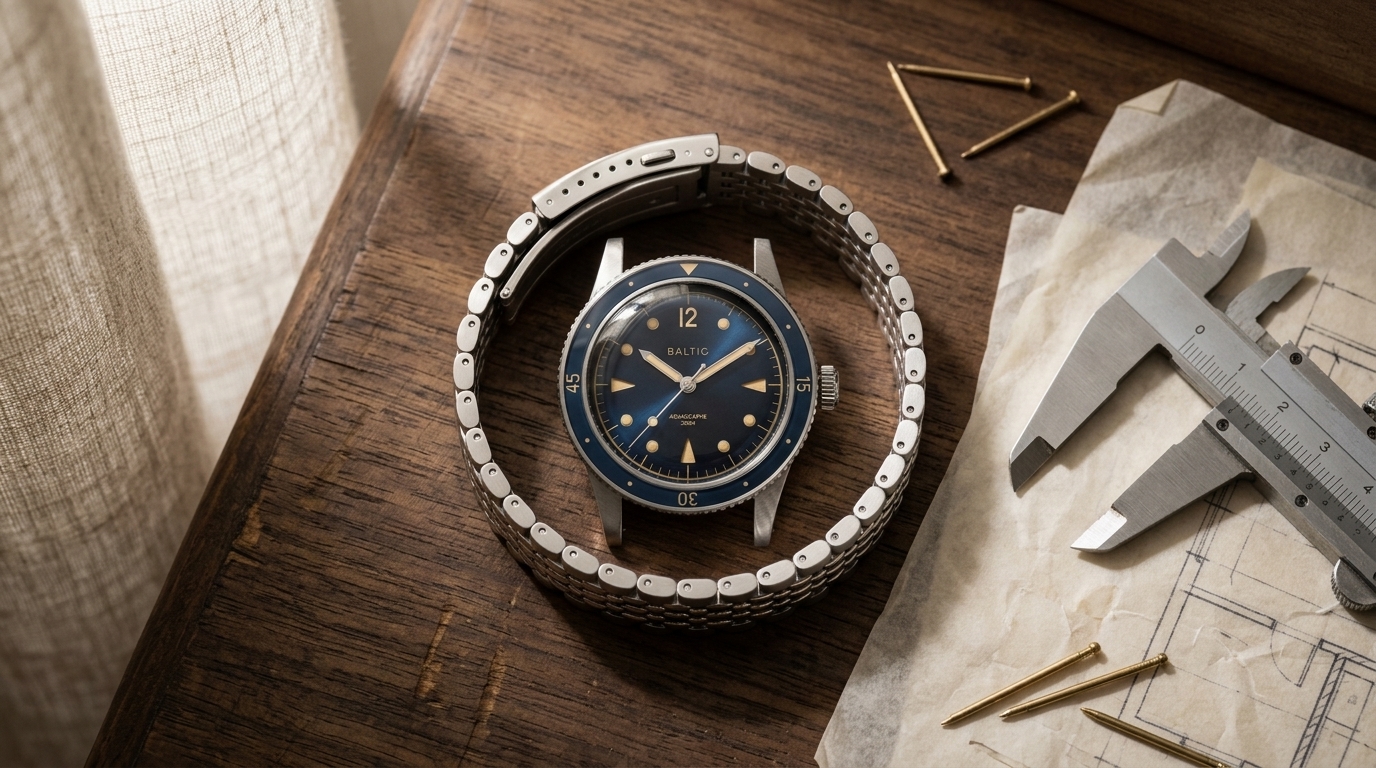
There is a broader cultural reason this attention resonates. Modern life is full of objects that are frictionless and placeless. A phone looks like every other phone after the screen wakes. A car dashboard becomes software. A bank card, a laptop, a wireless earbud: each tends toward the same sealed anonymity. Mechanical watches have become desirable partly because they resist that erasure, but the desire is not always for grandeur. Sometimes it is for scale, tactility, and a sense that an object belongs to a lineage of use. Baltic provides the outline of such lineage without requiring the purchaser to master the anxieties of vintage collecting. The watch can be wound. The bezel can be turned. The seconds hand can be followed around a dial whose design seems to have existed before the present owner and will likely outlast the present software cycle.
Still, the almost-familiar is never innocent. It depends on collective memory, and collective memory is easily flattened. One must ask what happens when the past becomes a set of purchasable cues. Gilt print, sector lines, syringe hands, beads-of-rice bracelets, domed crystals: these elements can become a costume trunk if used without necessity. Baltic’s challenge, as it matures, is to keep its historical language from hardening into formula. The brand has already shown signs of movement beyond simple vintage revival, but its audience often desires precisely the comfort of recognition. Commercial success may pull it back toward the known. Serious design may require it to stay slightly ahead of that comfort.
The best Baltic watches seem aware of this tension. They do not sever themselves from the archive; they tilt the archive. The MR01’s Chinese micro-rotor beneath a classically European face is, in its quiet way, a more contemporary object than a straightforward Swiss homage would be. The Bicompax’s ST1901 movement, with its Venus ancestry and Tianjin production, turns mechanical history into migration rather than purity. The Aquascaphe’s vintage skin-diver profile paired with modern sapphire and 200 meters of stated water resistance makes practicality part of the memory. These are not radical gestures. They are small displacements, but small displacements are often where modern watch design becomes interesting.
It is tempting to frame Baltic as a gateway brand, and in a commercial sense that may be true. Many enthusiasts discover mechanical watches through objects that teach them to look: to notice lug width, case thickness, hand length, movement architecture, dial balance. Baltic offers an education in these matters without the severity of rarefied collecting. But the phrase “gateway” can sound dismissive, as though the watches are merely stations on the way to better things. That misses the character of the achievement. A modestly priced watch that sharpens the eye has its own dignity. It may remain satisfying not because it is the last watch one could ever want, but because it preserves the first reasons anyone cared.
The question of value follows Baltic everywhere, because price is one of the brand’s materials. A watch is never only design and mechanics; it is also the meaning created by what it asks in exchange. Baltic’s watches occupy the zone where desire can remain somewhat light. They are not disposable, but neither do they demand the solemnity of major acquisition. This affects how they are perceived. The owner of an expensive vintage chronograph may become its custodian, anxious about rain, service parts, theft, and originality. A Baltic chronograph, by contrast, can carry the image of that world while remaining usable in daily life. Its scratches would not be historical tragedy. Its maintenance would not require negotiation with a specialist in extinct components. The almost-familiar becomes not only an aesthetic mode, but a practical ethics of wearing.
There is a French quality to the project, though not in any lazy national sense. It appears in the acceptance of style as a serious matter, the belief that proportion and reference can carry thought without heavy explanation. Baltic is based in Paris, and while its components and movements come through the international channels that define contemporary watchmaking, the watches often have the composure of objects edited rather than engineered into personality. They resist aggression. Even when they borrow from tool watches, they do not usually indulge in machismo. Their dive watch is compact. Their chronograph is measured. Their dress watch is small enough to be vulnerable. This vulnerability is part of the charm, though charm is a word that must be used carefully around watches. It can excuse too much. In Baltic’s case, it more often describes a controlled lightness.
To consider Baltic closely is to see how modern horology has changed around the edges. Prestige once moved downward from the great houses: complications, hand finishing, precious metals, names printed on dials with old authority. Now influence also moves sideways, through forums, auctions, archival photographs, independent brands, and enthusiasts who know enough to be particular but not always enough to be doctrinaire. Baltic understood this environment early. It made watches for people who recognized references before they could afford originals, and for people who preferred a living interpretation to a fragile relic. It turned connoisseurship into a more casual pleasure without emptying it entirely of substance.
The danger for any brand built on memory is that memory becomes decoration. Baltic’s future will depend on whether it continues to find tension inside its own formula. More original cases, better-integrated bracelets, movements chosen for more than novelty, dials that risk unfamiliarity as much as they court recognition: these are the paths by which the brand could deepen. The appetite for the almost-familiar will not disappear. If anything, it will grow as the past becomes ever more visible and the present ever more diffuse. But the watches that endure within that appetite will be those that understand resemblance as a beginning, not an endpoint.
For now, the most compelling Baltic is still that first visual hesitation: the watch seen at a glance, half-known, quietly refusing to resolve into a single ancestor. A sector line leads the eye backward. A crown, a handset, a polished bevel interrupts the route. The movement beneath the back tells a different geography from the dial above it. The case sits in a size that feels recovered from a period before watches became screens for status. Nothing about it is untouched by reference, but little about it is merely copied. It stands in the narrow band between recollection and invention, where the modern watch lover so often lives.
That band is not a compromise. It may be one of the defining spaces of watchmaking now. In an era when originality is frequently confused with strangeness, and heritage with repetition, Baltic has found value in the near-known. Its watches speak in borrowed accents, certainly, but they do not always repeat borrowed sentences. They remind the observer that the history of wristwatches was never a straight line of masterpieces, but a crowded field of forms, suppliers, movements, cases, and habits passing across borders and decades. To make something new from that field is not to escape the past. It is to arrange memory until it ticks again.