Ball Watch Company and the Question of Trust in a ‘Railroad’ Watch

At 4:47 in the afternoon on an April day in 1891, two trains met where they should not have met, on a single track outside Kipton, Ohio. The place was not grand enough for myth: a rural station, telegraph wires, cinders, timber, the blunt physics of steel moving on schedule. One engineer’s watch had stopped for four minutes and then begun again, carrying its error invisibly forward. In railroad time, four minutes was not a small private mistake. It was distance, authority, collision.
From that wreck came the central moral claim of the Ball Watch Company: that a watch could be trusted not because it looked handsome, or because a gentleman carried it, but because a system stood behind it. Webb C. Ball, a Cleveland jeweller and watch inspector, was appointed to bring order to railway timekeeping on the Lake Shore and Michigan Southern Railway. His task was not to invent railroad punctuality; railroads had already forced North America into standard time zones only a few years earlier, in 1883. His task was narrower and more severe. He had to make sure the men who moved trains carried watches that could be inspected, regulated, recorded, and believed.
That is why Ball occupies a peculiar place in horology. It is not remembered first as a manufacture in the old Swiss sense, nor as a house of lavish finishing, nor as the source of a single canonical calibre. Its fame comes from supervision. Ball watches were often made by others — Waltham, Elgin, Hamilton, Illinois, Howard — and marked, adjusted, inspected, or distributed under standards associated with Ball’s railroad service. The authority lay in the requirement, not merely in the dial signature. A railroad watch had to be legible in poor light, set safely so the hands could not be moved by accident, adjusted to positions and temperature, fitted with a dependable escapement and enough jewels to reduce wear where wear mattered. It was an object of discipline before it was an object of taste.
The old American railroad watch is one of the few timepieces whose design language can be traced directly to consequences. The open-face case placed the pendant at twelve so the watch could be read naturally in the hand. The white dial resisted gloom and soot. Heavy Arabic numerals made no concession to decoration. The minute track was exacting, sometimes almost severe, because trains were not dispatched by moods. Lever setting required the bezel to be opened before the hands could be adjusted, an inconvenience chosen to prevent a worse inconvenience. These watches did not ask to be admired. They asked to be checked.
In that context, the modern Ball wristwatch enters under a burden. The word “railroad” now carries romance as much as regulation. It summons lamps in depots, enamel signs, conductors’ chains, the black mouth of a tunnel. A watch can borrow that atmosphere easily. Trust is harder to borrow. The question surrounding a contemporary Ball is therefore not simply whether it is well made, nor whether it keeps adequate time. It is whether a brand whose original authority came from public standards and inspection can still make a convincing claim in a private age, when the owner is more likely to cross time zones in an aircraft cabin than stand beside a telegraph key waiting for clearance.
The company’s present watches answer in a language that is at once modern and stubbornly literal. They are Swiss-made, mechanical, usually robust, frequently equipped with self-winding movements derived from familiar ETA or Sellita architecture, and often certified by COSC when the reference calls itself a chronometer. Ball gives these movements its own calibre designations — names such as RR1103 and its variants appear often — but the underlying truth is not exotic. The 28,800 vibrations per hour, hacking seconds, automatic winding, date work, and practical serviceability belong to the broad Swiss industrial tradition. This is not a weakness by itself. Railroads were never interested in rarity for its own sake. They wanted repeatability, repairability, and known performance.
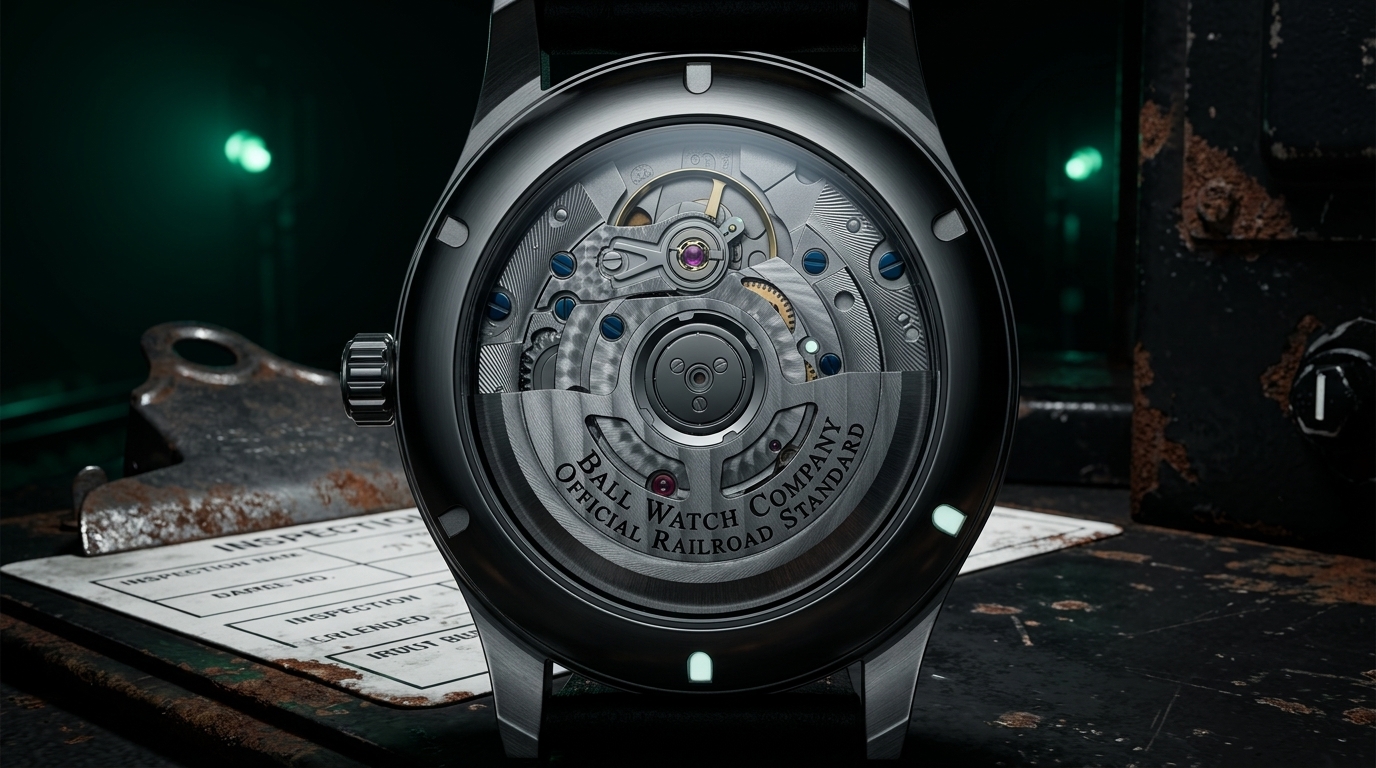
One sees this most clearly in watches such as the Engineer III Marvelight Chronometer, the Trainmaster Standard Time, or the various Engineer Master and Roadmaster models that carry Ball’s contemporary identity. The cases are commonly steel, sometimes around 40 millimetres, sometimes larger, with water resistance and shock resistance stated in clear engineering terms rather than poetic ones. The bracelets tend to be solid, the crowns easy to grasp, the casebacks either engraved or fitted with sapphire displays depending on the model. The finishing, when visible, is industrially neat: striped rotors, perlage, polished screws or bevelled edges where the movement supplier and price point allow. It rarely pretends to Geneva aristocracy. That restraint is, in its better moments, appropriate.
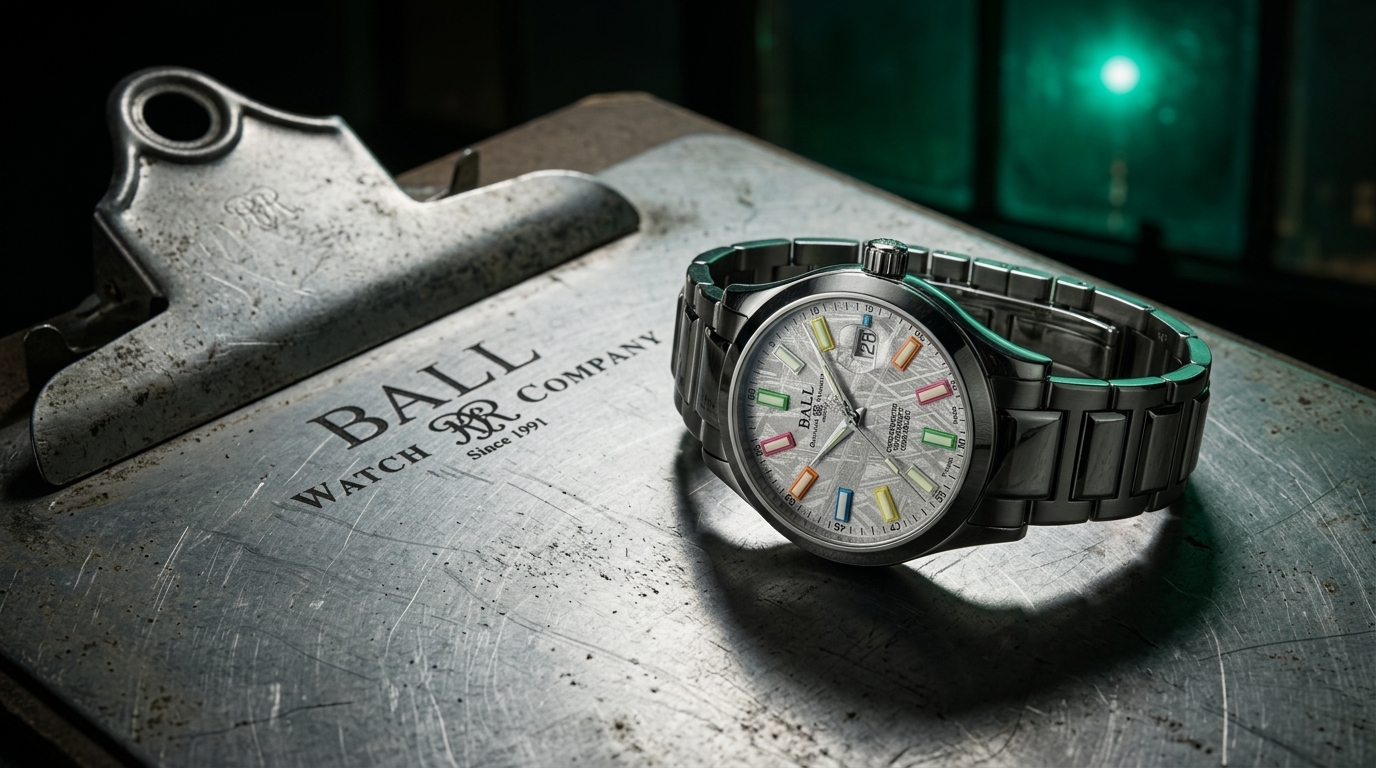
The most distinctive modern Ball feature is not the movement but the light. Tritium micro gas tubes sit on hands and markers, sealed glass vials containing a radioactive gas that makes phosphor glow without needing to be charged by the sun. In darkness the effect is different from Super-LumiNova. It is not the sudden flare of a diver’s watch after exposure to light, but a steady, low, persistent emission. The dial becomes a small instrument panel. On some models the tubes are arranged with sober clarity; on others the multiplicity of colours risks looking less like a timetable and more like a dashboard at night. Still, the principle has merit. A railroad watch had to be readable when conditions were unfriendly. Ball’s gas tubes are a modern answer to an old demand.
Yet legibility is not only brightness. It is hierarchy, proportion, silence. The best Ball dials remember this. Broad hands reach properly toward their tracks. Arabic numerals, when used, recall the pocket-watch ancestry without turning it into costume. Date windows are most persuasive when they do not interrupt the minute scale. A watch that invokes railroad discipline cannot afford confusion at the edge of the dial. The minute must be where the eye expects it. Seconds must be seen without searching. The older Ball standard was not merely to own a watch capable of accuracy, but to know at a glance what it said.
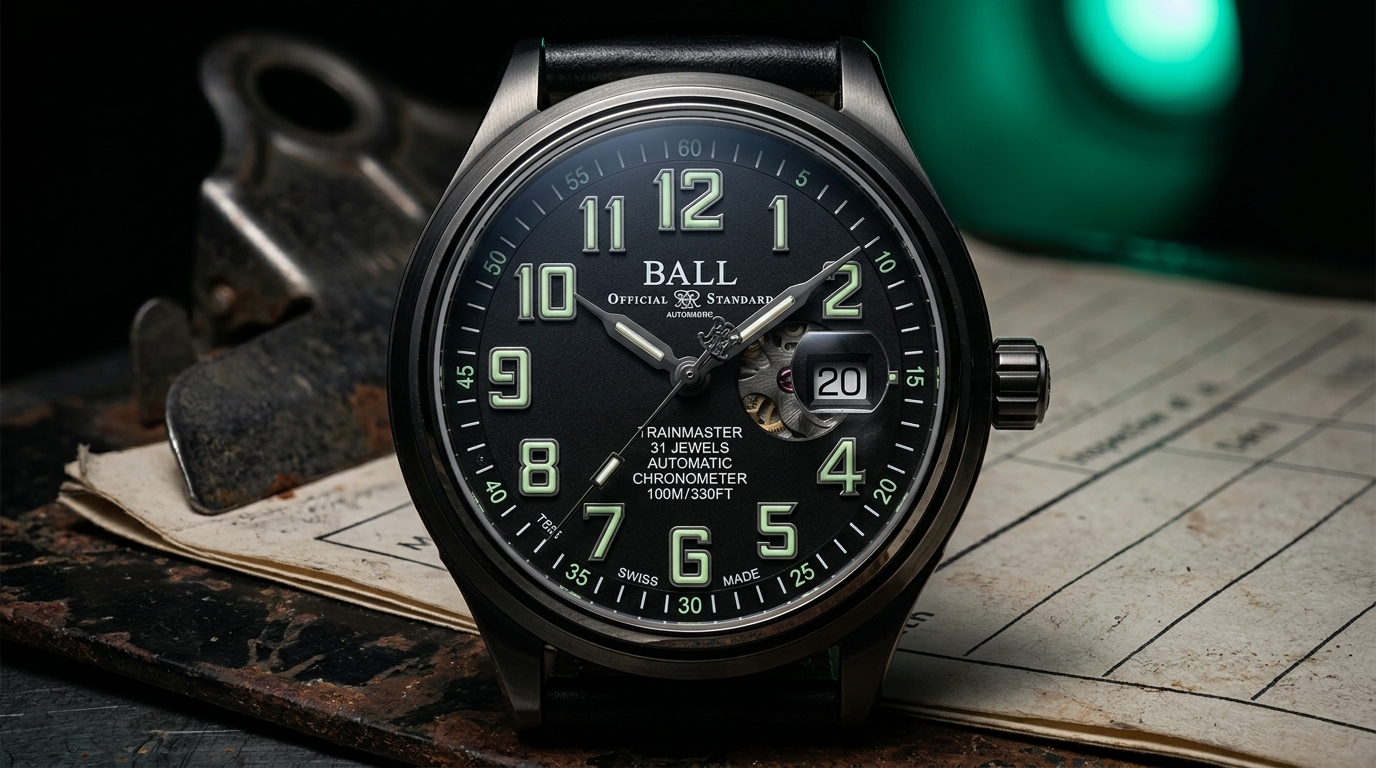
The brand’s name complicates everything because it is so powerful. “Ball Official Railroad Standard” is not a neutral inscription. It carries the authority of audits and watch cards, of an inspector opening a caseback, checking rate, noting a serial number, and deciding whether a man could continue to depend on that instrument in service. In the late nineteenth and early twentieth centuries, railroad watches were not lifestyle accessories. They were periodically compared against a standard clock. They were regulated if they drifted. They were removed from duty if they failed. The owner’s trust was reinforced by an institution outside the owner.
A modern wristwatch usually has no such world around it. COSC certification, when present, supplies one form of external testing: a movement is examined uncased over fifteen days in multiple positions and temperatures, and must perform within prescribed limits, most famously an average daily rate between -4 and +6 seconds. That is meaningful, and it is far from empty. But it is not the same as the old railroad regime, in which the watch continued to live under inspection after it left the counter. Nor does a chronometer certificate prove that the cased watch will remain properly regulated after years of shocks, magnetism, and neglect. Trust has shifted from a social system to a consumer promise.
Ball seems aware of this, sometimes almost too aware. Many current models declare anti-magnetic resistance, shock protection, water resistance, and chronometric performance with a kind of engineer’s bluntness. Some advertise protection to 5,000 gauss; certain robust references go far beyond the casual dress-watch expectation. The cases are often thicker than a purist might wish, because gaskets, inner cages, automatic movements, screw-down crowns, display backs, and micro gas tube dials all occupy space. The resulting watches can feel visually dense. Their shoulders are broad; their bezels and bracelets do not vanish. A railroad pocket watch was substantial too, but it lived in a vest. On the wrist, mass is never abstract.
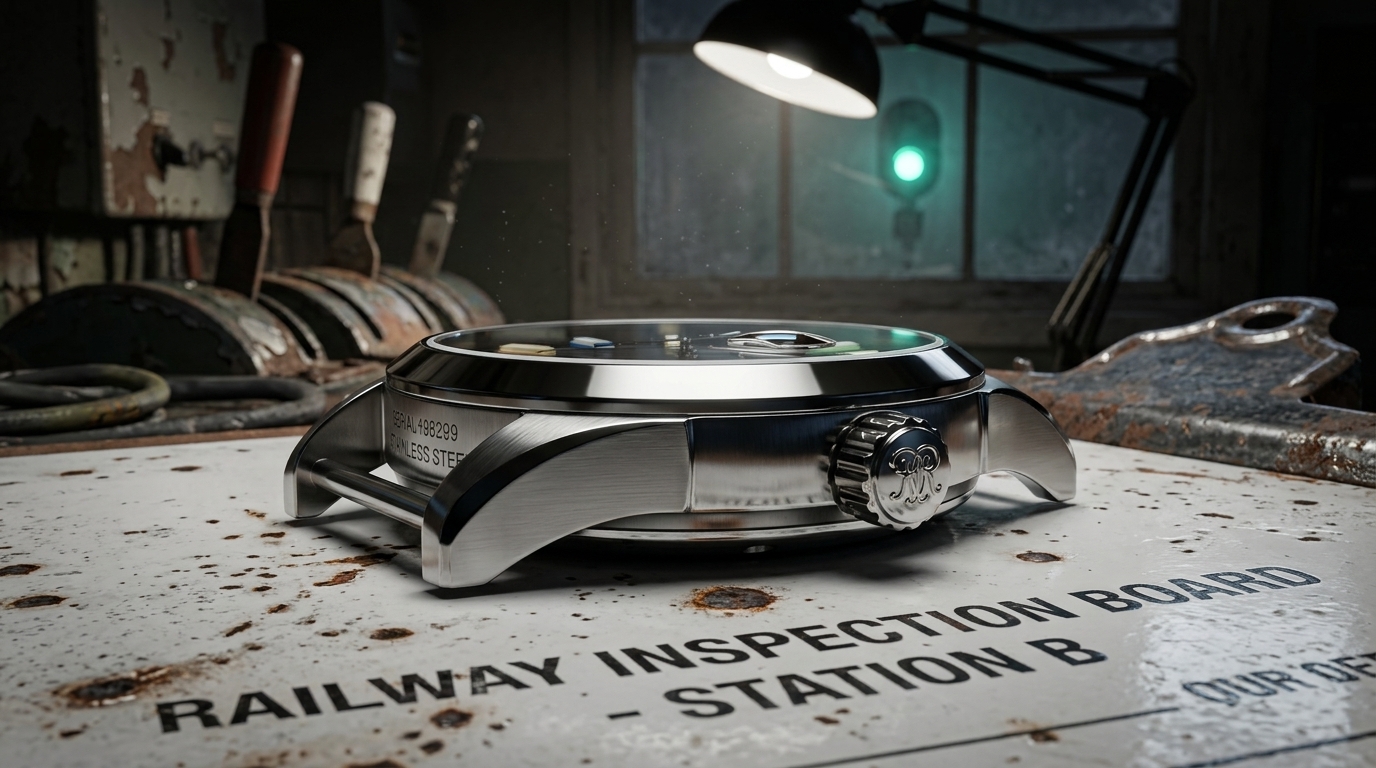
That thickness is one of the places where the romance of the railroad meets the reality of the modern market. A watch made for contemporary buyers must survive swimming pools, airport security trays, laptop magnets, bicycle commutes, and the casual violence of daily life. It must also look enough like itself from across a shop window to be recognised. Ball’s answer has often been to court durability in visible form. The screw-down crown is pronounced. The case flank may be strong, sometimes overbuilt. The bracelet may use polished centre links or brushed surfaces depending on the line, but solidity is usually part of the message. These are not fragile watches.
Whether they are beautiful depends on the reference and on the severity of the eye judging them. Some Ball designs carry the old utilitarian grammar with conviction: clean white or black dials, clear numerals, restrained cases, a sense that the watch could be read quickly by someone with work to do. Others crowd the surface with inscriptions, colours, and technical claims until the original railroad virtue — instant comprehension — begins to blur. The brand’s best inheritance is not decoration but accountability. Whenever the dial remembers that, the watches gain moral force. Whenever they forget, “railroad” becomes a label printed where a standard once stood.
The movements raise a similar question. To the collector trained to prize manufacture calibres, a Sellita or ETA-derived engine can seem ordinary. The bridges lack the architecture of haute horlogerie; the rotor finish may be competent rather than moving; the view through a sapphire back may clarify little beyond the fact that the machine is familiar. But railroad timekeeping never required theatrical novelty. Hamilton’s great American railroad movements were admired not because each was impossibly rare, but because they were built, adjusted, and maintained to do a job. A modern Ball using a proven ébauche can be faithful to that spirit if it is regulated well, protected well, and cased for service rather than spectacle.
There remains, however, a difference between reliability and trust. Reliability is a property of the mechanism. Trust is a relationship between the mechanism, the maker, the owner, and the consequences of being wrong. A modern Ball may keep time within a few seconds a day and still be trusted only in the ordinary way one trusts a good mechanical wristwatch: fondly, with awareness of its limitations, and with a phone nearby carrying atomic time. The original railroad watch lived under harsher terms. If it failed, trains might meet in the wrong place. Its accuracy had public weight.
This is what gives Ball’s history both gravity and danger. The gravity is genuine. Webb C. Ball’s work helped shape American watch standards, and the phrase attributed to railroad punctuality — “on the Ball” — whether repeated too easily or not, reflects a real association between his name and regulated time. The danger lies in sentimentality. History can become a varnish laid over unrelated products. A company founded on inspection risks looking merely nostalgic if its modern watches offer only period typography and bold claims. The better Ball watches avoid that by insisting on function: legibility, luminous performance, resistance to shocks and magnetism, chronometer testing where specified, and cases meant to be used.
A Trainmaster model with a white dial and black numerals can come close to the old pocket-watch clarity without dressing itself in sepia. Its proportions are wristwatch proportions, not a shrunken relic, and the automatic movement beneath the dial belongs honestly to the present. An Engineer III with micro gas tubes and a COSC-rated calibre makes a different argument: not that it looks like a railroad watch from 1900, but that the railroad concern with visibility and rate can be translated into a contemporary instrument. The Roadmaster line, with its sportier cases and higher stated resistance, moves still further from the depot clock and nearer to the modern field watch. In each case the charm depends on how exact the translation is.
The original Ball standard was never about luxury, although fine examples are now collected as beautiful things. A 999B Hamilton Ball Official Railroad Standard pocket watch, a Ball-signed Waltham Vanguard, or an Illinois-made Ball watch with a clean Montgomery dial has a disciplined splendour: gold chatons, polished steel, black lettering, a regulator index waiting under the caseback. But that splendour arose from mechanical seriousness. Jewels were placed where pivots needed them. Adjustments were made because temperature and position altered rate. The dial was designed so noon and midnight would not be misread, so minutes would not disappear. Beauty followed duty.
That is the measure by which a modern Ball deserves to be judged. Not whether it can reproduce the past. It cannot. The social machinery that made Webb Ball’s standards necessary has gone. The conductor’s watch card, the inspector’s bench, the governed railroad network of one territory and its authorised men — these belong to another arrangement of time. Nor should the modern watch pretend that its owner’s appointment calendar is equivalent to a dispatch sheet. But it can still honour the old demand by refusing softness where precision is required. It can make the hands long enough. It can regulate the movement carefully. It can ensure the crown, crystal, bracelet, and luminous system serve the reading of minutes rather than the theatre of ownership.
There is also something revealing in the continued use of Swiss production for an American railroad name. The old Ball identity was American in origin, bound to Cleveland and to the railway expansion of the United States. The modern company is headquartered in Switzerland, with the globalised supply chains and distribution of contemporary mechanical watchmaking. Purists may see rupture. Others may see continuity of another kind: Ball was always a coordinator of standards across makers, less a romantic atelier than an arbiter of performance. The name on the dial mattered because it implied compliance. Modern Swiss assembly does not betray that automatically. It only raises the old question anew: compliance with what, verified by whom, and for how long?

The answer, in the present, is necessarily partial. A Ball watch can be a serious mechanical object. It can be readable in darkness when many more expensive watches have faded. It can house a stable, serviceable automatic movement and, in chronometer form, arrive with evidence of tested rate. It can withstand more abuse than a dress watch and carry more history than a generic sports watch. But it cannot make the word “railroad” mean today what it meant after Kipton. No wristwatch can. The tracks have changed, and so has authority.
Still, the question of trust has not vanished. It has only become more intimate. The wearer of a mechanical watch now chooses inconvenience knowingly. The machine must be wound by motion or hand, serviced at intervals, protected from extremes. Its seconds are not governed by satellites. To trust it is to accept a small pact with regulated imperfection. Ball’s most convincing watches understand that pact. They do not ask to replace the phone, the network clock, or the atomic standard. They ask to make mechanical time legible, resilient, and accountable enough to matter.
In the end, a “railroad” watch is exposed by its own claim. The word cannot be used lightly. It brings with it the memory of a stopped watch near Kipton, of Webb Ball’s inspections, of white dials and lever sets, of men whose private timepieces became public instruments. A modern Ball stands under that cold lamp. When it is clear, accurate, durable, and disciplined, the lamp flatters it. When it is cluttered or merely nostalgic, the lamp is less forgiving.
The best of the company’s current watches seem to know this. They carry their gas tubes like signal lamps, their automatic calibres like dependable engines rather than hidden marvels, their heavy cases as protection and not always as grace. They are not the railroad watches of the nineteenth century. They are descendants, sometimes dutiful, sometimes loud, marked by a name that still asks for scrutiny. Trust, after all, was never granted to Ball as a decoration. It was earned by inspection, minute by minute, until the train passed safely through the dark.