
Jacob & Co. and the Courage to Treat Watches as Spectacle

Most watch brands want to be taken seriously.
They speak in careful tones. They reference heritage. They reassure collectors that their watches are restrained, timeless, and correct. Even when they innovate, they do so politely — explaining themselves in measured language, careful not to offend tradition.
Jacob & Co. does none of this.
It does not ask permission.
It does not seek approval.
It does not pretend that mechanical watches still live in a quiet, utilitarian world.
Instead, Jacob & Co. treats watches as something closer to performance art — kinetic, unapologetic, and impossible to ignore.
And strangely, that honesty makes it one of the most truthful brands in modern watchmaking.
Mechanical watches today survive almost entirely on emotion.
We no longer need them. We choose them. That choice is rarely rational — it is cultural, expressive, and personal. Yet much of the industry continues to behave as if watches must justify themselves through seriousness alone.
Jacob & Co. refuses that premise outright.
It starts from a simpler assumption: if mechanical watches exist because people want them, then there is no reason to pretend they must all aspire to subtlety.
Some can exist purely to astonish.
The Astronomia is not a watch in the traditional sense.
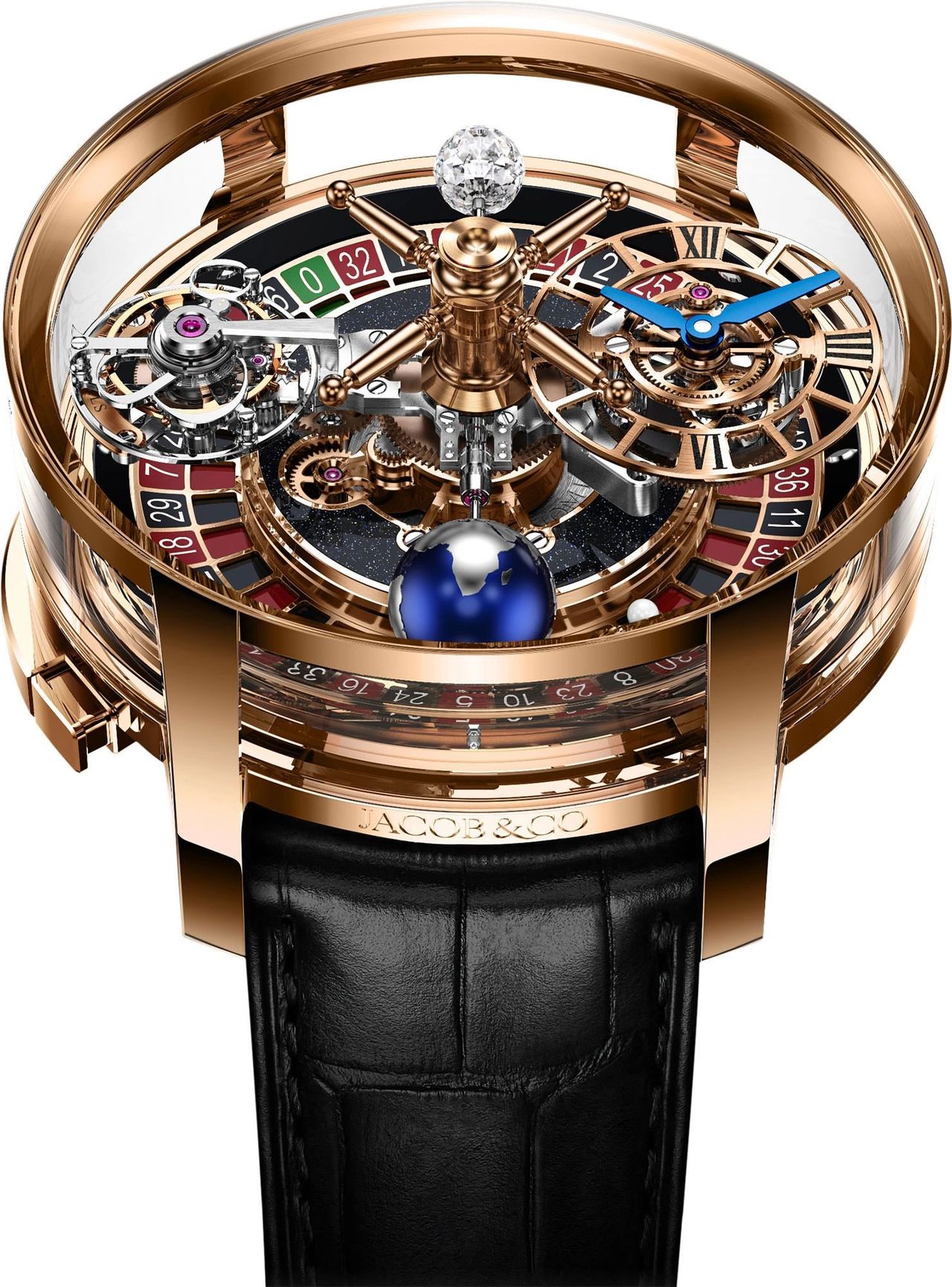
It does not prioritize legibility. It does not disappear under a cuff. It does not reward quiet contemplation. It rotates, spins, climbs, and performs — visibly and relentlessly.
To traditionalists, this feels offensive.
To others, it feels absurd.
But look closer and something important emerges: Jacob & Co. is not pretending.
It does not claim restraint while delivering excess. It does not disguise spectacle as heritage. It does not dress novelty in the language of tradition.
What you see is exactly what you get.
In an industry filled with euphemism, that clarity is refreshing.
Jacob & Co. understands something that many brands resist acknowledging: modern luxury is often theatrical.
Architecture, automobiles, fashion, and art have all embraced this. They celebrate scale, movement, and presence. Only watchmaking has remained strangely defensive — insisting that seriousness must always look conservative.
Jacob & Co. breaks that illusion.
Its watches are not designed to age quietly into anonymity. They are designed to exist in the present tense. To be photographed. To be reacted to. To provoke conversation.
This is not a failure of taste.
It is a deliberate positioning.
Critics often argue that Jacob & Co. prioritizes spectacle over watchmaking.
This misunderstands the challenge.

Creating a watch that rotates multiple axes, carries massive components, integrates high jewelry, and still functions mechanically is not trivial. The engineering required is not subtle — but it is real. Gravity does not become kinder because a watch is extravagant.
Jacob & Co. does not lack watchmaking seriousness.
It applies it differently.
Where others use engineering to disappear complexity, Jacob & Co. uses engineering to expose it.
The movement is not hidden.
The mechanism is not shy.
The watch tells you exactly how it works — by performing it continuously.
There is also cultural courage here.
Jacob & Co. does not aim for universal admiration. It accepts polarization as part of its identity. That willingness to divide opinion is rare in a luxury industry obsessed with safe desirability.
Most brands soften their edges to broaden appeal. Jacob & Co. sharpens them.
In doing so, it serves an important role: it expands the definition of what a mechanical watch is allowed to be.
Without brands like Jacob & Co., the industry risks collapsing inward — endlessly refining the same ideas, mistaking subtle variation for progress.

Spectacle, when done honestly, keeps the ecosystem alive.
There is also something deeply modern about Jacob & Co.’s relationship with time.
Traditional watchmaking treats time as something to be measured quietly. Jacob & Co. treats time as something to be experienced — visually, physically, emotionally.
The constant motion of its watches reminds the wearer that time is not static. It moves. It performs. It does not wait politely in the background.
This is not how watches have historically behaved.
But it may be how modern audiences understand time.
Jacob & Co. is often dismissed as excessive because it refuses to speak the industry’s preferred language. But excess, in itself, is not dishonesty. Pretending excess is restraint is.
Jacob & Co. does not pretend.
It understands that mechanical watches are no longer about necessity. They are about meaning, expression, and presence. Some people want silence. Others want spectacle.
Both can coexist.
Jacob & Co. does not represent the future of watchmaking.
It represents a possibility.
A reminder that mechanical watches are not obligated to be polite. That seriousness does not always require restraint. That innovation can be emotional, not just incremental.
In a world where many watches whisper, Jacob & Co. shouts.
And sometimes, a shout is exactly what keeps a conversation alive.