Cartier’s Everyday Radicalism: How a Dress Watch Learned to Travel
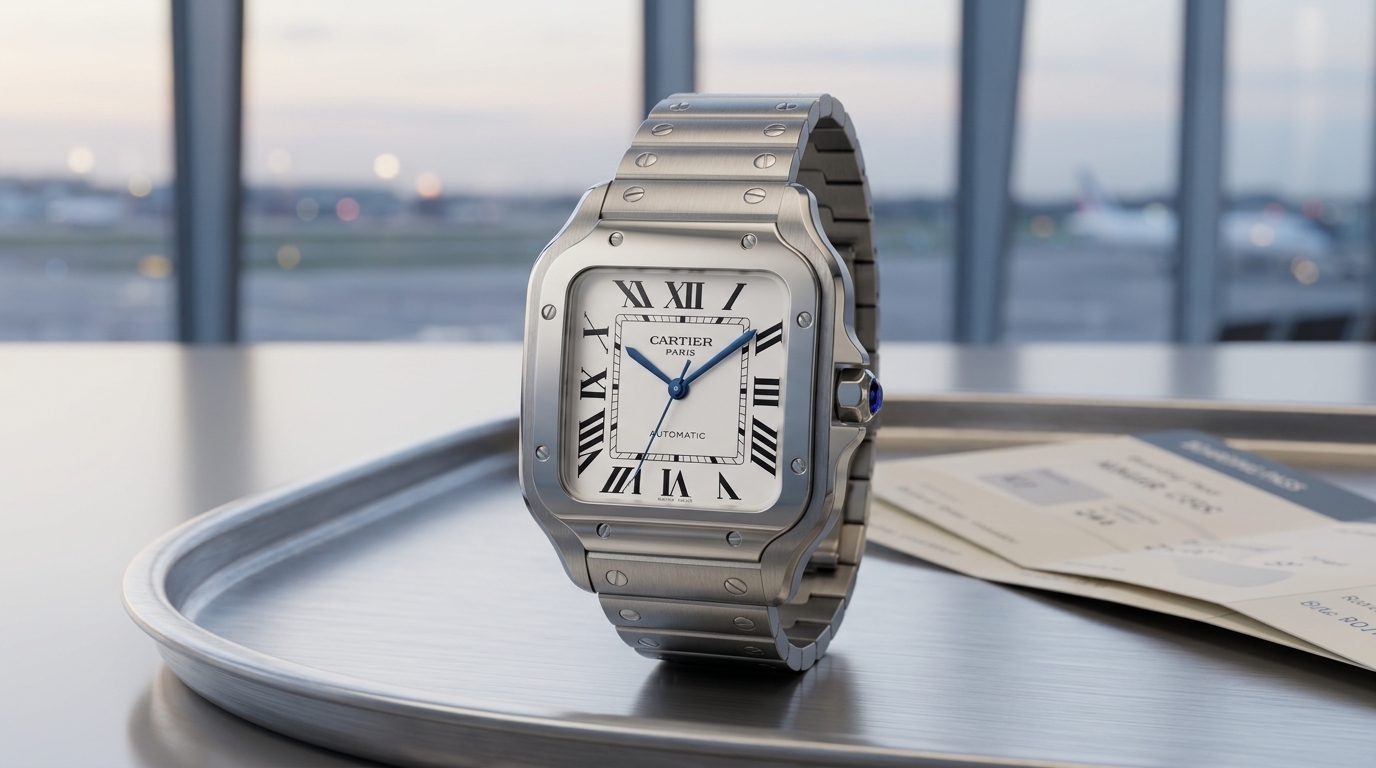
At an airport security tray, the Santos looks briefly disassembled from its world: steel bracelet pooled beside a passport, square case catching the hard white light, blue cabochon turned upward like a small navigational lamp. It is not a large watch, not by contemporary standards, and yet it has the peculiar authority of an object that has already survived several ideas of modernity. The Roman numerals remain stern. The screws remain visible. The bezel, brushed across its flat plane and polished at its edges, holds the dial as if the whole thing were a window bolted into metal.
Cartier’s genius has often been mistaken for politeness. The maison made watches that sat well under cuffs, watches that understood evening light, watches that could pass through a room without raising their voice. But the Santos, beneath its civility, began as a disturbance. In 1904, Alberto Santos-Dumont wanted to read the time while flying without reaching for a pocket watch. Louis Cartier answered not with a miniature clock on a strap, but with a wristwatch made for a man operating a machine in the air. That fact is now softened by repetition, but it remains quietly astonishing: a Parisian jeweller shaping one of the earliest purpose-built men’s wristwatches around the needs of flight.
The early Santos was not rugged in the modern sense. It did not require gaskets, crown guards, luminous plots, or a rotating bezel to justify itself. Its radical act was simpler. It moved time from the pocket to the wrist and made the gesture seem natural. A square case, rounded at the corners, exposed screws, Roman numerals, a minute track like a measured rail around the dial: nothing about it shouted aviation, and yet it was born from aviation’s practical impatience. The watch did not resemble an instrument so much as it behaved like one. It allowed a pilot to keep his hands where the sky required them.
That is Cartier’s everyday radicalism: not the drama of obvious invention, but the smaller trespass that becomes habit. The Santos took the wrist, once an uncertain place for a man’s watch, and made it respectable. More than respectable, it made it elegant. This is why the modern Santos de Cartier can feel so difficult to categorise. It is a dress watch with screws in its face. It is a sports watch with Roman numerals. It is a travel watch without a second time zone. It contains contradictions that most brands would try to resolve and that Cartier, wisely, leaves intact.
The current steel Santos, especially in the medium size, keeps the argument precise. Its case measures roughly 35 millimetres across and just under 9 millimetres thick, though the dimensions alone do not explain its success. A square watch carries itself differently from a round one. It occupies more visual space than its diameter suggests, pressing to the edges of its geometry. Cartier softens this with curved lugs and a bracelet that does not merely attach to the case but seems to flow out of it. The watch is architectural without being severe. It has corners, but no harshness.
On the dial, little has been permitted to drift. The silvered opaline surface carries black Roman numerals, a chemin de fer minute track, and blued steel sword hands. At VII, the Cartier signature hides inside the numeral, a private mark in a public design. There is no attempt to make the face appear technical. No depth rating is printed across it, no boast of chronometric virtue interrupts the symmetry. The large model adds a date at six, useful and not disastrous, but the medium version’s refusal of a date gives the dial a stronger historical pulse. It is a cleaner sentence.
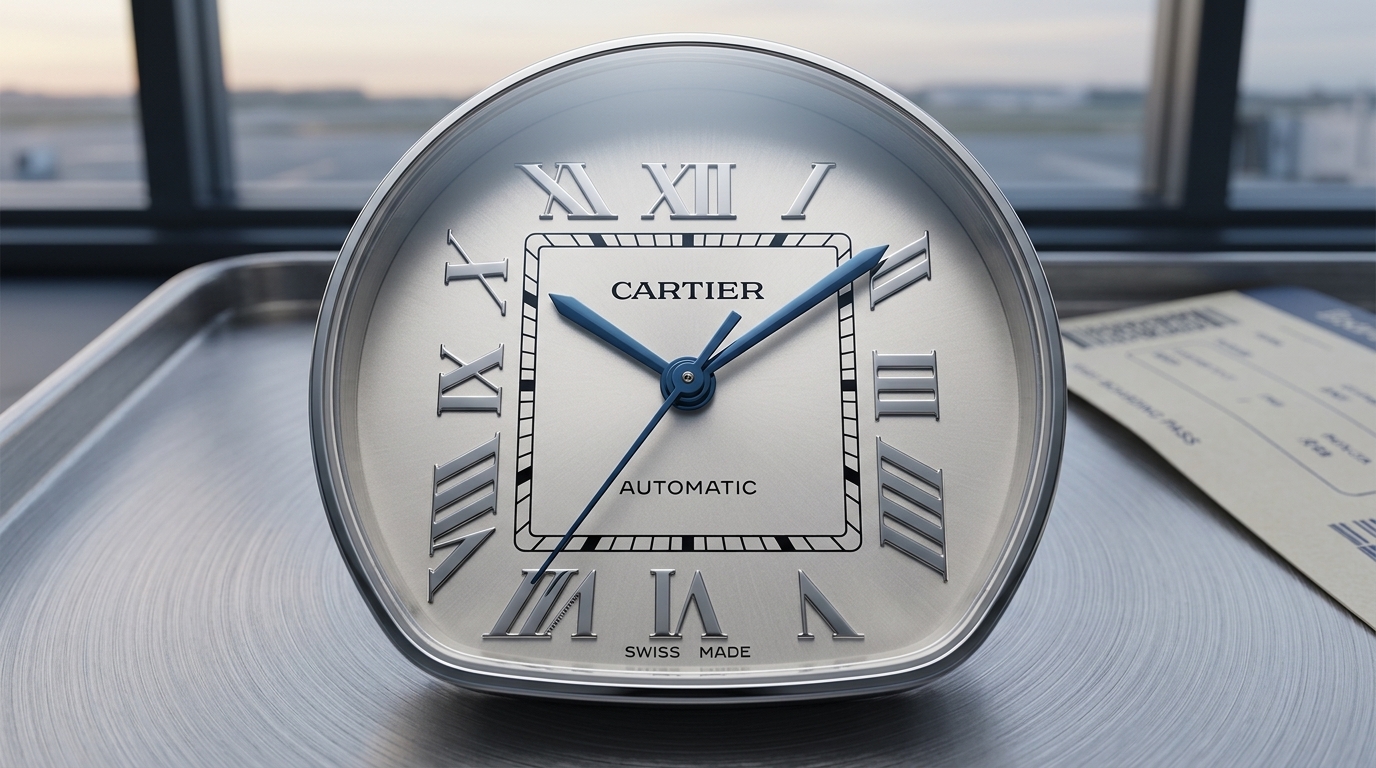
Inside, the automatic calibre 1847 MC does its work away from theatre. It is not a movement made to silence a room when the caseback is opened; in most Santos models, the back remains closed. The calibre beats at 28,800 vibrations per hour and offers around 40 hours of power reserve, an ordinary figure in an era that has learned to stretch barrels for weekend absences. Yet Cartier did not choose flamboyance here. The movement was built for reliability, for the daily rhythm of winding rotor, wrist motion, desk, train, hotel room. Its anti-magnetic considerations, including nickel-phosphorus components and shielding in the case construction, acknowledge a world of phones, tablets, laptop clasps, airport counters. The old pilot’s problem has changed. The modern traveller is surrounded not by propeller vibration but by invisible fields.
The Santos learned to travel most clearly in 2018, when Cartier reworked the line with a practicality that appeared almost too graceful to be practical. The QuickSwitch system allows the bracelet or strap to be released from the underside of the case without tools. A small recessed tab, pressed by a fingernail, frees the attachment. The SmartLink bracelet goes further: individual links can be removed by pressing small buttons hidden beneath them, releasing the screws without a screwdriver. These are not complications in the conventional watchmaking sense, but they are complications of daily life solved at the level of touch.
There is a particular intelligence in that. Travel rarely asks for one pure version of a watch. It asks for transitions. Bracelet in the morning, when the day begins with heat, taxis, and the abrasion of luggage handles. Leather at dinner, when the watch should sit lower in tone and closer to the language of its dial. Rubber, in some versions and configurations, when water and weather intrude. The Santos does not become a dive watch, and it should not pretend to. But with 100 metres of water resistance in the modern case, it no longer lives nervously at the edge of a washbasin or sudden rain. It has acquired a passport.
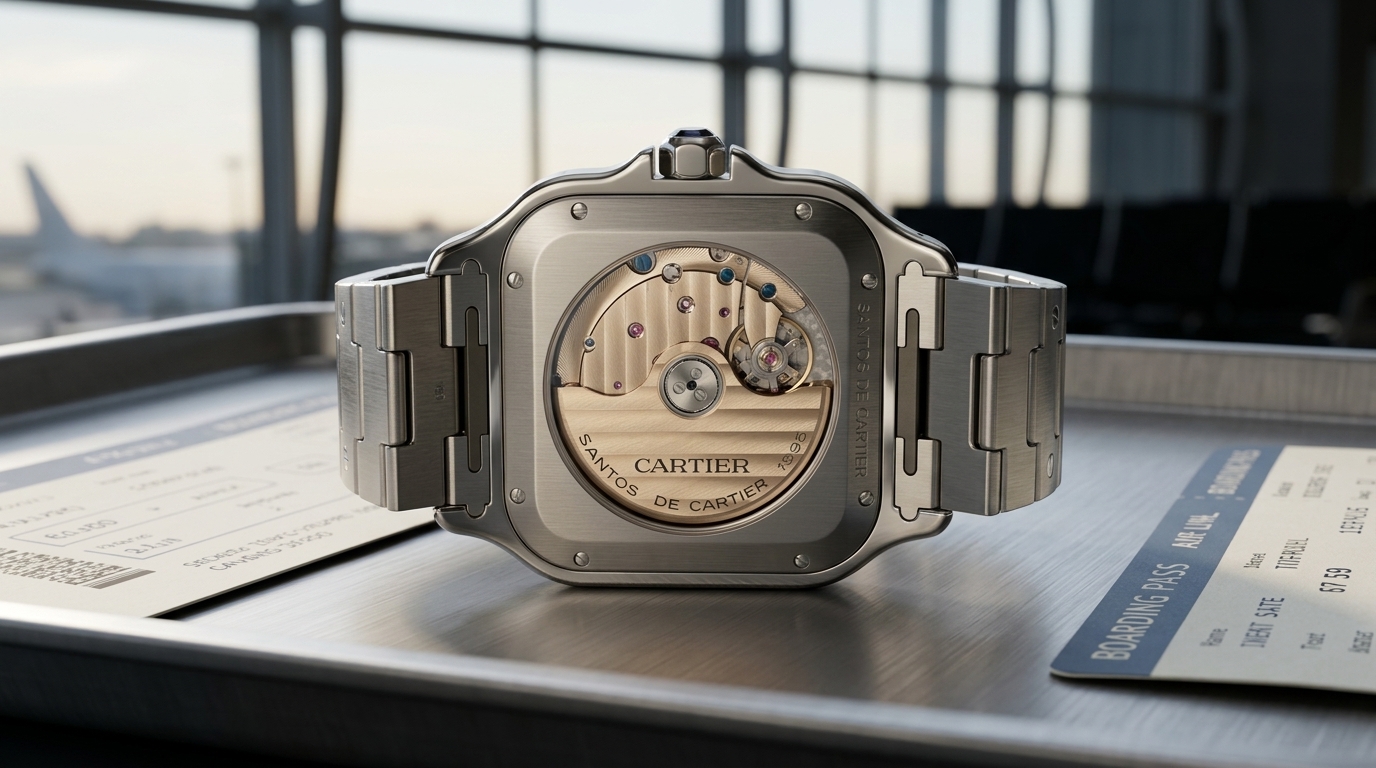
This is where the watch’s dress character becomes more interesting, not less. Many dress watches remain beautiful because they are protected from ordinary conditions. Their thin cases, polished bezels, and delicate straps belong to controlled interiors. The Santos carries some of that refinement into less controlled spaces. Its bezel will collect marks; in fact, its broad brushed surface seems almost designed to record them. That vulnerability is part of the bargain. A steel sports watch can hide scratches inside grain, bevel, crown guard, and bezel tooth. The Santos wears its evidence openly, like a cufflink dragged across a stone table. It is not fragile, but neither is it anonymous in use.
The exposed screws matter here. They are often treated as decorative codes, and they are that, but they also keep the watch from becoming too smooth, too well behaved. They interrupt the polish. They remind the eye that modern elegance was once related to bridges, rivets, machines, and the metalwork of the early twentieth century. Cartier has always been fluent in geometry, but the Santos is not the geometry of pure abstraction. It is the geometry of a city learning steel. One can see, in its bezel, a Paris of glass roofs, iron spans, and aircraft lifting uncertainly from grass fields.
Santos-Dumont himself belongs to that atmosphere: a figure in a hat and high collar, circling the Eiffel Tower in an airship, insisting with almost theatrical calm that the future could be made intimate. Flight, before it became procedure, was a social event and a mechanical gamble. The Santos watch came out of that world, but its endurance depends on having escaped costume. It does not require the wearer to cosplay an aviator. It carries the origin story lightly, translated into proportion and legibility rather than nostalgia.
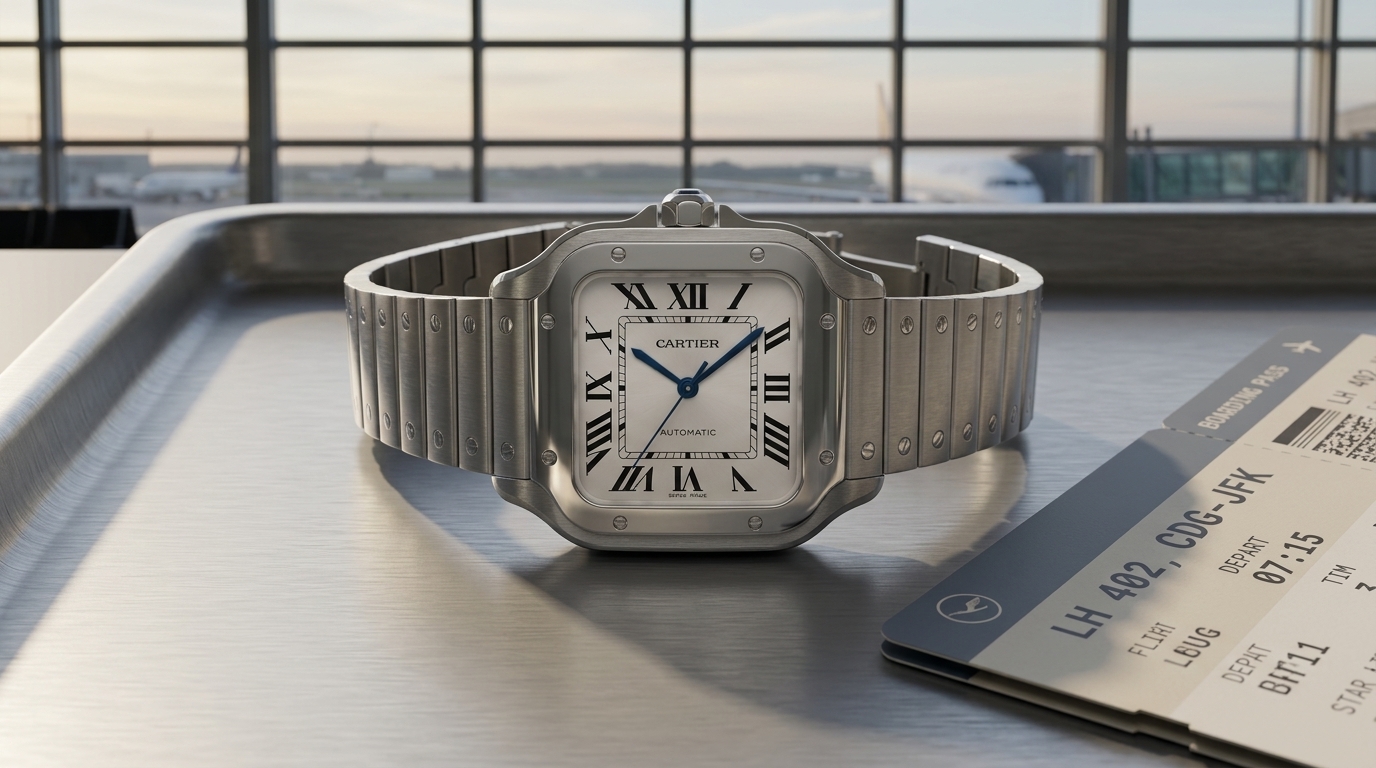
The modern bracelet is central to this translation. Earlier bracelets on the Santos had their own period charm, but the current design makes the watch more fluid on the wrist. The links curve and taper; the screws on them echo the bezel without making the whole watch feel over-designed. The integration is strong enough to give the Santos some of the presence associated with steel sports watches, yet the case remains thin enough to slide beneath a sleeve. This tension is the watch’s natural habitat. It does not want to choose between salon and concourse.
It also refuses the usual travel-watch grammar. There is no GMT hand circling in another colour, no city ring, no world map on the dial. For crossing time zones, it offers the old method: pull the crown and set the hands. The crown itself, seven-sided and capped with blue, is small but legible to the fingers. A traveller who needs simultaneous home time may look elsewhere. But travel is not only the management of time zones. It is also the instability of context: the need for one object to pass through airport, meeting, walk, train platform, hotel bar, and long tired morning without becoming absurd in any of them. In that sense, the Santos is almost cunning.
Cartier’s restraint helps. The watch does not posture as equipment, though it has gained equipment-like solutions. Its innovations are hidden beneath the case or inside the bracelet rather than spread across the dial. That distinction matters. The Santos does not ask to be admired for solving problems. It simply makes certain frictions disappear. No jeweller’s screwdriver in a hotel room. No anxious calculation over whether a steel bracelet is too much for dinner or a leather strap too little for a humid afternoon. The watch changes register quickly, but it does not change identity.

There is a lesson in this for modern watch design. Much of contemporary horology treats versatility as a kind of loud neutrality: black dial, round case, broad bezel, applied markers, enough water resistance, enough lume, enough diameter to satisfy the market’s idea of competence. The result is often a watch ready for everything and specific to nothing. The Santos begins from specificity. It is square. It is Roman. It is recognisably Cartier from across a table. Its versatility comes not from erasing character, but from making character adaptable.
This is risky. A Santos will not disappear in the way a plain three-hand watch disappears. The bezel flashes. The numerals declare themselves. The case shape catches doorways of light. Some watches are made to accompany clothing; the Santos sometimes seems to edit it. Yet because its form has been in circulation for more than a century, its distinctness has lost any need for self-explanation. It is strange, but no longer shocking. That may be Cartier’s most enduring trick: to make the radical appear inevitable after enough years of disciplined repetition.
The finishing follows the same logic. The alternation of brushing and polishing is not extravagant, but it is sharply judged. The flat bezel surface has a directional grain that contrasts with the polished case flanks. Edges are bright where they need to catch light, muted where glare would cheapen the plane. The dial printing is crisp, the hands narrow and blue enough to shift with angle, sometimes nearly black, sometimes electric. The watch rewards close looking without demanding magnification. Its pleasures are visible at the distance of ordinary life.
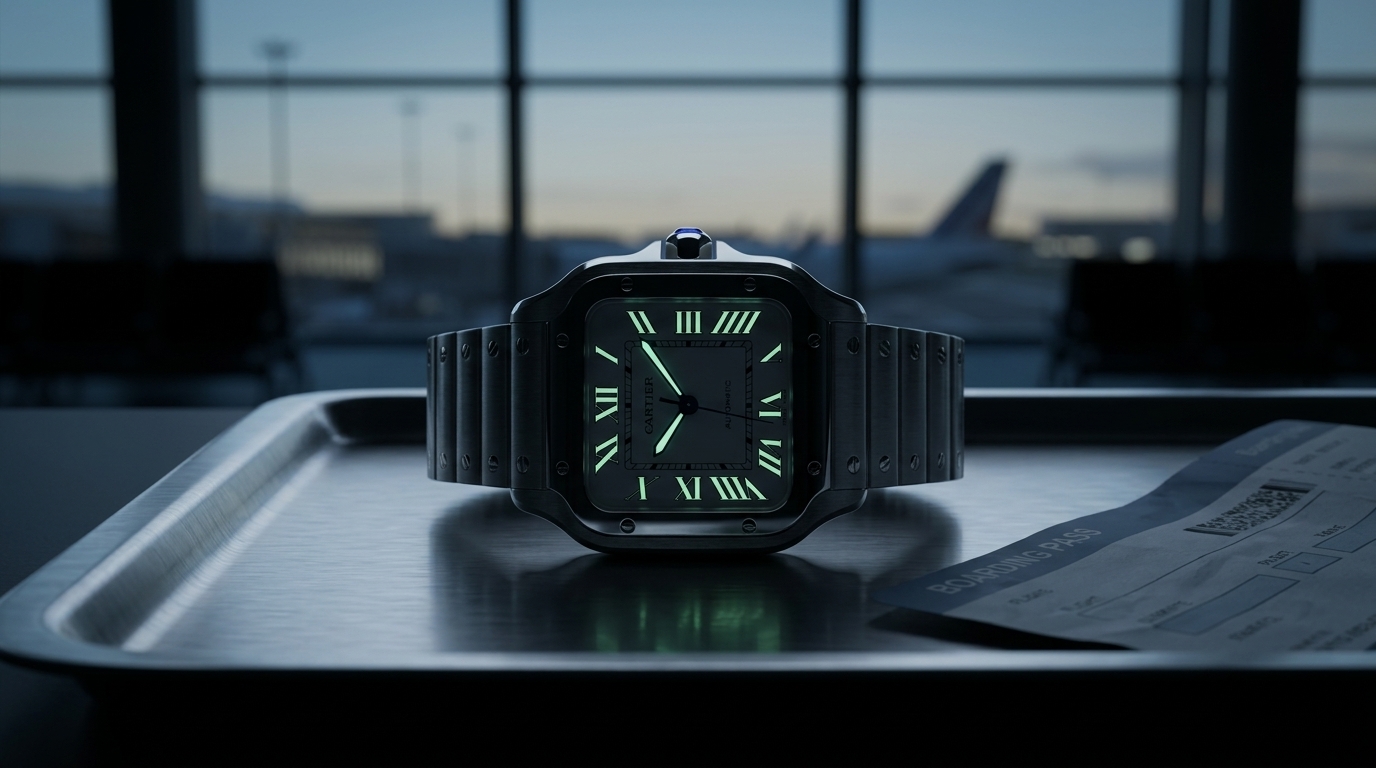
No serious account should pretend that the Santos is perfect. The power reserve is modest. The polished bezel can look marked after a short acquaintance with the world. Those who prefer a watch to vanish may find the square case too present. Those who expect travel functionality to mean multiple time zones will not be persuaded by a bracelet system and a closed caseback. But these objections, while real, clarify the watch rather than diminish it. The Santos is not a universal answer. It is a particular proposition: that elegance can be engineered for motion without becoming casual, and that practicality need not dress itself in military or nautical codes.
That proposition feels unusually relevant now. The boundaries that once separated dress watches from sports watches have thinned, sometimes to the point of confusion. Offices have softened. Travel has become both common and burdensome. A watch must often move through more kinds of day than its ancestors were asked to endure. Many brands have responded by making dress watches sportier or sports watches more luxurious. Cartier did something subtler with the Santos. It allowed a formal design to keep its manners while teaching it new habits.
The watch still begins with a dial that could sit comfortably beneath a cuff at dinner. Yet its bracelet can be sized at a table without tools. Its strap can be changed before a flight. Its case can tolerate water better than its profile suggests. Its movement is protected against some of the magnetic clutter of modern transit. These are not romantic details, but they preserve the romance by removing inconvenience. They let the watch remain itself in circumstances that would once have made such a watch seem precious.
In this way, the Santos returns to its origin without imitating it. The first problem was practical: a man in flight needed to read the time. The contemporary problem is also practical, though less heroic: a person in motion needs a refined watch that can survive the changing weather of the day. Cartier’s answer, across the decades, has been to keep the square, keep the screws, keep the Roman numerals, and adjust the machinery of use around them. The surface remains familiar; the experience becomes more mobile.
At the end of a journey, placed beside coins, keys, and a folded boarding pass, the Santos does not look like a watch that has conquered distance. It looks composed, perhaps a little scratched, its bezel holding the day in fine lines. That is the point. Its radicalism was never noise. It was the decision to put time on the wrist when the wrist was not yet an obvious place for it, and later the decision to let a dress watch move through the world without armour or disguise. The Santos learned to travel not by becoming less Cartier, but by becoming more useful in the places Cartier was never supposed to go.