Citizen and the Technology That Made Quartz Feel Human Again
At the edge of a black dial, a seconds hand arrives precisely where it promised to arrive. It does not sweep, hesitate, or breathe in the familiar mechanical way. It advances in a small, clean step, the sort of motion that quartz taught the world to expect and then, over decades, taught many collectors to distrust. Yet on certain Citizens, that step no longer feels like a cheap abbreviation of time. It feels deliberate. The hand lands on its marker as if the watch has been waiting for the moment, not merely counting it.
For much of modern watch culture, quartz carried an unfair stain. It was too successful. It did its work too well, too cheaply, with too little visible drama. The quartz crisis of the 1970s and 1980s was not just an industrial upheaval; it was a change in the emotional weather. A balance wheel could be seen and understood as a tiny living organ, beating away beneath bridges and screws. Quartz hid its intelligence. It reduced the theatre of timekeeping to a crystal, a circuit, a battery, and a motor. Accuracy improved, but intimacy seemed to vanish.
Citizen’s achievement was not simply to make quartz more accurate. Seiko, Longines, Omega, Girard-Perregaux and others all contributed to the history of high-precision quartz in their own ways. Citizen’s deeper contribution was to soften the machine without making it nostalgic. It found ways to give quartz a relationship with the natural world again: with light, with touch, with craft, with the passing of seasons, with the human reluctance to open the back of a watch unless absolutely necessary. It made the invisible feel less anonymous.
The story begins before Eco-Drive had a name, and before the phrase became attached to shop windows and casebacks across the world. Citizen, founded from the Shokosha Watch Research Institute and associated with the Citizen name from the 1924 pocket watch, had always lived close to the democratic promise implied in that word. A citizen’s watch was not meant to be an aristocratic object sealed behind glass. It belonged to daily life. That emphasis helped explain why the company became so fluent in practical innovation: shock-resistant watches, electronic watches, early quartz, titanium cases, radio-controlled precision, satellite timekeeping, and light-powered movements that asked almost nothing from their owners except exposure to the day.
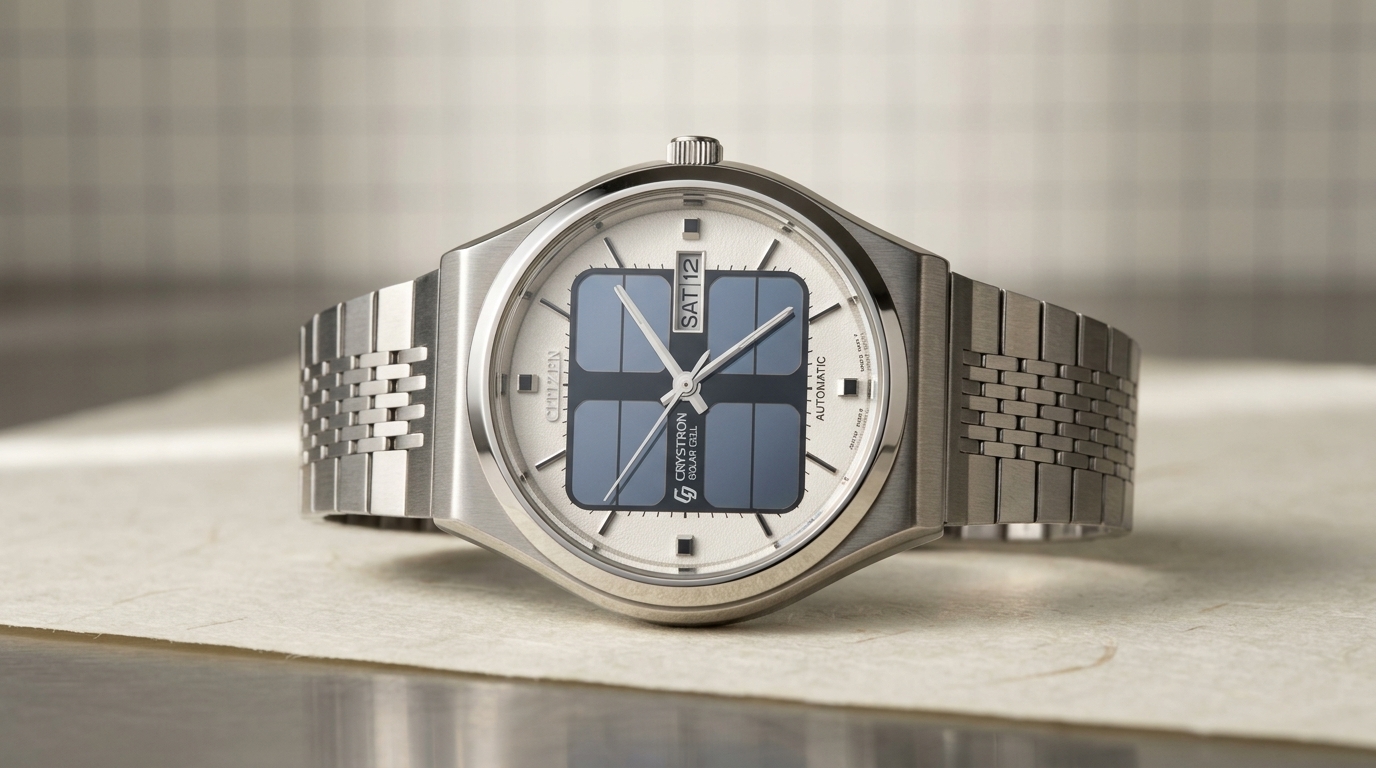
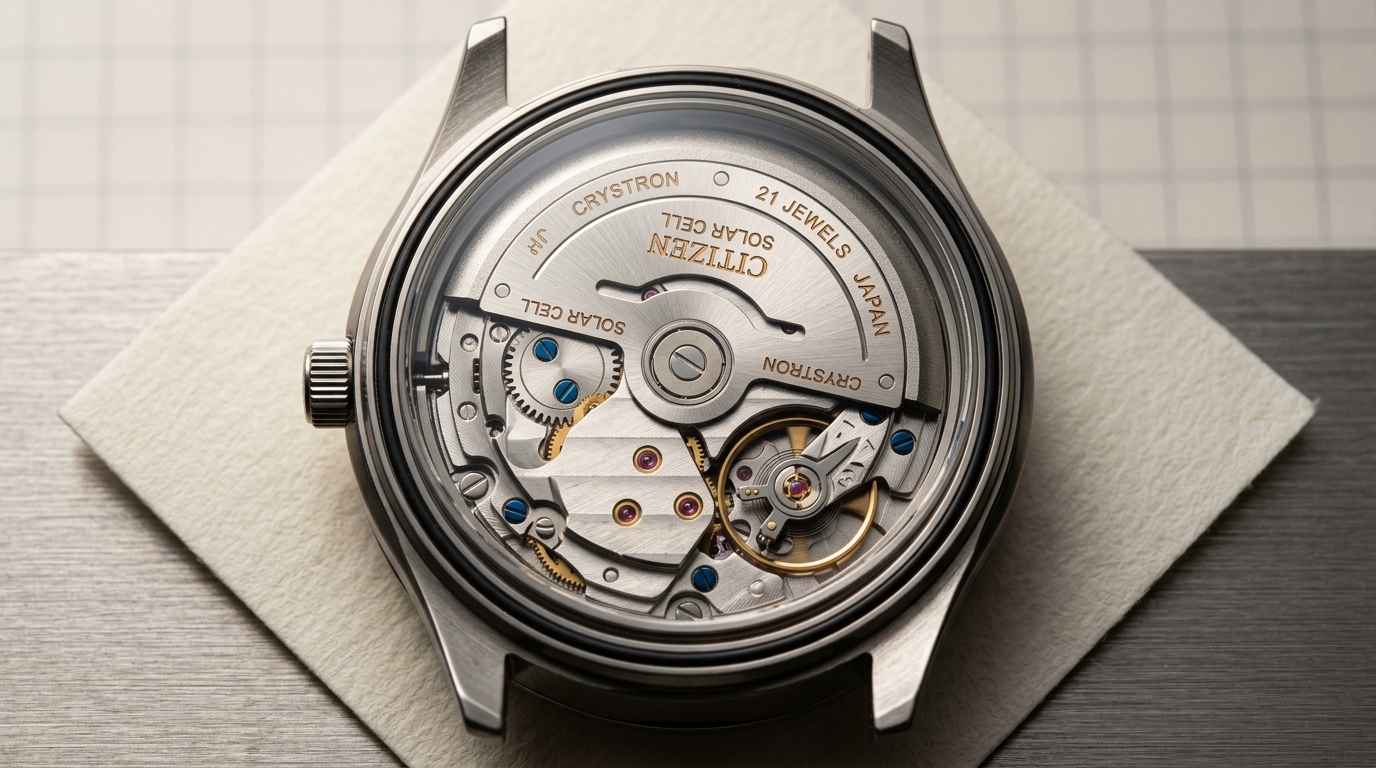
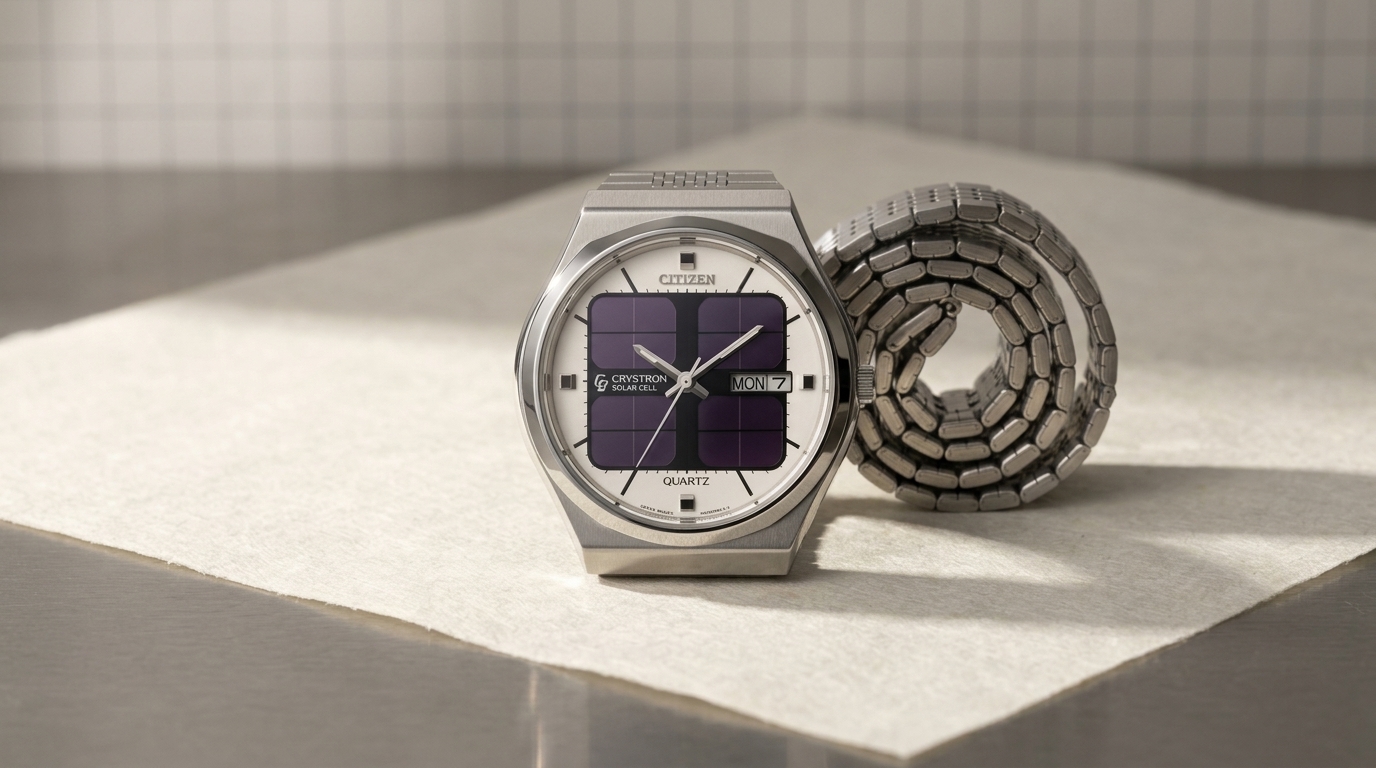
In 1976, Citizen introduced the Crystron Solar Cell, one of the decisive watches in the long effort to free quartz from the disposable character of its battery. It was early, ungainly by later standards, and unmistakably a technological object, but its premise was profound. A watch could gather energy from ambient light and store it for use in darkness. It could live in the rhythm of rooms, windows, sleeves, and skies. The act of wearing it became part of its maintenance. There was no winding ritual, no rotating mass visible through sapphire, yet there was still a kind of exchange.
That exchange would mature into Eco-Drive, the system Citizen formally developed and named in the 1990s, though its roots were older. The genius of Eco-Drive was not theatrical. It was quiet engineering placed in service of continuity. Light passed through a dial, sometimes transparently, sometimes through surfaces designed not to advertise their purpose. Beneath that dial, a solar cell converted light into electrical energy, stored in a rechargeable cell. The movement could then run for months in darkness, sometimes far longer, depending on calibre and power-saving modes. In ordinary life, it removed the most awkward fact of quartz ownership: the dead watch in a drawer, the pried-open caseback, the compromised gasket, the battery changed by uncertain hands.
This mattered because water resistance, case integrity, and longevity are not abstractions. A watch lives by remaining closed. A mechanical watch may need servicing, but there is an accepted ritual to that intervention. Battery quartz, by contrast, often suffered little acts of violence over the years: casebacks scratched, seals disturbed, movements exposed to dust, cells leaked after neglect. Citizen understood that for quartz to become emotionally durable, it needed to stop feeling temporary. Eco-Drive changed the mood. The watch was no longer a battery appliance. It was a solar instrument, dependent on the same conditions as plants on a sill or paper fading near a window.
There is a human tenderness in that dependence. A light-powered watch can be neglected, but not infinitely. Leave it buried long enough and it will sleep. Bring it back to the morning and the circuit resumes its work. Some Eco-Drive calibres include power reserve indication, low-charge warnings, and energy-saving states in which the hands stop while the internal count continues. The watch appears dormant, then corrects itself when light returns. It is not life, of course. It is electronics. But horology has always depended on metaphor, and here the metaphor is unusually persuasive.
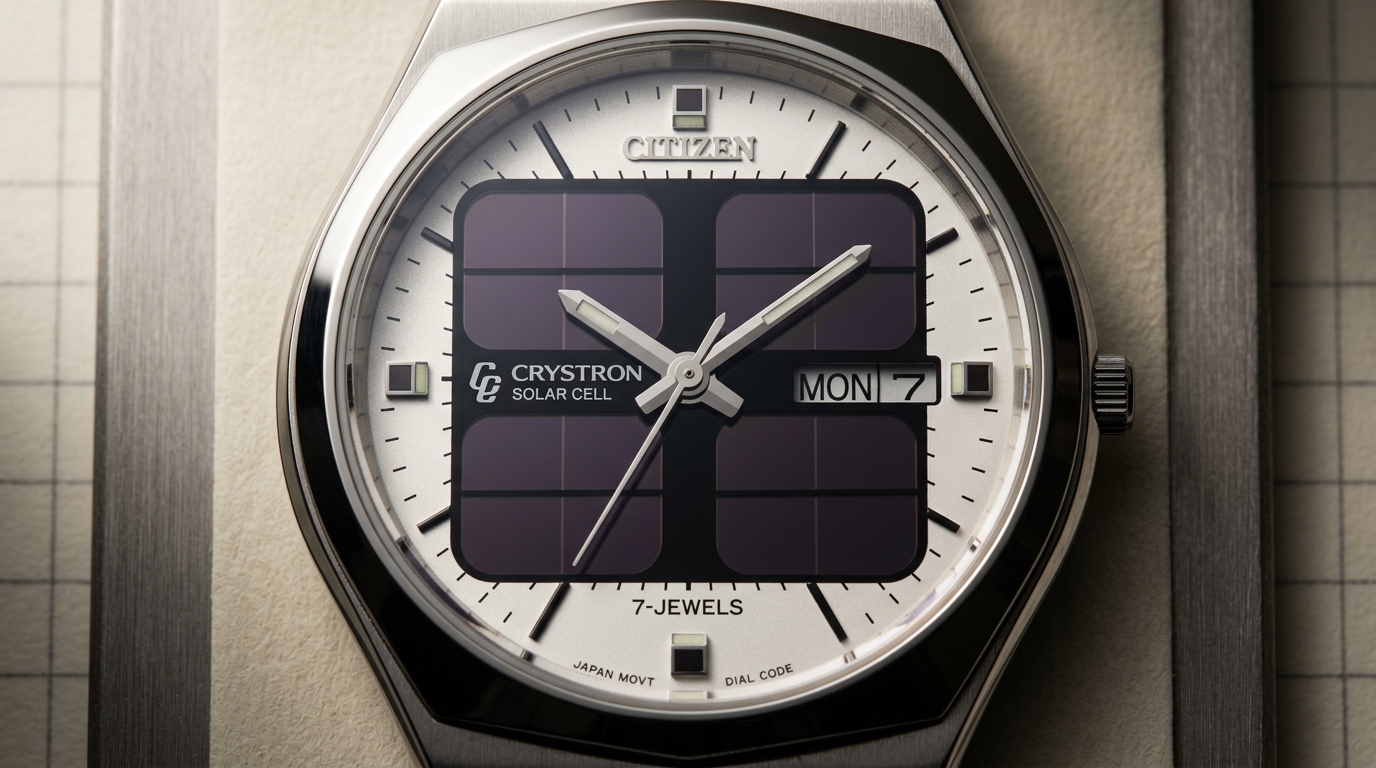
Citizen did not leave the idea at utility. The company pushed quartz in two directions at once: outward, toward radio signals, satellite reception, and global time correction; inward, toward autonomous precision and finishing strong enough to invite scrutiny. The first path produced watches that could listen to atomic clocks from transmitters or interpret signals from satellites overhead. These were feats of engineering with a distinctly modern poetry: a wristwatch quietly negotiating with the sky. But the second path, the path of high-accuracy quartz under the banner of The Citizen, is where the argument becomes more intimate.
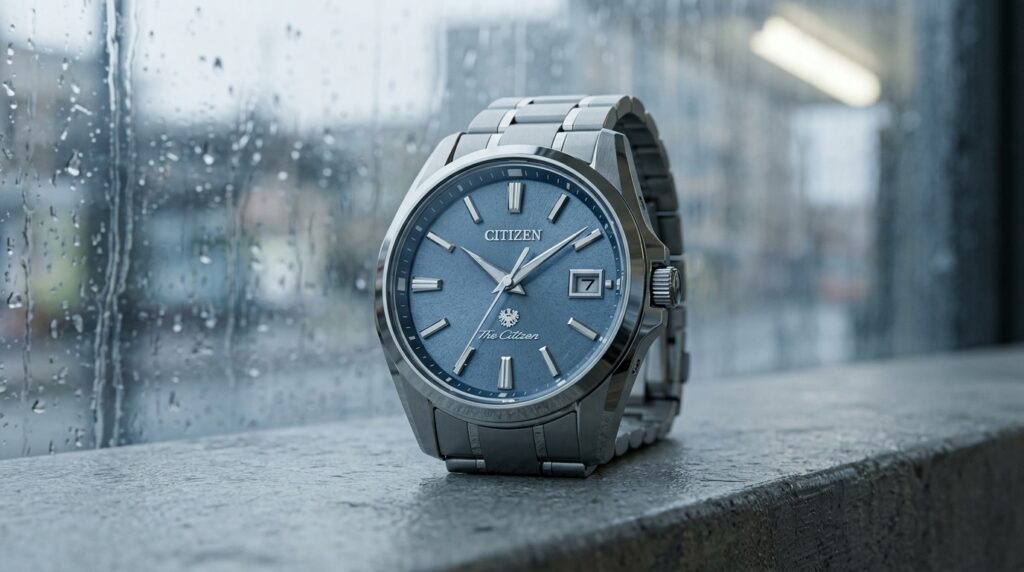
The Citizen, especially in its Chronomaster forms, asks to be regarded slowly. It is easy to miss if one is trained to search for complication in the old sense. There are no exposed tourbillons, no chiming racks, no chronograph levers presented like architecture. Instead there is proportion, alignment, dial texture, hand finishing, and an accuracy rating that would have looked impossible for everyday watchmaking in the middle of the twentieth century. Calibres such as the A060, often rated to within five seconds per year, reveal Citizen’s particular seriousness. Not five seconds per day. Not per month. Per year.
The A060 is more than a precise oscillator packaged in a handsome case. It is a solar-powered perpetual calendar movement, designed to account for leap years and unequal months, with an independently adjustable hour hand useful for travel and a power reserve that frees the watch from nervous maintenance. Its annual accuracy depends on thermal compensation, the movement attending to changes in temperature that would otherwise alter the behaviour of the quartz crystal. The work is mostly hidden, which may be why it receives less romance than it deserves. A mechanical chronometer compensates through materials, geometry, lubrication, poising, and regulation. A high-accuracy quartz movement compensates through measurement and correction. Different languages, same old desire: to make time less vulnerable to the world.
Citizen’s best dials give that hidden discipline a surface worthy of it. Some versions of The Citizen use washi paper, a material whose fibres hold light in uneven, organic ways. The choice could have become a gimmick in less careful hands, but here it serves the movement beneath it. A light-powered watch needs a dial that can admit energy, and washi allows translucency without surrendering texture. The result is neither sterile nor rustic. It is technical paper made horological, a membrane between sun and circuit. Under magnification, such a dial resists the flat perfection associated with mass electronics. It has grain, small variations, the suggestion of hand and material. Quartz, so often accused of being faceless, receives a face that behaves like something made rather than printed.
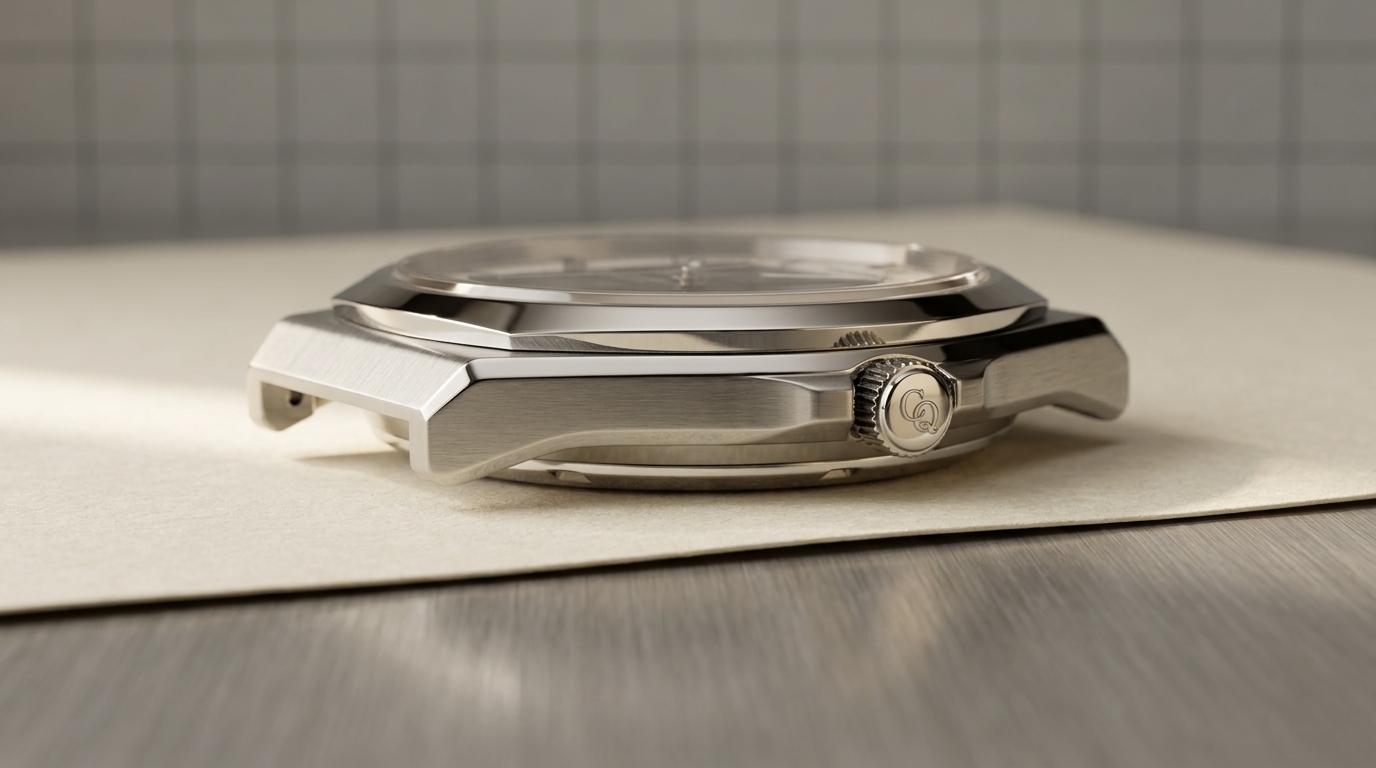
The cases matter too. Citizen’s work with titanium dates back to the X-8 Chronometer of 1970, commonly cited as the first titanium watch offered to the public. Titanium solved problems that steel could not: weight, corrosion resistance, and a certain skin-friendly neutrality. But raw titanium scratches easily, and its grey surface can appear dull if not treated with care. Citizen’s answer, developed through decades of Duratect hardening and surface treatment, turned titanium from a technical compromise into a refined material. On many high-end Citizens, especially those known as Super Titanium, the case feels conceived for endurance rather than display. It is light, almost disarming in the hand by reputation, yet the finishing can be crisp: brushed planes, polished bevels, clean transitions around lugs and bezels.
That lightness changes the emotional register of a watch. Heavy steel often announces itself as value. Gold declares itself by mass before it declares anything by design. Titanium disappears more readily. It does not insist. For a quartz watch, this absence of strain can feel appropriate. The movement is efficient; the case is efficient; the object does not pretend to be a miniature locomotive. It becomes something closer to an instrument, but an instrument refined enough to avoid coldness.
The highest expression of Citizen’s humanised quartz arrived with the Caliber 0100, created to mark the company’s centenary and later placed into limited wristwatches. Its claim is stark: accuracy to within one second per year, without relying on radio towers, satellites, Bluetooth, or external correction. It is autonomous. That word matters. A connected watch may be correct because the world keeps correcting it. The Caliber 0100 is correct because its own internal architecture has been made extraordinarily stable.
At its heart is a quartz oscillator operating at 8,388,608 Hz, far higher than the familiar 32,768 Hz frequency that defined conventional quartz watchmaking. The number is not arbitrary; it belongs to the binary logic by which quartz oscillations are divided down into one-second impulses. Higher frequency creates greater opportunity for precision, but it also brings demands: more energy, greater sensitivity to design, more difficult control. Citizen paired this with an AT-cut quartz crystal, chosen for superior temperature characteristics compared with the tuning-fork-shaped quartz used in ordinary movements. The result was not a watch made accurate by periodic outside obedience, but one disciplined from within.
Yet the Caliber 0100’s most memorable quality may not be its number. One second per year is almost too abstract. It exceeds the scale at which daily human life can easily feel error. What gives the watch presence is the way that precision is staged. On the wristwatch versions introduced in 2019, including Super Titanium references and the white-gold model, the design was spare, even severe. The seconds hand became the protagonist. Long and sharply counterweighted, it travelled around a dial marked with strong, architectural indices. Each jump asked a question: will it land cleanly? The answer, by design, was yes.
Misalignment is the small tragedy of ordinary quartz. A seconds hand that strikes between markers reminds the wearer that the motor and dial do not quite speak the same language. Citizen’s finest quartz watches treat that alignment as a moral issue. The hand must meet the mark. It must justify the tick. In doing so, the one-second advance becomes less crude. It becomes ceremonial. A mechanical sweep offers continuity; a good quartz tick offers decision.
This is where Citizen’s work acquires its particular literary force. It did not attempt to disguise quartz as mechanical. It did not blur the seconds into a false sweep or decorate the movement with imitation bridges. Instead it accepted the nature of quartz and refined the consequences. The watch ticks because quartz ticks. It stores light because quartz needs energy. It measures temperature because crystals respond to temperature. It is honest about its physics, and from that honesty comes character.
The broader watch world has often confused humanity with visible imperfection. Mechanical watches gain affection partly because they vary: a few seconds fast, a few seconds slow, gaining on the wrist, losing on the dresser, adjusting to position and habit. Their errors can feel companionable. Quartz, by contrast, can appear indifferent. But Citizen discovered another route. A watch can feel human not because it errs, but because it participates in conditions familiar to human beings: light and shadow, rest and recovery, durability, aging surfaces, the need to be trusted.
This trust has always been central to Citizen’s identity. The company’s name still carries a faint civic ambition, rare in luxury watchmaking. It suggests usefulness before exclusivity. Even the most sophisticated Citizen quartz watches remain connected to that origin. A Chronomaster with a paper dial and a five-seconds-per-year movement may be built to standards that invite collectors, but its deepest pleasure is practical. It will be ready. Its calendar will know the date. Its solar cell will reduce the indignity of sudden failure. Its titanium case will resist the small abrasions of daily use better than untreated metal. These are not romantic claims in the old watchmaking sense, but they accumulate into something emotionally persuasive.
Finishing plays a quiet role in this persuasion. Citizen’s upper-level cases and bracelets do not succeed by excess. Their grammar is usually restrained: facets that catch light cleanly, lugs shaped to reduce mass, crowns that sit properly within the case profile, indices polished enough to flash but not shout. The eagle mark on some The Citizen dials, representing the line’s ideals of foresight and dedication, can feel almost old-fashioned in its symbolism, yet it suits the watches. They are built around vigilance. The movement watches temperature. The calendar watches the century. The solar cell watches for light. The owner is relieved of watching too much.
Quartz once promised liberation from fuss, and then, in becoming cheap, lost much of its dignity. Citizen’s great repair was to restore seriousness to convenience. Convenience need not mean disposability. Accuracy need not mean emptiness. Low maintenance need not mean low craft. In a culture that often treats difficulty as proof of value, Citizen made an argument for grace: the best technology may be the kind that withdraws from drama while remaining deeply considered.
There is a reason the Caliber 0100 feels philosophically different from a smartwatch synchronised every night, or a phone whose time is perfect because networks make it so. Those devices are accurate as members of a system. Remove the system and their authority weakens. Citizen’s highest quartz movements express a more watch-specific ideal. They are enclosed, self-sufficient, and local. Light enters; time comes out. The case contains the problem and the solution.
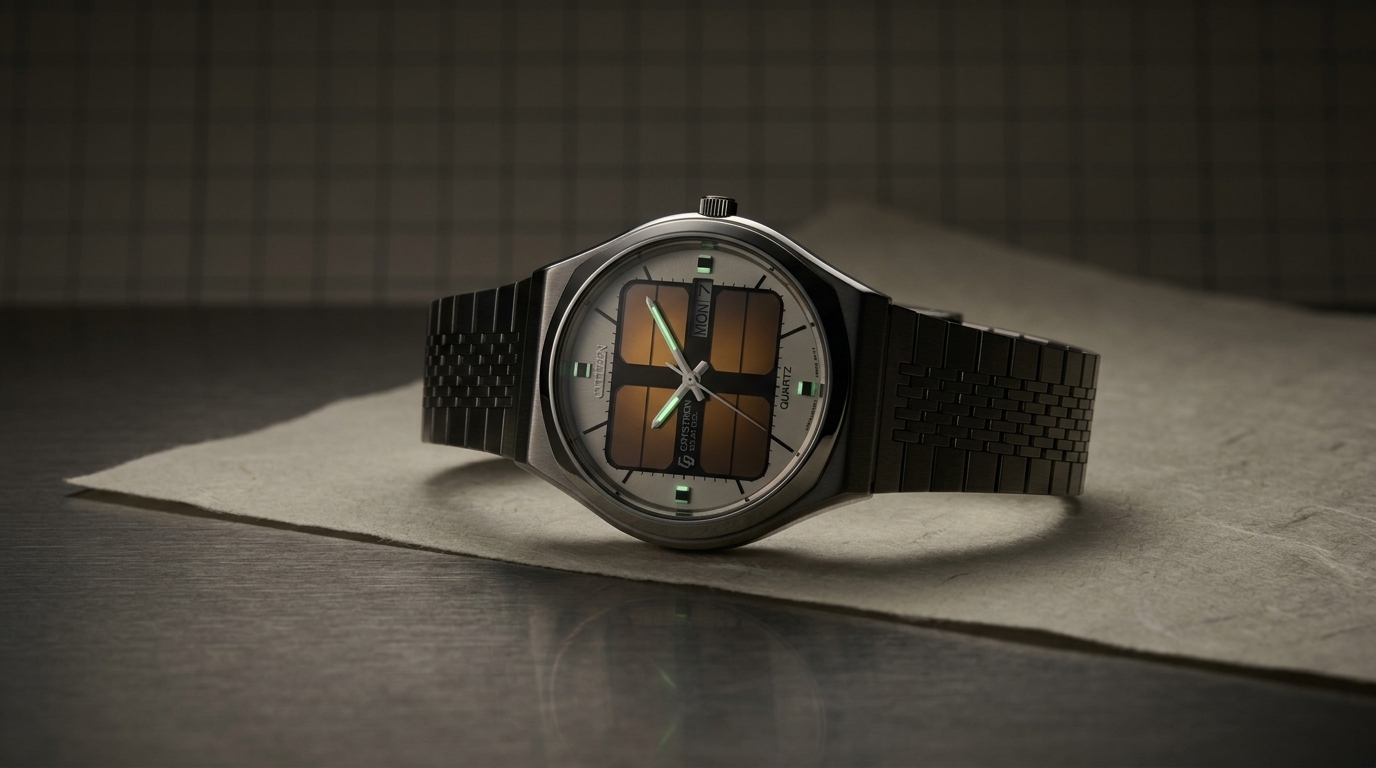
This enclosure is important to horology. A watch is not merely a time display. It is a small sealed world. Mechanical watchmaking has long understood the romance of that world: a spring storing force, gears dividing it, an escapement releasing it, a balance regulating it. Citizen’s humanised quartz asks for a similar imaginative courtesy. Inside, a crystal vibrates at a rate no eye can follow. A circuit counts. A motor steps. A rechargeable cell holds the memory of light. None of this resembles the old village of wheels and pinions, but it has its own integrity. It is another way of making a world small enough to wear.
The irony is that quartz needed time before its own poetry became visible. In the 1970s, it was too new and too disruptive. In the 1980s and 1990s, too associated with cheapness. Only later, after mechanical watchmaking had been saved and romanticised almost beyond recognition, could collectors return to quartz and see distinctions that had been flattened by prejudice. A plastic throwaway and a thermocompensated, solar-powered Citizen with a hand-finished case are not the same category of object simply because both contain quartz crystals. To pretend otherwise is to mistake an energy source for a philosophy.
Citizen’s philosophy is clearest in the watches that do not demand attention yet reward it. They allow the owner to forget them, but not because they are forgettable. Rather, they are built around a form of reliability so complete that attention becomes optional. When attention does return, there is the aligned seconds hand, the dial surface taking light, the case edge still sharp after use, the date correct at the end of February, the movement quietly within a few seconds of truth after another year has passed.
That may be the most humane thing technology can do in a watch: not to mimic life, not to overwhelm it, but to accompany it with competence. Citizen made quartz feel human again by giving it manners. It taught the tick to land properly. It gave the battery a relationship with daylight. It placed advanced circuitry beneath dials made of paper, mother-of-pearl, or disciplined matte surfaces. It hardened titanium without making it brutal. It pursued accuracy so extreme that the figure itself became less important than the devotion behind it.
At the edge of the dial, the seconds hand continues. It does not plead for romance. It has no visible escapement to charm the sceptic, no open heart, no trembling balance. It advances, stops, and advances again, each second separated from the last with clean intent. In that restraint lies Citizen’s unusual gift. The company did not make quartz human by making it less quartz. It made quartz human by understanding what quartz could be when treated not as a shortcut, but as a form of watchmaking worthy of patience, material intelligence, and care.