Breguet and the Problem of Being Too Influential
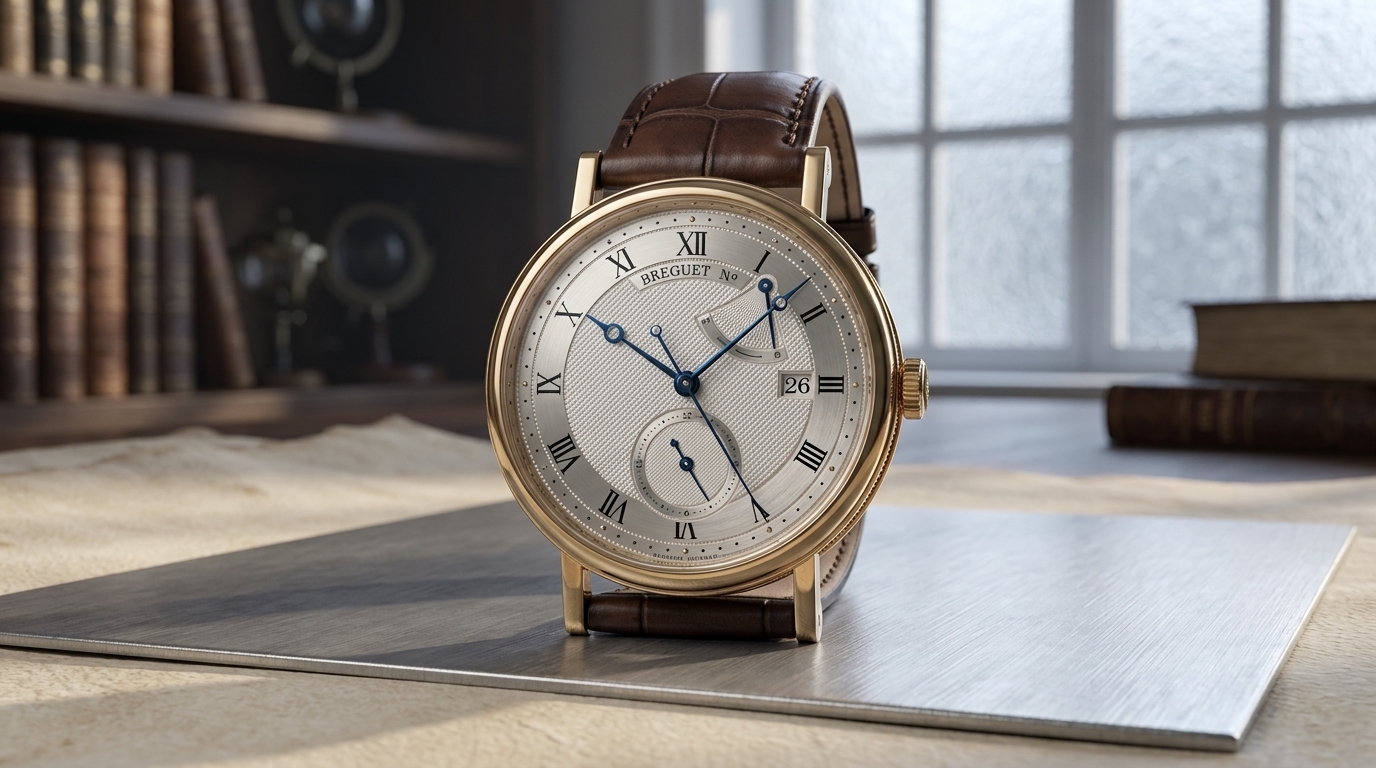
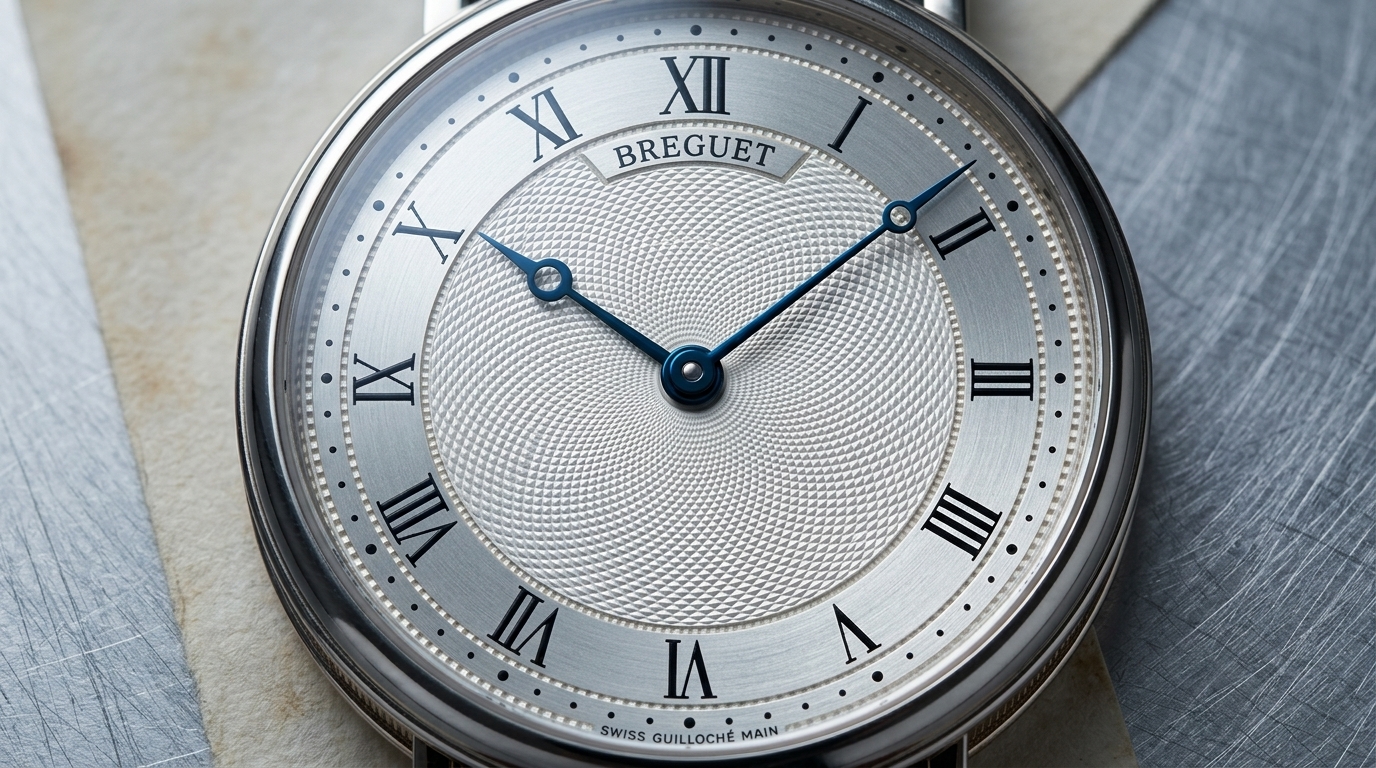
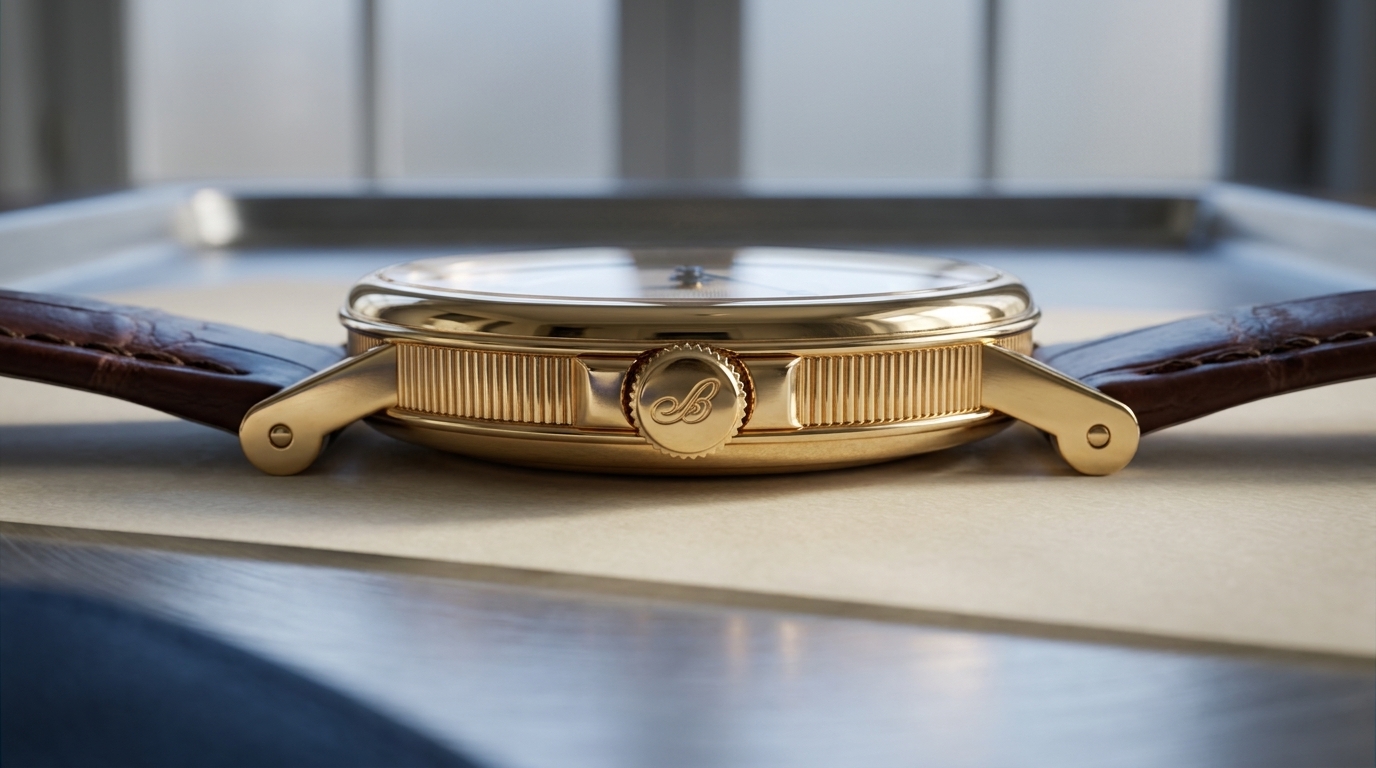
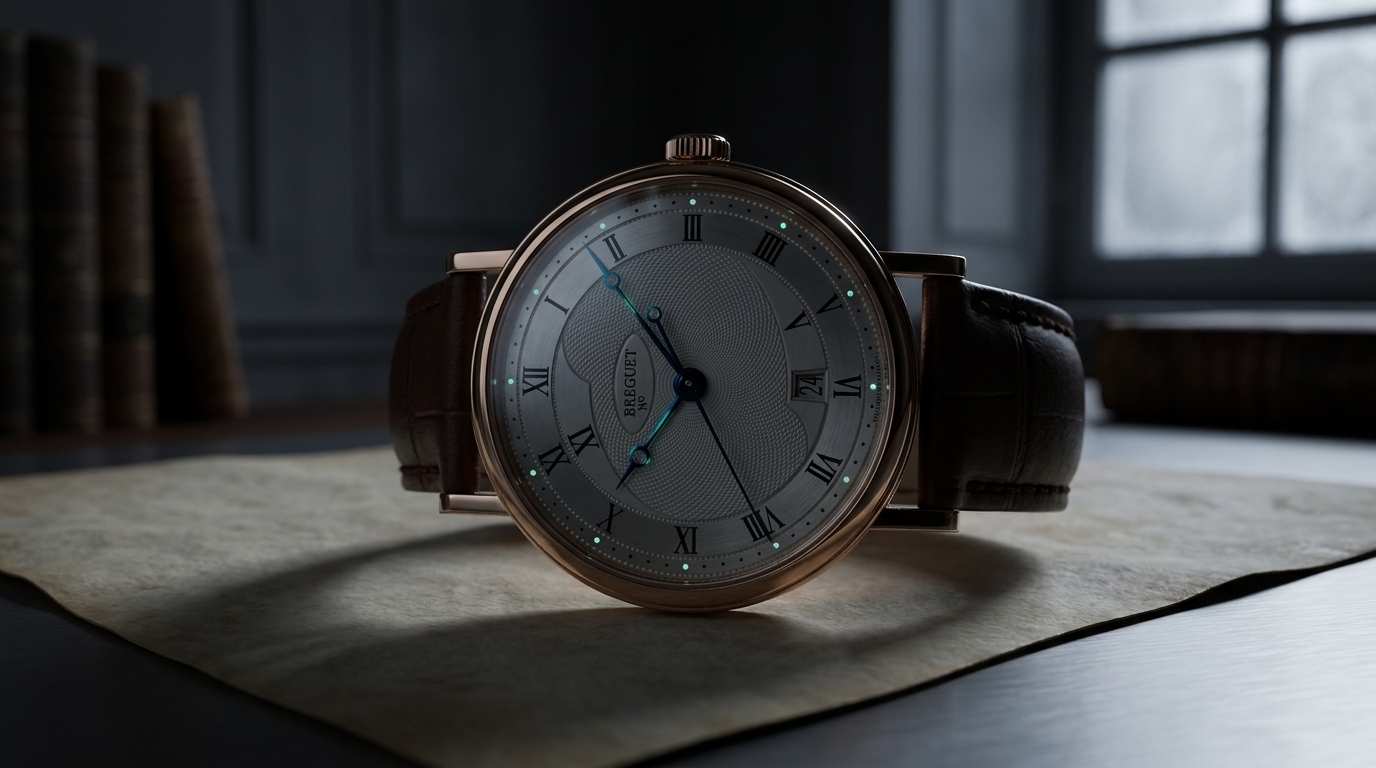
The minute hand is a circle with a tail, a sliver of blued steel opening around nothing. Against the silvered dial it seems almost too delicate to be useful, a piece of punctuation rather than machinery. Its tip reaches toward black Roman numerals printed on a brushed chapter ring, while the central field beneath it has been cut into a tight pattern of guilloché, each line catching the light at a different angle. The case edge is fluted. The lugs are straight. The dial carries a secret signature so faint that it can disappear in the face of a lamp. On the wrist, or in the tray, or under the hard white light of a dealer’s loupe, a modern Breguet Classique can look not merely old-fashioned but strangely familiar, as though it has arrived already quoted.
That familiarity is the beginning of Breguet’s difficulty. The watch appears to contain a set of conventions, but many of those conventions began as Breguet. The open-tipped hand, now lazily called a Breguet hand wherever it appears. The Arabic numerals with their swelling curves, copied and softened by generations of dial makers. The engine-turned dial used not as decoration alone but as a way of separating indications and catching legibility from reflected light. The coin-edge caseband, the disciplined symmetry, the quiet hierarchy of information. One looks at such a watch and sees the vocabulary of formal watchmaking. The problem is that the vocabulary has been spoken by everyone else for so long that the author can seem, at first glance, like another fluent imitator.
Abraham-Louis Breguet’s name has always carried the burden of invention. Born in Neuchâtel in 1747 and established in Paris, he entered watchmaking at a moment when horology was still visibly argumentative: thick cases, ornate decoration, verge escapements, watches that kept aristocratic time rather than exact time. By the late eighteenth century, Breguet had begun to impose a different order. His watches were cleaner, flatter, more legible. They were not plain in the modern sense; they were severe by contrast. The ornament moved from excess to structure. A guilloché dial did not merely glitter. It organized the surface. A hand was not merely graceful. It revealed the hour without blocking it. A case was not merely precious. It became an instrument’s enclosure.
This is easy to praise now, and therefore easy to flatten. The catalogue of Breguet inventions is so often repeated that it risks hardening into museum text: the self-winding perpétuelle watches, the pare-chute shock protection, the gong spring for repeating watches, the subscription watch, the tourbillon patented in 1801. Each achievement has been polished by retelling until its original strangeness is nearly gone. But the force of Breguet’s work was not simply that he made clever mechanisms. It was that he gave mechanical time a new social and visual form. His watches were made for monarchs, scientists, financiers, soldiers, and exiles; they passed through courts and revolutions. They were intimate machines from a period when intimacy and power often shared a pocket.
The tourbillon is the most famous example, and perhaps the most misunderstood. Today it is a theatrical object, often enlarged, exposed, jeweled, skeletonized, sent spinning beneath sapphire for the pleasure of being noticed. Breguet’s tourbillon was not conceived as spectacle. It was a regulating device for the vertical positions of a pocket watch, a small rotating carriage intended to average errors caused by gravity. Its poetry was mathematical before it was visual. In a wristwatch, where the positions are more varied and the need less absolute, the tourbillon has become a symbol of mastery that sometimes tells more about taste than timekeeping. This, too, is part of the problem: Breguet’s solutions have outlived their original necessities and reappeared as signs.
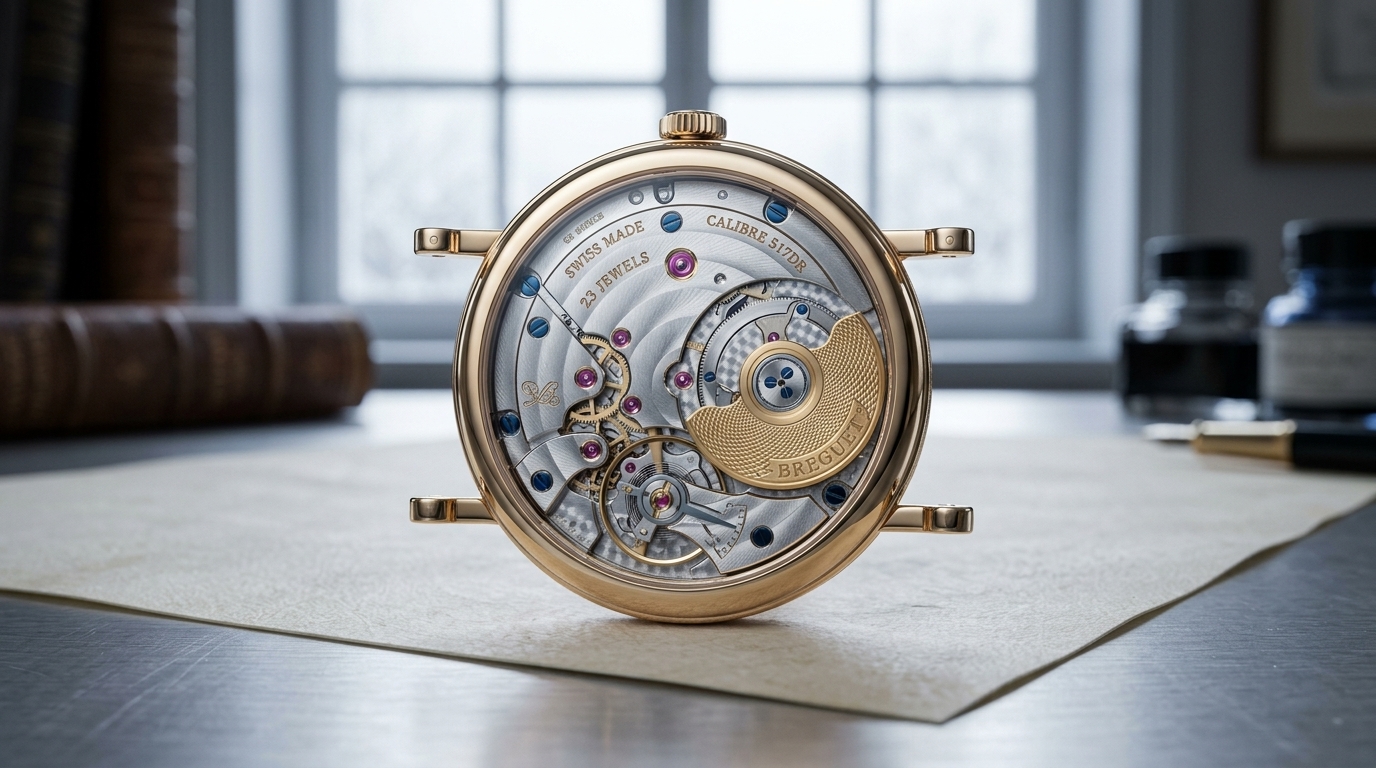
A modern Breguet therefore lives in a peculiar state of repetition. Take the Classique 5157, one of the purest current expressions of the house’s old grammar. Its proportions are restrained by contemporary standards: a thin round case, often in gold, with a diameter that sits close to the traditional dress watch ideal. The dial is silvered gold and hand-guilloché, usually worked with a clous de Paris hobnail pattern at the centre, bordered by a chapter ring carrying Roman numerals. The minutes are indicated by small dots. The hands are blued steel, annealed rather than painted, their colour depending on heat and patience. Inside is the automatic calibre 502.3, famously thin, with an off-centre rotor in gold, descended from the Frédéric Piguet ultra-thin architecture and adapted over time into Breguet’s own language with modern materials such as a silicon balance spring in some versions.
None of that shouts. In fact, the watch’s most telling quality is its refusal to provide a dramatic first answer. There is no openworked theatre, no aggressive case geometry, no forced vintage patina, no complication announcing the owner’s seriousness. It asks for the kind of attention that modern luxury often mistrusts: the slow reading of surface, edge, proportion, and silence. Yet silence can be mistaken for absence. In a market trained to reward novelty at a glance, Breguet’s codes may pass by unnoticed precisely because they have been absorbed into the background. The brand’s influence has made it legible everywhere and startling nowhere.
This is not merely a commercial inconvenience. It is an aesthetic trap. When a design becomes foundational, returning to it can look conservative even when it is historically original. A Calatrava from Patek Philippe, many formal Vacheron Constantin models, countless independent and industrial dress watches—all can carry some portion of the Breguet inheritance, whether in hands, numerals, dial layout, guilloché, or the idea that refinement means subtraction under control. The broader the influence, the harder it becomes for the source to astonish. Breguet’s watchmaking grammar has been naturalized. Its inventions are no longer perceived as inventions. They are simply how certain watches are supposed to look.
The house has tried, at different moments, to escape this by leaning into mechanism. The Tradition line, introduced in the early 2000s, was one of the more intelligent attempts. Rather than merely reproducing the outward signs of eighteenth-century Breguet, it brought the architecture of the old subscription watches to the dial side: barrel prominently displayed, bridges and wheels arranged as landscape, balance visible, surfaces frosted or shot-blasted to recall antique finishing without pretending to be old. A Tradition 7027 or later 7097 does not hide the machine beneath civility. It turns the foundational apparatus into the face itself. Here, influence becomes excavation. The watch does not say, “Look how tasteful we remain.” It says, more interestingly, “Look where this language came from.”
Even there, the tension remains. Too much historical reference and Breguet risks embalming itself. Too little and it risks becoming any other prestigious manufacture searching for relevance through size, colour, or complication. The marine watches offer another version of the dilemma. Breguet’s historical connection to naval chronometry is real; in 1815 Abraham-Louis Breguet was appointed Horloger de la Marine Royale. Precision at sea was not romantic styling but imperial infrastructure, a matter of navigation, trade, war, and survival. Modern Marine watches, especially in their more assertive forms, try to translate that history into contemporary sport-luxury language. Sometimes the translation is convincing; sometimes the old name must carry more weight than the design can bear. Influence, again, is both inheritance and demand.
The present-day company must also answer for the distance between Abraham-Louis Breguet’s workshop and a modern luxury group. Since the late twentieth century, under the ownership of what became the Swatch Group, Breguet has had resources that many historic names would envy: manufacturing depth, movement development, restoration capability, technical experimentation, and access to the enormous industrial base around Swiss watchmaking. Nicolas G. Hayek took a particular interest in the marque, treating it not as a dormant signature but as a cultural asset to be revived. That revival gave Breguet stability and visibility, but also fixed the modern brand in a complicated role: part manufacture, part custodian, part monument.
A monument is difficult to animate. Too much motion looks undignified; too little and dust gathers. This is why the best modern Breguet watches are often those that understand themselves as living instruments rather than commemorative objects. The Classique chronographs, the perpetual calendars, the equation-of-time pieces, and the sophisticated chiming watches are strongest when the dial remains governed by clarity rather than crowded by proof. Breguet’s historical greatness came not from complexity alone but from the domestication of complexity. The owner of an early Breguet did not need to see every solution being performed. The watch looked composed because the work had been done elsewhere.
This distinction matters because contemporary high horology often confuses exposure with honesty. Sapphire casebacks have taught collectors to look at movements, and that is no bad thing. Anglage, black polishing, striping, perlage, sharp internal corners, rounded steelwork—these are real forms of labour and judgment. But the temptation is to make the mechanism plead its case loudly. Breguet at its best resists that. Even when a movement is visible, the house’s deeper principle is not transparency but order. The mechanism should appear inevitable, as if each bridge and wheel has accepted its place after a long negotiation. That is a harder effect to sell in photographs than a tourbillon cage spinning like a small captive star.
The dial remains the truest battleground. Guilloché, in particular, has suffered from the fate of successful beauty. Machine-stamped imitations are common; laser-cut approximations have brought texture to watches at nearly every price level. On a genuine hand-guilloché dial, the pattern is cut on a rose engine or straight-line engine by a human guiding metal against a burin. The lines have depth and direction. They do not merely sit on the dial; they remove material from it. Different patterns can separate the hours from the small seconds, the power reserve from the moon phase, the date from the centre. In Breguet’s world, surface is not filler. It is syntax.
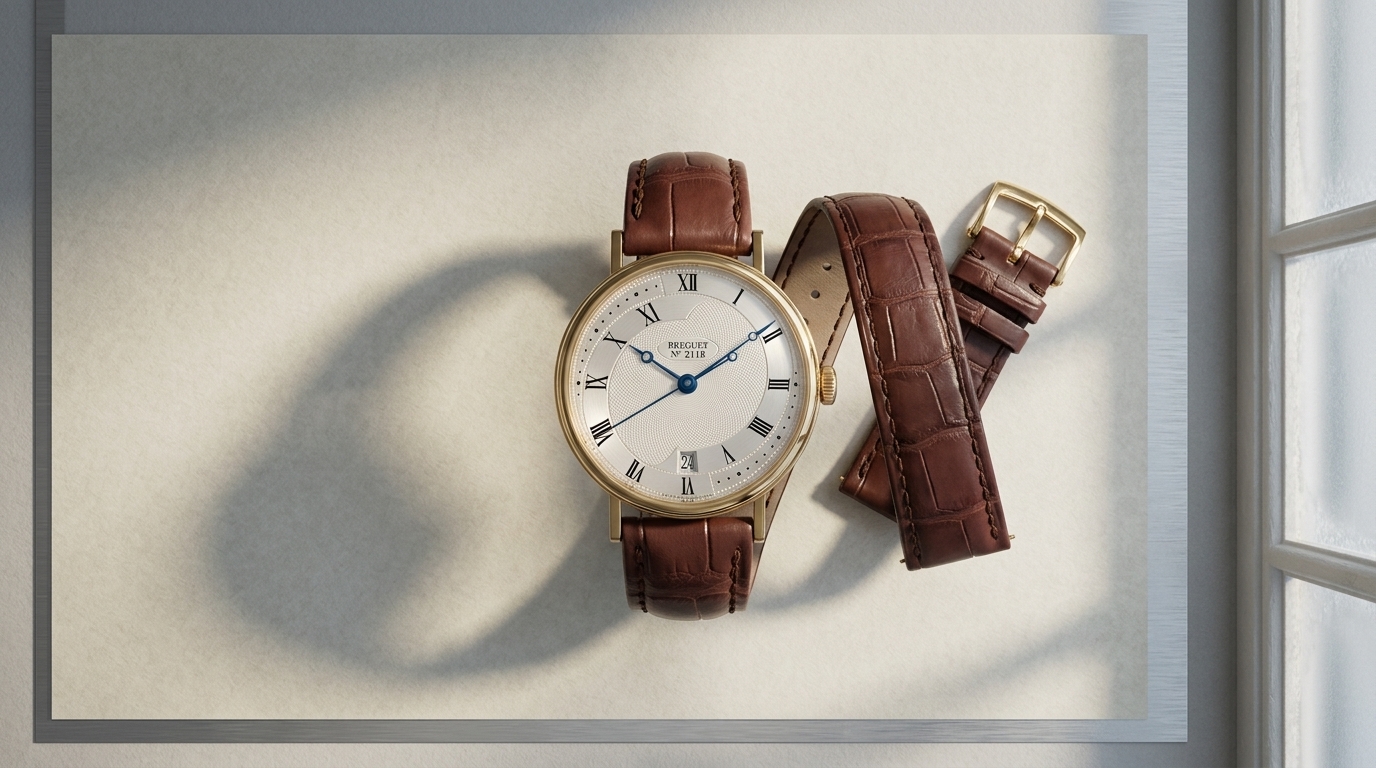
Yet from a distance, syntax can be misread as style. A person glancing through glass may see only “old watch.” Roman numerals, thin case, blue hands, silver dial. The encoding has to be learned, and modern watch culture is not always patient with learning. It often prefers recognizability to recognition: the bezel shape, the bracelet integration, the dial colour associated with a waiting list. Breguet’s signs are quieter and more widely dispersed. A fluted caseband does not behave like an octagonal bezel. A secret signature does not announce itself across a restaurant. The brand’s authority resides in details that almost refuse the social contract of conspicuous luxury.
That refusal can be noble, but it can also become an excuse. Not every Breguet design succeeds simply because the ingredients are correct. There are watches where the dial furniture feels too polite, where the date aperture interrupts a plane that would have been better left whole, where the case diameter stretches the old grammar beyond its natural tension. There are references in which Breguet’s codes appear applied rather than necessary, as though the brand has dressed a movement in ancestral clothes. Influence does not protect against awkwardness. If anything, it makes awkwardness more visible, because the standard is internal and severe. A Breguet is always being judged against Breguet.
The most interesting question is whether a house so closely associated with origin can still surprise without betraying itself. Surprise does not have to mean rupture. Abraham-Louis Breguet was not a nostalgic watchmaker; he was a modern one in his own century. His clarity was radical because it answered the confusions of his time. The equivalent today would not be to make eighteenth-century watches with better tolerances. It would be to ask what clarity means now, when mechanical watches no longer provide necessary time but chosen time. Perhaps it means thinner cases, more disciplined indications, less sentimental vintage theatre. Perhaps it means complications that restore intelligibility instead of multiplying subdials. Perhaps it means a sharper awareness that restraint is not the same thing as repetition.
There is something almost tragic in being responsible for a language. The innovator disappears into common speech. Nobody thanks the alphabet when writing a letter. Breguet hands can be placed on watches with no relation to Breguet. Breguet numerals can be printed on dials that have inherited only their outline. Tourbillons can be made by firms whose connection to chronometry is thinner than the cage they display. The signs travel. They are detached, simplified, consumed. Meanwhile the original house must stand beneath its own name and prove, again and again, that it is not merely selling the residue of past genius.
This is where the watches themselves become more persuasive than the mythology. A well-made Breguet does not need the entire legend pressed upon it. The legend can, in fact, get in the way. Look instead at the conjunction of dial and case, the way the fluting catches darkness between ridges, the fineness of the printed minute track, the temperature of blued steel against silver, the almost architectural calm of a small seconds subdial cut into a different guilloché ground. Consider the proportions of a Classique extra-thin, where the case must house an automatic movement and still keep the watch close to the wrist. Consider the Tradition, where old movement architecture is not hidden behind reverence but reorganized into a contemporary composition. These are not arguments made by slogans. They are made by intervals.
A Breguet watch often seems to operate in intervals: between invention and memory, between ornament and utility, between French neoclassical taste and Swiss industrial continuity, between courtly elegance and scientific instrumentality. The brand’s greatest pieces have always occupied such thresholds. Even the famous watch made for Marie Antoinette, completed decades after it was ordered and long after her death, exists as both object and myth, an accumulation of complications so extreme that it becomes less a possession than a fable about desire, patience, and historical violence. Breguet’s history is full of such crossings. The name belongs to salons and observatories, to naval offices and royal inventories, to patents and thefts and restorations.
But a modern watch cannot live forever in the reflected glow of old rooms. It must meet the eye in the present tense. That is why the problem of being too influential is not solved by asserting importance. Importance has a way of making watches feel remote, as though they should be admired through glass. The solution, if there is one, lies in making the influence newly specific. Not “Breguet” as a set of signs, but Breguet as a method: reduce confusion, refine the indication, let decoration serve reading, let mechanism justify its display, let proportion carry emotion without theatrical strain.
When this happens, the effect is quieter than triumph. The watch does not become new in the shallow sense. It becomes exact. The old hand with the hollow moon tip no longer looks like a borrowed period detail. It looks like the answer to a problem of visibility. The guilloché no longer reads as texture but as a map of functions. The caseband’s ridges cease to be ornament and become a tactile boundary between object and world. The Roman numerals, so often imitated, regain their odd sharpness. What seemed familiar becomes particular again.
Breguet’s difficulty, then, is inseparable from its achievement. The brand helped define how refinement looks in mechanical watchmaking, and refinement is easily diluted once defined. Its codes have become common property, but common property is not the same as common understanding. The finest modern Breguets ask the observer to reverse the usual direction of looking: not from novelty toward history, but from history back into the object, where old decisions still perform their work. The reward is not surprise as shock. It is recognition with depth.
The blued hand continues its slow circuit over the silvered dial. Nothing dramatic occurs. The pattern beneath it changes as the light moves, and the secret signature appears, then vanishes. Around the case, the fluting holds small alternating strips of brightness and shade. It is possible, in that quiet, to understand the peculiar burden of the name on the dial. Breguet does not suffer because it has been forgotten. It suffers because it has been remembered everywhere, often without being recognized. The watch must therefore accomplish something difficult. It must teach the eye that what looks familiar may not be derivative at all. It may be the source, still speaking in a language so widely inherited that its accent has nearly disappeared.