Blancpain’s Quiet Obsession with the Sea
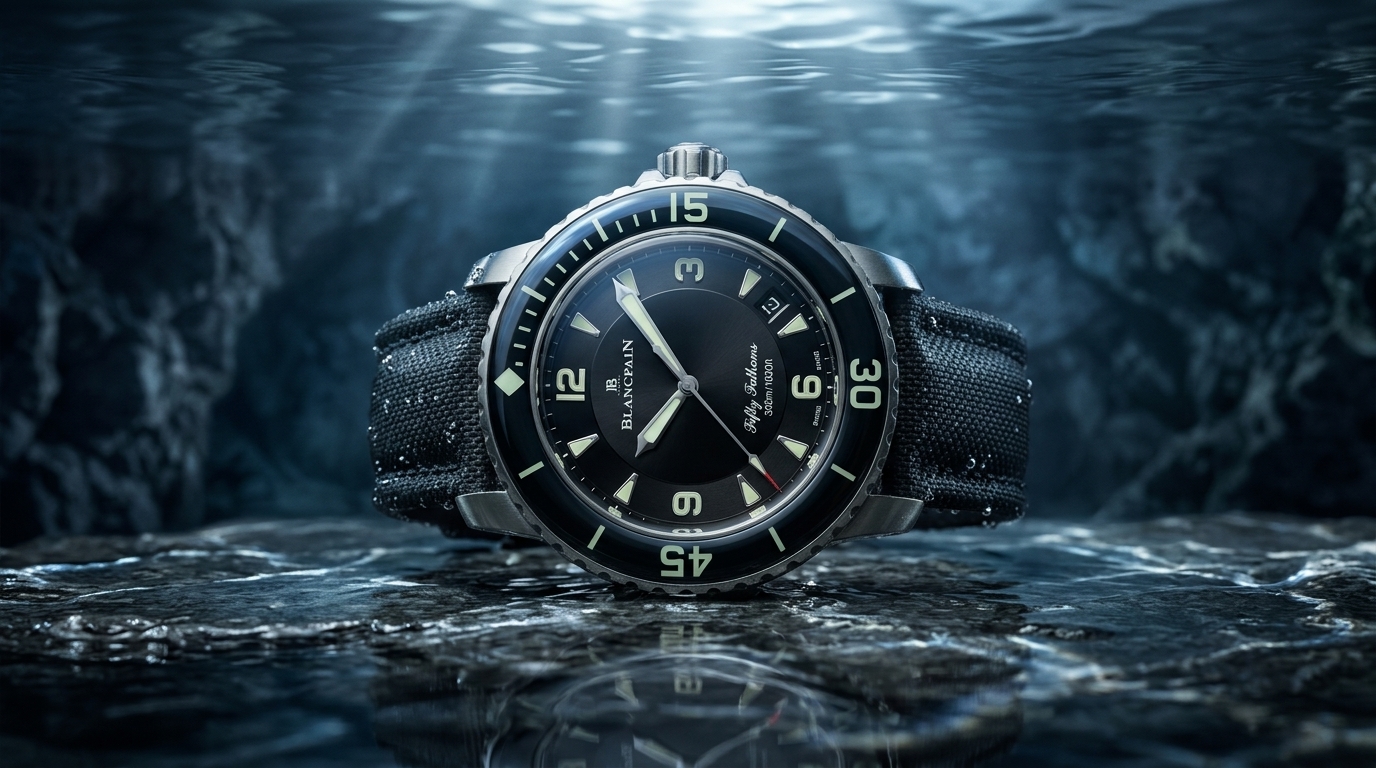
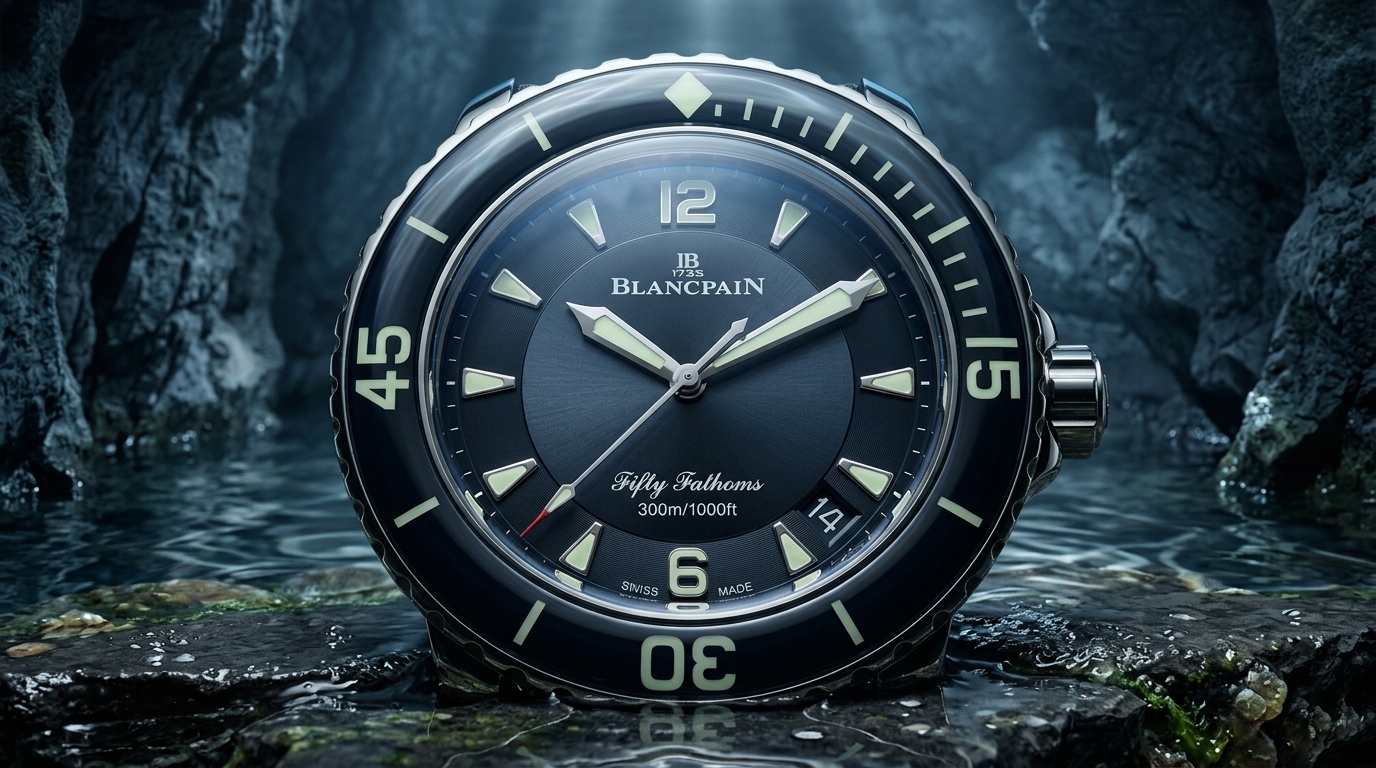
The luminous pip at twelve sits inside its clear ring of sapphire like a lamp behind thick glass, waiting for darkness. Around it the bezel descends into black, not the flat black of lacquer or ink, but a deeper pool, curved by the transparent dome above it. The minute hand is long and blunt enough to be read through silt; the hour hand, broader and shorter, holds its ground. On the dial, the numerals do not ask to be admired. They are there to be found quickly, when a wrist is moving, when air is being counted, when the surface has become an idea rather than a place.
Blancpain’s relationship with the sea has never had the cheerfulness of yacht varnish or regatta flags. It is older, colder, and more technical than that. The marque’s marine watch is not really about leisure, though it has long since entered the world of collectors, boutiques, and polished display cases. Its first language was necessity. The Fifty Fathoms emerged in 1953 from a period when underwater exploration was becoming newly possible and still visibly dangerous. The aqualung had changed the shape of human ambition; men could move below the surface with a freedom that felt modern and primitive at once. But freedom underwater is measured in minutes, and minutes require instruments.
Jean-Jacques Fiechter, Blancpain’s chief executive at the time, was a diver himself, not merely a manufacturer listening to a military brief. That distinction matters. The watch that followed was shaped by the particular fears of a person who understood how quickly confusion could arrive beneath the water. Fiechter had experienced the grave simplicity of a timing error while diving, and the lesson moved from the body into metal. The watch needed an automatic movement, because a self-winding mechanism reduced the need to pull out the crown and disturb the case seals. It needed a bezel that could mark elapsed time clearly. It needed luminous material that would speak in darkness. It needed a case more resistant to water than almost anything worn on the wrist had been.
At nearly the same moment, Captain Robert “Bob” Maloubier and Lieutenant Claude Riffaud of the French combat diving corps were looking for a watch that could serve their swimmers. The story has been repeated often enough to risk becoming lacquered with legend, but it remains useful because it explains the shape of the object. Maloubier’s requirements were not decorative. A black dial. Large luminous numerals. A rotating bezel. A watch that could survive the work. The name Fifty Fathoms referred to a depth of roughly 91 metres, a limit that spoke to the practical frontier of compressed-air diving in the period. It was not poetry first. It became poetic later because the words contained the pressure of the thing.
Early examples have an almost severe clarity. The round case, the broad bezel with its luminous markings sealed beneath a protective insert, the legible dial and automatic calibre together formed a grammar that would be copied, refined, and argued over for decades. Blancpain’s invention was not simply a waterproof watch; it was a complete underwater timing instrument. The bezel allowed the diver to align zero with the minute hand and track elapsed time at a glance. Modern divers take unidirectional bezels as moral law, but in the early years the problem was still fresh: if a bezel moved accidentally, it must not suggest that more air remained than truly did. The discipline of the sea entered the design through such small acts of caution.
There is something revealing in the fact that Blancpain’s dive watch has always seemed most itself when stripped of flourish. Its beauty, when it has beauty, comes from proportion under stress. A polished dress watch has the luxury of behaving like an object in a room. A diver’s watch must anticipate poor visibility, gloves, shock, depth, the awkward angle of a forearm near a gauge or valve. This is why the Fifty Fathoms line can look almost blunt in photographs and then become more nuanced in close observation. The bezel’s shine is not jewellery shine; it resembles wet stone. The case flank has mass because mass is part of reassurance. The dial keeps its distances. Nothing fragile is allowed to stand in the way of reading time.
The MIL-SPEC models brought an even more nervous intelligence to the design. The moisture indicator at six o’clock, with its small circular warning divided into pale and darker segments, looks almost quaint now, but it belongs to a world in which a compromised case could be fatal to the mission and ruinous to the movement. If water entered, the indicator changed colour. No rhetoric, no flourish, just evidence. For the American market, the Tornek-Rayville TR-900 carried this logic into one of the most studied military dive watches of the twentieth century, produced under arrangements that navigated procurement restrictions with a name that hid Blancpain in plain sight. “Rayville,” an approximate anagrammatic disguise of Villeret, has the strange charm of bureaucracy meeting danger.
Modern Blancpain has returned to these details with a careful hand, sometimes too careful for those who prefer their military objects unrestored and unromantic. Yet the brand’s obsession with the sea is not confined to remaking old watches. It is sustained through a language of continued pressure resistance, high-grade automatic movements, sapphire bezels, and cases that accept contemporary scale without entirely surrendering to fashion. The current Fifty Fathoms Automatique, in its familiar 45 mm form, is not a small watch and never pretends to be. Its size is part of its modern identity, a wide black instrument with a 300-metre depth rating and a bezel whose domed sapphire insert gives depth to the numerals beneath. Light slides over it slowly, as if over water at night.
Inside, the calibre 1315 is central to Blancpain’s modern interpretation of the dive watch. It is not a movement chosen merely to fill a case. With three series-coupled barrels and a power reserve of around five days, it answers a practical question with mechanical abundance: a watch left aside over a weekend can continue running, and a sports watch receives a reserve equal to its physical confidence. The movement beats at 28,800 vibrations per hour, uses a free-sprung balance, and in contemporary production benefits from a silicon balance spring, a material resistant to magnetism and corrosion in a way that feels appropriate for a watch born from hostile environments. Its finishing is visible through the back in many versions, which remains a point of debate among purists who prefer a closed steel case on a diver. Blancpain chooses to show the machine.
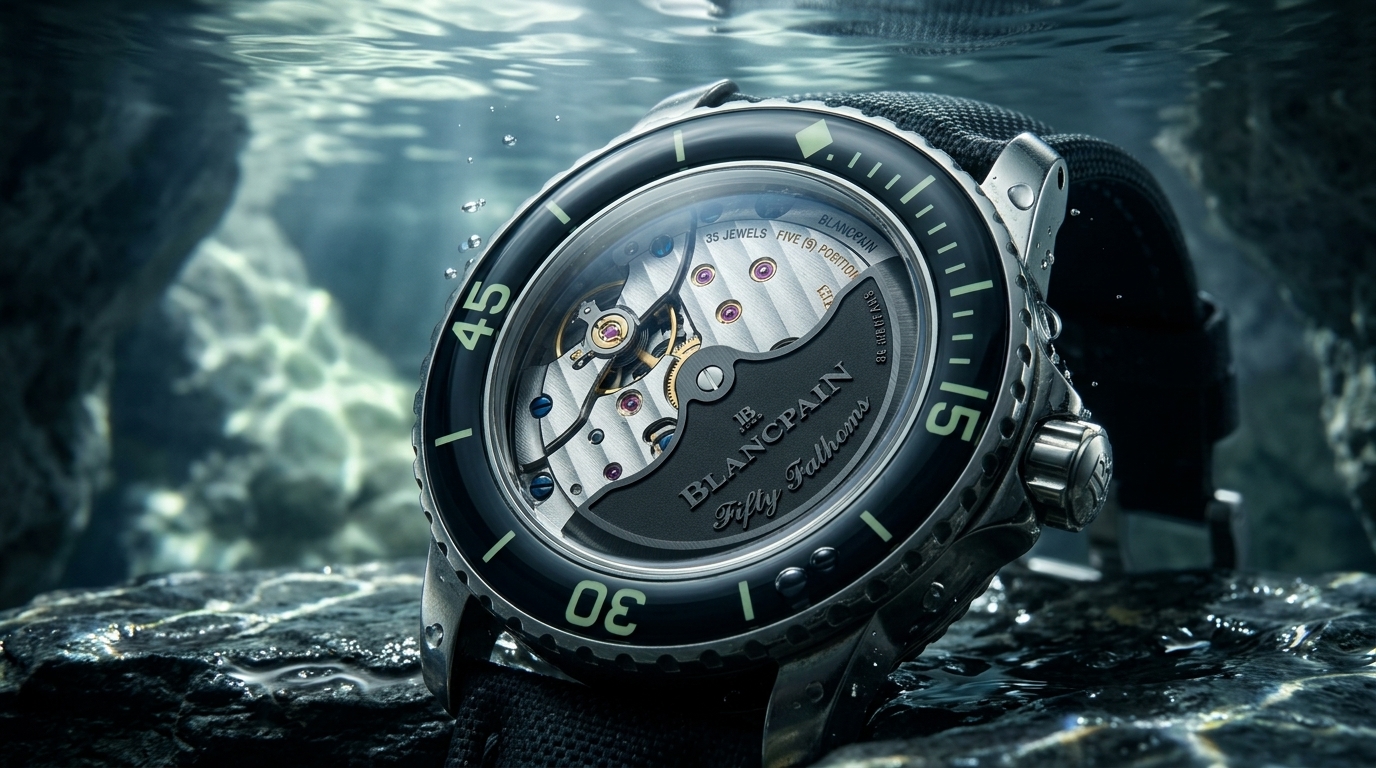
That visible movement reveals the tension at the heart of the modern Fifty Fathoms. It is descended from military equipment, but it is now finished as a luxury watch. The bridges carry striping; edges are bevelled; the rotor, often in gold and darkened on sport models, swings with a density that speaks both of winding efficiency and preciousness. Some will say a professional dive watch has no need for such theatre behind the wrist. That is fair. But Blancpain is not making disposable equipment for frogmen in 1953. It is making a memory of equipment, mechanically serious enough to withstand scrutiny, refined enough to acknowledge that the object now lives in another world. The sea remains present, but not as a costume. It is the pressure against which the watch defines itself.
The Bathyscaphe tells the story in a quieter register. First conceived as a more civilian companion to the Fifty Fathoms, it took its name from the deep-diving vessel associated with exploration rather than combat. In modern form, especially in the restrained three-hand models, it has a leaner silhouette. The bezel is flatter, the dial more open, the markers more reserved. Where the Fifty Fathoms Automatique carries the round-shouldered presence of the original instrument, the Bathyscaphe feels drawn with a finer pencil. In larger cases it uses the same family of substantial automatic movements; in smaller executions Blancpain has turned to calibres such as the 1150, thin and long-running, with twin barrels and a power reserve that can approach four days. The technical commitment remains, but the watch speaks at lower volume.
This matters because Blancpain’s marine obsession has never been a single shape. It is a recurring pressure applied to different cases, different decades, different ideas of use. The brand has made chronographs within the Bathyscaphe line, including flyback versions driven by the high-frequency F385 calibre, where the sweep of elapsed seconds becomes not only legible but immediate. It has made tributes to MIL-SPEC watches with moisture indicators restored as historical punctuation. It has made limited editions that nod toward expeditions and ocean research. Some are more convincing than others. That is inevitable. The sea is a large subject, and watch companies are not immune to symbolic excess. But Blancpain’s strongest marine watches are those that keep returning to instruments: elapsed time, sealed cases, luminous markers, automatic winding, endurance.
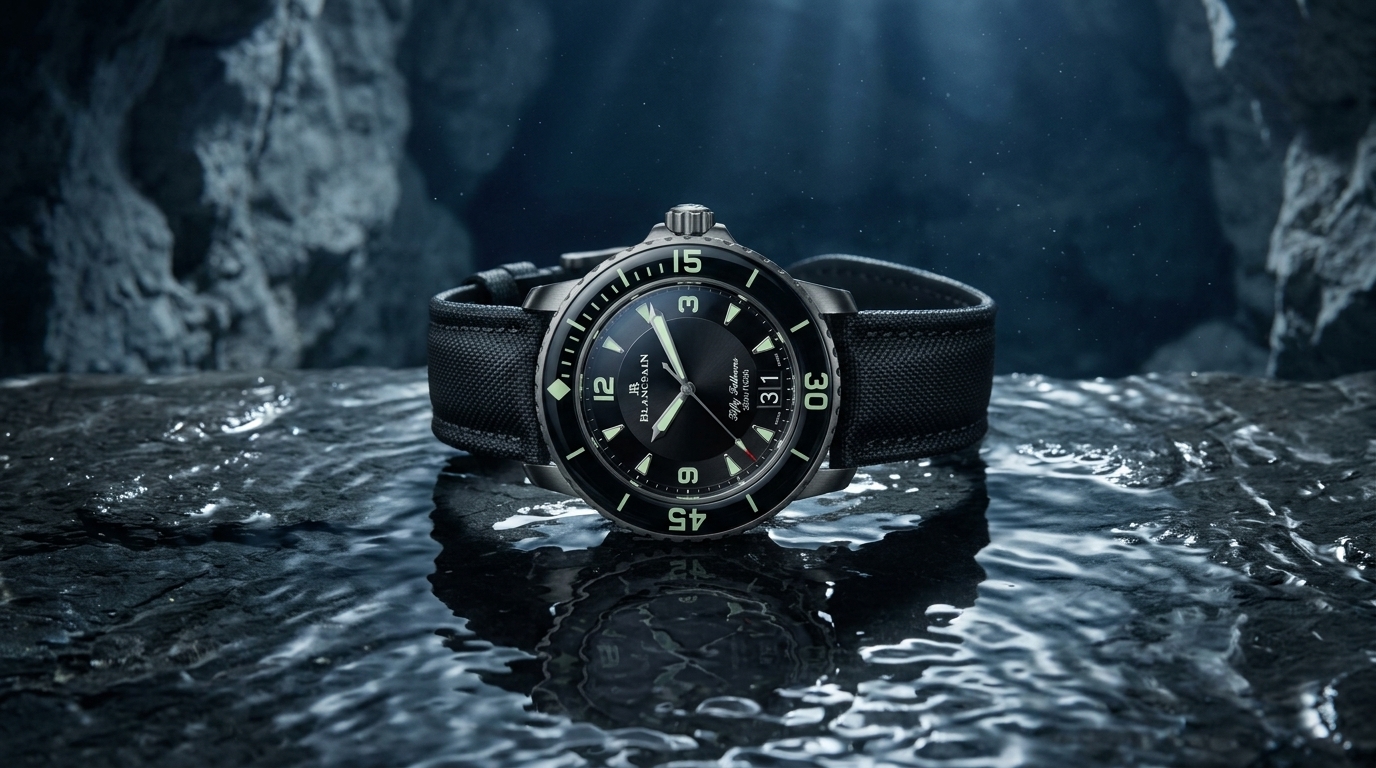
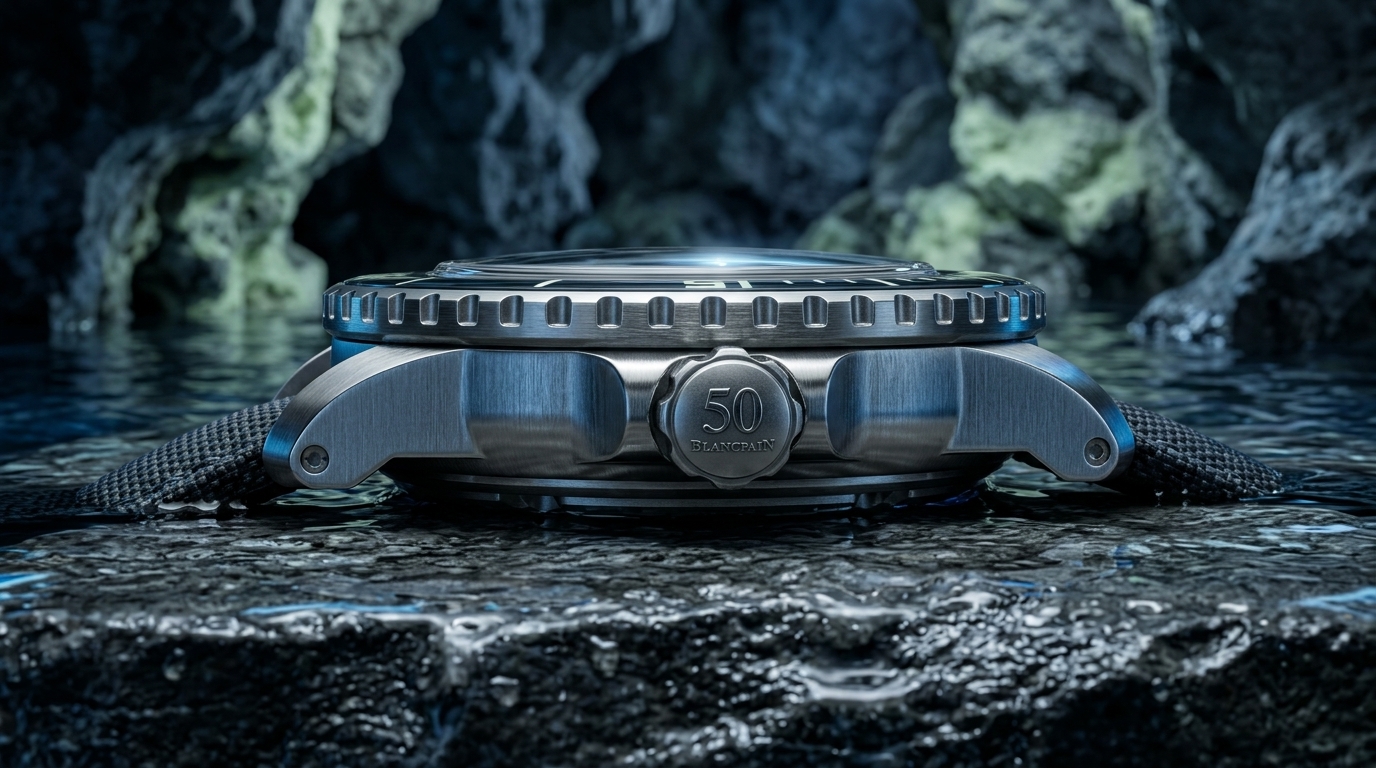
The case proportions reveal how Blancpain thinks about water. A Fifty Fathoms is rarely timid on the wrist, even in reduced diameters, because its architecture requires a particular confidence. The bezel must be broad enough to be gripped and read. The dial must breathe inside a minute track that does not crowd the hands. The crown must feel like a component meant to seal, not a decorative bead attached to the flank. The sapphire bezel, now one of the collection’s visual signatures, introduces a surface unlike aluminium or ceramic. It is glossy, yes, but also strangely deep. The numerals seem submerged beneath it, protected from abrasion, visible as if through a mask.
There is restraint in the dial typography when Blancpain gets it right. The Arabic numerals on the classic Fifty Fathoms have enough shape to be remembered, but not enough eccentricity to interrupt the reading of time. The date, often placed between four and five on the Automatique, is more contentious. It slightly disturbs the purity of the dial, as dates often do on dive watches, but it also admits the truth of daily use. These watches are now worn far from decompression tables and dive boats. They pass through airports, offices, winter streets, restaurants, hotel rooms. The date is a concession to that life. Whether it improves the composition is another question.
The older watches were not pure either, at least not in the way collectors sometimes imagine purity. They were modified, supplied, branded, and adapted for different military and civilian needs. There were “No Radiations” dials indicating safer luminous material after concerns over radium. There were moisture indicators, alternate signatures, changing case forms, and small variations that now occupy catalogues and auction notes. The history is not a straight line; it is a tide chart. Blancpain’s achievement was to establish a design flexible enough to survive these changes without losing its basic identity. A Fifty Fathoms can tolerate variation because its core idea is strong: make elapsed time legible under water.
That idea has aged better than many mid-century technical dreams. Aviation watches often retain the romance of cockpits and navigation, but their scales and slide rules can feel distant from contemporary life. Racing chronographs still carry speed, but speed has been domesticated by screens and regulations. The dive watch, though largely unnecessary for modern recreational diving in an era of digital computers, retains an elemental authority. It measures a resource the body understands. Breath. Time below. The way back. Even on land, that symbolism remains unusually direct. A rotating bezel continues to be useful for cooking, parking meters, meetings, train departures; these are trivial descendants of a grave function, but they keep the old gesture alive.
Blancpain’s quietness comes from its refusal, at its best, to over-explain this connection. The brand does support ocean exploration and conservation, and its name has been tied to underwater photography, scientific expeditions, and the work of divers who move in places most owners will never see. But the watch itself does not need a painted wave on the dial to establish its loyalty. The loyalty is in the engineering choices and the long return to black dials, luminous plots, sealed crowns, and bezels that turn with a measured resistance. The obsession is not expressed as nostalgia alone. It is expressed as repetition, refinement, and near-stubborn continuity.
There is also a particular kind of Swiss contradiction in the thing. The sea is not Switzerland’s natural landscape. Blancpain comes from Villeret and Le Brassus, from valleys and workshops, from winters and benches rather than harbours. Yet perhaps that distance sharpened the imagination. The ocean, for a mountain watchmaker, is not background scenery. It is an adversary in the abstract: pressure, salt, darkness, shock, corrosion, depth. These are problems a watchmaker can understand without romanticising them. The sea becomes a testing ground for seals, tolerances, lubricants, legibility, and autonomy. It is less a postcard than a set of demands.
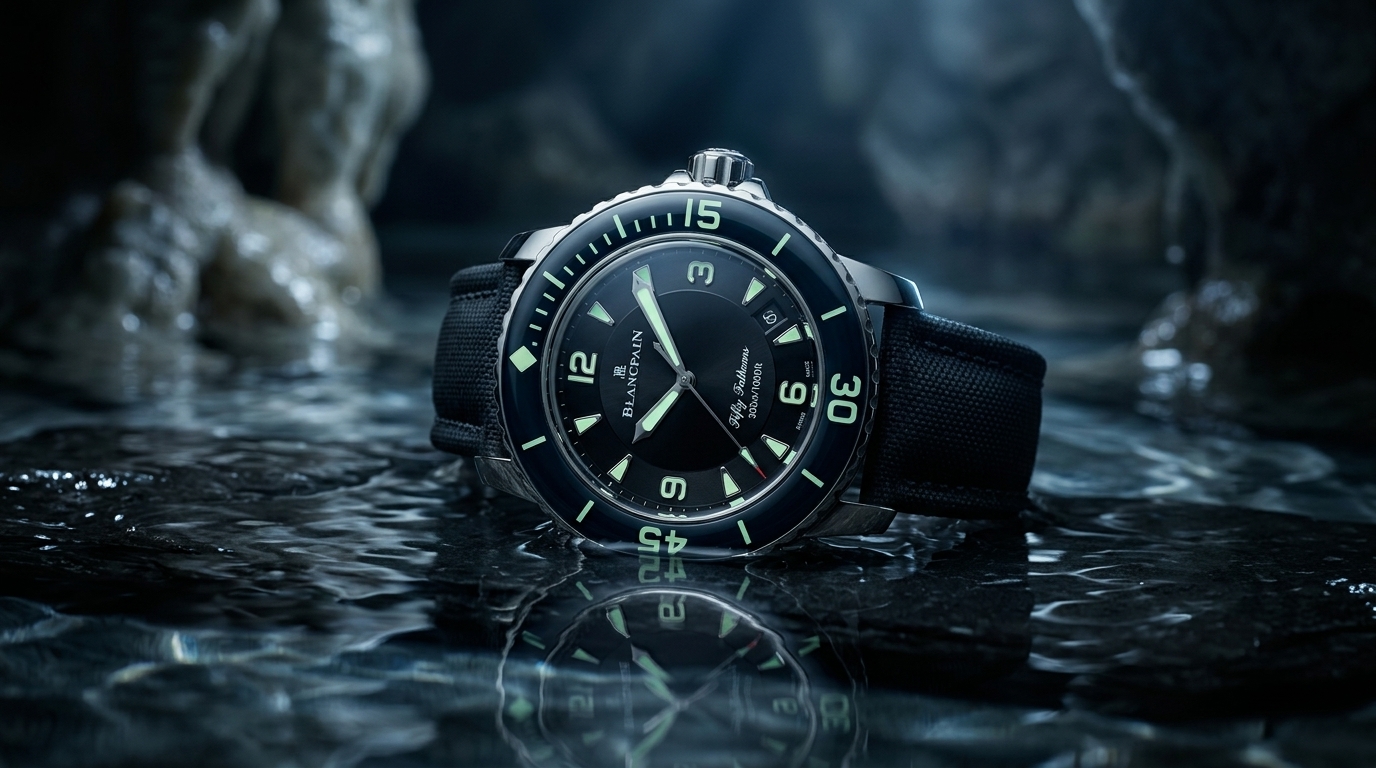
The best Fifty Fathoms watches hold that demand in balance with a certain solemnity. They are not playful objects, though some versions add colour and polish. Their natural state is nocturnal. Black dial, white luminous compound, steel or titanium case, a bezel catching a narrow seam of light. The hands move with the indifference of all mechanical watches, but on a diver the motion carries an extra severity. Every minute is a fraction of a limit. Every turn of the bezel is a small agreement with consequence. This is why the design can survive luxury without being swallowed by it. Beneath the finishing and the sapphire and the careful bevels, the watch still remembers a man looking at his wrist beneath the surface.
Blancpain’s obsession with the sea is quiet because it is lodged in the parts of the watch that do not shout: in the long reserve of the calibre, in the compression of gaskets, in the grip of the bezel edge, in the legibility of a minute hand against a dark field. It has lasted because the sea remains indifferent to style. A watch made for it must answer in function first, even when that function is later polished, priced, and placed behind glass. The Fifty Fathoms endures not as a relic of diving’s heroic age, but as a mechanical form of respect for limits. It looks toward depth, and depth has a way of silencing excess. The rest is measured in minutes.