Baltic and the Fine Line Between Homage and Authors’ Voice
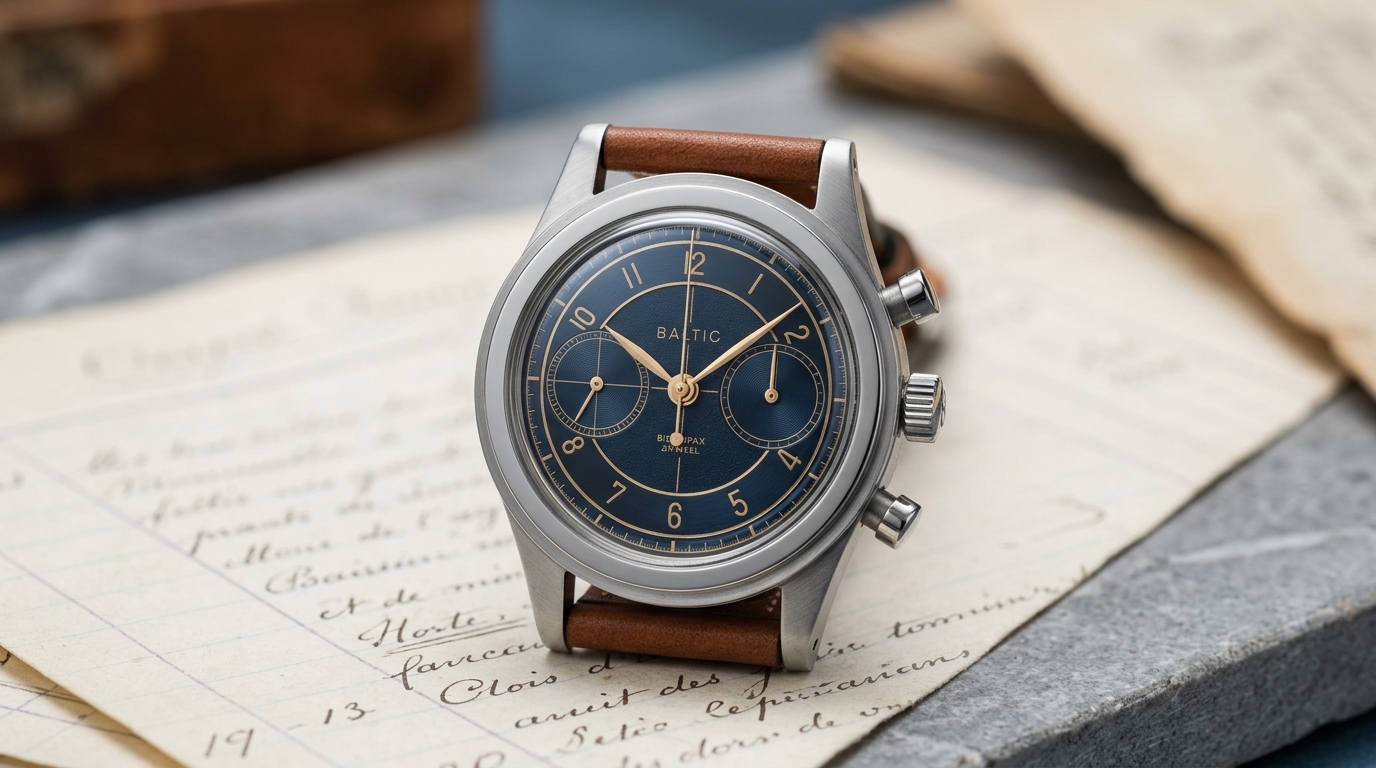
On a pale dial, two registers sit like small windows in an old apartment block: one counting minutes, the other keeping seconds with the patience of a metronome. Around them, a railway track holds the edge of the dial in place, and a slim hand reaches outward with the slightly formal confidence of another century. The watch in question might be a Baltic Bicompax, though at first glance it seems to arrive with several ghosts behind it. There is the ghost of mid-century chronographs, of steel cases worn narrow by shirt cuffs, of Universal Genève and Excelsior Park and all the anonymous Swiss instruments that once treated proportion as a kind of grammar. Baltic’s achievement, and its predicament, begins there. It makes watches that remember too much to be innocent, yet not enough to be mere replicas.
The conversation around Baltic often starts with resemblance. This is understandable. Its watches are fluent in a language whose vocabulary was largely fixed before the quartz crisis: sector dials, stepped cases, gilt printing, beads-of-rice bracelets, domed crystals, syringe hands, big crowns, small seconds, compact diameters. To some eyes, this is fidelity. To others, it is dependence. The debate is not new in watchmaking, where every dive watch lives under the long shadow of the Submariner and every rectangular watch must somehow answer to the Tank. But Baltic sharpens the question because it operates with unusual clarity. It does not disguise its sources. It arranges them carefully, almost lovingly, and then asks whether arrangement can become authorship.
The brand was born in Paris in 2017, founded by Etienne Malec, and its origin story carries the kind of inherited romance that watch culture tends to preserve. A family collection, memories of a father, a fascination with old objects and the lives stored inside them: these are not mechanical specifications, but they matter. They explain why Baltic’s earliest watches did not arrive as experiments in futurism. The HMS 001 and Bicompax 001 were small, hand-wound and automatic pieces that behaved as if the postwar wristwatch had not yet been asked to become oversized, over-waterproofed, over-decorated. Their cases sat in the middle thirties of millimetres. Their dials breathed. Their value proposition was practical, but their emotional proposition was archival.
The word homage is useful only until it becomes lazy. In watches, it can describe a sincere bow, a commercial shortcut, or an act of almost forensic copying. It can mean a dive watch with a black bezel and Mercedes hands sold under another name; it can mean a chronograph that borrows the architecture of an extinct reference while changing the scale, movement and mood. Baltic tends to live in the more ambiguous middle. It rarely copies a single watch with the bluntness of a photocopier. Instead, it assembles familiar elements from several historical rooms. A sector dial may recall the scientific order of the 1930s. A beads-of-rice bracelet may conjure the soft articulation of Gay Frères designs. A domed crystal may summon plexiglass even when the material is sapphire or hesalite-like in feeling. The result is not a quotation from one book, but a paragraph written in an old syntax.
This is why the accusation of imitation never entirely settles the matter. A Baltic Aquascaphe is recognisably a vintage-inflected dive watch, and no serious observer could pretend otherwise. Its 39 mm case, restrained thickness, sapphire bezel insert and clean dial layout stand near the lineage of the Fifty Fathoms, early skin divers and the pragmatic aquatic watches of the 1960s. The numerals at twelve, six and nine, the triangular marker, the luminous pips, the broad timing bezel: all of it belongs to a sea of precedent. Yet the Aquascaphe also avoids the most obvious trap. It is not trying to impersonate one holy ancestor. It has a particular softness at the lugs, a measured compactness, and a way of wearing its nostalgia without distressing the furniture. The bezel is not artificially aged. The case is not scarred at birth. It remembers the past, but it does not pretend to have survived it.
That distinction matters. Artificial patina can make a watch feel as though it is acting in costume, performing age rather than acknowledging influence. Baltic has used warm lume tones and vintage-coded typography, but generally with restraint. There is a difference between cream-coloured markers chosen for harmony and a dial made to look as if it spent fifty years in a drawer in Marseille. Baltic’s better watches understand that the old forms were often elegant because they were functional. A small seconds subdial was not invented for sepia photographs. A sector layout was a legibility system before it became a mood. A chronograph tachymeter was a tool before it became an emblem of connoisseurship. When Baltic preserves these elements with discipline, the homage becomes less theatrical. The watch stops pointing at the past and begins using it.
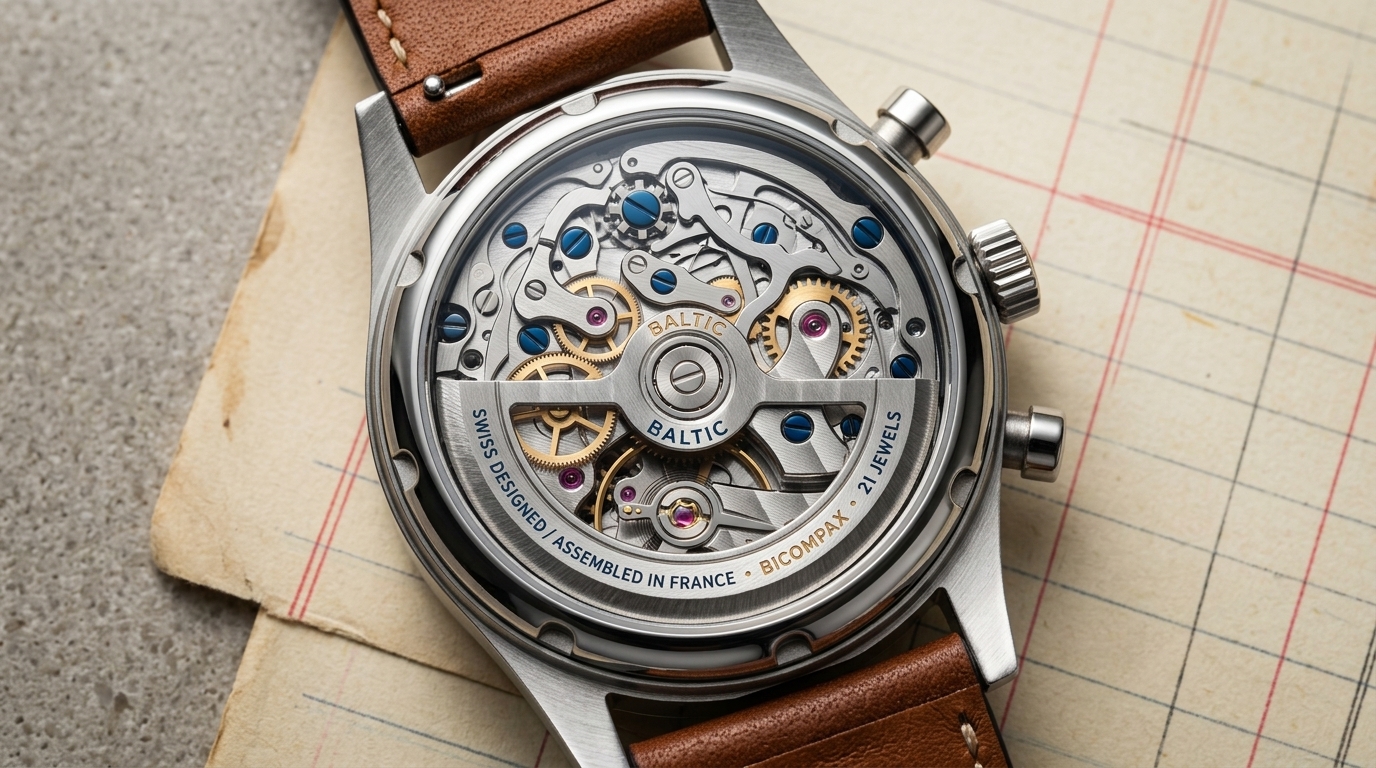
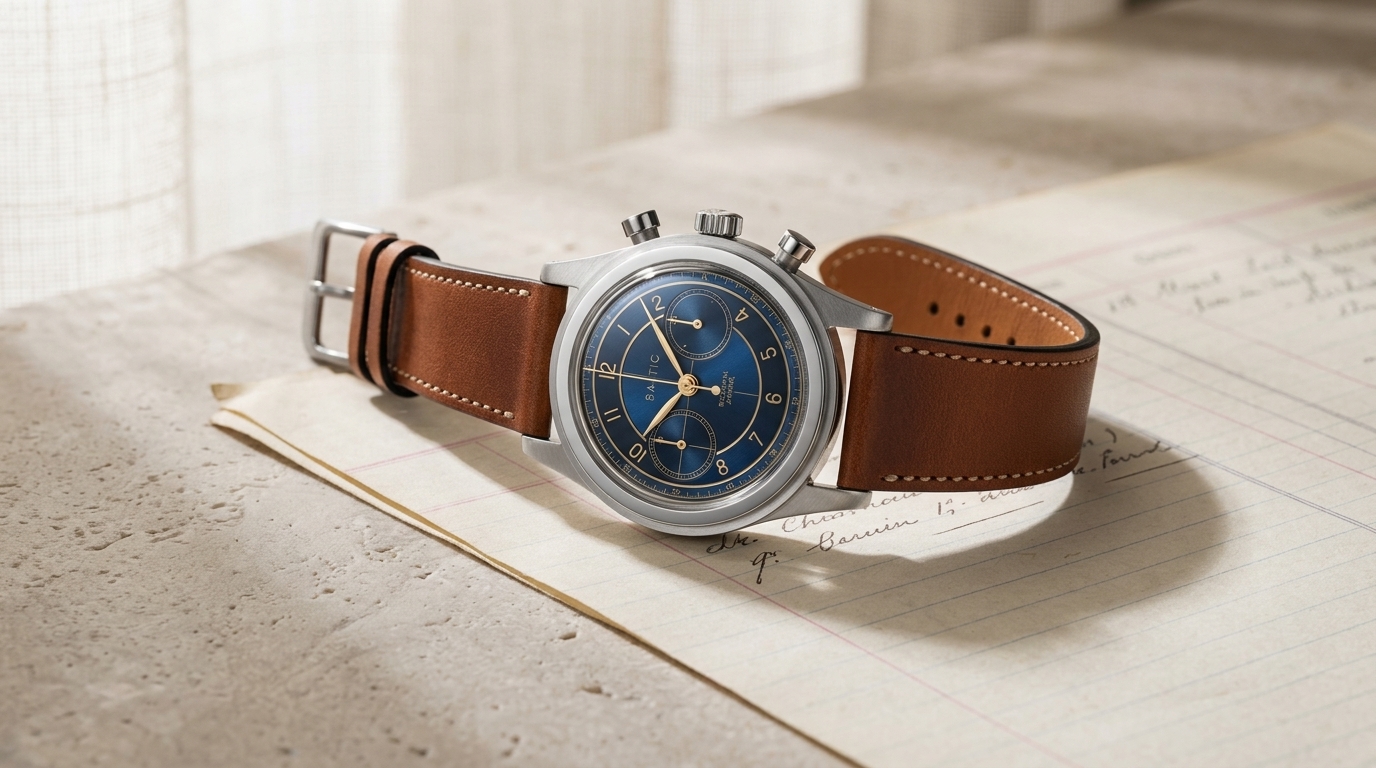
The Bicompax line is perhaps the clearest example. Its very name describes the architecture: two registers, balanced horizontally, sober and direct. Inside certain Bicompax models, Baltic has used the Seagull ST1901, a hand-wound column-wheel chronograph movement descended from the Venus 175 tooling acquired by China in the 1960s. That movement brings its own complications to the story. It is inexpensive by Swiss chronograph standards, visually engaging, and historically peculiar. Through a display back it offers blue screws, levers, a column wheel and the stacked drama that made hand-wound chronographs beloved long before automatic modules thickened the genre. It is not haute horlogerie finishing. Anglage is not the point. But there is theatre in its exposed mechanics, and also honesty. A watch drawing on mid-century chronograph design is animated by a movement whose ancestry belongs to that same mechanical age, even if its modern production tells a more global story.
The case proportions do much of the quiet work. Vintage-inspired watches often fail because they preserve the dial furniture but inflate the building. A 1940s chronograph language stretched across 42 or 44 mm can become caricature. Baltic’s preference for smaller diameters—often 36, 38 or 39 mm—keeps the designs within the scale at which their details make sense. A narrow bezel does not look timid on a compact case. A subdial does not drift too far from centre. A domed crystal can rise without turning the watch into a bubble. These measurements are not merely nostalgic; they are compositional. The eye reads space differently when the watch is allowed to be modest in footprint.
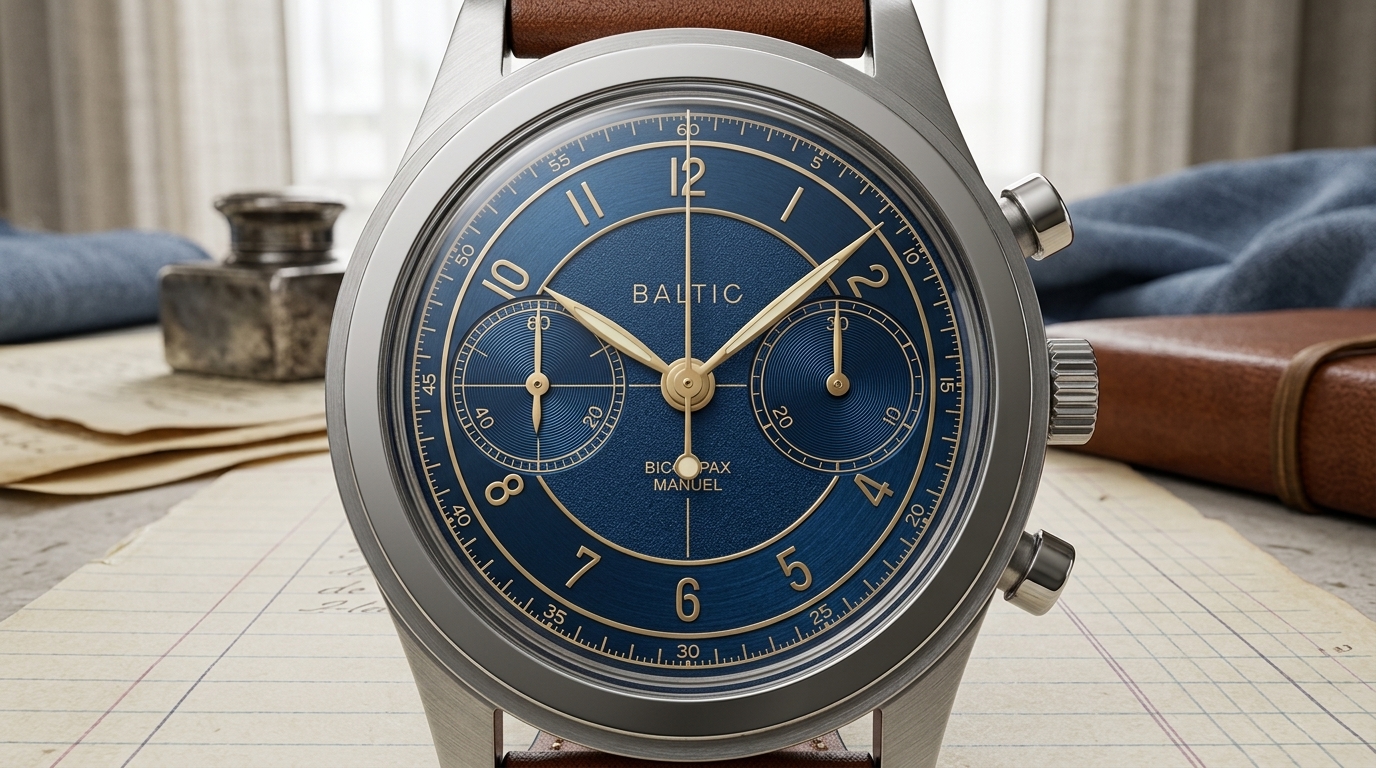
Still, restraint is not the same as originality. The more delicately Baltic handles old references, the more difficult the authorship question becomes. In literature, a writer may echo a predecessor’s cadence and still speak in an unmistakable voice. In watch design, the evidence is smaller and more material: a lug profile, a handset, the radius of a bezel, the pressure exerted by typography. Baltic’s voice emerges not through invention of new categories, but through editing. Its watches are edited objects. They reduce rather than proclaim. They tend to remove the aggressive branding, the oversized logo, the needless complication, the shiny flourish added because a committee feared silence. This editorial instinct is not nothing. In a market crowded with watches shouting their influences, Baltic often speaks in a lower register.
The MR01 complicated the discussion further. It arrived with a 36 mm case, a micro-rotor movement visible through the back, an off-centre small seconds at seven-thirty, and Breguet-style numerals that immediately stirred memories of much more expensive watches. Some saw Patek Philippe in the air, especially references with sub-seconds and classical numerals. Others saw a general pocket-watch-derived elegance converted into an accessible wristwatch. The movement, the Hangzhou CAL5000A, became part of the fascination: a Chinese automatic micro-rotor calibre with attractive architecture, perlage-like decoration, blued screws and a rotor set into rather than atop the movement. It was not the same conversation as an ultra-thin Swiss micro-rotor from Buren, Universal Genève, Piaget or Patek. But for a watch at Baltic’s price level, the visual and mechanical gesture was significant.
The MR01 is also where the fine line becomes almost visible. Its dial is undeniably derivative in atmosphere. The numerals curl with old-world academic manners. The small seconds sits eccentrically enough to feel charming rather than merely practical. The leaf hands, the minute track, the polished case: each element knows its genealogy. Yet the total object has a strange independence, partly because it brings such references into a price and production context where they are rarely handled with this degree of care. It does not become a Patek substitute; that would reduce it to insecurity. Instead it becomes a modern Parisian microbrand’s interpretation of salon watch codes, filtered through accessible manufacturing and contemporary taste for compact dress watches. The distance between those descriptions is the distance between homage and costume.
Baltic’s Prismic moved the brand into another register. With its faceted case, mixed finishing and more elaborate dial construction, it suggested that Baltic was becoming less content to curate pieces from the vintage archive and more interested in building character from geometry. The watch still carried ancestry—few dress watches escape the gravitational pull of mid-century case design—but its surfaces had more tension. Brushed and polished planes met with sharper intent. The proportions felt less like a recovered template and more like a decision. That kind of development matters for a brand whose early identity was so closely tied to resemblance. At a certain point, the audience that applauded the tastefulness of the archive begins to ask what the archivist will write.
This is not a demand for novelty as spectacle. Much contemporary watch design mistakes originality for distortion: strange cases, crowded dials, complications arranged as if disorder were automatically imagination. Baltic’s challenge is subtler. Its path forward may not require abandoning old forms, because old forms remain useful. A round steel watch with hands at the centre is an old form. A dive bezel is an old form. A chronograph register is an old form. The question is whether the combination begins to express a consistent temperament. In Baltic’s case, that temperament seems to involve compactness, legibility, a preference for mechanical interest over luxury signalling, and a certain French ability to let austerity and romance occupy the same room.
The finishing tells the same story at a practical scale. Baltic is not pretending to compete with hand-finished Geneva movements, black-polished steelwork or inward angles that require patient human cruelty. Its cases are industrial objects finished to a standard appropriate to their category, with brushing and polishing used to articulate shape rather than dazzle. The bracelets, especially the beads-of-rice options, contribute tactile memory. They drape differently from oyster-style bracelets, catching light in smaller pieces and softening the watch’s outline on the wrist. Even when made by modern methods, they refer to a period when bracelets felt less like armour and more like jointed fabric. That choice has consequences. It makes a dive watch less militarised, a chronograph less severe, a dress watch less precious.
What Baltic has done unusually well is understand that accessibility does not have to mean bluntness. In the years since microbrands became a force, many small companies discovered that enthusiasts would pay attention to specifications: sapphire crystal, ceramic bezel, high water resistance, regulated movements, screw-down crowns, solid end links, luminous compounds named like chemicals in a laboratory report. Baltic entered that world but did not let the specification sheet become the soul of the watch. The Aquascaphe’s 200 metres of water resistance matters, as does the Miyota 9039 automatic movement found in later models, a slim no-date calibre from Citizen’s higher-grade family. But the watch is not chiefly memorable because of its water resistance or its beat rate. It is memorable because its details cohere at human scale.
That coherence is fragile. The market rewards recognisability, and recognisability often comes from leaning harder into what people already know. A brand can easily become trapped by its own good taste, repeating the same warm lume, the same old numerals, the same consoling proportions until the language becomes wallpaper. Baltic has so far avoided total stagnation by moving between categories: chronograph, field-adjacent three-hander, diver, micro-rotor dress watch, dual-crown Aquascaphe variants, more architectural dress pieces. But the risk remains. The better a company becomes at evoking the past, the more carefully it must ration evocation.
There is also the matter of national imagination. Baltic is a French brand using global supply chains, Japanese and Chinese movements, and designs rooted largely in Swiss and broader European watch history. That hybridity is not a weakness; it is the condition of modern watchmaking outside the old vertically integrated houses. The romance of a single valley producing every component under snow and tradition has always been partly myth, and today it is often marketing theatre. Baltic’s watches are honest about the dispersed nature of contemporary production, even when their dials look backward. A Parisian design office, Asian calibres, European assembly for some lines, vintage Swiss references, internet-native distribution: this is not a betrayal of heritage. It is a new map laid over an old one.
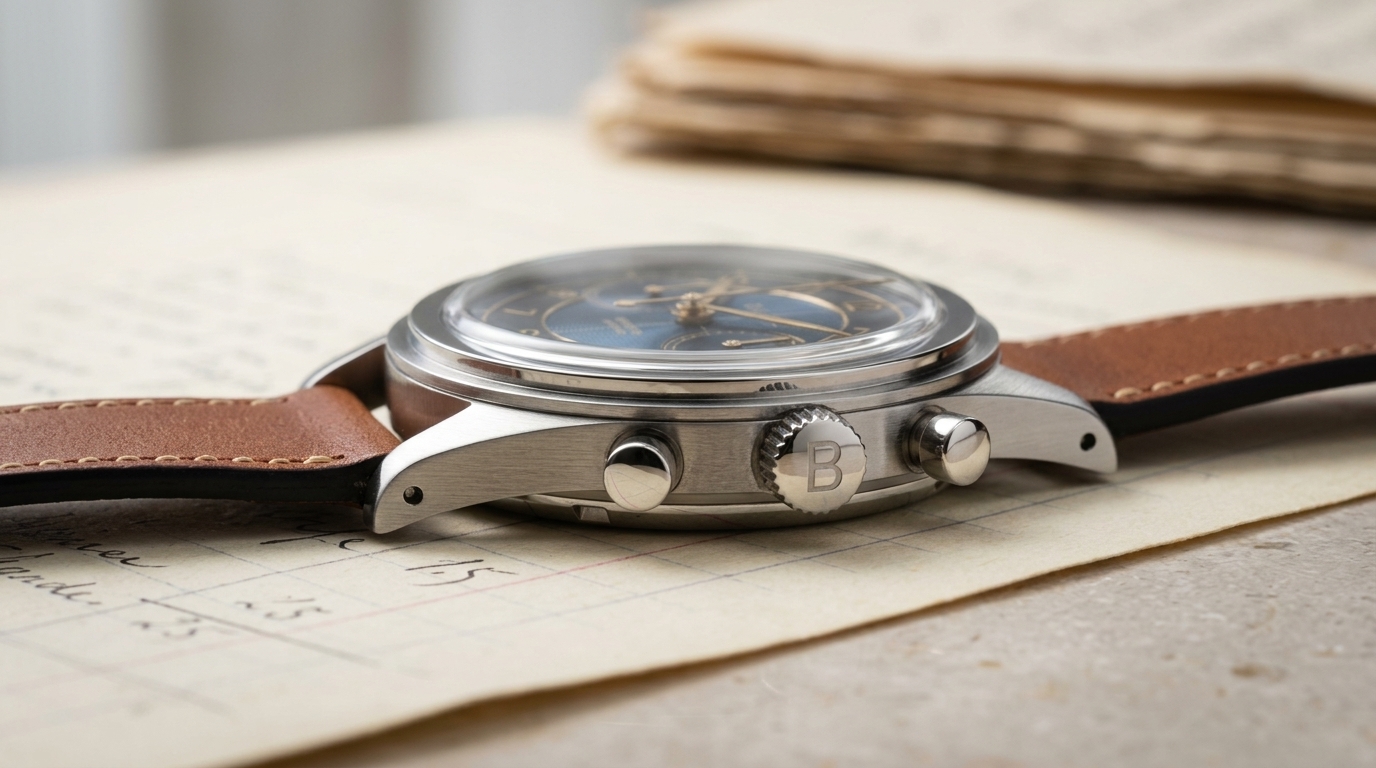
The word “author” in watchmaking is difficult because watches are collaborative. Cases, dials, hands, crystals, movements, bracelets, suppliers, assemblers and designers all leave marks. Yet some brands develop a recognisable sentence structure. Baltic’s sentence is usually short, balanced and slightly melancholic. It favours margins. It allows negative space to carry meaning. Its logo, set without excessive ceremony, rarely dominates the dial. Even when the influence is obvious, the composition tends to avoid vulgarity. This does not absolve every design choice from critique. Nor does it turn borrowing into genius. It simply suggests that authorship can emerge through selection, proportion and refusal.
The harshest critics of homage watches often speak as though originality were pure, as though great historical watches appeared without reference to anything before them. But the archive tells a messier story. The early waterproof watch borrowed from military needs and case-making experiments. The dress watch borrowed from pocket-watch enamel and typography. The chronograph borrowed from scientific instruments, dashboards, artillery timing, motorsport and medicine. Even the icons were not born in isolation. What separates influence from imitation is not the absence of ancestry, but the presence of transformation. A watch must do something with what it inherits. It must change the temperature, the scale, the context, the emphasis. Baltic’s best pieces do exactly that, modestly but perceptibly.
The less successful moments, when they occur, tend to be those where the historical reference feels too complete, where the viewer reaches the source before reaching the watch. In those cases, admiration becomes interrupted by recognition. The object narrows. It becomes a doorway to something else rather than a room of its own. This is the danger for any brand that builds near beloved ruins. The stones are beautiful, but they can crush the new structure if placed without enough distance. Baltic’s discipline lies in knowing when to stop restoring and when to start drawing.
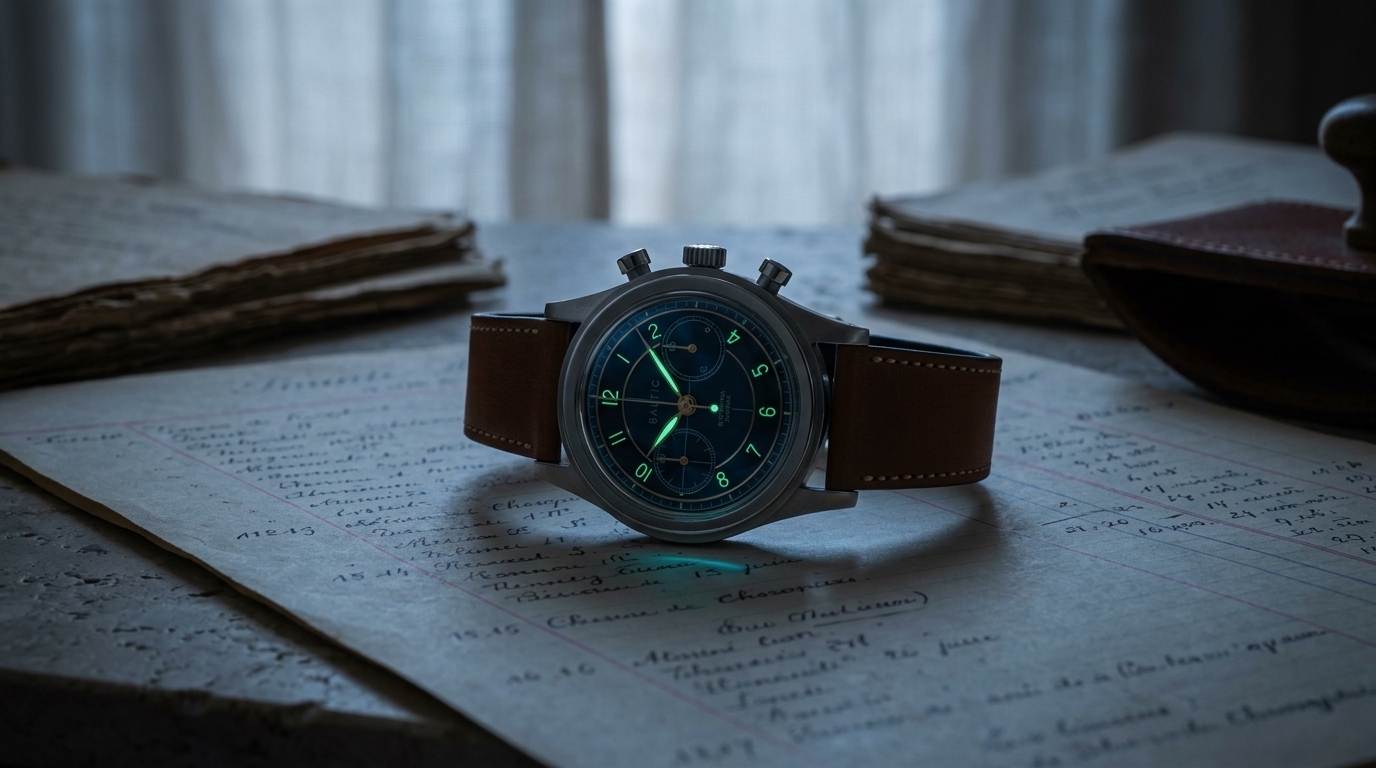
Perhaps that is why the brand attracts such sustained attention among collectors who already know the references. These are not watches made for ignorance. They often reward the viewer who recognises a stepped bezel, a sector layout, a 1930s dial logic, a 1960s diver silhouette, a micro-rotor romance. But they do not require ownership of the original artefacts, many of which have become fragile, expensive or absurdly inflated by the market. Baltic offers not the original song, but a new arrangement played on modern instruments. Whether that is enough depends on what one expects from contemporary watchmaking. If the demand is radical novelty, Baltic will disappoint. If the demand is faithful reproduction, it will also disappoint, because its watches are generally too composed, too gently altered, to satisfy the purist copyist. Its territory lies between.
That in-between territory may be the defining space of modern independent watch culture. Most small brands cannot invent new escapements, machine exotic cases in-house or finish movements to observatory fantasy. What they can do is choose. They can choose scale against bloat, clarity against decoration, mechanical interest against empty prestige, historical literacy against random nostalgia. Baltic’s choices have formed a recognisable outline. The outline is still young. It may yet harden into formula, or it may deepen into language. For now, it remains one of the more compelling studies in how a brand can stand close to the past without disappearing into it.
At the edge of the dial, the minute track continues its quiet circuit. Hands cross numerals, subdials turn, a rotor swings invisibly or a column wheel waits under glass for the next press of the pusher. The watch does not resolve the question by argument. It resolves it, if at all, by proportion. Too much resemblance, and the object becomes a shadow. Too much forced novelty, and it becomes noise. Baltic’s finest watches occupy the narrow middle, where memory is not yet mimicry and restraint has not yet become silence. There, in that fine line, the brand’s voice can be heard—not loud, not entirely free of echoes, but distinct enough to keep listening.