Christopher Ward’s Quiet Rebellion Against the Swiss Script

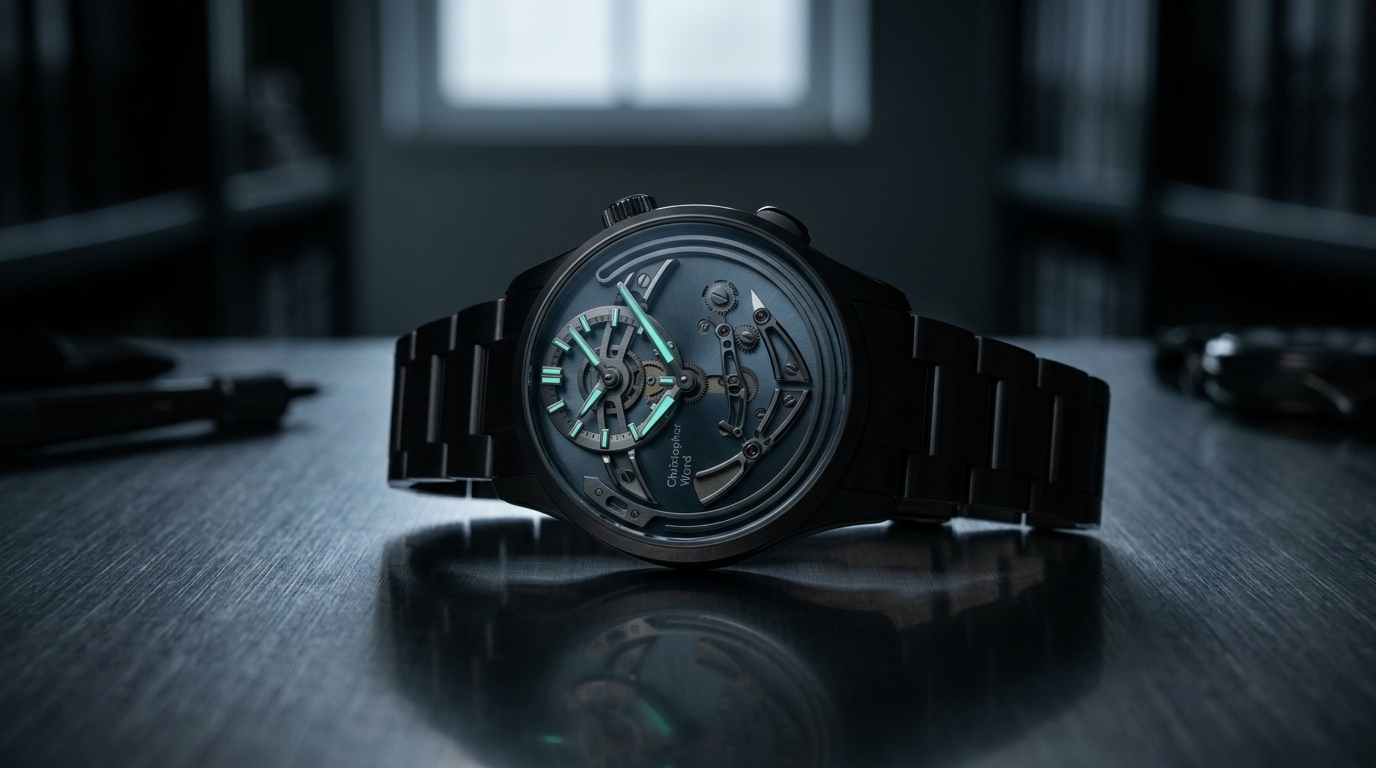
At twelve o’clock on the dial, a pair of small hands perform their quiet duty while, beneath them, the rest of the watch seems to have been caught mid-breath. A hammer waits. A bridge arcs across the plate. A polished gong traces the perimeter like a wire of tension. In most watches, the mechanism keeps its secrets under brass and dial lacquer; here, Christopher Ward has brought part of the theatre to the surface and then refused to shout about it. The C1 Bel Canto does not pretend to be an old complication from an old house. It is something stranger, and more revealing: a modern British-led watch, Swiss-made in the legal and mechanical sense, that appears to understand the Swiss script well enough to step around it.
That script has governed mechanical watchmaking for generations. It is written in patina, family names, valley towns, black-polished steel, and the slow accumulation of legitimacy. It has its virtues. Switzerland earned its place by making movements, cases, escapements and finishing into an industrial language of unusual refinement. But the script also developed habits: guarded pricing, inherited prestige, scarcity as theatre, and the suggestion that seriousness must wear the face of age. Christopher Ward’s rebellion is not loud because the watches are not loud in the usual way. They do not sneer at Switzerland. They use Swiss suppliers, Swiss assembly, Swiss regulation, Swiss movements. The rebellion is in the refusal to behave as though reverence must be bought at a distance, through fogged glass.
The company’s beginning was almost awkwardly unromantic. Founded in 2004 by Mike France, Peter Ellis and Christopher Ward, it had no ancestral workshop, no archive of military chronographs, no sepia portrait of a founder at a bench in 1898. Its early watches were sold online, directly, at prices that made the industry uncomfortable not because they were absurdly cheap, but because they exposed how much of the traditional luxury transaction depended on ritual. Christopher Ward did not invent direct-to-consumer watchmaking, but it brought the model into a corner of mechanical horology where the old manners still mattered. The brand’s famous early promise of “the cheapest most expensive watches in the world” was ungainly, but it contained the seed of a point: the price of a watch had become part object, part costume.
The name itself carried a peculiar English plainness. Christopher Ward sounded less like a manufacture than a person signing a letter. For years, the brand struggled visually with that identity. The logos changed, sometimes clumsily. “Chr. Ward” gave way to full wordmarks, then to the twin-flag device, then to cleaner arrangements that allowed dials to breathe. This restlessness is often treated as a weakness, and at times it was. A watch dial is not forgiving. Move a signature a few millimetres and the whole face can tilt into unease. Yet the very instability of the branding told the truth of a young company searching in public. Most Swiss houses edited their adolescence out of the record long ago. Christopher Ward had to live with its own.
Its earliest credibility did not come from fantasy but from competence. The C60 Trident became the recognisable fixture: a dive watch with a ceramic bezel in later forms, a trident counterweight on the seconds hand, solid water resistance, and proportions that gradually sharpened over successive generations. The Trident was not a radical object. It stood in the broad current of modern sports watches, where Submariner shadows are impossible to escape entirely. But Christopher Ward approached the category with obsessive iteration rather than mystique. Cases slimmed. Bezels improved. Bracelets gained quick-adjust systems. The “Light-catcher” case, with its alternating brushed and polished planes, became one of the brand’s more convincing signatures because it did not rely only on surface novelty. It used geometry to make mass feel less blunt.
Then came a more consequential move, one that disturbed the easy dismissal of the brand as merely a value play. In 2014, for its tenth anniversary, Christopher Ward introduced Calibre SH21, a five-day automatic movement developed with Synergies Horlogères and associated with watchmaker Johannes Jahnke. Twin barrels gave it a long power reserve; COSC certification gave it measurable seriousness; its architecture gave the company something few young brands possess: a proprietary calibre that was not simply a decorated ébauche with an invented name. SH21 was large, robust and not especially delicate in the poetic Swiss sense. It did not whisper Vallée de Joux refinement. It spoke in torque, autonomy and intent.
The importance of SH21 was not that it made Christopher Ward a manufacture in the grand old meaning of the word. The term has been stretched so often that it now behaves like warm glass. Its importance was more practical and more dangerous to the established order. It showed that a young company, without a century of accumulated mythology, could commission, develop and sell a serious mechanical engine at a price that unsettled the hierarchy around it. The Swiss script says that legitimacy descends through time. SH21 suggested it might also be engineered.
Still, the company rarely behaved like a revolutionary movement. That is part of its interest. Its catalogue has included aviation watches, dress watches, divers, GMTs, moonphases, integrated-bracelet sports models and marine chronometers of varying conviction. Some were handsome. Some were forgettable. Some carried too much influence from better-known watches. Christopher Ward’s story is not one of immaculate taste arriving fully formed. It is one of pressure and adjustment, of a brand learning where homage ends and identity begins. The failures matter because they remove the polish from the myth. This is not Geneva perfection descending from a mountain. It is a workshop culture being built in view of its audience.
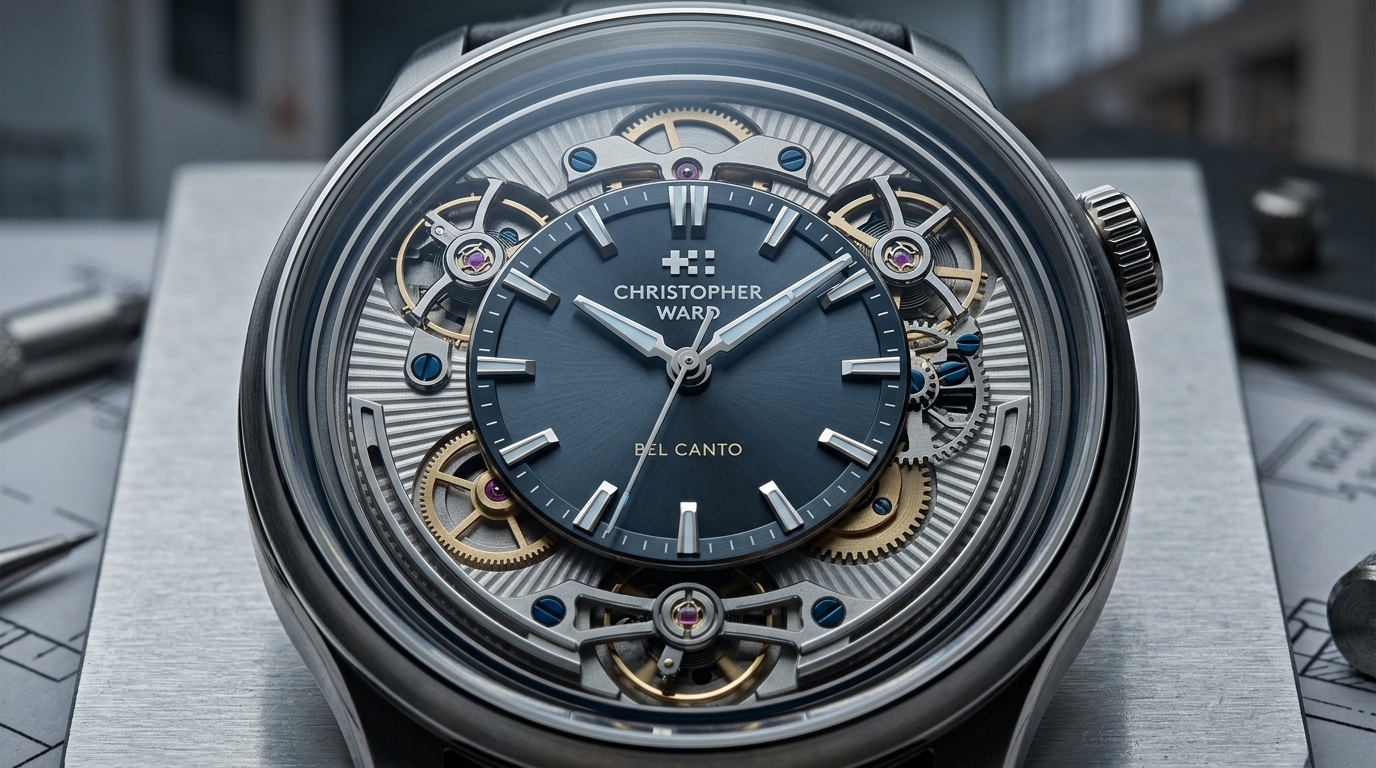
The C1 Bel Canto changed the temperature of that conversation. Its complication is conceptually simple and emotionally potent: on the hour, when activated, a hammer strikes a gong once. Not a minute repeater with cathedral chimes and aristocratic lineage, not a grande sonnerie requiring the caution of a museum curator, but an hourly passing chime extracted from the realm of six-figure watchmaking and reimagined with industrial clarity. Inside is a Sellita SW200-1 base movement, familiar and serviceable, supporting a custom chiming module visible from the front. The calibre, known as FS01, brought more than fifty additional components into play. A pusher around four o’clock allows the wearer to silence or engage the chime. The architecture is exposed not as decoration alone, but as explanation.
That distinction matters. Openworked watches often reveal little beyond the maker’s anxiety to impress. They carve away metal until the eye has nowhere to rest, then call the result technical. The Bel Canto is different because its exposed mechanism has a sentence to speak. The hammer is legible. The gong is legible. The small time display at twelve clears the lower dial for the acoustic mechanism. The watch looks asymmetrical because the complication demands it. Even the case, in grade 5 titanium and roughly 41 millimetres across, serves the idea by keeping the object lighter than its visual complexity might suggest. At around 13 millimetres thick, it is not a wafer, but neither is it the swollen trophy that complicated watches sometimes become.
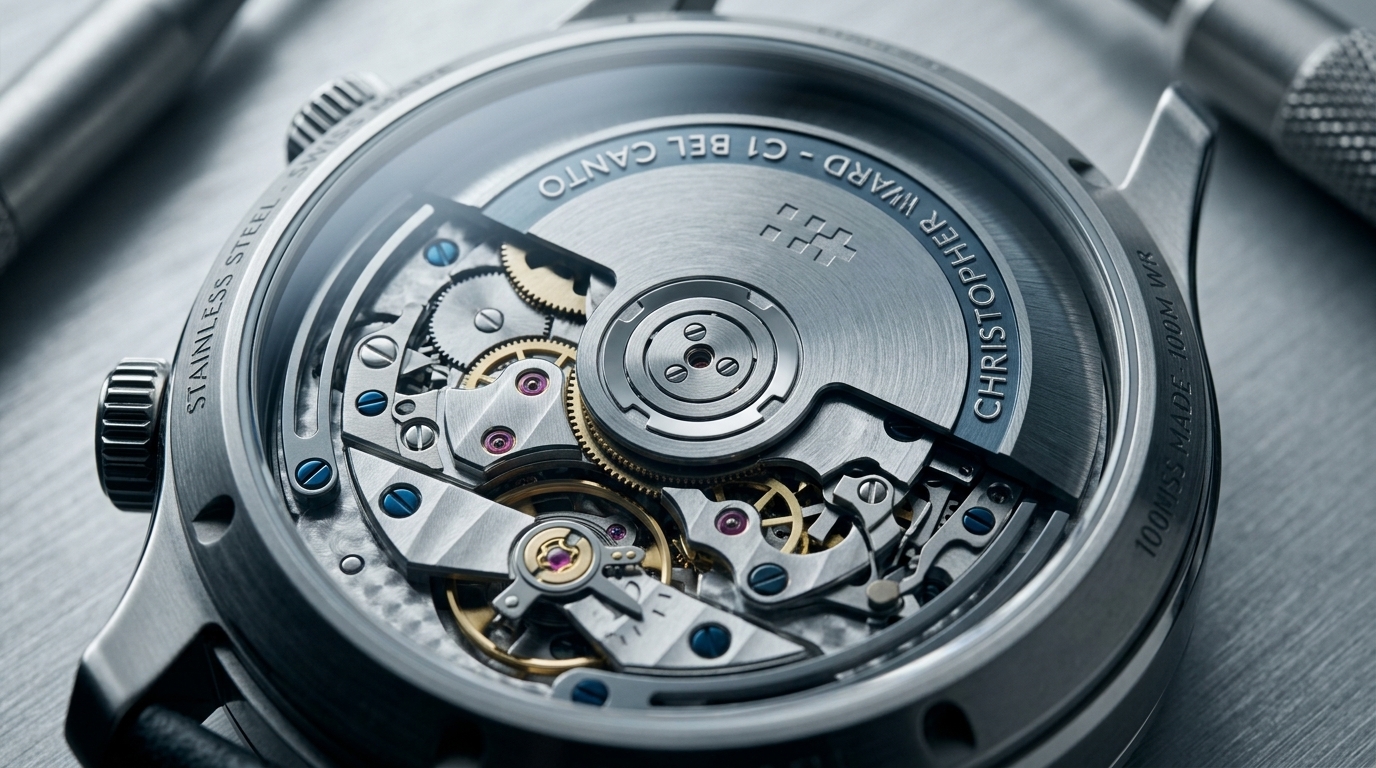
The finishing is neither haute horlogerie in the strict old sense nor careless industrial work. It occupies Christopher Ward’s chosen middle ground, where machine precision, bright chamfers, brushed plates and polished accents create enough light to animate the mechanism without pretending to be hand-finished Geneva craft. The bridgework has a crisp, almost architectural quality. Colours vary across editions, from saturated blue to more restrained tones, but the fundamental impression remains mechanical rather than decorative. This is a watch that lets the owner see the reason for its eccentricity. It does not hide the Sellita beneath a curtain of language. It admits the base and elevates the result through construction.
For traditional Swiss maisons, the passing chime has long belonged to a protected class of objects. Sound is difficult. It asks for space, metal, tension, case resonance, and a tolerance for adjustment that resists easy scaling. Even a simple strike carries symbolic weight because chiming watches sit near the summit of mechanical romanticism. Christopher Ward’s decision to enter that territory was bold less because of the complication itself than because of the price at which it appeared. The Bel Canto did not make acoustic horology cheap; no finely assembled chiming watch can honestly be called cheap. But it placed the experience within reach of collectors accustomed to seeing sound locked behind velvet ropes.
There is a danger in framing this only as disruption. The word has been abused by every company that discovered a spreadsheet and a supply chain. Christopher Ward’s better achievement is quieter. It has treated transparency not as a slogan but as a design pressure. The brand has often spoken openly about margins, supply, components and service in a way that breaks with the cultivated opacity of luxury watchmaking. This candour is not romance, and it does not replace craft. But in an industry where silence often passes for dignity, candour can feel almost impolite.

The Twelve, Christopher Ward’s integrated-bracelet sports watch, shows another side of the same rebellion. It entered one of the most crowded and treacherous categories in contemporary watchmaking, a category haunted by Gérald Genta and by the endless afterlife of the Royal Oak and Nautilus. The Twelve could not escape those ghosts; no watch with an integrated bracelet, faceted bezel and textured dial truly can. Yet its execution revealed how far the brand’s case and bracelet work had moved. The case bevels catch light without overcomplicating the silhouette. The bracelet articulation is considered. The dial texture, built from repeated twin-flag forms, risks cleverness but gives the surface more structure than a plain stamped pattern. In steel and titanium variants, with Sellita automatic calibres inside, it is not a manifesto. It is a disciplined answer to an overburdened genre.
What distinguishes Christopher Ward at its best is not originality in the abstract. Almost no modern watch is original in that pure sense. The wristwatch is too old, too small, too governed by inherited shapes. The more honest question is whether a brand can take familiar forms and make them accountable: to price, to construction, to proportion, to the intelligence of the buyer. This is where Christopher Ward’s quiet rebellion finds force. It does not ask to be excused from comparison with Switzerland. It invites the comparison and then changes the terms. Instead of lineage, it offers specification. Instead of secrecy, explanation. Instead of inherited authority, a visible accumulation of competence.
That approach has limits. A watch cannot live by rational argument alone. If it could, the industry would be ruled by chronometer certificates and service manuals. Mechanical watches survive because irrational attachments cling to them: the sweep of a seconds hand, the glint on a bevel, the unnecessary pleasure of a crown turning against a fingertip, the knowledge that time is being divided by springs and teeth rather than software. Christopher Ward sometimes leans hard into the measurable case, as though proving value were the same as making desire. The stronger watches resist that trap. They use the numbers as scaffolding, then allow shape, sound and texture to do their slower work.

The Bel Canto is persuasive because it cannot be reduced to its specification. Its hourly chime is functionally unnecessary. That is precisely why it matters. In a world where phones regulate alarms, calendars and universal time with dead accuracy, the mechanical watch has no practical defence left except craft, ritual and beauty under constraint. An hourly note from a wristwatch is a small absurdity, and the absurdity is human. A hammer lifts. A gong receives the blow. The air changes for a moment. Then the machine returns to silence. It is not convenience. It is ceremony stripped to a single sound.
The Swiss script knows ceremony well, perhaps too well. It has learned to stage it with lacquered boutiques, guarded allocations and histories polished until contradiction disappears. Christopher Ward’s version is less theatrical and more exposed. The company’s headquarters may be in Britain, its manufacturing network rooted in Switzerland, its ambitions scattered across forums, waiting lists, reviews and collector arguments. Its watches carry the tension of that hybrid identity. They are not British in the old pocket-watch sense, nor Swiss in the old dynastic sense. They are products of contemporary horology as it actually exists: designed across borders, assembled through specialist networks, judged in public, revised quickly, and made to survive a buyer more informed than ever before.
That buyer is important. The modern enthusiast knows movement references, lug-to-lug measurements, clasp systems, beat rates and regulation tolerances. He or she can identify a Sellita SW200, a Sellita SW300, an ETA 2892 architecture, a ceramic bezel insert, a screw-down crown, a micro-adjust clasp, a twin-barrel layout. The old luxury fog no longer works as reliably as it once did. Christopher Ward rose in the age of the forum and matured in the age of the microscope photograph. Every flaw travels. Every improvement travels too. The brand’s closeness to its audience has made it vulnerable, but also unusually adaptive.
There is something almost literary in that position: a company trying to write itself into a tradition that usually grants admission slowly, by bloodline or by acquisition. Christopher Ward did not buy an ancient name, though its Swiss operation grew through partnership and consolidation. It did not pretend that 2004 was 1865. Instead, it built legitimacy the uneasier way, through serial evidence. A better case. A better bracelet. A proprietary movement. A chiming module. A design language that, while not always settled, has become increasingly recognisable. The rebellion is quiet because it is cumulative. No single watch overturns the order. But each credible watch removes one more excuse for dismissing the outsider.
The word “outsider” itself has become complicated. Christopher Ward is no longer a garage insurgent. It is a substantial independent brand with a global customer base, Swiss production relationships and enough success to attract the scrutiny it once aimed upward. Success changes the moral weather around any challenger. The transparent-price rebel becomes, inevitably, a business with its own margins, launches, delays and compromises. This does not invalidate the rebellion, but it matures it. The question is no longer whether Christopher Ward can embarrass the old houses on value. It is whether it can keep building watches with enough character to outgrow the comparison.
The answer, at least in its best work, is visible in metal. On the Bel Canto, the hammer still waits beneath the crystal. On the Trident, the seconds hand still carries its small barbed signature around a practical dial. On the SH21 movement, twin barrels still store more autonomy than most daily wear requires. These are not relics of inherited nobility. They are arguments, each made through components. Some are more eloquent than others. But together they form a body of work that refuses to accept that mechanical legitimacy must arrive draped in age.
The Swiss script will endure. It deserves to. There remains no substitute for the accumulated knowledge of places that have spent centuries teaching metal to behave. Christopher Ward’s rebellion is not a burning of that library. It is a note written in the margin, firm enough to be noticed: that price should answer to construction; that provenance should not be confused with myth; that a young watch can be serious without pretending to be old; that sound, finish, precision and proportion need not be guarded as hereditary privileges.
When the Bel Canto strikes the hour, its note is brief. It does not fill a room like a clock tower or unfurl like a minute repeater in a collector’s salon. It is a small metallic declaration from a small machine, and then it is gone. The quiet is part of the point. Christopher Ward’s rebellion has never been the romance of overthrow. It is the more patient disturbance of expectation, repeated watch by watch, calibre by calibre, revision by revision, until the old script no longer reads quite the same way.