Cartier’s Other Kind of Tool Watch: Elegance Under Pressure
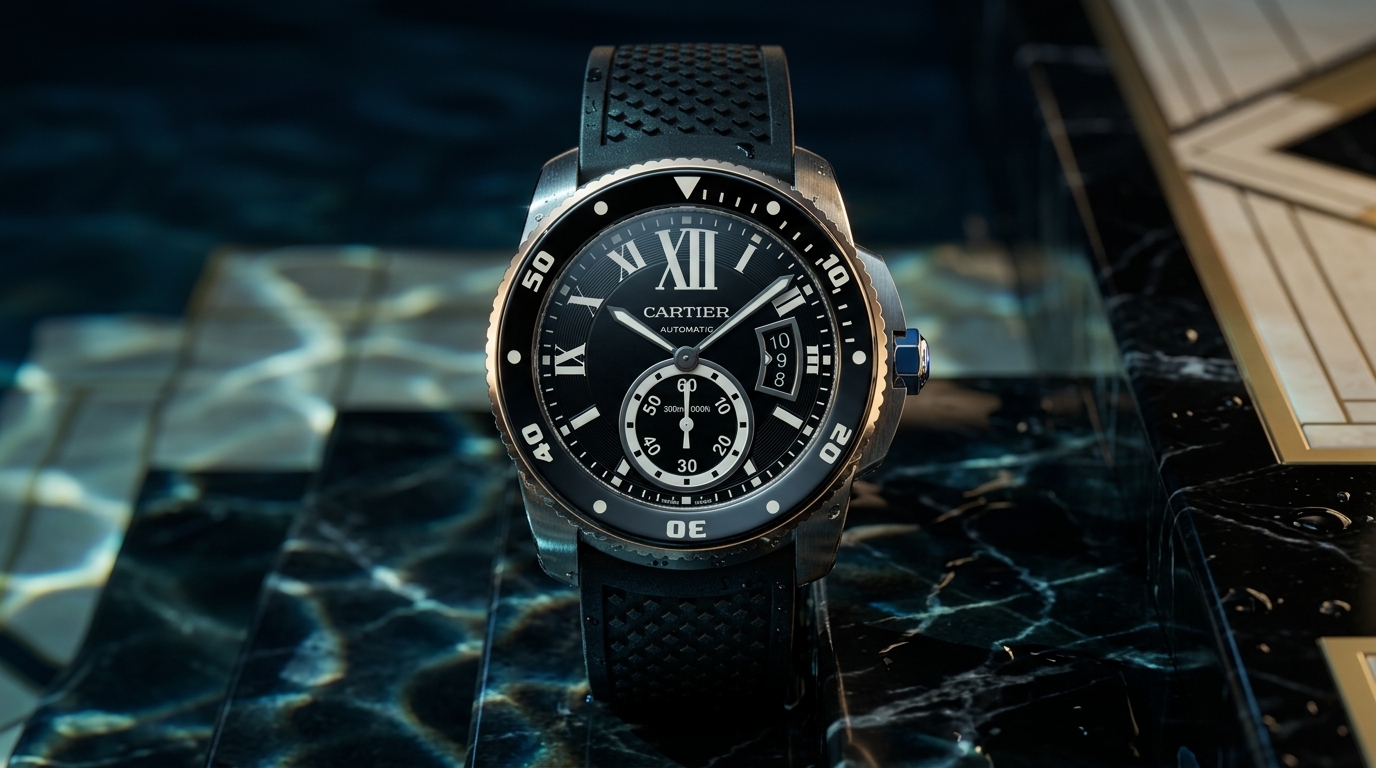
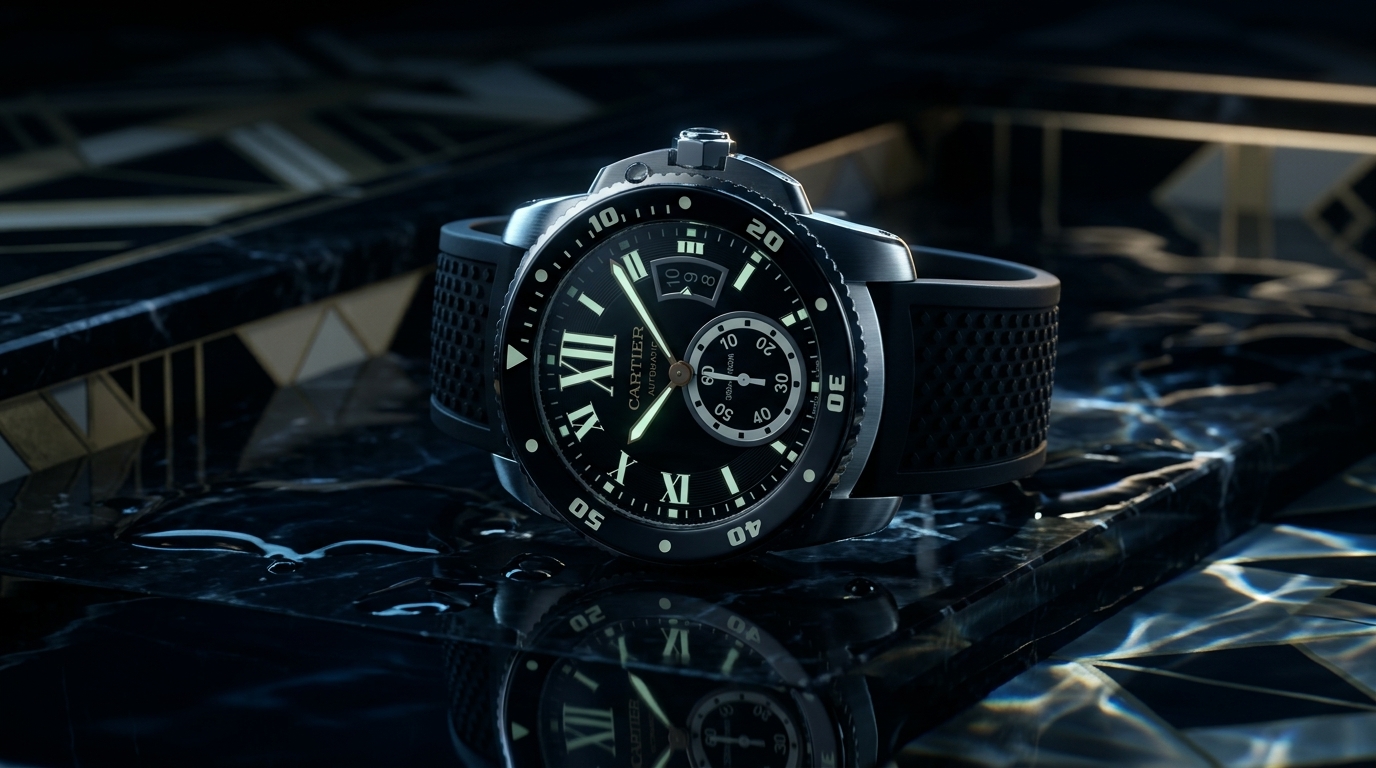
At the edge of a black dial, just inside the minute track, Cartier places Roman numerals where another dive watch might have printed blunt blocks of luminous paint. The bezel turns with the expected discipline. The crown screws down. The case is sealed against 300 metres of pressure. Yet the face still speaks in the house language of Paris rather than the clipped vocabulary of a naval instrument.
This is where the Calibre de Cartier Diver becomes interesting. Not because it tries to out-muscle the established dive watches of Switzerland, and not because it wears its depth rating like a medal, but because it asks a quieter question: what happens when a maison known for shaped watches, blue cabochons and formal restraint decides to build something that must survive beneath the surface?
Cartier has always been closer to machines than its reputation sometimes allows. The Santos was not born as jewellery. It was a response to a practical problem, made for Alberto Santos-Dumont at a time when checking a pocket watch in an aircraft was an absurd inconvenience. That square case, those visible screws, the bracelet that later became part of its identity — all of it carried the residue of early aviation. The Tank, too, was drawn from machinery, its brancards recalling the tracks of armoured vehicles seen from above. Cartier’s elegance often begins with steel, rivets, engines, a tool made civilized by proportion.
The Diver belongs to that same lineage, though it comes from a different century and a different kind of pressure. Introduced in 2014, it arrived as a marine instrument in Cartier dress, based on the Calibre de Cartier case that had appeared a few years earlier. The original Calibre line mattered because it housed the 1904 MC, Cartier’s first self-winding movement produced in-house at meaningful scale. The Diver took that foundation and tightened the screws, literally and figuratively. It brought a screw-down crown, a unidirectional bezel, broad luminous hands, and water resistance to 300 metres. It was not merely “inspired” by diving. Cartier built it to comply with ISO 6425, the standard that separates decorative aquatic watches from actual dive watches.
The case is the first sign that Cartier did not simply borrow the genre’s costume. At 42 millimetres across and roughly 11 millimetres thick, the Diver is wide but not swollen. Many dive watches accept height as part of their identity, stacking crystal, bezel, midcase and back into a compact pressure vessel. Cartier’s version keeps its profile controlled. The watch has shoulders, certainly, and a broad stance on the wrist, but its thickness remains surprisingly modest for the rating. This matters because the sensation of a dive watch is often made not only by diameter, but by vertical mass. The Calibre Diver sits closer to the idea of a dress watch adapted for depth than a submarine hatch adapted for polite society.
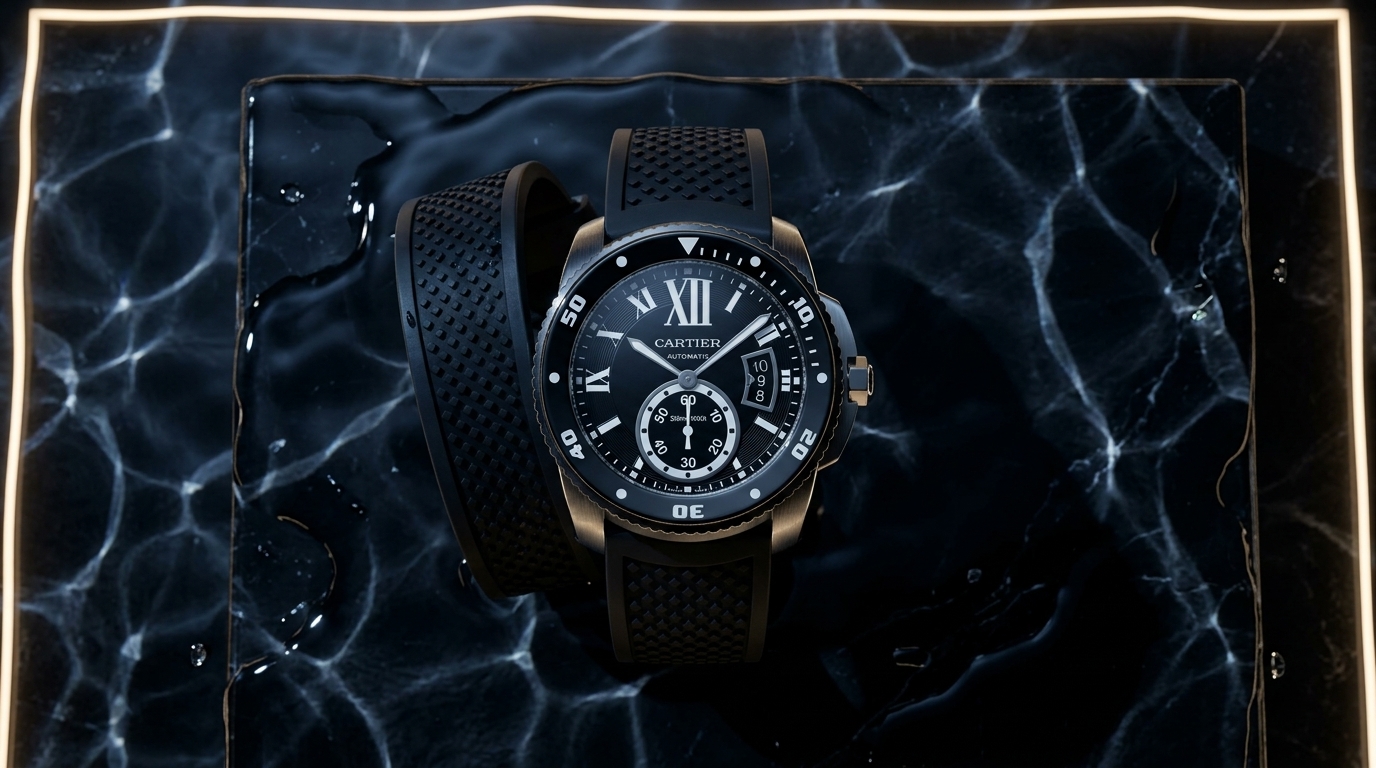
The bezel gives it away as a working object. It is marked for elapsed time, its first quarter divided with useful precision, its grip cut deep enough to be felt rather than merely seen. On many examples, the bezel insert is black ADLC-coated steel, a dark ring against the bright case, though Cartier also made versions in pink gold and two-tone combinations where the tension between refinement and function becomes more visible. The bezel turns only one way, as a diver’s bezel should. If knocked, it can shorten a dive, not lengthen one. This small mechanical pessimism — the assumption that safety requires error to fall in one direction — is part of the poetry of the form.
Yet the dial resists the complete surrender to utility. Cartier’s large Roman numerals occupy the upper field with the confidence of old architecture. The oversized XII is unmistakable, the numerals cut through with luminous material in a way that makes them legible without making them crude. The lower half holds the small seconds at six, a signature of the 1904-PS MC movement, and the date sits at three beneath a discreet aperture. The layout is not symmetrical in the severe way of military instruments. It has balance instead, that more difficult quality in which unequal elements settle into a convincing whole.
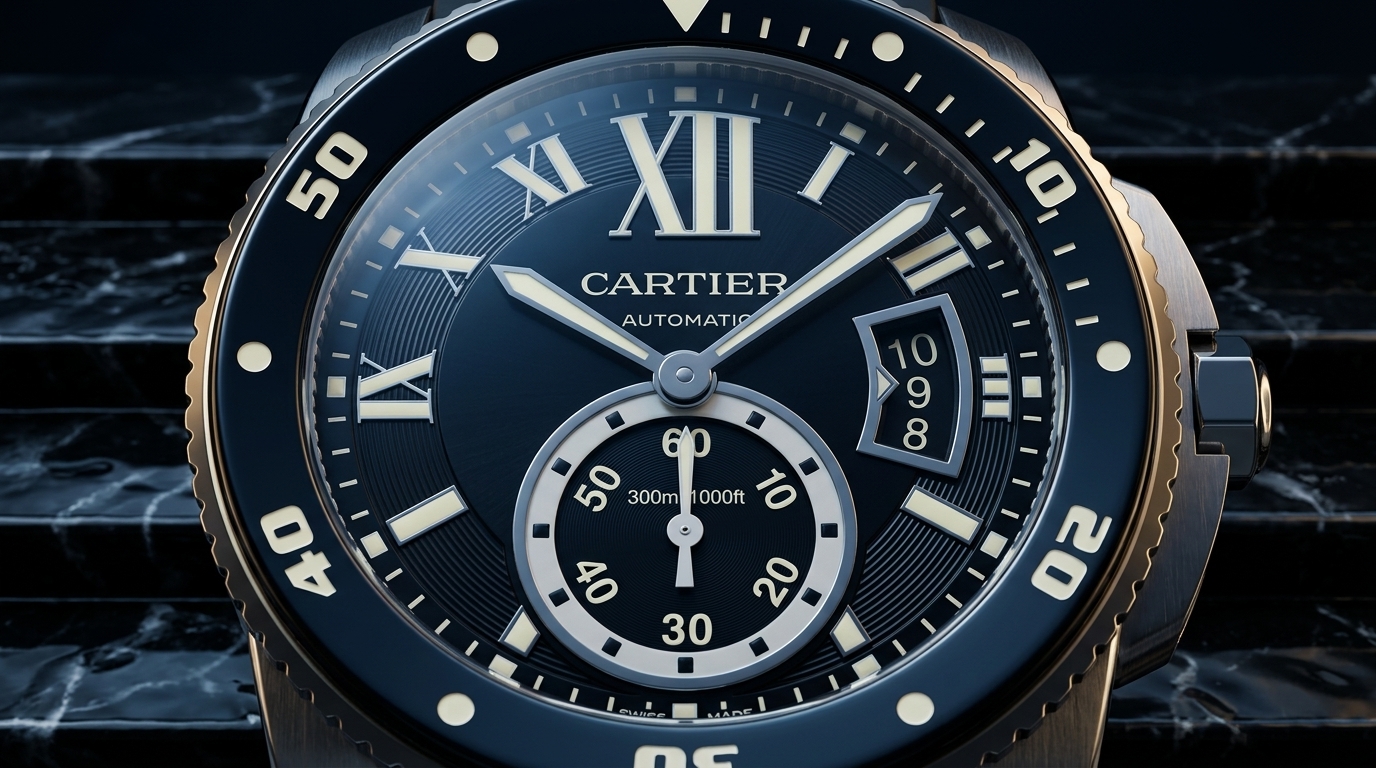
The hands are broad and sharp, Cartier’s sword form strengthened for darkness. They must serve two masters: they need to be read quickly in poor light, but they also need to belong on a dial with Roman numerals and a minute chapter that still carries the trace of the jeweller’s pen. The seconds hand, with its luminous tip, has a practical purpose beyond ornament. On a dive watch, the running seconds confirms the watch is alive. A stopped mechanical watch underwater is not a philosophical inconvenience. It is a failed instrument.
Cartier’s use of its own movement gives the watch another layer of seriousness. The 1904-PS MC was not conceived as a high-drama calibre, and that is part of its suitability here. It is an automatic movement with twin barrels, designed not to extend power reserve extravagantly but to provide steadier torque as the mainsprings unwind. It runs at 4 Hz, a modern beat rate, with stop seconds for precise setting. The small seconds subdial and date are integrated into the architecture rather than added as afterthoughts. Finishing is visible through a sapphire back on some Calibre models, but the Diver closes itself with a solid back for the sake of pressure resistance, leaving the movement to be known by behaviour rather than display.
That hiddenness suits the watch. Dive watches have always contained a private contract. The user sees the dial, the bezel, the crown, the strap; the depth rating is partly a promise made by gaskets, threads, tolerances and tests out of sight. Cartier, a house so often associated with surfaces — polished flanks, lacquered dials, gem-set form — here depends on the invisible. The watch’s credibility rests on compression, seals, and the unglamorous discipline of water resistance.
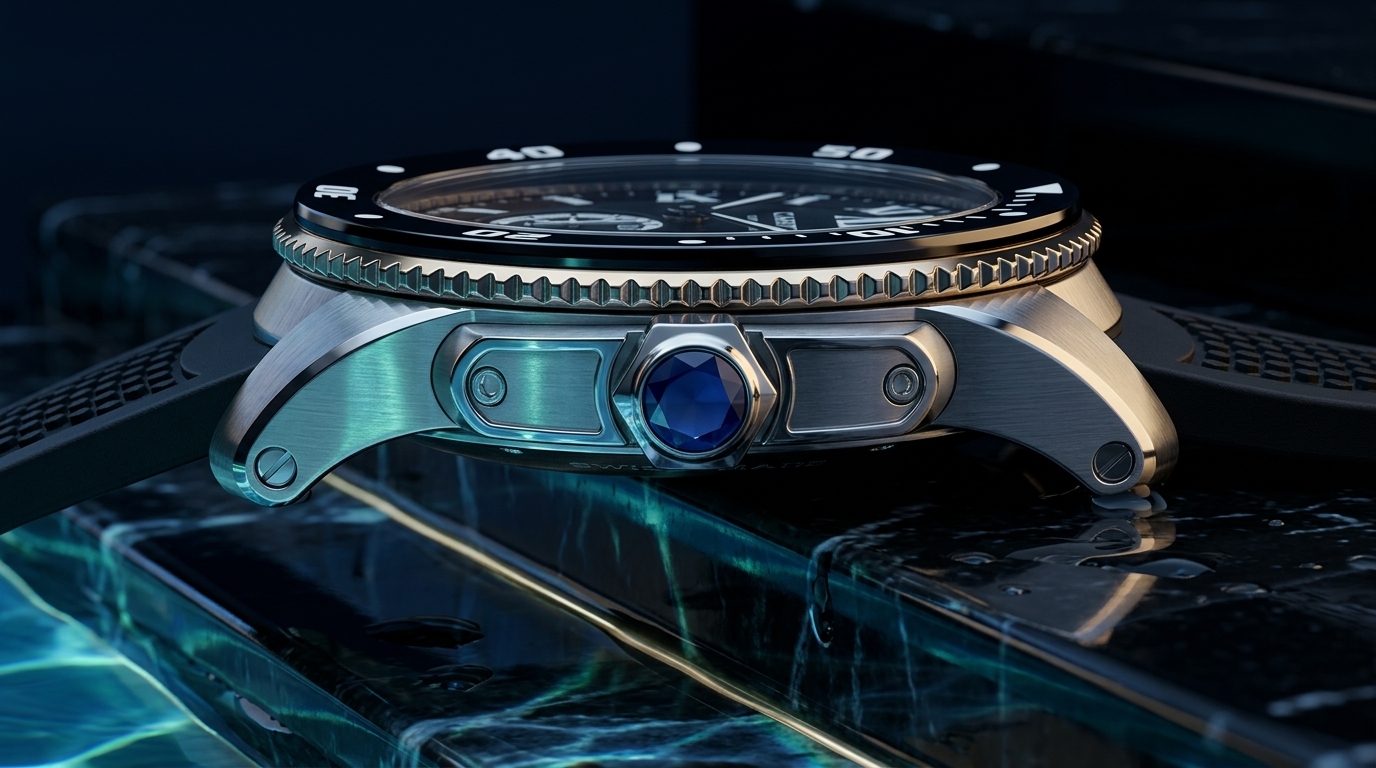
The crown is another negotiation. Cartier’s cabochon crown is one of the most recognisable small forms in watchmaking, a blue bead of identity often placed where industrial logic would prefer a knurled cylinder. On the Diver, the crown is enlarged and protected, with a faceted blue element that preserves the signature without pretending this is a Tank Louis. It screws down securely into the case. The gesture of winding or setting becomes less delicate, more deliberate. The hand must engage threads. The watch asks to be closed before it can be trusted.
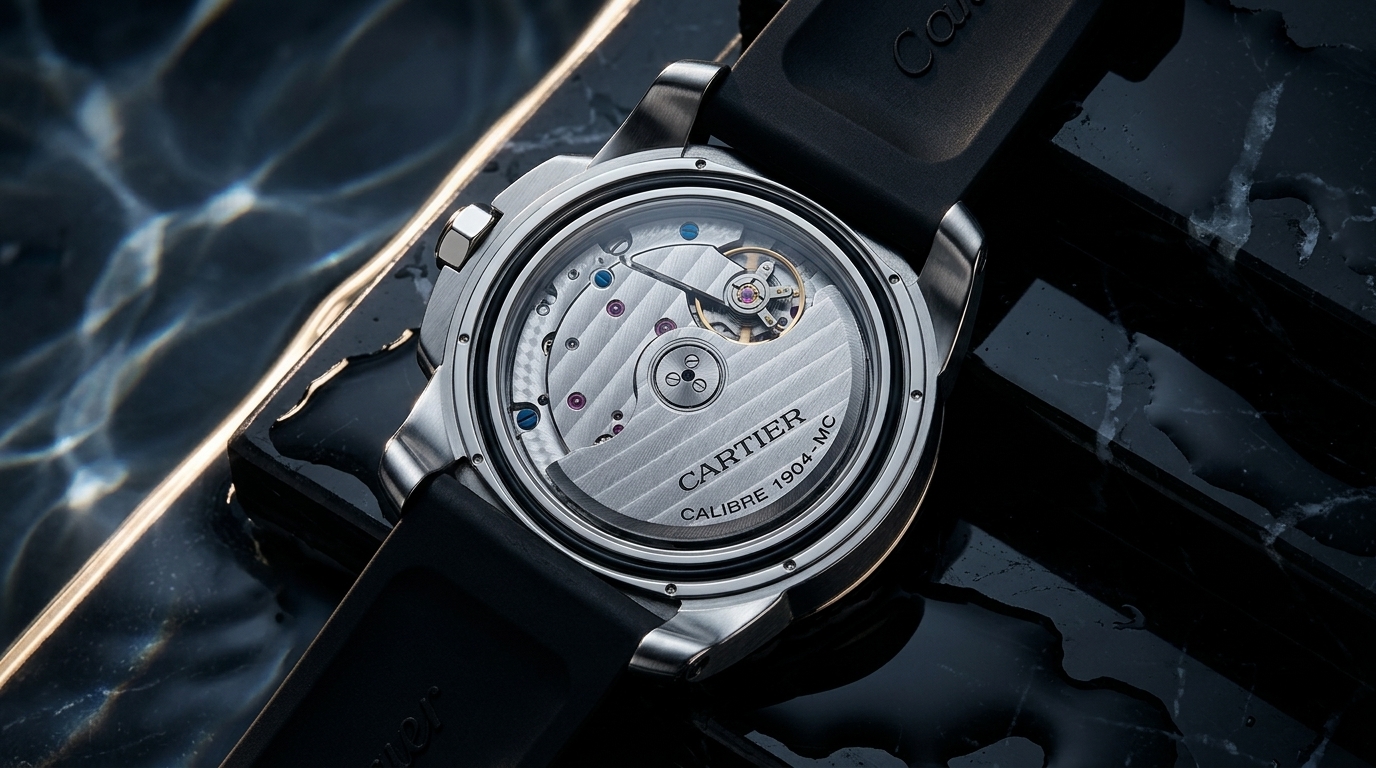
There is a kind of restraint in the finishing that keeps the Diver from becoming costume. The case alternates brushed and polished surfaces, but not with the aggressive theatrics often used to make steel appear more complex than it is. The bezel edge catches light. The lugs curve down with enough attention to ergonomics that the diameter does not tell the whole story. On a rubber strap, the watch leans into its aquatic purpose; on a steel bracelet, it becomes more ambiguous, a sports watch with submersible credentials and dinner-table manners. Cartier’s bracelet work has long understood articulation as a visual and tactile matter, not merely a means of attachment, and the Calibre bracelet continues that approach with broad links that echo the case’s weight.
Still, the Diver is not a watch without contradictions. Its Roman numerals, though luminous, will never read with the brutal immediacy of round plots against a matte dial. Its polished accents will gather marks. Its date window interrupts the field in a manner some purists will resist. The small seconds, elegant and mechanically rooted, is less instantly communicative than a central seconds hand sweeping around the entire dial. These are not failures so much as evidence that Cartier refused to erase itself in pursuit of the category. The watch accepts compromise, and in doing so becomes more specific.
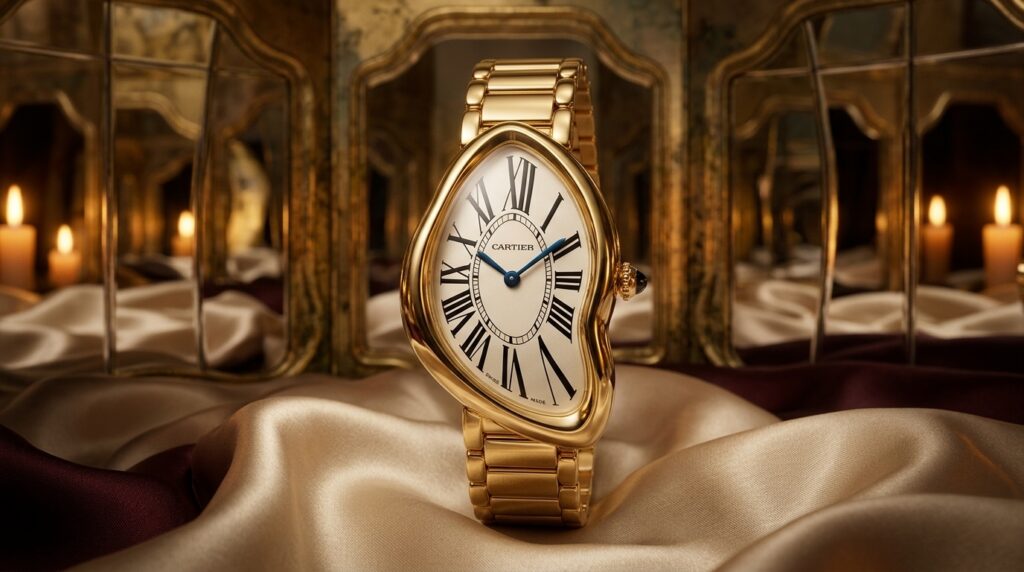
This specificity is why it occupies an unusual place in modern Cartier history. The Santos is widely understood now as a foundational wristwatch, a pilot’s watch before the term became a genre. The Tank has been written into the cultural record so thoroughly that its origins in war machinery are softened by a century of cuffs, portraits and formal rooms. The Calibre Diver is newer, less mythologised, and easier to overlook. It does not have the long chain of famous wrists behind it. It does not belong to Cartier’s classic shaped-watch canon. Nor did it arrive during the current wave of enthusiasm for Cartier’s design heritage, when collectors began speaking with renewed seriousness about the Crash, the Pebble, the Cintrée and the strange poetry of asymmetry.
Instead, it came from a moment when Cartier was asserting itself as a manufacture in a more conventional Swiss sense. The early 2010s saw the maison building technical credibility at La Chaux-de-Fonds, producing calibres, complications and the ID concept watches that explored lubrication-free escapements and carbon crystal components. The Calibre de Cartier family was part of that push: round, masculine, mechanical, and intended to show that Cartier could do more than shape cases beautifully around movements sourced elsewhere. The Diver took this logic into the most codified sports category of all.
The risk was obvious. Dive watches are guarded territory. Their icons were forged through naval contracts, saturation-diving experiments, professional use, and decades of visual repetition. A Submariner, a Seamaster, a Fifty Fathoms, a Doxa — each carries its own archive of salt, rubber, steel and myth. Cartier could not enter that space by imitation without looking faintly absurd. A Cartier dive watch that looked like everyone else’s would have been unnecessary. One that ignored the rules would have been unserious. The Calibre Diver survives because it does neither.
Its beauty, if that is the right word, lies in compliance without surrender. The bezel times. The case seals. The lume glows. The movement is modern and robust enough for the task. But the dial remains recognisably Cartier, even at a glance. The numerals are not decoration pasted onto a tool; they are the point at which the tool becomes Cartier’s. The watch is not trying to disappear into a wetsuit. It keeps a trace of the salon even as it prepares for pressure.
Pressure is the governing metaphor, but also a material fact. At 300 metres, the numbers become abstract for most owners, yet the engineering cannot be abstract. Water exploits weakness with patience. It enters through crowns not closed, seals aged, crystals poorly seated, backs insufficiently tightened. It does not care for brand history. A dive watch, at minimum, must respect this indifference. The Calibre Diver’s ISO certification matters because it places the watch under a standard beyond style. Cartier submitted its object of design to a regime of legibility, shock, magnetism, condensation and water resistance. Elegance, in this case, had to pass a test.
That is the phrase around which the watch seems to gather itself: elegance under pressure. Not elegance as softness, nor as thinness, nor as a refusal of function. Rather, elegance as the ability to remain composed when the environment becomes hostile. The Calibre Diver is not elegant because it is fragile. It is elegant because it does not become frantic in order to prove strength. Its dial does not shout. Its case does not inflate itself for theatre. Its details remain legible as Cartier details, even after being pulled through the demands of a professional category.
The watch also reveals something about the limits of the term “tool watch.” In collecting language, the phrase often implies a narrow aesthetic: matte surfaces, high contrast, no ornament beyond necessity, preferably a history involving armed forces, exploration, aerospace or deep water. But tools have always reflected the cultures that make them. A pilot’s watch from 1930s Germany, a French naval diver, a Japanese professional saturation watch, an Italian frogman’s instrument — each solves problems through a different visual grammar. Cartier’s grammar is no less real because it is more formal. The Santos was a tool for a man in an aircraft who also lived in a world of tailoring, dinners and public spectacle. The Calibre Diver extends that idea downward, from air to water.
There is poignancy in the fact that the line did not become a permanent pillar of the catalogue. Cartier eventually moved away from the Calibre case as its sports-watch energy returned to the Santos and later to integrated-bracelet forms such as the Santos de Cartier and the more recent emphasis on revived shapes. The Diver now sits in the secondary market as a slightly anomalous object: too Cartier for some dive-watch traditionalists, too conventionally sporty for some Cartier devotees. That in-between status may be its most revealing quality. Watches that sit uneasily between categories often age in more interesting ways than those that fulfill their brief too neatly.
One can study the dial and see the tensions still active. The open minute track wants to be read against a decompression schedule; the Roman numerals remember boulevard windows and enamelled clocks. The rubber strap suggests salt and rinse water; the polished bevels suggest sleeves and evening light. The screw-down crown belongs to the sea; the blue cabochon belongs to Cartier’s long theatre of small, precise signs. None cancels the other. The watch becomes a meeting point rather than a compromise.
This is not the Cartier most people picture first. That honour usually goes to a rectangular watch with brancards, a square watch with screws, or perhaps a curved case stretched along the wrist like a line drawn slowly by hand. But the maison’s history is larger than elegance in the narrow sense. It includes practical inventions, pre-war modernity, industrial motifs, and the old discipline of making objects that must function while remaining socially fluent. The Calibre Diver may lack the romance of early aviation or the purity of the Tank, but it has its own narrative: a round Cartier made to enter a domain where sentiment offers no protection.
Seen closely, it is less an exception than a reminder. Cartier’s strength has never been only prettiness, though prettiness is the lazy word often thrown at it. Its strength is control: of proportion, of line, of recognisable codes, of how much utility can be absorbed before an object loses its accent. The Calibre de Cartier Diver tests that control under literal pressure. It asks whether Roman numerals can descend, whether a cabochon can sit above a screw-down tube, whether a watch built by a jeweller can meet the sea without costume or apology.
The answer is not loud. It is there in the narrow case height, in the bezel’s guarded clicks, in the small seconds turning steadily at six, in the broad hands that hold enough luminous material to matter after the lights fall away. It is there in the 1904-PS MC, hidden behind steel, doing the plain work of keeping time. It is there in the fact that the watch remains recognisable at once, not as a generic diver with Cartier printed on the dial, but as a Cartier that has accepted the obligations of a diver.
At depth, every watch becomes a negotiation with darkness, pressure and breath. The Calibre Diver brings to that negotiation a language formed far from the ocean, among shaped cases, city light and the geometry of dress. That language does not make the watch less capable. It makes its capability stranger, more particular, and perhaps more Cartier than a purer instrument would have been. The bezel still turns. The crown still seals. The dial still carries its Roman architecture into the dark. Under pressure, it does not abandon its manners. It proves that manners, properly built, can be a kind of strength.