Baltic’s Carefully Manufactured Nostalgia
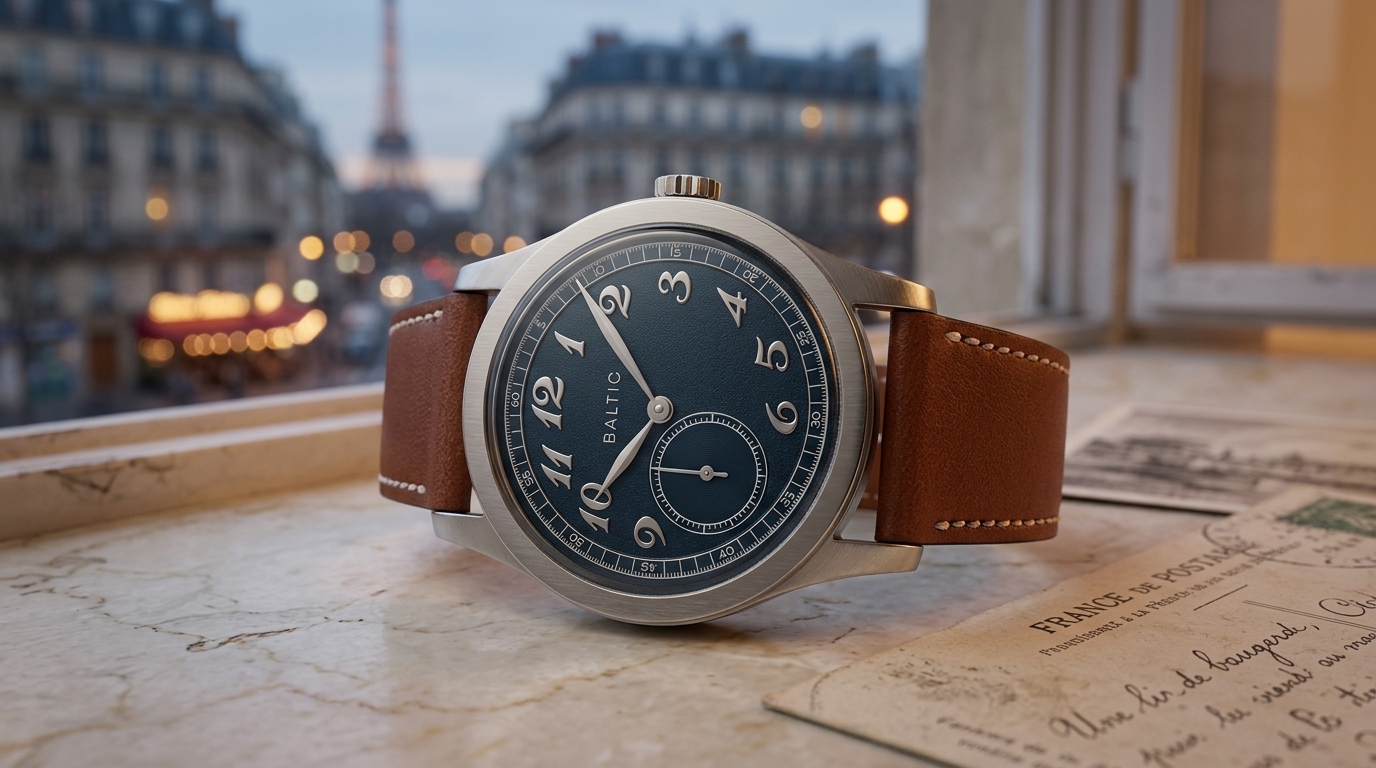
The beads-of-rice bracelet catches the light in small, broken flashes, not as a single bright surface but as a row of separate memories: café chrome, tram rails after rain, the polished lip of an old camera lens. On the wrist, a Baltic often begins there, with a texture that seems to have arrived from elsewhere. The case is new, the sapphire is new, the tolerances belong to the present, yet the watch behaves as if it has been waiting in a drawer since another decade. This is Baltic’s central trick, and also its most interesting tension. It does not inherit nostalgia. It manufactures it, carefully, openly, almost tenderly.
Baltic is not a legacy maison pretending that every contour has passed unchanged through generations of workshop discipline. It is a young French brand, founded in 2017 by Etienne Malec, whose origin story is not a royal warrant or an uninterrupted archive but a collection of watches left by his father and the emotional charge those objects held. That matters because Baltic’s work is not restoration. It is translation. The watches do not claim to be period pieces, and they are not quite replicas. They are contemporary objects built with an eye trained on the mid-century vocabulary of watchmaking: stepped cases, sector dials, compact diameters, domed crystals, beads-of-rice bracelets, blued hands, Breguet numerals, closed casebacks when mystery helps, display backs when mechanics can provide theatre.
The modern watch world has become fluent in this language, sometimes too fluent. Vintage influence is now so common that it risks becoming a default setting rather than a point of view. Cream-colored lume, gilt tracks, box crystals and smaller cases can be assembled like costume elements. On weaker watches, the result is less memory than stage dressing. Baltic’s better pieces avoid that failure because they tend to understand proportion before decoration. A 36mm case does not automatically make a watch charming. A sector dial does not automatically make it French. What Baltic often gets right is the relationship between the empty space and the printed line, between the diameter and the lug length, between the thickness of a bezel and the apparent depth of a dial. Its nostalgia is not accidental; it is edited.
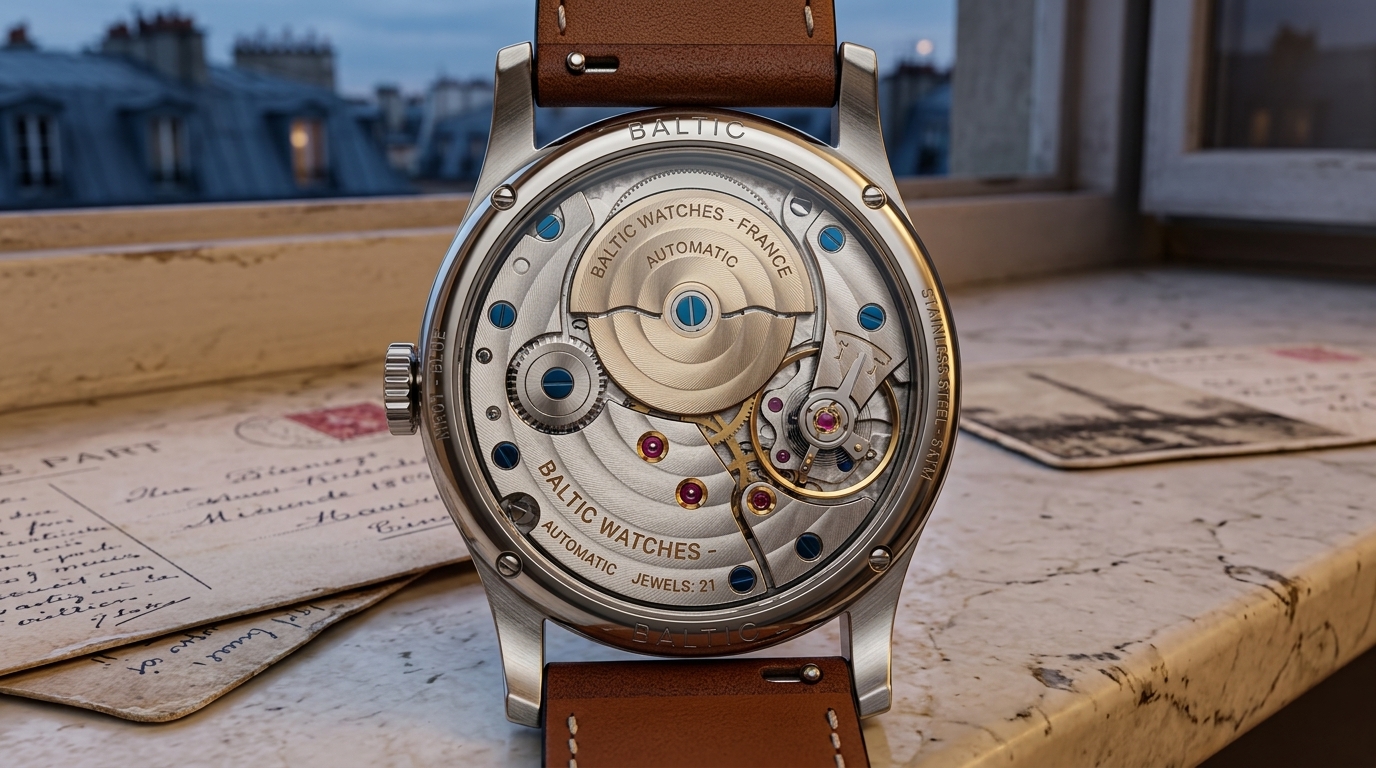
The MR01 remains the clearest expression of that edit. At roughly 36mm across, with a small seconds display and applied Breguet numerals, it could have become sentimental very quickly. Many watches dressed in that language collapse into prettiness. The MR01 instead has a slight unease, a pleasant disproportion, as if a pocket-watch dial has been reduced and set into a case that understands modern restraint. The numerals are ornate but not swollen. The minute track keeps order. The subsidiary seconds at seven-thirty disrupts the symmetry just enough to prevent the whole composition from becoming a postcard. Inside is a Chinese Hangzhou micro-rotor calibre, commonly identified as the CAL5000A, visible through the back. This choice has drawn both admiration and suspicion, which is why it is useful. A micro-rotor carries the glamour of high watchmaking history, from Universal Genève to Piaget and beyond, but here it is deployed at a price far below that lineage. Baltic does not hide the compromise. It lets the architecture do some of the seducing.
There is something revealing in that display back. The movement finishing is not Geneva watchmaking in the ceremonial sense. It does not pretend to be. The bridges are decorated, the rotor is small, the visual effect is charming, but any serious observer can see the distance between evocation and exaltation. Baltic’s nostalgia, at its best, lives inside that distance. It offers the shape of old refinement without insisting that the object is an heirloom of the same order. The watch is not trying to out-sing Patek Philippe’s Calatrava history or Vacheron Constantin’s dress-watch grammar. It is doing something more contemporary: taking fragments of a collective watch memory and making them available to buyers who may know the past mostly through auction catalogues, Instagram close-ups, and the soft glow of aged radium plots in photographs.
The Bicompax chronographs show the same instinct from a different angle. A manually wound chronograph with two registers immediately summons a crowded table of ancestors: wartime instrument watches, 1940s dress chronographs, the early architecture of practical timing before automatic rotors thickened cases and complicated silhouettes. Baltic’s Bicompax models use the Seagull ST1901, a Chinese-made column-wheel chronograph movement descended from the Venus 175 architecture, after tooling and know-how travelled east in the mid-20th century. This is not merely a budget movement with a picturesque explanation. Its lineage is strangely appropriate for Baltic: a European design displaced, reindustrialized, and reintroduced to a global enthusiast market. The movement itself is a kind of manufactured nostalgia, not fake, but historically tangled.
In a 38mm case, a Baltic Bicompax resists the inflation that has made many modern chronographs feel like instruments for larger lives than most people lead. The twin registers sit with a certain civility. The pushers have the simple mechanical drama of a door latch. The act of winding such a watch is part of its argument, but Baltic is careful not to romanticize hardship. It does not ask the wearer to tolerate fragility or poor legibility merely for atmosphere. The crystals are modern. The cases have contemporary water resistance appropriate to their type. The chronograph is priced in a way that acknowledges both pleasure and limitation. It is romantic, but not delusional.
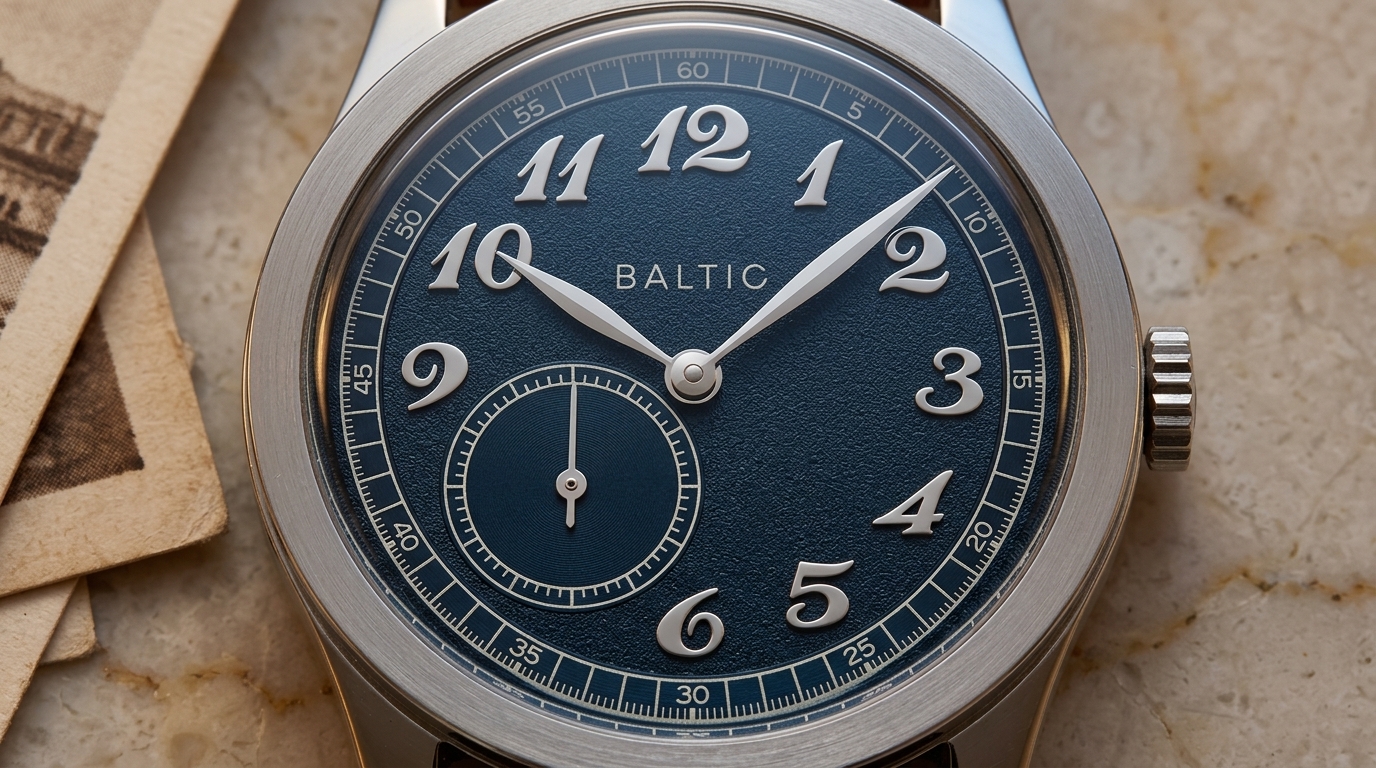
Still, the romance is engineered. The typeface, the color of the lume, the stance of the lugs, the width of the bezel around the dial—none of these details are innocent. Baltic’s watches can look as though they happened naturally, but they are highly composed objects. The danger in that composition is that nostalgia can become too clean. Real vintage watches are often awkward. Their cases have been polished badly. Their dials have spotted, browned, cracked or shifted unevenly. Their hands may not match. Their charm frequently comes from damage, from use, from the erosion of intent. Baltic must manufacture the feeling of age without the inconvenience of age itself. It has to offer patina without decay, memory without inheritance, warmth without corrosion.
That balancing act becomes more visible in the Aquascaphe. The dive-watch field is perhaps the most overworked territory in modern horology. Almost every new diver carries the spectral weight of the Blancpain Fifty Fathoms, the Rolex Submariner, the Tudor Submariner, the skin divers of the 1960s, the compressor-cased oddities and military-issued tools that have since become collector fetishes. Baltic’s Aquascaphe enters this crowded room quietly, with a 39mm case, a rotating bezel, a domed sapphire crystal, and the familiar practical architecture of a watch meant to be read through water, shadow and movement. It uses modern automatic calibres such as Miyota’s 9039 in certain references, a slim, workmanlike Japanese movement that speaks more of reliability and economy than romance. This contrast is central to the object. The outside dreams backward. The inside keeps time in the present.
The Aquascaphe’s success depends on its refusal to be too large, too thick, too eager. Many vintage-inspired divers misunderstand old dive watches by adding bulk in the name of capability. Baltic’s versions retain a compactness that makes their nostalgia credible. The bezel has gloss and depth, sometimes with sapphire lending a liquid surface that vintage bakelite might envy but could not match in durability. The lume plots are clean. The crown guards, when absent or minimal depending on the reference, allow the case to breathe. On the beads-of-rice bracelet, the watch leans dressier than a tool watch perhaps should, but that is part of its charm. It is less an object for underwater labor than for the idea that underwater labor once had better typography.
This is where Baltic’s project becomes culturally interesting rather than merely stylistic. The brand emerged during a period when younger enthusiasts were learning watch history in fragments: forum posts, auction records, macro photography, scanned advertisements, YouTube reviews, dealer listings, and the endless comparative memory of social media. The past no longer needed to be encountered in a dusty shop window or inherited from a relative; it could be consumed visually, repeatedly, at high resolution. Baltic understood the appetite that formed in that environment. It offered not the rare vintage watch itself, with its maintenance risks and rising prices, but the emotional outline of such a watch, stabilized for everyday use.
There is an honesty in that, and also a melancholy. A Baltic can feel like an answer to a world in which many original references have escaped ordinary reach. The mid-century chronographs that once sat unnoticed in trays now attract specialists. The early dive watches that were once scuffed tools are now locked behind glass or inflated by provenance. Even modest vintage pieces have become less straightforward to buy, burdened by questions of redials, relumes, swapped hands, polished cases, and movements whose parts are no longer easy to source. Baltic removes the anxiety. It offers the look of discovery without the peril of discovery. The buyer receives a clean watch, a warranty, modern assembly, and a story already shaped enough to be legible.
Yet the best Baltic watches do not feel cynical. This is important. Manufactured nostalgia can easily become exploitation, a way of selling borrowed emotion at scale. Baltic usually avoids that by keeping the objects modest in claim. There is no grand insistence that these watches are equivalent to the pieces that inspired them. They are not priced as miracles. They are designed with affection rather than conquest. A sector dial appears because it suits the watch, not because the brand needs to invent an entire lost aviation squadron around it. A bracelet echoes mid-century Gay Frères textures without pretending to be one. A chronograph movement with Venus ancestry is allowed to be interesting in its own right, rather than disguised as Swiss nobility.
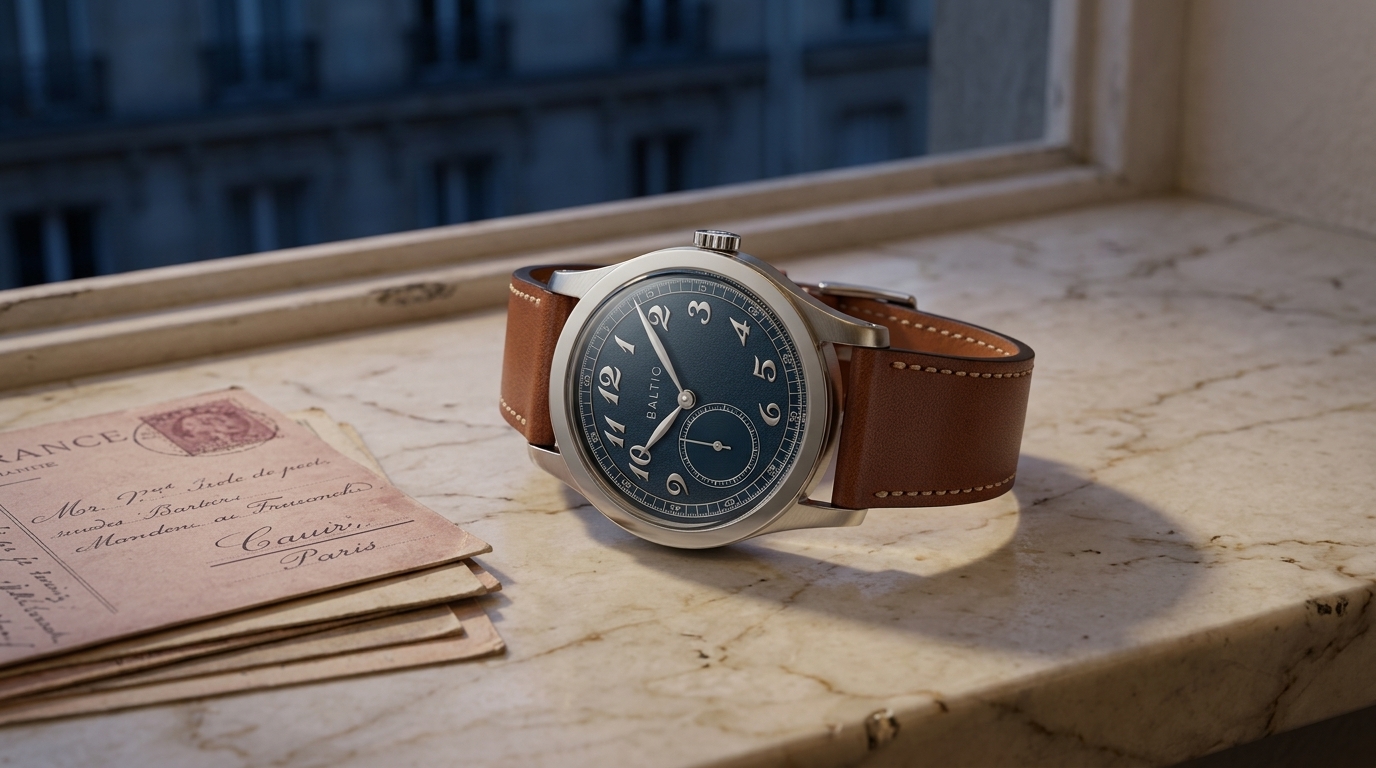
The cases are crucial to this restraint. Baltic’s diameters often hover in that zone—36mm, 38mm, 39mm—where vintage reference points make physical sense. A watch can only evoke the past so far if it arrives with the footprint of a modern sports luxury case. The smaller dimensions change the emotional register. They ask the dial to do less shouting. They make the lugs matter. They allow negative space to become part of the composition. In pieces like the HMS, with its sector-dial lineage and simple three-hand format, the watch gains its character not from complication but from the discipline of the printed track. The automatic movement inside, found across different generations of the line in Japanese calibres such as Miyota’s 8000 and 9000 series or later alternatives depending on reference, is almost beside the point visually, but it matters philosophically. Baltic is not building museum replicas. It is building contemporary watches that use accessible, serviceable engines to support a historical mood.
The word “mood” might sound imprecise, but in Baltic’s case it is the product. Not just the watch, not just the calibre, not just the case size. The brand sells the condition of looking at a new object and feeling that it has already lived a little. Packaging, photography, straps, typography, even the way the watches are named contribute to this. “HMS” carries marine and military echoes without becoming too literal. “Bicompax” invokes collector language. “Aquascaphe” sounds older than the company that coined it. These names participate in the construction. They are not dishonest exactly, but they are theatrical. Baltic’s intelligence lies in keeping the theatre small enough that the watches remain believable.
The Prismic, with its more architectural case and textured dial work, suggests another route for the brand: not abandoning nostalgia, but sharpening it into something less immediately referential. The temptation for any successful young watch company is repetition. Once a house style becomes recognizable, it can harden into formula. Cream lume, compact cases, vintage bracelets, sector layouts—the ingredients can only be recombined so many times before affection starts to taste pre-mixed. Baltic’s long-term credibility may depend on whether it can move from quoting the past to conversing with it. Some models already attempt this. The MR01, for all its old-world cues, is not a direct copy of one famous watch. Its off-center seconds and micro-rotor display create a distinct enough personality. That is the path worth watching.
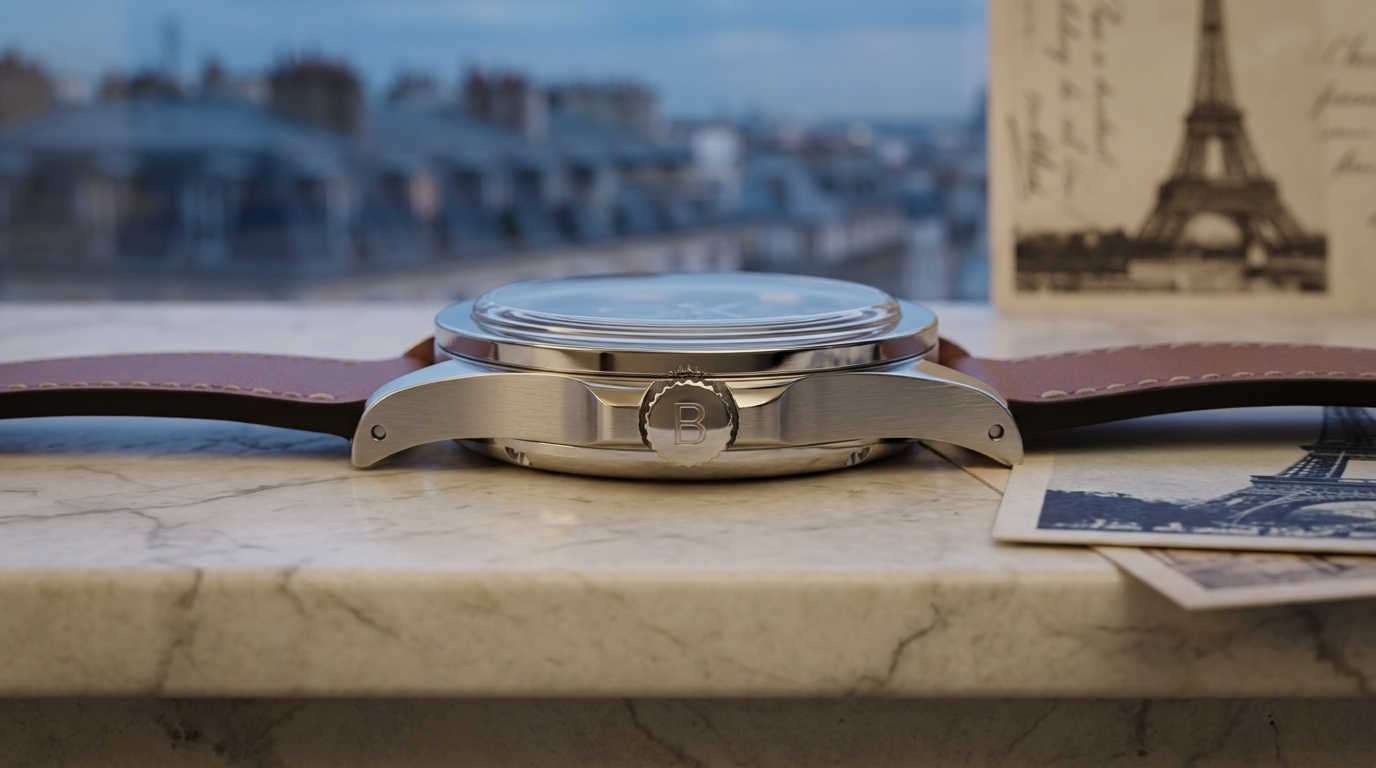
There is also the question of Frenchness. Baltic is headquartered in Paris, a detail that colors perception even when the supply chain, like most modern watchmaking supply chains, extends across borders. France has a rich but complicated horological history: Besançon, Lip, marine chronometry, carriage clocks, design culture, and the persistent shadow of Swiss industrial dominance next door. Baltic does not present itself as a revival of French watchmaking in any heavy-handed national sense. Its Frenchness is more atmospheric than mechanical. It appears in proportion, restraint, graphic balance, and a certain comfort with style as substance. That last phrase should not be read as criticism. In watches, style often is substance. A dial is not a wrapper around the real object; it is the face through which the object meets time.
The criticism Baltic invites is therefore not that it is too concerned with appearances, but that appearances are sometimes doing almost all the emotional work. When a watch leans on vintage cues, it borrows trust as well as beauty. Old designs have survived because collectors have already agreed to care about them. A young brand can step into that agreement without earning it in the same way. Baltic’s answer has been consistency. The finishing is generally in line with price, the proportions are considered, and the watches do not overpromise. The movements are chosen pragmatically, sometimes romantically, rarely extravagantly. This steadiness gives the manufactured nostalgia a frame. It prevents the project from becoming mere costume.
The idea of “manufactured” should not be mistaken for “false.” All watch nostalgia is manufactured to some degree. Even the great heritage brands curate their pasts, polishing certain decades while leaving awkward years in shadow. Reissues are edited. Archive pieces are reshaped to modern tastes. Lume is aged by color choice rather than radiation. Crystals are made more durable, cases more water resistant, bracelets less hair-pulling, movements more stable. The difference is that Baltic has no century-old institutional memory to conceal the act of construction. Its manufacture of nostalgia happens in public. The seams are visible. A French microbrand orders components, selects movements, designs cases, arranges typography, and produces an object that feels older than itself. The illusion is not hidden; it is the craft.
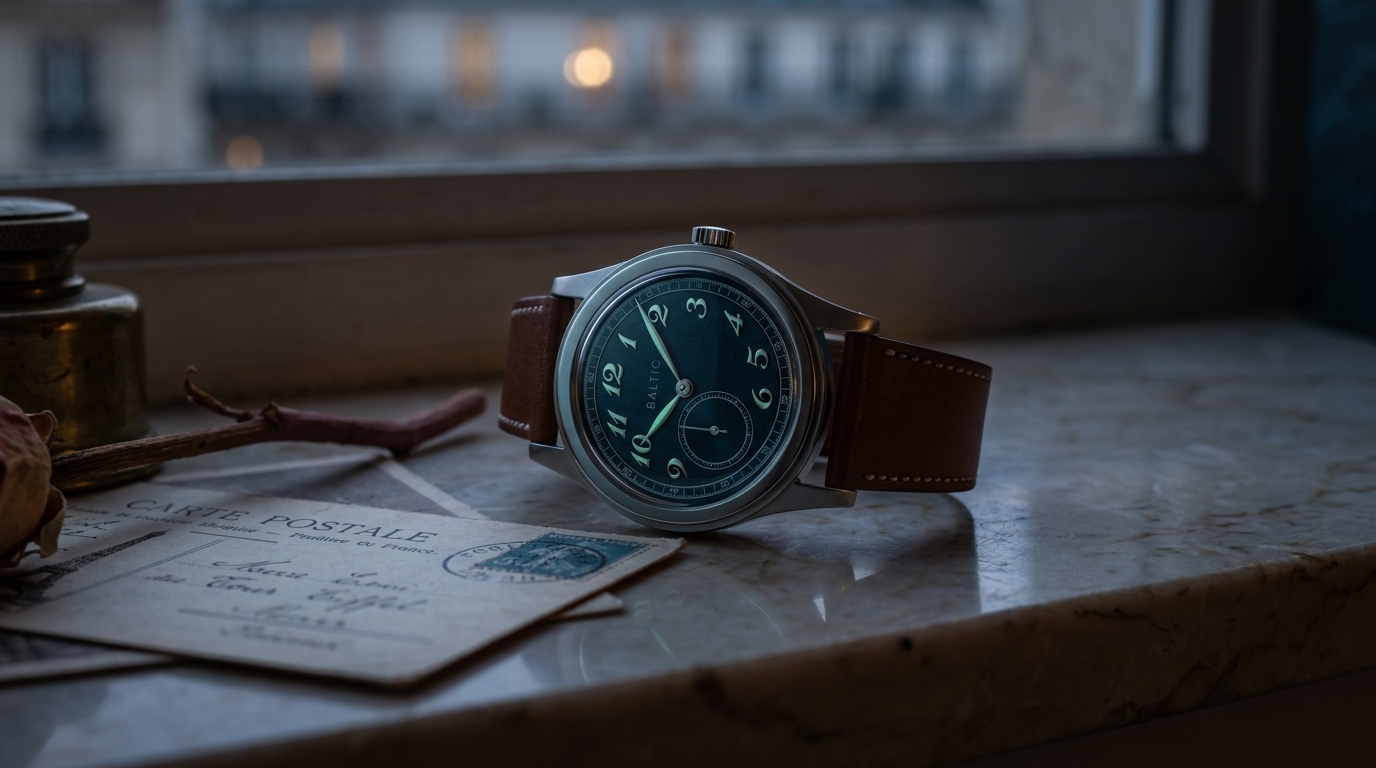
This may explain why Baltic has resonated so strongly with enthusiasts who know enough to recognize the references but not necessarily enough, or not willingly enough, to buy the originals. The watches reward looking. They give the owner small details to learn: the way a stepped bezel changes a shadow, the way a subdial can pull a composition off-center, the way a domed crystal distorts minute markers at the edge, the way manual winding changes one’s relationship with a chronograph. Such pleasures are not trivial. They are the grammar by which many people enter watch collecting. Baltic provides that grammar without demanding fluency first.
But there remains a softness at the center of the enterprise, a deliberate blur. The watches suggest stories they did not live. A Bicompax did not time a rally in 1952. An Aquascaphe did not descend with a naval diver off Toulon. An MR01 did not sit beneath the cuff of a postwar architect sketching a train station. Those images arrive uninvited because the design language has been tuned to call them forth. Baltic’s achievement is that the spell often survives this knowledge. The observer can know the nostalgia is manufactured and still find it affecting, just as a film set can be made of timber and paint yet still hold weather, silence, and consequence when lit correctly.
In the end, Baltic’s watches are less about returning to the past than about making the past usable. They compress the distance between old forms and modern expectations. They allow a collector to enjoy the outline of vintage watchmaking without surrendering to the uncertainties of vintage ownership. Their most successful models understand that memory in watch design is not created by one detail but by cadence: the diameter, the dial grain, the hand length, the crown size, the bracelet articulation, the movement glimpsed or concealed. Each choice contributes a note. Too many notes and the song becomes parody. Too few and the reference disappears. Baltic’s carefulness lies in knowing, more often than not, where that threshold sits.
The watch industry is crowded with brands searching backward for authority. Baltic searches backward for atmosphere. That distinction saves it. Authority would ring hollow from a company so young. Atmosphere, however, can be honestly made. A Baltic does not need to pretend that it survived the 1940s, or that its case was found in a naval archive, or that its dial design has lain dormant in a Parisian cabinet. Its value is quieter and more contemporary: it shows how powerfully the forms of the past still govern the desires of the present. The nostalgia is manufactured, yes. Carefully. Visibly. Sometimes beautifully. And in that care, the watches reveal something more honest than heritage theatre usually permits: that memory, in horology as elsewhere, is not only preserved. It is designed.