Chopard’s L.U.C and the Double Life of a Jewelry House
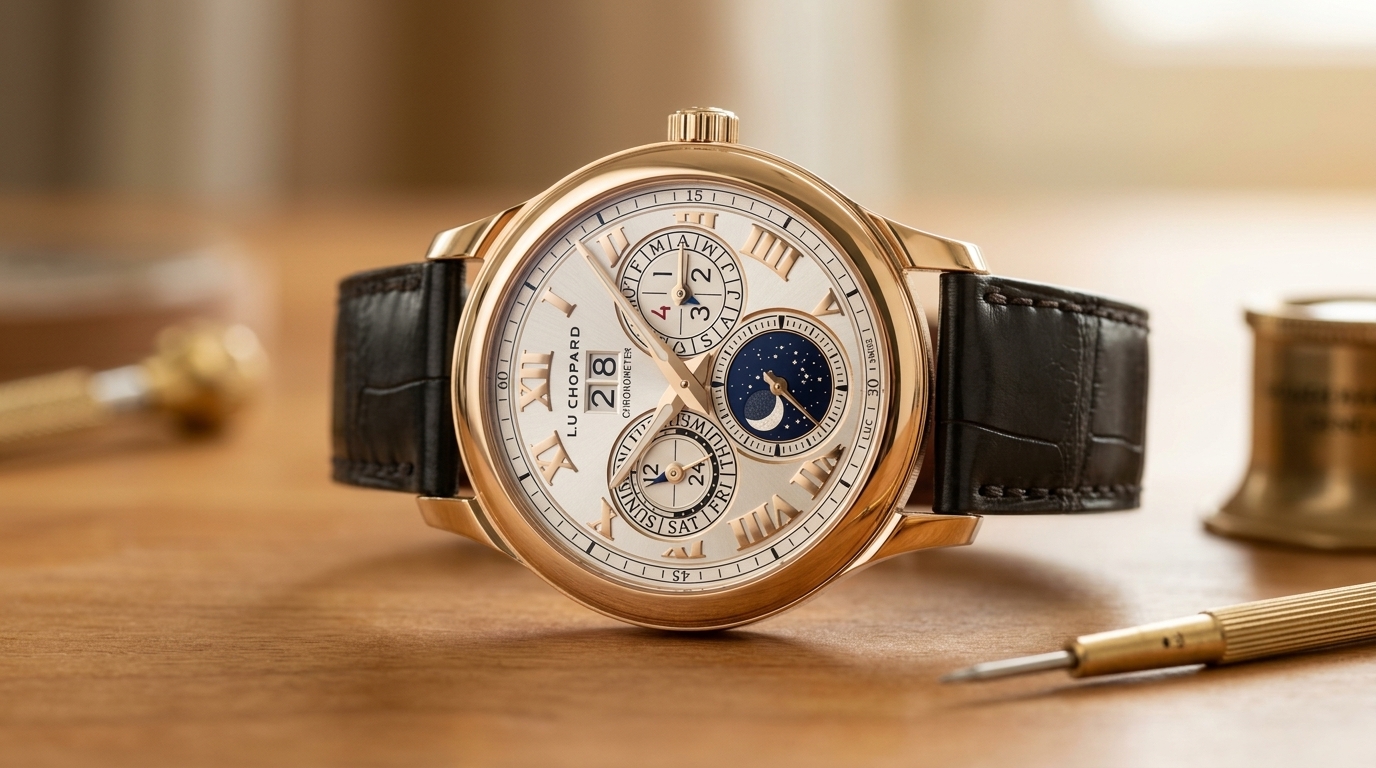
A gold micro-rotor turns beneath a sapphire back, not theatrically, not for applause, but with the small, steady authority of a machine that knows its work. Around it, bridges are laid out with old Swiss discipline: bevels catching the light at their edges, Geneva stripes moving like watered silk, jewel sinks polished until they appear almost wet. On the dial side, there may be little to announce the effort. A modest case, a date window, perhaps a small seconds register. The initials on the dial are three letters long: L.U.C. They belong to Louis-Ulysse Chopard, who opened his workshop in Sonvilier in 1860, but in contemporary watchmaking they also mark one of the more curious double lives in Swiss luxury: a jewelry house with a serious chronometric conscience.
Chopard is often encountered first in brighter rooms. Its public image has long been polished by diamonds, red carpets, sculptural necklaces, and the buoyant charm of Happy Diamonds sliding freely between sapphire crystals. The name carries the scent of Cannes, gala staircases, and high jewelry displays in which light is not so much reflected as multiplied. That is one Chopard. It is not false, nor is it superficial. Jewelry, at this level, requires its own discipline: stone selection, setting, proportion, the old theatre of metal and skin. But the other Chopard lives farther from cameras, in Fleurier, where tolerances are measured in microns and beauty must survive a loupe.
The L.U.C collection, launched in 1996 under Karl-Friedrich Scheufele’s direction, was not a mere extension of the brand into watches. Chopard already made watches; many jewelry houses do. The difference lay in ambition. The L.U.C project sought to build manufacture movements of genuine technical and aesthetic substance, with the kind of finishing and architecture that could stand beside the established maisons of traditional high horology. Its first answer, the calibre 1.96, was remarkably self-possessed. At a time when many luxury automatics were content to rely on supplied ébauches, Chopard produced a slim, automatic micro-rotor calibre with twin stacked barrels, a 22-carat gold winding mass, chronometer certification, and finishing that earned the Geneva Seal. It was not loud. It did not need to be.
The first L.U.C 1860, reference 16/1860, remains a useful way to understand the entire line. Its case measured roughly 36.5 millimetres, a size that now reads almost philosophical after years of swollen wristwatch architecture. The dial was formal but not inert, with a guilloché centre, applied markers, a discreet date at six, and hands that behaved as hands should: legible, balanced, unselfconscious. Turn it over, and the watch changed character. What seemed from the front like a restrained gold dress watch became a view into one of the most impressive automatic movements of its era. The calibre 1.96, later known within Chopard’s evolving nomenclature as part of the 96 family, made its case through construction rather than decoration alone. Its micro-rotor allowed the movement to stay slim without surrendering automatic winding. Its twin barrels, part of Chopard’s “Twin” technology, supplied about 65 hours of power reserve, impressive for such a thin engine. It beat at 28,800 vibrations per hour, carried fine adjustment, and was finished with a seriousness that resisted any accusation of vanity.
This is where the double life becomes interesting. A jewelry house understands surface better than almost anyone, but fine watchmaking punishes surface without structure. A brilliant dial cannot rescue a weak movement from mediocrity. A polished case cannot hide poor architecture from those who look beneath it. The L.U.C project therefore had to move in the opposite direction from spectacle. It had to become quiet. It had to earn belief in places no passer-by would see.
Chopard’s family ownership matters here. The Scheufele family acquired the company in 1963, and under their direction Chopard expanded into the jewelled glamour for which it is broadly known. Yet family companies can also indulge long projects that quarterly discipline might discourage. Building a manufacture in Fleurier was not the easy route. Neither was designing a movement like the 1.96 from the ground up when established suppliers existed. The L.U.C watches have always seemed to carry a private wager: that the house best known for diamonds could also make watches for those who distrust diamonds on principle.
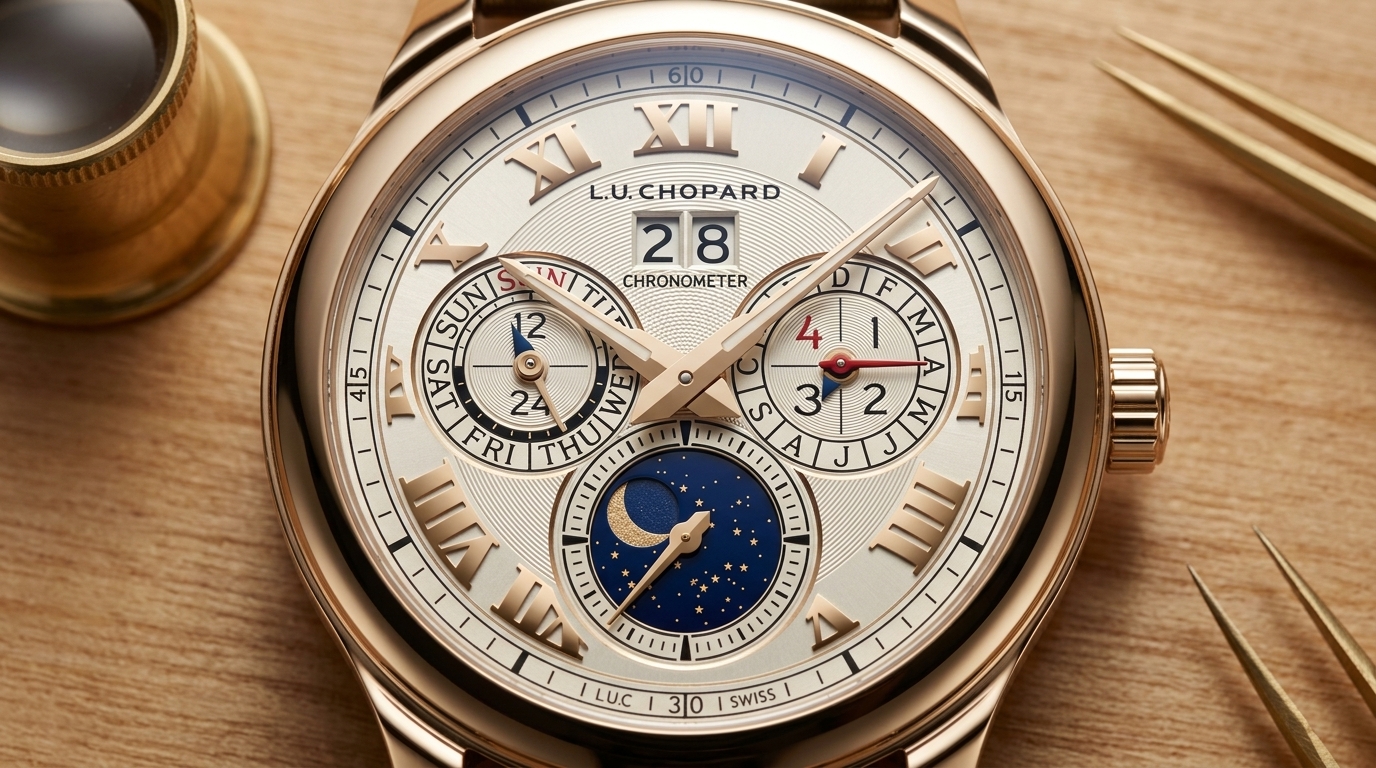
Fleurier is not Geneva, and that distinction gives L.U.C some of its character. The town sits in the Val-de-Travers, a valley with a watchmaking memory older than most brands’ marketing departments. It is a place associated with long winters, disciplined craft, and, in modern horology, a certain sobriety of purpose. Chopard Manufacture was established there not as a scenic backdrop but as a working answer to a technical problem: if the firm wanted to speak seriously in watchmaking, it needed control over design, development, finishing, and assembly. In time, L.U.C calibres would range from restrained automatics to tourbillons, perpetual calendars, eight-day and nine-day movements, chiming watches, and experiments in certification that went beyond decorative prestige.
The L.U.C Quattro, introduced in 2000, expressed this appetite for mechanical substance with particular clarity. Its manual-wound calibre used four barrels arranged to deliver a long power reserve, famously about nine days, while maintaining chronometric stability across much of that span. There is poetry in a long-running watch, but it is not the poetry of convenience alone. A large reserve tests the watchmaker’s command of torque, friction, gear train efficiency, and regulation. Too much force at the beginning can be as troublesome as too little at the end. The Quattro concept gave Chopard a signature that was not borrowed from anyone else’s catalogue. It said that L.U.C would not exist only to make slim gold watches for formal cuffs. It would build engines with their own personalities.
The Lunar One followed a similar path, combining perpetual calendar indications with an orbital moon display of considerable refinement. Later came tourbillons bearing the L.U.C name, watches submitted to exacting standards such as the Fleurier Quality Foundation certification, and complications that showed Chopard’s willingness to work in difficult territory. The Full Strike, a minute repeater with sapphire crystal gongs integrated with the crystal itself, won the Aiguille d’Or at the Grand Prix d’Horlogerie de Genève in 2017. Such prizes can be noisy things, but the watch was technically notable beyond the trophy. Chiming watches are among the least forgiving forms in horology. Sound exposes compromise. A repeater must be engineered not merely to function, but to breathe.
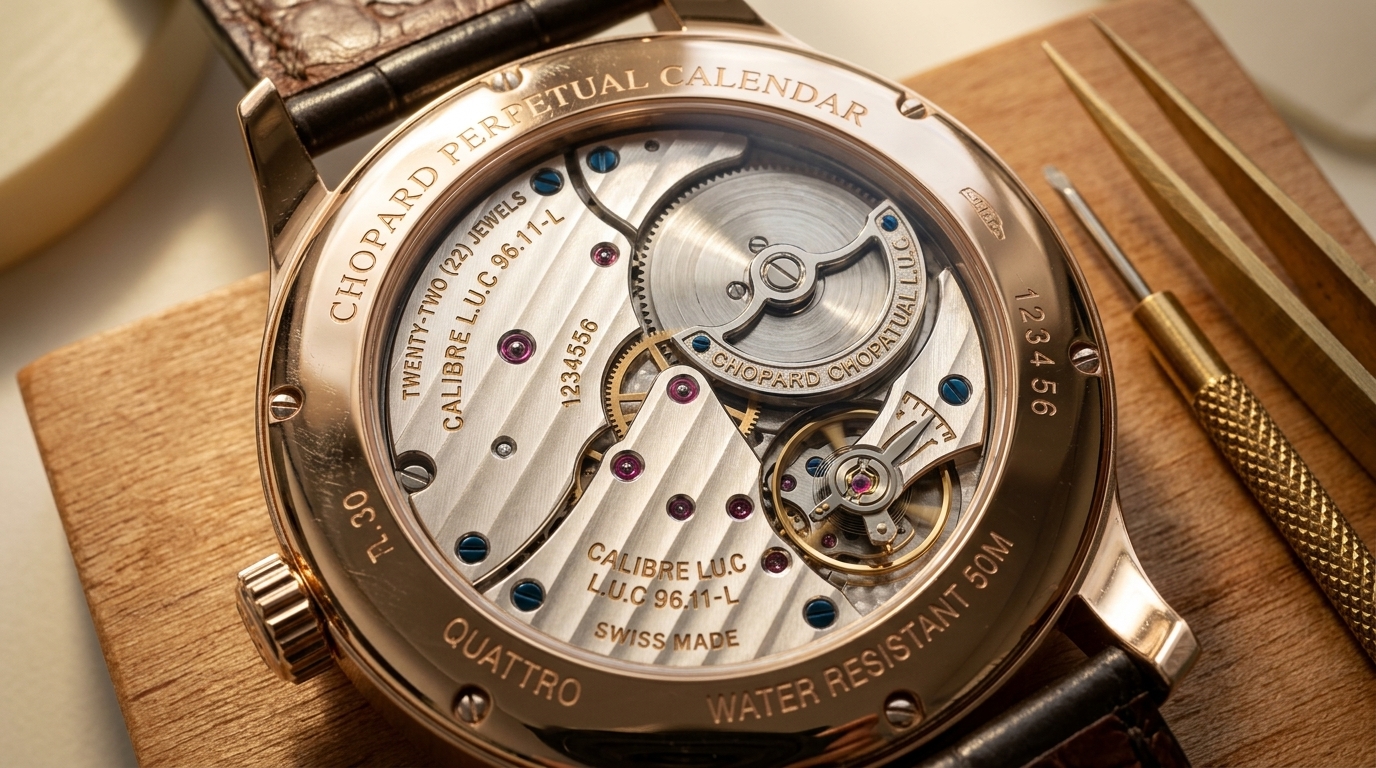
Still, the most persuasive L.U.C watches are often the ones that appear simplest. Simplicity is cruel in watchmaking. A three-hand watch leaves few hiding places. Proportions either settle or they do not. The bezel is either too wide or exactly calm. The lugs either continue the case with purpose or hang from it like afterthoughts. The dial printing either has tension or it fades into politeness. Chopard’s finest L.U.C pieces tend to understand this. Cases are often slim, rounded, and formally cut without being brittle. Dials may use Roman numerals, sector layouts, hand-guilloché textures, or sunburst finishes, but the better examples avoid theatrical heritage. They do not dress up as antiques. They behave as contemporary watches informed by older manners.
The L.U.C XPS line, with its extra-flat automatic movements, illustrates the house’s restraint at its best. These watches often depend on millimetres and small decisions: the height of a baton marker, the slope of a bezel, the length of a seconds hand, the relationship between dial opening and case diameter. Inside, the micro-rotor movements continue the story begun in 1996. They are watches for people who understand that thinness alone is not elegance; thinness must be managed, protected from fragility in appearance and practice. A very slim watch can become precious in the wrong way, almost apologetic. The stronger L.U.C pieces avoid that. They have enough metal around the movement to feel complete.
The chronometer obsession also deserves notice. The letters L.U.C are frequently accompanied by COSC certification, and many movements have pursued additional seals and tests. Chopard has used the Geneva Seal on appropriate movements, and some models have met the stricter demands of Qualité Fleurier, which includes COSC certification, durability testing through Chronofiable, finishing requirements, and the Fleuritest simulation of actual wearing conditions. These are not merely badges when taken seriously. They reveal the house’s desire to bind decoration to performance. The watch must be beautiful, but it must also keep time with documented rigour. In a field where the language of craft is often used as perfume, this insistence has weight.
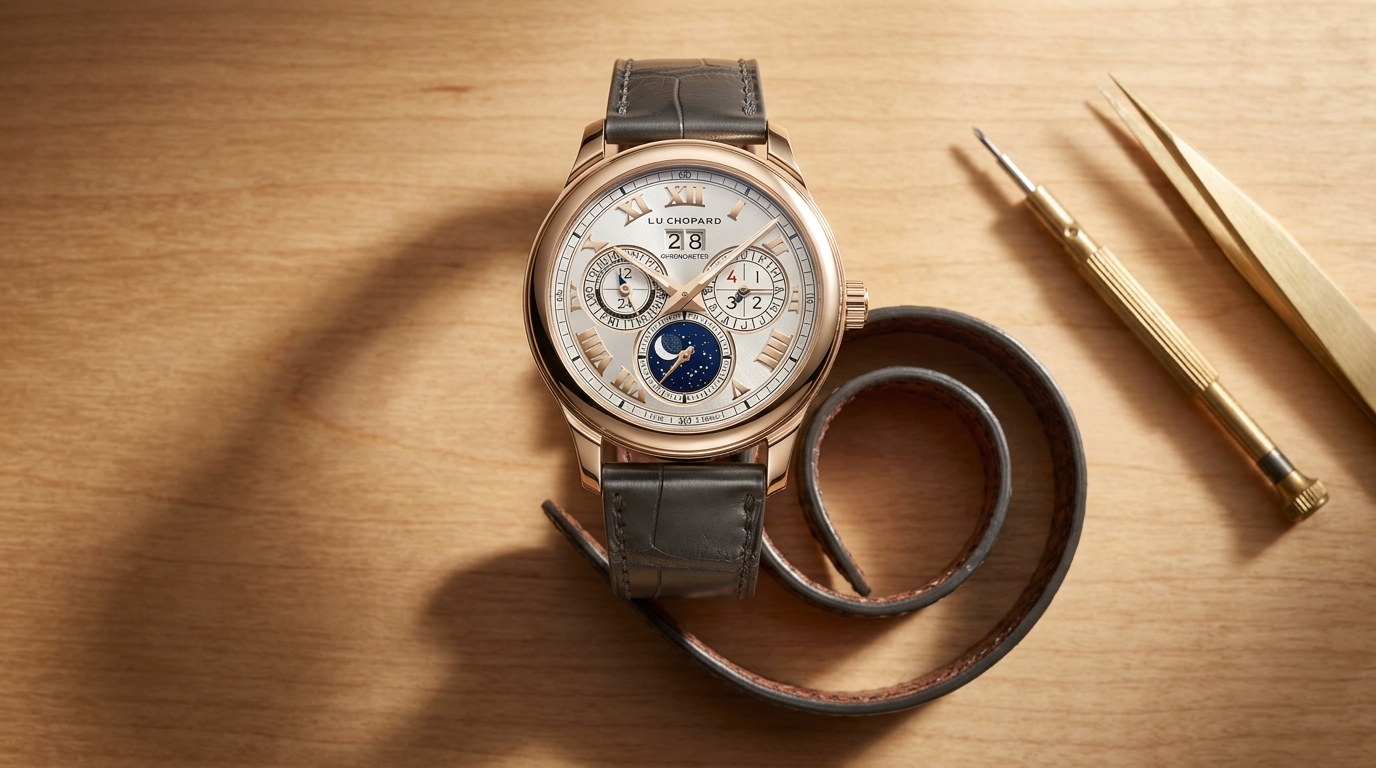
And yet the tension remains. Chopard is not a small independent known only to collectors comparing bridge shapes under magnification. It is a major luxury house with boutiques that glitter, ambassadors, high jewelry suites, and watches shaped as much by desire as by engineering. The L.U.C collection must therefore live in two climates. It belongs to the same name that sets diamonds into spectacular necklaces, but it also asks to be judged against Patek Philippe, Vacheron Constantin, A. Lange & Söhne, Audemars Piguet, and the best of modern independent watchmaking. That is a difficult request. Collectors can forgive a manufacture many things, but not confusion about what it wants to be.
At times, L.U.C has seemed almost too discreet for its own good. The watches have not always carried the instant silhouette recognition that helps a line become mythology. Nor have they been supported by the kind of monastic brand image that makes every screw feel predestined. There is a certain unfairness in this. The movement quality has often been exceptional for the category. The finishing, particularly on higher-end pieces, can be deeply accomplished. The designs, when disciplined, offer a rare combination of warmth and technical credibility. But the marketplace does not reward merit automatically. It rewards memory, symbol, repetition. Chopard’s jewelry-world brilliance can cast a shadow over the quieter achievements of Fleurier.
That shadow may be precisely what makes L.U.C intriguing. There is something compelling about a watch that has not become exhausted by overexposure. The best L.U.C pieces retain a slightly inward quality. They do not explain themselves at a glance. Their pleasures arrive through sequence: first the proportion, then the dial furniture, then the caseback, then the realization that the movement is not a borrowed convenience but a seriously conceived mechanism. In an age when many watches are designed to photograph well before they are designed to live coherently on a wrist, this delayed persuasion feels almost old-fashioned.
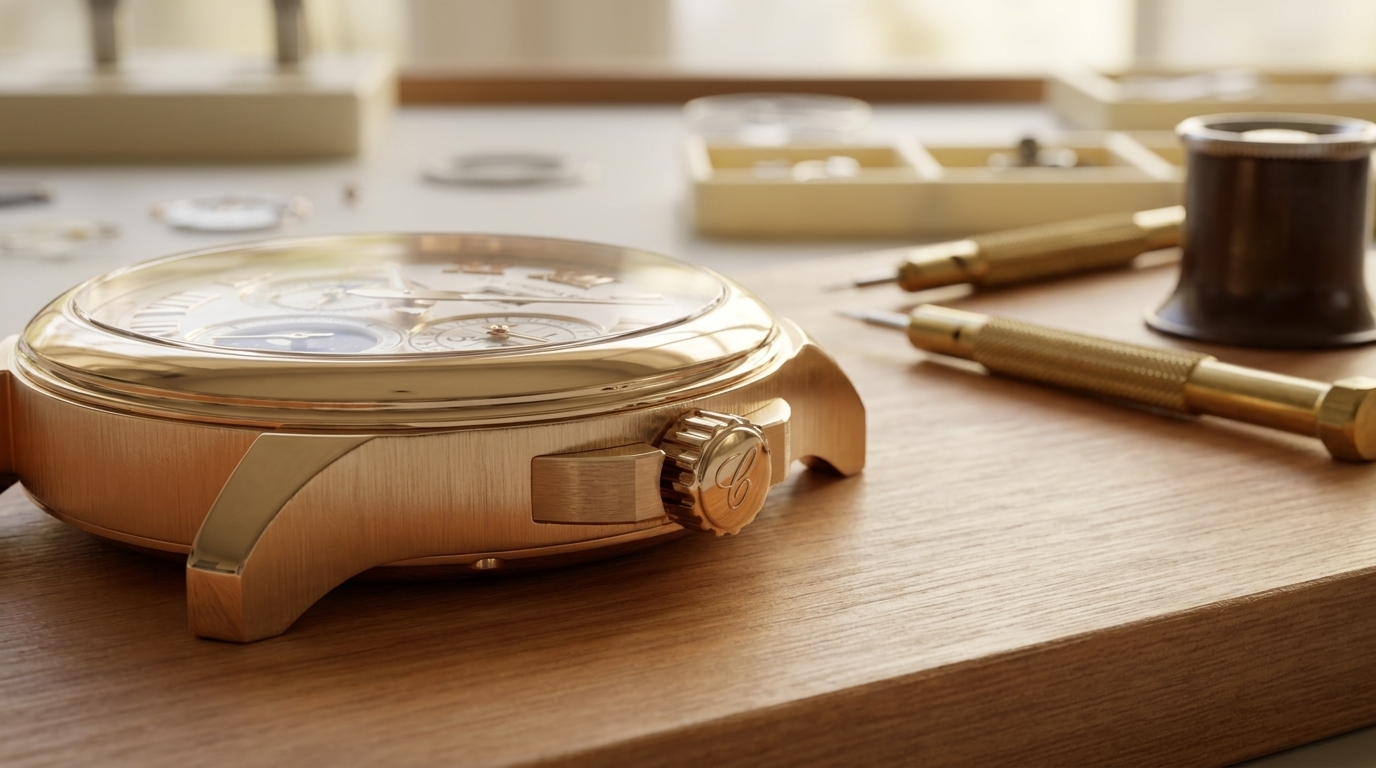
Materials have also become part of Chopard’s story. The house has promoted ethical gold sourcing and developed Lucent Steel, an alloy used in parts of its watch production, with a brighter tone and a high recycled content. These initiatives can easily become corporate language, and watchmaking is not immune to moral gloss. But in the context of Chopard’s double identity, material conscience is not irrelevant. A jewelry house knows the weight of sourcing, both literally and ethically. Gold and stones carry histories before they reach a workshop. If L.U.C represents the inward, mechanical half of Chopard, the metal around that mechanics still belongs to the wider world of jewelry, mining, refinement, and responsibility.
The dials, too, show the jewelry house’s hand, though not always in obvious ways. Chopard understands sheen. It understands how a surface changes between direct light and shadow, how a brushed chapter ring can quiet a guilloché centre, how applied indices can lift a dial without cluttering it. The danger for any jeweller making a serious watch is over-finishing the face until it becomes decorative rather than expressive. L.U.C has occasionally approached that line, as most maisons do. But when the balance holds, the result is subtle: a dial that carries craft without demanding that every act of craft be noticed.
The name itself is a bridge backward. Louis-Ulysse Chopard was a watchmaker before Chopard became a jeweller in the modern international sense. He built precision pocket watches that found markets beyond Switzerland. The L.U.C initials therefore do more than brand a collection. They recover an origin. Not every heritage claim deserves patience, but this one has structural force because the watches themselves attempt to justify it mechanically. A revived name without a calibre is nostalgia. A revived name attached to a micro-rotor manufacture movement, twin barrels, chronometer performance, and hand finishing becomes something sturdier.
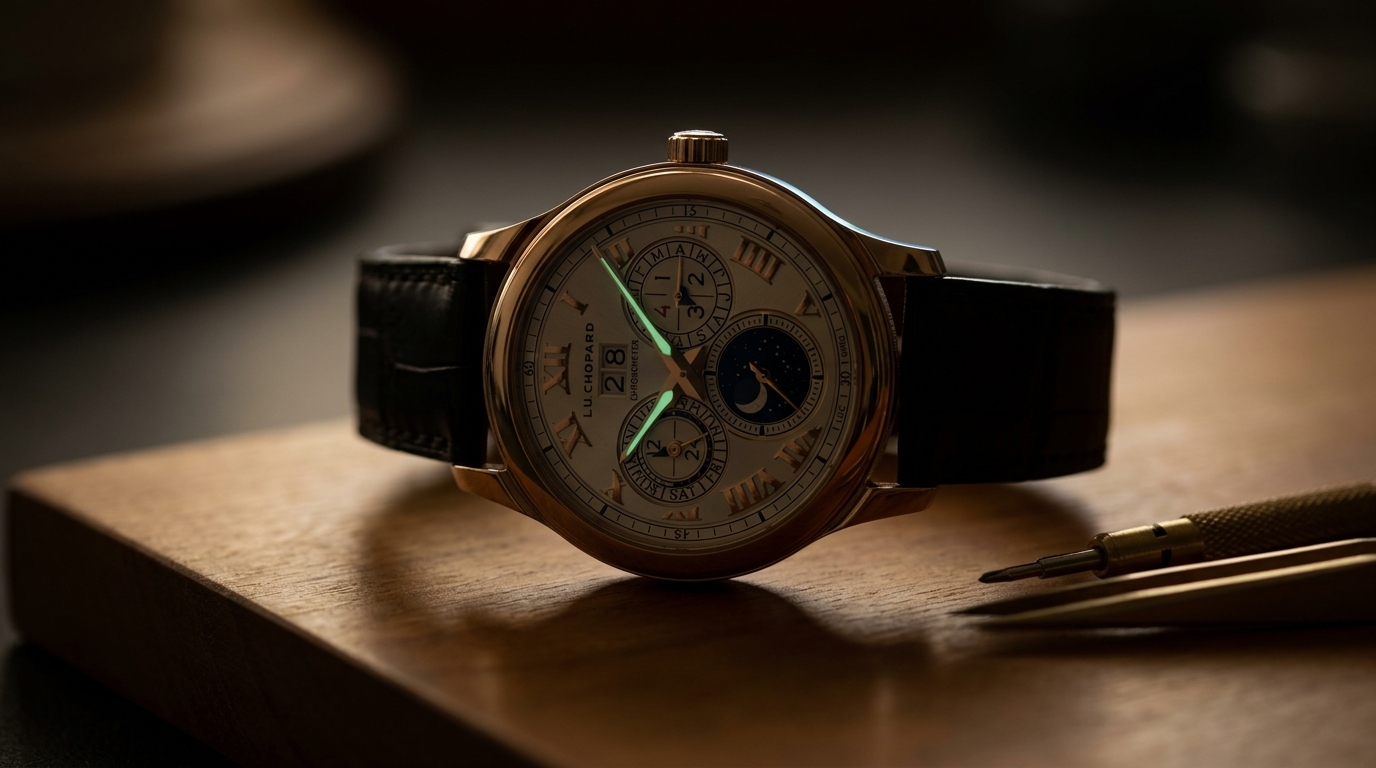
The double life of Chopard is not a contradiction that needs solving. It is the source of the L.U.C collection’s peculiar atmosphere. The watches are made by a house fluent in adornment but determined, in this corner of its activity, to submit adornment to precision. They come from a company comfortable with red-carpet light but are at their most convincing under quieter illumination, where the bevel on a bridge or the curve of a lug can be observed without performance. They show that a jewelry house need not abandon beauty to be serious, but it must understand that beauty in watchmaking is accountable to construction.
This accountability is what gives the L.U.C line its best moments. A calibre like the 1.96 remains important not because it was Chopard’s first manufacture movement, but because it arrived complete in thought. The Quattro matters because its long reserve was engineered as a mechanical identity, not a line in a catalogue. The Full Strike matters because sound forced the house into a domain where decoration could not disguise failure. The slim automatics matter because they demonstrate that restraint can be more difficult than complication. Across these watches, L.U.C has built a vocabulary of seriousness that sits somewhat apart from Chopard’s brighter public face.
There is a scene implied by every L.U.C watch, though not the one usually associated with luxury. It is not a flashbulb scene, nor a boutique tray under hard lights. It is a bench in Fleurier, a movement holder, a sharpened piece of pegwood, a strip of gentian pith, the slow correction of an angle no owner may ever consciously see. It is a watchmaker adjusting an escapement that will later disappear behind a dial of composed restraint. It is a gold rotor turning in silence inside a case whose maker is famous for diamonds. That doubleness gives the watch its tension. One life faces the room. The other keeps time.