Grand Seiko and the Discipline of Finishing What No One Asked For
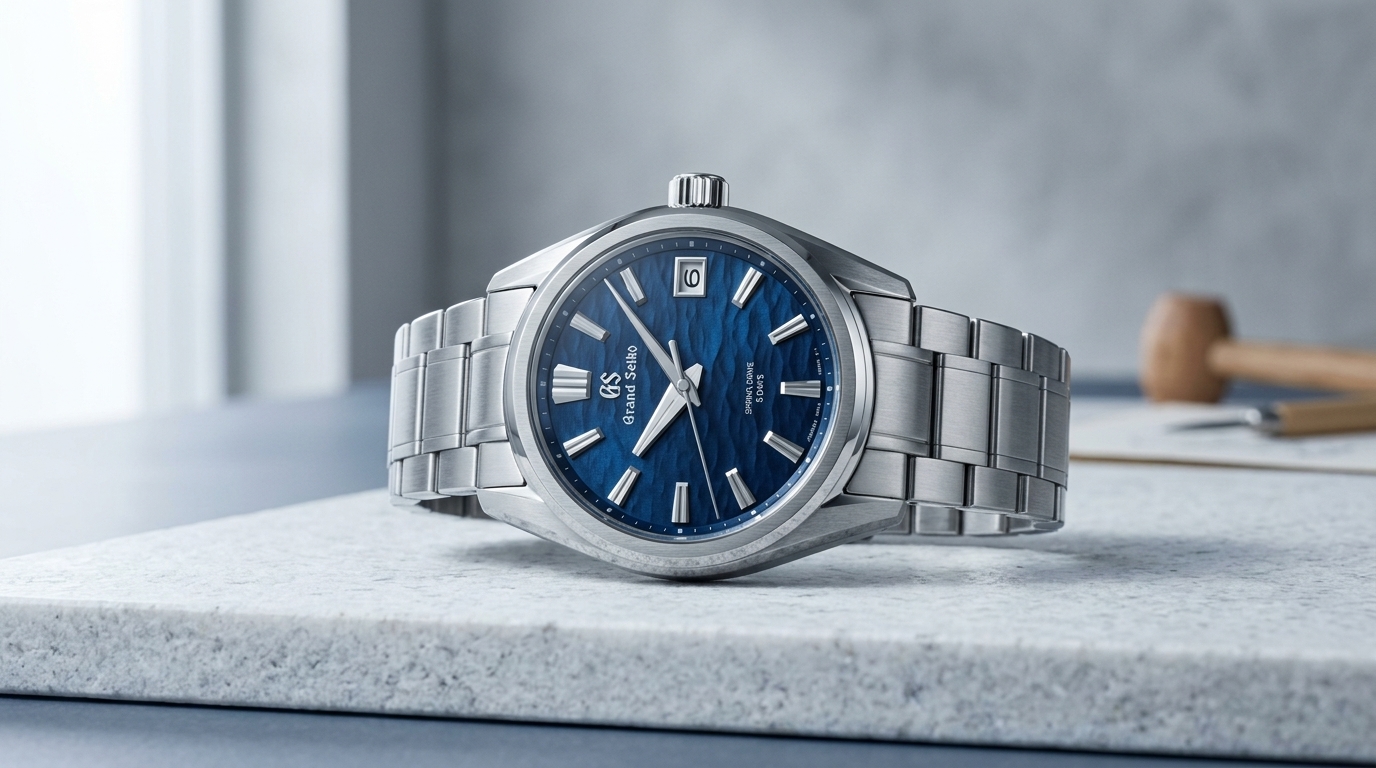
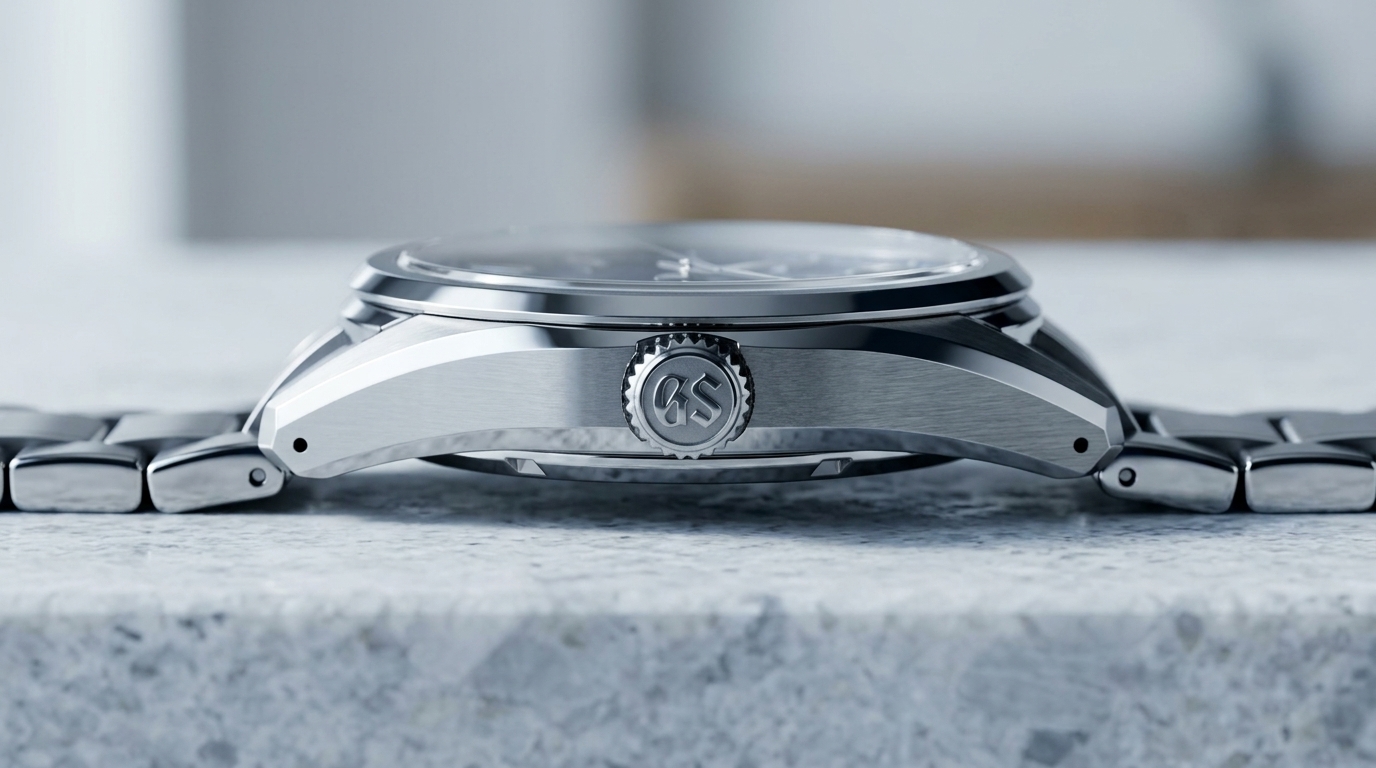
A polished flank of a Grand Seiko case does not behave like ordinary steel. It receives the window, the sleeve, the pale square of afternoon, and returns them without blur, as if the metal had been taught to remember straight lines. Beside it, a brushed plane cuts the light short. The boundary between the two is not softened for comfort. It is a ridge, exact and almost severe, the sort of edge that announces less about luxury than about restraint: someone decided where the light should stop, and then made the steel obey.
This is where Grand Seiko’s peculiar discipline begins. Not in complication, not in rarity for its own sake, not in the theater of visible machinery, but in surfaces that seem too carefully considered for the brief glances most owners will give them. A bevel under a lug. The side of an hour marker. A hand whose top plane is brushed lengthwise and whose facets catch light from angles the eye may never consciously register. No one asked for that level of work, not in any practical sense. A watch will keep time without it. A dial will remain legible without it. The wrist will not know the difference in weight or warmth. And yet Grand Seiko has built much of its identity around precisely these unnecessary completions.
The story is often told from 1960, when the first Grand Seiko appeared as a sober dress watch under the Seiko name, with a chronometer-grade movement and a quiet ambition to stand beside the Swiss. It wore its purpose plainly: sharp printing, clean hands, a case that did not need ornament to make its point. But the deeper language arrived in the years after, when Japanese watchmaking began to ask what form accuracy should take on the outside. In 1967, the 44GS gave that answer a grammar. Broad flat surfaces. Mirror-polished planes. Distortion-free reflections. Bezels and lugs drawn with tension rather than softness. Taro Tanaka’s “Grammar of Design” was not a slogan then, but a method, born from the observation that many watches disappeared under Western conventions while polished cutlery and faceted gems held light with greater authority. Grand Seiko would become legible not by decoration, but by geometry.
The polishing most associated with that geometry is called Zaratsu, a word whose crispness has acquired an aura of its own. Its origins are more practical than mystical, deriving from the name Sallaz, the European polishing machines once used in Japanese workshops. But the result, in Grand Seiko’s hands, has become unmistakable. Unlike conventional buffing, which can round edges as it chases shine, Zaratsu polishing is done against the side of a rotating tin plate. It requires pressure, angle, and an unforgiving sense of flatness. Too much hesitation and the plane becomes uneven; too much force and the edge loses its line. The task is less like polishing a spoon than sharpening a thought.
This kind of work resists easy photography. A catalogue can show reflection, but not the way the reflection breaks. On certain cases, especially those descended from the 44GS form, one polished facet will blaze while the next falls nearly black, not because anything has been added, but because the planes are disciplined enough to refuse the same light. The watch seems assembled from decisions. A lug is not merely a structure to hold a strap; it is a meeting of planes, brushed on one surface, mirrored on another, separated by an edge kept intact through finishing. There is a moral quality to such restraint, though not a sentimental one. It suggests that the unseen labor was not performed to impress a passing crowd. It was performed because an unfinished edge would be false to the design.
The same severity continues on the dial, where Grand Seiko’s reputation is sometimes reduced too quickly to texture. Snow fields, birch bark, frost, lake surfaces, mountain ridges: the language around these dials can become soft if allowed to wander. But the stronger point is not that the dials resemble nature. It is that their textures remain subordinate to time. The famous SBGA211 “Snowflake,” with its lightly ridged white dial and Spring Drive movement, is never merely decorative. Its blue seconds hand moves over the surface without a tick, and the dial’s irregularity gives that motion a ground, like wind crossing a field. The SLGH005 “White Birch,” powered by the high-beat 9SA5, is more aggressive in texture, its silvered surface sharply vertical, but the hands and markers still impose order. Grand Seiko may invoke landscape, yet it rarely lets landscape become indulgence.
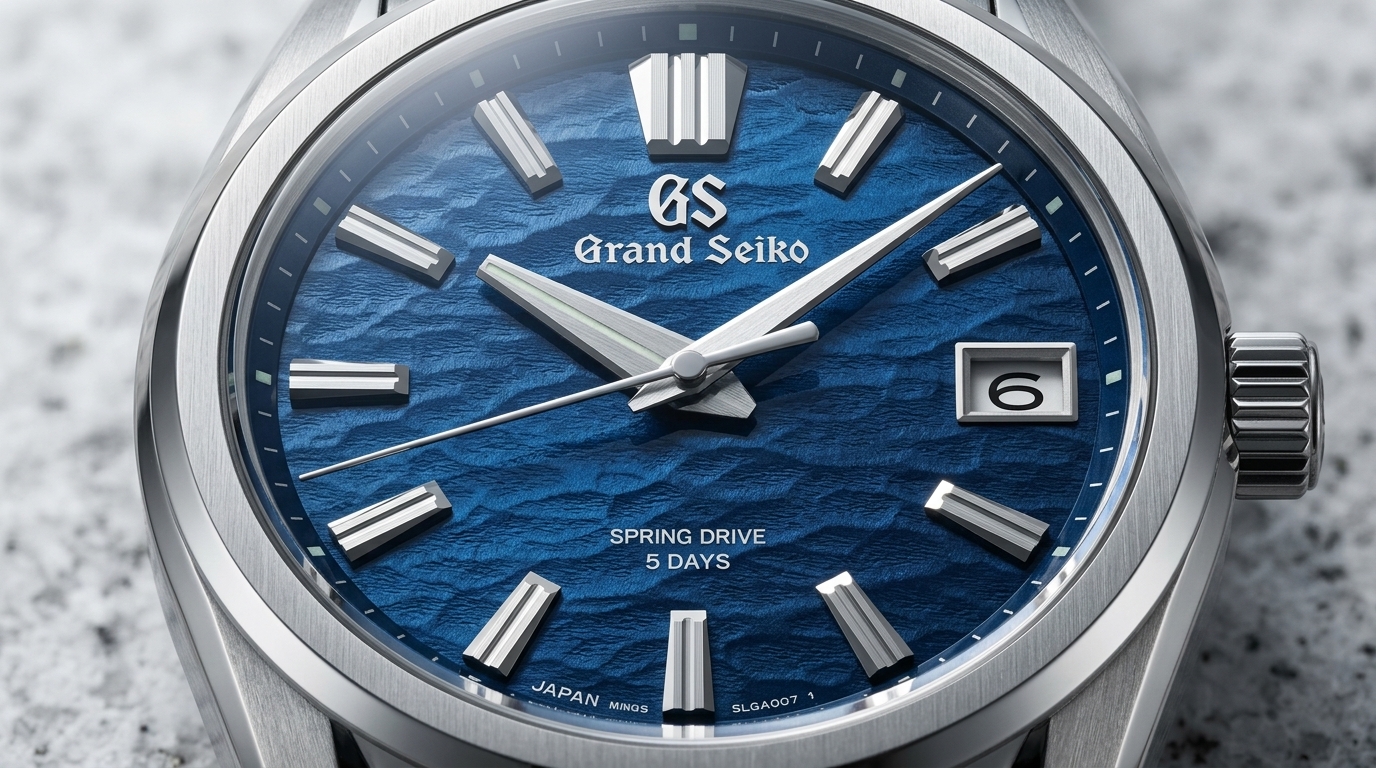
Those markers deserve closer attention than they usually receive. An applied index on a Grand Seiko dial can look simple until it is understood as a tiny piece of architecture. Its top may be brushed. Its bevels are polished. Its length and height are calculated so that it remains readable in half-light, not through luminous paint, but through reflection. The hands follow the same principle. The broad dauphine shape, one of the brand’s enduring signatures, is often sharply faceted down the center, creating surfaces that alternately disappear and flash. At a glance, the watch is clean. Under scrutiny, it is filled with quiet labor. The eye benefits from work it does not need to name.
Such finishing has an unusual relationship to utility. It is possible to argue that the polished bevel of a hand improves legibility, that the flat case planes make the watch visually clear, that the disciplined transitions prevent the design from collapsing into generic shine. All of that is true. But it is also insufficient. There remains a surplus of care beyond the reach of function. Grand Seiko often finishes what the owner did not request, what the market did not demand, what the broader public may never notice. This is not extravagance in the usual sense. It is closer to duty. A surface, once drawn, must be brought to its final form. A line, once imagined, must survive the workshop.
Inside the case, the same temperament appears in several dialects. The mechanical 9S family carries the inheritance of Japanese chronometry, with versions beating at 28,800 vibrations per hour and high-beat calibres running at 36,000. The 9S85, with its 5 Hz rhythm, recalls the era when Grand Seiko and King Seiko competed through accuracy trials and technical persistence. The more recent 9SA5, introduced in 2020, is not merely a thinner, longer-running high-beat movement. Its Dual Impulse Escapement delivers power directly to the balance in one direction and indirectly through the lever in the other. Its twin barrels give roughly 80 hours of reserve. Its free-sprung balance and horizontal gear train allowed Grand Seiko to reduce height while preserving amplitude. These are not surface details, but they reflect the same impulse: solve the problem fully, even if the solution remains hidden under a dial and a caseback.
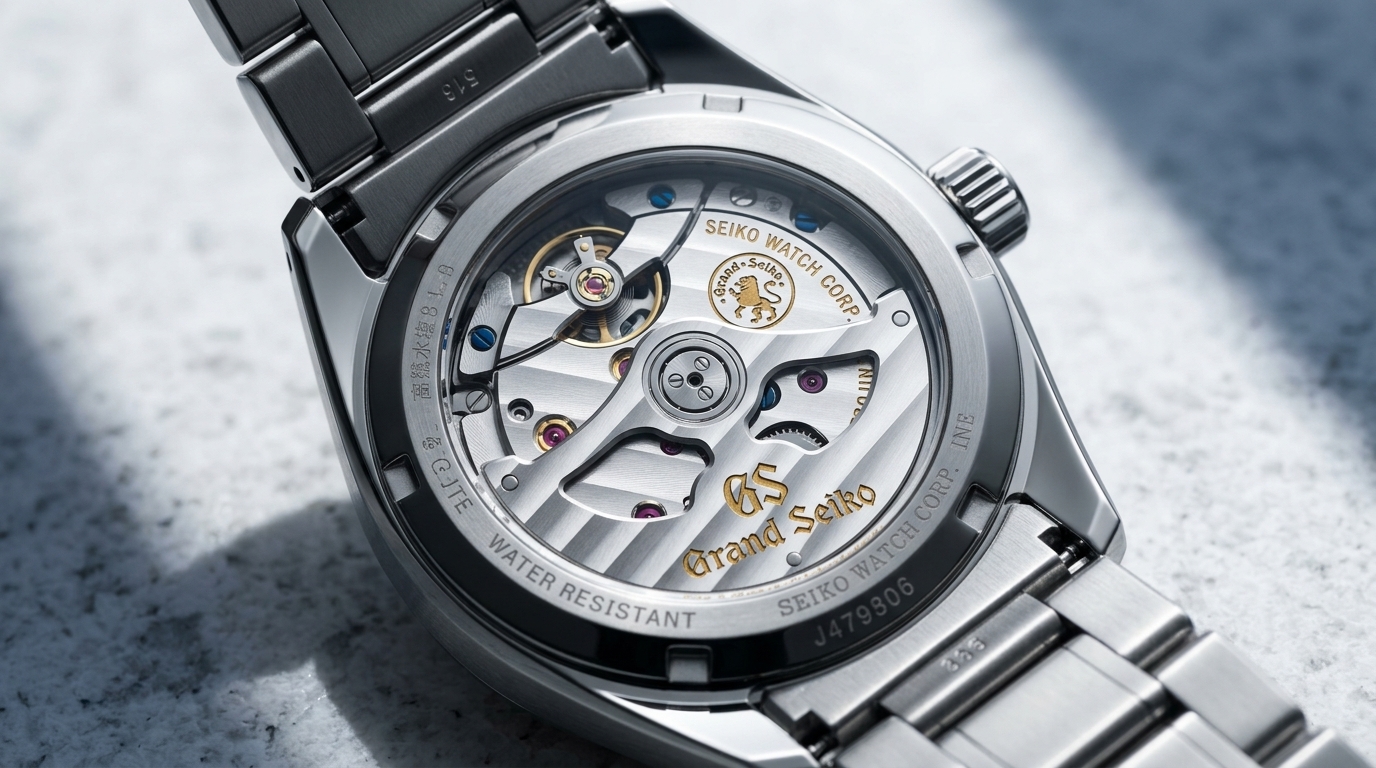
Spring Drive offers another version of the same philosophy, stranger and more poetic. It has been described too often as a compromise between quartz and mechanical watchmaking, when it is better understood as a refusal to accept the limits of either category. In a Spring Drive calibre such as the 9R65, the mainspring supplies the energy. The gear train turns. The rotor winds. Yet the regulating organ is not an escapement releasing force in increments, but a glide wheel controlled by an electromagnetic brake and a quartz reference. The seconds hand moves continuously, not in a theatrical sweep but in a steady drift. No tick divides one moment from the next. Time appears to pass as it does outside the watch: without steps.
That glide is perhaps the most visible expression of Grand Seiko’s obsession with unnecessary completion. A less exact watch could display seconds in pulses and lose nothing essential. Mechanical watches have done so beautifully for centuries. Quartz watches have done so efficiently for decades. Spring Drive insists on another image of accuracy, one that required years of research and many failed prototypes before reaching commercial form in 1999. The result is not loud. It does not announce its complexity through exposed bridges or spinning cages. It simply lets a hand cross a dial as if friction had been edited out of the world.
Even the 9F quartz movements, often overlooked by those who confuse quartz with disposability, belong to this story. Grand Seiko’s 9F calibres are thermo-compensated, sealed against dust within the movement, and built with a backlash auto-adjust mechanism so the seconds hand lands cleanly on each marker without tremble. Some use a twin-pulse control motor to move heavier hands that ordinary quartz movements would struggle to drive. The date change is instantaneous. The battery can run for years. Here again the labor disappears into behavior. A seconds hand that strikes an index precisely is not as dramatic as a tourbillon cage, but it is a small act of discipline repeated 86,400 times a day.
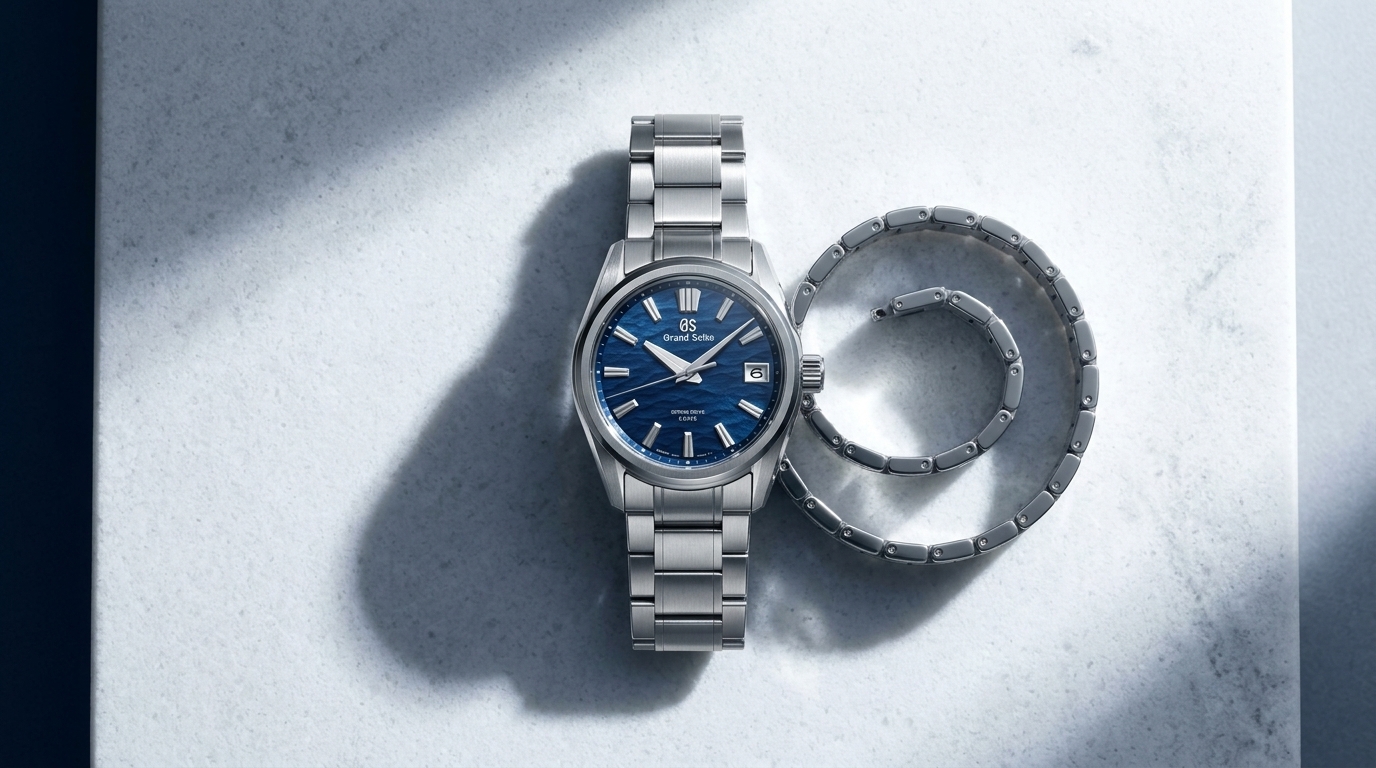
Grand Seiko’s finishing culture is sometimes compared to Swiss haute horlogerie, but the comparison can obscure more than it reveals. A Geneva bevel, rounded and gleaming along the edge of a bridge, carries a different sensibility from the flat mirror planes of a Grand Seiko case. Anglage courts softness. Zaratsu courts tension. Côtes de Genève flow; Grand Seiko’s exterior finishing often cuts. The two traditions do not need to be ranked to be understood. They come from different ideas about how beauty should behave. One may invite the gaze inward, toward craft as ornament. The other often organizes the outside so rigorously that ornament becomes unnecessary.
This is why proportion matters so much in the better Grand Seiko watches. The finishing cannot save a weak shape; in fact, it will expose it. A polished plane made too large becomes glare. A case made too thick loses the authority of its edge. The old 44GS form is powerful partly because it understands mass. Its shoulders are broad, but not for swagger. They give the polishing room to work. The bezel is narrow enough to open the dial, but not so thin that the watch loses structure. Modern references derived from this shape, from hand-wound dress pieces to Spring Drive and high-beat sports models, succeed when that balance remains intact. When the cases grow too deep or the dials too restless, the discipline becomes harder to hear.
Grand Seiko’s most persuasive watches are often those that let finishing speak at conversational volume. A hand-wound SBGW reference in a modest case can reveal more about the brand than a limited edition with an elaborate dial. The 37 to 39 millimeter range suits the grammar well; the facets have enough space to resolve, the dial remains calm, and the watch does not need scale to make its point. On such pieces, the polished bezel and lugs do not shout. They catch light briefly and return to silence. The pleasure lies in alternation: flash, shadow, brushed grain, inked minute track, the small framed opening of a date or the cleaner balance of its absence.
There is also a historical modesty in the way Grand Seiko matured. For much of the twentieth century, Seiko was known globally for democratizing accuracy, not for luxury finishing. The quartz revolution, which the company helped unleash with the Astron in 1969, changed the entire industry and nearly destroyed parts of the Swiss mechanical establishment. Yet Grand Seiko’s domestic identity remained more layered. It was a place where Japanese watchmaking could pursue precision without spectacle, where chronometer ambitions, observatory trials, high-beat calibres, quartz mastery, and later Spring Drive could coexist. When Grand Seiko became more visible internationally, particularly after the brand separated more clearly from Seiko in 2017, the wider watch public discovered not a new phenomenon but a long-contained one.
That delayed recognition has shaped the way the watches are discussed. Enthusiasts often approach Grand Seiko with the language of revelation, as though discovering a secret. But the watches themselves rarely behave like secrets. They behave like objects made by a culture of incremental exactness, one in which mastery is not always theatrical. The case polisher at a bench in Shiojiri or Morioka is not working for the vocabulary of an online review. The dial maker is not pressing texture into metal so that it may become an easy metaphor. The watchmaker adjusting a movement to Grand Seiko standards is not performing drama. The labor accumulates quietly, and the watch carries that accumulation without confession.
This is not to say Grand Seiko is beyond criticism. The brand can multiply references until distinctions blur. Limited editions can feel less like rare thoughts than repeated weather reports. Some casebacks expose movements whose industrial finishing, though precise, does not always equal the exterior’s severity. Some bracelets have been faulted for clasps and articulation that lag behind the cases they accompany. These criticisms matter because the standard set by the best parts is so high. When a hand is finished like a small blade and a case side reflects without distortion, a stamped-feeling clasp becomes harder to forgive. Discipline, once established, demands consistency everywhere.
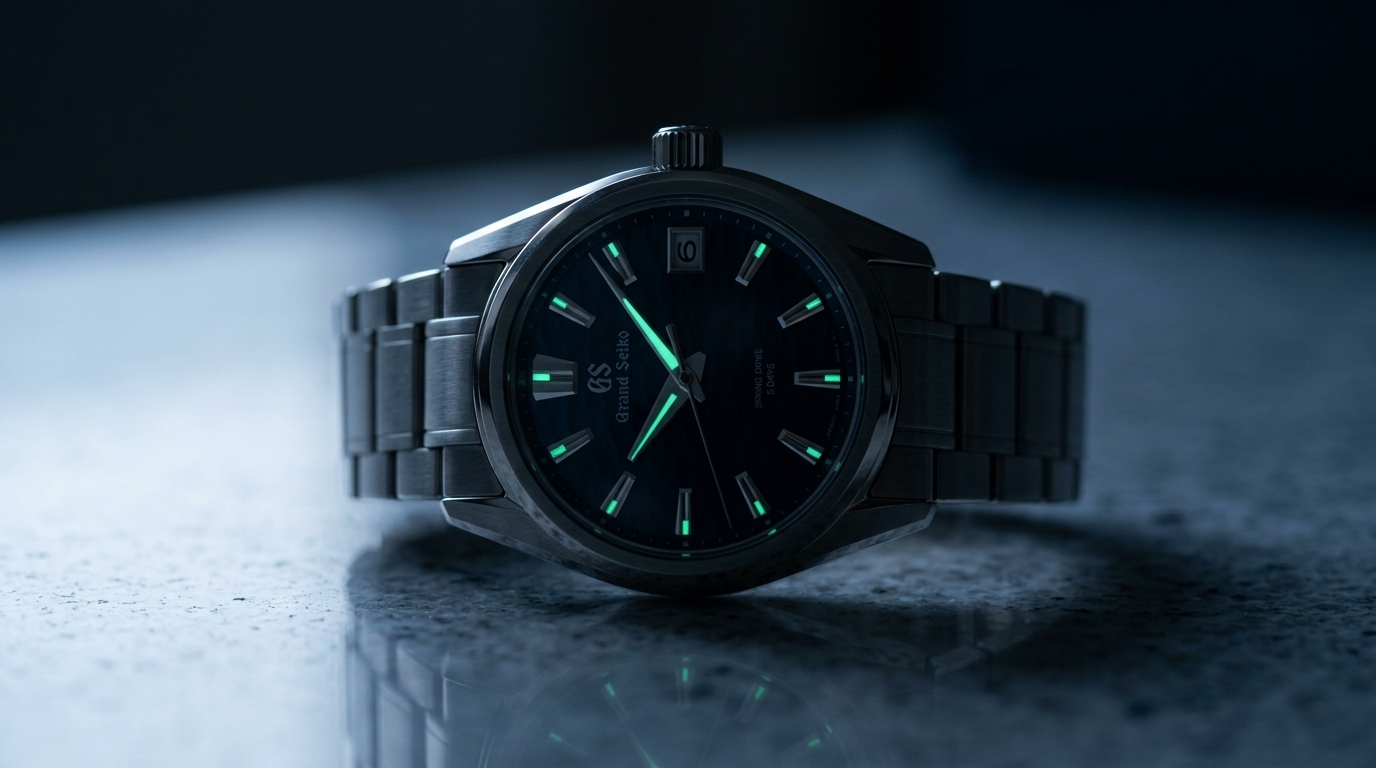
But the central achievement remains. Grand Seiko has made a philosophy from finishing that often exceeds attention. It asks the owner to slow down, but it does not collapse if the owner does not. The watch continues its work whether noticed or ignored. The facets hold their shape in a sleeve’s shadow. The seconds hand lands, sweeps, or glides according to the nature of its calibre. The dial changes with the hour. The movement inside, whether 9S, 9R, or 9F, keeps its particular form of faith with accuracy. Much of this will pass unseen on an ordinary day, which may be the point. The object is not diminished by the viewer’s haste.
In that sense, Grand Seiko’s finishing is less about luxury than conscience. Luxury often depends on recognition; conscience does not. A hidden surface may be polished not because anyone will praise it, but because the maker knows it is there. A bevel may be sharpened because the design would otherwise be incomplete. An index may receive facets so small they border on absurdity, yet their presence changes the way the dial breathes. This is the discipline of finishing what no one asked for: the refusal to let necessity define the limit of effort.
The watch returns to the table. Light crosses the case and breaks cleanly. The brushed surface dulls it, the polished plane clarifies it, the hand advances in its appointed manner. Nothing about the scene insists on admiration. There is only a steel object arranged with unusual care, carrying forward an old argument that precision is not confined to rate results or movement architecture. Precision can be visual. It can be ethical. It can live in the place where two surfaces meet and neither is allowed to lie.