Czapek’s Comeback Wasn’t a Resurrection—It Was a Reinterpretation
On the dial of the Quai des Bergues, the eye does not land in the centre and settle there. It is pulled downward, toward two subsidiary indications set like quiet instruments in the lower half of the face: small seconds on one side, power reserve on the other, both held in a composition that seems at first quaint and then, with longer looking, deliberately unsettled. The arrangement belongs to another century, yet the watch around it does not behave like a museum label made wearable. The case has the mass and polish of a contemporary object. The movement beneath the back has the frankness of modern independent watchmaking. The name on the dial, Czapek, carries the dust of old Geneva, but the watch itself speaks in a later tense.
That tension is the point. Czapek’s return to watchmaking could easily have been staged as a resurrection, with all the solemn theatrical machinery that word implies: the rediscovered archive, the restored signature, the suggestion that a dormant maison had merely been asleep behind a locked door. Horology is vulnerable to such stories. Its dead names are rarely allowed to remain dead if there is romance to be drawn from them, and few words are as profitable as heritage when printed small beneath a polished logo. Yet Czapek’s modern life has been more interesting because it did not simply pretend that continuity had survived intact. It approached the past less as a sacred relic than as a language—one with syntax, accents, oddities, and omissions that could be studied, edited, and spoken again with a different mouth.
The historical François Czapek is a figure whose outline flickers at the edge of more famous narratives. A Polish-born watchmaker, he arrived in Geneva in the nineteenth century, a period when the city’s watch trade was both workshop and web: établisseurs, case makers, dial makers, finishers, merchants, families, rivalries. In 1839, he entered into partnership with Antoine Norbert de Patek, forming Patek, Czapek & Cie. The association lasted only a few years before Patek continued along the path that would eventually lead to Patek Philippe, while Czapek established Czapek & Cie in 1845 with Juliusz Gruzewski. His firm supplied refined watches, including pieces associated with Paris and the French court. Then, after the 1860s, the trail thinned. The name receded. The workshops disappeared into the usual fog of dissolved partnerships, deaths, unpaid invoices, and changing markets.
There is a temptation, when a name returns after such silence, to imagine a direct bridge thrown across the gap. In reality, gaps matter. They are not flaws to be concealed. They are part of the record. The modern Czapek, revived in 2015 by a group led by Xavier de Roquemaurel, did not possess an unbroken manufacture lineage or a hidden room of continuous production. It began with an old signature, surviving watches, a set of historical references, and the modern problem of how to make a credible object under a name that had been absent for more than a century. Its first important gesture was therefore not mechanical. It was ethical. The company had to decide whether to mimic the nineteenth century or converse with it.
The Quai des Bergues supplied the answer. Its name looked toward Geneva, to the address historically associated with Czapek, and its dial was inspired by an 1850s pocket watch known from the records of the old house. But inspiration here did not mean the flattening of time. The model did not shrink a pocket watch into a wristwatch and call the task complete. It translated an eccentric dial architecture into a round modern case and set it above the hand-wound calibre SXH1, a movement developed with Chronode. The result was a watch that showed its ancestry without dressing as an ancestor. Its enamel and guilloché variants nodded to a world of pocket chronometers and formal dress watches; its open caseback, long power reserve, and architectural bridges placed it firmly in the age of contemporary independents.
The SXH1 was central to this act of reinterpretation. A seven-day hand-wound movement with twin barrels, it immediately gave the watch a narrative different from that of a simple revival piece. Through the back, the calibre presented two large ratchet wheels near the top, their circular forms exposed under broad bridges finished with restrained Geneva stripes, perlage, anglage, and sober engraving. The layout had something of the nineteenth-century three-quarter plate in spirit, but it was not a replica of Czapek’s pocket-watch calibres. It was an invented continuity, if the phrase may be allowed: not false continuity, but a carefully made bridge between what a Czapek movement might suggest and what a modern buyer expects to see beneath sapphire crystal.
That distinction is subtle but important. A resurrection asks the viewer to believe that the past has returned unchanged. A reinterpretation admits that return is impossible. It accepts that François Czapek’s Geneva no longer exists, that the craftsmen, suppliers, clients, and social codes of his world have vanished, and that any watch made today bears the fingerprints of today’s machines, tolerances, tastes, and capital. The revived brand seemed at its strongest when it allowed this truth to show. In the Quai des Bergues, the asymmetrical lower dial carried the memory of an old pocket watch, but the case proportions, movement design, and finishing choices belonged to a different economy of watchmaking—one shaped by collectors who turn watches over, discuss bridge architecture, compare bevels under magnification, and expect transparency from independent brands.
The decision to involve collectors was itself modern. Czapek’s relaunch used equity crowdfunding, an uncommon route in high horology and one that made the company’s comeback feel less like the reopening of an aristocratic house than the assembly of a small public around a name. In older Swiss watchmaking myth, legitimacy descends from founders, family, valleys, and uninterrupted production. Czapek’s legitimacy had to be negotiated more openly. It came from documents, surviving watches, partnerships with respected specialists, and the coherence of the objects themselves. This exposed the brand to more scrutiny, but it also freed it from the burden of pretending to be a continuous dynasty.
A name alone can decorate a dial. It cannot carry one for long. The revived Czapek had to find a design grammar broad enough to include more than the historical Quai des Bergues layout, and this is where the comeback became more than a dignified archival exercise. The Faubourg de Cracovie chronograph, introduced after the early time-only models, took the house into a different register. Its name recalled Warsaw, the city connected to Czapek’s Polish origins, but its mechanics and stance were entirely contemporary. The automatic chronograph calibre SXH3, developed with Vaucher, offered a column wheel, vertical clutch, and high-frequency operation at 5 Hz. On the dial, sub-registers, date, and tachymetric scale sat within cases that could carry grand feu enamel, elaborate guilloché, or bolder colour. It was not an old Czapek chronograph reborn. It was a modern chronograph asking how far the revived signature could stretch before it broke.
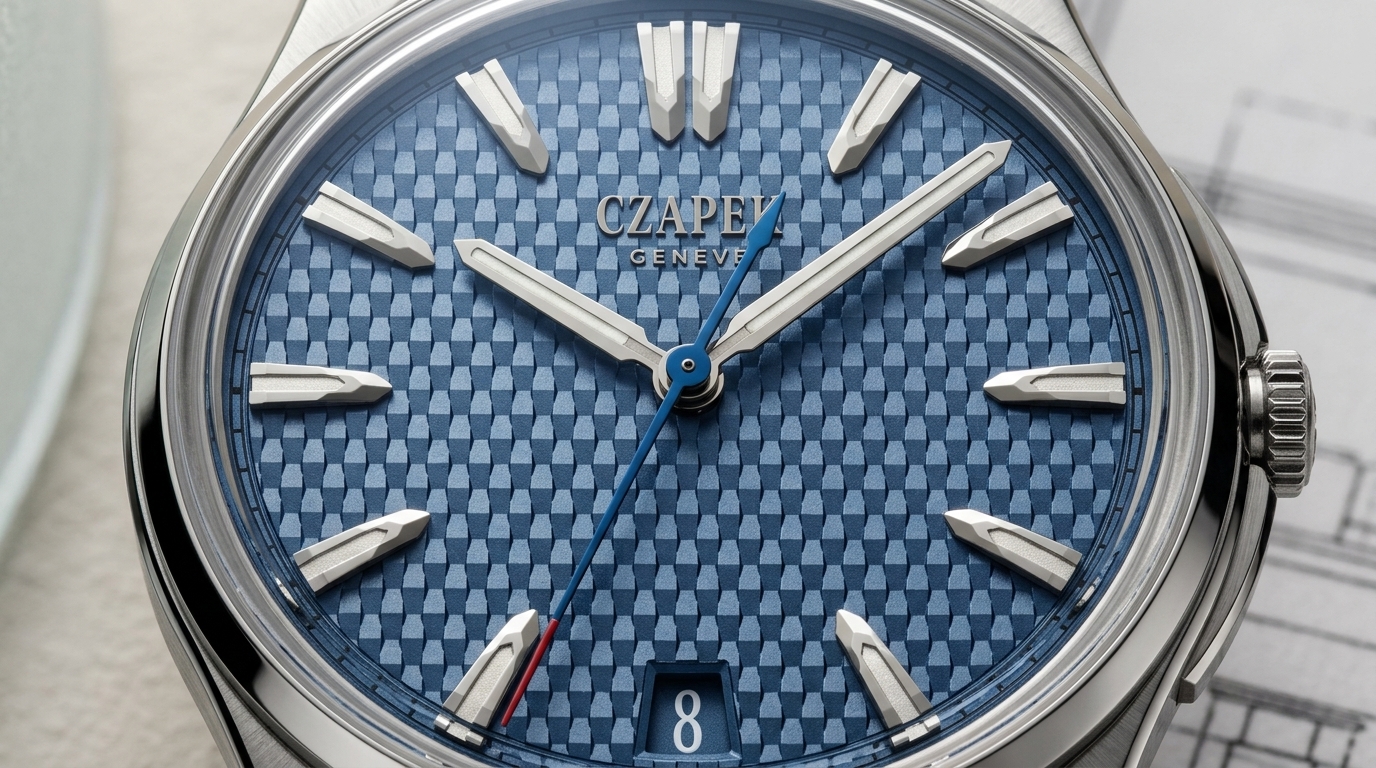
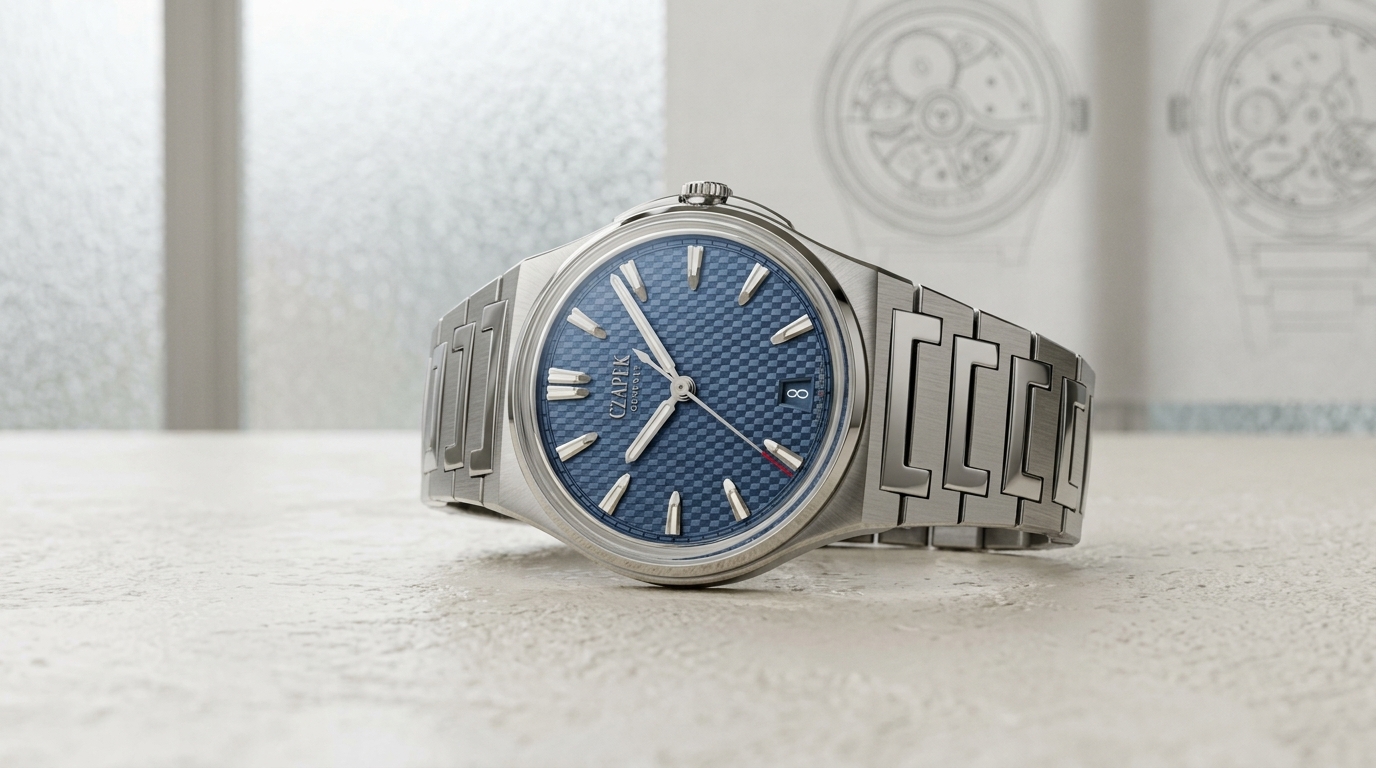
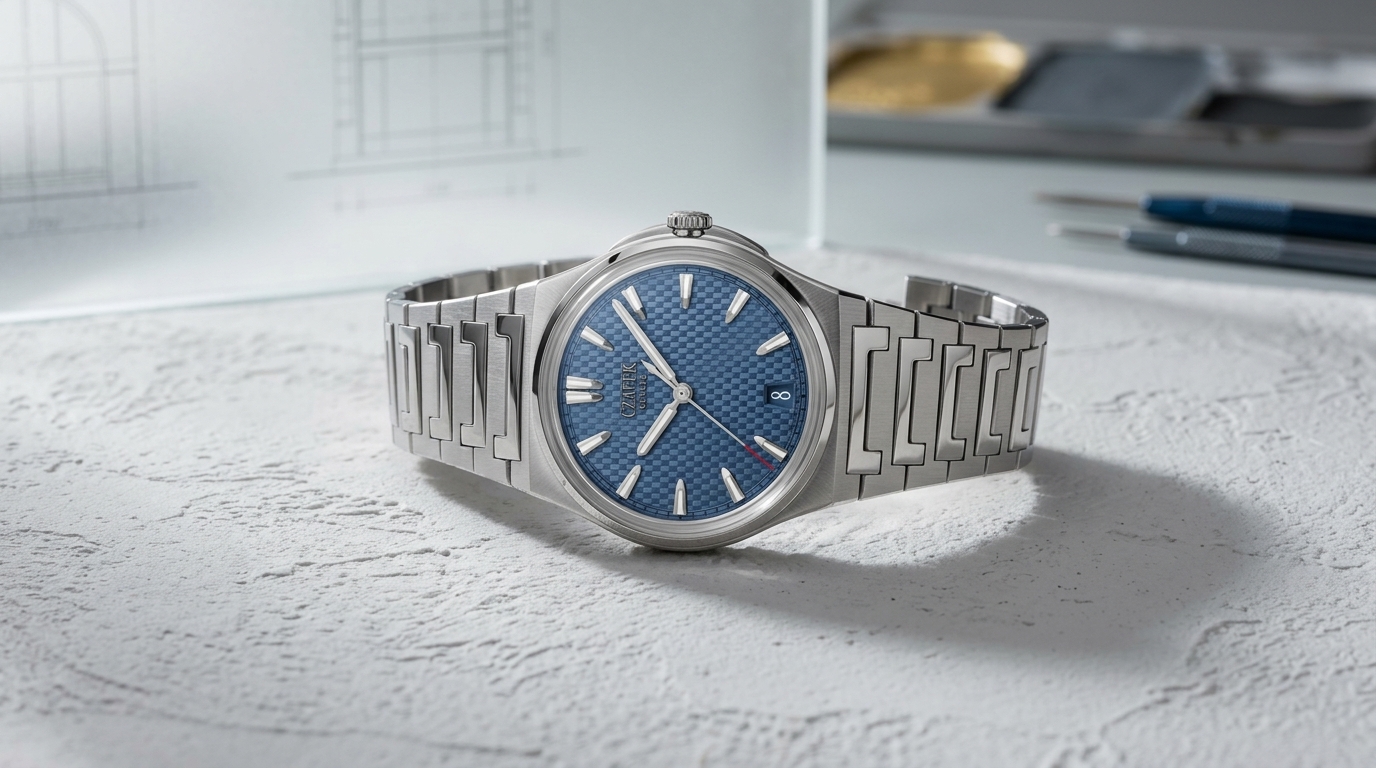
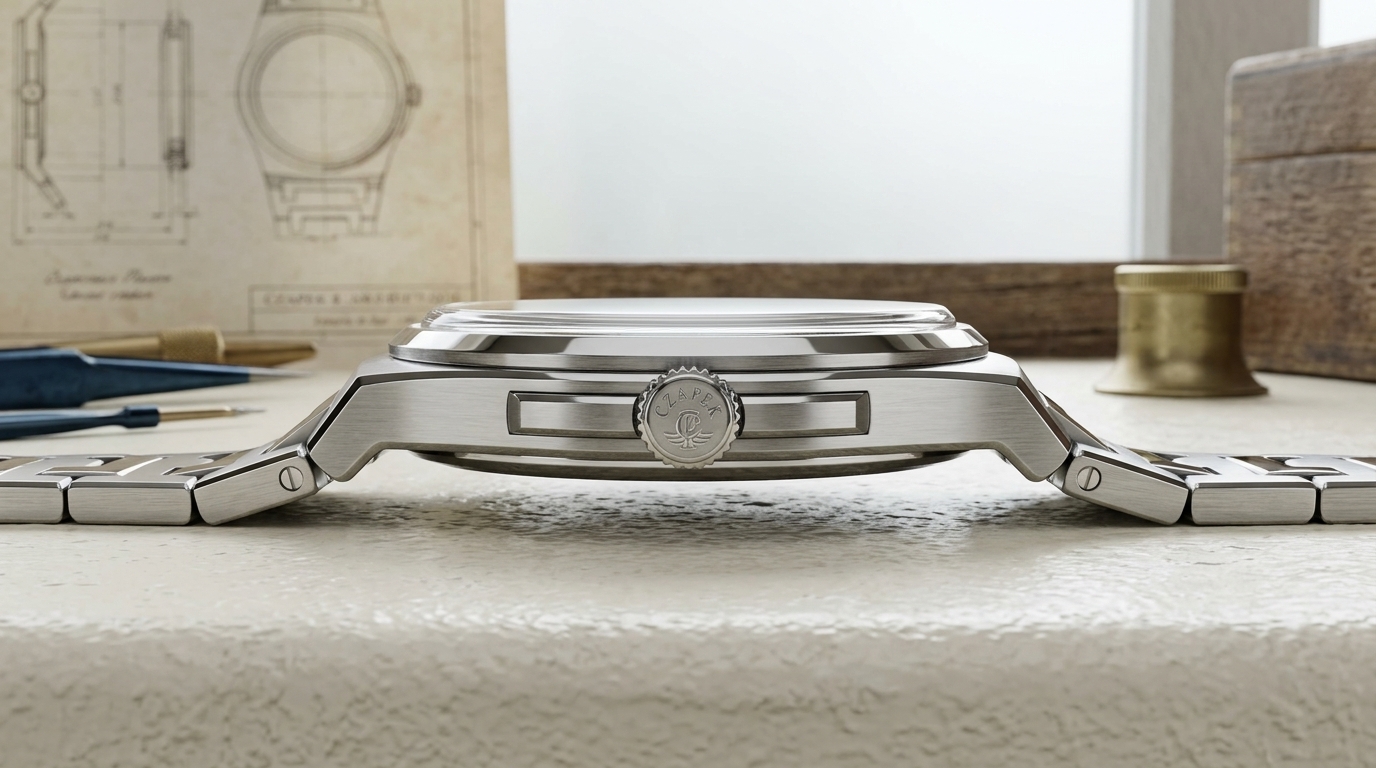
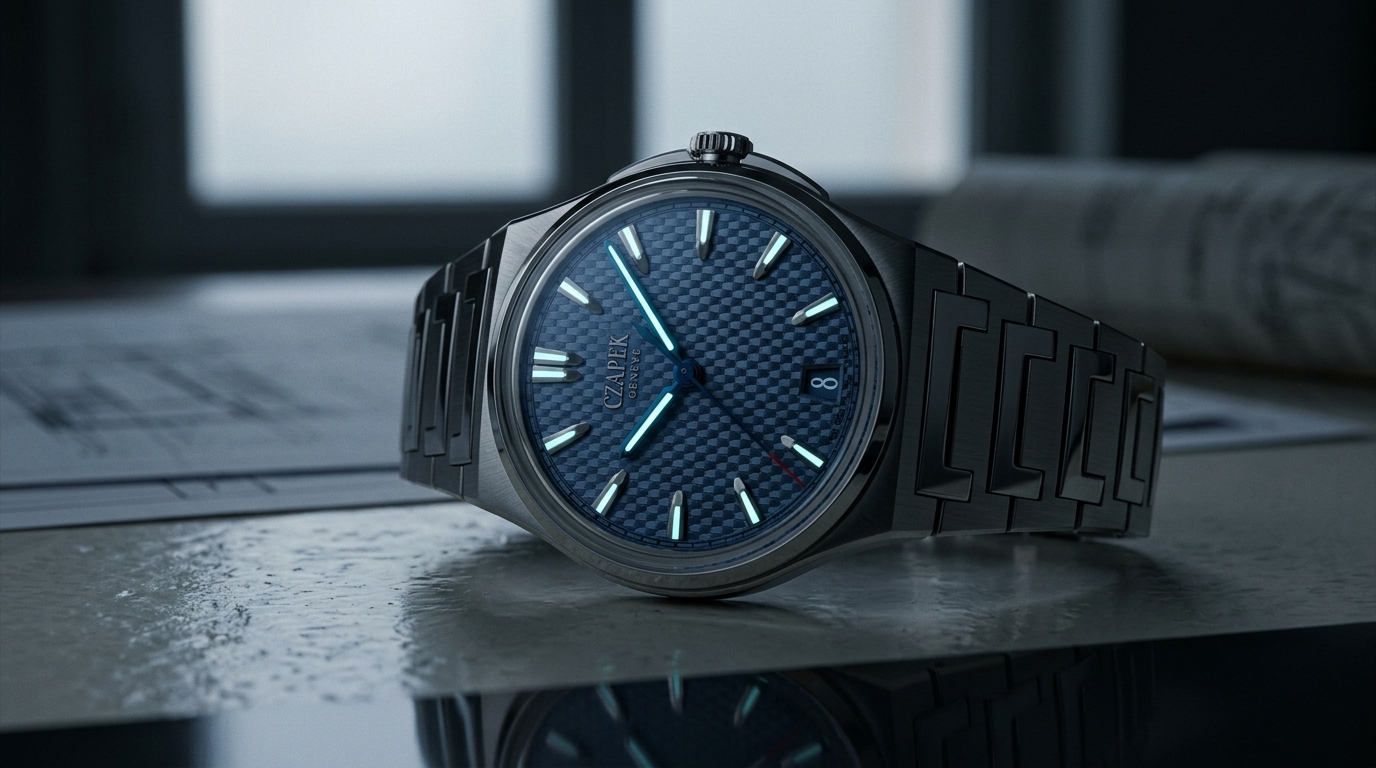
That question became sharper with the Antarctique. When it appeared in 2020, the field of steel sports watches with integrated bracelets was already crowded with echoes. Any new entry risked being mistaken for a late arrival at a conversation begun decades earlier by the Royal Oak and Nautilus and repeated often enough to become almost a dialect of its own. Czapek’s answer was not to deny the genre but to write within it carefully. The Antarctique Terre Adélie arrived in a 40.5 mm steel case with pronounced shoulders, a slim bezel, and a bracelet whose distinctive C-shaped centre links gave the watch a recognisable signature from the side as much as from above. Its dial avoided the usual porthole quotation. Instead, it used texture, depth, and proportion to establish distance from the obvious ancestors.
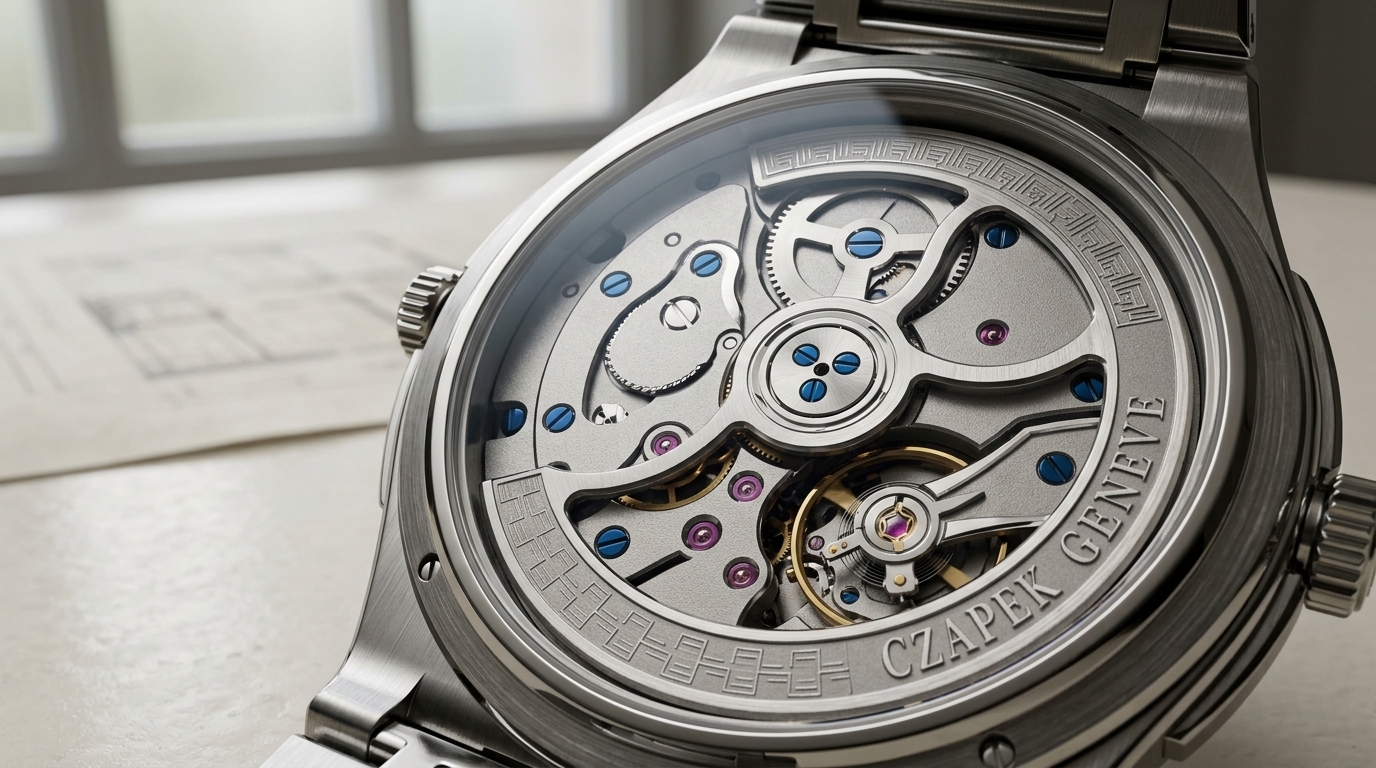
More significant was the movement. The SXH5, Czapek’s first in-house automatic calibre, gave the Antarctique an identity deeper than case design. Its micro-rotor, made from recycled platinum, kept the movement thin while allowing an unobstructed view of the architecture. Seven skeletonised bridges crossed the back like structural ribs, revealing the gear train rather than concealing it under a decorative plate. The calibre ran at 4 Hz with a roughly sixty-hour reserve and a free-sprung balance, practical choices rather than ornamental claims. It did not look like the SXH1, and it did not need to. It showed that Czapek’s revived identity was not confined to one historical dial layout or one romance of old Geneva. The brand was building a family of ideas, not merely repeating a founding image.
The Antarctique also clarified the difference between brand revival and brand memory. A resurrection narrative would have required Czapek to remain close to nineteenth-century codes: enamel dials, subsidiary registers, precious metals, formal cases, names taken from old addresses. The Antarctique stepped out of that room. It accepted the habits of twenty-first-century collecting—the desire for steel, bracelet integration, daily practicality, visible movement architecture—and filtered them through Czapek’s developing sensibility. In doing so, it risked contradiction. But contradiction may be healthier than docility. A revived brand that never risks contradiction becomes a costume department.
There has always been something slightly unresolved in Czapek’s modern watches, and that may be why they reward attention. They do not possess the effortless inevitability of maisons whose forms have been burnished in public for a century. Their identity is still under construction, sometimes visibly. The Quai des Bergues leans toward historical romance; the Faubourg de Cracovie toward technical urbanity; the Antarctique toward contemporary sports-watch architecture; later creations such as the Place Vendôme Complicité explore more theatrical mechanical display, including double escapement architecture developed with partners capable of such specialised work. The pieces do not all speak at the same volume. Some are more convincing than others. But across them runs a consistent refusal to let the old name dictate only one possible future.
This matters because watchmaking is unusually haunted by its own past. A modern wristwatch, even at its most advanced, is rarely free of an older image: pocket chronometers, marine instruments, officers’ watches, racing chronographs, dive watches, pilots’ timers. Mechanical timekeeping survives partly because it has learned how to turn obsolescence into significance. In such a field, revival brands face a delicate choice. If they lean too heavily on archived forms, they become antiquarian. If they discard the past too abruptly, the revived name becomes arbitrary, a label rescued from an old registry and applied to unrelated goods. Czapek’s better work occupies the narrow corridor between these failures.
The finishing tells part of that story. Czapek has not generally pursued the extreme inward-angle theatre of some independents, nor the sealed perfection of the largest prestigious houses. Its movements show industrial precision refined by traditional techniques: polished bevels, brushed steel, engraved bridges, carefully treated screws, grained surfaces. The effect is architectural rather than baroque. Even when the dials are decorative—flinqué enamel, ricochet guilloché, salmon tones, deep blues—the watch tends to preserve enough air around the indications for the original asymmetry to breathe. This restraint is not the same as timidity. It suggests an awareness that a resurrected name can easily drown itself in gestures of legitimacy.
The proportions have also evolved in revealing ways. The early Quai des Bergues models often appeared in larger cases, around 42.5 mm, a size that suited the expansive dial but could feel more contemporary than classical. Later variants in smaller diameters, including 38.5 and 40.5 mm forms, showed the brand adjusting its historical vocabulary to changing tastes and wrist realities. Such adjustments are not minor. In wristwatch design, a millimetre can alter the entire moral character of a watch. Too large, and the old dial becomes theatrical; too small, and its geometry may turn cramped. Czapek’s willingness to revisit dimensions suggests again that the past was not being treated as a commandment.
The dial work deserves its own quiet scrutiny. On many Czapek watches, the dial is where the brand’s argument is clearest. The 1850s pocket-watch inspiration of the Quai des Bergues gives the lower half of the dial an almost instrument-panel quality, while the upper half remains calm, carrying only the brand name and the sweep of the hour and minute hands. On guilloché versions, patterns such as the “ricochet” motif create motion beneath the indications without disturbing legibility. On enamel versions, the surface takes on a different discipline: flat, cool, unforgiving, with printed markings that must sit exactly where the eye expects them. These surfaces are not nostalgic by themselves. They become meaningful because they are placed within cases and movements that decline to vanish into nostalgia.
The same can be said of naming. Quai des Bergues, Faubourg de Cracovie, Place Vendôme, Antarctique: the names form a map, but not a straightforward one. Geneva, Warsaw, Paris, Antarctica. Some point toward biography, others toward exploration or abstraction. A cynic might see only branding cartography, but there is a more charitable reading. The modern Czapek seems to understand that its founder’s story was migratory, not rooted in one village myth. François Czapek himself was Polish-born, Swiss-active, Paris-facing, and commercially European. A revived Czapek that pretended to be purely Genevan would miss something essential. Its geography was always plural.
Still, the central achievement of the comeback is not that the company made watches with old names and respectable suppliers. It is that it made absence visible without being paralysed by it. The lost years between the nineteenth century and 2015 are not erased. They hover around the watches, lending them both vulnerability and freedom. When a collector looks at a modern Czapek, there is no need to imagine an unbroken line of masters handing tools from one bench to the next. The more interesting vision is of fragments gathered with care: a pocket watch dial, a signature, a Geneva address, a Polish memory, a contemporary movement constructor, a bracelet link shaped like a letter, a micro-rotor turning under open bridges. From these fragments, a coherent present is assembled.
That assembly is what separates reinterpretation from imitation. Imitation fixes its gaze on surfaces. It asks what shape the hands were, how the numerals leaned, how the seconds subdial was bordered, and then reproduces the answer with reverence. Reinterpretation asks a more difficult question: what kind of thinking produced those choices, and what might that thinking produce now? In Czapek’s case, the answer seems to involve asymmetry, openness, visible mechanics, cosmopolitan references, and a willingness to collaborate outside the fiction of total self-sufficiency. Swiss watchmaking has always depended on networks, no matter how often modern branding prefers the myth of the isolated manufacture. Czapek’s transparency about partners has often felt closer to historical truth than a forced claim of vertical purity would have done.
There is also an appealing modesty in the fact that Czapek’s revival has not tried to rewrite the hierarchy of nineteenth-century watchmaking around itself. François Czapek’s brief partnership with Patek is historically fascinating, but the modern brand has generally been strongest when it does not lean on that association too hard. The connection is real; it is also not the whole story. To reduce Czapek to “the other name before Philippe” would be to make it a footnote in someone else’s biography. The revived watches argue for a separate identity, one built not on rivalry with the giant that history favoured, but on a different temperament: more open-ended, less codified, still searching.
Searching, in watchmaking, can be risky. Collectors often ask young or revived brands to arrive fully formed, to possess at birth the clarity that older houses achieved only through decades of repetition. But the visible formation of an identity can be part of the pleasure. Czapek’s modern catalogue has the feeling of a brand testing the tensile strength of its own name. How far can it move from the Quai des Bergues before it becomes unrecognisable? How much historical quotation is enough? How much contemporary architecture is too much? The answers are not settled once and for all. They are worked out case by case, dial by dial, calibre by calibre.
This is why the comeback resists the easy drama of resurrection. Resurrection implies a miracle, a body restored. Czapek’s return was not a body restored. It was a text reread. Some lines were legible; others had been lost. The modern company chose not to fill every blank with costume and incense. Instead, it allowed the blanks to remain part of the composition, and built watches that could acknowledge them without apology. The Quai des Bergues looked backward with care. The Antarctique looked sideways into the crowded present. The movements, particularly the SXH1 and SXH5, gave mechanical substance to what might otherwise have remained a charming name.
Near the balance wheel of the SXH5, the movement is all contemporary exposure: bridges opened, wheels visible, rotor reduced to a dense crescent of platinum mass. On the dial side of the Quai des Bergues, the power reserve still descends through its days with the old courtesy of a pocket watch concerned with autonomy. Between those two images lies the modern Czapek. Not a ghost returning to claim its house, and not a new tenant wearing an inherited coat, but something more difficult to categorise: a watchmaker’s name used as a set of questions. What survives when a brand disappears? What can be rebuilt from a signature? What must be invented because continuity has failed?
The most convincing answer is found not in the archive alone, nor in the movement alone, but in the refusal to collapse one into the other. Czapek’s comeback works when the old details are allowed to be strange, and the new details are allowed to be new. The asymmetrical indications need not pretend to be contemporary minimalism. The micro-rotor sports watch need not pretend that François Czapek foresaw integrated bracelets. Each belongs to its own moment, and the revived brand gains force by letting those moments touch without forcing them to merge.
So the comeback was not a resurrection. It was more fragile and more honest than that. It was a reinterpretation made under the pressure of history, market, and taste, with the constant danger of slipping into theatre on one side or anonymity on the other. At its best, Czapek has avoided both by treating the past as material rather than script. The old name remains on the dial, small and legible. Around it, the watch continues to be made—not as proof that nothing was lost, but as evidence that loss, handled carefully, can become a form of design.